Chapter 07
TRUE/FALSE
1. Another name for the IDE hard drive interface is ATA.
2. E-IDE is a serial interface technology whereas SATA is a parallel interface technology.
3. CD-R is just a shorthand way to write CD-ROM, but they mean the same thing.
4. With SAN technology, servers use a separate network to communicate with the storage device.
5. An advantage of using tape drives for backup is that the data is accessible in random access order,
making all data on the tape equally fast to retrieve.
MULTIPLE CHOICE
1. A Terabyte is the same as which of the following values?
a.
10,000 GB
c.
1,000,000 MB
b.
.1 PB
d.
100 GB
2. If you want to attach six hard drives to your computer using a single disk controller interface, which
interface type should you choose?
a.
IDE
c.
PATA
b.
eSATA
d.
SCSI
3. Your server has been running with two hard disks for the last few months. You needed additional
storage so you have just installed a third disk on your SCSI interface; however, when you reboot the
computer, the SCSI drives are not recognized by the system. What is a possible cause?
a.
you damaged the drives while installing
the third disk
c.
the power supply cannot handle the
additional load
b.
you neglected to re-install the terminator
after the last disk
d.
you can only install two disks on a SCSI
system
4. Which of the following is true about using GPT versus MBR?
a.
GPT supports fewer, but larger partitions
c.
GPT supports larger disks than MBR
b.
MBR is a newer method and is only
supported by a few OSs
d.
GPT is not supported by Windows Server
2008
5. A friend of yours has a Mac OS X Snow Leopard computer and he has just read something about hard
drives sometimes failing. He is not very familiar with his computer’s built-in software and wants to
know how he can back up his data. What should you tell him?
a.
use the Backup and Restore Wizard found
in System Tools
c.
use the GUI versions of dump and cpio
b.
use the Time Machine Utility found on the
Dock
d.
use Backup and Restore found in Disk
Management
6. You are building a new computer and you have just installed Windows Server 2008. You have two
hard disks that you want to configure for fault tolerance using a Windows RAID configuration. How
should you set up your hard disk?
a.
configure two volumes on each basic disk
c.
Reinstall using Windows Server 2008 R2
because Windows Server 2008 doesn’t
support RAID
b.
configure the disks as dynamic disks and
create the RAID
d.
create the RAID using Disk Management
and then convert the disks to dynamic
7. Which of the following is NOT true about SSD drives compared to mechanical drives?
a.
they come in much larger storage
configurations
c.
no moving parts to wear out
b.
lower power requirements
d.
faster access to data
8. Which of the following is NOT a possible advantage of using RAID versus single-disk configurations?
a.
increased reliability
c.
fault tolerance
b.
increased speed
d.
lower cost
9. You have a music collection that you want to backup to optical media such as some type of DVD/CD.
You want to be able to use the same disc to do backups each time you update your collection. Which
disc type should you use?
a.
CD–ROM
c.
DVD–RW
b.
CD-R
d.
DVD+R
10. You are building a network that will have three servers. You want the servers to have access to
storage that is separate from the servers themselves but you don’t want the traffic involved with
accessing the storage to affect your corporate LAN. What technology should you use?
a.
NAS with InfiniBand
c.
DAS with iSCSI
b.
SAN with Fibre Channel
d.
eSATA with Ethernet
11. Which of the following statements is NOT true of cloud storage?
a.
storage is available through Web
applications
c.
most cloud storage provides fault
tolerance
b.
you connect to cloud storage using a local
SAN
d.
you can access storage through the
Internet
12. Which of the following is used for removable storage?
a.
SCSI
c.
eSATA
b.
iSCSI
d.
E-IDE
13. Which of the following media types has the most storage capacity?
a.
fixed hard disk
c.
Blu-Ray disc
b.
SSD
d.
flash drive
14. You have a mission-critical server that you must back up on a daily basis. You start the backup when
you leave at night and the backup must be finished the next morning with no user intervention. Your
server has a storage capacity of almost 2 TB. Which tape media will hold all of your server’s storage
on a single tape?
a.
DAT
c.
LTO
b.
AIT
d.
SDLT
15. You need to create new volumes and format a new disk you just installed on your Windows 7
computer. Which tool should you use?
a.
format
c.
cfdisk
b.
Disk Management
d.
Disk Utility
16. Which of the following represents a valid Linux command to mount a CD/DVD drive?
a.
fdisk -t /dev/cdrom iso9660 /cdrom
c.
mount -t iso9660 /dev/cdrom /cdrom
b.
mount -t udf /mnt/cdrom /cdrom
d.
fdisk -t udf /mnt/cdrom /cdrom
17. Which of the following is NOT a Linux/Unix file or disk management command?
a.
cfdisk
c.
tar
b.
xfsdump
d.
xterm
18. You are planning to buy a new laptop computer. One of your primary concerns with this laptop is that
it is reliable, can take a little physical abuse, and has pretty long battery life. The data you will store
on it is only a couple dozen GB. Which storage technology should you use?
a.
Blu-Ray discs
c.
SATA
b.
SSD
d.
IDE
19. You have a Windows 7 desktop computer that has a C: drive and a D: drive that are separate disks.
You use the D: drive for storing data and applications. You are finding that you are almost out of disk
space on the D: drive. What is a good solution to your disk space problem?
a.
convert the D: drive to dynamic, add a
new drive and extend the D: volume onto
the new drive
c.
backup the D: drive, reformat it and use
disk encryption; restore the contents of the
D: drive
b.
buy a new disk, and convert the D: drive
to a RAID volume and use disk mirroring
d.
extend the D: drive onto a storage area
network
20. You have a server with four SCSI disks. You have just installed a fifth SCSI disk into the server.
After a reboot of the system, your disk controller only recognizes three of the five disks. What is a
likely cause of the problem?
a.
the fifth disk is the identical size and
brand of one of the other disks, causing a
conflict
c.
the new disk’s address conflicts with one
of the other disk’s address
b.
the new disk is dead and one of the
existing disks also died
d.
SCSI can only support four disks and the
fifth disk is causing the fourth disk to not
work properly
COMPLETION
1. The IDE interface is the same as the ANSI _____ interface standard.
2. _________ is a SCSI technology that also supports SATA drives.
3. ______ is a newer way to partition disks and supports disk sizes up to 18 EB.
4. A ______ volume can provide your storage system with fault tolerance.
5. ________ is a removable storage technology that uses disks compatible with SATA.
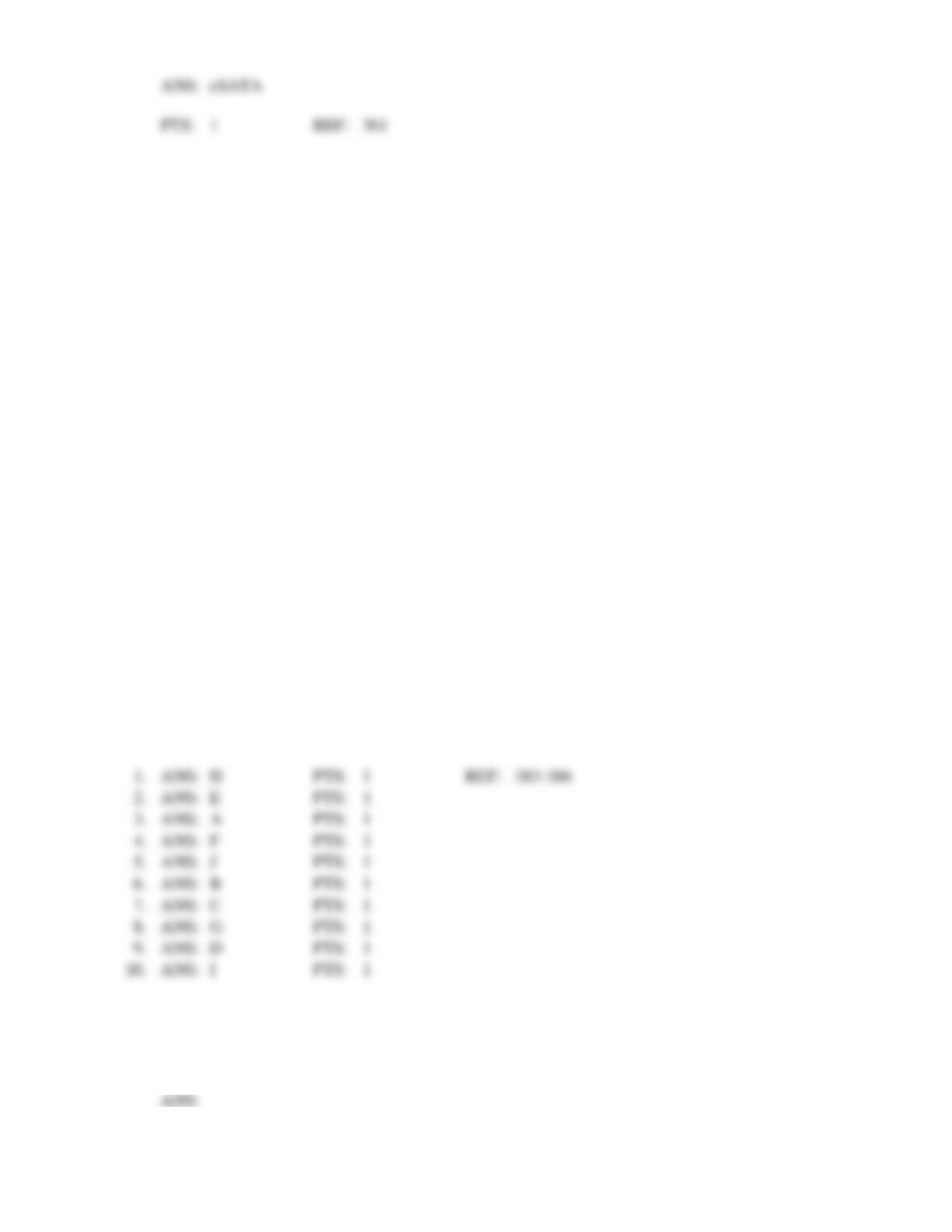
MATCHING
a.
cloud storage
f.
CRCC
b.
dynamic disk
g.
InfiniBand
c.
fault tolerance
h.
AIT
d.
Light Peak
i.
terminator
e.
basic disk
j.
disk geometry
1. a tape drive that has an erasable memory chip and has
a capacity up to 1.3 TB
2. a physical hard drive used in Windows that can contain primary partitions, extended partitions, or
logical drives
3. storage that is used through the Internet or a network via a Web-based
interface or software, such as a browser
4. a data error correction method that uses an
algebraic polynomial and error key to detect and overcome errors.
5. critical information about a hard drive’s hardware configuration. This
information is often stored in an area of nonvolatile memory in the computer.
6. used by Windows operating systems to provide the option to create volumes
that span multiple disks and to provide more security and management features
7. implementing software or hardware to protect against hardware failures,
power interruptions, and lost data
8. a technology designed for ultra-fast communications connectivity in data
centers, such as linking one server to another for clustering servers to act as one powerful server
9. a computer peripheral device connection technology that uses optical cables
instead of copper cables and has faster communications than USB.
10. an electronic resistor used at the end of a cable and that absorbs the electronic signal so that the signal
is not reflected back onto the cable
SHORT ANSWER
1. What is the primary difference between SATA and IDE with respect to how the data is transferred?
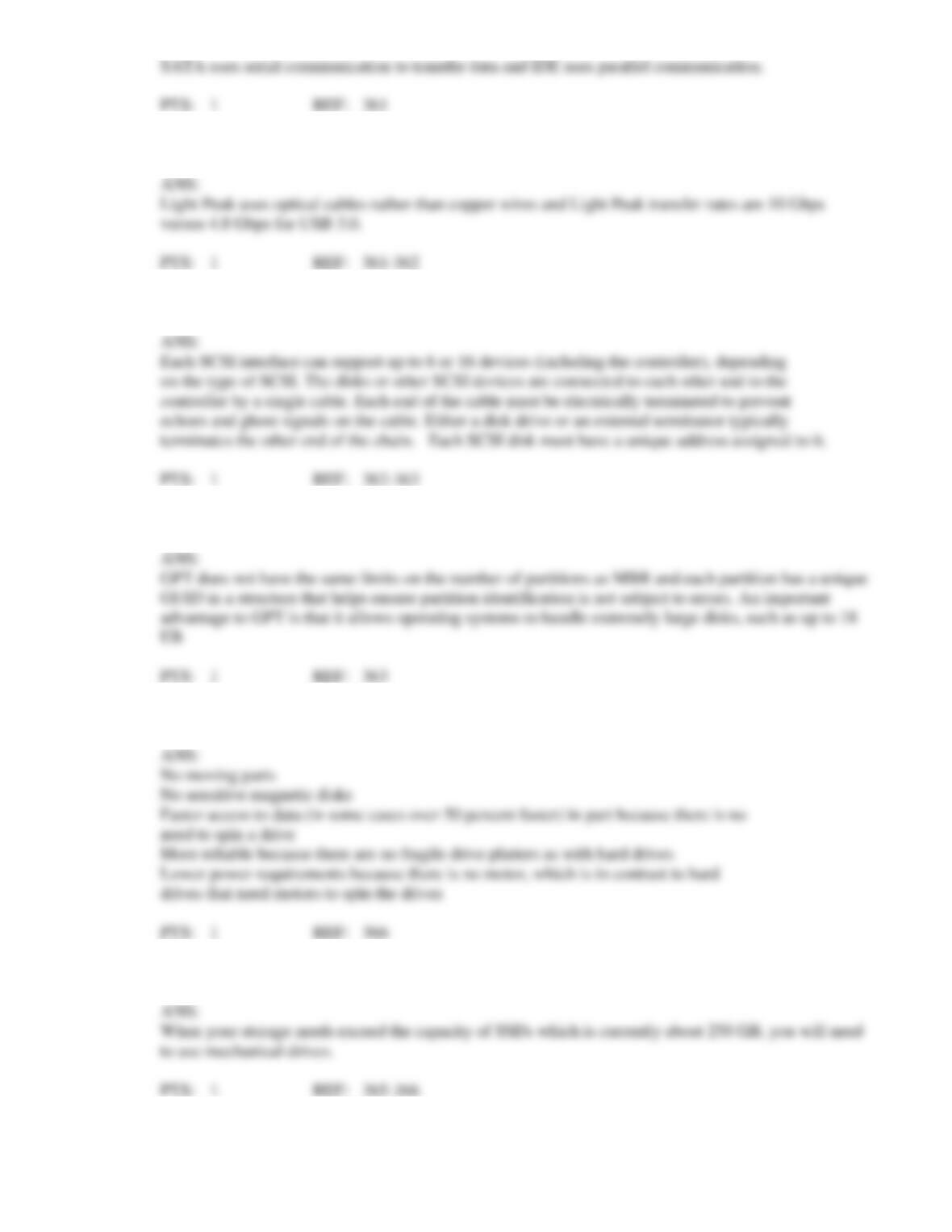
2. What are two distinguishing feature between the Light Peak technology and USB 3.0?
3. Describe how the SCSI interface works including how disk drives are connected to the controller.
4. How do the MBR and GPT methods of disk partitioning differ?
5. List three advantages to using SSD versus mechanical disk drives.
6. Aside from price, under what circumstance might you want to use mechanical drives instead of SSDs?
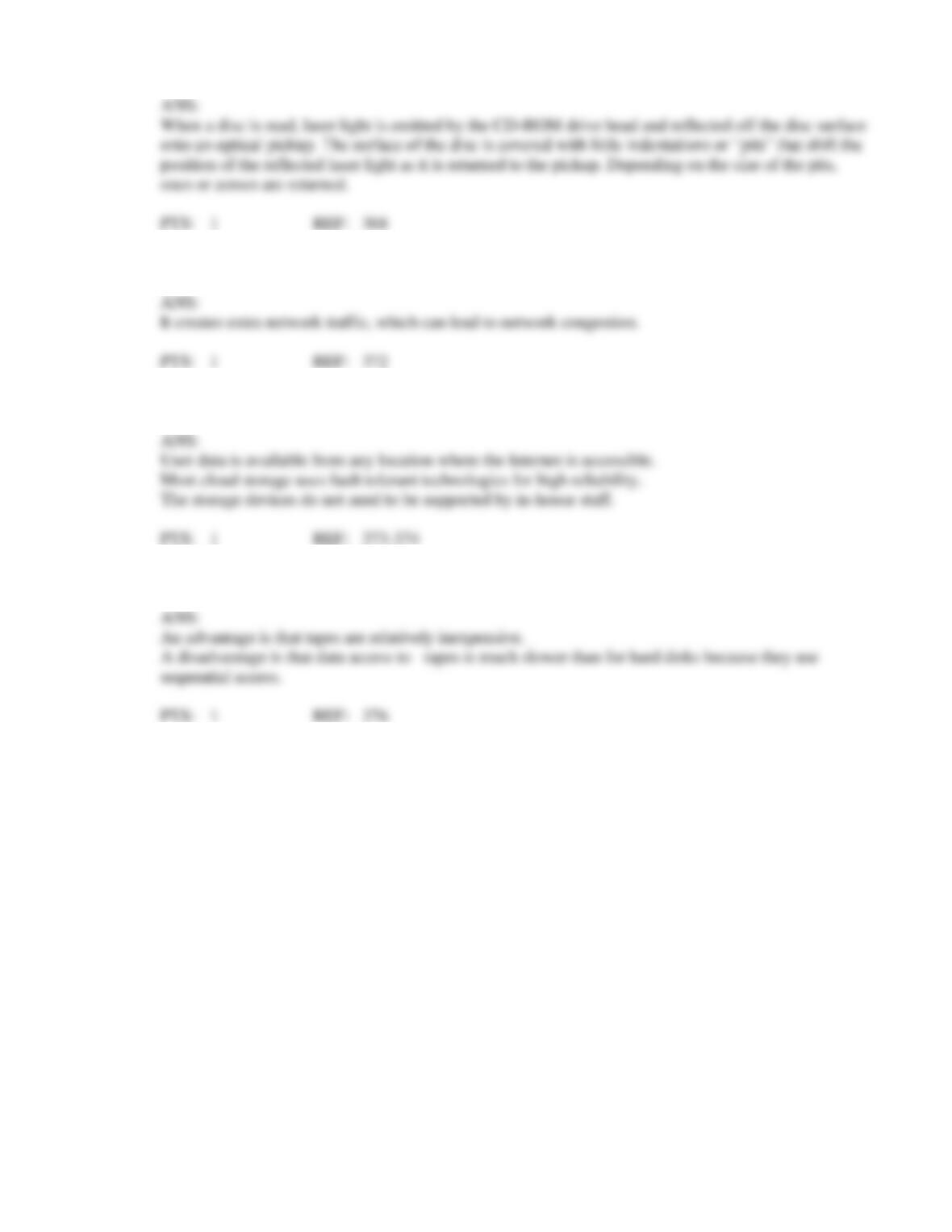
7. Briefly describe how data is read from a CD drives.
8. What is a downside for using iSCSI for access to your NAS?
9. What are two reasons you might want to consider using cloud storage hosted on the Internet?
10. Name one advantage and one disadvantage of using tapes for backup media.