Chapter 7: Inventories: Cost Measurement and Flow Assumptions
Exhibit 7-3
Davis Co. had the following inventory activity during April:
52. Refer to Exhibit 7-3. Assuming Davis uses a periodic FIFO cost flow assumption, ending inventory at April 30 would
be
a.
$880
b.
$920
c.
$1,090
d.
$1,890
d
1
Moderate
ACCT.WHAL.16.7.5 – LO: 7.5
United States – BUSPORG: Analytic
United States – OH – Default City – AICPA: FN-Measurement
53. Refer to Exhibit 7-3. Assuming Davis uses a periodic LIFO cost flow assumption, ending inventory at April 30 would
be
a.
$880
b.
$920
c.
$1,090
d.
$1,890
b
1
Moderate
ACCT.WHAL.16.7.5 – LO: 7.5
United States – BUSPORG: Analytic
United States – OH – Default City – AICPA: FN-Measurement
54. Refer to Exhibit 7-3. Assuming Davis uses a perpetual LIFO cost flow assumption, ending inventory at April 30
would be
a.
$880
b.
$920
c.
$1,090
d.
c
1
Moderate
ACCT.WHAL.16.7.5 – LO: 7.5
United States – BUSPORG: Analytic
$1,890
Exhibit 7-4
RJ, Inc. had the following activity for an inventory item during June:
Unit
Units
Cost
Beginning inventory
50
$10
Purchase (June 5)
10
16
Purchase (June 15)
30
14
Sale (June 20)
40
Sale (June 25)
20
Purchase (June 30)
10
20
55. Refer to Exhibit 7-4. Assuming RJ, Inc. uses a periodic weighted average cost flow assumption, ending inventory for
June would be
a.
$512
b.
$560
c.
$768
d.
$720
a
1
Moderate
ACCT.WHAL.16.7.5 – LO: 7.5
United States – BUSPORG: Analytic
United States – OH – Default City – AICPA: FN-Measurement
Chapter 7: Inventories: Cost Measurement and Flow Assumptions
56. Refer to Exhibit 7-4. Assuming RJ uses a perpetual moving average cost flow assumption, cost of goods sold for June
would be
a.
$512
b.
$560
c.
$768
d.
$720
d
1
Moderate
ACCT.WHAL.16.7.5 – LO: 7.5
United States – BUSPORG: Analytic
57. Which one of the following statements is false?
a.
Under conditions of rising prices, the LIFO method results in lower income than the FIFO method.
b.
In most cases, the FIFO method approximates the physical flow of items in inventory.
c.
The LIFO method produces a higher ending inventory value than the FIFO method.
d.
The FIFO method includes holding gains in income.
c
1
ACCT.WHAL.16.7.5 – LO: 7.5
United States – BUSPROG: Reflective Thinking – BUSPROG: Analytic
United States – OH – Default City – AICPA: FN-Measurement
58. Which of the following inventory cost flow assumptions produces the same ending inventory values under both the
periodic and perpetual systems?
a.
FIFO
b.
LIFO
c.
weighted average
d.
dollar-value LIFO
a
1
Easy
ACCT.WHAL.16.7.5 – LO: 7.5
United States – BUSPROG: Reflective Thinking – BUSPROG: Analytic
59. On July 1, Maxwell Company had 40 units of inventory at a cost of $6 per unit. July purchases and sales were as
follows:
Purchases
Sales
July 5
10 units @ $8
July 4
20 units
12
20 units @ $10
20
12 units
25
10 units @ $16
The cost of goods sold during July was $272. Maxwell must use:
a.
FIFO
b.
LIFO perpetual
c.
weighted average
d.
LIFO periodic
c
1
Moderate
ACCT.WHAL.16.7.5 – LO: 7.5
United States – BUSPORG: Analytic
United States – OH – Default City – AICPA: FN-Measurement
60. La Grange, Inc. reported sales of $1,200 in October and a gross profit of $370. The company had an October 1
inventory of 60 units that had a total cost of $300. October purchases and sales were as follows:
Purchases
Sales
October 7
40 units @ $6
October 2
20 units
10
20 units @ $7
8
40 units
18
40 units @ $8
12
10 units
24
20 units @ $9
20
20 units
28
20 units @ $10
26
30 units
La Grange, Inc., must use
a.
LIFO perpetual
b.
FIFO
c.
weighted average
d.
LIFO periodic
a
1
Moderate
ACCT.WHAL.16.7.5 – LO: 7.5
United States – BUSPORG: Analytic
United States – OH – Default City – AICPA: FN-Measurement
61. Which one of the following is not a disadvantage of the LIFO inventory cost flow assumption?
a.
the impact of LIFO liquidation profits
b.
failure to match the most recent costs with revenue
c.
the possibility of income manipulation by management
d.
impaired comparability between companies using LIFO
b
1
Easy
ACCT.WHAL.16.7.6 – LO: 7.6
United States – BUSPROG: Reflective Thinking – BUSPROG: Analytic
United States – OH – Default City – AICPA: FN-Decision Modeling
62. Which one of the following sets of inventory cost flow assumptions is not susceptible to profit manipulation by
management?
a.
FIFO and specific identification
b.
LIFO and average cost
c.
FIFO and average cost
d.
LIFO and specific identification
c
1
ACCT.WHAL.16.7.6 – LO: 7.6
United States – BUSPROG: Reflective Thinking – BUSPROG: Analytic
United States – OH – Default City – AICPA: FN-Decision Modeling
63. For the year in which prices rise, adoption of a “just-in–time” inventory system will most likely result in
a.
a permanent increase in the size of the inventory
b.
a reduction in income taxes
c.
an increase in total assets
d.
an increase in income
d
1
Moderate
ACCT.WHAL.16.7.6 – LO: 7.6
United States – BUSPROG: Reflective Thinking – BUSPROG: Analytic
United States – OH – Default City – AICPA: FN-Decision Modeling
64. Which one of the following is not an advantage of using the FIFO cost flow assumption?
a.
produces lowest net income in periods of rising prices
b.
provides a relevant ending inventory value
c.
is not as susceptible to profit manipulation by management
d.
does not produce unusual results when inventory liquidation occurs
a
1
Easy
ACCT.WHAL.16.7.6 – LO: 7.6
United States – BUSPROG: Reflective Thinking – BUSPROG: Analytic
United States – OH – Default City – AICPA: FN-Decision Modeling
65. Which one of the following is an advantage of LIFO?
a.
In periods of rising prices, less income tax is paid.
b.
In periods of rising prices, more holding gains are reported in net income.
c.
Record keeping and financial statement preparation are easier.
d.
Conservative income statements and balance sheet disclosures result from falling prices.
a
1
Easy
ACCT.WHAL.16.7.6 – LO: 7.6
United States – BUSPROG: Reflective Thinking – BUSPROG: Analytic
United States – OH – Default City – AICPA: FN-Decision Modeling
66. Which one of the following cost flow assumptions provides the lowest inventory value in periods of rising prices?
a.
FIFO periodic
b.
LIFO periodic
c.
FIFO perpetual
d.
moving average
b
1
Moderate
ACCT.WHAL.16.7.6 – LO: 7.6
United States – BUSPROG: Reflective Thinking – BUSPROG: Analytic
United States – OH – Default City – AICPA: FN-Decision Modeling
67. Taylor Company changed its inventory cost flow assumption from FIFO to LIFO in a period of rising prices. What
would be the effect of this change on ending inventory in the year of the change?
a.
increased ending inventory
b.
decreased ending inventory
c.
no change in ending inventory
d.
cannot be determined from the information given
b
1
Easy
ACCT.WHAL.16.7.6 – LO: 7.6
United States – BUSPORG: Analytic
68. Which one of the following statements is true?
a.
Income manipulation is difficult under LIFO.
b.
Accounting principles do not require that the inventory cost flow approximate the physical flow of goods.
c.
Companies may use LIFO for tax purposes and FIFO in the financial statements.
d.
In periods of declining prices, LIFO will result in the payment of lower income taxes.
b
1
ACCT.WHAL.16.7.6 – LO: 7.6
United States – BUSPROG: Reflective Thinking – BUSPROG: Analytic
United States – OH – Default City – AICPA: FN-Decision Modeling
69. Which one of the following is not an advantage of LIFO?
a.
In periods of rising prices, less income tax is paid.
b.
In periods of rising prices, less holding gains are reported in net income.
c.
Record keeping and financial statement preparation are easier.
d.
Conservative income statements and balance sheet disclosures result from rising prices.
c
1
Easy
ACCT.WHAL.16.7.6 – LO: 7.6
United States – BUSPROG: Reflective Thinking – BUSPROG: Analytic
United States – OH – Default City – AICPA: FN-Decision Modeling
70. Which of the following is not a disadvantage of using the FIFO cost flow assumption?
a.
creates the highest outflow for income taxes during periods of rising prices
b.
does not match current costs against current revenues
c.
includes all the holding gains in income during periods of rising prices
d.
provides a relevant ending inventory value
d
1
Moderate
ACCT.WHAL.16.7.6 – LO: 7.6
United States – BUSPROG: Reflective Thinking – BUSPROG: Analytic
United States – OH – Default City – AICPA: FN-Decision Modeling
71. Which inventory cost flow assumption is not allowed for financial reporting in many foreign countries?
a.
specific identification
b.
average
c.
FIFO
d.
LIFO
d
1
Easy
ACCT.WHAL.16.7.6 – LO: 7.6
United States – BUSPROG: Reflective Thinking – BUSPROG: Analytic
United States – OH – Default City – AICPA: FN-Decision Modeling
72. IFRS does not allow the use of LIFO because it
a.
would have to be allowed for tax reporting in each country.
b.
would result in too many overstatements of income.
c.
is inconsistent with any presumed physical flow of inventory.
d.
would have to be the only method permitted.
c
1
Easy
ACCT.WHAL.16.7.6 – LO: 7.6
United States – BUSPROG: Reflective Thinking – BUSPROG: Analytic
United States – OH – Default City – AICPA: FN-Decision Modeling
73. IFRS and GAAP are similar for all of the following inventory accounting standards except IFRS
a.
do not allow the inclusion of overhead in inventory
b.
have provisions for use of the LIFO cost flow assumption
c.
exclude the weighted average approach to inventory valuation
d.
require the same cost flow assumption for all inventories that are similar in nature and use
d
1
Moderate
ACCT.WHAL.16.7.6 – LO: 7.6
United States – BUSPROG: Reflective Thinking – BUSPROG: Analytic
United States – OH – Default City – AICPA: FN-Decision Modeling
74. Which of the following cannot be used as the current cost in dollar-value LIFO calculations?
a.
the cost of the first acquisitions in a year
b.
the cost of the last acquisitions in a year
c.
the cost of the acquisitions in the middle of a year
d.
the average cost of all acquisitions in a year
c
1
Easy
ACCT.WHAL.16.7.7 – LO: 7.7
United States – BUSPROG: Reflective Thinking – BUSPROG: Analytic
United States – OH – Default City – AICPA: FN-Decision Modeling
75. For companies that have little change in the characteristics of their inventory items, the most appropriate method for
computing a cost index for dollar-value LIFO is the
a.
inventory pool method
b.
double-extension method
c.
weighted average method
d.
link-chain method
b
1
Easy
ACCT.WHAL.16.7.7 – LO: 7.7
United States – BUSPROG: Reflective Thinking – BUSPROG: Analytic
United States – OH – Default City – AICPA: FN-Decision Modeling
76. Dollar-value LIFO uses
a.
current cost only
b.
cost indexes only
c.
current cost and cost indexes
d.
numerous detailed records from either a physical count or perpetual records
c
1
Easy
ACCT.WHAL.16.7.7 – LO: 7.7
United States – BUSPROG: Reflective Thinking – BUSPROG: Analytic
United States – OH – Default City – AICPA: FN-Decision Modeling
77. The second step in calculating dollar-value LIFO is to
a.
compute the change in the inventory level for the year at base-year cost
b.
roll back the ending inventory cost to base-year costs
c.
value the total ending inventory at current-year costs
d.
roll forward the increase to current-year cost by applying the current-year conversion index
b
1
Easy
ACCT.WHAL.16.7.7 – LO: 7.7
United States – BUSPROG: Reflective Thinking – BUSPROG: Analytic
United States – OH – Default City – AICPA: FN-Decision Modeling
Exhibit 7-5
Sullivan Produce Co. switched from FIFO to LIFO on January 1, 2015, for external reporting and income tax purposes,
while retaining FIFO for internal reports. On that date, the FIFO inventory equaled $360,000. The ensuing three-year
period resulted in the following:
Inventory
Cost
Date
Year-End Costs
Index
December 31, 2015
$438,000
1.05
December 31, 2016
460,000
1.15
December 31, 2017
520,000
1.25
78. Refer to Exhibit 7-5. The ending inventory at December 31, 2016, at base-year price is:
a.
$400,000
b.
$402,000
c.
$406,000
d.
$424,000
a
1
Moderate
ACCT.WHAL.16.7.7 – LO: 7.7
United States – BUSPORG: Analytic
United States – OH – Default City – AICPA: FN-Measurement
79. Refer to Exhibit 7-5. The ending inventory at December 31, 2017, using the dollar-value LIFO method would be
a.
$422,000
b.
$402,000
c.
$426,000
d.
$420,400
a
1
Moderate
ACCT.WHAL.16.7.7 – LO: 7.7
United States – BUSPORG: Analytic
United States – OH – Default City – AICPA: FN-Measurement
80. Trip Corp. began business in 2015. On December 31, 2015, Trip’s single pool of inventory was valued at $300,000,
using the dollar-value LIFO inventory method. On December 31, 2016, the value of Trip’s inventory at current costs
was $450,000. The 2016 year-end cost index was 120. What was the value of Trip’s inventory at the end of 2016,
using the dollar-value LIFO method?
a.
$375,000
b.
$390,000
c.
$480,000
d.
$540,000
b
1
Moderate
ACCT.WHAL.16.7.7 – LO: 7.7
United States – BUSPORG: Analytic

81. Morris Corp. uses dollar-value LIFO. Certain information follows:
Ending Inventory−
Year
Current Cost
Index
2015
$10,000
100
2016
11,845
103
2017
12,096
108
2018
13,090
110
Compute the ending 2018 inventory.
a.
$11,900
b.
$11,985
c.
$12,006
d.
$12,090
c
1
Moderate
ACCT.WHAL.16.7.7 – LO: 7.7
United States – BUSPORG: Analytic
United States – OH – Default City – AICPA: FN-Measurement
82. The term LIFO reserve refers to
a.
a cost flow assumption for valuing inventory
b.
a special fund set aside to cover LIFO liquidation
c.
inventory pools used in the dollar-value LIFO method
d.
any difference between the ending inventory amount under LIFO and the ending inventory amount under
FIFO or average cost
d
1
Easy
ACCT.WHAL.16.7.8 – LO: 7.8
United States – BUSPROG: Reflective Thinking – BUSPROG: Analytic
United States – OH – Default City – AICPA: FN-Decision Modeling
83. Typically, the impact of the LIFO reserve is to
a.
increase cost of goods sold and decrease ending inventory
b.
decrease cost of goods sold and decrease ending inventory
c.
increase cost of goods sold and increase ending inventory
d.
have no effect on cost of goods sold and ending inventory
a
1
Moderate
ACCT.WHAL.16.7.8 – LO: 7.8
United States – BUSPROG: Reflective Thinking – BUSPROG: Analytic
United States – OH – Default City – AICPA: FN-Decision Modeling
84. A company uses a LIFO reserve because internal reporting
a.
and GAAP reporting are not the same as tax reporting
b.
and GAAP reporting are the same as tax reporting
c.
is the same as GAAP reporting and tax reporting
d.
is not the same as GAAP reporting and tax reporting
d
1
Moderate
ACCT.WHAL.16.7.8 – LO: 7.8
United States – BUSPROG: Reflective Thinking – BUSPROG: Analytic
United States – OH – Default City – AICPA: FN-Decision Modeling
85. Management’s choice to use LIFO or FIFO can make a financial analyst’s efforts to compare companies difficult. The
financial analyst’s job is made easier because of the
a.
requirement that the financial statements and tax return must use the same inventory valuation methodology
b.
fact that most companies in an industry use the specific identification method
c.
use of the weighted average method
d.
d
1
Moderate
ACCT.WHAL.16.7.8 – LO: 7.8
United States – BUSPROG: Reflective Thinking – BUSPROG: Analytic
United States – OH – Default City – AICPA: FN-Decision Modeling
disclosure of the LIFO reserve
86. In interim reporting, a LIFO liquidation requires the company to forecast the year-end
a.
cost of goods sold
b.
ending inventory
c.
LIFO reserve
d.
tax liability
b
1
Moderate
ACCT.WHAL.16.7.8 – LO: 7.8
United States – BUSPORG: Analytic
United States – OH – Default City – AICPA: FN-Measurement
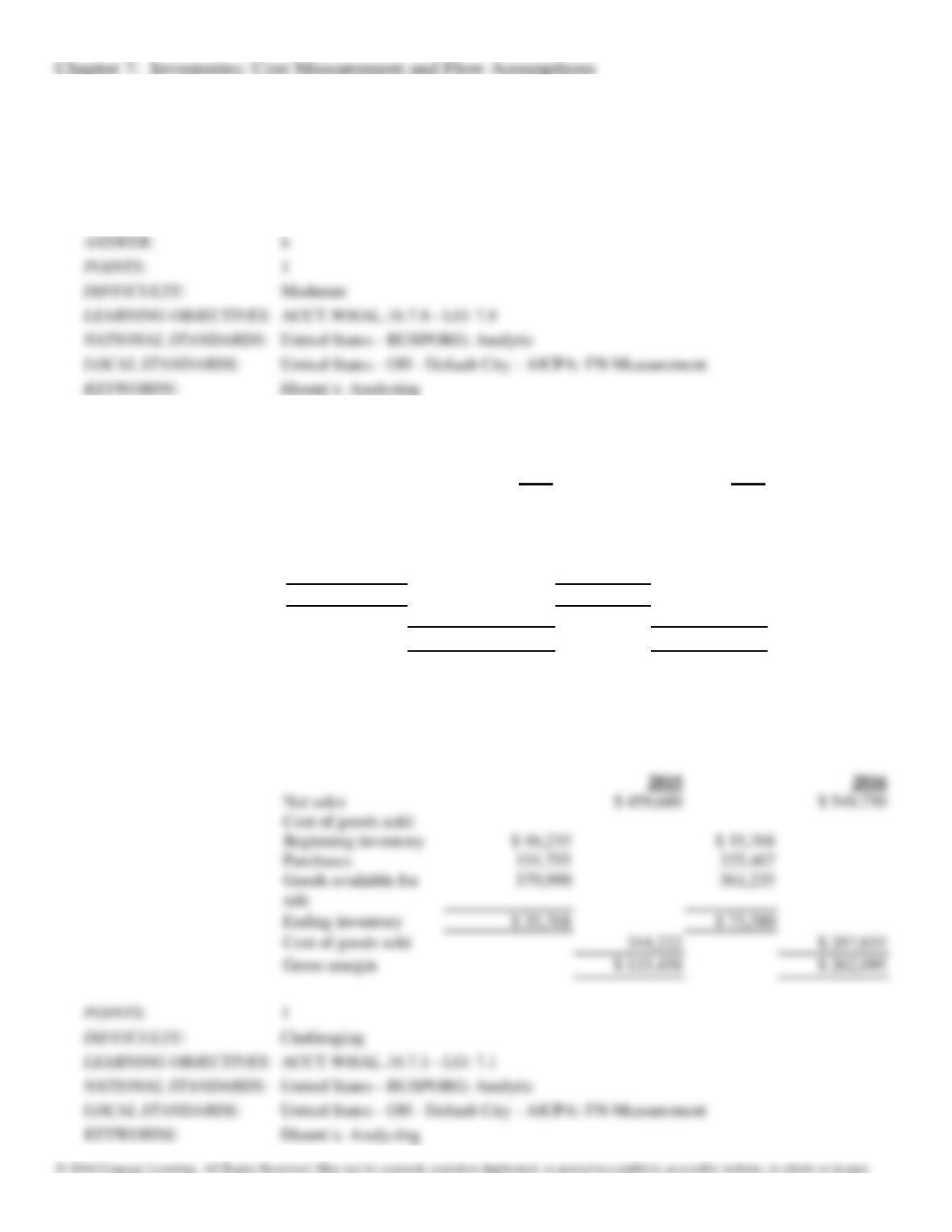
87. The following information was obtained from the accounting records of Junie Company.
2015
2016
Net sales
$ 459,680
$ 549,750
Cost of goods sold:
Beginning inventory
$48,235
(d)
Purchases
(a)
$ 325,467
Goods available for sale
(b)
(e)
Ending inventory
$35,768
(f)
Cost of goods sold
(c)
$ 287,655
Gross margin
$ 115,458
(g)
Required:
Compute the missing amounts.
ANSWER:
Net sales
Cost of goods sold:
Beginning inventory
Purchases
Ending inventory
Gross margin
1
Challenging
ACCT.WHAL.16.7.1 – LO: 7.1
United States – BUSPORG: Analytic

88. Revolution Hardware reported $475,000 of inventory on December 31, 2016, based on a physical count.
Additional information is as follows:
∙
Included in the 2016 physical count were machines billed to a customer FOB shipping
point on December 31. These machines had a cost of $12,000 and had been billed at
$30,000. The shipment was on Revolution’s loading dock waiting to be picked up by the
carrier.
∙
Goods were in transit from a vendor to Revolution. The invoice cost was $85,000 and the
goods were shipped FOB shipping point on December 29, 2016.
∙
Work in process inventory (not included in the physical count) costing $7,850 was sent to
an outside processor for finishing on December 30, 2016.
∙
Goods out on consignment amounted to $26,500 (sales price) with shipping costs of $590
(not included in sales price). Markup is 15% on cost.
Required:
Compute the correct amount of December 31, 2016, ending inventory for Revolution Hardware.
1
ACCT.WHAL.16.7.3 – LO: 7.3
United States – OH – Default City – AICPA: FN-Measurement

89. At December 31, 2016, Jefferson, Inc. had inventory on hand amounting to $270,000. The following items were not
included in this inventory:
∙
Goods sold and still in transit, shipped Dec. 29 FOB destination, sales price $12,000,
freight costs $500.
∙
Goods held by Johnson on consignment from Miller Company, sales price $12,500,
shipping costs $300.
∙
Goods returned by customers and held pending inspection, cost $1,100.
∙
On Jan. 1, 2017, a monthly freight bill for $1,600 was received. The bill specifically related
to merchandise purchased in December 2016, 40 percent of which was sold in December.
No related adjustment had yet been made.
Jefferson sells at a gross profit of 25% on cost.
Required:
Compute the cost of ending inventory to be reported on Jefferson’s December 31, 2016, balance sheet.
*
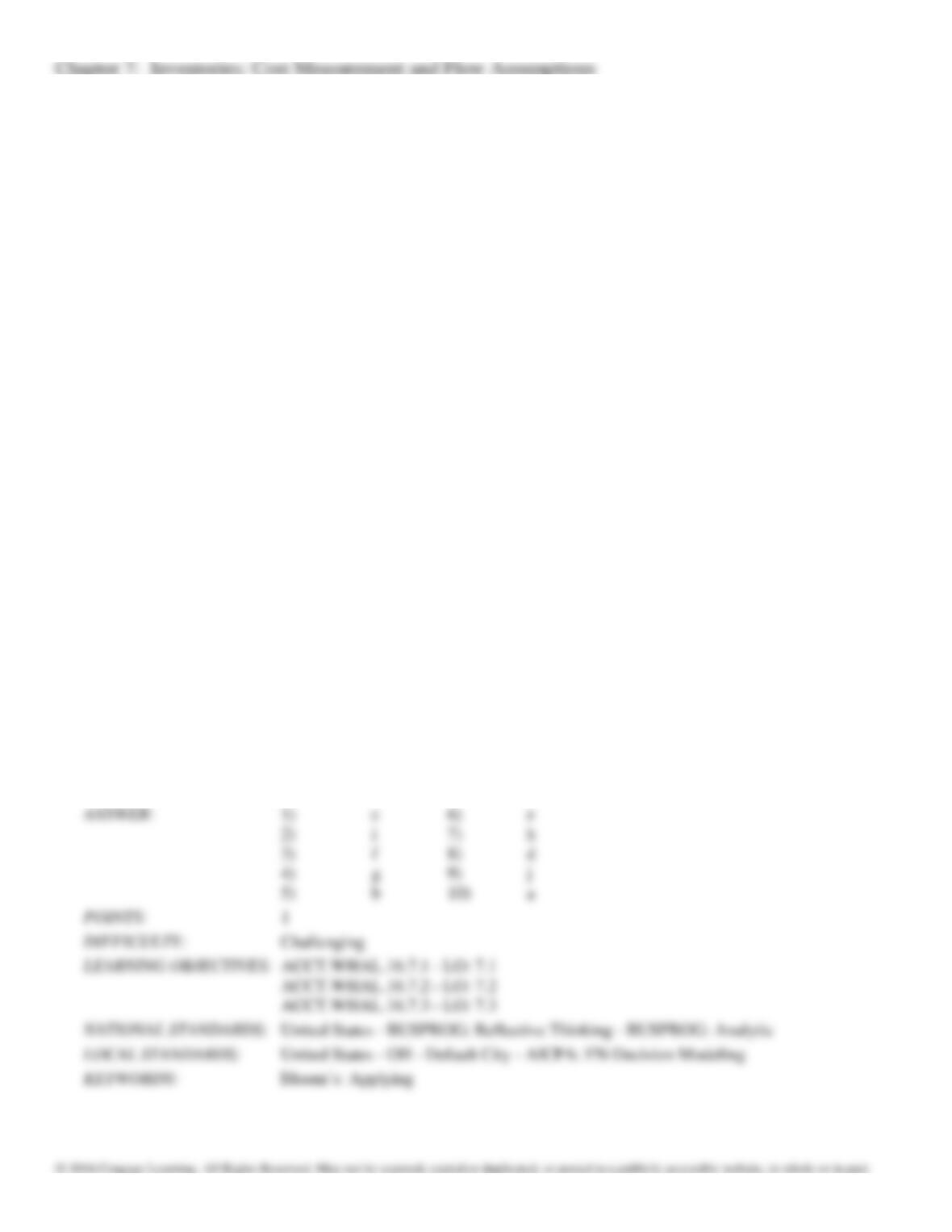
90. Below is a list of key terms.
______
1)
Bill and hold sale
______
6)
Periodic Inventory
______
2)
Consigned Goods
_____
7)
Perpetual Inventory
______
3)
Finished Goods Inventory
______
8)
Purchase obligation
______
4)
FOB Destination
______
9)
Raw Materials Inventory
______
5)
FOB Shipping Point
______
10)
Work-in-Process Inventory
Required:
Match each key term with its appropriate definition.
a)
Includes direct labor, raw materials, and manufacturing overhead.
b)
Buyer recognizes purchase of inventory at shipment.
c)
The requested goods will be delivered to the buyer at a later date.
d)
Not recognized in inventory until delivered.
e)
A temporary account is used to record purchases.
f)
Goods ready for sale.
g)
Buyer recognizes purchase of inventory at destination.
h)
Purchases are recorded in an inventory account.
i)
A third party acts as a sales agent for another company’s goods.
j)
Tangible goods used in production.
1)
c
6)
e
2)
i
7)
h
3)
f
8)
d
4)
g
9)
j
5)
b
10)
a
1
Challenging
United States – BUSPROG: Reflective Thinking – BUSPROG: Analytic
United States – OH – Default City – AICPA: FN-Decision Modeling
91. Logan Company has provided the following information:
(1)
Included in the physical count were inventory items billed to a customer FOB shipping
point on December 31, 2016. The goods had a cost of $280 and had been billed at $400.
The shipment was on Logan’s loading dock waiting to be picked up by the trucking
company.
(2)
Goods returned by customers and held pending inspection in the returned goods area on
December 31, 2016, were not included in the physical count. On January 5, 2017, the
goods costing $260 were inspected and returned to inventory. Credit memos totaling $380
were issued to the customers on the same date.
(3)
On January 3, 2017, a monthly freight bill in the amount of $170 was received. The bill
specifically related to merchandise purchased in December 2016, 30% of which was still in
inventory at December 31, 2016. The freight charges had not been recorded at December
31, 2016.
(4)
Goods were shipped out on consignment on December 15, 2016, and were recorded as a
sale at the sales price of $550. The consignee has not yet sold these items. Goods are sold
at a markup of 10% on cost. The goods were not included in inventory.
Required:
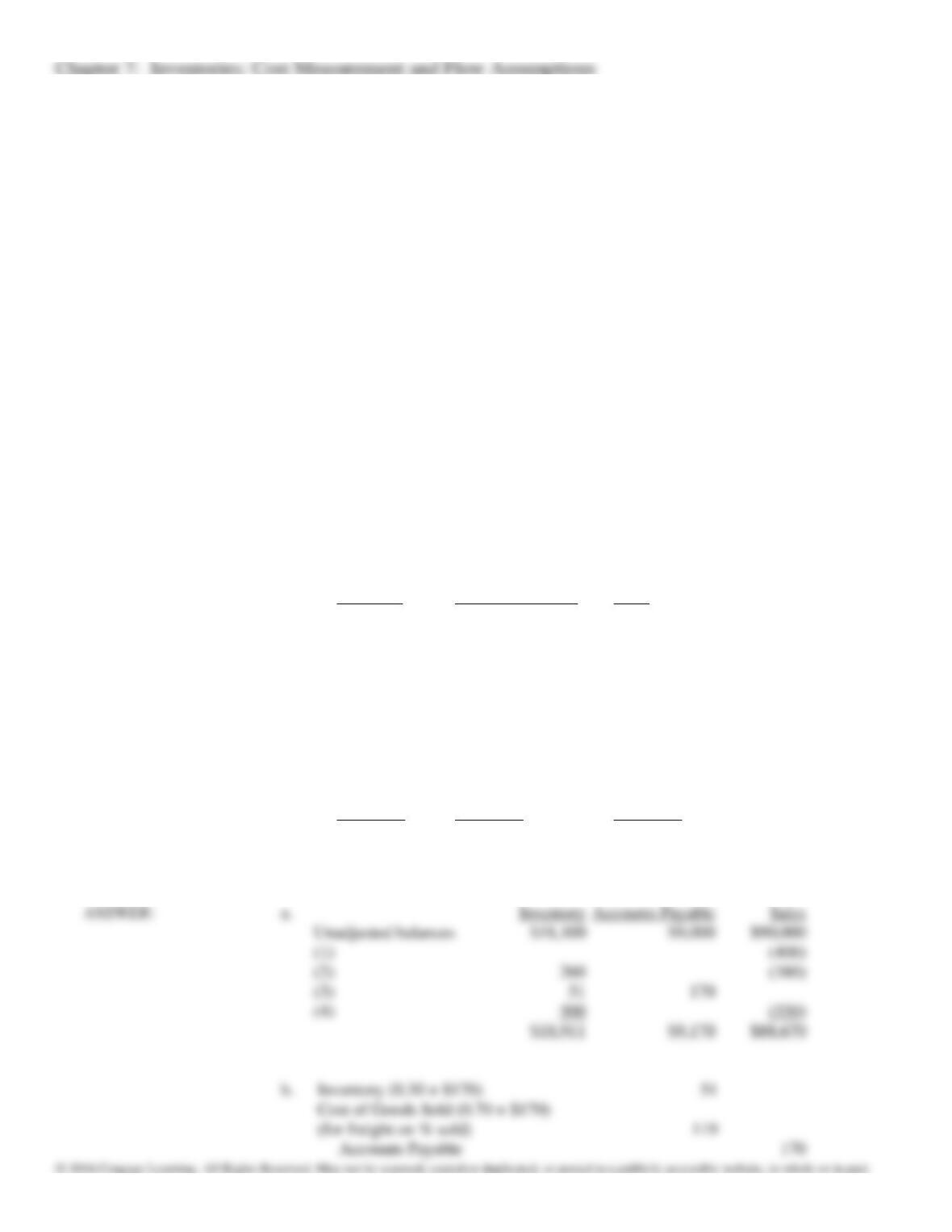
Logan’s unadjusted balances on December 31, 2016, for Inventory, Accounts Payable, and Sales are provided in the
three columns of the schedule below.
a.
Complete the schedule to provide the correct adjusted balances at December 31, 2016.
Inventory
Accounts Payable
Sales
Unadjusted balances
$18,100
$9,000
$90,000
(1)
________
________
________
(2)
________
________
________
(3)
________
________
________
(4)
________
________
________
Adjusted balances
________
________
________
b.
Prepare the December 31, 2016, adjusting journal entry that Logan would prepare to record the freight charges
described in item 3 above.
Unadjusted balances
(1)
(2)
(3)
(4)
Cost of Goods Sold (0.70 × $170)
(for freight on % sold)

92. On June 1, Sabrex Electric bought $7,500 of goods with terms of 3/15, n/45.
Required:
Fill in the blanks below with dollar amounts, if any are appropriate.
(Use the net method for items a. and b. below.)
a.
If payment was made on June 15, you would debit Accounts Payable for $________.
b.
If payment was made on July 3, you would debit Purchases Discounts Lost for $________.
(Use the gross price method for c. and d. below.)
c.
If payment is made on June 15, you would credit Cash for $________.
d.
Assuming no payment had yet been made, you would debit Purchase Discounts Lost for
$________ in the adjusting entry at July 31 (fiscal year-end).
a.
b.
d.
1
Challenging
ACCT.WHAL.16.7.4 – LO: 7.4
United States – BUSPORG: Analytic
United States – OH – Default City – AICPA: FN-Measurement
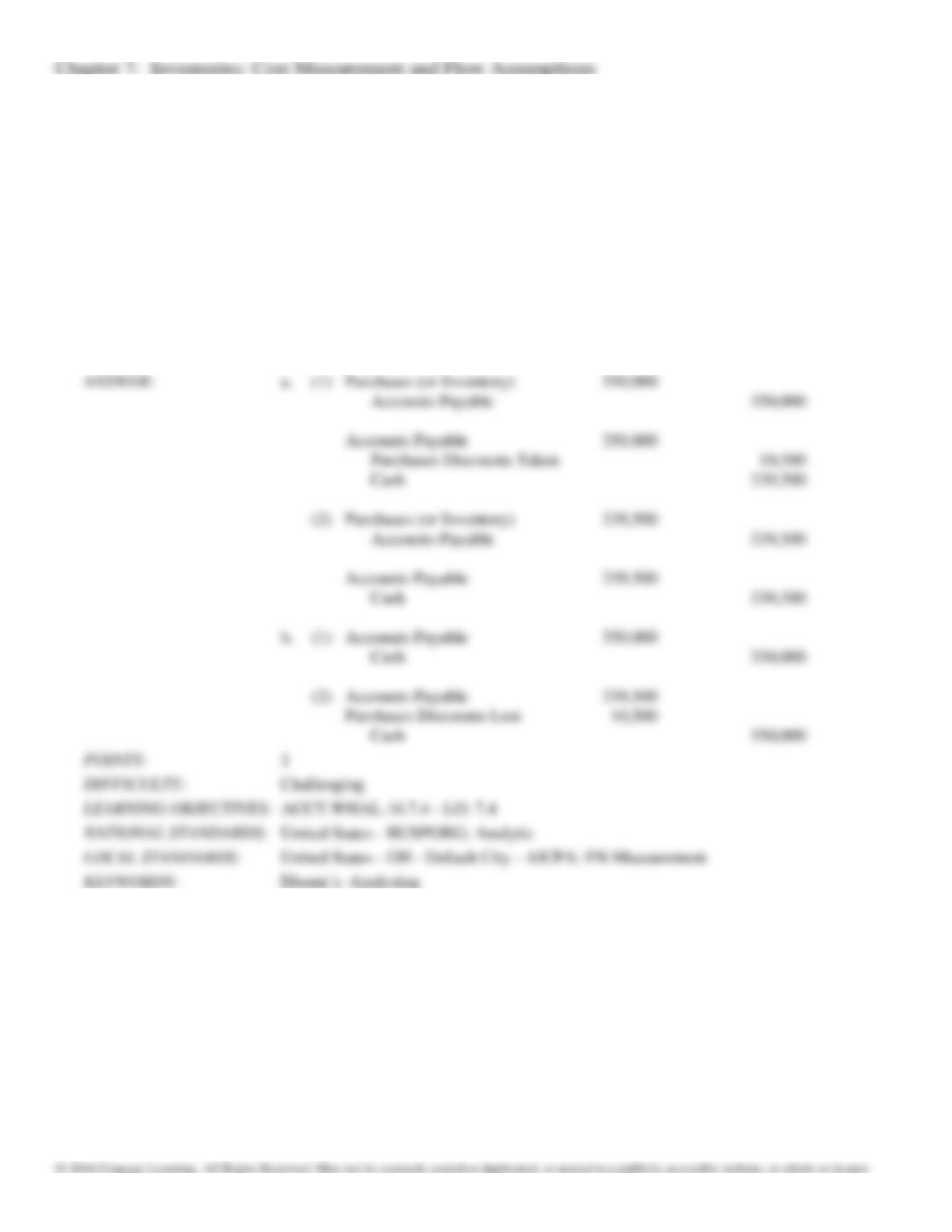
93. On April 15, Jones, Inc. purchased merchandise inventory at an invoice price of $350,000, with terms of 3/15, n/30.
Required:
a.
Assuming that the full, appropriate payment was made on April 28, prepare journal entries
to record the purchase and payment, using the:
(1)
gross price method
(2)
net price method
b.
Assuming that the full, appropriate payment was made on May 15, prepare journal entries
to record the payment, using the:
(1)
gross price method
(2)
net price method
Accounts Payable
Accounts Payable
Purchases Discounts Taken
Cash
(2)
Purchases (or Inventory)
Accounts Payable
Accounts Payable
Cash
b.
(1)
Accounts Payable
Cash
(2)
Accounts Payable
Purchases Discounts Lost
Cash
1
Challenging
ACCT.WHAL.16.7.4 – LO: 7.4
United States – BUSPORG: Analytic
United States – OH – Default City – AICPA: FN-Measurement