32)
Which of the following is the best method to sterilize heat–labile solutions?
32)
A)
freezing
B)
membrane filtration
C)
dry heat
D)
pasteurization
E)
autoclave
33)
Which concentration of ethanol is the most effective bactericide?
33)
A)
100 percent
B)
70 percent
C)
50 percent
D)
40 percent
E)
30 percent
Table 7.2
The fate of E. coli O157:H7 in apple cider held at 8°C for 2 weeks,
with and without preservatives, is shown below:
Bacteria/ml
Cider only 2.2
Cider with potassium sorbate 2.0
Sodium benzoate 0
Potassium sorbate + sodium benzoate 0
34)
In Table 7.2, which preservative is most effective?
34)
A)
potassium sorbate
B)
sodium benzoate
C)
potassium sorbate + sodium benzoate
D)
no preservative
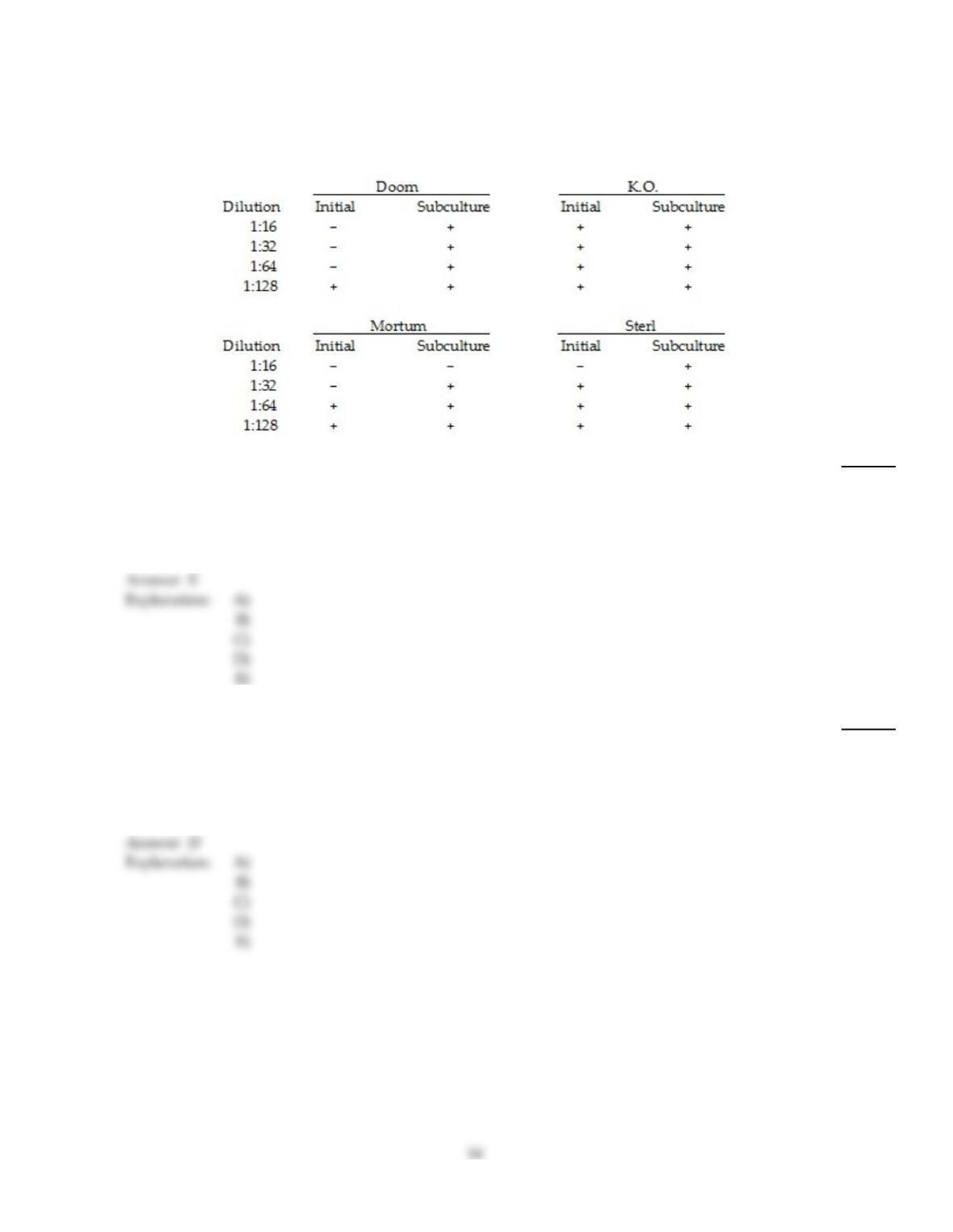
Table 7.3
The following data were obtained by incubating gram–positive bacteria in
nutrient medium + disinfectant for 24 hr, then transferring one loopful to
nutrient medium (subculturing). (+ = growth; – = no growth)
35)
In Table 7.3, which disinfectant was most effective against Salmonella?
35)
A)
K.O.
B)
Sterl
C)
Doom
D)
Mortum
E)
The answer cannot be determined based on the information provided.
36)
Bone and tendons for transplant are decontaminated by
36)
A)
ethylene oxide.
B)
plasma sterilization.
C)
glutaraldehyde.
D)
supercritical fluids.
E)
peroxygens.
D
E

Table 7.1
A disk–diffusion test using Staphylococcus gave the following results:
Disinfectant Zone of inhibition (mm)
A 0
B2.5
C10
D 5
37)
In Table 7.1, which compound was the most effective against Staphylococcus?
37)
A)
A
B)
B
C)
C
D)
D
E)
The answer cannot be determined based on the information provided.
38)
Which of the following pairs is mismatched?
38)
A)
ultraviolet radiation — desiccation
B)
supercritical fluids — CO2
C)
ionizing radiation — hydroxyl radicals
D)
plasma sterilization — free radicals
E)
ozone — takes electrons from substances
A
39)
The antimicrobial activity of chlorine is due to which of the following?
39)
A)
the formation of a hypochlorite ion
B)
the formation of hydrochloric acid
C)
disruption of the plasma membrane
D)
the formation of ozone
E)
the formation of hypochlorous acid
E
C
40)
All of the following are effective for destroying prions EXCEPT
40)
A)
NaOH + autoclaving at 134°C.
B)
incineration.
C)
proteases.
D)
boiling.
E)
None of the answers are correct; each of these will destroy prions.
41)
All of the following are methods of food preservation EXCEPT
41)
A)
osmotic pressure.
B)
microwaves.
C)
high pressure.
D)
ionizing radiation.
E)
desiccation.
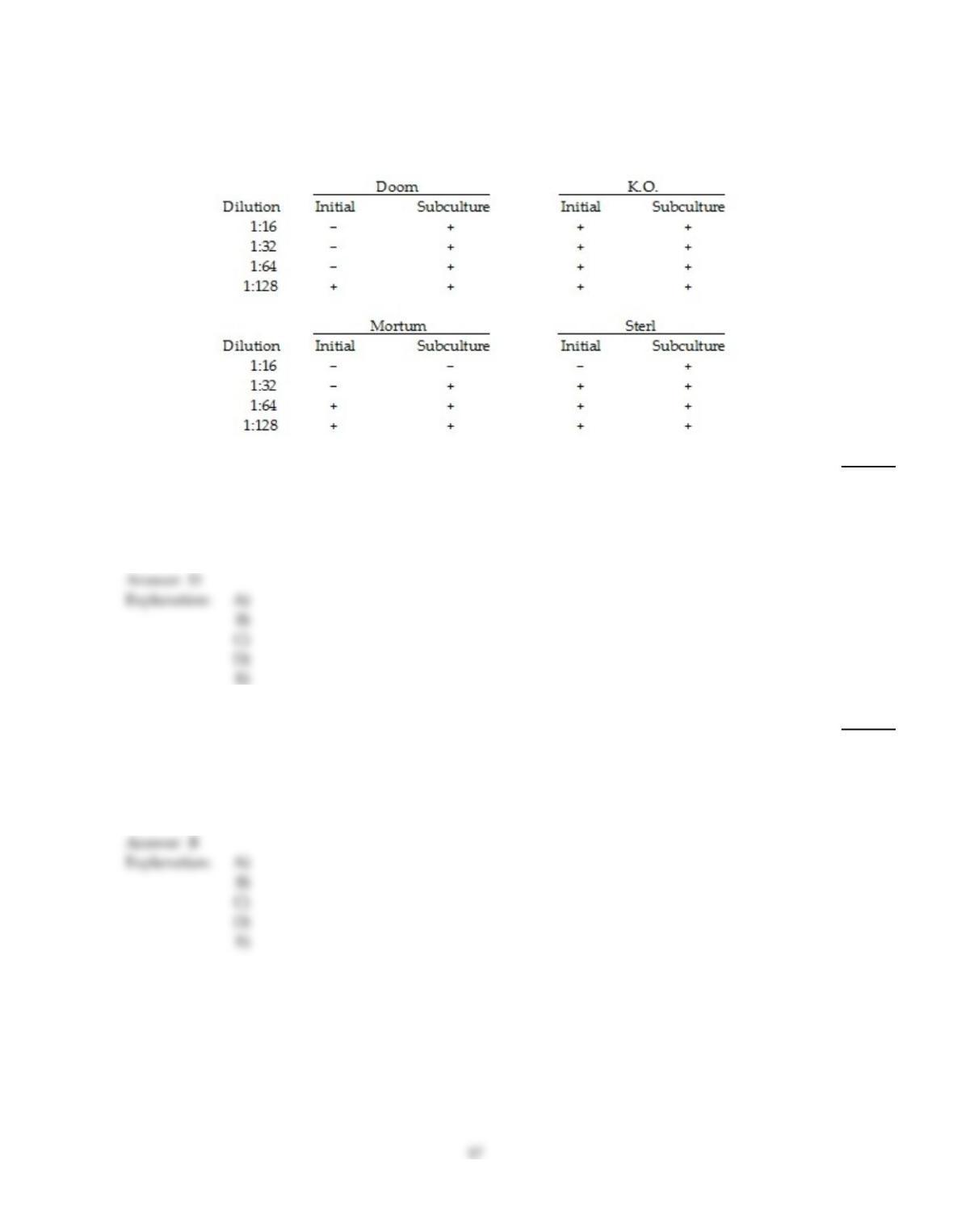
Table 7.3
The following data were obtained by incubating gram–positive bacteria in
nutrient medium + disinfectant for 24 hr, then transferring one loopful to
nutrient medium (subculturing). (+ = growth; – = no growth)
42)
In Table 7.3, which disinfectant was bactericidal?
42)
A)
Doom
B)
Sterl
C)
K.O.
D)
Mortum
E)
The answer cannot be determined based on the information provided.
43)
Which of the following pairs of terms is mismatched?
43)
A)
sterilant — destroys all living microorganisms
B)
bacteriostatic — kills vegetative bacterial cells
C)
fungicide — kills yeasts and molds
D)
germicide – kills microbes
E)
virucide – inactivates viruses
B
D
Table 7.1
A disk–diffusion test using Staphylococcus gave the following results:
Disinfectant Zone of inhibition (mm)
A 0
B2.5
C10
D 5
44)
In Table 7.1, which compound was bactericidal?
44)
A)
A
B)
B
C)
C
D)
D
E)
The answer cannot be determined based on the information provided.
45)
An iodophor is a(n)
45)
A)
agent that reduces oxygen.
B)
form of formaldehyde.
C)
phenol.
D)
iodine mixed with a surfactant.
E)
quaternary ammonium compound.
D
TRUE/FALSE. Write ‘T’ if the statement is true and ‘F’ if the statement is false.
46)
Ultraviolet light (UV) causes irreversible breaks in DNA strands.
46)
47)
Autoclaving is the most effective method of moist heat sterilization.
47)
48)
The pH of the medium has no effect on the activity of the disinfectant being applied.
48)
E
49)
Pseudomonas has been found growing in quaternary ammonium compounds (quats).
49)
50)
Microorganisms placed in high concentrations of salts and sugars undergo lysis.
50)
51)
The thermal death time is the time needed to kill all the bacteria in a particular culture at a certain
temperature.
51)
52)
Any process that destroys the non–spore forming contaminants on inanimate objects is
sterilization.
52)
53)
Some antimicrobial chemicals are considered to be disinfectants and antiseptics.
53)
54)
Moist heat destroys organisms by denaturing proteins.
54)
55)
Desiccation is a reliable form of sterilization.
55)
ESSAY. Write your answer in the space provided or on a separate sheet of paper.
56)
Assume that you are responsible for decontaminating materials in a large hospital. How would you sterilize
each of the following? Briefly justify your answers.
a. a mattress used by a patient with bubonic plague
b. intravenous glucose–saline solutions
c. used disposable syringes
d. tissues taken from patients
57)
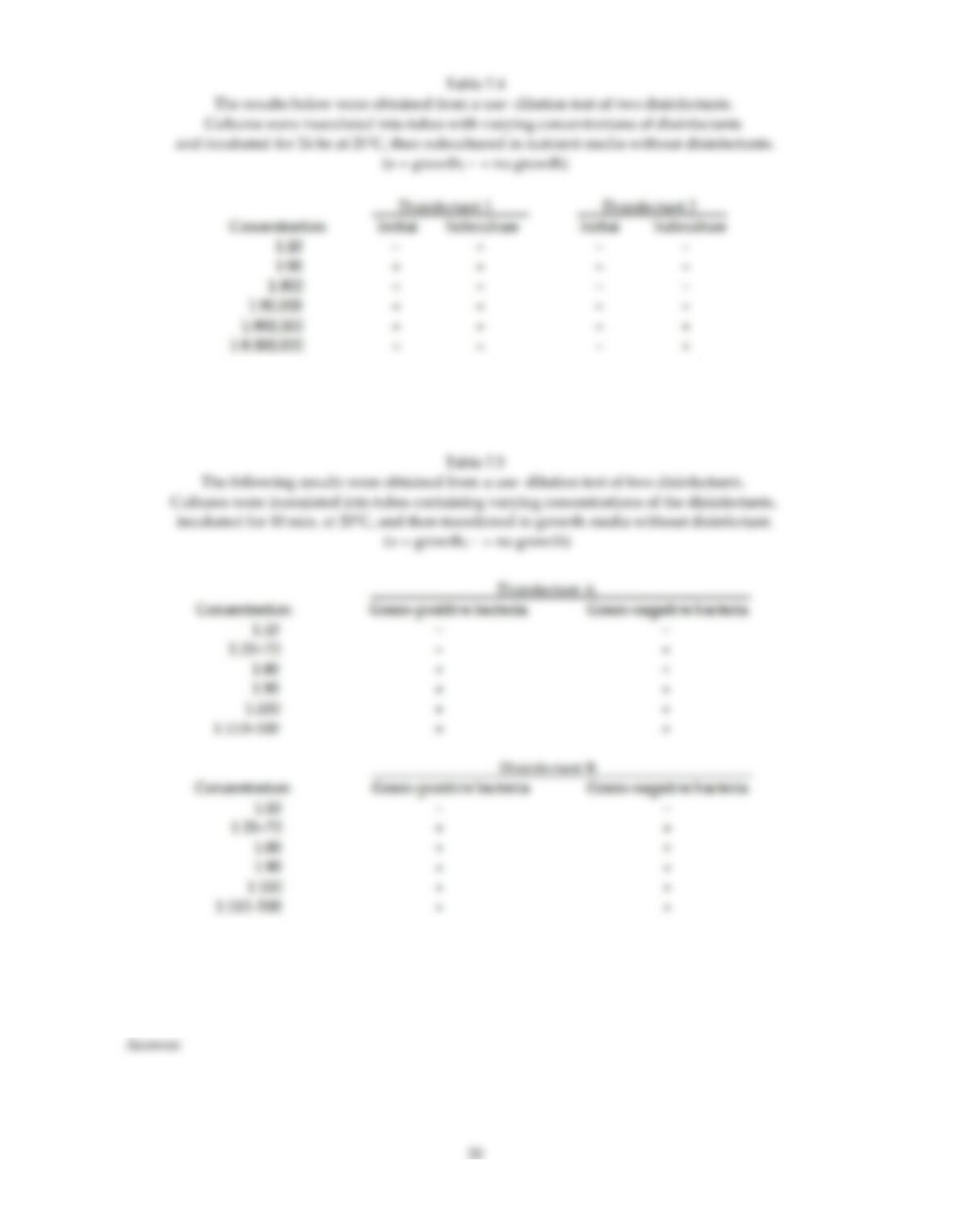
In Table 7.4, what is the minimal bacteriostatic concentration of each disinfectant? Which compound is
bactericidal? At what concentration?
Answer:
58)
In Table 7.5, which disinfectant is most effective? Against which group of bacteria is Disinfectant A most
effective?
Answer:
59)
How is hydrogen peroxide antimicrobial?
Answer:

60)
Why must most milk sold in the U.S. be refrigerated at all times while evaporated canned milk and
milk in cardboard containers sold in Europe do not need to be refrigerated until they are opened?
Answer Key
Testname: C7
22
Answer Key
Testname: C7