Chapter 7 Test Questions
[1]
the automobile industry. The subassemblies are made in three different shapes (for
different car models). These subassemblies need an electric motor, and Laurence is
trying to find a supplier for these motors. The specifications of the electric motor
required for the three subassemblies are almost identical; however the motors need to be
of slightly different shapes to fit into the subassembly. Assume that the firm works for
300 days in a year and the daily requirement of each type of motor is normally distributed
with a mean of 200 units and a standard deviation of 50 units. Laurence intends to hold
safety stock to meet a 95% service level. The annual holding cost of the motor is 25% of
the price of the motor. Also, by convention, the French firm pays for the motors the
moment they are shipped.
Laurence has received two quotations. The first is from a firm in Asia. The unit price per
motor is 50 Euros. In addition, the transportation cost per unit is 5 Euros. The transit
time from Asia is 25 days. The second quotation is from a company in North America.
This firm offers to price the motors at 60 Euros/unit, and a transportation cost of 7.5
Euros. It will take only 10 days to deliver the motors.
Evaluate each of the two proposals to determine the most economical alternative. What
is your recommendation? (Be specific and show all of your calculations.) (10 points)
Answer:
[2] A fashion company decides to market denim jeans in unusual colors: lightning green,
electric orange and shocking red. The company buys denim and dyes it in each of the
three colors. The next step is producing the jeans – which involves cutting, sewing, etc. –
in each of the three colors. In year 1, the company expected demand for each product to
be approximately the same, and produced 100,000 units of each product. However, the
electric orange jeans were a runaway success (demand was 250,000), while the other two
colors sold only 25,000 units each. It is unclear which color will catch on next year, and
the company wants to avoid facing the same problem. As a result they decide to reverse
their operations, producing basic white denim jeans first, and then dyeing them in
different colors. Assume that sufficient capacity exists in both operations, and the dyeing
operation is a very simple and quick process. What specific advantages might the
with the problem they faced last year? (5 points)
(Ideal) Answer:
[3] Daily demand for the ice creams at I-Scream parlor is normally distributed with a mean
of 160 quarts and a standard deviation of 100 quarts. The owner has the ice cream
supplied by a wholesaler who charges $2 per quart. The wholesaler charges a $400
delivery charge independent of order size. It takes 4 days for an order to be supplied.
The opportunity cost of capital to I-Scream is estimated to be 25% per year. Assume 360
days in the year. [Show all work]
(a) The optimal order size of each order is:
506 quarts
(b) The owner would like to ensure no stock-outs in 95% of the cycles. The optimal
safety stock the store should have is:
660 quarts
(c) Currently the owner orders 4000 quarts of ice cream when they have 1680 quarts on
hand. The average time spent by a quart of ice cream at the parlor is:
39.6 days
[4]
competition (ii) Lower price than competition. Clearly these components of their strategy
are in conflict. List two operational actions that allow Benetton to support these
objectives of the marketing strategy and execute them successfully.
Answer:
[5] Big Old Tires currently owns and operates four warehouses in the Chicago area. Assume
that each warehouse serves a geographic region. Weekly demands in any region are
normally distributed with a mean of 200 tires and a standard deviation of 100 tires.
Orders from suppliers take 4 weeks to be delivered. Big Old Tires is contemplating a
consolidation of warehouses from four to one. Upon consolidation, the wholesaler
carries the same safety stock in one warehouse as previously in four warehouses
combined. The service level (in terms of probability of not stocking out in a cycle) s/he
can provide from this single warehouse will be [Give 1-line explanation]:
[6] Hewlett-Packard produces deskjet printers for worldwide demand at its Vancouver, WA
facility. It is observed that the monthly demand for type AB printers at the European DC
averages 15,830 with a standard deviation of 5,624.
(a) The fixed cost of transportation and ordering is $100,000. Each printer costs $100
and HP has a holding cost of 20%. The optimal order quantity for the European DC is
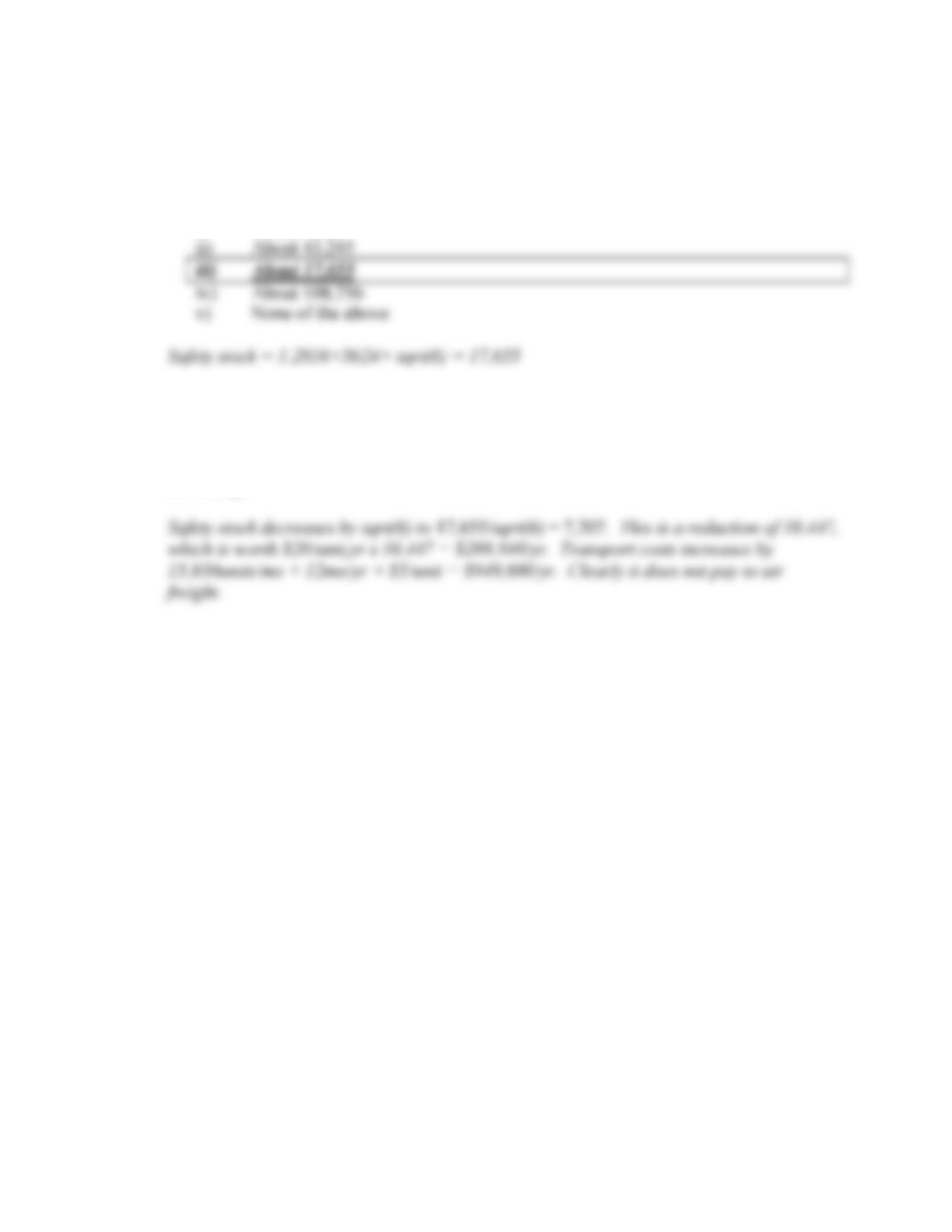
(b) If the delivery lead time from the Vancouver factory is 6 months, how much safety
stock of the AB printers should the European DC carry to provide a cycle service
level (frequency of no stock-out) of 90%?
i) About 7,207
(c) HP is considering sending the printers by airfreight instead of sending them by sea.
Airfreight will cost an extra $5 per printer but will reduce the delivery lead-time to 1
month. Identify the tradeoff that HP must consider when deciding whether to go with the
airfreight option. What would you recommend? Why? Quantify the costs and benefits of
the change.