Chapter 7: Inventories: Cost Measurement and Flow Assumptions
94. The list below provides several terms connected with inventory valuation. Following the list is a series of descriptive
statements.
a.
consignee
f.
gross price method
b.
consignor
g.
merchandise inventory
c.
finished goods inventory
h.
net price method
d.
FOB destination
i.
periodic inventory system
e.
FOB shipping point
j.
perpetual inventory system
____
1.
Goods acquired for resale.
____
2.
Goods manufactured for resale.
____
3.
Maintains an up-to–date cost of goods sold account balance.
____
4.
Establishes ending inventory by performing a physical count.
____
5.
Legal title to the inventory transfers to the buyer when the goods leave the seller’s
place of business.
____
6.
Legal title to the inventory passes to the buyer when the goods reach the buyer’s
place of business.
____
7.
The company that relinquishes possession to the goods so that they may be sold,
while retaining ownership of the goods until they are sold.
____
8.
The company that takes possession of the goods, but not legal title, in order to sell
them.
____
9.
Records the discount only if it is taken.
____
10.
Records the discount only if it is not taken.
Required:
Match the terms to their respective descriptive statements by placing the appropriate letter in the space provided.
1.
g
6.
2.
c
7.
3.
j
8.
4.
i
9.
5.
e
10.
95. On October 17, Conrad Beauty Supplies bought $42,000 of goods with terms of 1/10, n/30. One half of the bill was
paid on October 24, and the rest of the bill was paid on October 31.
Assume that the seller has agreed to grant discounts on partial payments.
Required:
Prepare journal entries for October 24 using the:
(1)
gross price method
(2)
net price method
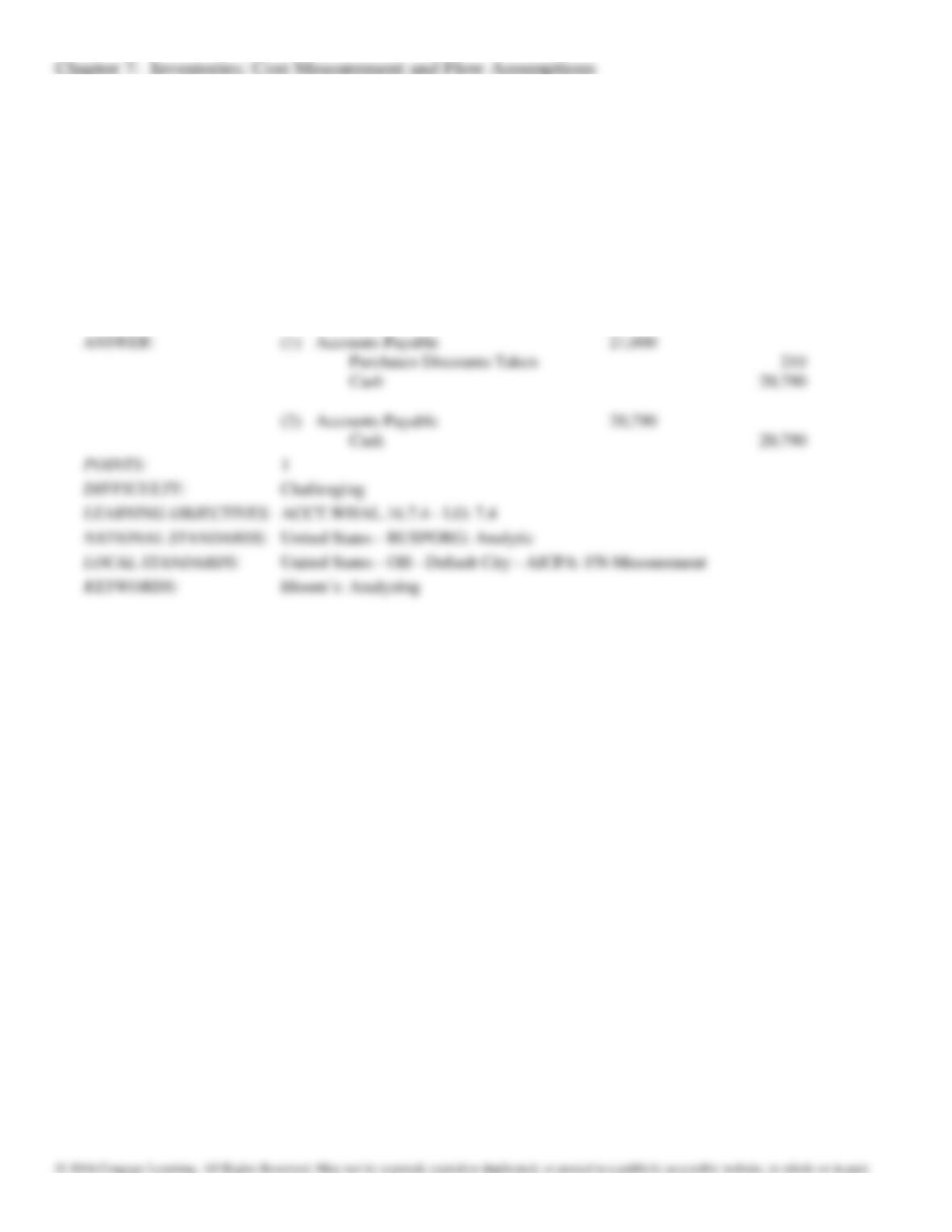
(1)
Accounts Payable
Purchases Discounts Taken
Cash
1
ACCT.WHAL.16.7.4 – LO: 7.4
United States – OH – Default City – AICPA: FN-Measurement
96. The following data has been provided by Lee Company regarding its inventory purchases and sales throughout the
year.
Transaction
Units
Cost per Unit
1-Jan
Balance
175
$86
14-Mar
Sale
55
23-May
Purchase
135
90
21-Aug
Sale
100
5-Nov
Purchase
175
91
18-Nov
Sale
100
30-Nov
Sale
100
5-Dec
Sale
100
10-Dec
Purchase
25
95
Required:
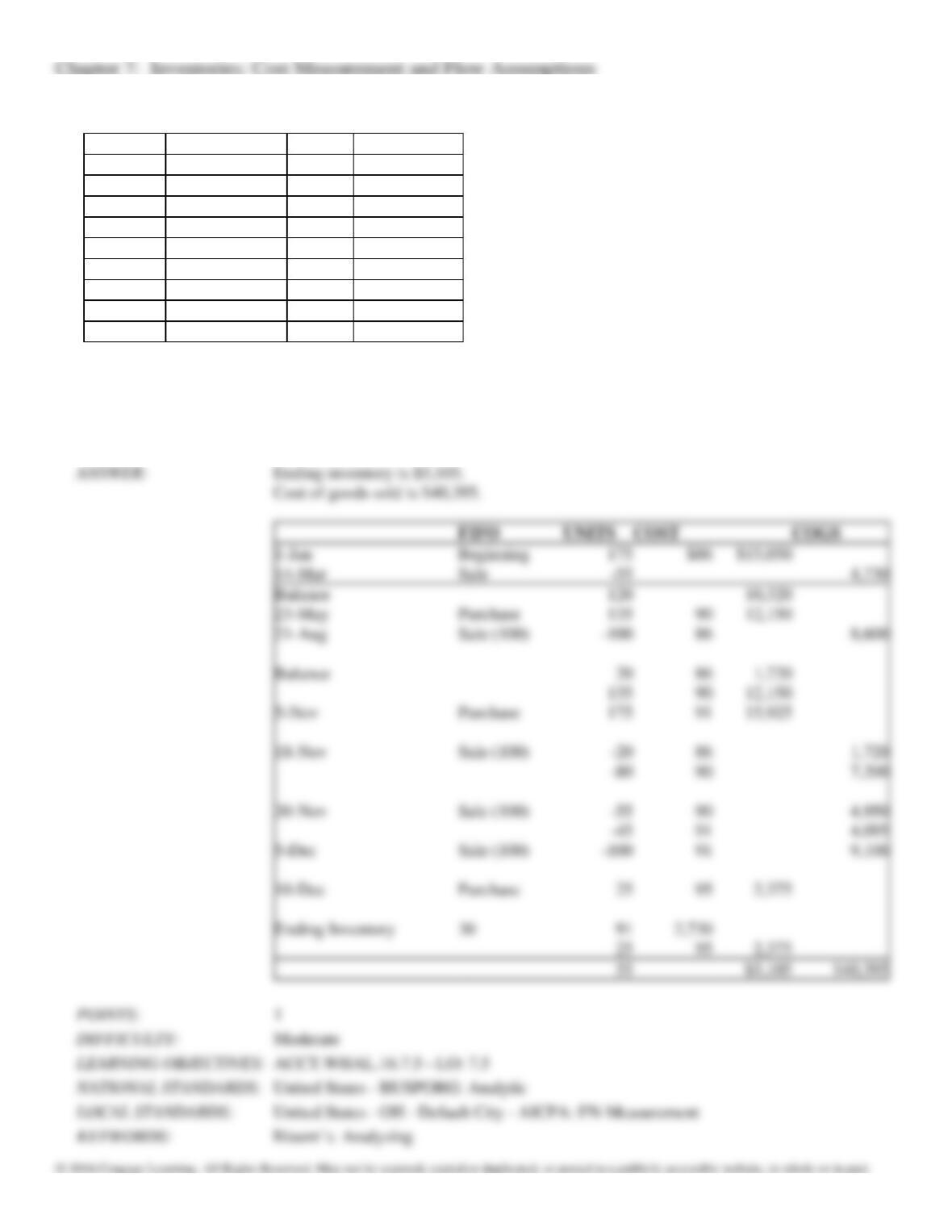
Compute the cost of goods sold and ending inventory using the perpetual inventory system for the FIFO cost flow
assumption.
FIFO
UNITS
COST
COGS
1-Jan
Beginning
14-Mar
Sale
Balance
23-May
Purchase
21-Aug
Sale (100)
Balance
5-Nov
Purchase
18-Nov
Sale (100)
30-Nov
Sale (100)
5-Dec
Sale (100)
10-Dec
Purchase
Ending Inventory
30
1
Moderate
ACCT.WHAL.16.7.5 – LO: 7.5
United States – OH – Default City – AICPA: FN-Measurement
97. The following data has been provided by Lee Company regarding its inventory purchases and sales throughout the
year.
Transaction
Units
Cost per Unit
1-Jan
Balance
175
$86
14-Mar
Sale
55
23-May
Purchase
135
90
21-Aug
Sale
100
5-Nov
Purchase
175
91
18-Nov
Sale
100
30-Nov
Sale
100
5-Dec
Sale
100
10-Dec
Purchase
25
95
Required:
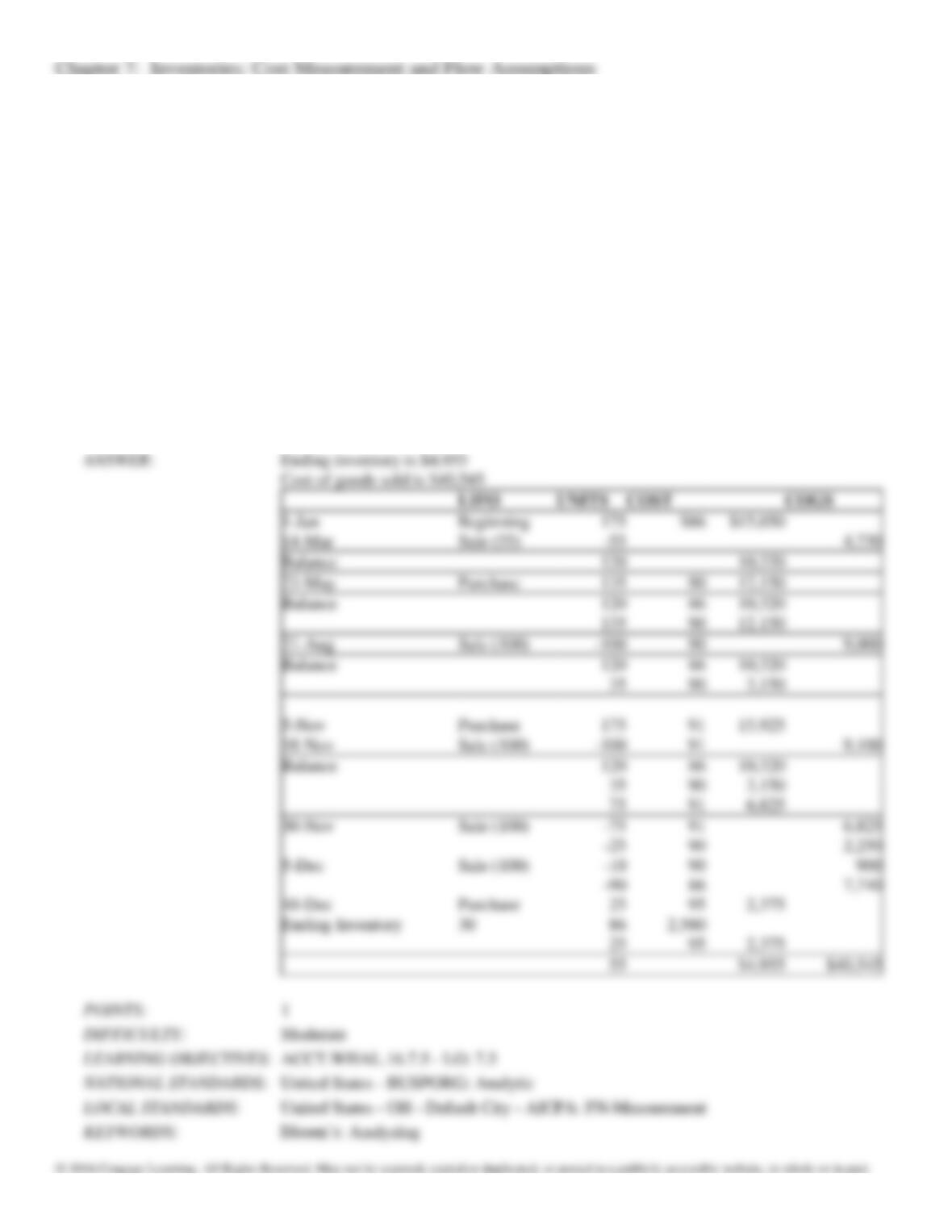
Compute the cost of goods sold and ending inventory using the perpetual inventory system for the LIFO cost flow
assumption.
1-Jan
Beginning
14-Mar
Sale (55)
Balance
23-May
Purchase
Balance
Balance
5-Nov
Purchase
18-Nov
Sale (100)
Balance
30-Nov
Sale (100)
5-Dec
Sale (100)
Ending Inventory
30
1
Moderate
ACCT.WHAL.16.7.5 – LO: 7.5
United States – OH – Default City – AICPA: FN-Measurement
98. Trooper Company has provided the following inventory data for the year:
Transaction
Units
Cost per Unit
1/1
Balance
50
$ 8
2/14
Sale
25
5/23
Purchase
100
10
8/21
Sale
50
11/5
Purchase
25
14
11/18
Sale
95
Required:
Compute the cost of goods sold and the ending inventory using the periodic inventory system for each of the
following cost flow assumptions:
a.
FIFO
b.
LIFO
c.
weighted average
b.
c.
*
99. On November 1, Lacy Company began business with the purchase of 250 units of inventory for $21,625. During the
month, Lacy had the following inventory transactions:
Date
November 6
Purchased 100 units @ $75 per unit
11
Sold 200 units
17
Sold 85 units
24
Purchased 100 units @ $125 per unit
28
Purchased 50 units @ $110 per unit
30
Sold 100 units
Required:
Compute the cost of the inventory at the end of November under the following alternatives:
a.
FIFO periodic
b.
FIFO perpetual
c.
LIFO periodic
d.
LIFO perpetual
e.
Weighted average (round unit costs to 2 decimal places)
f.
Moving average (round unit costs to 2 decimal places)
a.
b.
d.
e.
f.
100. The following information is available for Quest Company:
Mar. 1
Beginning inventory
15 units @ $12.00 per unit
Mar. 9
Purchase
10 units @ $16.00 per unit
Mar. 14
Sale
6 units
Mar. 20
Purchase
6 units@ $18.00 per unit
Mar. 26
Sale
9 units
Required:
Answer the following questions for Quest Company:
a.
If FIFO is in use, what is the ending inventory in dollars?
b.
If periodic LIFO is in use, what is the cost of goods sold?
c.
If moving average is in use, what is the ending inventory in dollars (round calculations to
the nearest cent)?
d.
If weighted average is in use, what is the ending inventory in dollars (round unit cost to the
nearest cent)?
b.
c.
Mar. 1
15
× $12.00
Mar. 9
10
× $16.00
25
× $13.60
Mar. 14
× $13.60
19
× $13.60
Mar. 20
6
× $18.00
25
× $14.66
Mar. 26
× $14.66
End. Inv.
16
× $14.66
16 units × $14.45 =$231.20
101. Given the following information for Goode Company:
May 1
Beginning inventory
18 units @ $4 per unit
May 7
Purchase
12 units @ $5 per unit
May 10
Sale
14 units
May 17
Purchase
10 units @ $6 per unit
May 19
Sale
4 units
Required:
Answer the following questions for Goode Company:
a.
If FIFO is in use, what is the total ending inventory in dollars?
b.
If perpetual LIFO is in use, what is the cost of goods sold for the month?
c.
If weighted average is in use, what is the ending inventory?
d.
If moving average is in use, what is the cost per unit sold for the May 10 sale?
b.
Purchases
Sales
Balance
May 1 18 @ $4
18 @ $4
7 12 @ $5
12 @ $5
2 @ $4 = 8
17 10 @ $6
16 @ $4
10 @ $6
sold = $92
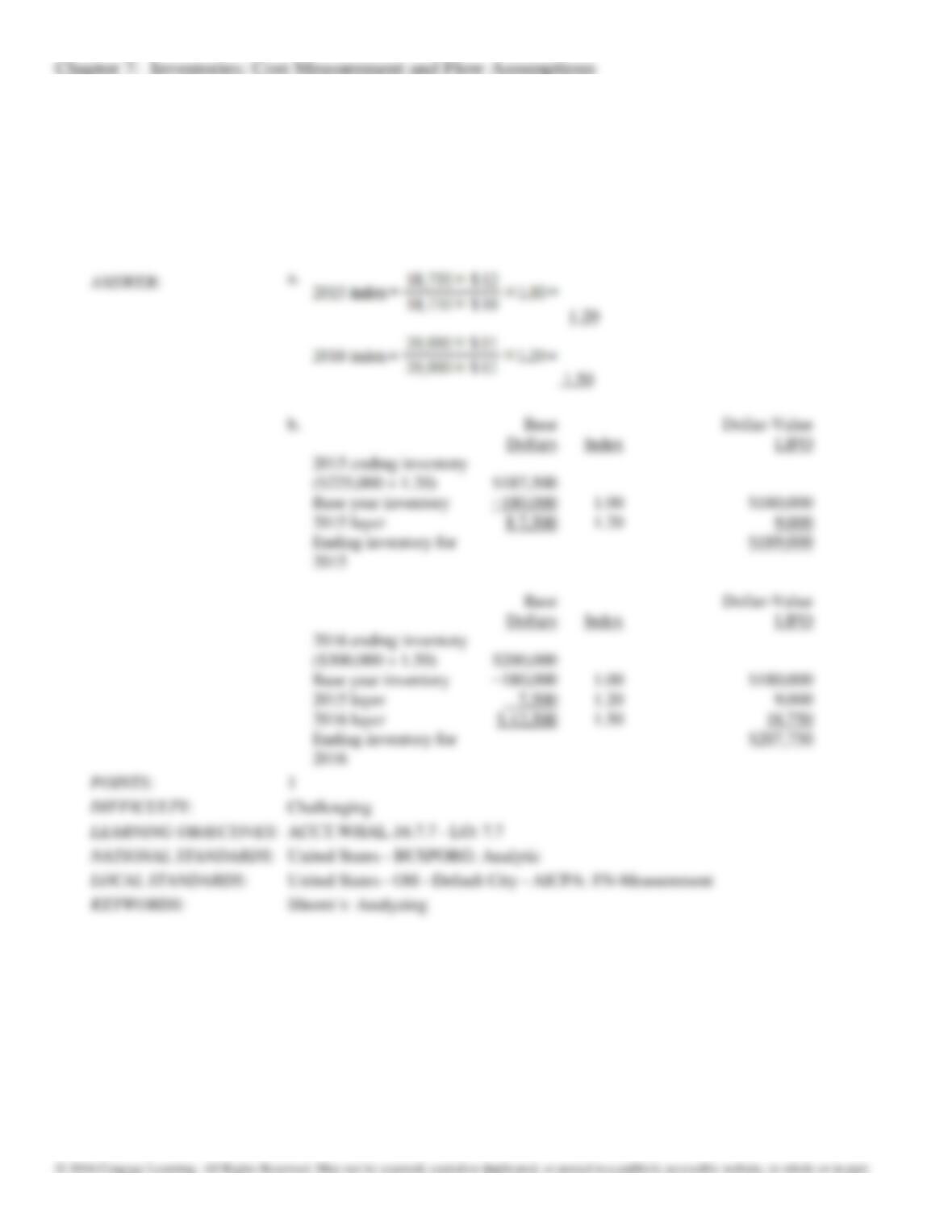
102. Silver Quick adopted LIFO in January 1, 2015, when the inventory had a FIFO cost of $180,000 ($10 per unit). At
the end of 2015, inventory consisted of 18,750 units at $12 per unit, and the ending inventory for 2016 consisted of
20,000 units at $15 per unit.
Required:
a.
Calculate the cost index to be used for 2015 and 2016 using the link-chain method.
b.
Compute the ending inventory for 2015 and 2016 using dollar-value LIFO.
b.
2015 ending inventory
($225,000 ÷ 1.20)
2015 layer
($300,000 ÷ 1.50)
2015 layer
2016 layer
Challenging
ACCT.WHAL.16.7.7 – LO: 7.7
United States – OH – Default City – AICPA: FN-Measurement
103. The information below is provided for Sea Company:
Ending Inventory
Price
Year
End-of-Year Prices
Index
2014
$ 90,000
100
2015
97,650
105
2016
103,550
109
2017
109,760
112
Required:
a.
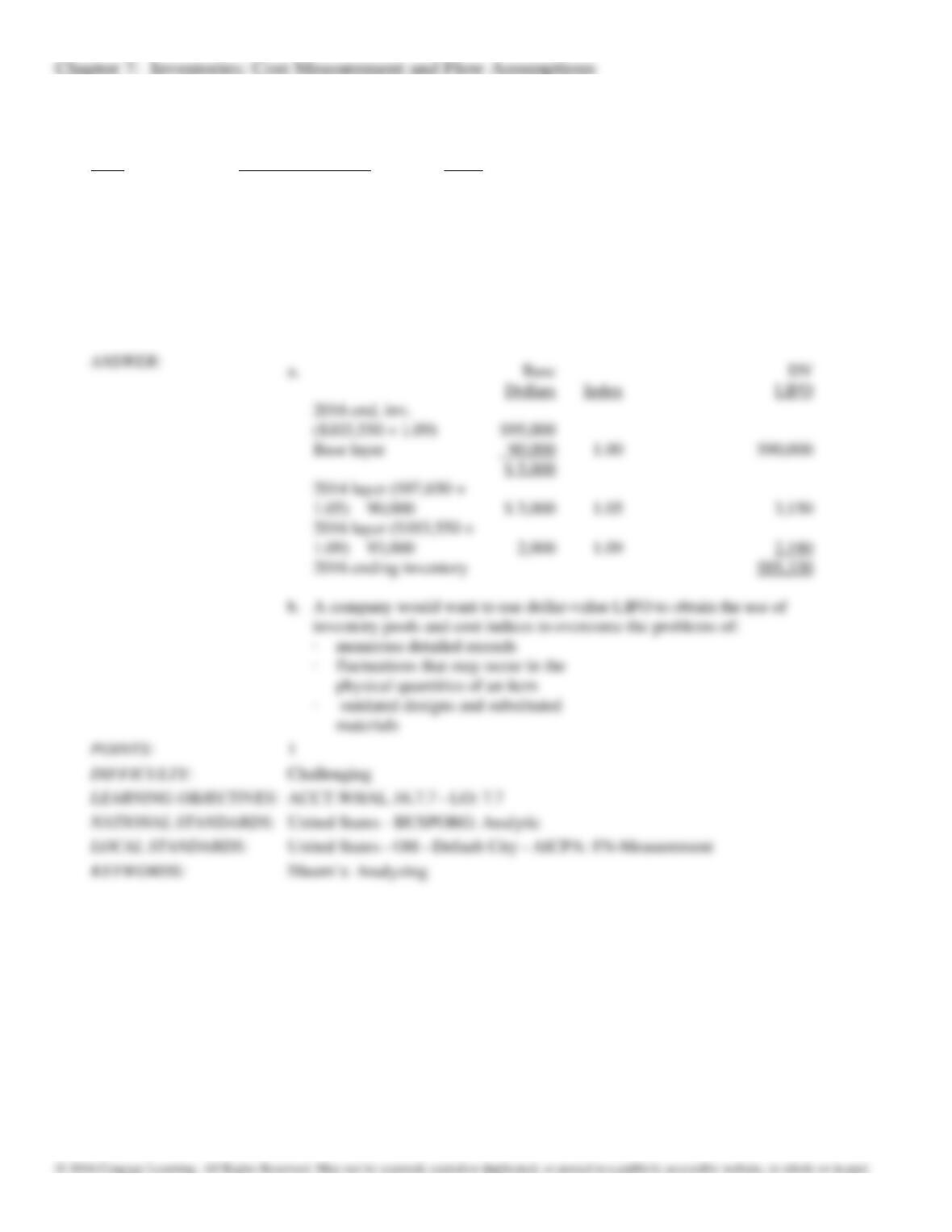
Compute Sea Company’s 2016 ending inventory using dollar-value LIFO.
b.
Explain why a company would want to use dollar-value LIFO.
Base layer
2016 ending inventory
inventory pools and cost indices to overcome the problems of:
numerous detailed records
physical quantities of an item
materials
1
Challenging
ACCT.WHAL.16.7.7 – LO: 7.7
United States – BUSPORG: Analytic
United States – OH – Default City – AICPA: FN-Measurement
104. The information below is provided for the only two inventory items held by Hammond, Inc.:
Base
Jan. 1, 2015
Dec. 31, 2015
No. of
Cost per
No. of
Cost per
Item
Units
Unit
Units
Unit
Tapes
300
$25.00
400
$30.00
Extenders
800
40.00
1,000
52.00
The company uses double-extension dollar-value LIFO with only one pool.
Required:
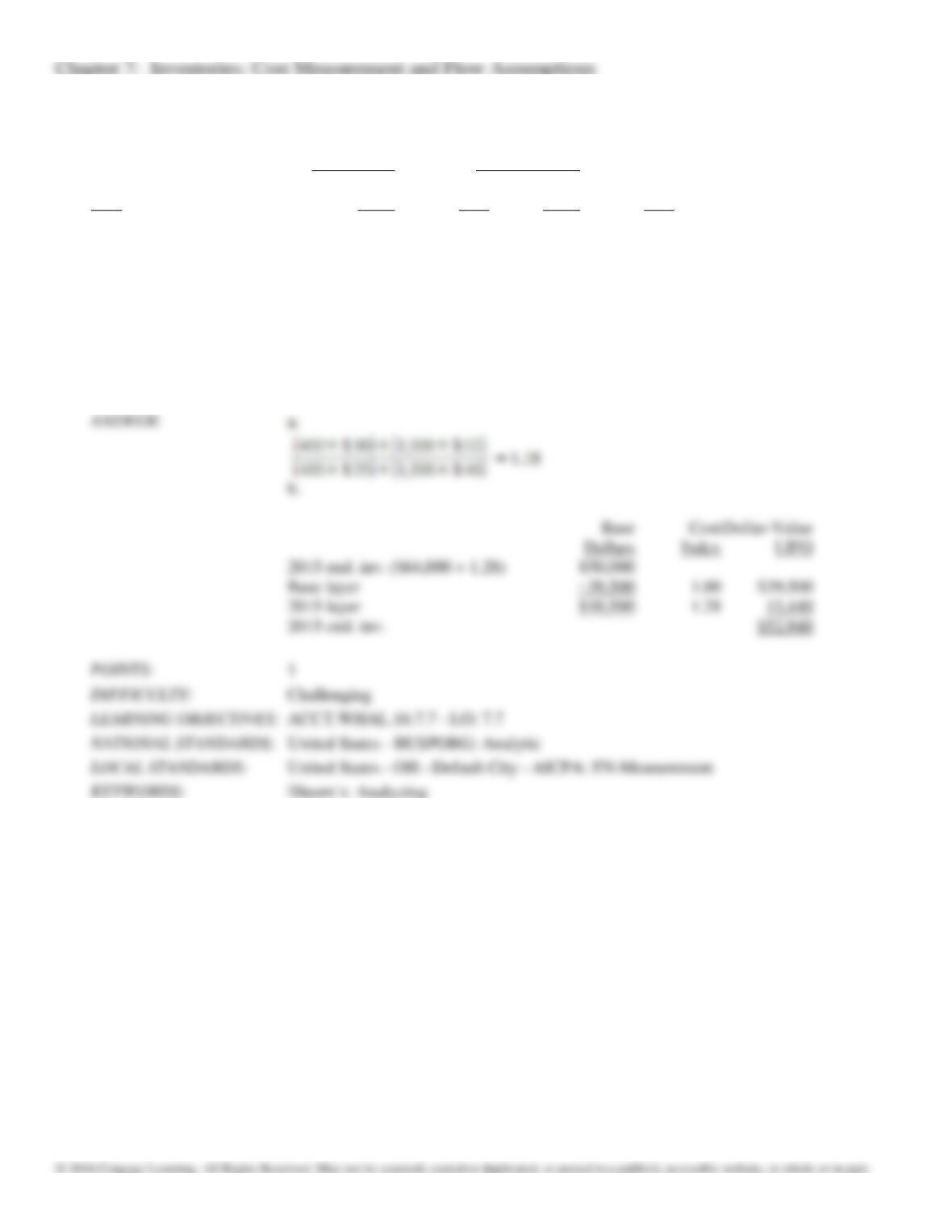
a. Calculate the cost index for 2015. Round to the nearest hundredth for decimals.
b. Calculate the December 31, 2015 ending inventory for Hammond using dollar-value LIFO. Round to the nearest
dollar.
Index
2015 end. inv. ($64,000 ÷ 1.28)
Base layer
1.00
$39,500
2015 layer
2015 end. inv.
$52,940
1
Challenging
ACCT.WHAL.16.7.7 – LO: 7.7
United States – BUSPORG: Analytic
United States – OH – Default City – AICPA: FN-Measurement