7-1
Chapter 07 Test Bank KEY
1. “Total compensation” includes
2. Fringe benefits currently account for approximately what percentage of total compensation?
3. As a percentage of benefits, the largest share goes to
4. The proportion of total compensation paid out as fringe benefits tends to be larger in
5. The share of fringe benefits in total employee compensation
6. Which one of the following is not a valid explanation for why workers may prefer an extra dollar’s
worth of fringe benefits to an extra dollar’s worth of cash?
7. Because there is a _______ marginal rate of substitution of fringe benefits for wages, a worker’s wage-
fringe indifference curves are typically _______.
8. The slope of a wage-fringe indifference curve reflects
9. An individual wage-fringe isoprofit line shows
10. The slope of a wage-fringe isoprofit curve reflects
11. The firm’s wage-fringe isoprofit curve typically has a slope less than 1 (absolute value) because
12. If a firm can offer fringe benefits worth more than one dollar for a one dollar reduction in wages,
13. The employer’s share of the Social Security and Medicare components of the payroll tax has
increased, from 6.13% in 1980 to its current rate of 7.65%. Because employers pay no payroll tax on
many fringe benefits, this change in tax rates has effectively
7-4
14. The trend of fringe benefits as a percentage of total compensation can be partially explained by the
fact that
15. Fringe benefits will tend to be a greater proportion of total compensation, the
16. Which of the following is not a cause of fringe benefit growth?
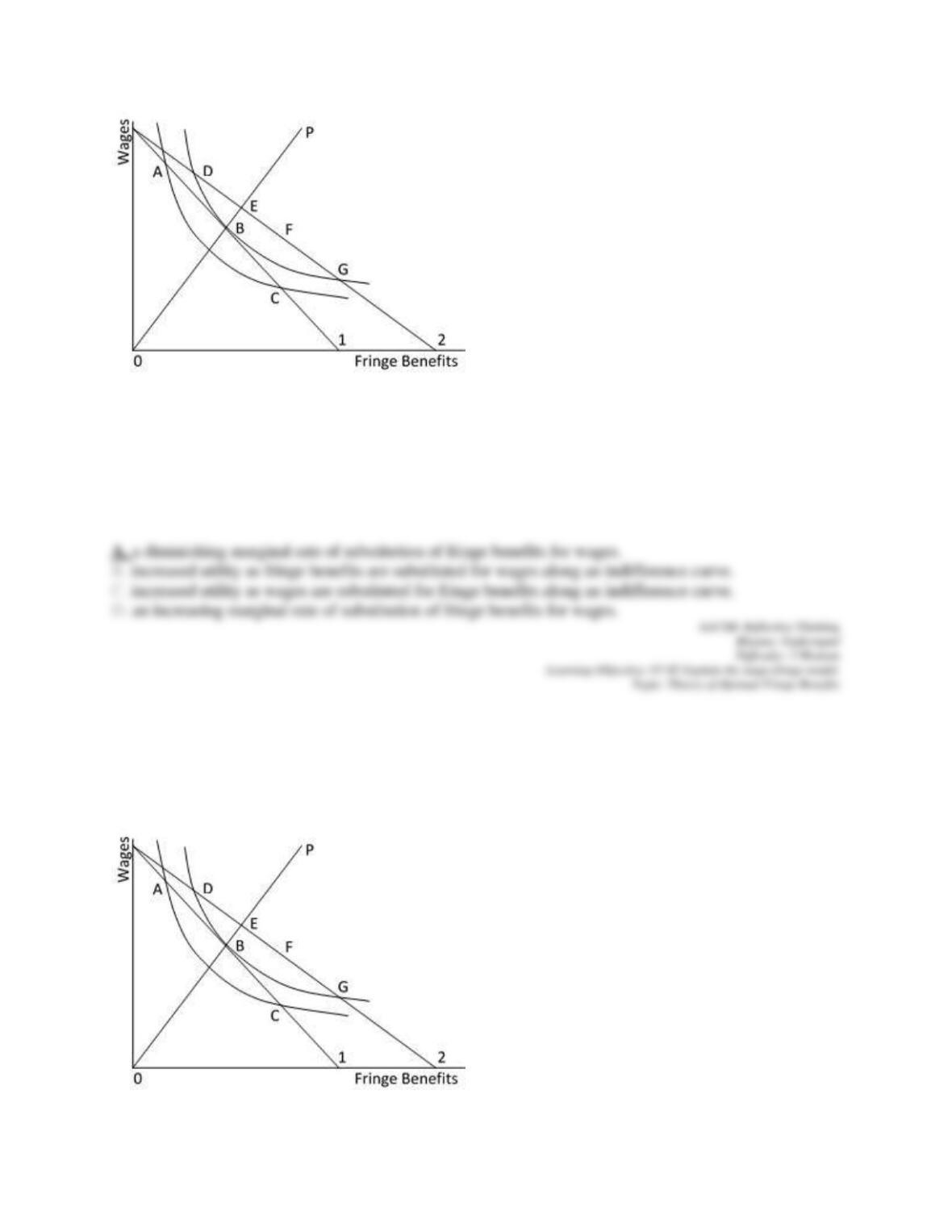
17. Refer to the diagram below. All points along the ray 0P reflect a constant proportion of wages to
fringe benefits.
7-5
The shape of the indifference curves reflects
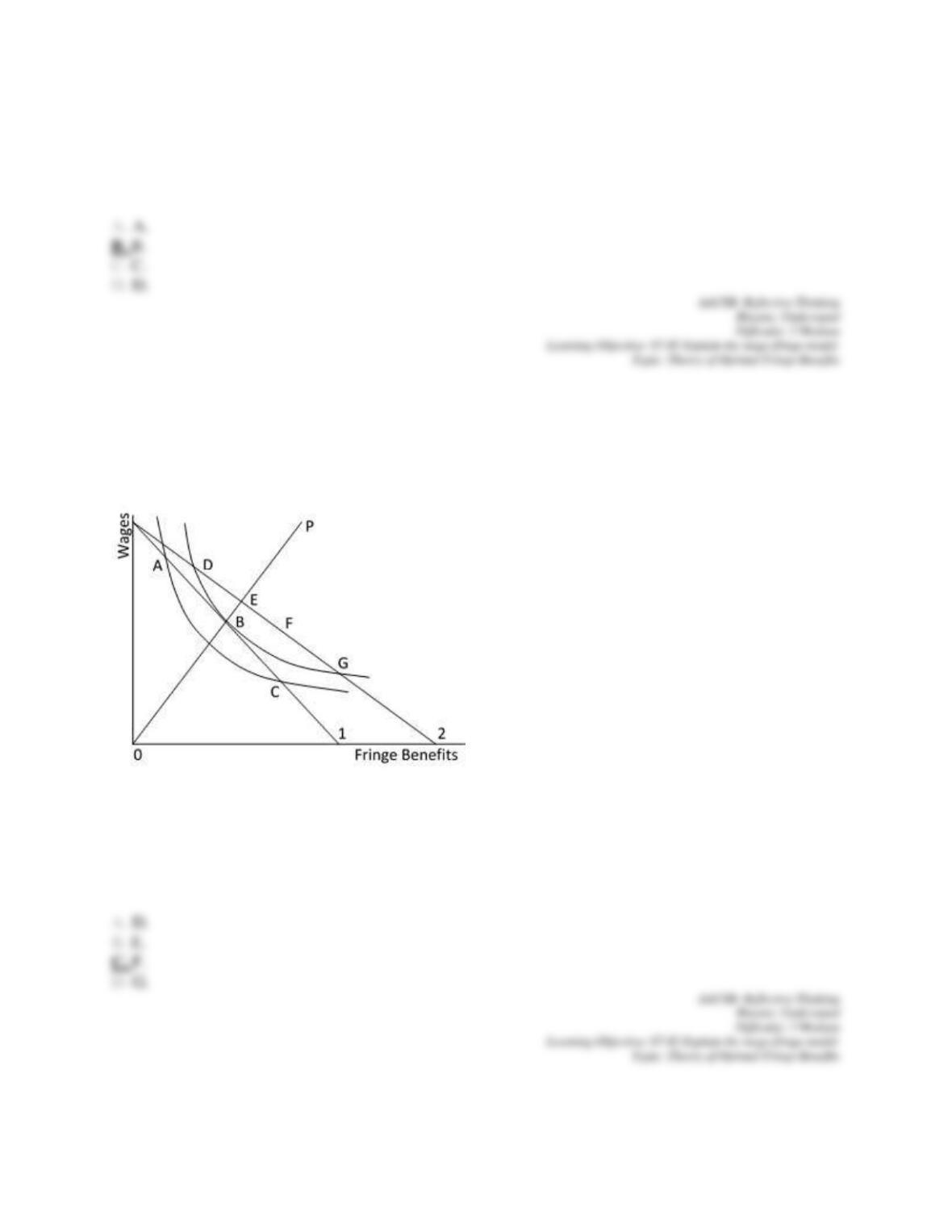
18. Refer to the diagram below. All points along the ray 0P reflect a constant proportion of wages to
fringe benefits.
7-6
Given isoprofit line 1, this worker’s wage-fringe optimum is given by point
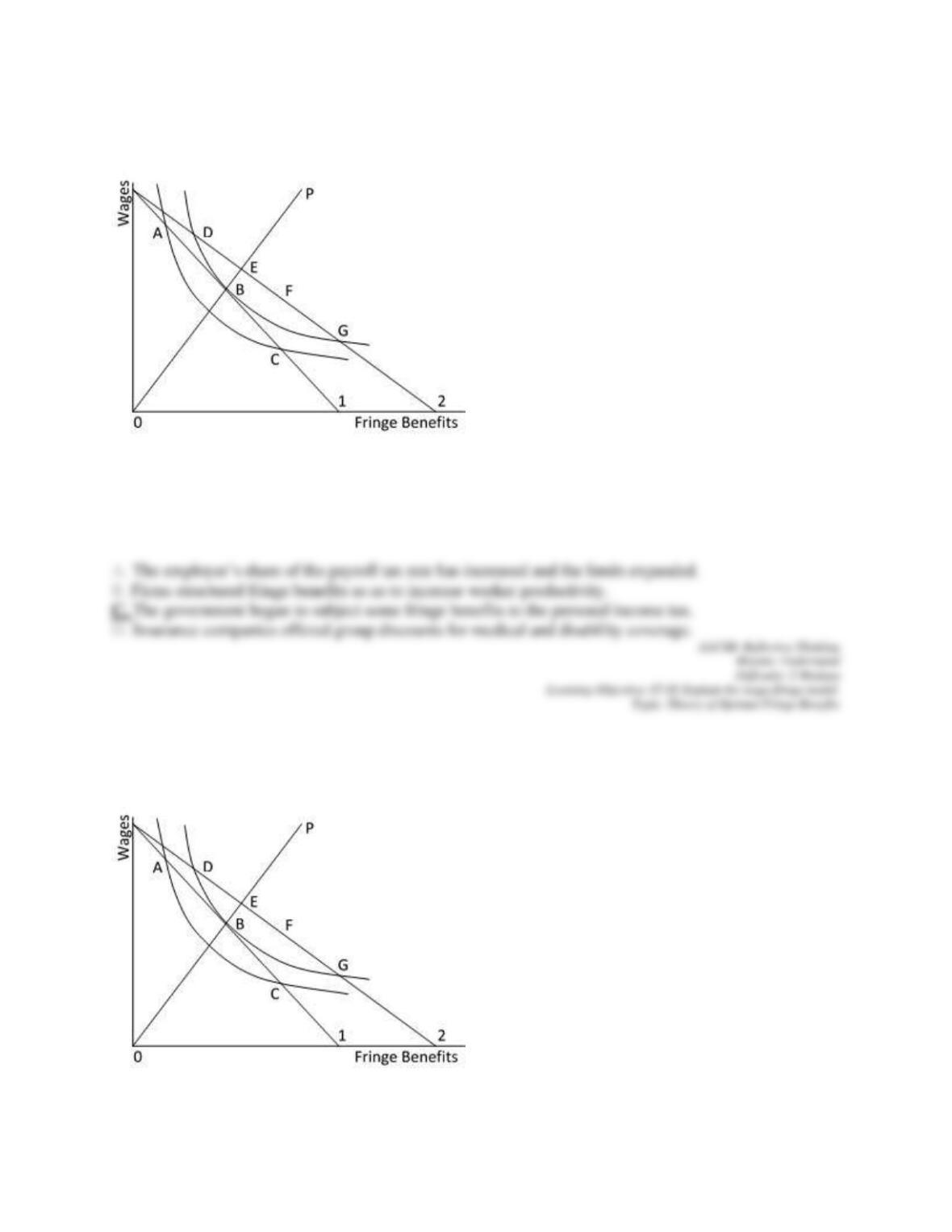
19. Refer to the diagram below. All points along the ray 0P reflect a constant proportion of wages to
fringe benefits.
Suppose some development rotates the isoprofit line outward, to line 2. If history is a guide, we would
expect this worker’s new wage-fringe optimum to be at point
7-7
20. Refer to the diagram below. All points along the ray 0P reflect a constant proportion of wages to
fringe benefits.
Which one of the following events could not have caused a shift from isoprofit line 1 to line 2?
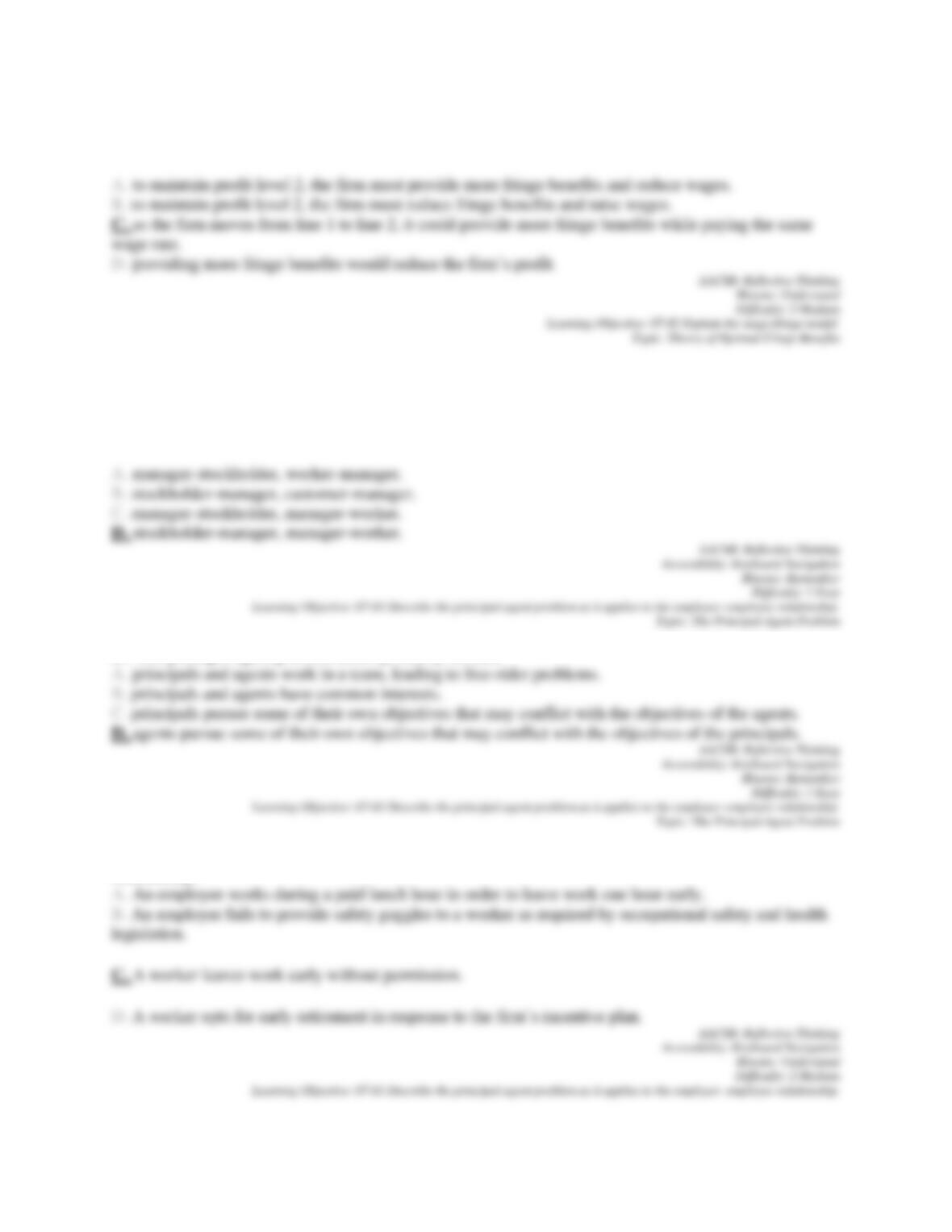
21. Refer to the diagram below. All points along the ray 0P reflect a constant proportion of wages to
fringe benefits.
7-8
If the isoprofit line shifts from line 1 to line 2, then
22. One view of the firm is that stockholders hire managers who, in turn, hire workers. Maximum profits
are earned by satisfying the customer. The two principal-agent relationships illustrated in this view are
23. The principal-agent problem arises primarily because
24. Which one of the following best represents the principal-agent problem in the employer-employee
relationship?
25. Compensation paid in proportion to the value of sales best describes
26. Which of the following best exemplifies a piece-rate compensation scheme?
27. Royalties would most likely be received by a(n)
28. For employers, the chief advantage of royalties and commissions is that these pay policies
29. Salaried workers can be considered “quasi-fixed resources” in that
30. Raises and promotions are used by employers as a device to
31. In a work environment in which teamwork is highly valued, pay is more likely to be received as
32. A simple income-leisure model might predict that salaried workers would work fewer hours than
hourly workers. In fact the opposite seems to be true, in part because
33. The effectiveness of profit-sharing plans may be diminished because
34. Team bonuses
7-11
35. In some instances, profit sharing may not be a very effective tool for raising worker productivity
because of the
36. The free-rider problem is most likely to arise in
37. A stock option will have value to a worker if
38. Tournament pay
7-12
Topic: Pay for Performance
39. Raises and promotions may be viewed as a form of
40. Compared to their counterparts in other developed countries, CEOs in the United States are paid
41. A firm might choose to pay its employees a wage higher than that which would clear the market
because
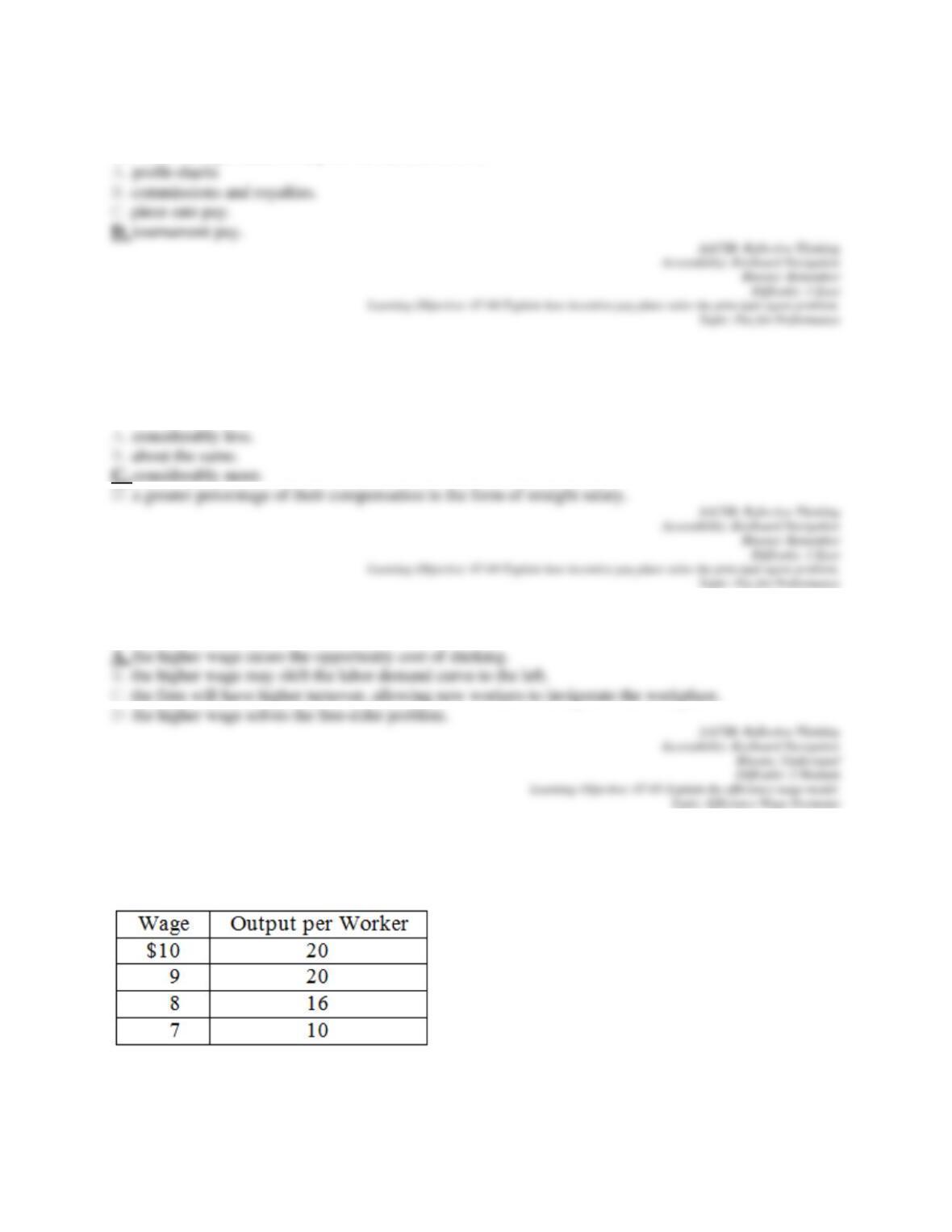
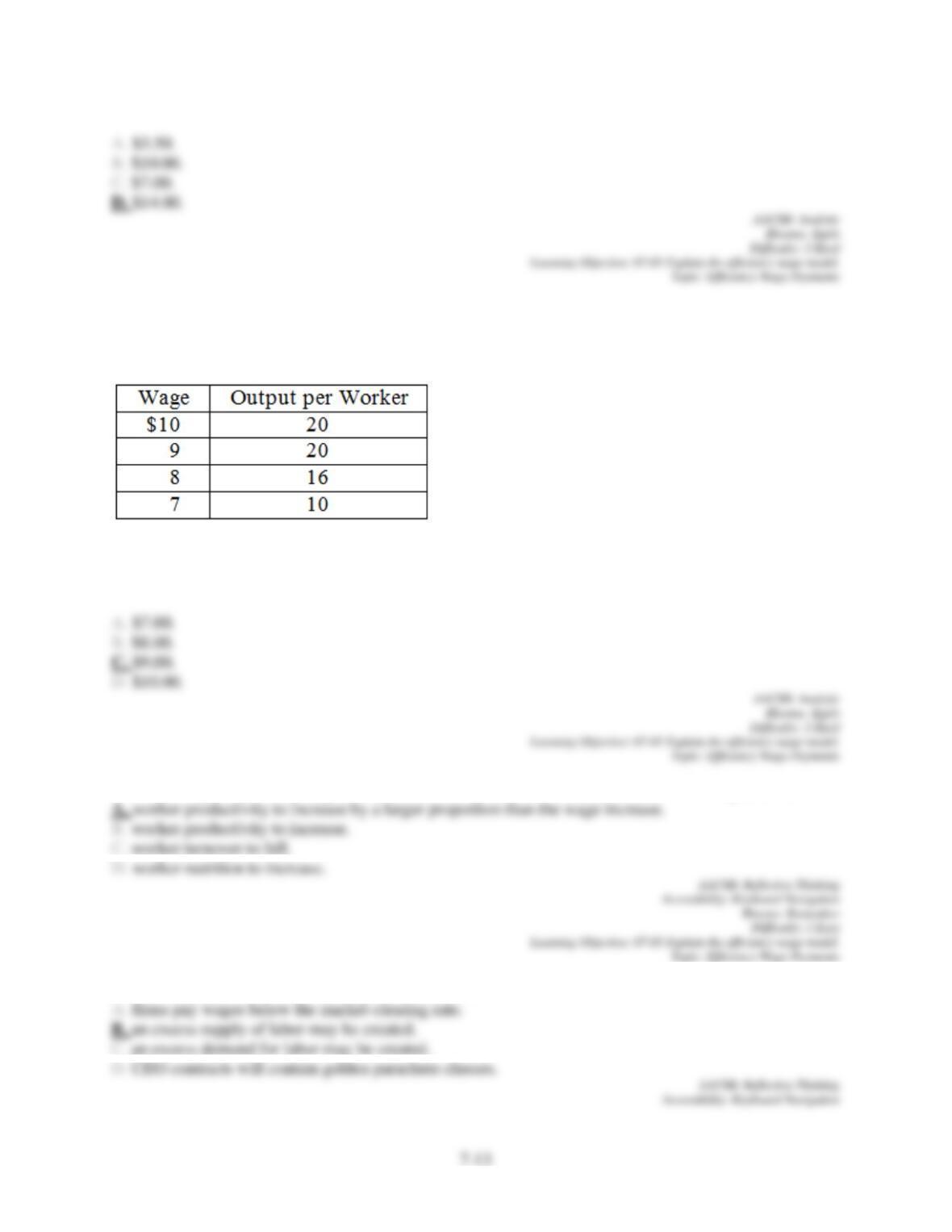
42. Suppose a “fully effective” worker can produce 20 units per hour in a particular firm. The firm’s
wage-productivity relationship is given by the table below.
If the actual wage is $7, the wage cost per effective unit of labor is
43. Suppose a “fully effective” worker can produce 20 units per hour in a particular firm. The firm’s
wage-productivity relationship is given by the table below.
This firm’s efficiency wage rate is
44. According to efficiency wage models, the firm’s profits will increase whenever the wage causes
45. One implication of efficiency wage models is that
46. Which one of the following is not typically offered as an explanation for efficiency wages?
47. Efficiency wage models are often criticized because
48. Labor market efficiency requires that each worker be allocated to
49. In 1914 Ford Motor Company doubled the wage it paid its employees, resulting in

7-15
Chapter 07 Test Bank Summary
Category
# of Questions
AACSB: Analytic
2
AACSB: Reflective Thinking
47
Accessibility: Keyboard Navigation
42
Blooms: Apply
2
Blooms: Remember
38
Blooms: Understand
9
Difficulty: 1 Easy
38
Difficulty: 2 Medium
9
Difficulty: 3 Hard
2
Learning Objective: 07-01 Describe the types and growth in fringe benefits.
5
Learning Objective: 07-02 Explain the wage-fringe model.
16
Learning Objective: 07-03 Describe the principal-
agent problem as it applies to the employer–employee relationship.
3
Learning Objective: 07-
04 Explain how incentive pay plans solve the principal-agent problem.
16
Learning Objective: 07-05 Explain the efficiency wage model.
9
Topic: Economics of Fringe Benefits
5
Topic: Efficiency Wage Payments
9
Topic: Pay for Performance
16
Topic: The Principal-Agent Problem
3
Topic: Theory of Optimal Fringe Benefits
16