Chapter 7: Inventories
167.
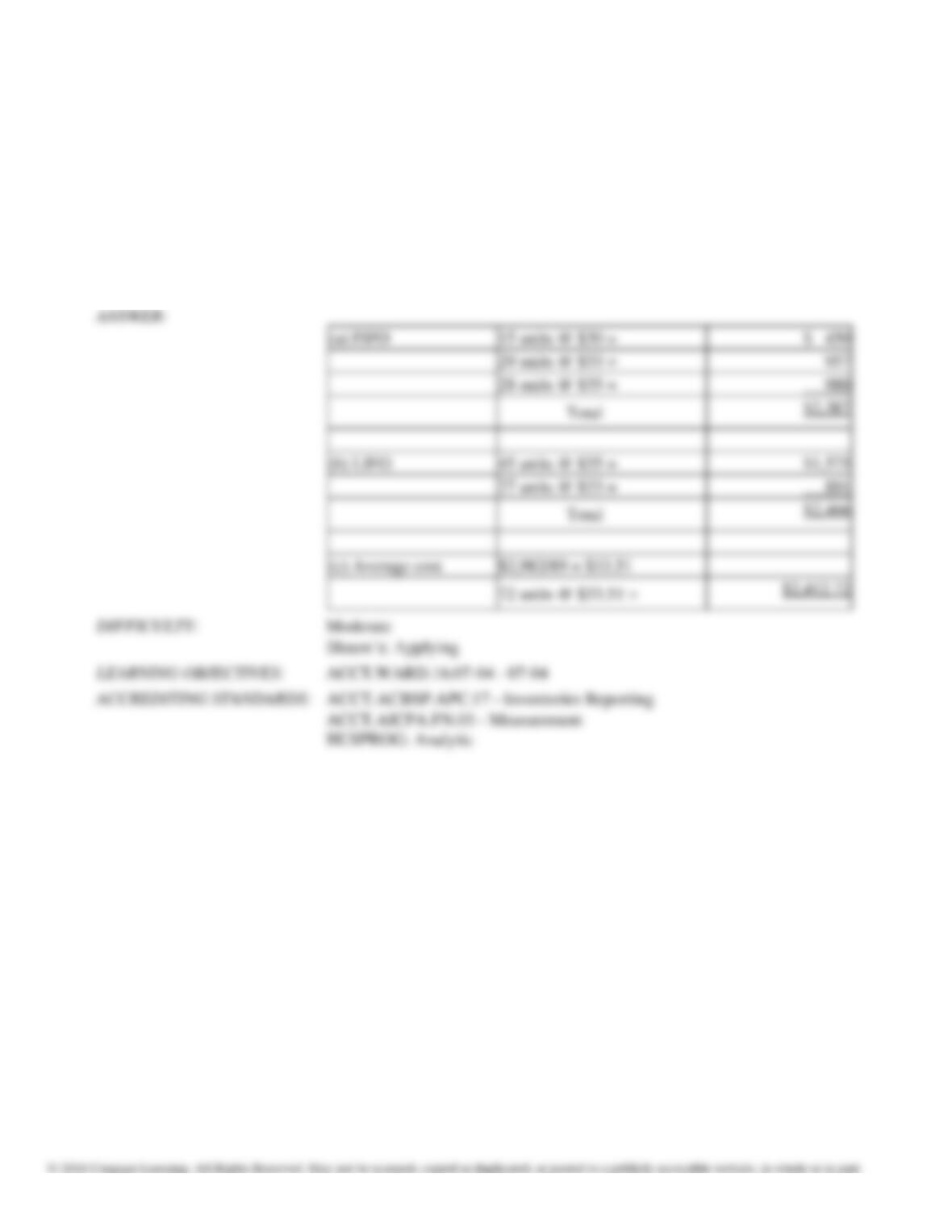
The units of Product Green-2 available for sale during the year were as follows:
April
1
Inventory
15 units
@
$30
June
16
Purchase
29 units
@
$33
Sep.
28
Purchase
45 units
@
$35
There are 17 units of the product in the physical inventory at September 30. The periodic inventory system
is
used. Determine the cost of merchandise sold by (a) FIFO, (b) LIFO, and (c) average cost methods.
Chapter 7: Inventories
168.
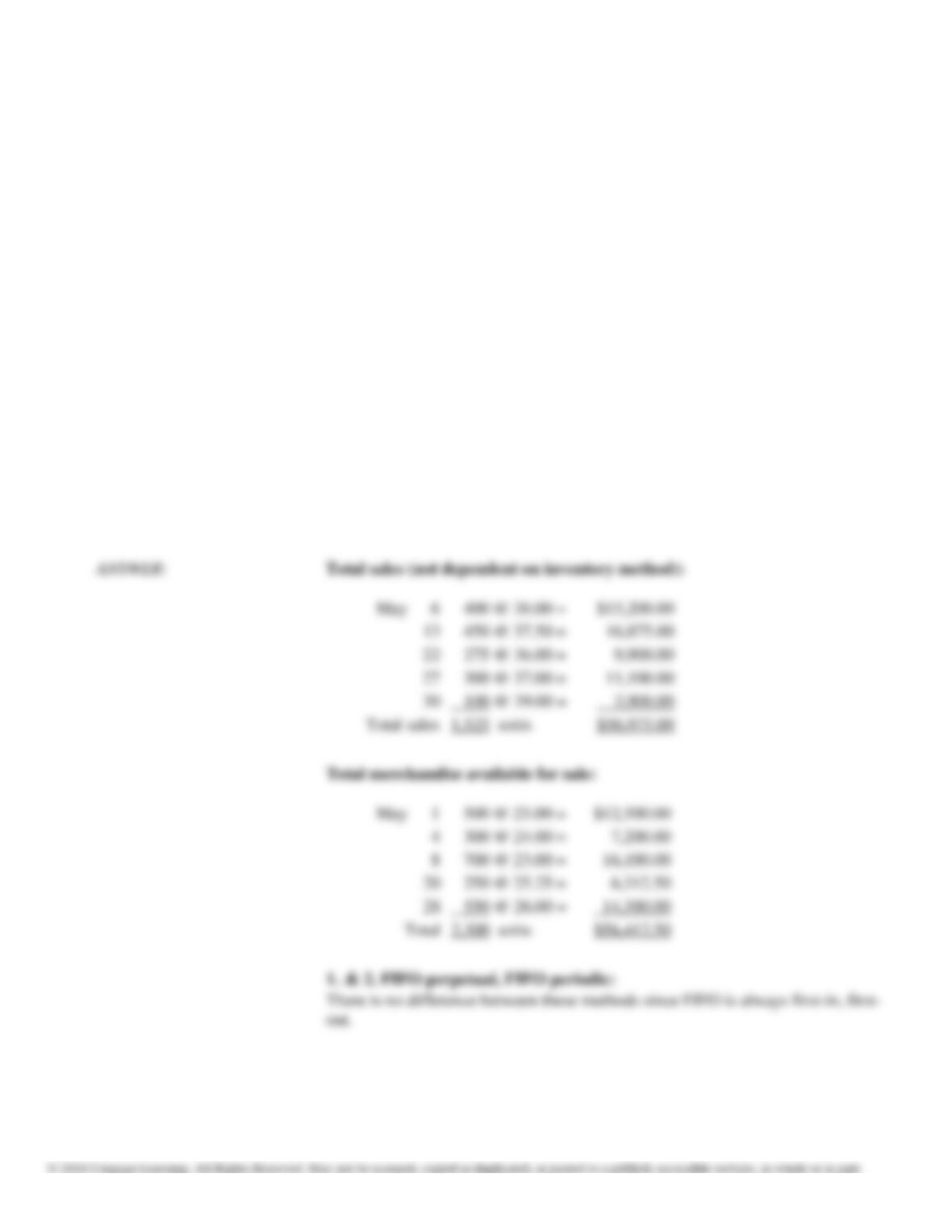
Brutus Corporation, a newly formed corporation, has the following transactions during May, its first month
of
operations.
May 1 Purchased 500 units @ $25.00 each
4 Purchased 300 units @ $24.00 each
6 Sold 400 units @ $38.00 each
8 Purchased 700 units @ $23.00 each
13 Sold 450 units @ $37.50 each
20 Purchased 250 units @ $25.25 each
22 Sold 275 units @ $36.00 each
27
Sold 300 units @ $37.00 each
28
Purchased 550 units @ $26.00 each
30 Sold 100 units @ $39.00 each
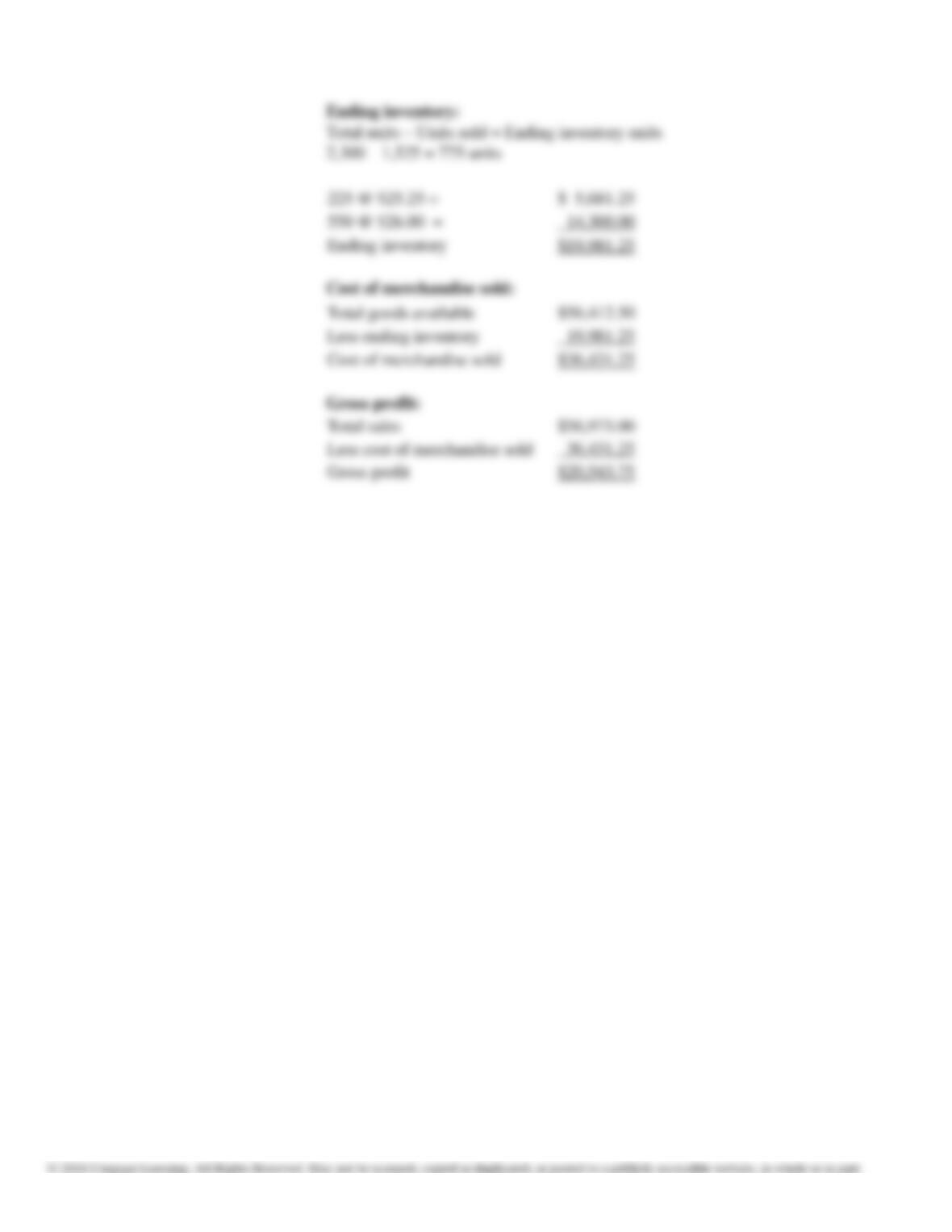
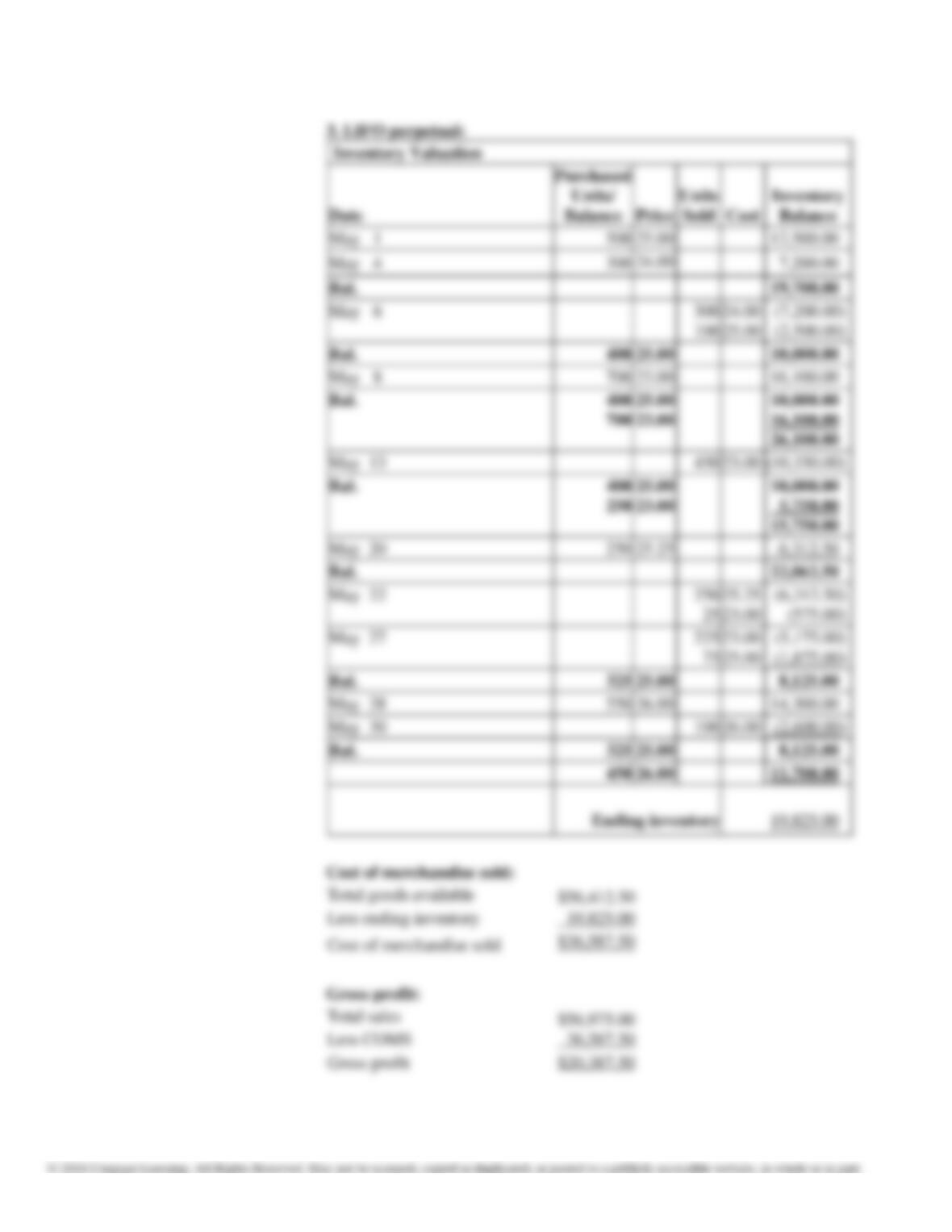
Calculate total sales, cost of merchandise sold, gross profit, and ending inventory using each of the
following
inventory methods:
1.
FIFO perpetual
2.
FIFO periodic
3.
LIFO perpetual
4.
LIFO periodic
5.
Average cost periodic (round average to nearest cent)
Chapter 7: Inventories
Chapter 7: Inventories
Chapter 7: Inventories
169.
Basic inventory data for April 30 are presented below for a business that employs the lower–of-cost-or-market
basis of inventory valuation to each category.
Commodity
Inventory
Quantity
Cost per
Unit
Market Value
per Unit
Cost
Total
Market
LCM
A
35
$ 52
$ 55
_______
_______
_______
B
20
155
150
_______
_______
_______
C
25
82
85
_______
_______
_______
D
40
58
55
_______
_______
_______
(a)
Complete the table.
(b)
Determine the amount of reduction in the inventory at April 30 attributable to
market
decline.
Commodity
Chapter 7: Inventories
170.
Hampton Co. took a physical count of its inventory on December 31. In addition, it had to decide whether or
not
the following items should be added to this count.
(a)
Merchandise on hand had been sold earlier in the year but had been returned by customers
for various warranty repairs.
(b)
Hampton Co. sent merchandise on a consignment basis on December 31 just prior to
the
physical count.
(c)
On December 22, Hampton Co. ordered merchandise on FOB destination terms. The
merchandise was shipped by the supplier on December 30 but had not been received by
December 31.
(d)
On December 27, Hampton Co. ordered merchandise on FOB shipping point terms. The
merchandise was shipped on December 29 but had not been received by December 31.
(e)
Merchandise sold FOB shipping point on December 31 was picked up by the
freight
company just before closing on December 31.
(f)
Merchandise shipped to a customer FOB destination was picked up by the freight
company
on December 28 but had not arrived at its destination as of December 31.
Answer “yes” or “no” to indicate which items should and should not be added to the December 31 inventory count.
Chapter 7: Inventories
171.
1. Explain the effect of the following on the financial statements:
Goods held on consignment were included in the ending inventory count.
Goods purchased FOB shipping point were in transit on the last day of the year.
The goods were not counted as part of ending inventory.
Goods sold FOB shipping point were in transit on the last day of the year.
These goods were not counted as part of ending inventory.
2. What happens if inventory errors are not found and corrected?
Chapter 7: Inventories
172.
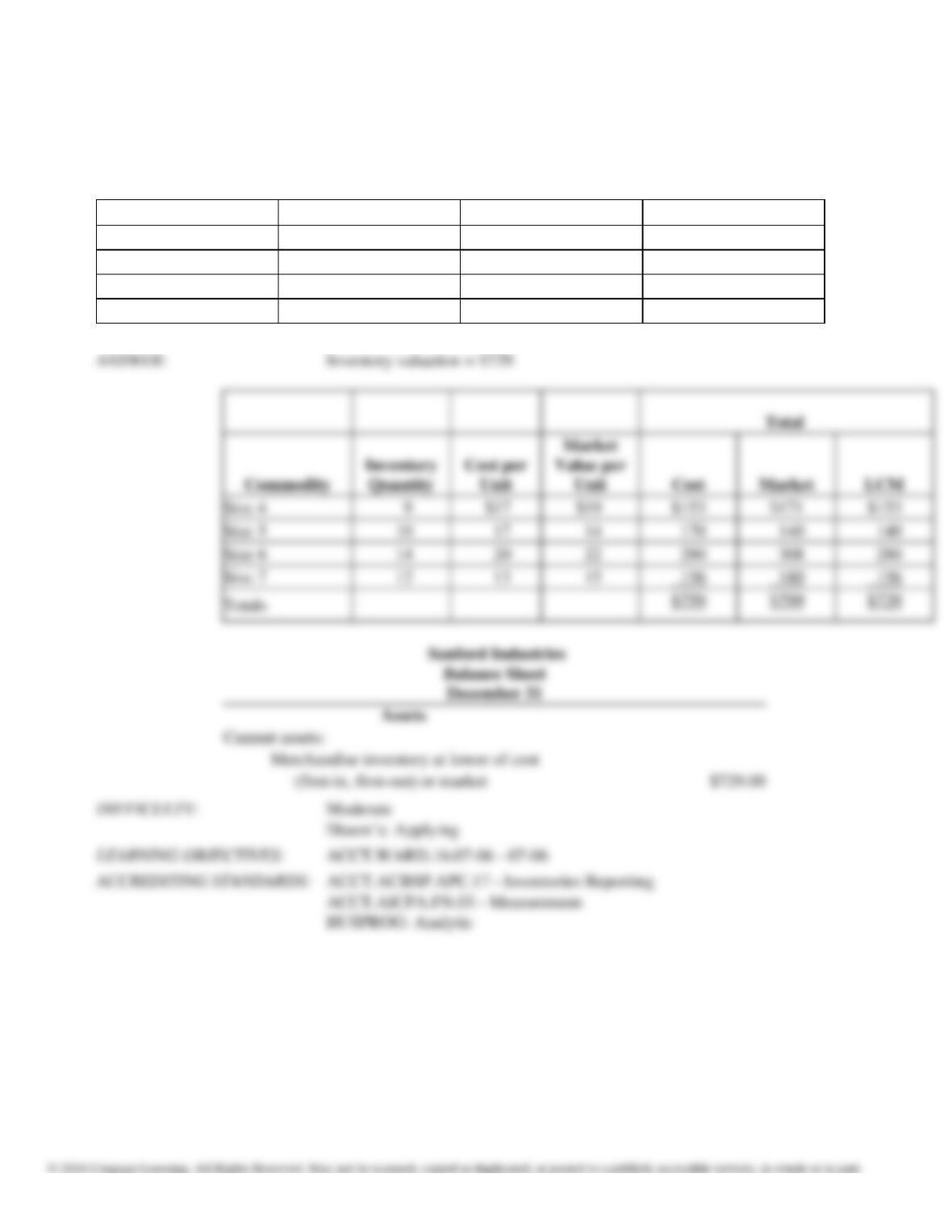
On the basis of the following data for Sanford Industries as of December 31, determine the value of the inventory
at
the lower of cost or market. Also, show how the merchandise inventory would appear on the balance sheet
(assume that the cost was determined by the FIFO method). Apply lower of cost or market to each inventory
item.
Commodity
Inventory Quantity
Cost per Unit
Market Value per Unit
Size 4
9
$17
$19
Size 5
10
17
14
Size 6
14
20
22
Size 7
12
13
15
Chapter 7: Inventories
173.
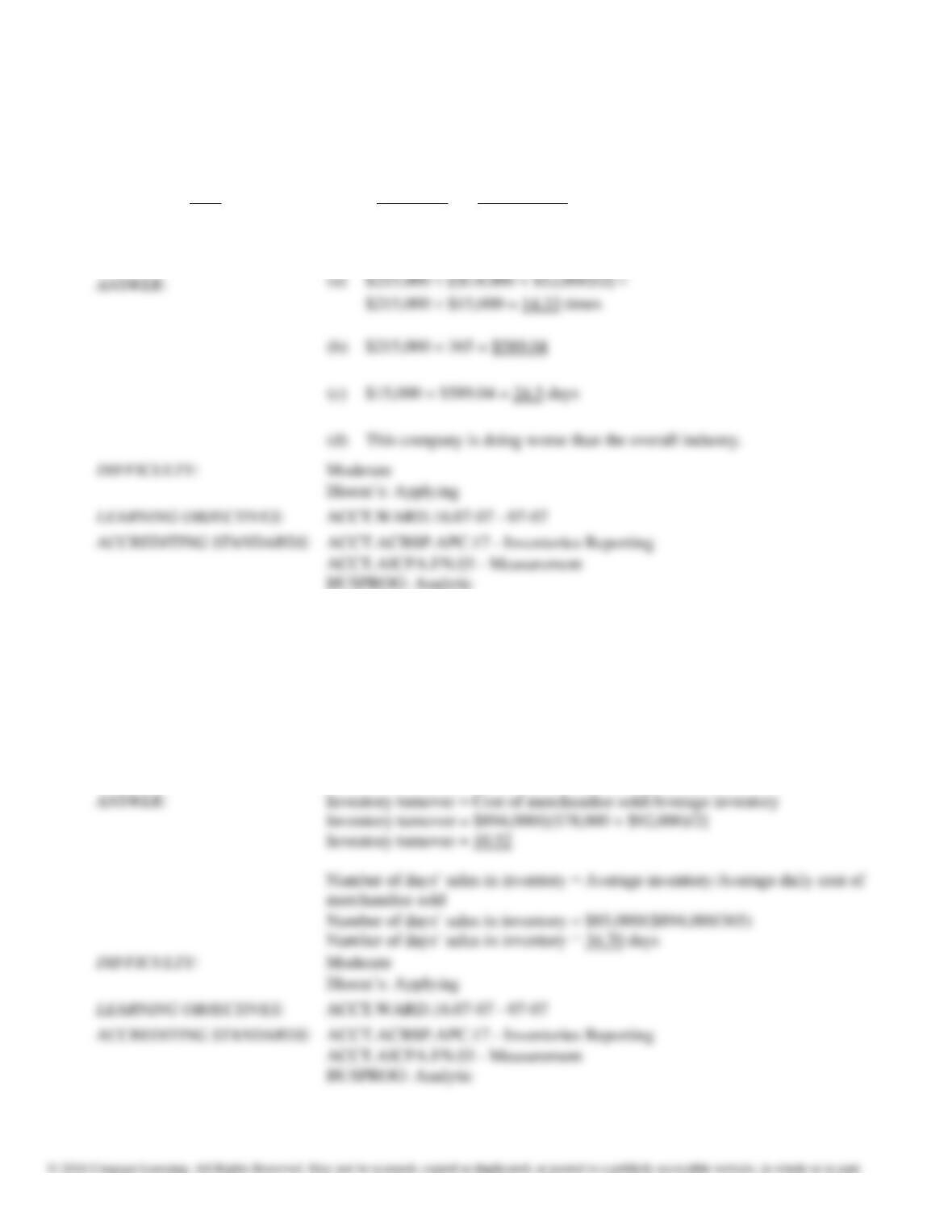
Based on the following information: compute (a) inventory turnover; (b) average daily cost of merchandise sold;
and (c) number of days’ sales in inventory for the current year. Use a 365-day year. (d) If an inventory turnover
of
12 is average for the industry, how is this company doing?
Item
Cost of merchandise sold
Prior Year Current Year
$172,900 $215,000
Inventory
18,000 12,000
174.
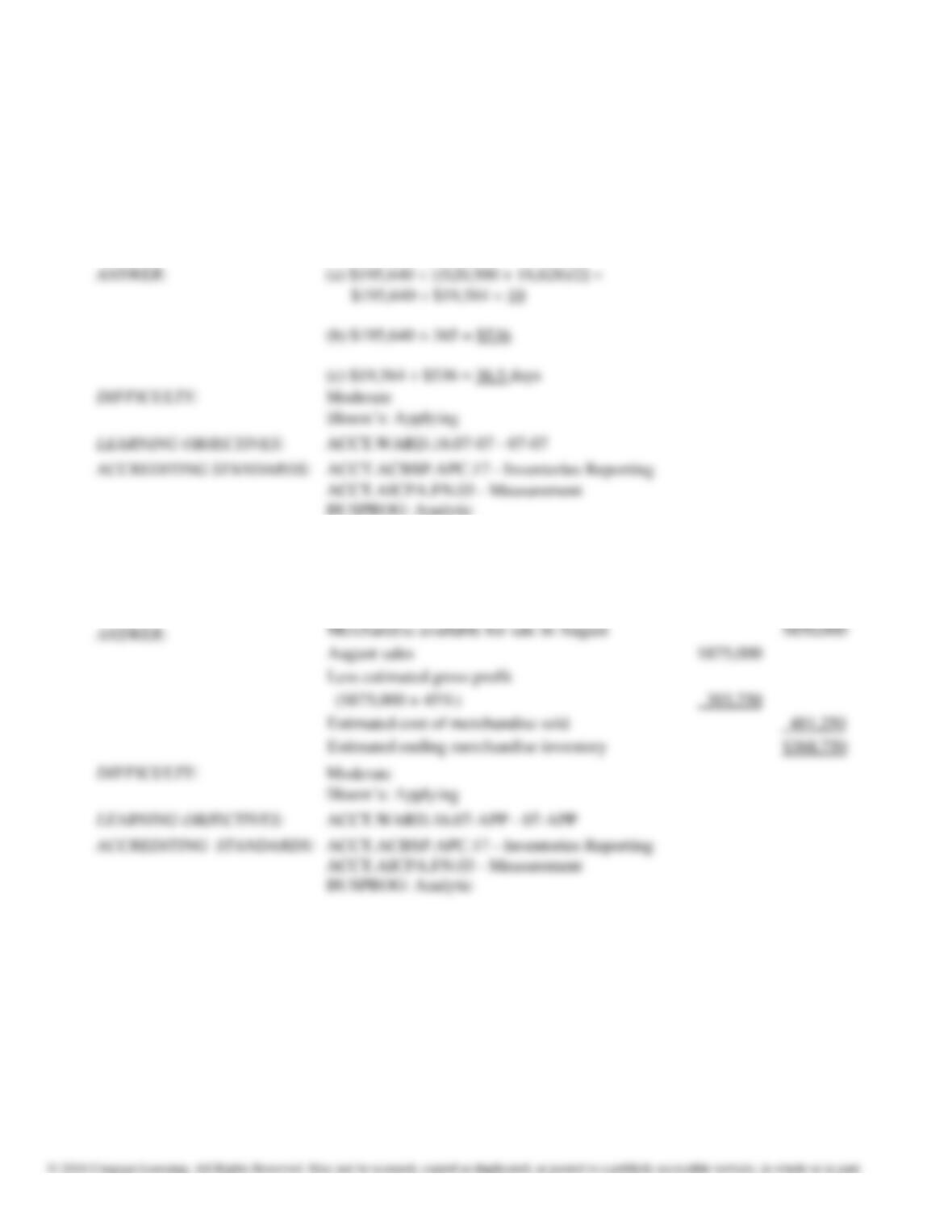
The following data were taken from Castle, Inc.
Cost of merchandise sold $894,000
Inventory, end of year 78,000
Inventory, beginning of the year 92,000
Determine the inventory turnover ratio and the number of days’ sales in inventory for Castle Inc. Round to two
decimal places.
Chapter 7: Inventories
175.
Based on the following information, compute (a) inventory turnover; (b) average daily cost of merchandise sold
using a 365 day year; and (c) number of days’ sales in inventory.
Cost of merchandise sold
$195,640
Inventory:
Beginning
20,500
Ending
18,628
176.
During August, the first month of the fiscal year, sales totaled $875,000 and the cost of merchandise available
for
sale totaled $850,000. Estimate the cost of the merchandise inventory as of August 31, based on an
estimated
gross profit rate of 45%.
Chapter 7: Inventories
177.
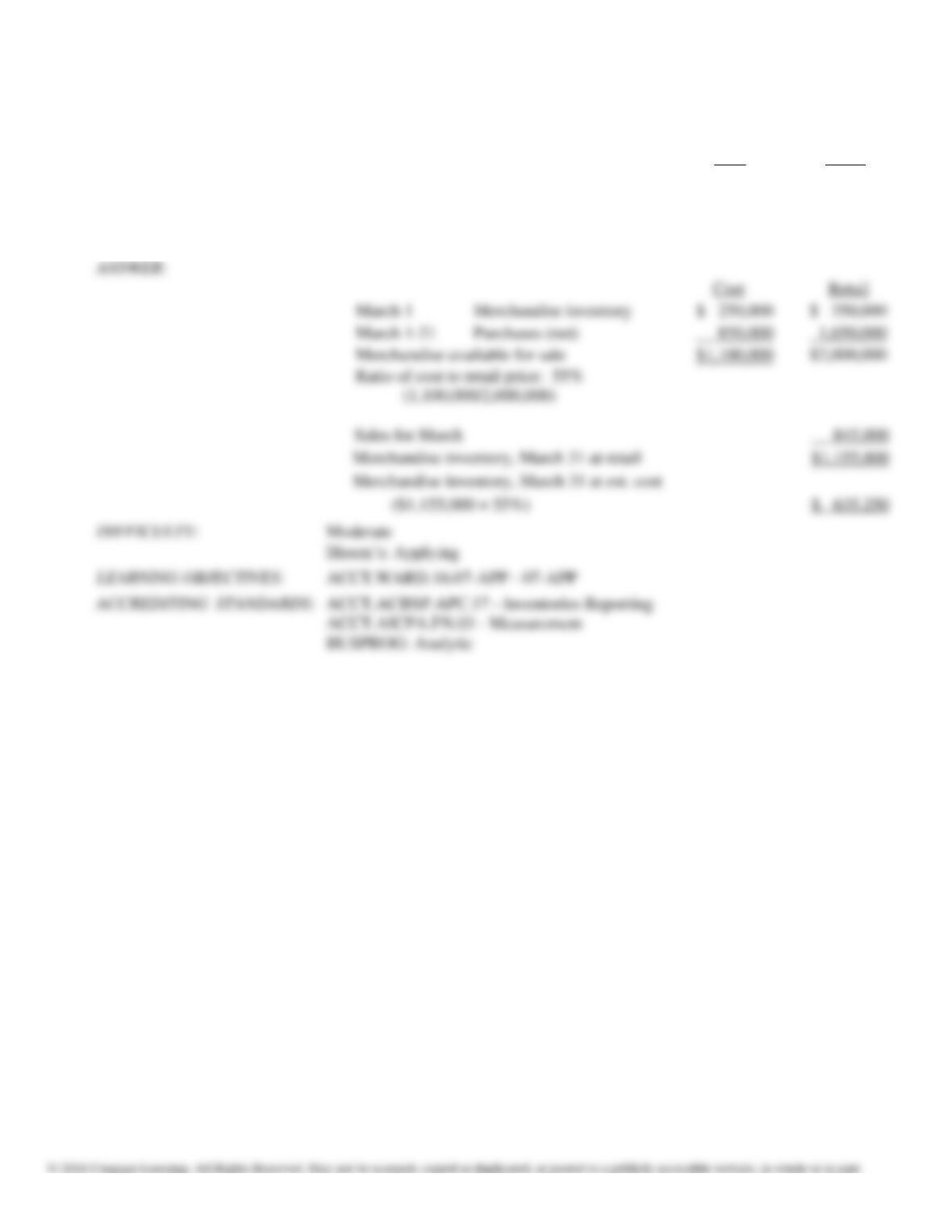
On the basis of the following data, estimate the cost of the merchandise inventory at March 31 by the retail method.
Cost
Retail
March 1
Merchandise inventory
$250,000
$ 350,000
March 1–31
Purchases (net)
850,000
1,650,000
March 1–31
Sales
845,000
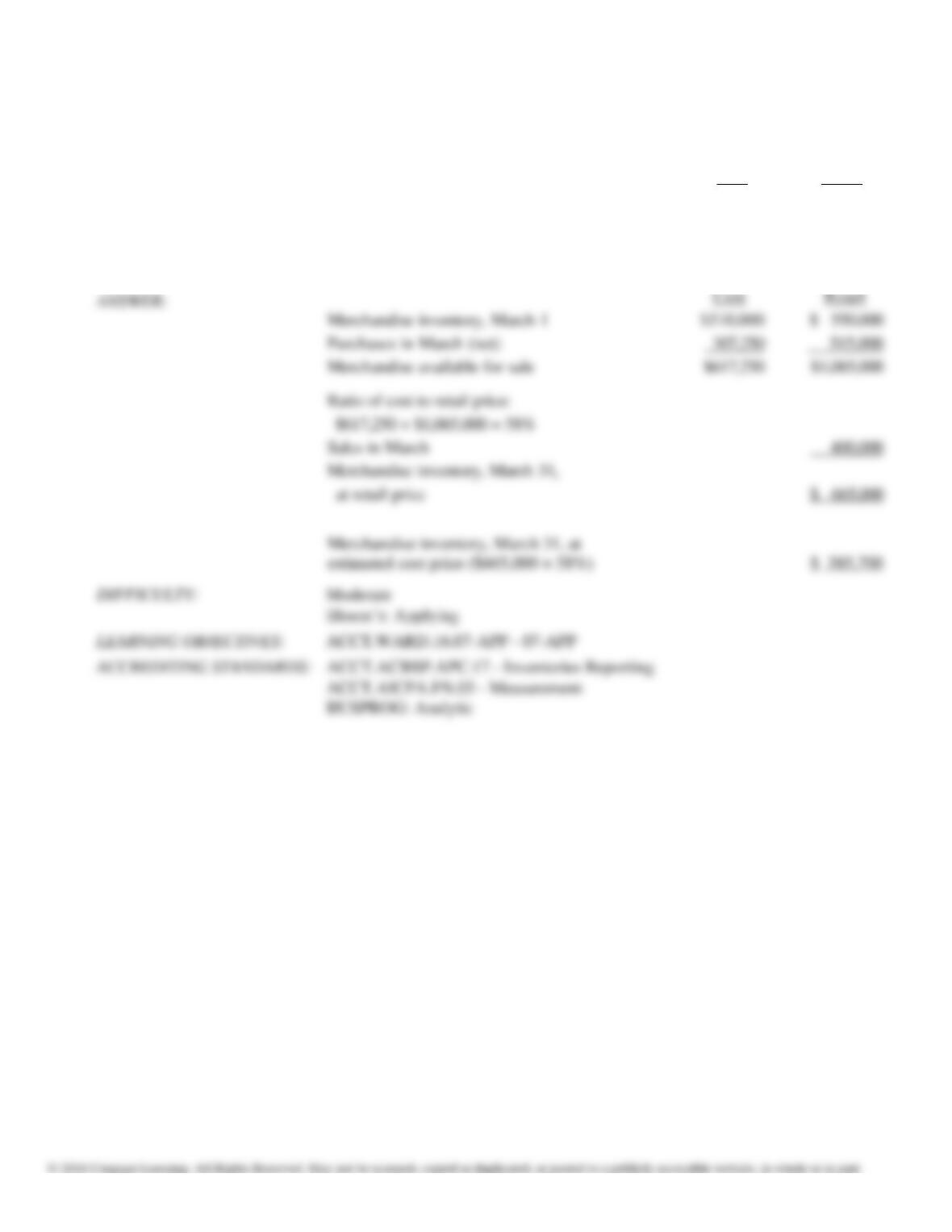
Chapter 7: Inventories
178.
On the basis of the following data, determine the estimated cost of the inventory as of March 31 by the
retail
method, presenting details of the computation in good order.
Cost
Retail
Mar.
1
Merchandise inventory
$310,000
$ 550,000
1–31
Purchases (net)
307,250
515,000
1–31
Sales
400,000

Chapter 7: Inventories
Match each description to the appropriate document used for inventory control (a–c).
a.
Receiving report
b.
Vendor’s invoice
c.
Purchase order
DIFFICULTY: Easy
Bloom’s: Remembering
LEARNING OBJECTIVES: ACCT.WARD.16.07-01 – 07–01
ACCREDITING STANDARDS: ACCT.ACBSP.APC.17 – Inventories Reporting
ACCT.AICPA.FN.03 – Measurement
BUSPROG: Analytic
179.
last document in the chain, use to compare all three for accuracy
180.
authorizes the purchase of inventory from an approved vendor
181.
establishes an initial record of the receipt of inventory
Match each description to the appropriate cost flow assumption (a–d).
a.
Weighted average
b.
First-in, first-out (FIFO)
c.
Last-in, first-out (LIFO)
d.
Specific identification
DIFFICULTY: Easy
Bloom’s: Remembering
LEARNING OBJECTIVES: ACCT.WARD.16.07-02 – 07–02
ACCREDITING STANDARDS: ACCT.ACBSP.APC.17 – Inventories Reporting
ACCT.AICPA.FN.03 – Measurement
BUSPROG: Analytic
182.
The cost of the units sold and in ending inventory is a weighted average of the purchase costs.
183.
Cost flow is assumed to be in the reverse order of costs incurred.

Chapter 7: Inventories
184.
Cost flow matches the unit sold to the unit purchased.
185.
Cost flow is in the order in which the costs were incurred.
Match each description to the appropriate inventory system (a or b).
a.
Perpetual
b.
Periodic
DIFFICULTY: Easy
Bloom’s: Remembering
LEARNING OBJECTIVES: ACCT.WARD.16.07-03 – 07–03
ACCT.WARD.16.07-04 – 07–04
ACCREDITING STANDARDS: ACCT.ACBSP.APC.17 – Inventories Reporting
ACCT.AICPA.FN.03 – Measurement
BUSPROG: Analytic
186.
This system can be costly and time consuming if not computerized.
187.
Average cost is rarely used with this system.
188.
Under this system, only revenue is recorded when sales are made.
189.
When using this system, a physical inventory is necessary to determine cost of merchandise sold.

Chapter 7: Inventories
Match each description to the appropriate cost flow assumption (a–c).
a.
FIFO
b.
LIFO
c.
Weighted average
DIFFICULTY: Moderate
Bloom’s: Remembering
LEARNING OBJECTIVES: ACCT.WARD.16.07-02 – 07–02
ACCT.WARD.16.07-03 – 07–03
ACCT.WARD.16.07-04 – 07–04
ACCT.WARD.16.07-05 – 07–05
ACCREDITING STANDARDS: ACCT.ACBSP.APC.17 – Inventories Reporting
ACCT.AICPA.BB.01 – Industry
ACCT.AICPA.FN.03 – Measurement
BUSPROG: Analytic
190.
Produces the same cost of merchandise sold under both the periodic and the perpetual inventory systems
191.
Rarely used with a perpetual inventory system
192.
Produces results that are similar to the specific identification method
193.
Widely used for tax purposes
194.
Never results in either the highest or lowest possible net income
195.
Produces the highest gross profit when costs are decreasing
196.
Produces the highest ending inventory when costs are increasing

Chapter 7: Inventories
197.
Assigns the same value to all inventory units
198.
Prohibited under International Financial Reporting Standards (IFRS)
199.
Does not follow the physical flow of goods in most cases
200.
Cost of the latest purchases are assigned to ending inventory
Match each situation to its impact (a–c) on the current year’s net income.
a.
Net income for the current year will be overstated.
b.
Net income for the current year will be understated.
c.
There will be no error effect on net income.
DIFFICULTY: Moderate
Bloom’s: Remembering
LEARNING OBJECTIVES: ACCT.WARD.16.07-06 – 07–06
ACCREDITING STANDARDS: ACCT.ACBSP.APC.17 – Inventories Reporting
ACCT.AICPA.FN.03 – Measurement
BUSPROG: Analytic
201.
Purchased merchandise was shipped FOB shipping point on the last day of the year. The cost of the merchandise
was not included in ending inventory.
202.
Merchandise was purchased FOB destination on the last day of the year. The cost of the merchandise purchased
was not included in ending inventory.
203.
Merchandise held on consignment was included in the count of ending inventory.
204.
A consignor included merchandise in the hands of the consignee in ending inventory.

Chapter 7: Inventories
205.
Beginning inventory was understated.
206.
Merchandise that was sold and shipped FOB destination on the last day of the year was not included in the seller’s
ending inventory.
207.
Merchandise that was sold and shipped FOB shipping point on the last day of the year was not included in the seller’s
ending inventory.
208.
The beginning inventory was recorded as $10,000, when actual inventory on hand was $12,000.