The Cultural Landscape, 11e (Rubenstein)
Chapter 7 Ethnicities
1) The racist laws that divided South Africans were known as
A) secessionist.
B) apartheus.
C) apomatox.
D) apartheid.
E) states rights.
2) Racist laws divided benches, drinking fountains, bathrooms, and schools in South Africa until
A) 1948.
B) 1974.
C) 1988.
D) 1994.
E) 2004.
3) Ethnicity is important because
A) it provides the only stable basis of political states in the modern world.
B) it opposes nationalism and globalization.
C) it promotes peace and wellbeing in the face of the globalization of culture.
D) it reinforces diversity in the face of the globalization of culture.
E) it defines citizenship and sovereignty in the political arena.
4) The most populous ethnic group in the United States is
A) African Americans.
B) Asian Americans.
C) Latinos/Hispanics.
D) American Indians and Alaska Natives.
E) Austral-Asians.
5) The second most populous ethnic group in the United States is
A) Latinos/Hispanics.
B) Asian Americans.
C) African Americans.
D) American Indians and Alaska Natives.
E) Austral-Asians.
6) The largest Hispanic/Latino groups in the United States are from which two countries?
A) Guatemala and Mexico
B) Cuba and Mexico
C) Puerto Rico and Mexico
D) Puerto Rico and Cuba
E) Dominican Republic and Cuba
7) The largest numbers of Asian Americans are descended from immigrants from
A) Vietnam.
B) Japan.
C) China.
D) the Philippines.
E) Korea.
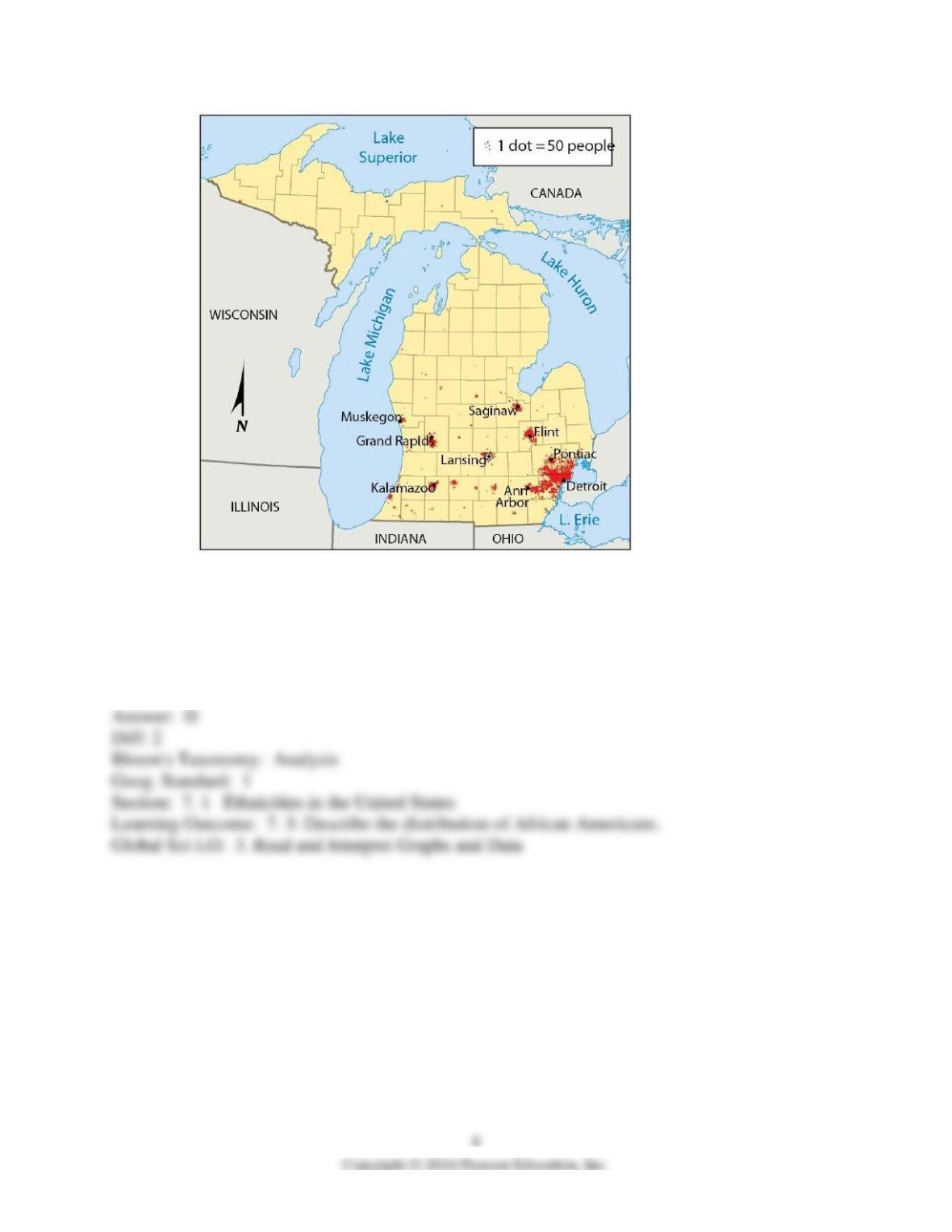
8) This map shows that African Americans in Michigan are concentrated mainly in
A) the northeast.
B) the north, northeast, and west.
C) the southwest.
D) the southeast.
E) the northwest.
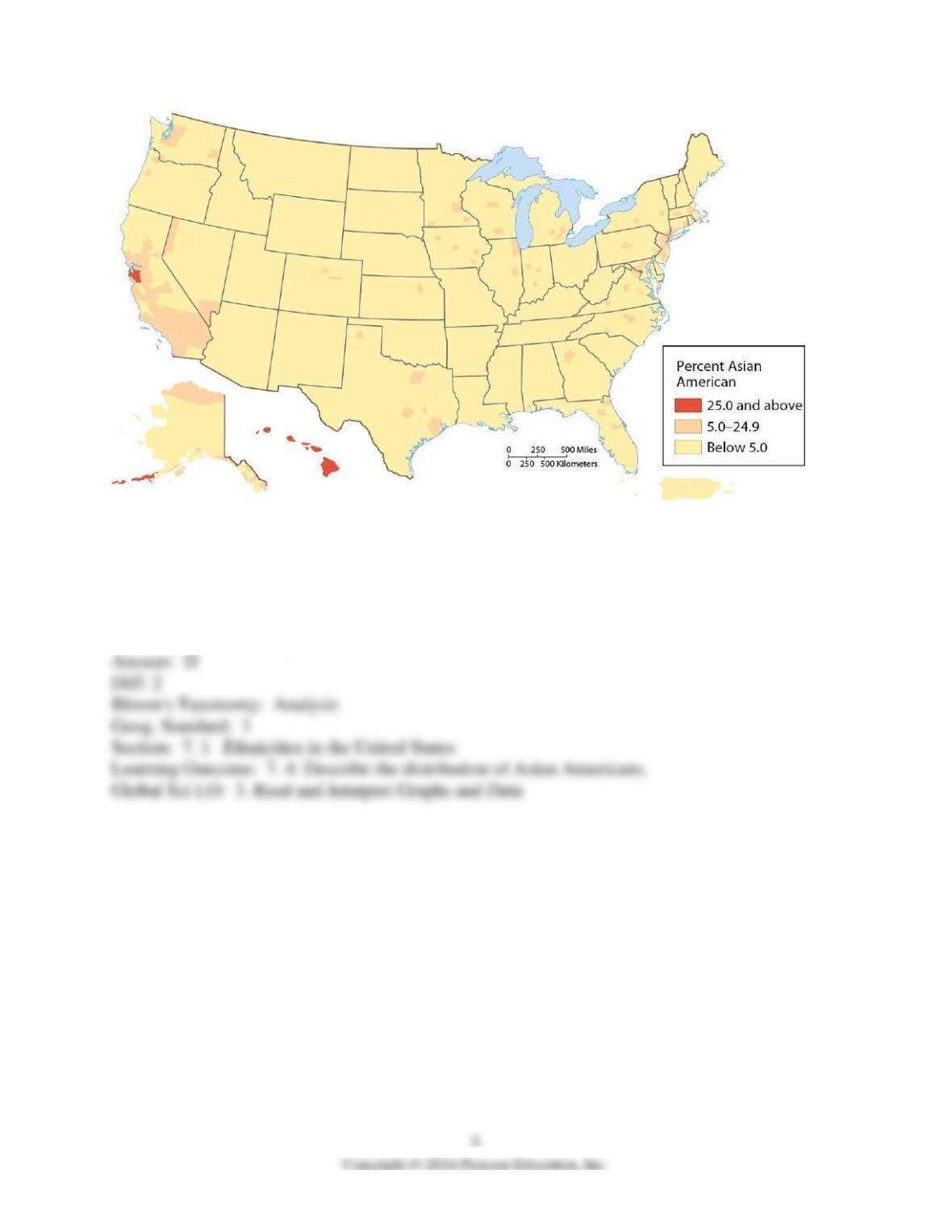
9) By evaluating this map, we can surmise that the Asian American population in Texas is
A) fairly evenly dispersed in the state’s rural communities.
B) more concentrated in the northern part of the state.
C) more concentrated in the urban areas in the northwest and southwest.
D) more concentrated in the urban areas in the northeast and southeast.
E) migrating to other states such as California.
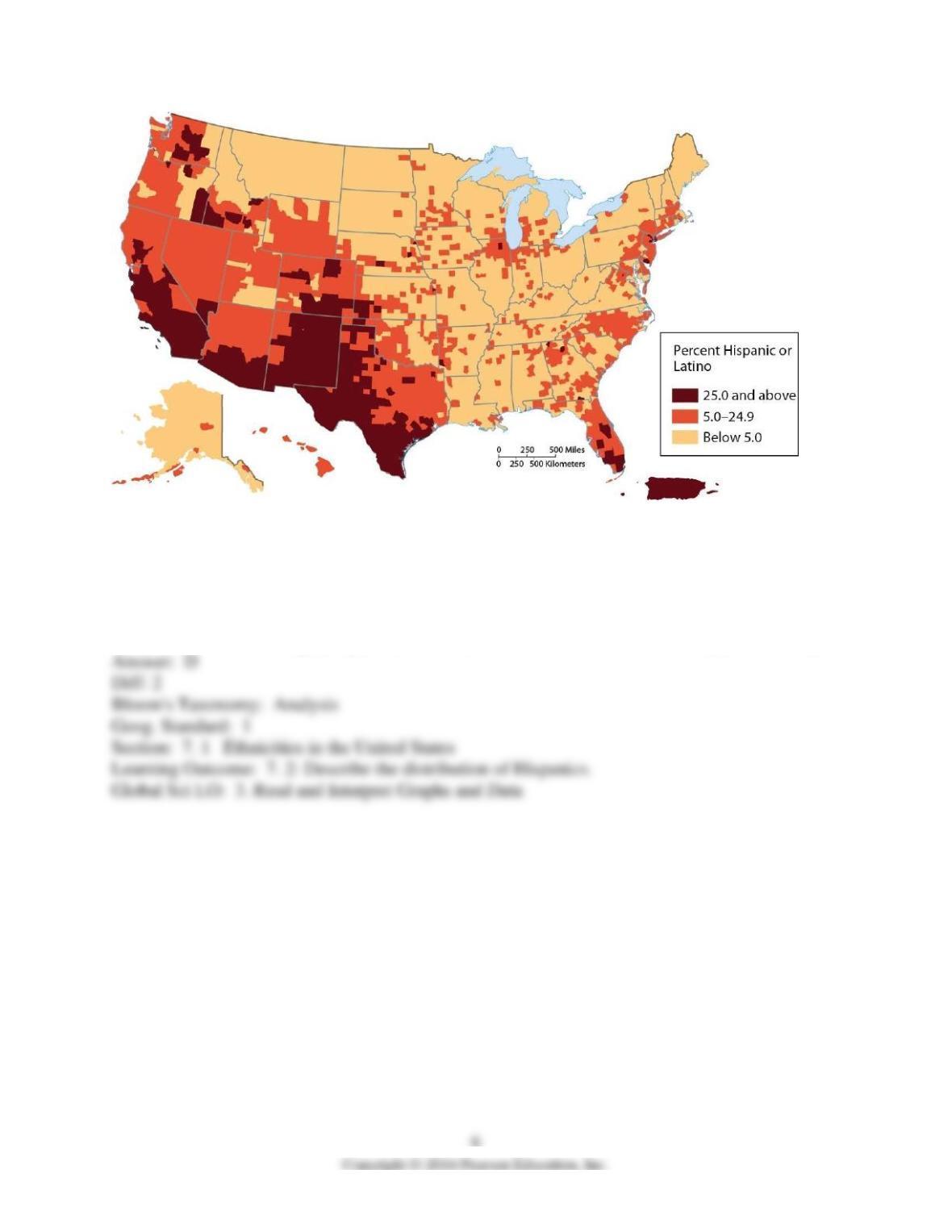
10) By interpreting this map, we can surmise that in the Hispanic population
A) hardly any live in the northwestern United States.
B) in Florida, there is more of a concentration in the northern part of the state.
C) in California, there is more of a concentration in the northern part of the state.
D) in Idaho, there is more of a concentration in the southern part of the state.
E) in Idaho, there are roughly equal concentrations in the northern and southern parts of the state.
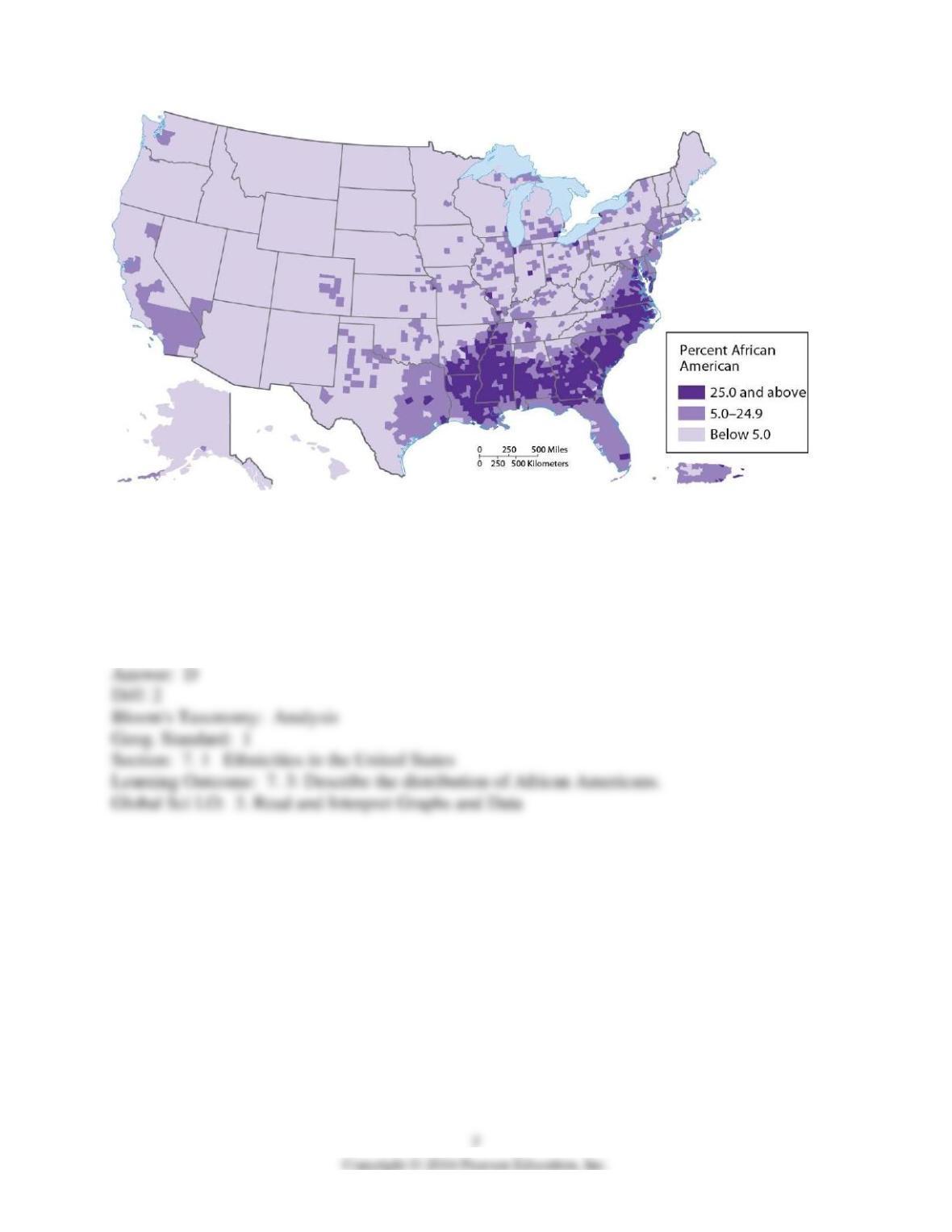
11) By interpreting this map, we surmise that in the African American population
A) in Illinois, nearly all are distributed in the southern part of the state.
B) in Florida, there is more of a concentration in the western part of the state.
C) in California, there is more of a concentration in the northern part of the state.
D) in Arkansas, there is more of a concentration in the southern part of the state.
E) in Nevada, there are roughly equal concentrations in the northern and southern parts of the
state.
12) President Barack Obama is a good example of the
A) complexity of ethnic identity in the United States.
B) confusion over ethnicity and race in Kenya.
C) natural and biological basis for classifying humans.
D) complexity of Asian American identity in the United States.
E) principle of the distribution of persons of color.
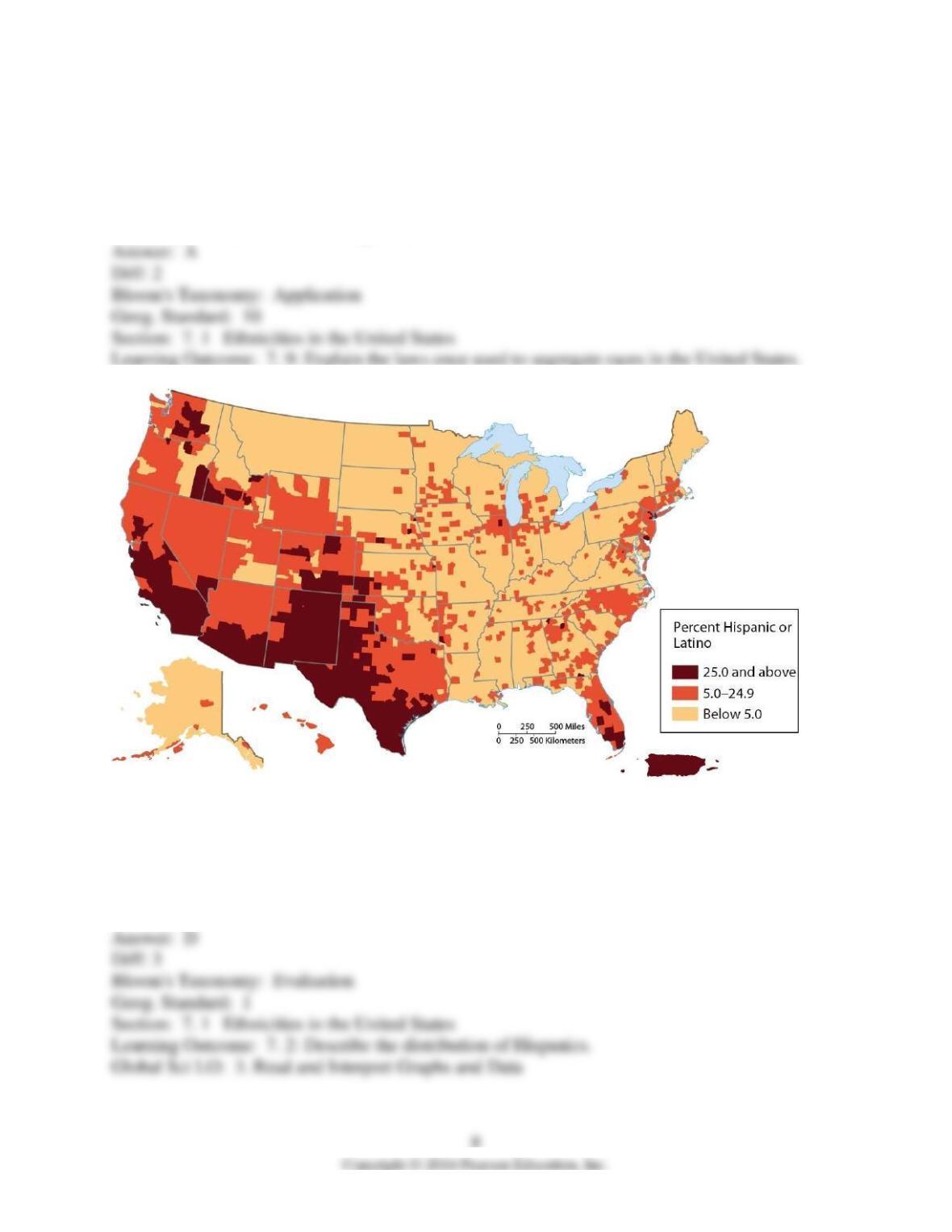
13) Evaluating this map, we can determine that
A) more than 95 percent of Latinos live in the southwestern United States.
B) Latinos are mainly concentrated in the northwest, southwest, and northeast.
C) Latinos are concentrated only in the largest cities.
D) Latinos live throughout the United States.
E) only 10 percent of Latinos live in the southwest.
14) Asian Americans are clustered in what area of the United States?
A) Southwest
B) West
C) Plains states
D) Northeast
E) Southeast
15) Los Angeles has what kind of ethnic distribution?
A) dispersed
B) clustered
C) diverse
D) contiguous
E) inverted
16) Which is the most dramatic change in the geographic distribution of African Americans in
the United States?
A) rural to urban within the state
B) change to sharecropping
C) relocation to northern cities
D) movement out of inner-cities
E) relocation to coastal cities
17) Which is the most dramatic change in the geographic distribution of African Americans in
the United States?
A) rural to urban within the state
B) change to sharecropping
C) relocation to northern cities
D) movement out of inner-cities
E) relocation to coastal cities
18) An examination of the distribution of ethnicities in the United States reveals
A) ethnicities are not often clustered in urban areas.
B) different ethnicities cluster in each U.S. region.
C) ethnic neighborhoods contain a heterogeneous mix of ethnicities, even in cities that were once
known for their patterns of segregation.
D) segregation and exclusion are a thing of the past for nearly all U.S. ethnic groups.
E) ethnic groups tend to cluster in urban areas and in different U.S. regions.
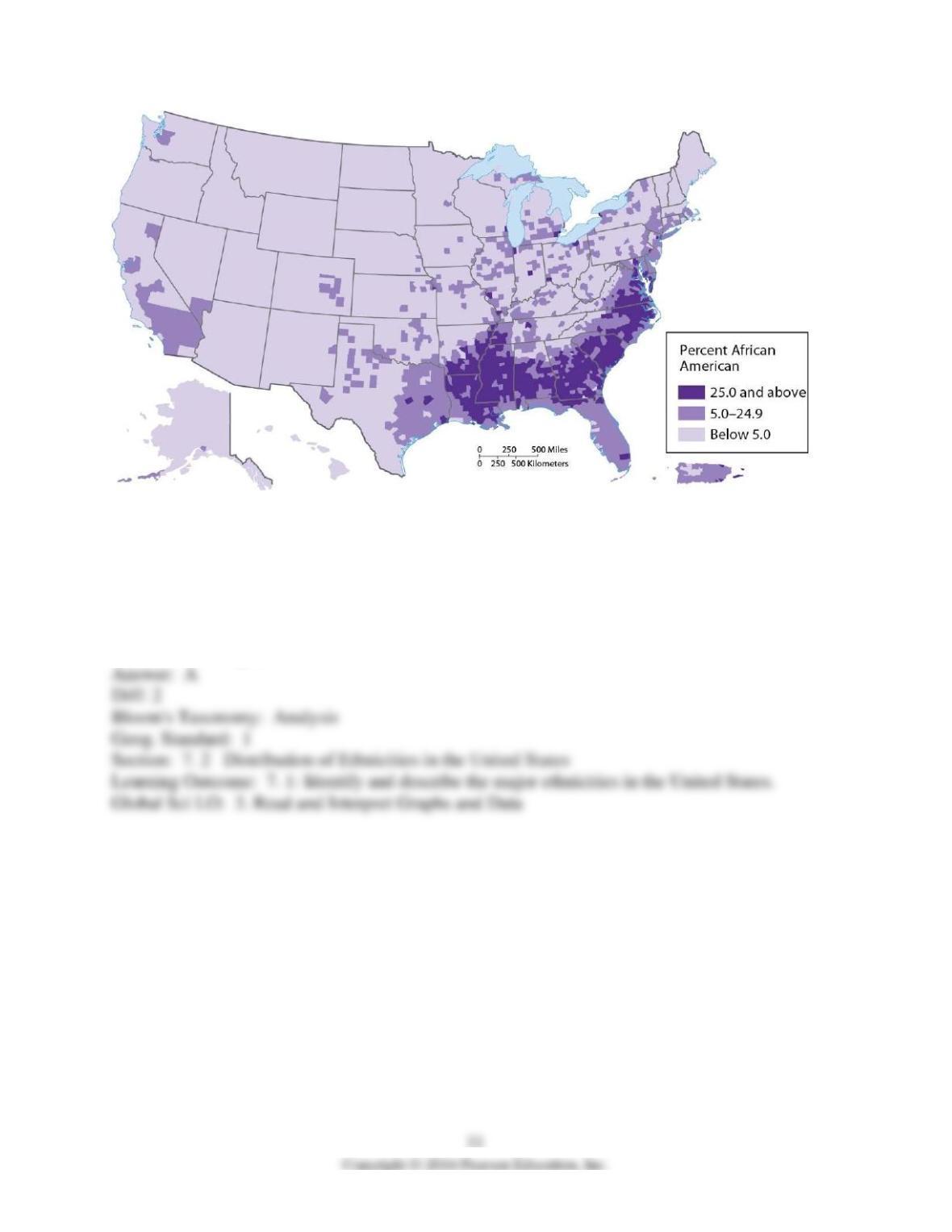
19) An analysis of this map indicates that African Americans are clustered in what part of North
Carolina?
A) the eastern half of the state
B) the southwest
C) the western half of the state
D) the southern part of the state
E) the western highlands
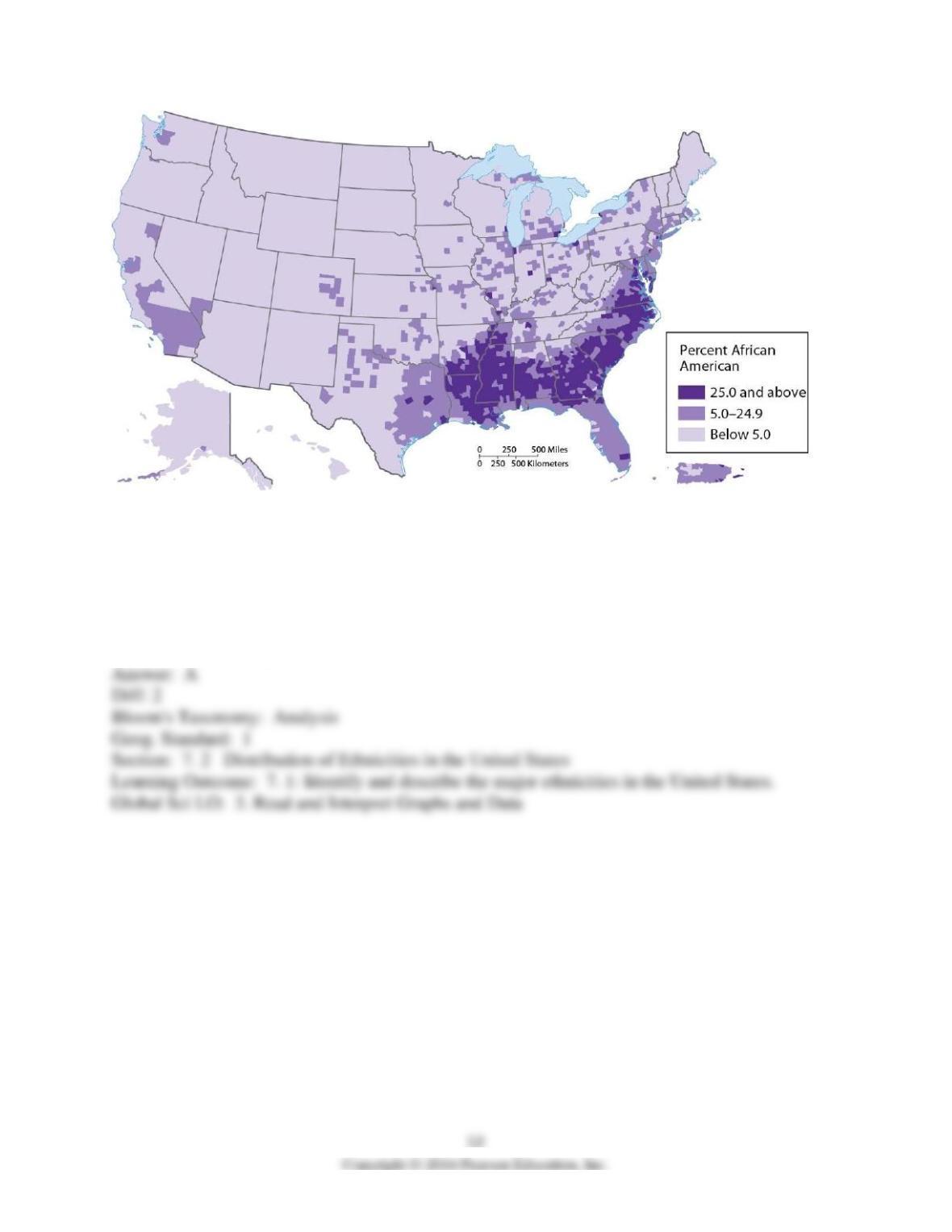
20) An analysis of this map indicates that African Americans are clustered in what part of
Colorado?
A) the eastern half of the state
B) the southwest
C) the western half of the state
D) the southern part of the state
E) the western mountains
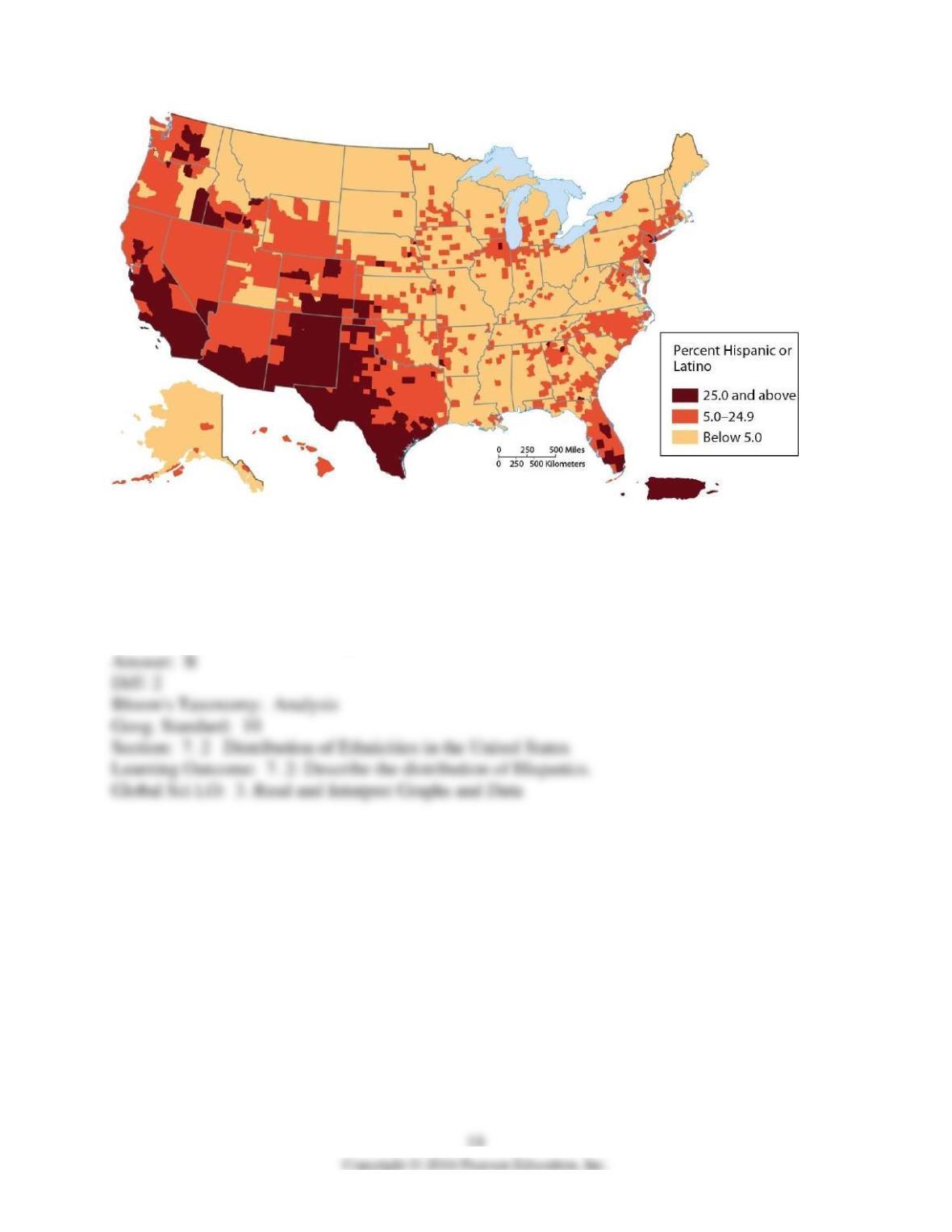
21) The map indicates that Latinos/Hispanics are clustered in what areas of the United States?
A) Northeast, cities
B) West, Southwest
C) Southwest, Southeast
D) cities
E) Pacific Northwest, Plains states
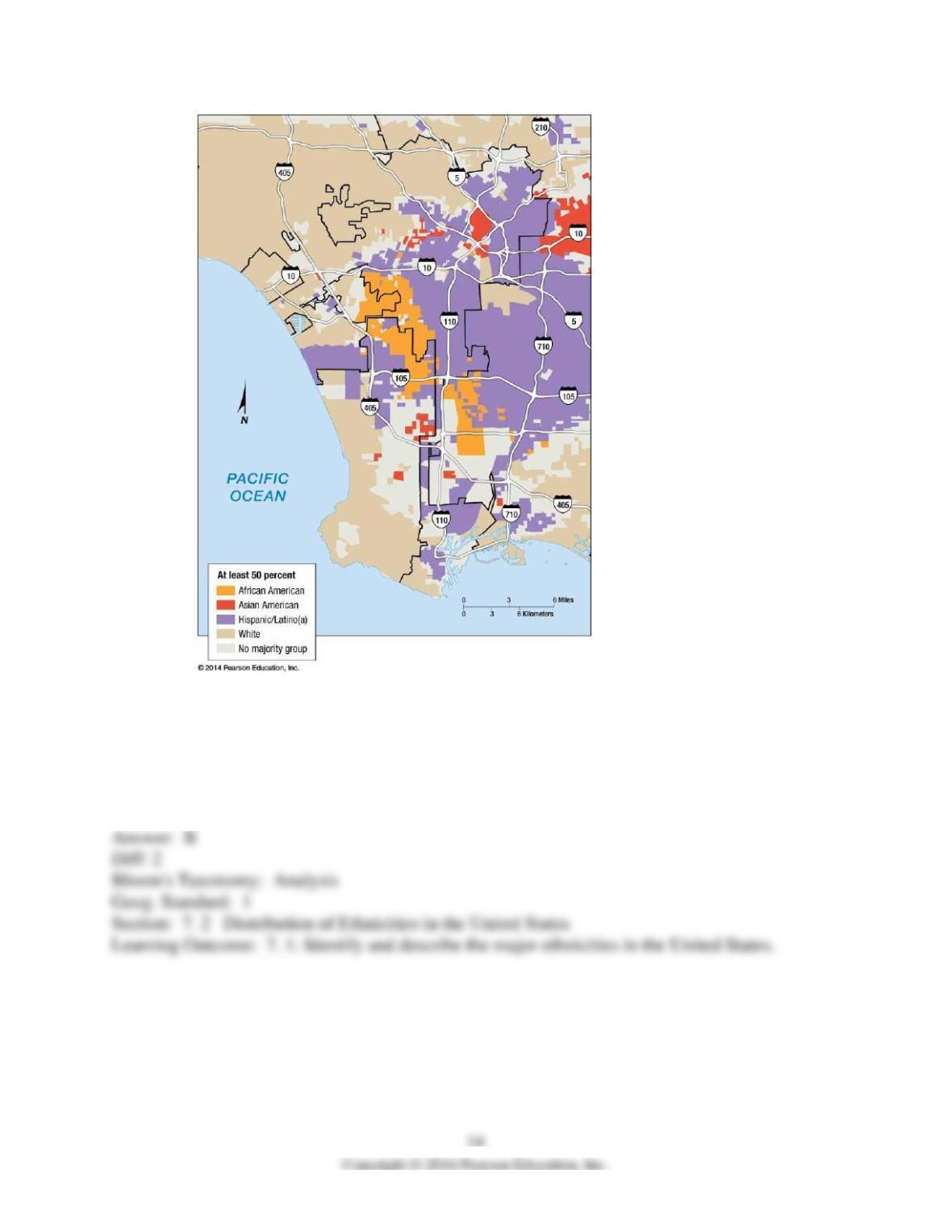
22) This map indicates that in Los Angeles, Asian Americans are mainly concentrated
A) in the southeast.
B) in the northeast.
C) in the approximate geographic center.
D) in a contiguous line from the northeast to the southeast.
E) in an inverted pattern from west to east.
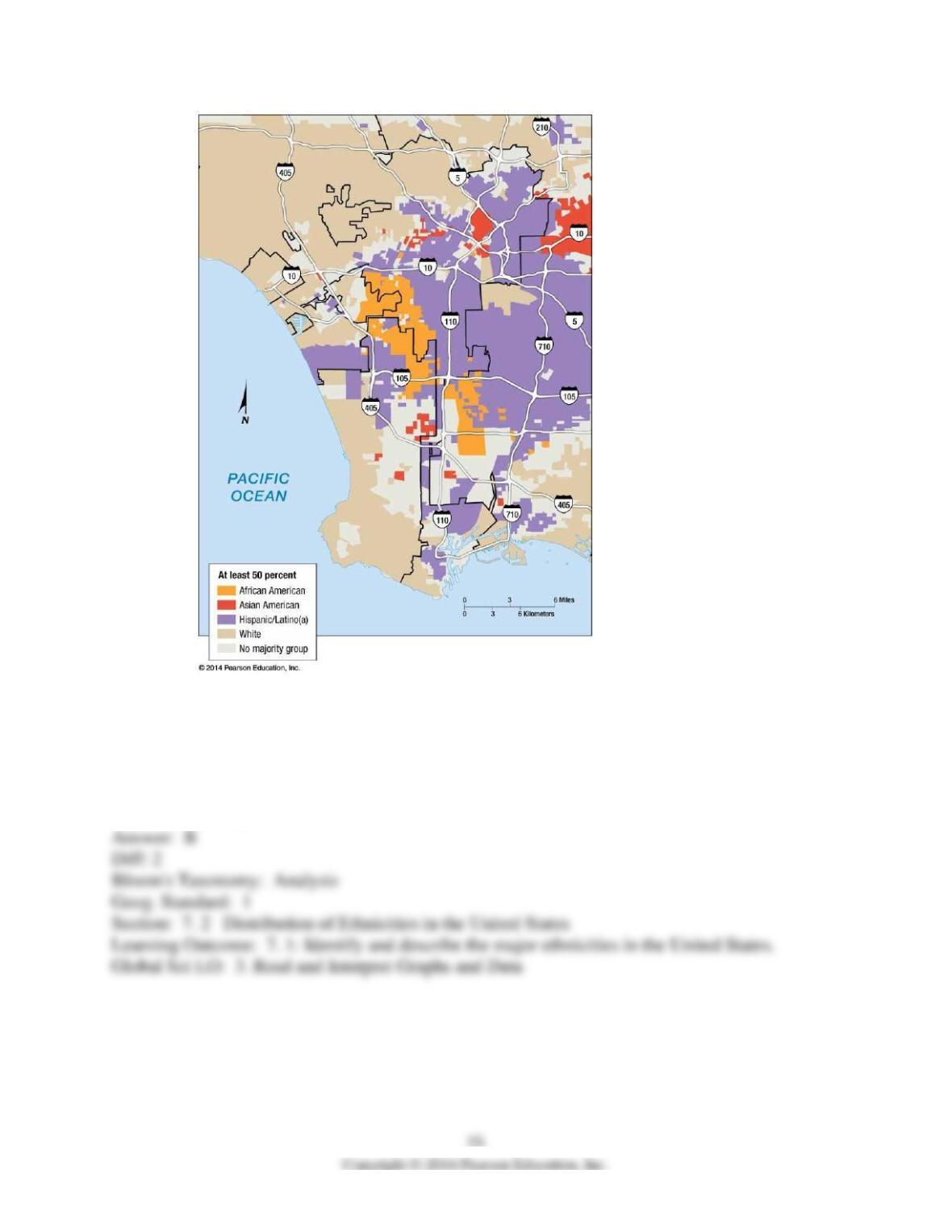
23) This map indicates that in Los Angeles, African Americans are mainly concentrated
A) in the northeast.
B) near the geographic center of the urban area.
C) in the southeast.
D) in a contiguous line from the northeast to the southeast.
E) in an inverted pattern from west to east.
24) As part of the triangular slave trade system, ships bound for Europe carried
A) cloth and trinkets.
B) rum and molasses.
C) slaves.
D) gold and silver.
E) slaves and molasses.
25) After World War II ended, millions of people were forced to migrate because of
A) Soviet repatriation of Gypsies and Jews.
B) counterattacks by the Allies.
C) German expansion.
D) the return of defeated German soldiers to their homes.
E) changes in the boundaries of states.
26) African Americans migrated out of the U.S. South partly as a consequence of
A) the removal of travel visa requirements for people of color.
B) increased farm mechanization leading to a decreased demand for farm labor.
C) the development of better airports, allowing for rapid and efficient travel.
D) increasing opportunities to work in northern coal mines and the California gold rush.
E) the growth of agriculture in the U.S. North.
27) From 1910 to 1950, population density of African Americans in ghettos
A) increased.
B) remained the same.
C) decreased.
D) briefly increased before decreasing.
E) fluctuated.
28) What was apartheid?
A) the dialect of Dutch which is spoken in South Africa
B) South Africa’s governmental system
C) the existence of landlocked states in southern Africa
D) the geographic separation of races in South Africa
E) the kinship system of Sub-Saharan Africa
29) A racist believes in
A) the equality of women and men regardless of ethnic or racial identity.
B) the superiority of some groups because of cultural identity.
C) the inferiority of some groups because of economic factors and the superiority of other groups
because of political affiliations.
D) the biological classification of people and the superiority of some groups over others on the
basis of racial identity.
E) the biological classification of people along with an understanding that all human beings are
one species and therefore one extended family without any inherent differences.
30) Which of the following does the United States Census Bureau not consider a race?
A) Japanese
B) Black
C) Hispanic/Latino
D) White
E) Samoan
31) People who were restricted by covenants in deeds included all of the following people in the
United States except for
A) Caucasians.
B) Jews.
C) Blacks.
D) Roman Catholics.
E) Mexican Americans.
32) The “separate but equal” doctrine in the United States was legally established by
A) individual states.
B) Plessy v. Ferguson.
C) Brown v. Board of Education.
D) the Missouri Compromise.
E) the fourteenth amendment to the Constitution.
33) The “separate but equal” doctrine of racial equality was accompanied by
A) the abolition of discriminatory lending practices and restrictive covenants.
B) the end of the U.S. Civil War.
C) the required integration of schools.
D) the end of legal discrimination in the American South.
E) “Jim Crow” laws across the American South.
34) The Brown v. Board of Education court decision ruled that
A) separate schools for blacks and whites were unconstitutional.
B) “white flight” was morally wrong and should be curtailed.
C) discriminatory lending practices and restrictive covenants were unconstitutional.
D) separate facilities for blacks and whites were acceptable so long as they were of the same
quality.
E) separate schools for blacks and whites were constitutional but separate drinking fountains
were unconstitutional.
35) According to the United States Census Bureau, a Mexican American might also be
considered a member of which races?
A) Japanese, Cuban, or another
B) Black, Mexican, or another
C) Black, White, or another
D) White, Guatemalan, or Mexican
E) White only
36) An example of white flight is the
A) movement of whites from northern cities like Chicago and New York to southern cities.
B) movement of whites from southern cities like New Orleans to western cities like Los Angeles.
C) establishment of suburbs around Los Angeles.
D) decrease in the percent of whites remaining in the Southeast because of black migration from
the Southeast.
E) emigration of whites from central Los Angeles as blacks were arriving.
37) Which pair of concepts or entities from South Africa and the United States is the best match?
A) apartheid—“Jim Crow” laws
B) homelands—blockbusting
C) South African Nationalist Party—U.S. Tea Party
D) Nelson Mandela—white flight
E) apartheid—U.S. Libertarian Party.
38) South Africa is the only state in southern Africa that
A) still practices apartheid despite efforts to end the practice.
B) is completely landlocked.
C) first elected a Black as president during the 1990s.
D) signed the Law of the Sea despite concerns over ethnic segregation.
E) has a large Italian minority population.