22) The internal rate of return rule can result in the wrong decision if the projects being
compared have:
A) differences in scale.
B) differences in timing.
C) differences in NPV.
D) A and B are correct.
Use the information for the question(s) below.
Larry the Cucumber has been offered $14 million to star in the lead role of the next three Larry
Boy adventure movies. If Larry takes this offer, he will have to forgo acting in other Veggie
movies that would pay him $5 million at the end of each of the next three years. Assume Larry’s
personal cost of capital is 10% per year.
23) Explain why the NPV decision rule might provide Larry with a different decision outcome
than the IRR rule when evaluating Larry’s three movie deal offer.

7.3 The Payback Rule
Use the following information to answer the question(s) below.
Rearden Metals is considering opening a strip mining operation to provide some of the raw
materials needed in producing Rearden metal. The initial purchase of the land and the associated
costs of opening up mining operations will cost $100 million today. The mine is expected to
generate $16 million worth of ore per year for the next 12 years. At the end of the 12th year
Rearden will need to spend $20 million to restore the land to its original pristine nature
appearance.
1) The payback period for Rearden’s mining operation is closest to:
A) 5.00 years
B) 6.00 years
C) 6.25 years
D) 6.50 years
2) Which of the following statements is FALSE?
A) It is possible that an IRR does not exist for an investment opportunity.
B) If the payback period is less than a pre-specified length of time you accept the project.
C) The internal rate of return (IRR) investment rule is based upon the notion that if the return on
other alternatives is greater than the return on the investment opportunity you should undertake
the investment opportunity.
D) It is possible that there is no discount rate that will set the NPV equal to zero.
3) Which of the following statements is FALSE?
A) The payback investment rule is based on the notion that an opportunity that pays back its
initial investments quickly is a good idea.
B) An IRR will always exist for an investment opportunity.
C) A NPV will always exist for an investment opportunity.
D) In general, there can be as many IRRs as the number of times the project’s cash flows change
sign over time.

4) Which of the following statements is FALSE?
A) In general, the IRR rule works for a stand-alone project if all of the project’s positive cash
flows precede its negative cash flows.
B) There is no easy fix for the IRR rule when there are multiple IRRs.
C) The payback rule is primarily used because of its simplicity.
D) No investment rule that ignores the set of alternative investment alternatives can be optimal.
5) Which of the following statements is FALSE?
A) The payback rule is useful in cases where the cost of making an incorrect decision might not
be large enough to justify the time required for calculating the NPV.
B) The payback rule is reliable because it considers the time value of money and depends on the
cost of capital.
C) For most investment opportunities expenses occur initially and cash is received later.
D) Fifty percent of firms surveyed reported using the payback rule for making decisions.
Use the table for the question(s) below.
Consider a project with the following cash flows:
Year Cash Flow
0 -10,000
1 4,000
2 4,000
3 4,000
4 4,000
6) Assume the appropriate discount rate for this project is 15%. The payback period for this
project is closest to:
A) 3.0
B) 2.5
C) 2.0
D) 4.0

Use the table for the question(s) below.
Consider the following two projects:
Project Year 0
Cash Flow Year 1
Cash Flow Year 2
Cash Flow Year 3
Cash Flow Year 4
Cash Flow Discount Rate
A -100 40 50 60 N/A .15
B -73 30 30 30 30 .15
7) The payback period for project A is closest to:
A) 2.0 years
B) 2.4 years
C) 2.5 years
D) 2.2 years
8) The payback period for project B is closest to:
A) 2.5 years
B) 2.0 years
C) 2.2 years
D) 2.4 years

Use the table for the question(s) below.
Consider the following two projects:
Project Year 0
C/F Year 1
C/F Year 2
C/F Year 3
C/F Year 4
C/F Year 5
C/F Year 6
C/F Year 7
C/F Discount
Rate
Alpha -79 20 25 30 35 40 N/A N/A 15%
Beta -80 25 25 25 25 25 25 25 16%
9) The payback period for project Alpha is closest to:
A) 3.2 years
B) 2.9 years
C) 3.1 years
D) 2.6 years
10) The payback period for project beta is closest to:
A) 2.9 years
B) 3.1 years
C) 2.6 years
D) 3.2 years

Use the information for the question(s) below.
The Sisyphean Company is planning on investing in a new project. This will involve the
purchase of some new machinery costing $450,000. The Sisyphean Company expects cash
inflows from this project as detailed below:
Year One Year Two Year Three Year Four
$200,000 $225,000 $275,000 $200,000
The appropriate discount rate for this project is 16%.
11) The payback period for this project is closest to:
A) 2.1 years
B) 3.0 years
C) 2.0 years
D) 2.2 years
7.4 Choosing Between Projects
1) Which of the following statements is FALSE?
A) Problems can arise using the IRR method when the mutually exclusive investments have
different cash flow patterns.
B) The IRR is affected by the scale of the investment opportunity.
C) Multiple incremental IRRs might exist.
D) The incremental IRR rule assumes that the riskiness of the two projects is the same.

2) Which of the following statements is FALSE?
A) The incremental IRR investment rule applies the IRR rule to the difference between the cash
flows of the two mutually exclusive alternatives.
B) When a manager must choose among mutually exclusive investments, the NPV rule provides
a straightforward answer.
C) The likelihood of multiple IRRs is greater with the regular IRR rule than with the incremental
IRR rule.
D) Problems can arise using the IRR method when the mutually exclusive investments have
differences in scale.
3) Which of the following statements is FALSE?
A) When using the incremental IRR rule, you must keep track of which project is the
incremental project and ensure that the incremental cash flows are initially positive and then
become negative.
B) Picking one project over another simply because it has a larger IRR can lead to mistakes.
C) Problems arise using the IRR method when the mutually exclusive investments have
differences in scale.
D) When the risks of two projects are different, only the NPV rule will give a reliable answer.
4) Which of the following statements is FALSE?
A) The incremental IRR need not exist.
B) If a change in the timing of the cash flows does not affect the NPV, then the change in timing
will not impact the IRR.
C) Although the incremental IRR rule can provide a reliable method for choosing among
projects, it can be difficult to apply correctly.
D) When projects are mutually exclusive, it is not enough to determine which projects have
positive NPVs.

5) Consider two mutually exclusive projects A & B. If you subtract the cash flows of
opportunity B from the cash flows of opportunity A, then you should:
A) take opportunity A if the regular IRR exceeds the cost of capital.
B) take opportunity A if the incremental IRR exceeds the cost of capital.
C) take opportunity B if the regular IRR exceeds the cost of capital.
D) take opportunity B if the incremental IRR exceeds the cost of capital.
6) You are trying to decide between three mutually exclusive investment opportunities. The
most appropriate tool for identifying the correct decision is:
A) NPV.
B) profitability index.
C) IRR.
D) incremental IRR.

Use the table for the question(s) below.
Consider the following two projects:
Project Year 0
Cash Flow Year 1
Cash Flow Year 2
Cash Flow Year 3
Cash Flow Year 4
Cash Flow Discount Rate
A -100 40 50 60 N/A .15
B -73 30 30 30 30 .15
7) Assume that projects A and B are mutually exclusive. The correct investment decision and
the best rational for that decision is to
A) invest in project A since NPVB < NPVA.
B) invest in project B since IRRB > IRRA.
C) invest in project B since NPVB > NPVA.
D) invest in project A since NPVA > 0.

8) An incremental IRR of Project B over Project A is closest to:
A) 12.6%
B) 23.3%
C) 1.7%
D) 17.3%
9) The maximum number of incremental IRRs that could exist for project B over project A is:
A) 1
B) 2
C) 0
D) 3

Use the table for the question(s) below.
Consider the following two projects:
Project Year 0
C/F Year 1
C/F Year 2
C/F Year 3
C/F Year 4
C/F Year 5
C/F Year 6
C/F Year 7
C/F Discount
Rate
Alpha -79 20 25 30 35 40 N/A N/A 15%
Beta -80 25 25 25 25 25 25 25 16%
10) Assume that projects Alpha and Beta are mutually exclusive. The correct investment
decision and the best rational for that decision is to
A) invest in project Beta since NPVBeta > 0.
B) invest in project Alpha since NPVBeta < NPVAlpha.
C) invest in project Beta since IRRB > IRRA.
D) invest in project Beta since NPVBeta > NPVAlpha > 0.


11) Assume that projects Alpha and Beta are mutually exclusive. Which of the following
statements is true regarding the investment decision tools’ suitability for deciding between
projects Alpha & Beta?
A) The incremental IRR should not be used since the projects have different lives.
B) The incremental IRR should not be used since the projects have different discount rates
C) The incremental IRR should not be used since the projects have different cash flow patterns.
D) Both the NPV and incremental IRR approaches are appropriate to solve this problem.
12) When choosing between projects, an alternative to comparing their IRRs is:
A) to compute the incremental IRR, which tells us the discount rate at which it becomes
profitable to switch from one project to the other.
B) to compute the incremental payback period, which tells us the number of years during which
it becomes profitable to switch from one project to the other.
C) to compute the incremental NPV, which tells us the discount rate at which it becomes
profitable to switch from one project to the other.
D) There is no alternative selection criterion to comparing IRRs.
Use the table for the question(s) below.
Consider two mutually exclusive projects with the following cash flows:
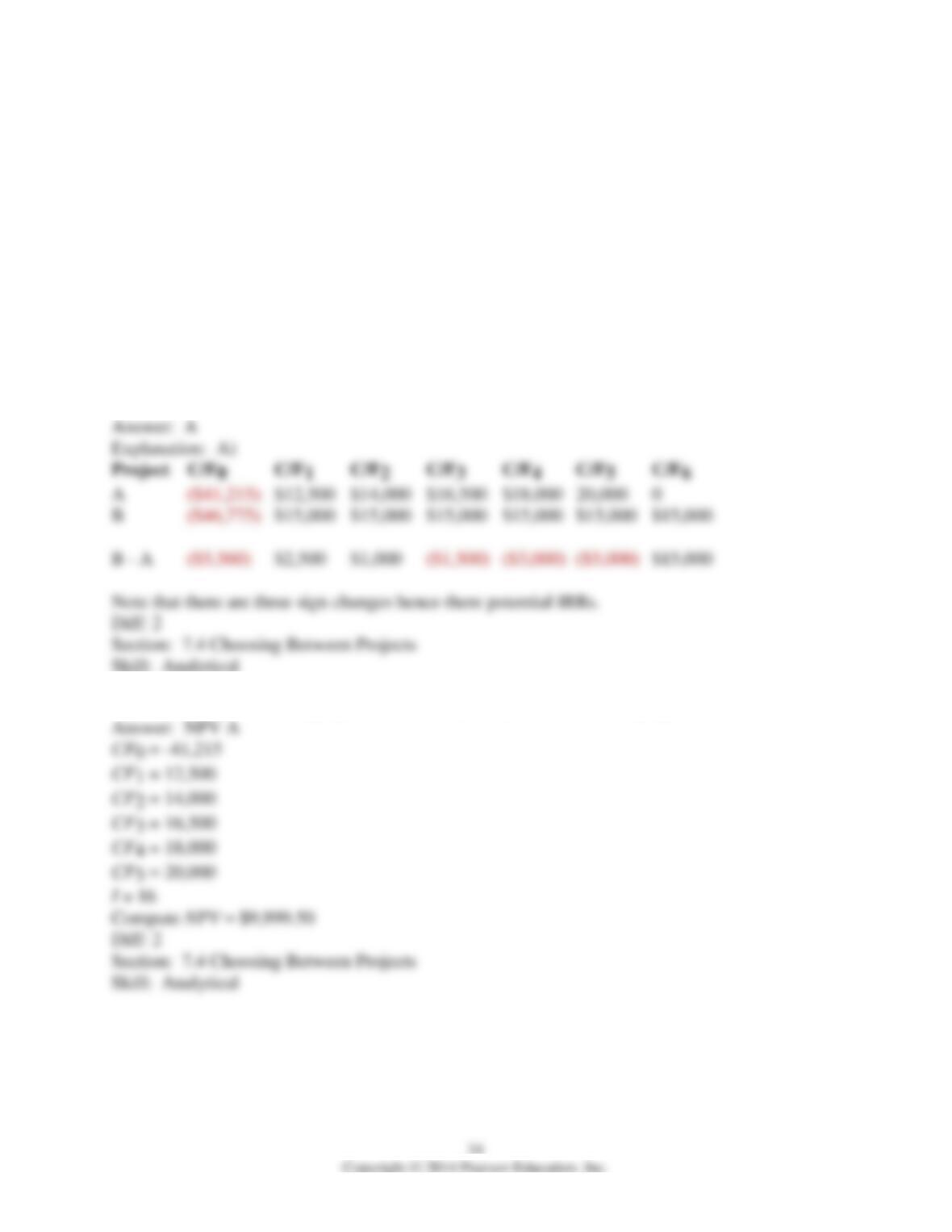
Project C/F0 C/F1 C/F2 C/F3 C/F4 C/F5 C/F6
A $(41,215) $12,500 $14,000 $16,500 $18,000 $20,000 N/A
B $(46,775) $15,000 $15,000 $15,000 $15,000 $15,000 $15,000
13) You are considering using the incremental IRR approach to decide between the two mutually
exclusive projects A & B. How many potential incremental IRRs could there be?
A) 3
B) 0
C) 2
D) 1
14) If the discount rate for project A is 16%, then what is the NPV for project A?
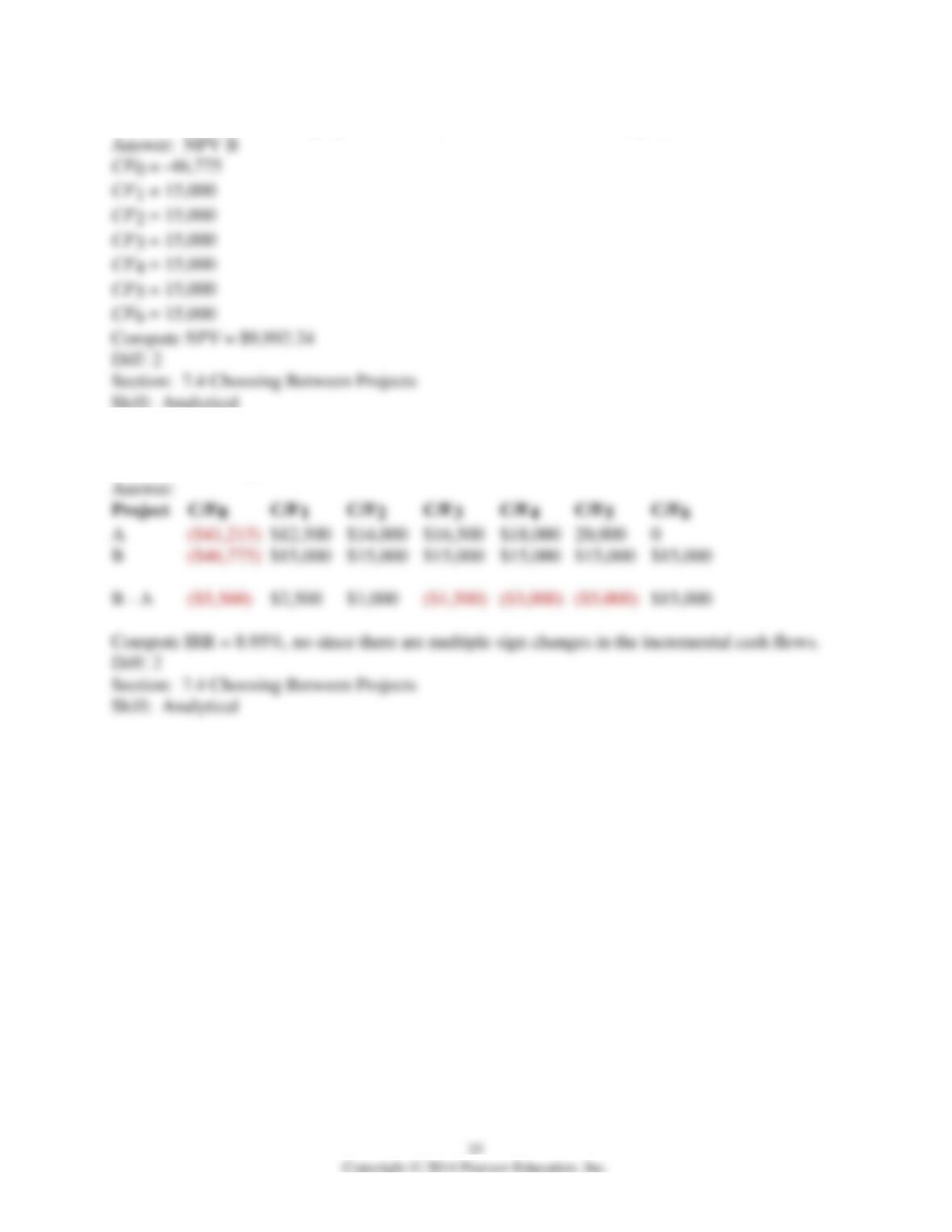
15) If the discount rate for project B is 15%, then what is the NPV for project B?
16) What is one of the incremental IRRs for project B over project A? Would you feel
comfortable basing your decision on the incremental IRR?