
Chapter 7: Inventories: Cost Measurement and Flow Assumptions
105. Cabinets for Less uses FIFO for internal reporting purposes and LIFO for financial and income tax purposes. At the
end of 2016, the following information was obtained from the inventory records:
2015
2016
Ending inventory, FIFO
$78,650
$93,250
Ending inventory, LIFO
68,500
78,350
Required:
Prepare the necessary entry to convert to LIFO at the end of 2016.
Cost of Goods Sold
4,750
LIFO Valuation Allowance (or LIFO Reserve)
4,750
1
106. Richardson’s Flower Depot uses FIFO for internal reporting purposes and LIFO for financial and income tax
purposes. At the end of 2017, the following information was obtained from the inventory records:
2015
2016
2017
Ending inventory, FIFO
$78,650
$82,785
$93,678
Ending inventory, LIFO
68,500
75,640
84,675
Beginning inventory, FIFO
67,535
78,650
82,785
Beginning inventory, LIFO
74,565
68,500
75,640
Required:
1) Prepare the necessary entry to convert to LIFO at the end of 2017.
2) How much would Richardson’s cost of goods sold differ in 2017 if it used FIFO for external reporting?
Cost of Goods Sold
1,858
LIFO Valuation Allowance (or LIFO Reserve)
1,858
the change in the allowance ($10,893-$9,035).
1
Challenging
ACCT.WHAL.16.7.8 – LO: 7.8
United States – BUSPORG: Analytic
United States – OH – Default City – AICPA: FN-Measurement
107. Martins Game Stop began the current quarter with the following inventory: 900 units @ $10 per unit and 250 units
@ $12 per unit. During the quarter, Martin purchased 400 units @ $13 per unit and sold 680 units. Martin prepares
interim financial statements each quarter.
Required:
a.
Determine the amount of LIFO liquidation profit for the quarter.
b.
Assume the liquidation is not to be reflected in the current quarter’s financial statements.
Prepare the necessary adjusting entry.
c.
Explain the circumstances when an inventory liquidation is not reported on interim
financial statements.
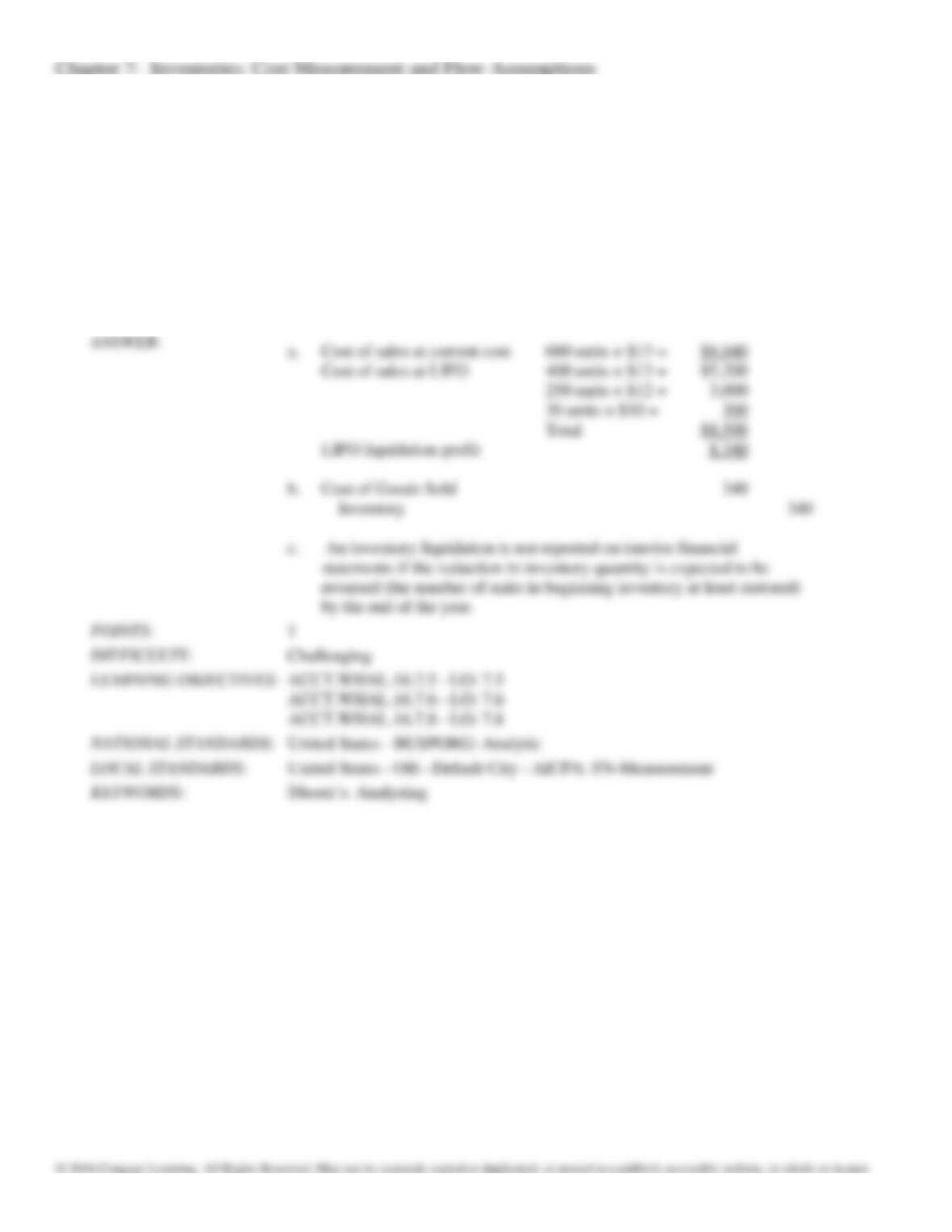
a.
Cost of sales at current cost
680 units × $13 =
Cost of sales at LIFO
400 units × $13 =
250 units × $12 =
30 units × $10 =
Total
LIFO liquidation profit
b.
Cost of Goods Sold
Inventory
reversed (the number of units in beginning inventory at least restored)
1
Challenging
ACCT.WHAL.16.7.6 – LO: 7.6
United States – BUSPORG: Analytic
United States – OH – Default City – AICPA: FN-Measurement

108. There are many differences between inventory cost flow assumptions. Listed below is a series of descriptive
statements.
LIFO
FIFO
_____
_____
a.
Requires increased cash outflows during periods of rising prices.
_____
_____
b.
Places the most recent costs in cost of goods sold.
_____
_____
c.
Is susceptible to possible income manipulation.
_____
_____
d.
Includes all of the holding gains in income.
_____
_____
e.
Usually approximates the physical flow of goods.
_____
_____
f.
Is required for financial reporting when used for income taxes.
_____
_____
g.
Results in liquidation profits when unit sales exceed purchases.
_____
_____
h.
Impairs comparability between companies.
_____
_____
i.
Emphasizes the balance sheet valuation of inventory.
_____
_____
j.
Can be used with either periodic or perpetual inventory systems.
Required:
For each statement, indicate if it applies to LIFO or FIFO or both by placing an “X” in the appropriate column(s).
a.
FIFO
b.
LIFO
g.
c.
LIFO
h.
d.
FIFO
i.
e.
FIFO
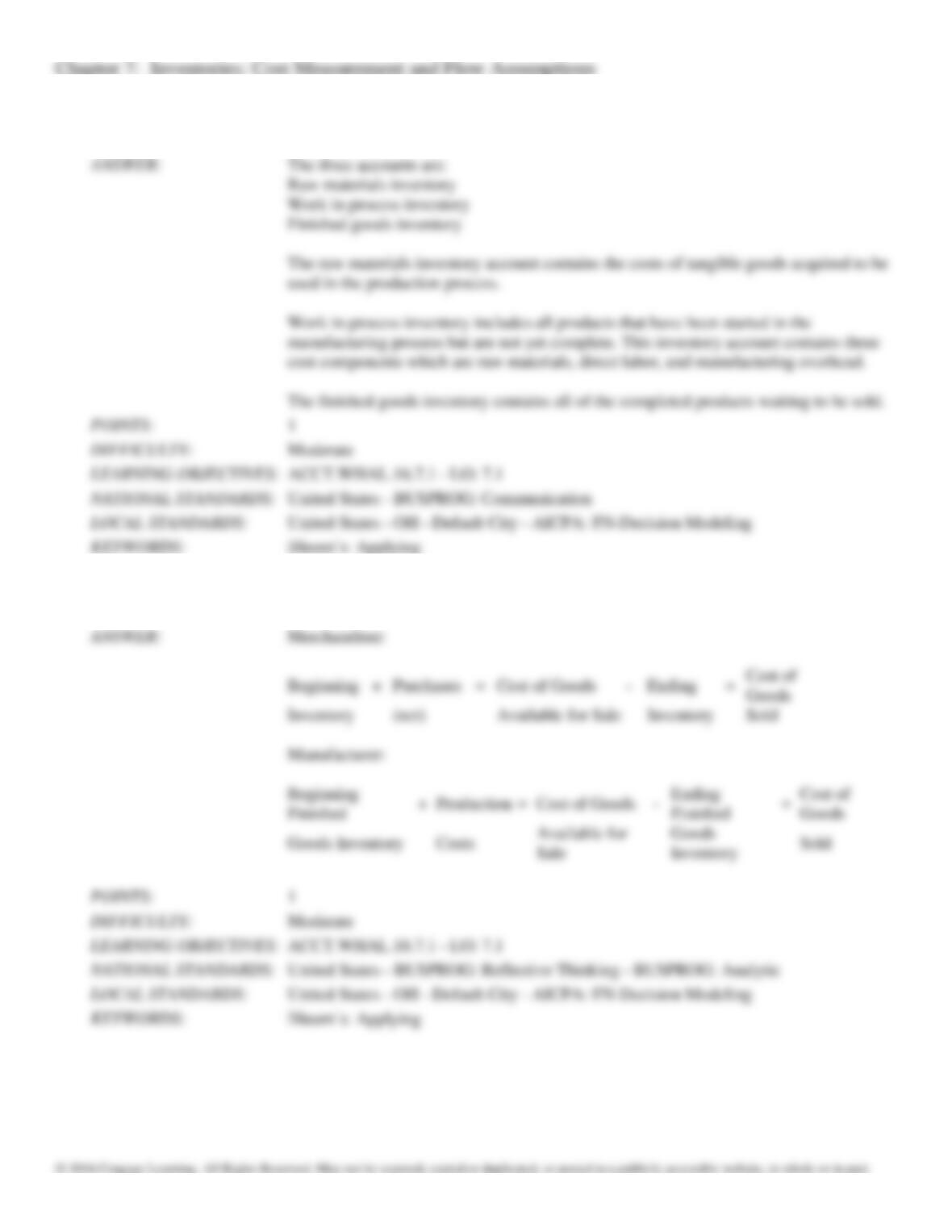
109. A manufacturing company uses three inventory accounts. What are the accounts? Provide a brief description of the
costs that accumulate in each account.
110. What is the cost of goods sold model for a merchandiser? What is the cost of goods sold model for a manufacturer?

111. What are the differences between the perpetual and periodic inventory systems?
112. What is the difference between FOB shipping point and FOB destination? Why is this important?

113. When a seller offers a discount, it can be accounted for under the gross or net price method. What is the difference
between the gross and net price method?
114. What are the cost flow assumptions available to record costs associated with inventory?
115. In a period of rising prices what are the differences between LIFO and FIFO?

116. What is the LIFO conformity rule?
117. What three difficulties does dollar-value LIFO overcome compared to applying simple LIFO?
118. What is the LIFO Valuation Allowance, also known as LIFO reserve?
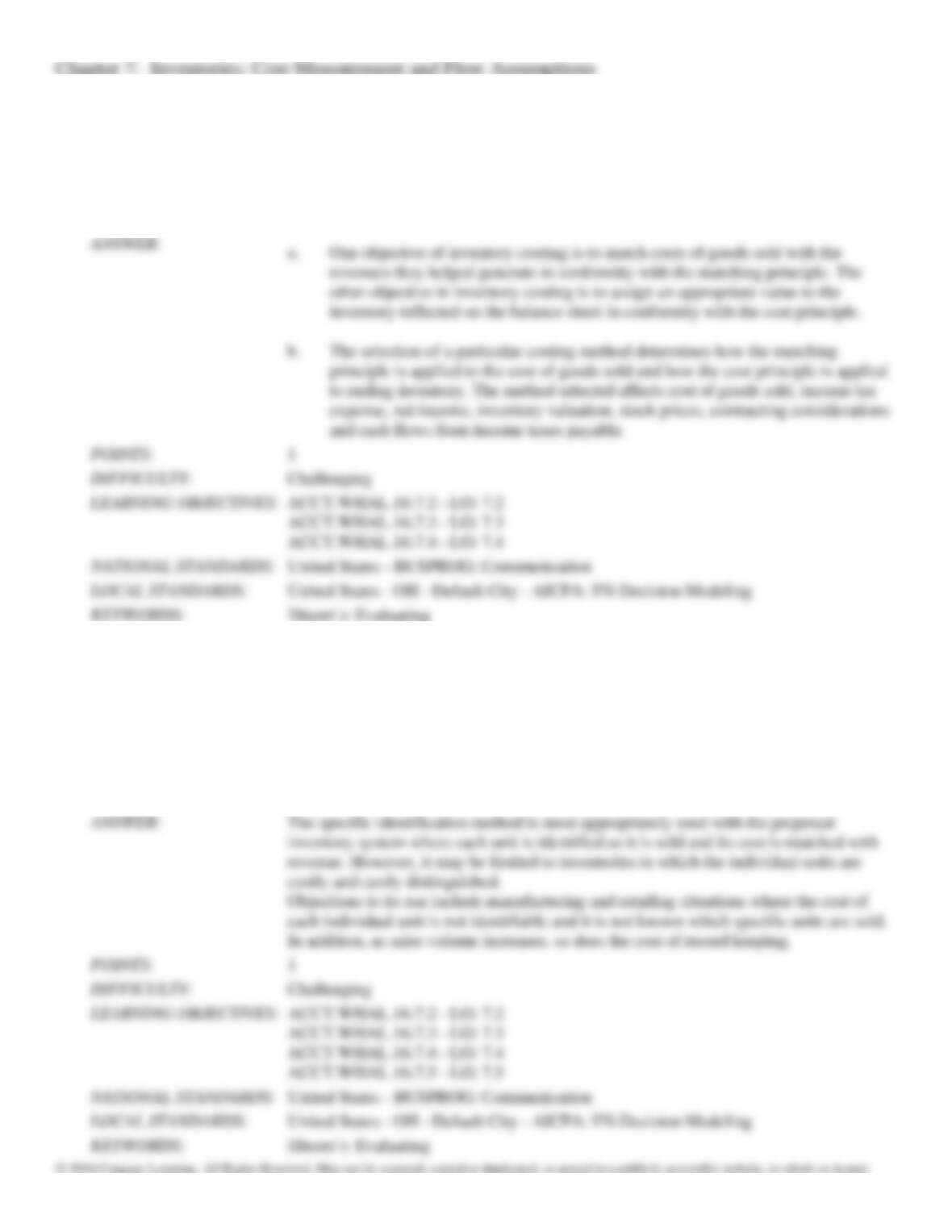
119. There are many different methods available for costing inventory. Therefore, the decision on which method to select
should involve some serious thought as to the consequences involved.
Required:
a.
Discuss the objectives of inventory costing in terms of accounting principles.
b.
Explain the consequences of the method selected.
1
Challenging
United States – BUSPROG: Communication
United States – OH – Default City – AICPA: FN-Decision Modeling
120. Because the specific identification method seems simple and matches actual costs against revenues, it may appear to
be the ideal cost flow assumption to be used in any situation.
Required:
Indicate whether a periodic or perpetual inventory system is more appropriate for this cost flow assumption, indicate
when its use is practical, and discuss the practical and theoretical objections to its use.
1
Challenging
ACCT.WHAL.16.7.5 – LO: 7.5
United States – BUSPROG: Communication
United States – OH – Default City – AICPA: FN-Decision Modeling

121. One of the disadvantages of the LIFO cost flow assumption is the impact of the liquidation of LIFO layers.
Required:
a.
Explain what is meant by inventory liquidation under the LIFO cost flow assumption.
b.
Discuss why this may be a serious problem for LIFO but not for FIFO.
no base layer to be maintained. Therefore, a liquidation profit cannot be incurred.
1
Challenging
ACCT.WHAL.16.7.8 – LO: 7.8
United States – BUSPROG: Communication
United States – OH – Default City – AICPA: FN-Decision Modeling

122. Even though the LIFO cost flow assumption will reduce taxable income and the related cash outflow for income
taxes, there are certain difficulties encountered with its implementation. Dollar-value LIFO is often used to help
overcome these difficulties.
Required:
Discuss three different ways that the dollar-value LIFO method overcomes some of the difficulties in the application
of the LIFO approach.

123. The IFRS disallow the use of LIFO for external financial reporting. Assume a U.S. based company has been using
LIFO for financial and tax reporting but now wants to prepare IFRS conforming financial statements to enable its
stock to be traded on one of the European stock exchanges.
Required:
What choices of inventory accounting methods would be available to the U.S. company
under IFRS?
All methods other than LIFO are acceptable under IFRS. However, IFRS require
that the method selected be adopted for all inventories.
ACCT.WHAL.16.7.6 – LO: 7.6
United States – OH – Default City – AICPA: FN-Decision Modeling