
Chapter 7 – Scheduling Activities
TRUE/FALSE
1. In order for activities to be useful as schedule building blocks, they should have tangible output that
can be verified.
2. There is often terrific pressure to complete a project as quickly as possible. To confront this pressure,
a project manager should quickly promise to meet the deadlines requested by the sponsor and then
assemble a team to create the corresponding schedule.
3. The first process in developing a project schedule is to identify all the resources available to work on
the project.
4. While the lowest level of decomposition in a Work Breakdown Structure is the work package, work
packages can still be decomposed further into project activities.
5. Except in rare circumstances, project teams should not attempt to decompose work packages into
project activities because work packages provide sufficient detail to develop a project schedule.
6. A successor activity follows a predecessor activity based on their logical relationship.
7. The most common type of logical dependency to determine the sequence of project activities is
“finish–to–finish”.
8. A mandatory dependency in a relationship that is contractually required or inherent in the nature of the
work.

9. The “start-to–start” logical relationship used in activity sequencing applies to the case in which a
successor activity cannot start until a predecessor activity has started.
10. The length of time to perform an activity is often dependent upon who will do that work.
11. The critical path is the sequence of activities that represent the shortest path through the project, which
determines the shortest possible duration of the project.
12. If a project manager delays the start of an activity on the critical path, then the expected completion
date of the project will occur at a later date than originally planned.
13. The enumeration method of determining the critical path relies upon identification of all paths through
the project network.
14. Even small delays on “near–critical” activities can change the critical path of a project.
15. When developing a project schedule, total float (or slack) refers to the amount of time a schedule
activity may be delayed from its early start date without delaying the project finish date.
16. PERT refers to the Program Evaluation and Review Technique, which was developed in the 1950s to
better understand how variability in the duration of individual activity durations impacts the entire
project schedule.
17. The primary advantage of PERT is that it removes uncertainty from the estimates of activity durations,
thereby increasing confidence in the reliability of a project schedule.

18. Monte Carlo simulation is a process which generates hundreds of thousands of probable performance
outcomes based on probability distributions for cost and schedule on individual tasks.
19. A Gantt chart is an easy-to-understand tool that can be used to communicate a project schedule.
20. GANTT refers to the Generalized Activity Network Tracking Technique which was developed to
better understand how variability in the duration of individual activities impacts the expected project
duration.
MULTIPLE CHOICE
1. Estimating the number of work periods that will be needed to complete individual schedule activities
characterizes which of the following time management processes?
a.
Define activities
b.
Sequence activities
c.
Estimate activity duration
d.
Create WBS
2. Creating a realistic schedule is often an iterative process because several factors can limit how fast a
project can be completed. All of the following factors can limit how fast a project can be scheduled
and completed EXCEPT:
a.
logical order
b.
imposed dates
c.
resource availability
d.
quality metrics
3. Faced with significant schedule challenges, the project manager has several responsibilities. All of
the following are among the project manager’s responsibilities EXCEPT:
a.
willingly accept end dates dictated by customers or sponsors
b.
persuade all stakeholders that the schedule makes sense
c.
deliver the project according to the agreed-upon schedule
d.
determine a schedule that is possible to achieve

4. All of the following items can provide useful assistance to a project team to define the activities of a
project EXCEPT:
a.
the work packages from the Work Breakdown Structure
b.
issue logs
c.
checklists for projects of the same type
d.
schedules from similar projects that are already completed
5. Milestones are important points in a project schedule that can serve as check points for project
managers and sponsors. All of the following reasons might justify the decision to establish a
milestone EXCEPT:
a.
completion of a major deliverable
b.
the time right before a large amount of money needs to be committed
c.
a merging point where multiple activities must be completed before progress can continue
d.
scheduling team status meetings
6. An activity that logically comes before a dependent activity in a schedule is called a ___:
a.
leader activity
b.
predecessor activity
c.
successor activity
d.
mandatory activity
7. The sequencing of activities is often based upon dependencies between the activities. The
dependencies that should guide activity sequencing can be either:
a.
critical or non-critical
b.
opportunities or threats
c.
mandatory or discretionary
d.
interior or exterior
8. Which of the following responses identifies a common type of logical dependency used to sequence
project activities?
a.
first-in; first-out
b.
last-in; last-out
c.
finish-to-start
d.
last-in; first-out

9. The total number of work periods (not including holidays or other non-work periods) required to
complete a schedule activity is known as:
a.
effort
b.
elapsed time
c.
duration
d.
resource days
10. All of the following strategies can help a project team to develop realistic time estimates for project
activities EXCEPT:
a.
adding a significant buffer to each activity
b.
be sure to consider learning curves, interruptions and competing priorities
c.
estimate times of completion without initial reference to a calendar
d.
verify the time estimates with the people doing the work
11. All of the following problems contribute to difficulty in estimating activity durations accurately
EXCEPT:
a.
merging – multiple predecessors
b.
omissions – leaving out key activities
c.
general uncertainty in the estimate
d.
poor vendor selection
12. Which of the following remedies may reduce the likelihood of omissions when developing activity
duration estimates?
a.
lessons learned
b.
resource buffers
c.
learning curve
d.
staggering project start dates
13. Which of the following statements correctly describes the critical path?
a.
The sequence of activities that represents the shortest path through the project network.
b.
It determines the latest possible end date of the project.
c.
It consists only of activities with zero float (slack).
d.
It consists only of activities with lag times
14. The amount of time a schedule activity can be delayed without delaying the early start date of any
successor is known as:
a.
reserve
b.
free float
c.
contingency
d.
lead
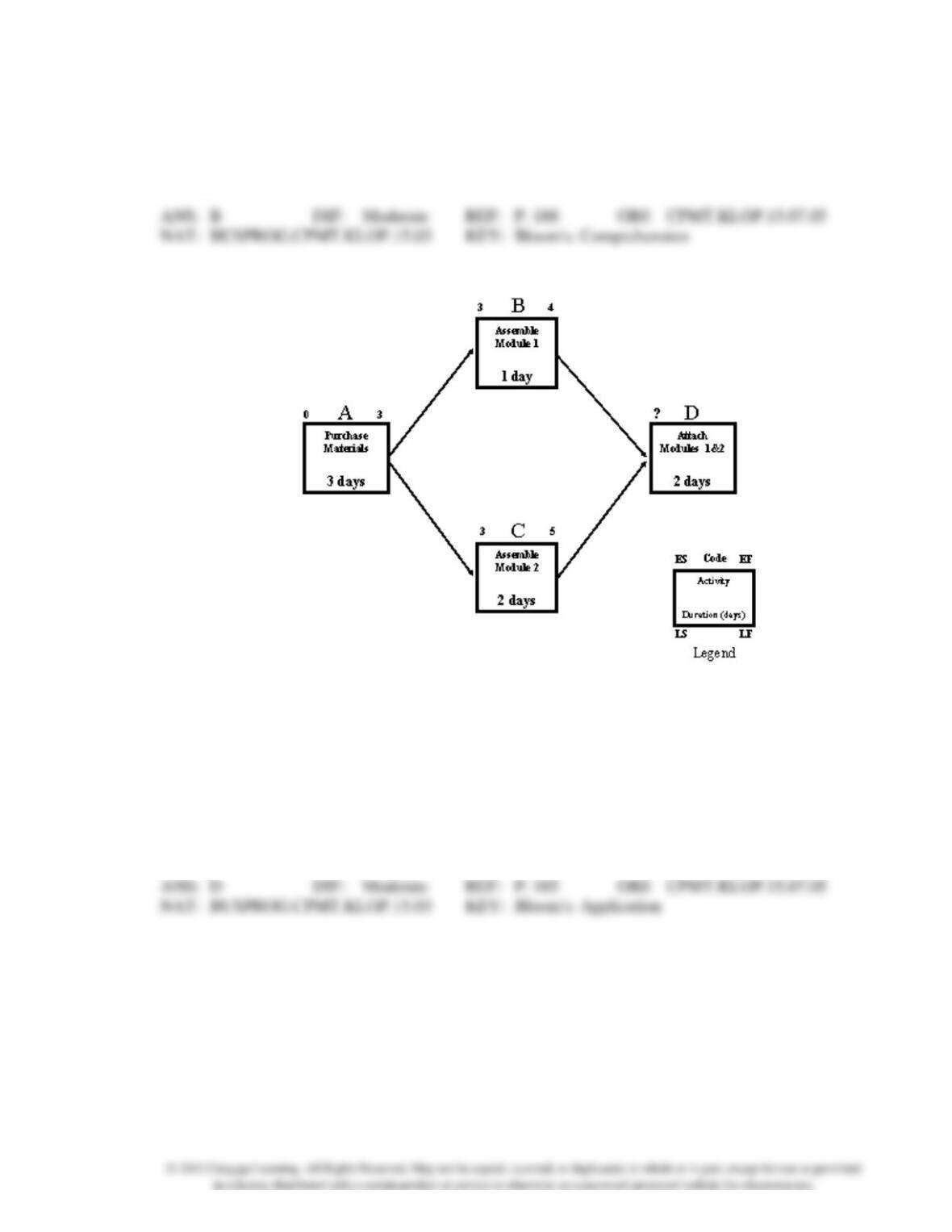
Figure 7-1 Assembly Project
15. Consider the Assembly Project depicted in Figure 7-1. Based on the information provided, what is
the early start date for activity D – “Attach Modules 1 & 2”?
a.
Day 0
b.
Day 3
c.
Day 4
d.
Day 5
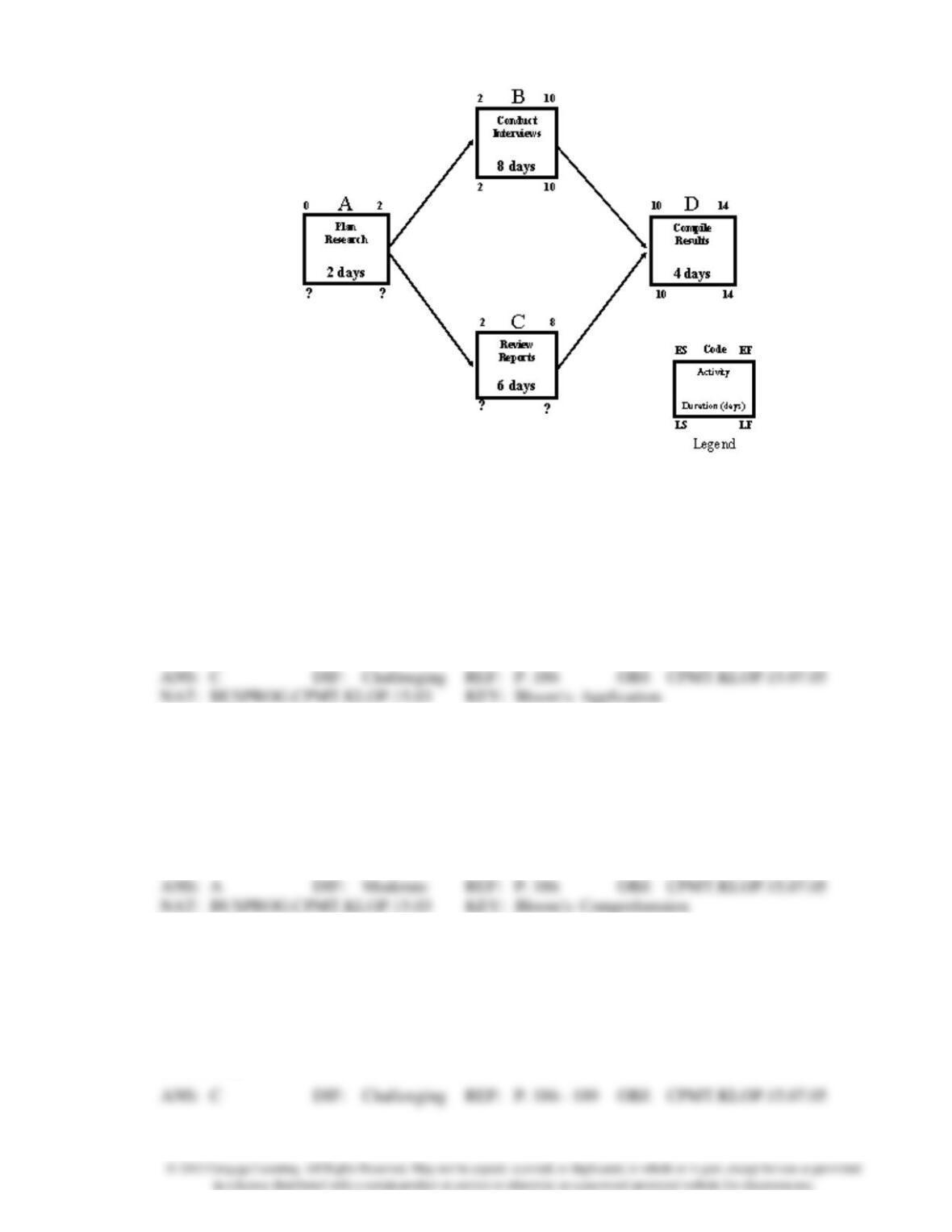
Figure 7-2 Research Project
16. Consider the Research Project depicted in Figure 7-2. Based on the information provided, what is the
late start date for activity C – “Review Reports”?
a.
Day 0
b.
Day 2
c.
Day 4
d.
Day 10
17. Consider the Research Project depicted in Figure 7-2. Based on the information provided, what is the
late start date for activity A – “Plan Research”?
a.
Day 0
b.
Day 2
c.
Day 4
d.
Day 10
18. Consider the Research Project depicted in Figure 7-2. Based on the information provided, which
activity can you delay by one day without impacting the expected completion date for the project?
a.
Activity A
b.
Activity B
c.
Activity C
d.
Activity D
19. Consider the Research Project depicted in Figure 7-2. Based on the information provided, what is the
slack associated with activity C – “Review Reports”?
a.
0 days
b.
1 day
c.
2 days
d.
4 days
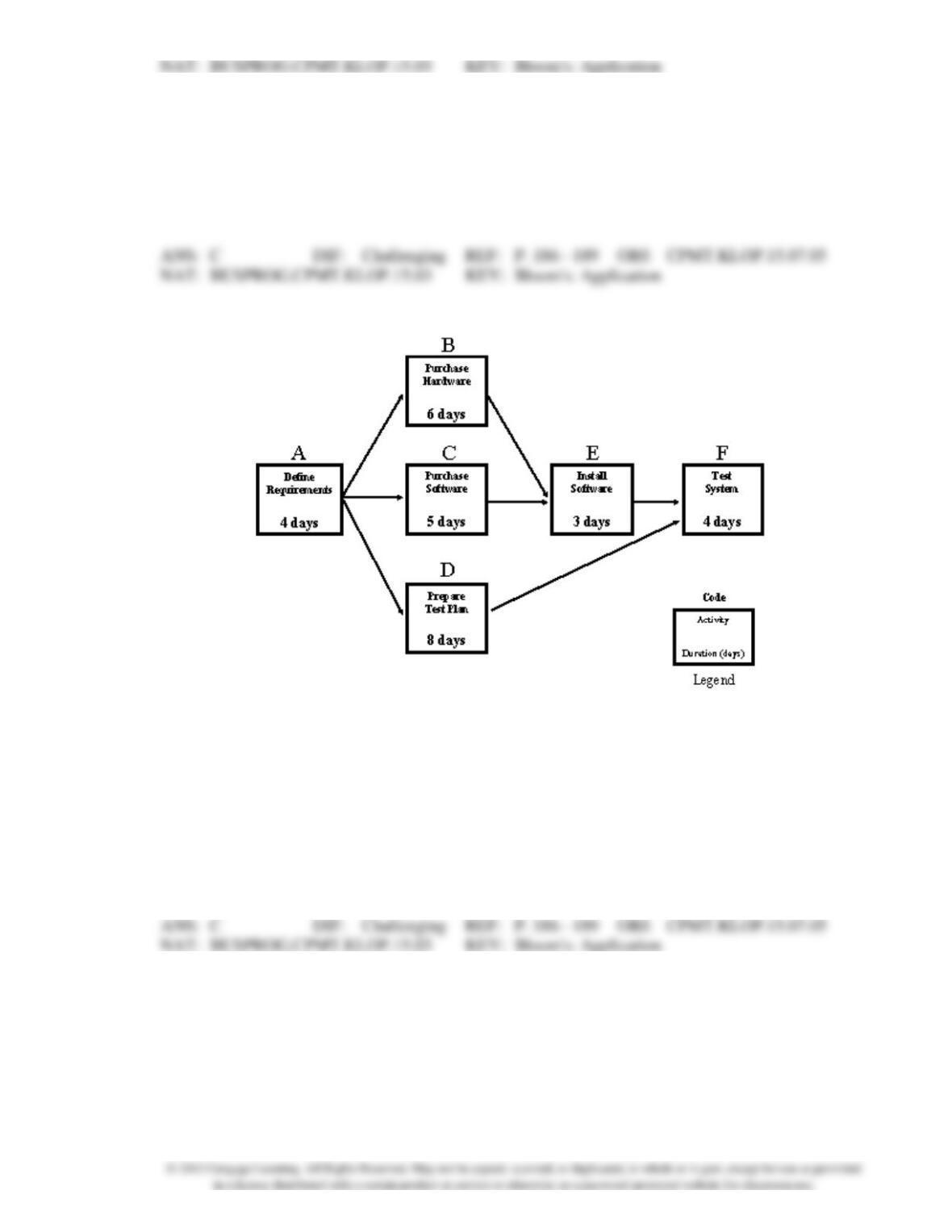
Figure 7-3 System Integration Project
20. Consider the System Integration Project depicted in Figure 7-3. Based on the information provided,
what is the expected duration of this project?
a.
15 days
b.
16 days
c.
17 days
d.
30 days
21. Consider the System Integration Project depicted in Figure 7-3. Based on the information provided,
which activities constitute the critical path for this project?
a.
A-B-E-F
b.
A-C-E-F
c.
A-D-E-F
d.
A-D-F
22. Consider the System Integration Project depicted in Figure 7-3. Based on the information provided,
which activities can be delayed one day without impacting the expected project completion date?
a.
Activity E – Install Software and Activity F – Test System
b.
Activity C – Purchase Software and Activity E – Install Software
c.
Activity C – Purchase Software and Activity D – Prepare Test Plan
d.
none of these
23. Consider the System Integration Project depicted in Figure 7-3. Based on the information provided,
how many days can you delay the purchase of software (Activity C), without impacting the expected
project completion date?
a.
0 days
b.
1 day
c.
2 days
d.
4 days
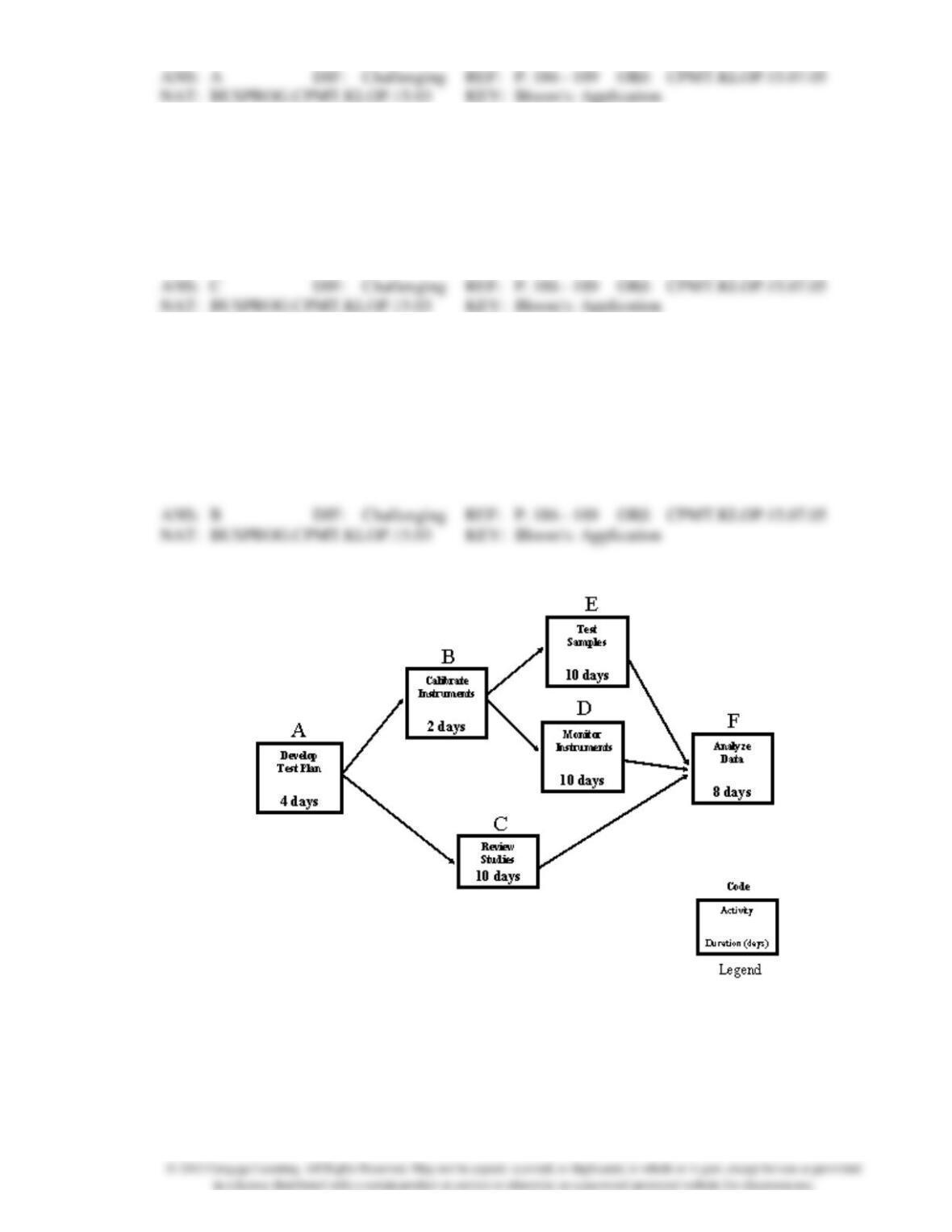
Figure 7-4 Lab Experiment Project
24. Consider the Lab Experiment Project depicted in Figure 7-4. Based on the information provided,
what is the expected duration of this project?
a.
22 days

b.
24 days
c.
26 days
d.
28 days
25. Consider the Lab Experiment Project depicted in Figure 7-4. Based on the information provided,
identify the critical path(s) for this project?
a.
A-C-F only
b.
A-B-D-F only
c.
A-B-E-F only
d.
Both A-B-D-F and A-B-E-F are critical paths
26. Consider the Lab Experiment Project depicted in Figure 7-4. Based on the information provided,
which activity can be delayed one day without impacting the expected project completion date?
a.
Activity B – Calibrate Instruments
b.
Activity C – Review Studies
c.
Activity D – Monitor Instruments
d.
Activity E – Test Samples
27. Consider the Lab Experiment Project depicted in Figure 7-4. Based on the information provided, how
many days can you delay the calibration of the instrumentation (Activity B), without impacting the
expected project completion date?
a.
0 days
b.
1 day
c.
2 days
d.
4 days
Activity
Predecessor(s)
Duration (days)
A
—
5
B
A
20
C
A
15
D
A
5
E
B, C
60
F
D
15
G
E
20
H
E
15
I
F, G, H
2

Figure 7-6 Network Scheduling Data
28. Consider the network scheduling data provided in Figure 7-6. Which activities constitute the critical
path for this project network?
a.
A-D-F-I
b.
A-C-E-H-I
c.
A-B-E-H-I
d.
A-B-E-G-I
29. Consider the network scheduling data provided in Figure 7-6. What is the expected duration of this
project?
a.
97 days
b.
102 days
c.
107 days
d.
112 days
30. Consider the network scheduling data presented in Figure 7-6. How many days of slack are
associated with activity F?
a.
0
b.
15
c.
80
d.
107
Activity
Optimistic
Time (a)
Most Likely
Time (m)
Pessimistic
Time (b)
Expected
Duration
A – Review Design
18
24
30
24
B – Assemble Item
14
21
28
21
C – Inspect Item
4
6
8
6
D – Package Item
5
10
12
?
Figure 7-5 Duration Estimates
31. Consider the activity duration estimates presented in Figure 7-5. Based on the information provided
and adopting the PERT conventions to calculate expected activity durations, what is the expected
duration of Activity D – “Package Item”?
a.
9 days
b.
9.5 days
c.
10 days

d.
12 days
32. All of the following statements correctly describe an advantage or disadvantage associated with the
use of Monte Carlo Analysis EXCEPT:
a.
The flexibility of Monte Carlo Analysis allows for more realistic estimates.
b.
Monte Carlo simulation aids in the identification of near-critical paths.
c.
Monte Carlo simulations typically require the use of special software and skills.
d.
Monte Carlo simulations do not consider risks
33. Despite the insights that PERT provides, there are still practical limitations that impact its usefulness.
All of the following difficulties are associated with the use of PERT EXCEPT:
a.
It often requires more effort to generate three estimates than one.
b.
It highlights uncertainty in project duration
c.
It does not accurately address the case when two activities both need to be accomplished
before a third can begin.
d.
There is no assurance that three estimates are any more accurate than one
ESSAY
1. Many factors can impact the accuracy of activity duration estimates. Describe four of the problems
associated with estimating time accurately, and the techniques you would use as a project manager to
overcome them.

2. Describe “slack” and how you can use slack to your advantage in managing a project.
3. Describe how you would use the members of your project team to develop and execute a project
schedule.