7-1
Chapter 07 Long-Term Assets Answer Key
True / False Questions
1.
The CEO, as head of the company, is ultimately responsible for the firm’s accounting.
2.
We record a long-term asset at its cost less all expenditures necessary to get the asset
ready for use.
7-2
3.
We use the term capitalize to describe recording an expenditure as an expense.
4.
Cash received from the sale of salvaged materials increases the total cost of land.
5.
Land improvements are recorded separately from the land itself because, unlike land,
these assets are subject to depreciation.
7-3
6.
A basket purchase is the purchase of more than one asset at the same time for one
purchase price.
7.
We allocate natural resources to expense through a process known as “depletion.”
8.
Many intangible assets are not recorded on the balance sheet at their estimated market
values.
7-4
9.
We record purchased intangible assets at their original cost plus all other costs necessary
to get the asset ready for use.
10.
Most of the costs associated with internally developed intangible assets are recorded as
intangible assets on the balance sheet.
11.
Research and development costs incurred in developing a patent internally are not
recorded as an intangible asset in the balance sheet, but rather are expensed directly in
the income statement.
7-5
12.
International accounting standards allow firms to record development costs that benefit
future periods as an intangible asset.
13.
Advertising costs that increase the value of trademarks are recorded to the asset account
entitled Trademarks.
14.
We expense internally generated intangible assets, such as research and development and
advertising costs, as we incur them.
7-6
15.
A patent is an exclusive right to a published work such as a song, film, or painting.
16.
A copyright is an exclusive right of protection given to the creator of a published work such
as a song, film, painting, photograph, book, or computer software.
17.
A trademark is a word, slogan, or symbol that distinctively identifies a company, product,
or service.
7-7
18.
When a firm develops a trademark internally through advertising, it does not record the
advertising costs as an intangible asset, but rather expenses them in the income
statement.
19.
The franchisee’s initial fee is recorded as an expense on the income statement.
20.
We record goodwill as an intangible asset in the balance sheet only when we purchase it
as part of the acquisition of another company.
7-8
21.
The acquiring company records goodwill equal to the purchase price less the book value of
the net assets acquired.
22.
We capitalize repairs and maintenance expenditures because they maintain a given level
of benefits.
7-9
23.
If a firm successfully defends an intangible right, it should expense the litigation costs as
incurred.
24.
If the defense of an intangible right is unsuccessful, then the firm should expense the
litigation costs as incurred because they provide no future benefit.
25.
Depreciation in accounting is the process of allocating to expense the cost of an asset
over its service life.
7-10
26.
Depreciation in accounting records the decrease in value of an asset.
27.
Accumulated Depreciation is a liability account that is increased by credits.
28.
Book value is equal to the original cost of the asset minus the current balance in
Accumulated Depreciation.
7-11
29.
The Accumulated Depreciation account allows us to reduce the carrying value of assets
through depreciation, while maintaining the original cost of each asset in the accounting
records.
30.
The service life of an asset is always equal to the full life of the asset.
31.
Residual value, also referred to as salvage value, is the amount the company expects to
receive from selling the asset at the end of its service life.
7-12
32.
With the straight-line depreciation method, we allocate an equal amount of the
depreciable cost to each year of the asset’s service life.
33.
When a change in estimate is required, the company changes depreciation in prior, current
and future years.
34.
Straight-line depreciation assumes that the benefits we derive from the use of an asset
are the same each year.
7-13
35.
Declining-balance depreciation will be lower than straight-line depreciation in earlier
years, but higher in later years.
36.
In an activity-based depreciation method, we allocate an asset’s cost based on its use.
37.
Straight-line produces a lower net income than accelerated methods in the earlier years of
an asset’s life.
7-14
38.
Straight-line, declining-balance, and activity-based depreciation all are acceptable
depreciation methods for both financial reporting and tax reporting.
39.
Most companies use straight-line amortization for intangibles and credit the amount of
amortization to the intangible asset account itself rather than to Accumulated
Amortization.
40.
Goodwill is amortized over its estimated useful life.
7-15
41.
Intangible assets with an indefinite useful life (goodwill and most trademarks) are not
amortized.
42.
We record a gain if we sell an asset for less than book value.
43.
We record a loss if we sell an asset for less than book value.
7-16
44.
A more comparable measure of profitability than income is return on assets, which equals
net income divided by average total assets.
45.
Profit margin is net income divided by net sales.
46.
Asset turnover is net sales divided by ending total assets.
7-17
47.
Management must review long-term assets for impairment when events or changes in
circumstances indicate that book value might not be recoverable.
48.
Impairment occurs when the future cash flows generated for a long-term asset fall below
its fair value.
49.
An impairment loss is equal to the amount by which book value exceeds the fair value of a
long-term asset.
7-18
50.
Taking a “big bath” is recording all losses in one year to make a bad year even worse.
Multiple Choice Questions
51.
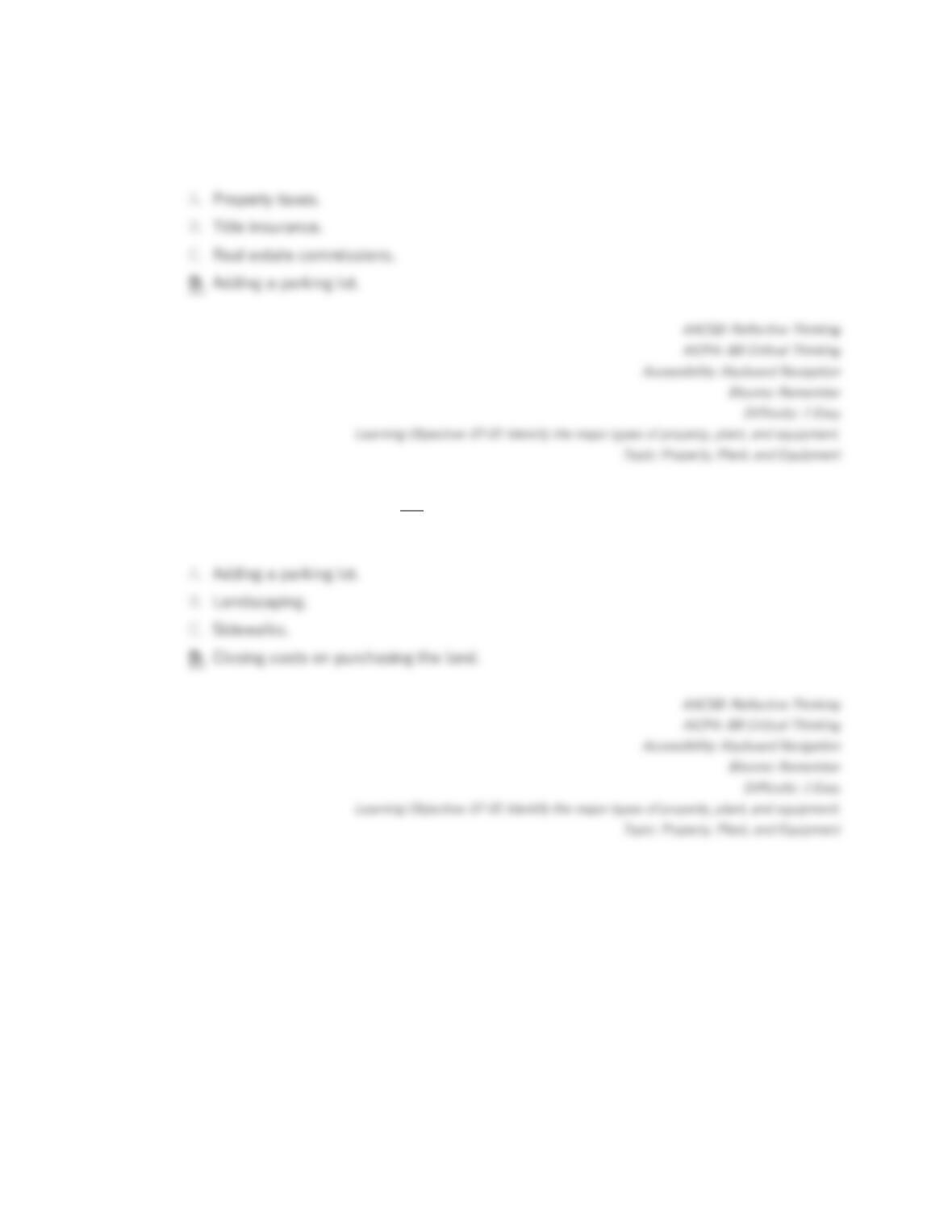
Real Angus Steakhouse purchased land for $75,000 cash. They also incurred commissions
of $4,500, property taxes of $5,000, and title insurance of $800. The $5,000 in property
taxes includes $4,000 in back taxes paid by Real Angus on behalf of the seller and $1,000
due for the current year after the purchase date. For what amount should Real Angus
Steakhouse record the land?
7-19
52.
Which of the following would be recorded as land improvements?
53.
Which of the following would not be recorded as land improvements?
7-20
54.
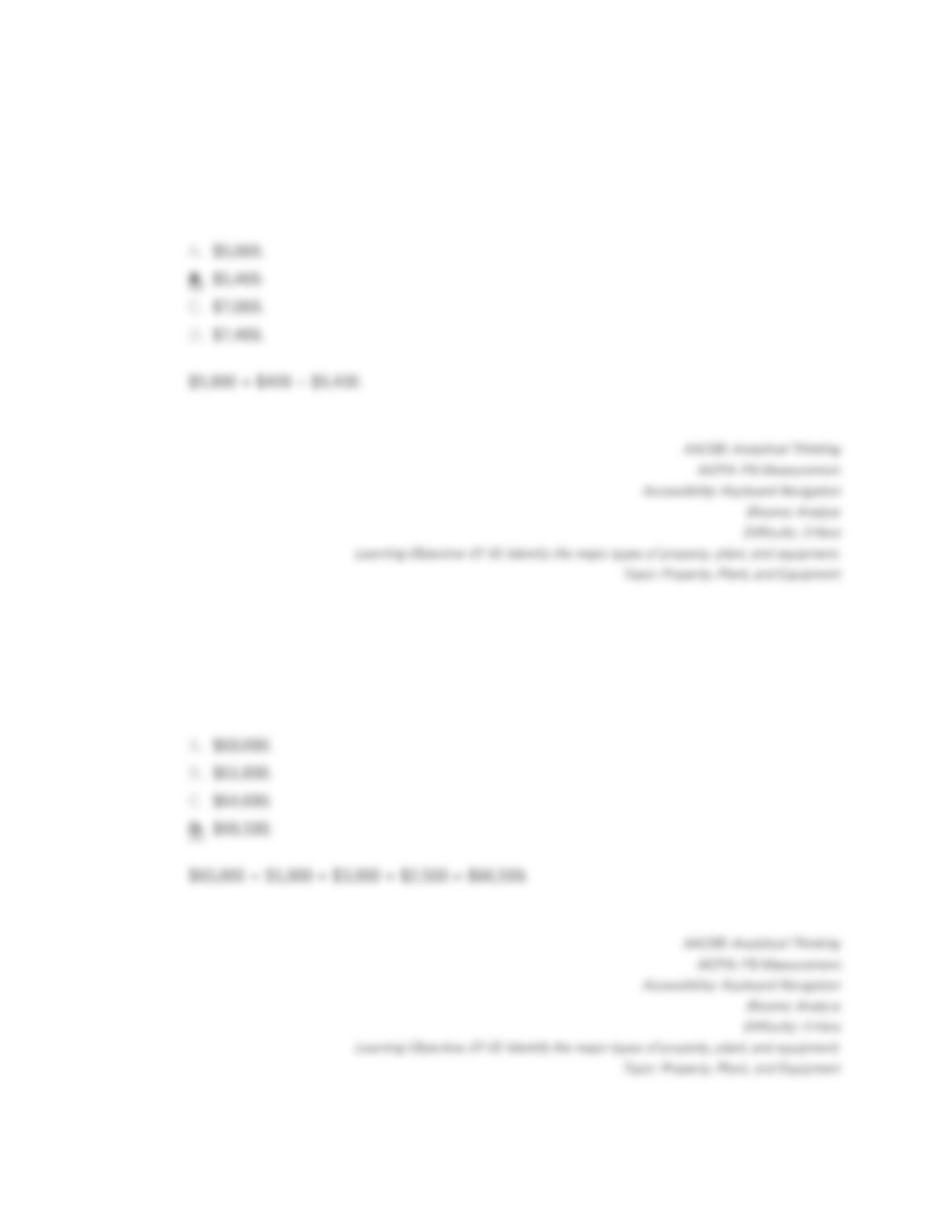
Bad Brads BBQ purchased a piece of equipment by paying $5,000 cash. They also incurred
a shipping cost of $400 to get the equipment to its factory. The fair value of this
equipment is $7,000. For what amount should Bad Brads BBQ record the equipment?
55.
Wiley Company purchased new equipment for $60,000. Wiley paid cash for the equipment.
Other costs associated with the equipment were: transportation costs, $1,000; sales tax
paid $3,000; and installation cost, $2,500. The cost recorded for the equipment was: