
FOR INSTRUCTOR USE ONLY
CHAPTER 7
FRAUD, INTERNAL CONTROL, AND CASH
SUMMARY OF QUESTIONS BY LEARNING OBJECTIVE AND BLOOM’S TAXONOMY
Item
LO
BT
Item
LO
BT
Item
LO
BT
Item
LO
BT
Item
LO
BT
True-False Statements
1.
1
K
9.
2
K
17.
2
K
25.
4
K
33.
6
K
2.
1
K
10.
2
K
18.
2
K
26.
4
K
34.
6
K
3.
2
K
11.
2
K
19.
2
K
27.
5
K
35.
7
K
4.
2
K
12.
2
K
20.
2
K
28.
5
K
36.
8
K
5.
2
K
13.
2
K
21.
3
K
29.
5
K
37.
8
K
6.
2
K
14.
2
K
22.
3
K
30.
5
K
*38.
9
K
7.
2
K
15.
2
K
23.
3
K
31.
6
K
*39.
9
K
8.
2
K
16.
2
K
24.
4
K
32.
6
K
Multiple Choice Questions
40.
1
C
73.
2
K
106.
4
K
139.
5
AP
172.
8
AP
41.
1
K
74.
2
K
107.
5
K
140.
5
C
173.
8
K
42.
2
K
75.
2
K
108.
5
K
141.
5
C
174.
8
K
43.
2
K
76.
2
K
109.
5
K
142.
5
C
175.
8
AP
44.
2
K
77.
2
K
110.
5
K
143.
5
C
176.
8
AP
45.
2
K
78.
2
C
111.
5
K
144.
5
AP
177.
8
C
46.
2
K
79.
2
C
112.
5
K
145.
5
AP
178.
8
AP
47.
2
K
80.
3
K
113.
5
K
146.
5
AP
179.
8
AP
48.
2
K
81.
3
K
114.
5
K
147.
5
AP
180.
8
AP
49.
2
K
82.
3
K
115.
5
K
148.
5
AP
181.
8
AP
50.
2
K
83.
3
K
116.
5
K
149.
5
AP
182.
8
AP
51.
2
K
84.
3
K
117.
5
K
150.
5
AP
183.
8
K
52.
2
K
85.
3
K
118.
5
AP
151.
5
AP
184.
8
AP
53.
2
K
86.
3
K
119.
5
AP
152.
5
AP
185.
8
AP
54.
2
K
87.
3
K
120.
5
AP
153.
5
AP
*186.
9
K
55.
2
K
88.
4
K
121.
5
AP
154.
6
C
*187.
9
K
56.
2
K
89.
4
K
122.
5
AP
155.
6
K
*188.
9
C
57.
2
K
90.
4
K
123.
5
AP
156.
6
K
*189.
9
K
58.
2
C
91.
4
K
124.
5
K
157.
6
K
*190.
9
AP
59.
2
C
92.
4
K
125.
5
K
158.
6
K
*191.
9
K
60.
2
K
93.
4
K
126.
5
K
159.
6
K
*192.
9
AP
61.
2
K
94.
4
K
127.
5
AP
160.
7
K
*193.
9
AP
62.
2
K
95.
4
K
128.
5
AP
161.
7
K
*194.
9
AP
63.
2
K
96.
4
K
129.
5
AP
162.
7
K
*195.
9
AP
64.
2
K
97.
4
K
130.
5
AP
163.
7
K
*196.
9
AP
65.
2
K
98.
4
K
131.
5
AP
164.
7
K
*197.
9
AP
66.
2
K
99.
4
K
132.
5
AP
165.
8
K
*198.
9
AP
67.
2
K
100.
4
C
133.
5
K
166.
8
AP
*199.
9
K
68.
2
K
101.
4
K
134.
5
AP
167.
8
AP
*200.
9
K
69.
2
C
102.
4
K
135.
5
AP
168.
8
AP
70.
2
K
103.
4
K
136.
5
AP
169.
8
K
71.
2
K
104.
4
K
137.
5
K
170.
8
AP
72.
2
K
105.
4
C
138.
5
AP
171.
8
AP
Test Bank for Financial Accounting: Tools for Business Decision Making, Seventh Edition
FOR INSTRUCTOR USE ONLY
7-2
Brief Exercises
201.
2
K
204.
4
K
207.
5
AP
210.
5
AP
202.
2
K
205.
5
K
208.
5
AP
211.
6
AP
203.
3
K
206.
5
K
209.
5
AP
Exercises
212.
2
C
218.
5
AP
224.
5
AN
230.
5
AP
*236.
9
AP
213.
2
AN
219.
5
AP
225.
5
AN
231.
5
AP
*237.
9
AP
214.
5
AP
220.
5
AP
226.
5
C
232.
8
AP
*238.
9
AP
215.
5
AP
221.
5
K
227.
5
AP
233.
8
AP
216.
5
AP
222.
5
AP
228.
5
AP
234.
8
AP
217.
5
AP
223.
5
AP
229.
5
AP
*235.
9
AP
Completion Statements
239.
1
K
243.
2
K
247.
4
K
251.
5
K
*255.
9
K
240.
1
K
244.
2
K
248.
5
K
252.
7
K
241.
1
K
245.
2
K
249.
5
K
253.
8
K
242.
1
K
246.
4
K
250.
5
K
*254.
9
K
Matching
256.
1-7
K
Short Answer Essay
257.
1
K
259.
2
C
261.
2
C
263.
5
C
265.
2
E
258.
2
C
260.
2
E
262.
4
K
264.
7
C
266.
2
C
*This topic is dealt with in an Appendix to the chapter.
SUMMARY OF LEARNIG OBJECTIVES BY QUESTION TYPE
Learning Objective 1
Item
Type
Item
Type
Item
Type
Item
Type
Item
Type
Item
Type
1.
TF
2.
TF
40.
MC
41.
MC
256.
Ma
257.
SA
Learning Objective 2
3.
TF
16.
TF
50.
MC
63.
MC
76.
MC
244.
C
4.
TF
17.
TF
51.
MC
64.
MC
77.
MC
245.
C
5.
TF
18.
TF
52.
MC
65.
MC
78.
MC
256.
Ma
6.
TF
19.
TF
53.
MC
66.
MC
79.
MC
258.
SA
7.
TF
20.
TF
54.
MC
67.
MC
201.
Be
259.
SA
8.
TF
42.
MC
55.
MC
68.
MC
202.
Be
260.
SA
9.
TF
43.
MC
56.
MC
69.
MC
212.
Ex
261.
SA
10.
TF
44.
MC
57.
MC
70.
MC
213.
Ex
265.
SA
11.
TF
45.
MC
58.
MC
71.
MC
239.
C
266.
SA
12.
TF
46.
MC
59.
MC
72.
MC
240.
C
13.
TF
47.
MC
60.
MC
73.
MC
241.
C
14.
TF
48.
MC
61.
MC
74.
MC
242.
C
15.
TF
49.
MC
62.
MC
75.
MC
243.
C
Fraud, Internal Control, and Cash
FOR INSTRUCTOR USE ONLY
7-3
Learning Objective 3
Item
Type
Item
Type
Item
Type
Item
Type
Item
Type
Item
Type
21.
TF
23.
TF
81.
MC
83.
MC
85.
MC
87.
MC
22.
TF
80.
MC
82.
MC
84.
MC
86.
MC
256.
Ma
Learning Objective 4
24.
TF
90.
MC
95.
MC
100.
MC
105.
MC
25.
TF
91.
MC
96.
MC
101.
MC
106.
MC
26.
TF
92.
MC
97.
MC
102.
MC
225.
C
88.
MC
93.
MC
98.
MC
103.
MC
256.
Ma
89.
MC
94.
MC
99.
MC
104.
MC
262.
SA
Learning Objective 5
27.
TF
117.
MC
131.
MC
145.
MC
210.
Be
227.
Ex
28.
TF
118.
MC
132.
MC
146.
MC
214.
Ex
228.
Ex
29.
TF
119.
MC
133.
MC
147.
MC
215.
Ex
229.
Ex
30.
TF
120.
MC
134.
MC
148.
MC
216.
Ex
230.
Ex
107.
MC
121.
MC
135.
MC
149.
MC
217.
Ex
248.
C
108.
MC
122.
MC
136.
MC
150.
MC
218.
Ex
249.
C
109.
MC
123.
MC
137.
MC
151.
MC
219.
Ex
250.
C
110.
MC
124.
MC
138.
MC
152.
MC
220.
Ex
251.
C
111.
MC
125.
MC
139.
MC
153.
MC
221.
Ex
256.
Ma
112.
MC
126.
MC
140.
MC
205.
Be
222.
Ex
263.
SA
113.
MC
127.
MC
141.
MC
206.
Be
223.
Ex
114.
MC
128.
MC
142.
MC
207.
Be
224.
Ex
115.
MC
129.
MC
143.
MC
208.
Be
225.
Ex
116.
MC
130.
MC
144.
MC
209.
Be
226.
Ex
Learning Objective 6
31.
TF
33.
TF
154.
MC
156.
MC
158.
MC
211.
Be
32.
TF
34.
TF
155.
MC
157.
MC
159.
MC
256.
Ma
Learning Objective 7
35.
TF
161.
MC
163.
MC
231.
C
264.
SA
160.
MC
162.
MC
164.
MC
256.
Ma
Learning Objective 8
36.
TF
168.
MC
173.
MC
178.
MC
183.
MC
233.
Ex
37.
TF
169.
MC
174.
MC
179.
MC
184.
MC
234.
Ex
165.
MC
170.
MC
175.
MC
180.
MC
185.
MC
253.
C
166.
MC
171.
MC
176.
MC
181.
MC
231.
Ex
167.
MC
172.
MC
177.
MC
182.
MC
232.
Ex
Test Bank for Financial Accounting: Tools for Business Decision Making, Seventh Edition
FOR INSTRUCTOR USE ONLY
7-4
Learning Objective 9
Item
Type
Item
Type
Item
Type
Item
Type
Item
Type
Item
Type
34.
TF
187.
MC
191.
MC
195.
MC
199.
MC
237.
Ex
38.
TF
188.
MC
192.
MC
196.
MC
200.
MC
238.
Ex
39.
TF
189.
MC
193.
MC
197.
MC
235.
Ex
254.
C
186.
MC
190.
MC
194.
MC
198.
MC
236.
Ex
255.
C
Note: TF = True-False C = Completion
MC = Multiple Choice Ex = Exercise
Ma = Matching SA = Short Answer Essay
CHAPTER LEARNING OBJECTIVES
1. Define fraud and internal control. A fraud is a dishonest act by an employee that results in
personal benefit to the employee at a cost to the employer. The fraud triangle refers to the
three factors that contribute to fraudulent activity by employees: opportunity, financial
pressure, and rationalization. Internal control consists of all the related methods and
measures adopted within an organization to safeguard its assets, enhance the reliability of its
accounting records, increase efficiency of operations, and ensure compliance with laws and
regulations.
2. Identify the principles of internal control activities. The principles of internal control are
establishment of responsibility; segregation of duties; documentation procedures; physical
controls; independent internal verification; and human resource controls.
3. Explain the applications of internal control principles to cash receipts. Internal controls
over cash receipts include: (a) designating only personnel such as cashiers to handle cash;
(b) assigning the duties of receiving cash, recording cash, and having custody of cash to
different individuals; (c) obtaining remittance advices for mail receipts, cash register tapes or
computer records for over-the-counter receipts, and deposit slips for bank deposits; (d) using
company safes and bank vaults to store cash with access limited to authorized personnel,
and using cash registers in executing over-the-counter receipts; (e) making independent daily
counts of register receipts and daily comparisons of total receipts with total deposits; and (f)
bonding personnel who handle cash, as well as requiring them to take vacations.
4. Explain the applications of internal control principles to cash disbursements. Internal
controls over cash disbursements include: (a) having only specified individuals such as the
treasurer authorized to sign checks; (b) assigning the duties of approving items for payment,
paying the items, and recording the payment to different individuals; (c) using prenumbered
checks and accounting for all checks, with each check supported by an approved invoice;
after payment, stamping each approved invoice “paid”; (d) storing blank checks in a safe or
vault with access restricted to authorized personnel, and using a machine with indelible ink to
imprint amounts on checks; (e) comparing each check with the approved invoice before
issuing the check, and making monthly reconciliations of bank and book balances; and (f)
bonding personnel who handle cash, requiring employees to take vacations, and conducting
background checks.
Fraud, Internal Control, and Cash
7-5
5. Prepare a bank reconciliation. In reconciling the bank account, it is customary to reconcile
the balance per books and the balance per bank to their adjusted balance. The steps
reconciling the Cash account are to determine deposits in transit, outstanding checks, errors
by the depositor or the bank, and unrecorded bank memoranda.
6. Explain the reporting of cash. Cash is listed first in the current assets section of the balance
sheet. Companies often report cash together with cash equivalents. Cash restricted for a
special purpose is reported separately as a current asset or as a noncurrent asset, depending
on when the company expects to use the cash.
7. Discuss the basic principles of cash management. The basic principles of cash
management include: (a) increase the speed of receivables collection, (b) keep inventory
levels low, (c) monitor the timing of payment of liabilities, (d) plan timing of major
expenditures, and (e) invest idle cash.
8. Identify the primary elements of a cash budget. The three main elements of a cash budget
are the cash receipts section, cash disbursements section, and financing section.
*9. Explain the operation of a petty cash fund. In operating a petty cash fund, a company
establishes the fund by appointing a custodian and determining the size of the fund. The
custodian makes payments from the fund for documented expenditures. The company
replenishes the fund as needed, and at the end of each accounting period. Accounting entries
to record payments are made each time the fund is replenished.
TRUE-FALSE STATEMENTS
1. The most important element of the fraud triangle is rationalization.
2. Employees sometimes commit fraud because of personal financial problems caused by
too much debt.
3. The safeguarding of assets is an objective of a company’s system of internal control.
4. When one individual is responsible for all related activities, the potential for errors and
irregularities is decreased.
5. Internal control is most effective when several people are responsible for a given task.
6. An effective system of internal control centralizes functions in a single capable individual.
Test Bank for Financial Accounting: Tools for Business Decision Making, Seventh Edition
7-6
7. The responsibility for keeping the records for an asset should be separate from the
physical custody of that asset.
8. Requiring employees to take vacations is a weakness in the system of internal controls
because it does not promote operational efficiency.
9. The extent of internal control features adopted by a company must be evaluated in terms
of cost-benefit.
10. Bonding means insuring a company against theft by employees.
11. It is unlikely that a company would want to bond its employees who handle cash or
inventory.
12. An effective system of internal control requires that at least two individuals be assigned to
one cash drawer so that each can serve as check on the other.
13. A good system of internal control will safeguard its assets and enhance the accuracy and
reliability of its accounting records.
14. A system of internal control cannot be considered good until the possibility of human error
has been completely eliminated.
15. Only large companies need to be concerned with a system of internal control.
16. Under an effective system of internal control, errors occur only as a result of fraud or
dishonesty.
17. The responsibility for ordering, receiving, and paying for merchandise should be assigned
to different individuals.
Fraud, Internal Control, and Cash
7-7
18. The separation of duties feature of internal control can be negated when several
employees are involved in a scheme.
19. In order to prevent a transaction from being recorded more than once, a company should
maintain only one book of original entry.
20. Segregation of duties among employees eliminates the possibility of collusion.
21. For efficiency of operations and better control over cash, a company should maintain only
one bank account.
22. Checks received in the mail should be immediately stamped “NSF” to prevent
unauthorized cashing of the check.
23. The treasurer should prepare and sign a check only after authorization to issue a check
has been provided.
24. Control over cash disbursements is improved if major expenditures are paid by check.
25. An example of segregation of duties is having a check signer recording cash
disbursements.
26. Electronic funds transfer (EFT) is a disbursement system that uses a telephone or a
computer to transfer cash from one location to another.
27. One example of a periodic independent verification is the bank reconciliation.
28. To obtain maximum benefit from a bank reconciliation, the reconciliation should be
prepared by the employee authorized to sign checks.
29. All reconciling items in determining the adjusted cash balance per books require the
depositor to make adjusting journal entries to the cash account.
Test Bank for Financial Accounting: Tools for Business Decision Making, Seventh Edition
FOR INSTRUCTOR USE ONLY
7-8
30. A bank reconciliation is generally prepared by the bank and sent to the depositor along
with canceled checks.
31. Cash equivalents are highly liquid investments that can be converted into a specific
amount of cash.
32. Cash equivalents include money market accounts, commercial paper, and U.S. treasury
bills held for ninety days or less.
33. Cash restricted in use should be separately reported on the balance sheet.
34. Sound internal control activities dictate that the amount of cash on hand should be kept to
a maximum.
35. A basic principle of cash management is to increase the speed of paying liabilities.
36. If a monthly cash budget is prepared properly, there will never be a cash deficiency at the
end of any month.
37. A cash budget contributes to more effective cash management.
*38. A petty cash fund is used to pay relatively large amounts.
*39. The petty cash fund eliminates the need for a bank checking account.
Fraud, Internal Control, and Cash
7-9
MULTIPLE CHOICE QUESTIONS
40. Which of the following is not one of the main factors that contribute to fraudulent activity?
a. Opportunity.
b. Incompatible duties.
c. Financial pressure.
d. Rationalization.
41. All of the following requirements about internal controls were enacted under the Sarbanes
Oxley Act except
a. independent outside auditors must attest to the level of internal control.
b. companies must develop sound internal controls over financial reporting.
c. companies must continually assess the functionality of internal controls.
d. independent outside auditors must eliminate redundant internal controls.
42. Which one of the following is not an objective of a system of internal controls?
a. Safeguard company assets.
b. Overstate liabilities in order to be conservative.
c. Enhance the accuracy and reliability of accounting records.
d. Reduce the risks of errors.
43. Which one of the following is not an objective of a system of internal controls?
a. Safeguard company assets.
b. Enhance the accuracy and reliability of accounting records.
c. Fairness of the financial statements.
d. Reduce the risks of errors.
44. All of the following are examples of internal control procedures except
a. using prenumbered documents.
b. reconciling the bank statement.
c. customer satisfaction surveys.
d. insistence that employees take vacations.
45. Each of the following is a feature of internal control except
a. an extensive marketing plan.
b. bonding of employees.
c. separation of duties.
d. recording of all transactions.
Test Bank for Financial Accounting: Tools for Business Decision Making, Seventh Edition
7-10
46. Each of the following is a feature of internal control except
a. limited access to assets.
b. independent internal verifications.
c. authorization of transactions.
d. generic design of documents.
47. Which of the following is not a limitation of internal control?
a. Cost of establishing control procedures should not exceed their benefit.
b. The human element.
c. Collusion.
d. The size of the company.
48. Internal controls are concerned with
a. only manual systems of accounting.
b. the extent of government regulations.
c. safeguarding assets.
d. preparing income tax returns.
49. Internal control is defined, in part, as a plan that safeguards
a. all balance sheet accounts.
b. assets.
c. liabilities.
d. capital stock.
50. Under the concept of establishment of responsibility, how many people should have the
ultimate responsibility?
a. Everyone in the organization.
b. An individual and his/her supervisor.
c. Only one individual.
d. The CEO.
51. Internal controls are not designed to safeguard assets from
a. natural disasters.
b. employee theft.
c. robbery.
d. unauthorized use.
Fraud, Internal Control, and Cash
7-11
52. Having one person responsible for the related activities of ordering merchandise,
receiving goods, and paying for them
a. increases the potential for errors and fraud.
b. decreases the potential for errors and fraud.
c. is an example of good internal control.
d. is a good example of safeguarding the company’s assets.
53. The custodian of a company asset should
a. have access to the accounting records for that asset.
b. be someone outside the company.
c. not have access to the accounting records for that asset.
d. be an accountant.
54. Internal auditors
a. are hired by CPA firms to audit business firms.
b. are employees of the IRS who evaluate the internal controls of companies filing tax
returns.
c. evaluate the system of internal controls for the companies that employ them.
d. cannot evaluate the system of internal controls of the company that employs them
because they are not independent.
55. When two or more people get together for the purpose of circumventing prescribed
controls, it is called
a. a fraud committee.
b. collusion.
c. a division of duties.
d. bonding of employees.
56. From an internal control standpoint, the asset most susceptible to improper diversion and
use is
a. prepaid insurance.
b. cash.
c. buildings.
d. land.
57. A traditional definition of internal control specifically includes all of the following features
except
a. adherence to prescribed managerial policies.
b. promotion of operational efficiency.
c. reliability of accounting data.
d. insistence that employees not take earned vacations.
Test Bank for Financial Accounting: Tools for Business Decision Making, Seventh Edition
7-12
58. A consequence of separation of duties is that
a. theft by employees becomes impossible.
b. operations become extremely inefficient because of constant training of employees.
c. more employees will need to be bonded.
d. theft is still possible when several employees are involved.
59. A very small company would have the most difficulty in implementing which of the
following internal control activities?
a. Separation of duties.
b. Limited access to assets.
c. Periodic independent verification.
d. Sound personnel procedures.
60. The principle of establishing responsibility does not include
a. one person being responsible for one task.
b. authorization of transactions.
c. independent internal verification.
d. approval of transactions.
61. The control principle related to not having the same person authorize and pay for goods is
known as
a. establishment of responsibility.
b. independent internal verification.
c. separation of duties.
d. rotation of duties.
62. Two individuals at a retail store work the same cash register. You evaluate this situation
as
a. a violation of establishment of responsibility.
b. a violation of separation of duties.
c. supporting the establishment of responsibility.
d. supporting internal independent verification.
63. An accounts payable clerk also has access to the approved supplier master file for
purchases. The control principle of
a. establishment of responsibility is violated.
b. independent internal verification is violated.
c. documentation procedures is violated.
d. separation of duties is violated.
Fraud, Internal Control, and Cash
7-13
64. Related selling activities do not include
a. ordering the merchandise.
b. making a sale.
c. shipping the goods.
d. billing the customer.
65. Related purchasing activities include
a. ordering, receiving, paying.
b. ordering, selling, paying.
c. ordering, shipping, billing.
d. selling, shipping, paying.
66. Joe is a warehouse custodian and also maintains the accounting record of the inventory
held at the warehouse. An assessment of this situation indicates
a. documentation procedures are violated.
b. independent internal verification is violated.
c. segregation of duties is violated.
d. establishment of responsibility is violated.
67. Physical controls to safeguard assets do not include
a. cashier department supervisors.
b. vaults.
c. safety deposit boxes.
d. locked warehouses.
68. In large companies, the independent internal verification procedure is often assigned to
a. computer operators.
b. management.
c. internal auditors.
d. outside CPAs.
69. Maximum benefit from independent internal verification is obtained when
a. it is made on a pre-announced basis.
b. it is done by the employee possessing custody of the asset.
c. discrepancies are reported to management.
d. it is done at the time of the audit.
Test Bank for Financial Accounting: Tools for Business Decision Making, Seventh Edition
7-14
70. If employees are bonded
a. it means that they are not allowed to handle cash.
b. they have worked for the company for at least 10 years.
c. they have been insured against misappropriation of assets.
d. it is impossible for them to steal from the company.
71. In a small business, the lack of certain separations of duties can best be overcome by
a. bonding the employees.
b. getting the owner actively involved.
c. hiring only honest employees.
d. holding one person responsible for a given set of transactions.
72. Mrs. Smith has worked for Bosco Inc. for 20 years without taking a vacation. An internal
control feature that would address this situation would be
a. human resource controls.
b. establishment of responsibility.
c. physical controls.
d. documentation procedures.
73. A system of internal control
a. is infallible.
b. can be rendered ineffective by employee collusion.
c. invariably will have costs exceeding benefits.
d. is premised on the concept of absolute assurance.
74. Which of the following statements is correct?
a. Due to its liquid nature, cash is the easiest asset to steal.
b. A good system of internal control will ensure that employees will not be able to steal
cash.
c. It takes two or more employees working together to be able to steal cash.
d. All of these answer choices are correct.
75. Internal control measures
a. only apply to publicly traded companies.
b. are in place to safeguard assets.
c. can eliminate all irregularities in the accounting process.
d. All of these answer choices are correct.
Fraud, Internal Control, and Cash
7-15
76. Sam’s Grocery Store has the following policy. ‘Only one cashier can have access to a
cash drawer.’ Which internal control principle supports this policy?
a. Documentation procedures.
b. Segregation of duties.
c. Physical controls.
d. Establishment of responsibilities.
77. Ron Jones has been a trusted employee for over 10 years. He is responsible for ordering
merchandise inventory, receiving the inventory items, and authorizing the payment for
these items. Which internal control principle, if any, is being violated?
a. None, Ron has proven to be trustworthy and has enough experience to do a good job.
b. Documentation procedures.
c. Establishment of responsibilities.
d. Segregation of duties.
78. What is the rationale for the internal control principle, segregation of duties?
a. History has shown that employees are generally dishonest and thus cannot be
entrusted with performing related duties.
b. The work of one employee should, without duplication of effort, provide a reliable basis
for evaluating the work of another employee.
c. Control is most effective when only one person is responsible for a give task.
d. Segregation of duties causes companies to hire more employees and thus it supports
the economy.
79. Bonding involves all of the following except
a. The company obtains insurance protection against misappropriation of assets by a
dishonest employee.
b. The insurance company screens employees before they are added to the policy.
c. The company informs employees that the insurance company will vigorously
prosecute all offenders.
d. Employees do not commit inappropriate acts because of the threat of prosecution and
their loyalty to the employer.
80. Which of the following would not be included in the definition of cash?
a. Money on deposit in a bank.
b. Coins.
c. NSF checks.
d. Petty cash.
Test Bank for Financial Accounting: Tools for Business Decision Making, Seventh Edition
7-16
81. At Emerson Company, one bookkeeper prepares the cash deposits while the other
bookkeeper enters the collections in the journal and ledger. Which of the following is the
best explanation of this type of internal control principle over cash receipts?
a. Physical controls.
b. Documentation procedures.
c. Segregation of duties.
d. Mechanical controls.
82. Which one of the following items would not be considered cash?
a. Coins.
b. Money orders.
c. Currency.
d. Postdated checks.
83. The reconciliation of the cash register tape with the cash in the register is an example of
a. other controls.
b. independent internal verification.
c. establishment of responsibility.
d. segregation of duties.
84. Which of the following is not an internal control procedure for cash?
a. Payments should be made with cash.
b. There should be limited access to cash.
c. The amount of cash on hand should be kept to a minimum.
d. Cash should be deposited daily.
85. Which of the following is not an internal control activity for cash?
a. The number of persons who have access to cash should be limited.
b. The functions of record keeping and maintaining custody of cash should be combined.
c. Surprise audits of cash on hand should be made occasionally.
d. All cash receipts should be recorded promptly.
86. Supervisors counting cash receipts daily is an example of
a. human resource controls.
b. independent internal verification.
c. establishment of responsibility.
d. segregation of duties.
Fraud, Internal Control, and Cash
7-17
87. Which of the following is not an internal control procedure for cash?
a. Only designated personnel are authorized to handle cash.
b. The same individual receives the cash and pays the bills.
c. Surprise audits of cash on hand should be made occasionally.
d. Access to cash is limited.
88. Which of the following is not an internal control activity for cash?
a. All payments should be made with currency, not checks.
b. Banking facilities should be used as much as possible.
c. The amount of cash on hand should be kept to a minimum.
d. Employees who have access to cash should be bonded.
89. Control over cash disbursements is generally more effective when
a. all bills are paid in cash.
b. disbursements are made by the accounts payable subsidiary clerk.
c. payments are made by check.
d. all purchases are made on credit.
90. Which of the following is not a suggested procedure to establish internal control over cash
disbursements?
a. Anyone can sign the checks.
b. Different individuals approve and make the payments.
c. Blank checks are stored with limited access.
d. The bank statement is reconciled monthly.
91. The use of prenumbered checks is an example of
a. documentation procedures.
b. independent internal verification.
c. establishment of responsibility.
d. segregation of duties.
92. Before a check authorization is issued, the following documents must be in agreement,
except for the
a. invoice.
b. remittance advice.
c. receiving report.
d. purchase order.
Test Bank for Financial Accounting: Tools for Business Decision Making, Seventh Edition
7-18
93. Which of the following is an appropriate internal control activity for cash?
a. Record keeping and custodianship over cash should be performed by the same
person.
b. Banking facilities should be used as little as possible.
c. All payments should be made with currency, not checks.
d. The amount of cash on hand should be kept to a minimum.
94. An exception to disbursements being made by check is acceptable when cash is paid
a. to an owner.
b. to employees as wages.
c. from petty cash.
d. to employees as loans.
95. Allowing only the treasurer to sign checks is an example of
a. documentation procedures.
b. separation of duties.
c. other controls.
d. establishment of responsibility.
96. Blank checks
a. should be safeguarded.
b. should be pre-signed.
c. do not need to be safeguarded since they must be signed to be valid.
d. should not be pre-numbered.
97. An employee authorized to sign checks should not record
a. owner cash contributions.
b. mail receipts.
c. cash disbursement transactions.
d. sales transactions.
98. Electronic funds transfer (EFT) is a disbursement system that transfers cash from one
location to another using
a. a telephone.
b. a telegraph.
c. a computer.
d. a telephone, telegraph, or computer.
Fraud, Internal Control, and Cash
7-19
99. A bank statement
a. lets a depositor know the financial position of the bank as of a certain date.
b. is a credit reference letter written by the depositor’s bank.
c. is a bill from the bank for services rendered.
d. shows the activities that increased or decreased the depositor’s account balance.
100. Which one of the following would not cause a bank to debit a depositor’s account?
a. Bank service charge.
b. Collection of a note receivable.
c. Wiring of funds to other locations.
d. Checks marked NSF.
101. A company maintains the asset account, Cash in Bank, on its books, while the bank
maintains a reciprocal account that is
a. a contra asset account.
b. a liability account.
c. also an asset account.
d. a stockholders’ equity account.
102. A deposit made by a company will appear on the bank statement as a
a. debit.
b. credit.
c. debit memorandum.
d. credit memorandum.
103. All of the following are items that would most likely be paid from a petty cash fund except
a. postage due.
b. taxi fares.
c. administrative wages.
d. freight-out.
104. All of the following are true regarding bank statements except
a. the bank statement will show a credit for deposits received from a company.
b. the bank statement balance will always agree with the company recorded balance.
c. the bank statement is a copy of the bank’s records sent to the customer for periodic
review.
d. the bank statement will show a debit if a check is paid for a company issuing the
check.
Test Bank for Financial Accounting: Tools for Business Decision Making, Seventh Edition
7-20
105. Which of the following controls would best help detect the removal of a blank check by an
employee from the back of a company’s checkbook for subsequent misappropriation of
funds?
a. An accounting policies manual.
b. Tracing any debit memorandums from the bank to the company’s records.
c. The use of prenumbered checks.
d. A review of the cash budget.
106. On a bank statement, paid checks are shown as
a. credits.
b. debits
c. assets.
d. liabilities.
107. A NSF check should appear in which section of the bank reconciliation?
a. Addition to the balance per books.
b. Deduction from the balance per bank.
c. Addition to the balance per bank.
d. Deduction from the balance per books.
108. Which of the following would be deducted from the balance per books on a bank
reconciliation?
a. Outstanding checks.
b. Deposits in transit.
c. Notes collected by the bank.
d. Service charges.
109. Which of the following would be added to the balance per books on a bank reconciliation?
a. Outstanding checks.
b. Deposits in transit.
c. Notes collected by the bank.
d. NSF check.
110. Which of the following would not be subtracted from the balance per books on a bank
reconciliation?
a. Outstanding checks.
b. NSF checks.
c. Check printing charge.
d. Service charges.
Fraud, Internal Control, and Cash
7-21
111. Which of the following would be deducted from the balance per bank on a bank
reconciliation?
a. Outstanding checks.
b. Deposits in transit.
c. Notes collected by the bank.
d. Service charges.
112. Which of the following would be added to the balance per bank on a bank reconciliation?
a. Outstanding checks.
b. Deposits in transit.
c. Notes collected by the bank.
d. Service charges.
113. A check returned by the bank marked “NSF” means
a. no service fee.
b. no signature found.
c. not satisfactorily filled out.
d. not sufficient funds.
114. A debit memorandum would not be issued by the bank for
a. a bank service charge.
b. the issuance of traveler’s checks.
c. the wiring of funds.
d. the collection of a notes receivable.
115. A bank reconciliation should be prepared
a. whenever the bank refuses to lend the company money.
b. when an employee is suspected of fraud.
c. to explain any difference between the depositor’s balance per books with the balance
per bank.
d. by the person who is authorized to sign checks.
116. Deposits in transit
a. have been recorded on the company’s books but not yet by the bank.
b. have been recorded by the bank but not yet by the company.
c. have not been recorded by the bank or the company.
d. are customers’ checks that have not yet been received by the company.
Test Bank for Financial Accounting: Tools for Business Decision Making, Seventh Edition
7-22
117. In preparing a bank reconciliation, outstanding checks are
a. added to the balance per bank.
b. deducted from the balance per books.
c. added to the balance per books.
d. deducted from the balance per bank.
118. If a check correctly written and paid by the bank for $628 is incorrectly recorded on the
company’s books for $682, the appropriate treatment on the bank reconciliation would be
to
a. add $54 to the book’s balance.
b. subtract $54 from the book’s balance.
c. deduct $54 from the bank’s balance.
d. deduct $628 from the book’s balance.
119. A check written by the company for $167 is incorrectly recorded by a company as $176.
On the bank reconciliation, the $9 error should be
a. added to the balance per books.
b. deducted from the balance per books.
c. added to the balance per bank.
d. deducted from the balance per bank.
120. For which of the following errors should the appropriate amount be added to the balance
per bank on a bank reconciliation?
a. Check for $63 recorded as $36.
b. Deposit of $600 recorded by bank as $60.
c. A returned $300 check recorded by bank as $30.
d. Check for $75 recorded as $57.
121. For which of the following errors should the appropriate amount be subtracted from the
balance per bank on a bank reconciliation?
a. Check for $63 recorded as $36.
b. Deposit of $600 recorded by bank as $60.
c. A returned $300 check recorded by bank as $30.
d. Check for $75 recorded as $57.
122. For which of the following errors should the appropriate amount be added to the balance
per books on a bank reconciliation?
a. Check written for $63, but recorded as $36.
b. Deposit of $600 recorded by bank as $60.
c. A returned $300 check recorded by bank as $30.
d. Check written for $57, but recorded as $75.
Fraud, Internal Control, and Cash
7-23
123. For which of the following errors should the appropriate amount be subtracted from the
balance per books on a bank reconciliation?
a. Check written for $63, but recorded as $36.
b. Deposit of $600 recorded by bank as $60.
c. A returned $300 check recorded by bank as $30.
d. Check written for $57, but recorded as $75.
124. Which of the following bank reconciliation items would not result in an adjusting entry?
a. Service charge.
b. Deposits in transit.
c. NSF check of customer.
d. Collection of a note by the bank.
125. Which of the following items on a bank reconciliation would require an adjusting entry on
the company’s books?
a. An error by the bank.
b. Outstanding checks.
c. A bank service charge.
d. A deposit in transit.
126. All of the following bank reconciliation items would result in an adjusting entry on the
company’s books except
a. interest earned.
b. deposits in transit.
c. fee for collection of note by bank.
d. NSF check of customer.
127. Notification by the bank that a deposited customer check was returned NSF requires that
the company make the following adjusting entry:
a. Accounts Receivable
Cash
b. Cash
Accounts Receivable
c. Miscellaneous Expense
Accounts Receivable
d. No adjusting entry is necessary.
Test Bank for Financial Accounting: Tools for Business Decision Making, Seventh Edition
7-24
128. James Company had checks outstanding totaling $21,600 on its June bank reconciliation.
In July, James Company issued checks totaling $155,600. The July bank statement
shows that $105,200 in checks cleared the bank in July. A check from one of James
Company’s customers in the amount of $1,200 was also returned marked “NSF.” The
amount of outstanding checks on James Company’s July bank reconciliation should be
a. $50,400.
b. $72,000.
c. $70,800.
d. $28,800.
129. Dekin Company had checks outstanding totaling $17,000 on its May bank reconciliation.
In June, Dekin Company issued checks totaling $106,400. The July bank statement
shows that $79,200 in checks cleared the bank in July. A check from one of Dekin
Company’s customers in the amount of $800 was also returned marked “NSF.” The
amount of outstanding checks on Dekin Company’s July bank reconciliation should be
a. $43,400.
b. $27,200.
c. $44,200.
d. $10,200.
130. Nilson Company gathered the following reconciling information in preparing its August
bank reconciliation:
Cash balance per books, 8/31 $21,000
Deposits in transit 900
Notes receivable and interest collected by bank 5,100
Bank charge for check printing 120
Outstanding checks 12,000
NSF check 1,020
The adjusted cash balance per books on August 31 is
a. $24,960.
b. $24,060.
c. $13,800.
d. $14,760.
Fraud, Internal Control, and Cash
7-25
131. Karlin Company gathered the following reconciling information in preparing its April bank
reconciliation:
Cash balance per books, 4/30 $13,200
Deposits in transit 1,800
Notes receivable and interest collected by bank 4,440
Bank charge for check printing 150
Outstanding checks 9,000
NSF check 840
The adjusted cash balance per books on April 30 is
a. $18,450.
b. $17,640.
c. $16,650.
d. $18,330.
132. Clark Company developed the following reconciling information in preparing its September
bank reconciliation:
Cash balance per bank, 9/30 $30,800
Note receivable collected by bank 16,800
Outstanding checks 25,200
Deposits in transit 12,600
Bank service charge 210
NSF check 3,360
Using the above information, determine the cash balance per books (before adjustments)
for the Clark Company.
a. $27,370.
b. $43,400.
c. $4,970.
d. $42,000.
133. Bank errors
a. occur because of time lags.
b. must be corrected by debits.
c. are infrequent in occurrence.
d. are corrected by making an adjusting entry on the depositor‘s books.
Test Bank for Financial Accounting: Tools for Business Decision Making, Seventh Edition
7-26
134. Higgins Company gathered the following reconciling information in preparing its October
bank reconciliation:
Cash balance per books, 10/31 $12,600
Deposits in transit 450
Notes receivable and interest collected by bank 2,550
Bank charge for check printing 60
Outstanding checks 6,000
NSF check 510
The adjusted cash balance per books on October 31 is
a. $14,130.
b. $12,030.
c. $8,580.
d. $14,580.
135. Dobler Company gathered the following reconciling information in preparing its June bank
reconciliation:
Cash balance per books, 6/30 $8,400
Deposits in transit 600
Notes receivable and interest collected by bank 1,480
Bank charge for check printing 50
Outstanding checks 3,000
NSF check 280
The adjusted cash balance per books on June 30 is
a. $10,150.
b. $9,880.
c. $9,550.
d. $10,110.
136. Adler Company developed the following reconciling information in preparing its December
bank reconciliation:
Cash balance per bank, 12/31 $20,000
Note receivable collected by bank 10,000
Outstanding checks 15,000
Deposits in transit 7,500
Bank service charge 125
NSF check 2,000
Using the above information, determine the cash balance per books (before adjustments)
for the Adler Company.
a. $4,625.
b. $27,500.
c. $14,625.
d. $20,000.
Fraud, Internal Control, and Cash
7-27
137. An adjusting entry is not required for
a. outstanding checks.
b. collection of a note by the bank.
c. NSF checks.
d. bank service charges.
138. In the month of November Gavin Company Inc. wrote checks in the amount of $37,000. In
December, checks in the amount of $50,632 were written. In November, $33,872 of these
checks were presented to the bank for payment, and $43,532 in December. What is the
amount of outstanding checks at the end of December?
a. $7,100.
b. $10,228.
c. $3,128.
d. $14,200.
139. In the month of November Gavin Company Inc. wrote checks in the amount of $27,750. In
December, checks in the amount of $37,974 were written. In November, $25,404 of these
checks were presented to the bank for payment, and $32,649 in December. What is the
amount of outstanding checks at the end of December?
a. $5,325.
b. $2,346.
c. $7,671.
d. $10,650.
140. What causes the balance on the bank statement to differ from the cash balance in the
general ledger?
a. Time lags.
b. Errors by the bank.
c. Errors by the company.
d. All of these answer choices are correct.
141. Of the following employees, who should prepare the bank reconciliation?
a. Anne, the bookkeeper, because she is aware of all transactions that affected cash.
b. Michael, the treasurer, because he has control of the checkbook and has taken more
accounting courses than any other employee.
c. Mary, the cashier, because she does not pay bills.
d. Frank, the purchasing agent, because he does not work in the accounting department.
Test Bank for Financial Accounting: Tools for Business Decision Making, Seventh Edition
7-28
142. While preparing the bank reconciliation, you notice that a check, written by the company
for $750, has been outstanding for 5 months. What is the best action for you to take?
a. Void the check. If it has not been cashed in 5 months, it will never be cashed.
b. Issue a replacement check because you assume the original check has been lost.
c. Wait 3 more months to give the bank more time to clear the check.
d. Investigate to determine why the check has not cleared.
143. Which of the following is an example of a bank reconciliation item that requires an
adjusting entry?
a. NSF check.
b. Deposit in transit.
c. Bank error.
d. None of these items requires an adjusting entry.
144. At April 30, Kessler Company has the following bank information:
Cash balance per bank $11,500
Outstanding checks $700
Deposits in transit $1,375
Credit memo for interest $25
Bank service charge $50
What is Kessler’s adjusted cash balance on April 30?
a. $12,150.
b. $12,200.
c. $10,825.
d. $12,175.
145. At April 30, Mendoza Company has the following bank information:
Cash balance per bank $7,200
Outstanding checks $560
Deposits in transit $1,100
Credit memo for interest $20
Bank service charge $40
What is Mendoza’s adjusted cash balance on April 30?
a. $7,720.
b. $7,760.
c. $6,660.
d. $7,740.
Fraud, Internal Control, and Cash
7-29
146. Lackey Company wrote checks totaling $25,620 during October and $27,976 during
November. $24,360 of these checks cleared the bank in October, and $27,330 cleared the
bank in November. What was the amount of outstanding checks on November 30?
a. $1,906.
b. $346.
c. $916.
d. $2,970.
147. Bishop Company wrote checks totaling $34,160 during October and $37,300 during
November. $32,480 of these checks cleared the bank in October, and $36,440 cleared the
bank in November. What was the amount of outstanding checks on November 30?
a. $2,540.
b. $460.
c. $1,220.
d. $3,960.
148. Russel Company assembled the following information in completing its March bank
reconciliation:
Balance per bank $11,460
Outstanding checks $2,325
Deposits in transit $3,750
NSF check $240
Bank service charge $75
Cash balance per books $13,200
As a result of this reconciliation, Russel will
a. reduce its cash account by $1,425.
b. reduce its cash account by $75.
c. increase its cash account by $165.
d. reduce its cash account by $315.
Test Bank for Financial Accounting: Tools for Business Decision Making, Seventh Edition
7-30
149. Schwinn Company assembled the following information in completing its March bank
reconciliation:
Balance per bank $15,280
Outstanding checks $3,100
Deposits in transit $5,000
NSF check $320
Bank service charge $100
Cash balance per books $17,600
As a result of this reconciliation, Schwinn will
a. reduce its cash account by $1,900.
b. reduce its cash account by $100.
c. increase its cash account by $220.
d. reduce its cash account by $420.
150. If a check correctly written and paid by the bank for $491 is incorrectly recorded on the
company’s books for $419, the appropriate treatment on the bank reconciliation would be
to
a. add $72 to the book’s balance.
b. subtract $72 from the book’s balance.
c. deduct $72 from the bank’s balance.
d. deduct $491 from the book’s balance.
151. A check written by the company for $275 is incorrectly recorded by a company as $257.
On the bank reconciliation, the $18 error should be
a. added to the balance per books.
b. deducted from the balance per books.
c. added to the balance per bank.
d. deducted from the balance per bank.
152. In the month of May, Lopat Company Inc. wrote checks in the amount of $55,500. In June,
checks in the amount of $75,948 were written. In May, $50,808 of these checks were
presented to the bank for payment, and $65,298 in June. What is the amount of
outstanding checks at the end of May?
a. $10,650.
b. $4,692.
c. $15,342.
d. $21,300.
Fraud, Internal Control, and Cash
7-31
153. In the month of May, Lopat Company Inc. wrote checks in the amount of $46,250. In June,
checks in the amount of $63,290 were written. In May, $42,340 of these checks were
presented to the bank for payment, and $54,415 in June. What is the amount of
outstanding checks at the end of June?
a. $8,875.
b. $3,910.
c. $12,785.
d. $17,750.
154. Which statement regarding negative cash balances is true?
a. The amount is offset against other current assets because users need to know net
current assets.
b. The amount is shown as a current liability because a company cannot have a cash
balance below zero.
c. The company must obtain a loan to bring the cash balance to zero before financial
statements are prepared.
d. The negative cash balance is included as a current asset and discussed in a footnote
to the financial statements.
155. Which item is a current asset?
a. Cash – regardless of whether it has a positive or negative balance.
b. Cash equivalents.
c. Cash that will be used to close a plant in eighteen months.
d. Restricted cash that will not be used within the upcoming year.
156. Which of the following would not be reported on the balance sheet as a cash equivalent?
a. Money market fund.
b. Commercial paper.
c. Treasury bill.
d. Restricted cash.
157. Cash equivalents do not include
a. money market accounts.
b. commercial paper.
c. U.S. Treasury bills.
d. long-term investment.
Test Bank for Financial Accounting: Tools for Business Decision Making, Seventh Edition
7-32
158. Restricted cash should be reported
a. always as a noncurrent asset.
b. separately on the income statement.
c. separately on the balance sheet.
d. always as a current asset.
159. All of the following are true regarding the management and monitoring of cash except
a. companies may have plenty of sales, but insufficient cash to support operations.
b. the cash to cash operating cycle for a manufacturer is generally shorter than that of a
merchandising company.
c. manufacturers may experience a significant lag between the purchase of raw
materials and the receipt of cash from customers.
d. companies should have sufficient cash to meet payments but minimize the amount of
non-revenue-generating cash on hand.
160. Collier Company has implemented a just-in-time system, which relies on suppliers to
deliver goods for resale as needed. This implementation is most consistent with which of
the following basic principles of cash management?
a. Increasing the speed of receivables collection.
b. Planning the timing of major expenditures.
c. Keeping inventory levels low.
d. Delaying the payment of liabilities.
161. Management of cash is the responsibility of the company
a. accountant.
b. president.
c. treasurer.
d. vice-president.
162. Which of the following is not a basic principle of cash management?
a. Increase the speed of collection on receivables.
b. Maintain idle cash.
c. Keep inventory levels low.
d. Delay payment of liabilities.
163. Which of the following is not a basic principle of cash management?
a. Increase collection of receivables.
b. Keep inventory levels high.
c. Delay payment of liabilities.
d. Invest idle cash.
Fraud, Internal Control, and Cash
7-33
164. Which of the following is not a basic principle of cash management?
a. Increase collection of receivables.
b. Keep inventory levels low.
c. Pay all liabilities early.
d. Invest idle cash.
165. Which of the following does not appear as a separate section on the cash budget?
a. Cash receipts.
b. Cash disbursements.
c. Cash sales.
d. Financing.
166. The following information was taken from Mitchell Company cash budget for the month of
July: Beginning cash balance $100,000
Cash receipts 96,000
Cash disbursements 136,000
If the company has a policy of maintaining end of the month cash balance of $100,000,
the amount the company would have to borrow is
a. $40,000.
b. $20,000.
c. $60,000.
d. $24,000.
167. The following information was taken from Hurlbert Company cash budget for the month
June Beginning cash balance $46,000
Cash receipts 62,000
Cash disbursements 78,000
If the company has a policy of maintaining end of the month cash balance of $40,000, the
amount the company would have to borrow is
a. $24,000.
b. $10,000.
c. $16,000.
d. $0.
Test Bank for Financial Accounting: Tools for Business Decision Making, Seventh Edition
7-34
168. The following information was taken from Niland Company cash budget for the month of
April Beginning cash balance $90,000
Cash receipts 81,000
Cash disbursements 102,000
If the company has a policy of maintaining end of the month cash balance of $75,000, the
amount the company would have to borrow is
a. $87,000.
b. $21,000.
c. $6,000.
d. $0.
169. Which one of the following sections would not appear on a cash budget?
a. Cash receipts.
b. Financing needed.
c. Investing.
d. Cash disbursements.
170. The following information was taken from Hobson Company cash budget for the month of
June Beginning cash balance $150,000
Cash receipts 145,000
Cash disbursements 170,000
If the company has a policy of maintaining end-of-the-month cash balance of $125,000,
the amount the company would have to borrow is
a. $50,000.
b. $25,000.
c. $0
d. $75,000.
171. The following information was taken from Molina Company cash budget for the month of
November:
Beginning cash balance $96,000
Cash receipts 116,000
Cash disbursements 160,000
If the company has a policy of maintaining an end-of-the-month cash balance of $80,000,
the amount the company would have to borrow is
a. $44,000.
b. $0.
c. $28,000.
d. $80,000.
Fraud, Internal Control, and Cash
7-35
172. The following credit sales are budgeted by Garcia Company:
January $255,000
February 375,000
March 525,000
April 450,000
The company’s past experience indicates that 70% of the accounts receivable are
collected in the month of sale, 20% in the month following the sale, and 8% in the second
month following the sale. The anticipated cash inflow for the month of March is
a. $462,900.
b. $420,000.
c. $450,000.
d. $441,000.
173. The cash receipts section of a cash budget includes all of the following except
a. cash sales.
b. collections from customers.
c. receipts of interest and dividends.
d. expected borrowings.
174. Which of the following is not included in the cash disbursements section of a cash
budget?
a. Payments for materials.
b. Payments for income taxes.
c. Repayments of borrowed funds.
d. All of these answer choices are included.
175. The following credit sales are budgeted by Gonzalez Company:
February 150,000
March 210,000
April 180,000
The company’s past experience indicates that 80% of the accounts receivable are
collected in the month of sale, 20% in the month following the sale. The anticipated cash
inflow for the month of April is
a. $144,000.
b. $168,000.
c. $180,000.
d. $186,000.
Test Bank for Financial Accounting: Tools for Business Decision Making, Seventh Edition
7-36
176. The following credit sales are budgeted by Gonzalez Company:
January $102,000
February 150,000
March 210,000
The company’s past experience indicates that 80% of the accounts receivable are
collected in the month of sale, 20% in the month following the sale. The anticipated cash
inflow for the month of March is
a. $198,000.
b. $168,000.
c. $210,000.
d. $204,000.
177. If the cash budget showed a projected cash shortage, the company would most likely
a. make fewer purchases of inventory so they could control costs.
b. lay off workers for that period.
c. arrange to borrow the necessary cash for that period.
d. cut salaries for that period.
178. Ferguson Company is preparing a cash budget for September. The company’s cash
balance on September 1 is $23,200. The company anticipates cash receipts of $111,800
and cash disbursements of $117,320. If Ferguson desires a cash balance of $24,000, it
must
a. acquire financing of $800.
b. acquire financing of $6,320.
c. acquire financing of $4,720.
d. acquire financing of $18,480.
179. Petersen Company is preparing a cash budget for September. The company’s cash
balance on September 1 is $17,400. The company anticipates cash receipts of $83,850
and cash disbursements of $87,990. If Petersen desires a cash balance of $18,000, it
must
a. acquire financing of $600.
b. acquire financing of $4,740.
c. acquire financing of $3,540.
d. acquire financing of $13,860.
Fraud, Internal Control, and Cash
7-37
180. The following credit sales are budgeted by Milford Company:
May $357,000
June 525,000
July 735,000
August 630,000
The company’s past experience indicates that 70% of the accounts receivable are
collected in the month of sale, 20% in the month following the sale, and 8% in the second
month following the sale. The anticipated cash inflow for the month of August is
a. $648,060.
b. $588,000.
c. $630,000.
d. $617,400.
181. A company’s past experience indicates that 60% of its credit sales are collected in the
month of sale, 30% in the next month, and 5% in the second month after the sale; the
remainder is never collected. Budgeted credit sales were:
April $ 200,000
May 120,000
June 300,000
The cash inflow in the month of June is expected to be
a. $226,000.
b. $171,000.
c. $180,000.
d. $216,000.
182. A company’s past experience indicates that 60% of its credit sales are collected in the
month of sale, 30% in the next month, and 5% in the second month after the sale; the
remainder is never collected. Budgeted credit sales were:
July $240,000
August 144,000
September 360,000
The cash inflow in the month of September is expected to be
a. $271,200.
b. $205,200.
c. $216,000.
d. $259,200.
Test Bank for Financial Accounting: Tools for Business Decision Making, Seventh Edition
FOR INSTRUCTOR USE ONLY
7-38
183. Which one of the following items would never appear on a cash budget?
a. Office salaries expense.
b. Interest expense.
c. Depreciation expense.
d. Travel expense.
184. Expected direct materials purchases in Rees Company are $140,000 in the first quarter
and $180,000 in the second quarter. Forty percent of the purchases are paid in cash as
incurred, and the balance is paid in the following quarter. The budgeted cash payments
for purchases in the second quarter are:
a. $192,000.
b. $180,000.
c. $156,000.
d. $144,000.
185. Expected direct materials purchases in Wade Company are $525,000 in the first quarter
and $675,000 in the second quarter. Forty percent of the purchases are paid in cash as
incurred, and the balance is paid in the following quarter. The budgeted cash payments
for purchases in the second quarter are:
a. $720,000.
b. $675,000.
c. $585,000.
d. $540,000.
*186. A credit balance in Cash Over and Short account is shown as
a. an asset.
b. a liability.
c. a revenue.
d. an expense.
*187. All of the following activities occur at the time of a cash disbursement from petty cash
except
a. the petty cash custodian signs the voucher.
b. available supporting documents are attached to the voucher.
c. a journal entry is made for each cash distribution.
d. the individual receiving payment signs the voucher.
Fraud, Internal Control, and Cash
FOR INSTRUCTOR USE ONLY
7-39
*188. All of the following actions would strengthen internal control over a petty cash fund except
a. surprise counts by a supervisor.
b. cancellation of paid vouchers.
c. submission of supporting documents.
d. multiple petty cash custodians.
*189. Which of the following is not a necessary internal control procedure for the replenishment
of the petty cash fund?
a. Segregation of duties.
b. Documentation procedures.
c. Independent internal verification.
d. Employee background check.
*190. The entry to replenish a petty cash fund includes a credit to
a. Petty Cash.
b. Cash.
c. Freight-In.
d. Postage Expense.
*191. A debit balance in Cash Over and Short is reported as a
a. contra asset.
b. miscellaneous asset.
c. miscellaneous expense.
d. miscellaneous revenue.
*192. A $100 petty cash fund has cash of $10 and receipts of $80. The journal entry to replenish
the account would include a credit to
a. Cash for $90.
b. Petty Cash for $90.
c. Cash Over and Short for $10.
d. Cash for $80.
*193. A $200 petty cash fund has cash of $37 and receipts of $160. The journal entry to
replenish the account would include a
a. debit to Cash for $160.
b. credit to Petty Cash for $163.
c. debit to Cash Over and Short for $3.
d. credit to Cash for $160.
Test Bank for Financial Accounting: Tools for Business Decision Making, Seventh Edition
FOR INSTRUCTOR USE ONLY
7-40
*194. A $100 petty cash fund has cash of $16 and receipts of $86. The journal entry to replenish
the account would include a
a. debit to Cash for $84.
b. credit to Petty Cash for $84.
c. credit to Cash Over and Short for $2.
d. credit to Cash for $86.
*195. A $200 petty cash fund has cash of $26 and receipts of $170. The journal entry to
replenish the account would include
a. debit to Cash for $170.
b. credit to Petty Cash for $170.
c. debit to Petty Cash for $174.
d. credit to Cash for $174.
*196. A $100 petty cash fund has cash of $14 and receipts of $84. The journal entry to replenish
the account would include a
a. debit to Cash for $84.
b. credit to Petty Cash for $84.
c. credit to Cash Over and Short for $2.
d. credit to Cash for $86.
*197. A $200 petty cash fund has cash of $32 and receipts of $171. The journal entry to
replenish the account would include
a. debit to Cash for $171.
b. credit to Petty Cash for $171.
c. credit to Cash over and Short for $3.
d. credit to Cash for $171.
*198. A petty cash fund of $200 is replenished when the fund contains $12 in cash and receipts
for $184. The entry to replenish the fund would
a. credit Cash Over and Short for $4.
b. credit Miscellaneous Revenue for $4.
c. debit Cash Over and Short for $4.
d. debit Miscellaneous Expense for $4.
Fraud, Internal Control, and Cash
FOR INSTRUCTOR USE ONLY
7-41
*199. A petty cash fund should be replenished
a. every day.
b. at the end of every accounting period.
c. once a year.
d. as soon as an expense is paid from the fund.
*200. Entries are made to the Petty Cash account when
a. establishing the fund.
b. making payments out of the fund.
c. recording shortages in the fund.
d. replenishing the fund.
Answers to Multiple Choice Questions
Test Bank for Financial Accounting: Tools for Business Decision Making, Seventh Edition
7-42
BRIEF EXERCISES
Be. 201
Below are descriptions of internal control problems. In the space to the left of each item, enter the
code letter of the one best internal control principle that is related to the problem described.
Internal Control Principles
A. Establishment of responsibility
B. Segregation of duties
C. Physical control devices
D. Documentation procedures
E. Independent internal verification
F. Human resource controls
____ 1. The same person opens incoming mail and posts the accounts receivable subsidiary
ledger.
____ 2. Three people handle cash sales from the same cash register drawer.
____ 3. A clothing store is experiencing a high level of inventory shortages because people try
on clothing and walk out of the store without paying for the merchandise.
____ 4. The person who is authorized to sign checks approves purchase orders for payment.
____ 5. Some cash payments are not recorded because checks are not prenumbered.
____ 6. Cash shortages are not discovered because there are no daily cash counts by
supervisors.
____ 7. The treasurer of the company has not taken a vacation for over 20 years.
Fraud, Internal Control, and Cash
7-43
Solution 201 (5 min.)
Be. 202
Indicate whether each of the business practices listed below strengthens (S) or weakens (W) a
company’s system of internal control.
____ a. Cashiers are not bonded.
____ b. All payments are made with checks.
____ c. Discouraging employees from taking paid vacations.
____ d. Two people handle cash sales from the same cash register drawer.
____ e. Using prenumbered sales tickets.
Be. 203
Identify the internal control procedures applicable to cash receipts for Colorado Company in each
of the following situations.
1. All cashiers are bonded.
2. The treasurer compares the total cash receipts to the bank deposit daily.
3. The bookkeeper records cash receipts which are held by the treasurer.
4. Only the treasurer holds cash receipts.
5. Deposit slips are completed for each deposit.
Be. 204
Identify the internal control procedures applicable to cash disbursements followed by Tolan
Company in each of the following cases.
1. Company checks are pre-numbered.
2. Only the treasurer is authorized to sign checks.
3. Bonding of employees that handle cash.
4. Blank checks are stored in a locked safe.
5. The bookkeeper, not the treasurer, records cash disbursements.
Test Bank for Financial Accounting: Tools for Business Decision Making, Seventh Edition
7-44
Solution 204
Be. 205
Identify whether each of the following items would be (a) added to the book balance, or (b)
deducted from the book balance in a bank reconciliation.
1. EFT transfer to a supplier.
2. Bank service charge.
3. Check printing charge.
4. Error recording check # 214 which was written for $230 but recorded for $320.
5. Collection of note and interest by bank on company’s behalf.
Be. 206
Identify which of the following reconciling items would require an adjusting entry to be made by
Costello Company.
1. Deposits in transit totaled $2,000.
2. A check written to the company for $350 by Grover Company was returned NSF.
3. The bank charged the company $46 for printing checks.
4. Outstanding checks totaled $1,667.
5. A debit memorandum reported an EFT of $178 to Paco Utilities.
Be. 207
Foyle Company needs to make adjusting entries for each of the following reconciling items.
Identify the account to be debited and the account to be credited in each case.
1. A check for $59 written to the company by J. Hammond was returned NSF.
2. The monthly service charge by the bank was $34.
3. The bank collected a $1,000 note plus interest of $60 on the company’s
behalf. The company had not accrued the interest.
Fraud, Internal Control, and Cash
FOR INSTRUCTOR USE ONLY
7-45
Solution 207
Be. 208
The following reconciling items are applicable to the bank reconciliation for the Gunselman
Company. Indicate how each item should be shown on a bank reconciliation.
a. Outstanding checks.
b. Bank credit memorandum for collecting a note for the depositor.
c. Bank debit memorandum for service charge.
d. Deposit in transit.
Be. 209
At August 31 Kiner Company has this bank information: cash balance per bank $9,450;
outstanding checks $762; deposits in transit $1,700; and a bank service charge $20. Determine
the adjusted cash balance per bank at August 31, 2014.
Be. 210
Given the following information, determine the adjusted cash balance per books;
Balance per books as of June 30 $8,800
Outstanding checks $600
NSF check returned with bank statement $130
Deposit mailed the afternoon of June 30 $300
Check printing charges $30
Interest earned on checking account $40
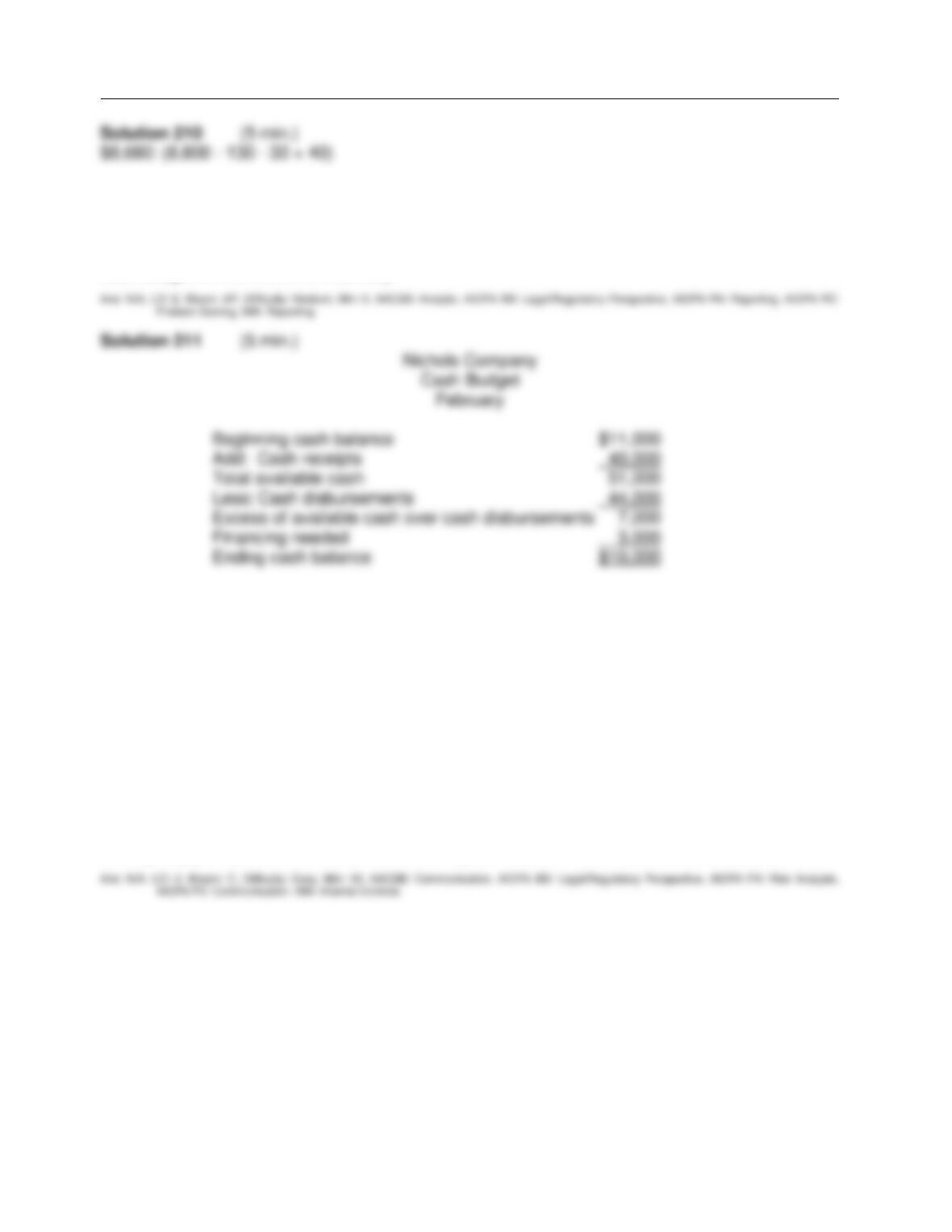
Test Bank for Financial Accounting: Tools for Business Decision Making, Seventh Edition
FOR INSTRUCTOR USE ONLY
7-46
Be. 211
The following information is available for Nichols Company for the month of February: expected
cash receipts $40,000; expected cash disbursements $44,000; cash balance February 1,
$11,000. Management wishes to maintain a minimum cash balance of $10,000. Prepare a basic
cash budget for the month of February.
Exercises
Ex. 212
Jim Gant has worked for Dr. Ken Flood for several years. Jim demonstrates a loyalty that is rare
among employees. He hasn’t taken a vacation in the last three years. One of Jim’s primary duties
at the medical office is to open the mail and list the checks received. He also takes cash from
patients at the cashier window as patients leave. At times it is so hectic that Jim doesn’t bother
with giving patients a receipt for the cash paid on their accounts. He assures them he will see to it
that they receive the proper credit. When the traffic is slow in the office Jim offers to help Lisa
post the payments to the patients’ accounts receivable. She is always happy to receive his help,
because he is a very conscientious worker.
Instructions
Identify any principles of internal control that may be violated in this medical office situation.
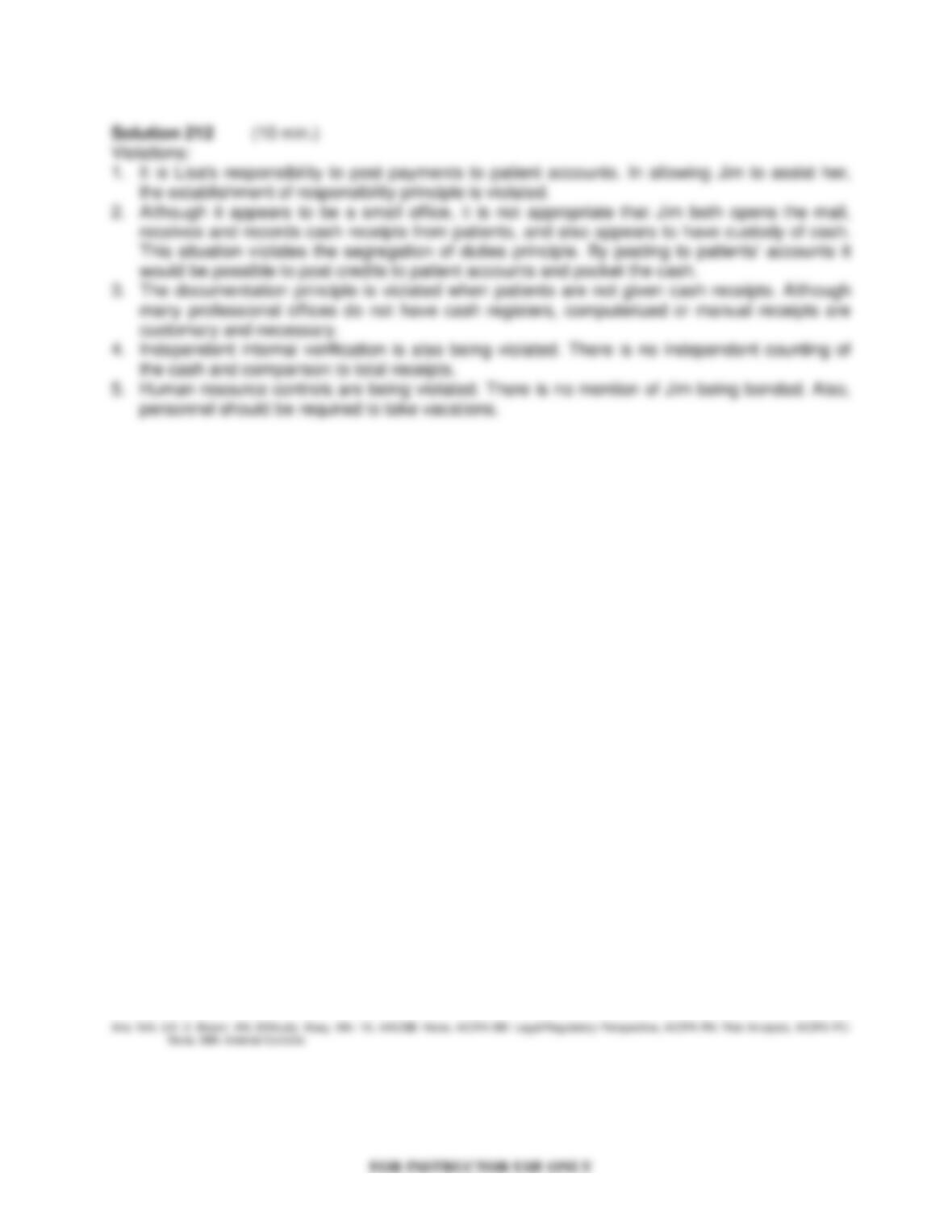
Fraud, Internal Control, and Cash
7-47
Ex. 213
Listed below are seven errors or problems that might occur in the processing of cash
transactions. Also shown is a list of internal control principles. Evaluate each possible error and
cite a principle that is listed that would reduce the probability of the error occurring. If none of the
principles given will correct the problem, write “None.” If you think more than one principle is
appropriate, list all principles that apply.
Possible Errors or Problems
1. An employee steals the cash collected from a customer for an account receivable and
conceals this theft by issuing a credit memorandum indicating that the customer returned the
merchandise.
2. A small fire destroys 3 days of cash receipts.
3. The official designated to sign checks is able to steal blank checks and issue them without
fear of detection.
4. A salesclerk in serving customers often rings up a sale for less than the actual amount and
then keeps the additional cash collected from the customer.
5. Three cashiers use one cash register drawer and the cash in the drawer is often short of the
balance kept on hand.
6. Each cashier counts his own register drawer each day and verbally reports the results to the
supervisor.
7. Cashiers with over 5-years experience are not bonded.
Internal Control Principles
a. Establishment of responsibility
b. Segregation of duties
c. Physical control devices
d. Documentation procedures
e. Independent internal verification
f. Human resource controls
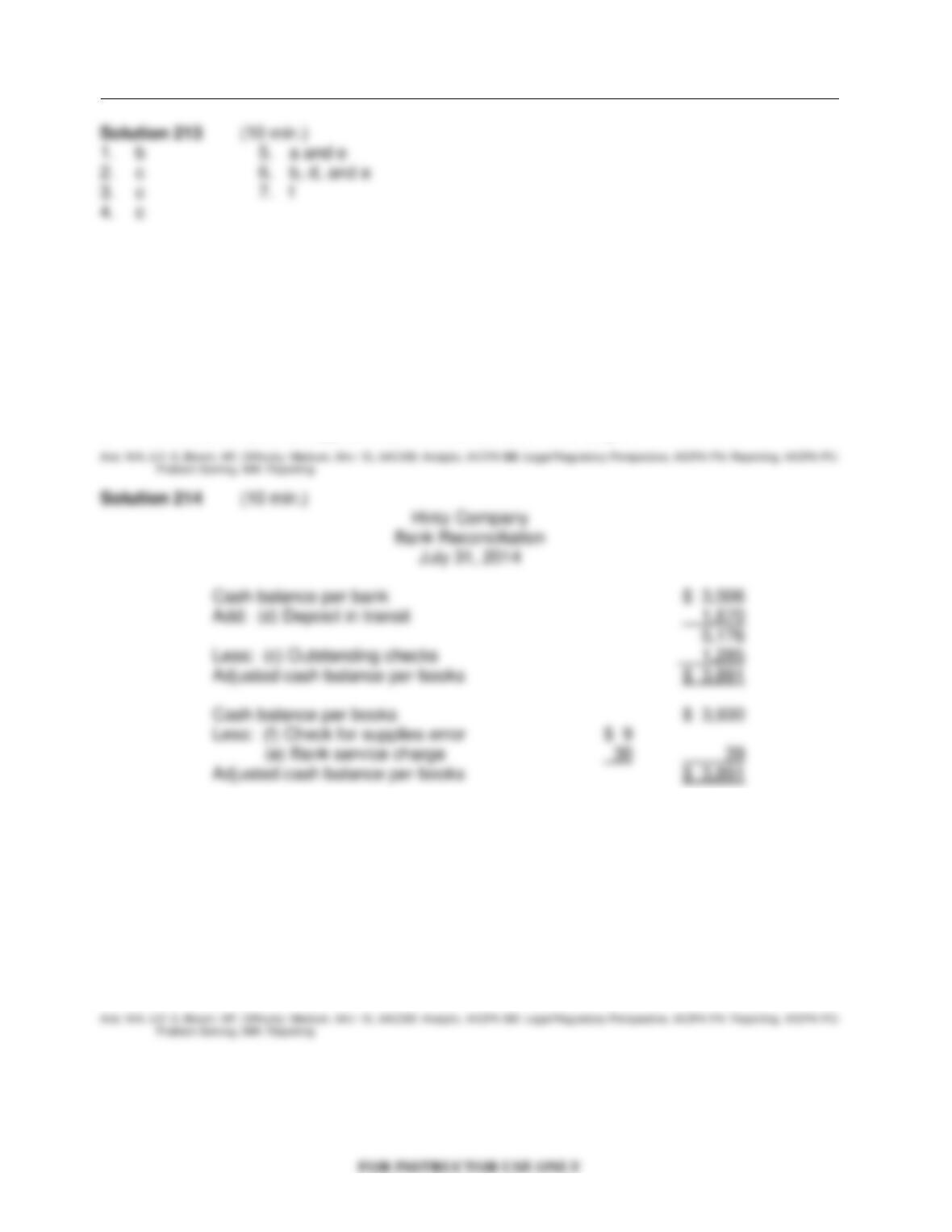
Test Bank for Financial Accounting: Tools for Business Decision Making, Seventh Edition
7-48
Ex. 214
Using the following information, prepare a bank reconciliation for Hintz Company for July 31,
2014.
a. The bank statement balance is $3,506.
b. The cash account balance is $3,930
c. Outstanding checks totaled $1,285.
d. Deposits in transit are $1,670.
e. The bank service charge is $30.
f. A check for $98 for supplies was recorded as $89 in the ledger.
Ex. 215
Using the following information, prepare a bank reconciliation for Munoz Company for May 31,
2014.
a. The bank statement balance is $8,300.
b. The cash account balance is $6,562
c. Outstanding checks totaled $1,950.
d. Deposits in transit are $600.
e. The bank service charge is $12.
f. Collection of note by bank, $400.
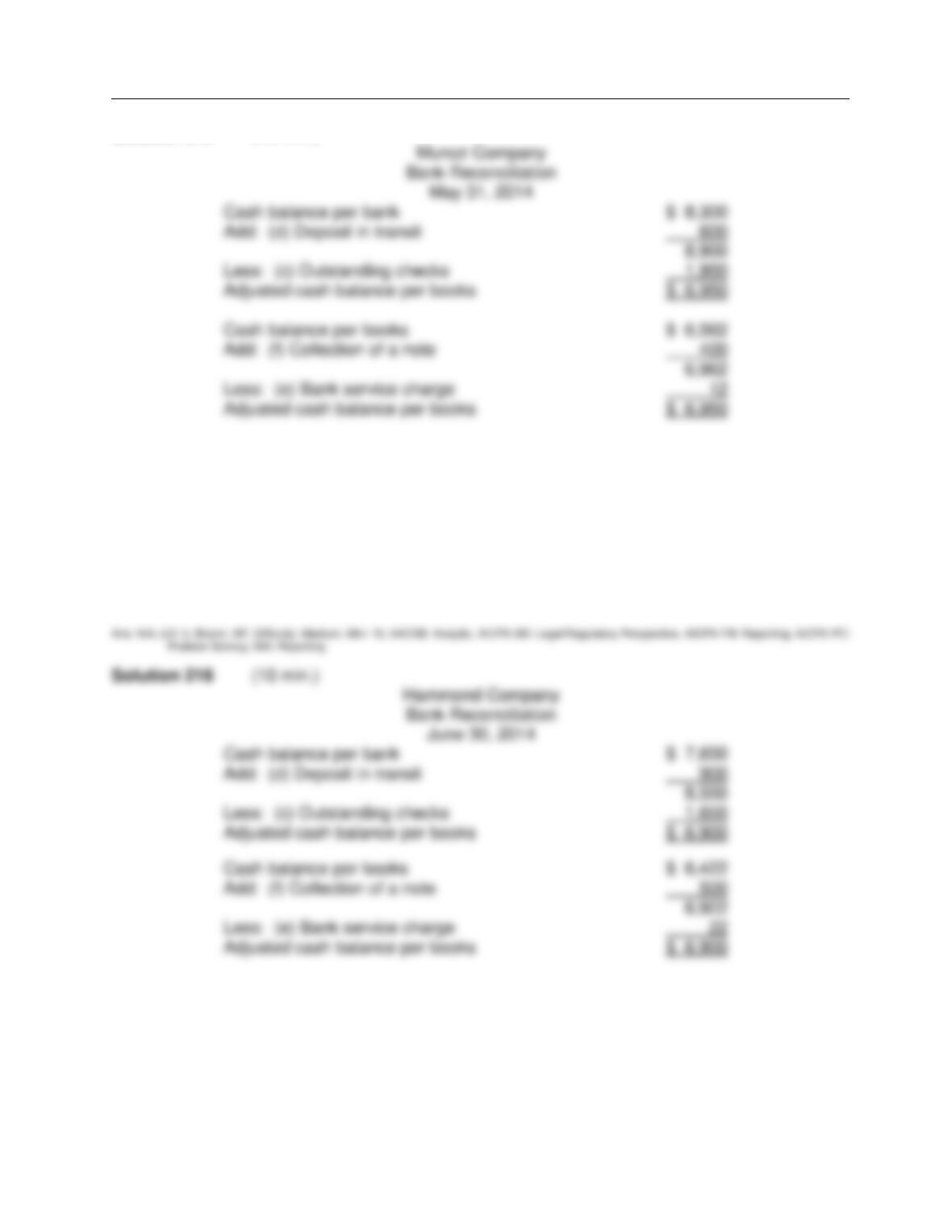
Fraud, Internal Control, and Cash
FOR INSTRUCTOR USE ONLY
7-49
Solution 215 (10 min.) Munoz Company
Ex. 216
Using the following information, prepare a bank reconciliation for Hammond Company for June
30, 2014.
a. The bank statement balance is $7,650.
b. The cash account balance is $6,422
c. Outstanding checks totaled $1,650.
d. Deposits in transit are $900.
e. The bank service charge is $22.
f. Collection of note by bank, $500.
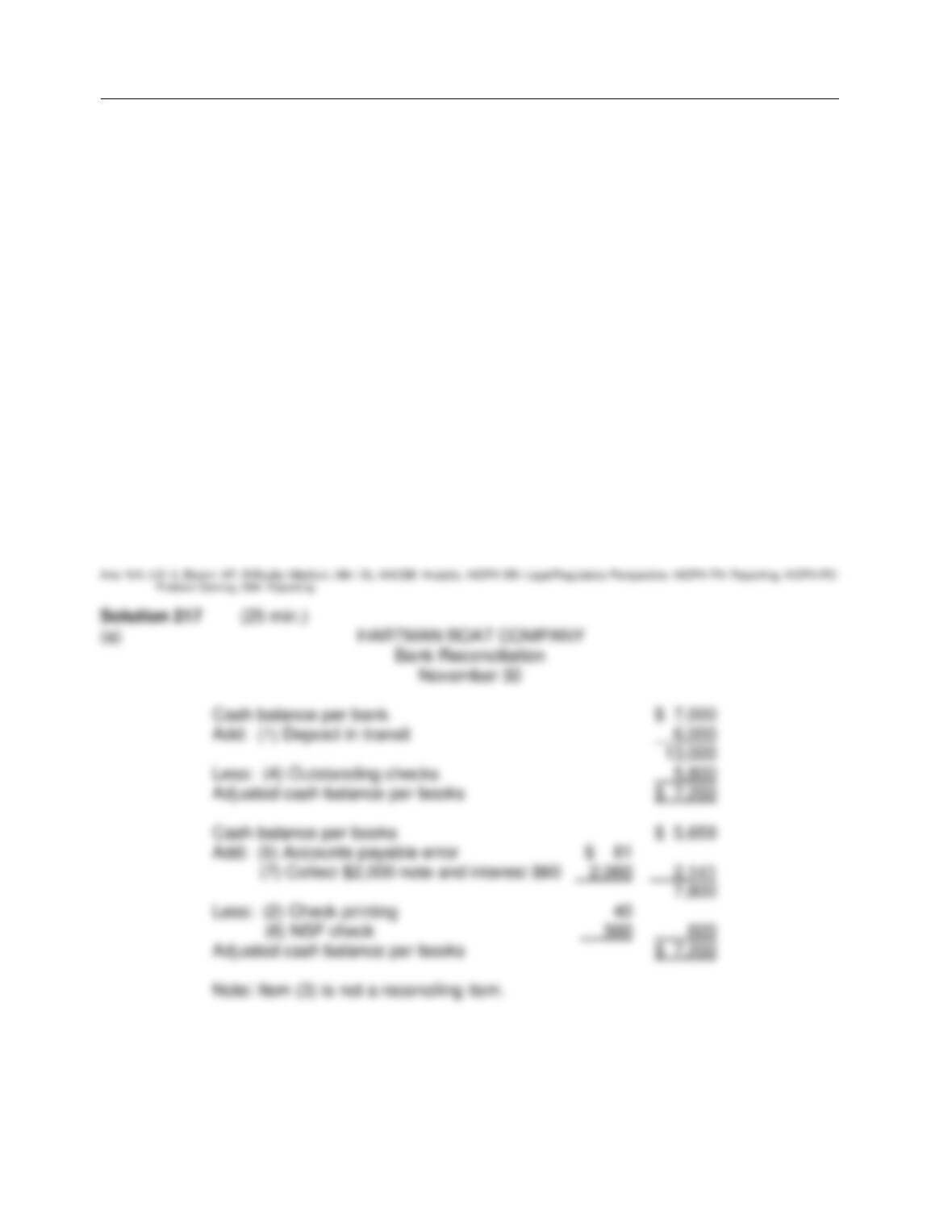
Test Bank for Financial Accounting: Tools for Business Decision Making, Seventh Edition
FOR INSTRUCTOR USE ONLY
7-50
Ex. 217
The Hartman Boat Company’s bank statement for the month of November showed a balance per
bank of $7,000. The company’s Cash account in the general ledger had a balance of $5,659 at
November 30. Other information is as follows:
(1) Cash receipts for November 30 recorded on the company’s books were $6,000 but this
amount does not appear on the bank statement.
(2) The bank statement shows a debit memorandum for $40 for check printing charges.
(3) Check No. 119 payable to Maris Company was recorded in the cash payments journal and
cleared the bank for $248. A review of the accounts payable subsidiary ledger shows a $36 credit
balance in the account of Maris Company and that the payment to them should have been for
$284.
(4) The total amount of checks still outstanding at November 30 amounted to $5,800.
(5) Check No. 138 was correctly written and paid by the bank for $409. The cash payment
journal reflects an entry for Check No. 138 as a debit to Accounts Payable and a credit to
Cash in Bank for $490.
(6) The bank returned an NSF check from a customer for $560.
(7) The bank included a credit memorandum for $2,060 which represents collection of a
customer’s note by the bank for the company; principal amount of the note was $2,000 and
interest was $60. Interest has not been accrued.
Instructions
(a) Prepare a bank reconciliation for the Hartman Boat Company at November 30.
(b) Prepare any adjusting entries necessary as a result of the bank reconciliation.
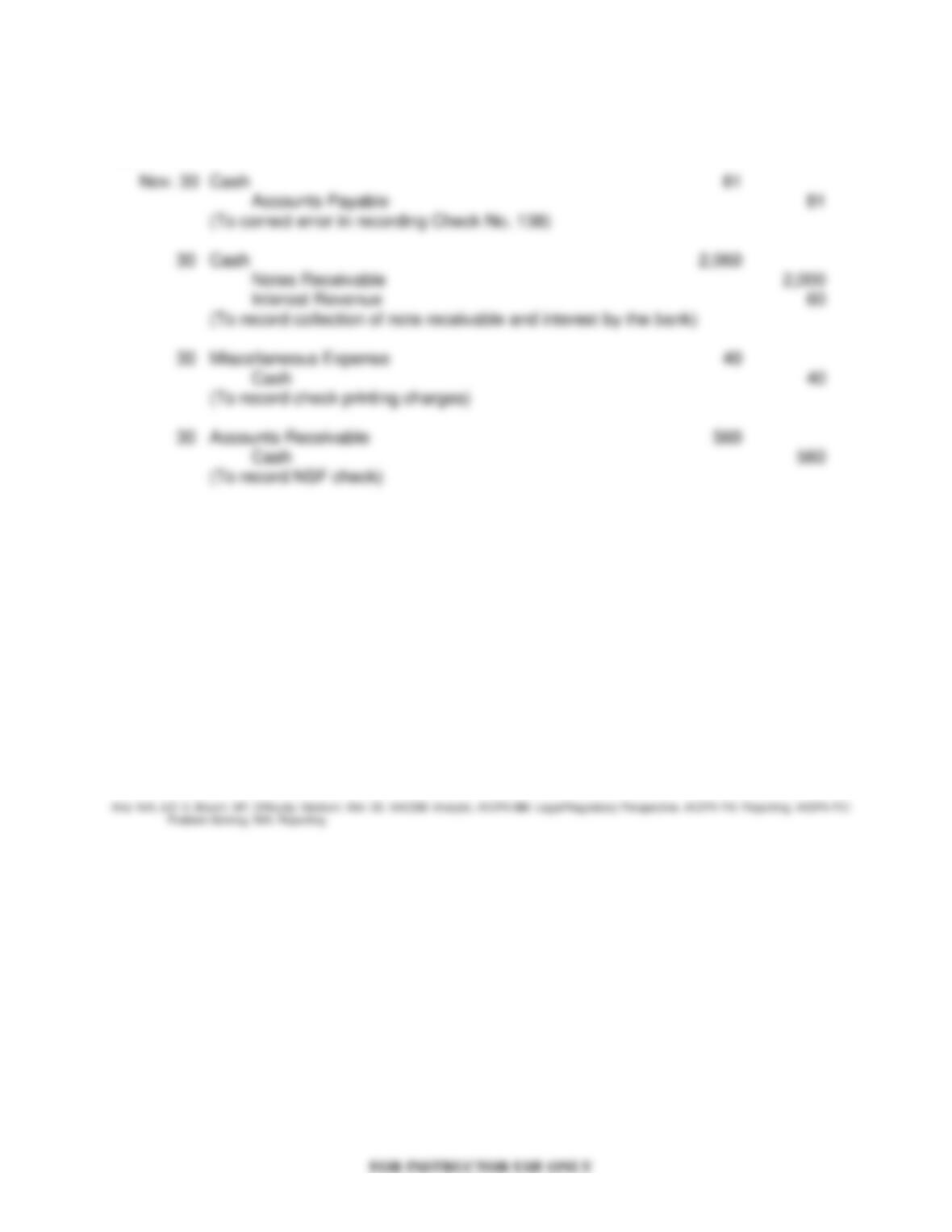
Fraud, Internal Control, and Cash
7-51
Solution 217 (Cont.)
(b)
Ex. 218
The bank statement for Cates Company indicates a balance of $1,730 on June 30. The cash
balance per books had a balance of $799 on this date. The following information pertains to the
bank transactions for the company.
1. Deposit of $760, representing cash receipts of June 30, did not appear on the bank
statement.
2. Outstanding checks totaled $340.
3. Bank service charges for June amounted to $25
4. The bank collected a note receivable for the company for $1,400 plus $56 interest revenue.
5. An NSF check for $80 from a customer was returned with the statement.
Instructions
a. Prepare a bank reconciliation for June 30.
b. Prepare any adjusting entries necessary as a result of the bank reconciliation.
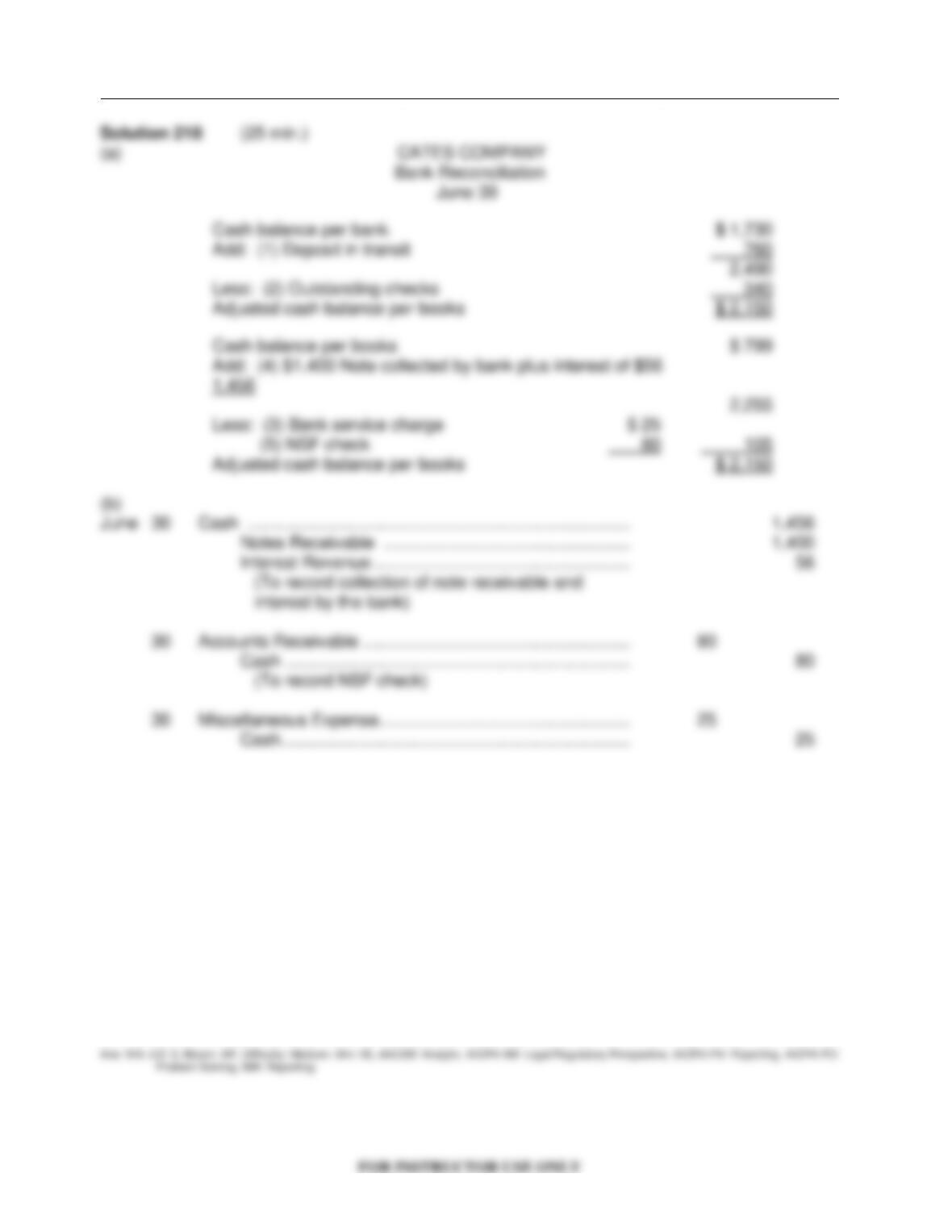
Test Bank for Financial Accounting: Tools for Business Decision Making, Seventh Edition
7-52
Ex. 219
The bank statement for Adcock Company indicates a balance of $830 on July 31. The cash
balance per books had a balance of $390 on this date. The following information pertains to the
bank transactions for the company.
1. Deposit of $840, representing cash receipts of July 31, did not appear on the bank statement.
2. Outstanding checks totaled $390.
3. Bank service charges for June amounted to $30.
4. The bank collected a note receivable for the company for $1,200 plus $48 interest revenue.
5. A NSF check for $328 from a customer was returned with the statement.
Instructions
a. Prepare a bank reconciliation for July 31.
b. Prepare any adjusting entries necessary as a result of the bank reconciliation.
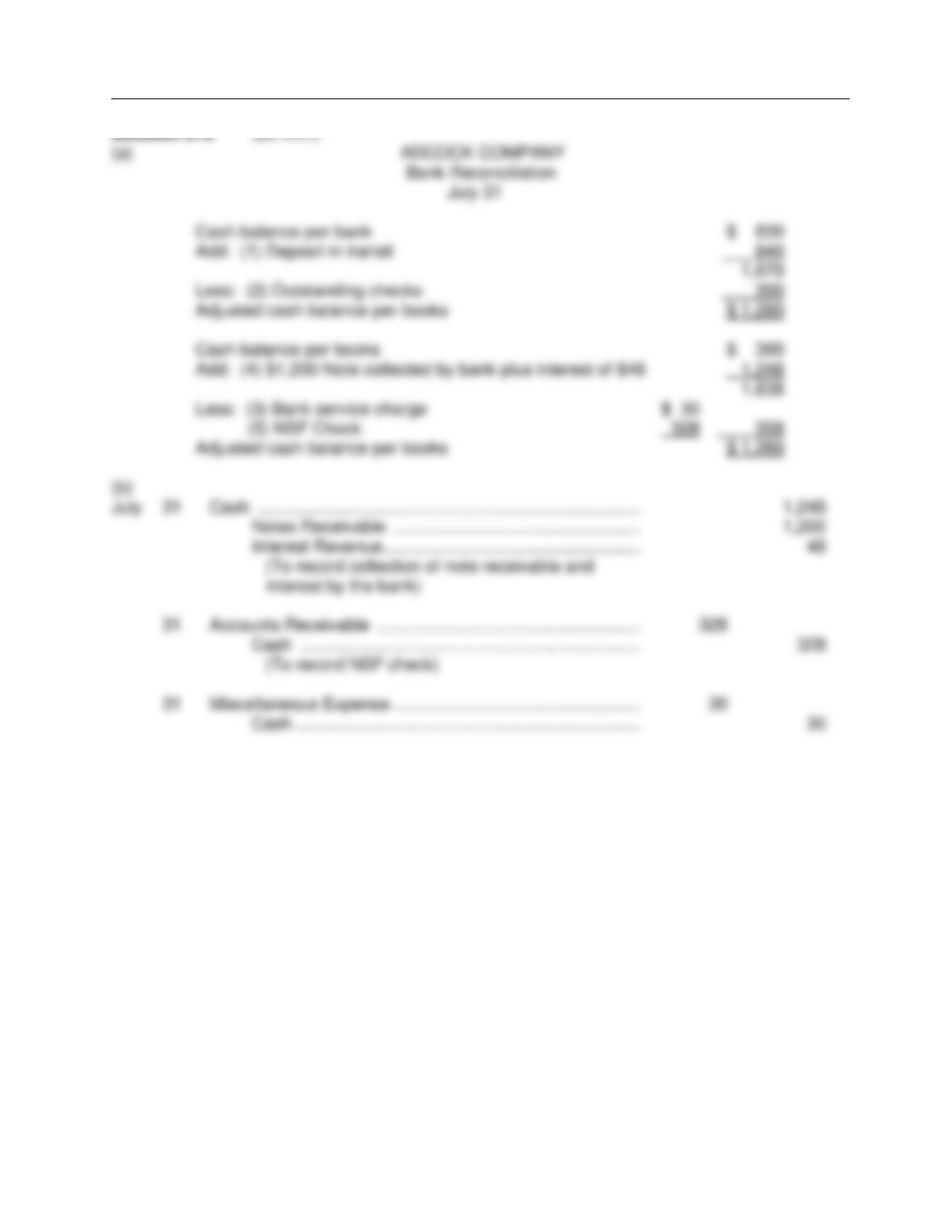
Fraud, Internal Control, and Cash
FOR INSTRUCTOR USE ONLY
7-53
Ex. 220
Grier Food Store used the following information in recording its bank reconciliation for the month
of April.
Balance per books April 30 $ 905
Balance per bank statement April 30 $11,300
___________________________________________________________________________
(1) Checks written in April but still outstanding $6,300.
(2) Checks written in March but still outstanding $2,800.
(3) Deposits of April 30 not yet recorded by bank $4,900.
(4) NSF check of customer returned by bank $500.
(5) Check No. 210 for $594 was correctly issued and paid by bank but incorrectly entered in the
cash payments journal as payment on account for $549.
(6) Bank service charge for April was $40.
(7) A payment on account was incorrectly entered in the cash payments journal and posted to
the accounts payable subsidiary ledger for $824 when Check No. 318 was correctly
prepared for $284. The check cleared the bank in April.
(8) The bank collected a note receivable for the company of $6,000 plus $240 interest revenue.
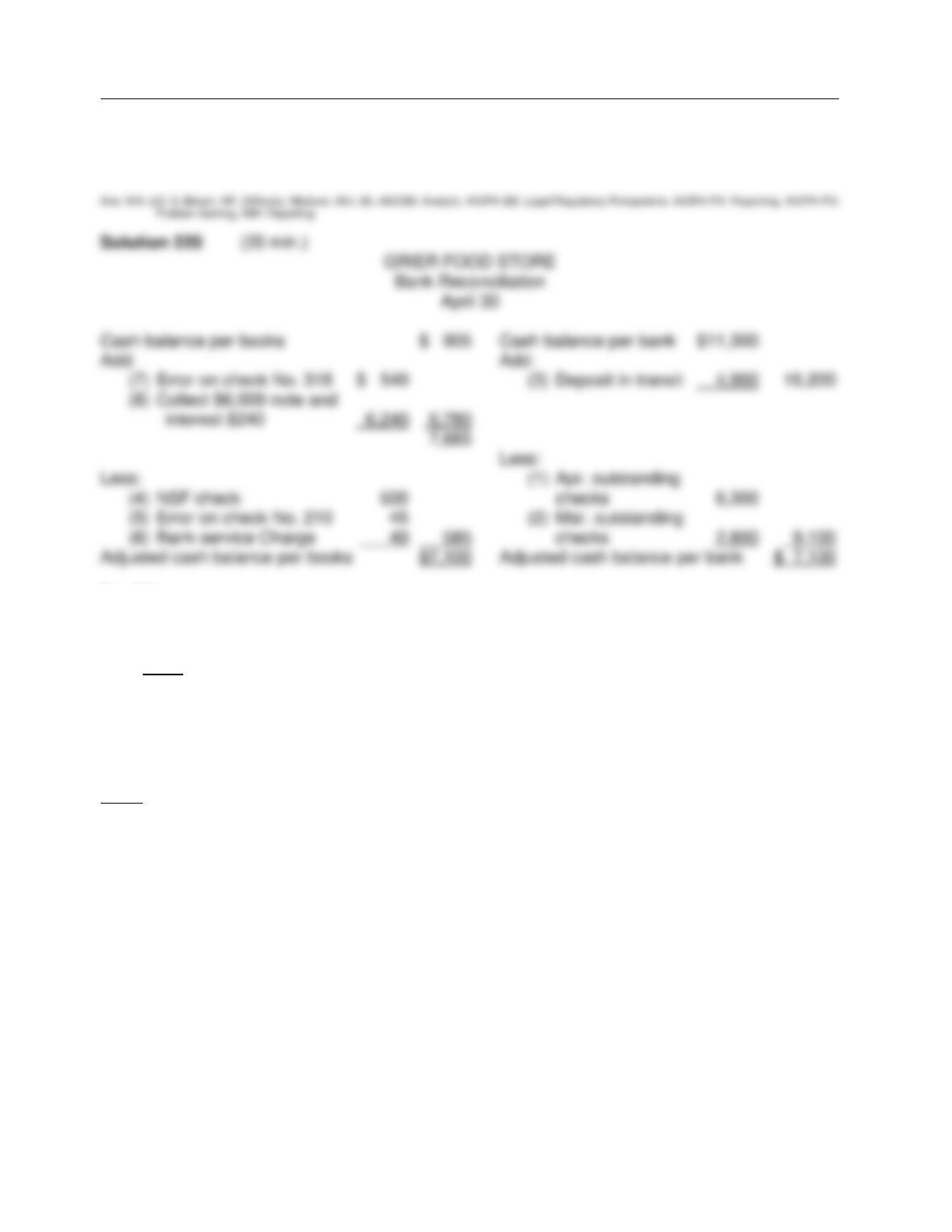
Test Bank for Financial Accounting: Tools for Business Decision Making, Seventh Edition
FOR INSTRUCTOR USE ONLY
7-54
Ex. 220 (Cont.)
Instructions
Prepare a bank reconciliation at April 30.
Ex. 221
Using the code letters below, indicate how each of the items listed would be handled in preparing
a bank reconciliation. Enter the appropriate code letter in the space to the left of each item.
Code
A Add to cash balance per books
B Deduct from cash balance per books
C Add to cash balance per bank
D Deduct from cash balance per bank
E Does not affect the bank reconciliation
Items:
____ 1. Outstanding checks
____ 2. Bank service charge
____ 3. Check for $320 correctly written and paid by the bank but incorrectly entered in the
cash payments journal for $230
____ 4. Deposit in transit
____ 5. Bank returns customer deposited check marked NSF
____ 6. Bank collects notes receivable and interest for depositor
____ 7. Bank debit memorandum for check printing fees
____ 8. Petty cash custodian has $86 in paid petty cash vouchers that have not been
reimbursed.
Fraud, Internal Control, and Cash
FOR INSTRUCTOR USE ONLY
7-55
Ex. 221 (Cont.)
____ 9. Bank charged a check against the company, which should have been charged to
another company.
____ 10. A check for $236 was correctly paid by the bank but was incorrectly entered in the
cash payments journal for $263
Ex. 222
The cash balance per books for Wellmeyer Company on November 30, 2014, is $10,740.93. The
following checks and receipts were recorded for the month of December 2014:
Checks Receipts
No. Amount No. Amount Amount Date
17 $372.96 22 $ 578.84 $ 843.86 12/5
18 780.62 23 1,687.50 941.54 12/21
19 157.00 24 921.30 808.58 12/27
20 587.50 25 246.03 1,367.00 12/31
21 234.15
In addition, the bank statement for the month of December is presented below:
Balance Deposits and Credits Checks and Debits Balance
Last Statement No. Total Amount No. Total Amount This Statement
$5,404.84 5 $9,578.36 10 $3,632.19 $11,351.01
________________________________________________________________________
Checks and other debits Deposits Date Balance
_________________________________________
No. Amount No. Amount No. Amount
________________________________________________________________________
14 148.29 17 372.96 22 578.84 5,484.38 12/1 $9,875.13
18 708.62 24 921.30 843.86 12/8 $9,219.03
19 157.00 25 246.03 941.54 12/23 $9,541.58
21 234.15 15.00 SC 808.58 12/29 $10,101.01
250.00 NSF 1,500.00 CM 12/31 $11,351.01
________________________________________________________________________
Symbols: NSF (Not sufficient funds) SC (Service charge) CM (Credit Memo)
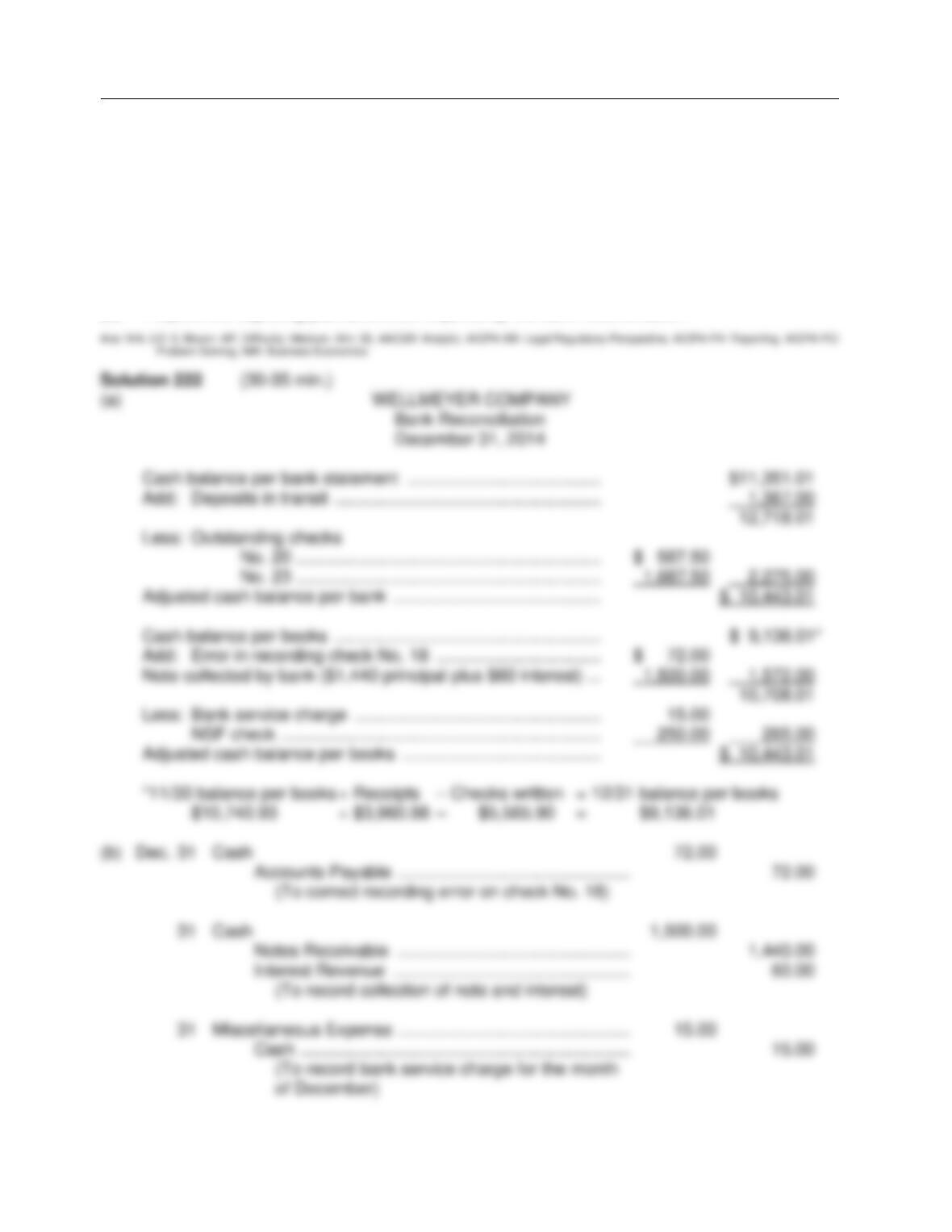
Test Bank for Financial Accounting: Tools for Business Decision Making, Seventh Edition
FOR INSTRUCTOR USE ONLY
7-56
Ex. 222 (Cont.)
Check No. 18 was correctly written for $708.62 for a payment on account. The NSF check was
from S. Gill, a customer, in settlement of an account receivable. An entry has not been made for
the NSF check. The credit memo is for the collection of a note receivable including interest of $60
that has not been accrued. The bank service charge is $15.00.
Instructions
(a) Prepare a bank reconciliation at December 31.
(b) Prepare the adjusting journal entries required by the bank reconciliation.
Fraud, Internal Control, and Cash
7-57
Solution 222 (Cont.)
Ex. 223
Seaver Company received a notice with its bank statement that the bank had collected a note
receivable for $18,000 plus $600 of interest. The bank had credited these amounts to Seaver’s
account less a collection fee of $30. Seaver Company had already accrued the interest for this
note on its books.
(a) How will these items affect Seaver Company’s bank reconciliation?
(b) Prepare the journal entry that Seaver Company will make to record this information on its
books.
Ex. 224
The cash records of the Dillon Company show the following:
1. The July 31 bank reconciliation indicated that deposits in transit totaled $390. During August
the general ledger account, Cash shows deposits of $11,800, but the bank statement
indicates that only $9,540 in deposits were received during the month.
2. The July 31 bank reconciliation also reported outstanding checks of $850. During the month
of August, the Dillon Company books show that $11,670 of checks were issued, yet the bank
statement showed that $10,500 of checks cleared the bank in August.
There were no bank debit or credit memoranda and no errors were made by either the bank or
the Dillon Company.
Answer the following questions:
(a) What were the deposits in transit at August 31?
(b) What were the outstanding checks at August 31?
Test Bank for Financial Accounting: Tools for Business Decision Making, Seventh Edition
7-58
Ex. 225
The cash records of Grayson Company show the following:
1. In February, deposits per the bank statement totaled $37,700; deposits per books $38,000;
and deposits in transit at February 28 were $3,550.
2. In February cash disbursements per books were $37,500; checks clearing the bank were
$37,300; and outstanding checks at February 28 were $2,500.
There were no bank debit or credit memoranda and no errors were made by either the bank or
Grayson Company.
Answer the following questions:
(a) What were the deposits in transit at January 31?
(b) What were the outstanding checks at January 31?
Fraud, Internal Control, and Cash
FOR INSTRUCTOR USE ONLY
7-59
Ex. 226
Listed below are items that may be useful in preparing the March 2014, bank reconciliation for the
Carrinton Machine Works.
Using the code letters below, insert in the space before each item the letter where the amount
would be located or otherwise treated in the bank reconciliation process.
Code Located or Treated
A Add to the cash balance per books
B Deduct from the cash balance per books
C Add to the cash balance per bank
D Deduct from the cash balance per bank
E Does not affect the bank reconciliation
____ 1. Included with the bank statement materials was a check from Joe Terrell for $40
stamped “account closed”.
____ 2. A personal deposit by Ron Carrinton to his personal account in the amount of $300 for
dividends on his General Electric common stock was credited to the company account.
____ 3. The bank statement included a debit memorandum for $22.00 for four books of blank
checks for Carrinton Machine Works.
____ 4. The bank statement contains a credit memorandum for $42.75 interest on the average
checking account balance.
____ 5. The daily deposits of March 30 and March 31 for $3,362 and $3,125, respectively,
were not included in the bank statement postings.
____ 6. Two checks totaling $316.86, which were outstanding at the end of February, cleared
in March and were returned with the March statement.
____ 7. The bank statement included a credit memorandum dated March 28, 2014, for $62.00
for the monthly interest on a 6-month, $15,000 certificate of deposit that the company
owns.
____ 8. Four checks, #8712, #8716, #8718, #8719, totaling $5,369.65, did not clear the bank
during March.
____ 9. On March 24, 2014, Carrinton Machine Works delivered to the bank for collection a
$3,400, 3-month note from Tom Jacobs. A credit memorandum dated March 29, 2014,
indicated the collection of the note and $102.00 of interest.
____ 10. The bank statement included a debit memorandum for $20.00 for the collection
service on the above note and interest.
Test Bank for Financial Accounting: Tools for Business Decision Making, Seventh Edition
FOR INSTRUCTOR USE ONLY
7-60
Ex. 227
On April 30, the bank reconciliation of Baxter Company shows three outstanding checks: no. 354,
$650, no. 355, $920, and no. 357, $615. The May bank statement and the May cash payments
journal show the following.
Bank Statement
Cash Payments Journal
Checks Paid
Checks Paid
Date
Check No.
Amount
Date
Check No.
Amount
5/4
354
650
5/2
358
159
5/2
357
615
5/5
359
275
5/17
358
159
5/10
360
890
5/12
359
275
5/15
361
800
5/20
360
890
5/22
362
750
5/29
363
480
5/24
363
480
5/30
362
750
5/29
364
840
Instructions
Using step 2 in the reconciliation procedure, list the outstanding checks at May 31.
Ex. 228
The information below relates to the Cash account in the ledger of Remington Company.
Balance September 1—$25,720 Cash deposited—$96,000.
Balance September 30—$26,100 Checks written—$95,620.
The September bank statement shows a balance of $24,635 on September 30 and the following
memoranda.
Credits
Debits
Collection of $3,750 note plus interest $50
$3,800
NSF check: J. E. Hoover
$635
Interest earned on checking account
$65
Safety deposit box rent
$75
At September 30, deposits in transit were $7,195, and outstanding checks totaled $2,575.
Instructions
Prepare the bank reconciliation at September 30.
No.
364
840
Total $2,560
Fraud, Internal Control, and Cash
7-61
Solution 228 (10 min.)
REMINGTON COMPANY
Ex. 229
The cash records of Landis Company show the following four situations.
1. The June 30 bank reconciliation indicated that deposits in transit total $1,080. During July
the general ledger account Cash shows deposits of $24,820, but the bank statement indicates
that only $23,400 in deposits were received during the month.
2. The June 30 bank reconciliation also reported outstanding checks of $1,020. During the
month of July, Landis Company books show that $25,800 of checks were issued. The bank
statement showed that $24,600 of checks cleared the bank in July.
3. In September, deposits per the bank statement totaled $40,100, deposits per books were
$38,100, and deposits in transit at September 30 were $3,150.
4. In September, cash disbursements per books were $35,550, checks clearing the bank
were $37,500, and outstanding checks at September 30 were $2,150.
There were no bank debit or credit memoranda. No errors were made by either the bank or
Landis Company.
Instructions
Answer the following questions.
(a) In situation (1), what were the deposits in transit at July 31?
(b) In situation (2), what were the outstanding checks at July 31?
(c) In situation (3), what were the deposits in transit at August 31?
(d) In situation (4), what were the outstanding checks at August 31?
Test Bank for Financial Accounting: Tools for Business Decision Making, Seventh Edition
FOR INSTRUCTOR USE ONLY
7-62
Solution 229 (10 min.)
Ex. 230
Lowe Inc.’s bank statement from Western Bank at August 31, 2014, gives the following
information.
Balance, August 1
$18,600
Bank debit memorandum:
August deposits
71,000
Safety deposit box fee
$ 25
Checks cleared in August
66,678
Service charge
30
Bank credit memorandum:
Balance, August 31
22,912
Interest earned
45
A summary of the Cash account in the ledger for August shows the following: balance, August 1,
$21,100, receipts $81,000; disbursements $73,570; and balance, August 31, $28,530. Analysis
reveals that the only reconciling items on the July 31 bank reconciliation were a deposit in transit
for $7,000 and outstanding checks of $4,500. In addition, you determine that there was an error
involving a company check drawn in August: A check for $400 to a creditor on account that
cleared the bank in August was journalized and posted for $40.
Instructions
(a) Determine deposits in transit.
(b) Determine outstanding checks.
(c) Prepare a bank reconciliation at August 31.
Fraud, Internal Control, and Cash
7-63
Solution 230 (10 min.)
Ex. 231
Holcomb Company expects to have a cash balance of $43,000 on January 1, 2014. These are
the relevant monthly budget data for the first two months of 2014.
1. Collections from customers: January $85,000, February $132,000
2. Payments to suppliers: January $40,000, February $50,000
3. Wages: January $34,000, February $40,000. Wages are paid in the month they are incurred.
4. Administrative expenses: January $24,000, February $31,000. These costs include
depreciation of $1,000 per month. All other costs are paid as incurred.
5. Selling expenses: January $15,000, February $20,000. These costs are exclusive of
depreciation. They are paid as incurred.
6. Sales of short-term investments in January are expected to realize $12,000 in cash.
Holcomb has a line of credit at a local bank that enables it to borrow up to $40,000. The
company wants to maintain a minimum monthly cash balance of $25,000.
Instructions
Prepare a cash budget for January and February.
Test Bank for Financial Accounting: Tools for Business Decision Making, Seventh Edition
FOR INSTRUCTOR USE ONLY
7-64
Solution 231 (5 min.) HOLCOMB COMPANY
Ex. 232
Shatner Company has budgeted sales revenue as follows:
Budgeted Sales Revenues
January $55,000
February 80,000
March 90,000
April 65,000
May 50,000
June 15,000
Past experience has indicated that 80% of sales each month are on credit and that collection of
credit sales occurs as follows: 60% in the month of sale, 30% in the month following the sale, and
5% in the second month following the sale. The other 5% is uncollectible.
Instructions
Prepare a schedule which shows expected cash receipts from sales for the months of April, May,
and June.
Fraud, Internal Control, and Cash
FOR INSTRUCTOR USE ONLY
7-65
Solution 232 (20-25 min.) SHATNER COMPANY
Ex. 233
Palmer Company has budgeted sales revenues as follows:
June July August
Credit sales $35,000 $30,000 $28,000
Cash sales 18,000 51,000 39,000
Total sales $53,000 $81,000 $67,000
Past experience indicates that 60% of the credit sales will be collected in the month of sale and
the remaining 40% will be collected in the following month.
Purchases of inventory are all on credit and 50% is paid in the month of purchase and 50% in the
month following purchase. Budgeted inventory purchases are:
June $65,000
July 53,000
August 21,000
Test Bank for Financial Accounting: Tools for Business Decision Making, Seventh Edition
7-66
Ex. 233 (Cont.)
Other budgeted cash disbursements: (a) selling and administrative expenses of $7,000 each
month, (b) dividends of $19,000 will be paid in July, and (c) purchase of a computer in August for
$6,000 cash.
The company wishes to maintain a minimum cash balance of $10,000 at the end of each month.
The company borrows money from the bank at 9% interest, if necessary, to maintain the
minimum cash balance. Borrowed money is repaid in months when there is an excess cash
balance. The beginning cash balance on July 1 was $10,000. Assume that borrowed money in
this case is for one month.
Instructions
Prepare a cash budget for the months of July and August. Prepare separate schedules for
expected collections from customers and expected payments for purchases of inventory.
Fraud, Internal Control, and Cash
FOR INSTRUCTOR USE ONLY
7-67
Solution 233 (Cont.)
Ex. 234
The management of Morton Company estimates that credit sales for August, September,
October, and November will be $180,000, $200,000, $230,000, and $160,000, respectively.
Experience has shown that collections are made as follows:
In month of sale 25%
In first month after sale 60%
In second month after sale 10%
Instructions
Determine the collections from customers in October and November. Show all computations.
Ex. *235
On October 1, 2014, Finley Company establishes a petty cash fund by issuing a check for $200
to Sara Mead, the custodian of the petty cash fund. On October 31, 2014, Sara Mead submitted
the following paid petty cash vouchers for replenishment of the petty cash fund when there is $7
cash in the fund:
Freight-in $70
Office Supplies Expense 35
Entertainment of Clients 60
Postage Expense 23
Test Bank for Financial Accounting: Tools for Business Decision Making, Seventh Edition
FOR INSTRUCTOR USE ONLY
7-68
Ex. *235 (Cont.)
Instructions
Prepare the journal entries required to establish the petty cash fund on October 1 and the
replenishment of the fund on October 31.
Ex. *236
On September 1, 2014, Watkins Company establishes a petty cash fund by issuing a check for
$250 to Mike Martz, the custodian of the petty cash fund. On September 30, 2014, Mike Martz
submitted the following paid petty cash vouchers for replenishment of the petty cash fund when
there is $35 cash in the fund:
Freight-in $25
Office Supplies Expense 75
Entertainment of Clients 37
Postage Expense 80
Instructions
Prepare the journal entries required to establish the petty cash fund on September 1 and the
replenishment of the fund on September 30.
Fraud, Internal Control, and Cash
FOR INSTRUCTOR USE ONLY
7-69
Ex. *237
The petty cash fund of $200 for Tomkins Company appeared as follows on December 31, 2014
Cash $50.60
Petty cash vouchers
Freight-in $58.40
Postage 40.00
Balloons for a special occasion 20.00
Meals 25.00
Instructions
1. Briefly describe when the petty cash fund should be replenished. Because there is cash on
hand, is there a need to replenish the fund at year end on December 31? Explain.
2. Prepare the general journal entry to replenish the fund.
3. On December 31, the office manager gives instructions to increase the petty cash fund by
$50. Make the appropriate journal entry.
Ex. *238
During October, Guiding Light Company experiences the following transactions in establishing a
petty cash fund.
Oct. 1 A petty cash fund is established with a check for $150 issued to the petty cash
custodian.
31 A count of the petty cash fund disclosed the following items:
Currency $19.00
Coins 0.40
Expenditure receipts (vouchers):
Office supplies $28.10
Telephone, Internet, and fax 16.40
Postage 75.00
Freight-out 6.80
31 A check was written to reimburse the fund and increase the fund to $200.
Test Bank for Financial Accounting: Tools for Business Decision Making, Seventh Edition
7-70
Ex. *238 (Cont.)
Instructions
Journalize the entries in October that pertain to the petty cash fund.
COMPLETION STATEMENTS
239. Internal control consists of the related methods and measures adopted within a business
to ____________ its assets and enhance the ______________ and ______________ of
its accounting records.
240. The principle of internal control that prevents one individual from being responsible for all
the related activities of a given task is ______________.
241. The ______________ of an asset should not have access to the accounting records of
that asset.
242. Employees of a company who evaluate the effectiveness of the company’s system of
internal controls on a year-round basis are called ______________.
243. Using _______________ documents is a control measure that helps to prevent a
transaction from being recorded more than once or to prevent the transactions from not
being recorded.
Fraud, Internal Control, and Cash
FOR INSTRUCTOR USE ONLY
7-71
244. Employees who handle cash should be ______________ in order to protect against
misappropriation of assets by dishonest employees.
245. Two limitations of systems of internal control are the concept of ______________ and the
______________.
246. Internal control over cash disbursements is more effective when payments are made by
______________, rather than by ______________.
247. A disbursement system that uses wire, telephone, computers, etc., to transfer cash from
one location to another is referred to as ______________.
248. A debit memorandum issued by the bank ______________ the cash balance in the
depositor’s account.
249. The difference between the cash in bank balance shown on the company’s books and the
cash balance shown on the bank statement may be caused by ______________ and by
______________ in recording transactions by either party.
250. In preparing a bank reconciliation, outstanding checks are ______________ from the
cash balance per ______________.
251. A check correctly written for $370 was incorrectly entered in the cash payments journal for
$730. In preparing a bank reconciliation, $____________ must be ______________ the
cash balance per ______________.
252. A basic principle of cash management is to delay payment of _____________.
253. Three major sections of a cash budget are: (1)________________, (2)_______________,
and (3)______________.
*254. A __________________ fund is used to pay relatively small expenditures.
Test Bank for Financial Accounting: Tools for Business Decision Making, Seventh Edition
FOR INSTRUCTOR USE ONLY
7-72
*255. A debit balance in Cash Over and Short is reported in the income statement as
______________.
Answers to Completion Statements
MATCHING
256. Match the items below by entering the appropriate code letter in the space provided.
A. Prenumbered documents G. Cash budget
B. Custody of an asset should be kept H. Restricted cash
separate from the record-keeping I. Invest idle cash
for that asset J. Canceled checks
C. Television monitors, garment sensors K. NSF checks
and burglar alarms are examples L. Outstanding checks
D. Bonding employees M. Petty cash receipt
E. Collusion N. Cash equivalents
F. Cash
____ 1. Segregation of duties.
____ 2. Cash that is not available for general use, but instead is restricted for a particular
purpose.
____ 3. Two or more employees circumventing prescribed procedures.
____ 4. Prevent a transaction from being recorded more than once.
____ 5. Checks which have been returned by the maker’s bank for lack of funds.
____ 6. Checks which have been paid by the depositor’s bank.
____ 7. A projection of anticipated cash flows.
____ 8. Anything that a bank will accept for deposit.
Fraud, Internal Control, and Cash
FOR INSTRUCTOR USE ONLY
7-73
256. (Cont.)
____ 9. Physical control devices.
____ 10. A basic principle of cash management.
____ 11. Insurance protection against misappropriation of assets.
____ 12. Document indicating the purpose of a petty cash expenditure.
____ 13. Issued checks that have not been paid by the bank.
____ 14. Highly liquid investments.
SHORT-ANSWER ESSAY QUESTIONS
S-A E 257
Fraud experts often say that there are three primary factors that contribute to employee fraud.
Identify the three factors and explain what is meant by each.
S-A E 258
(a) Explain the control principle of independent internal verification?
(b) What practices are important in applying this principle?
Test Bank for Financial Accounting: Tools for Business Decision Making, Seventh Edition
7-74
Solution 258
S-A E 259
Your friend, Jeff, has opened a movie theater. Jeff states that he does not have time to develop
and implement a system of internal controls.
a. Provide Jeff with the objectives of a system of internal control.
b. Explain to Jeff why he should develop a system of internal control.
S-A E 260
One of your accounting professors has alerted you about a job opportunity as an internal auditor.
a. What is the role of an internal auditor?
b. Is this position justified? Why or Why not?
Fraud, Internal Control, and Cash
FOR INSTRUCTOR USE ONLY
7-75
Solution 260 (Cont.)
S-A E 261
Important objectives of a system of internal controls are to safeguard assets and to enhance the
accuracy and reliability of the accounting records. Briefly discuss how (1) cost-benefit
considerations, (2) the human element, and (3) the size of the business affect the implementation
of a system of internal controls.
S-A E 262
How do these principles apply to cash disbursements:
(a) Physical controls?
(b) Human resource controls?
Test Bank for Financial Accounting: Tools for Business Decision Making, Seventh Edition
FOR INSTRUCTOR USE ONLY
7-76
S-A E 263
The preparation of a bank reconciliation is an important cash control procedure. If a company
deposits cash receipts daily and makes all cash disbursements by check, explain why the cash
balance per books might not agree with the cash balance shown on the bank statement. Identify
specific examples that may cause differences between the cash balance per books and the cash
balance per bank.
S-A E 264
A basic principle of cash management involves the investment of idle cash.
a. Explain why this should be done.
b. What type of investment is appropriate for the idle cash?
S-A E 265 (Ethics)
Samson Instruments is a rapidly growing manufacturer of medical devices. As a result of its
growth, the company’s management recently modified several of its procedures and practices to
improve internal control. Some employees are upset with the changes. They have complained
that all these changes just show that the company no longer trusts them.
Required:
“Internal controls exist because most people can‘t be trusted.” Is this true? Explain.
Fraud, Internal Control, and Cash
FOR INSTRUCTOR USE ONLY
7-77
Solution 265
S-A E 266 (Communication)
Clinix is a medical office management franchise. There are currently twenty-five medical offices
managed by a Clinix franchisee. One of the services provided to franchisees is assistance in
training various staff members.
Clinix is preparing a manual for the front office staff to use as a reference guide. It will be used in
training new employees as well. One of the reasons the manual is being prepared is to stress the
importance of strong internal controls.
Required:
Prepare a short paragraph, to be included in the training materials, describing the benefits of
sound internal control, from the viewpoint of the employee.
Test Bank for Financial Accounting: Tools for Business Decision Making, Seventh Edition
7-78
IFRS QUESTIONS
1. The principles of internal control activities are used
a. in the U.S. but not globally.
b. internationally but not in the U.S.
c. in the U.S. and Canada but not globally.
d. globally.
2. Sarbanes Oxley applies to
a. U.S companies but not international companies.
b. international companies but not U.S. companies.
c. U.S. and Canadian companies but not other international companies.
d. U.S and international companies.
3. The fraud triangle applies to
a. U.S companies but not international companies.
b. international companies but not U.S. companies.
c. U.S. and Canadian companies but not other international companies.
d. U.S and international companies.
4. What percentage of companies worldwide have experienced fraud in the last two years?
a. 1%
b. 10%
c. 50%
d. 100%
5. Tangible frauds include
a. asset misappropriation.
b. false pretenses.
c. counterfeiting.
d. all of these answer choices are correct.
6. IFRS, compared to GAAP, tends to be more
a. detailed.
b. rules-based.
c. principles-based.
d. full of disclosures requirements.
Fraud, Internal Control, and Cash
7-79
7. GAAP, compared to IFRS, tends to be more
a. simple in accounting requirements.
b. rules-based.
c. principles-based.
d. simple in disclosures requirements.
8. GAAP’s, accounting and internal control procedures related to cash and the definition of
cash equivalents, as compared to IFRS are:
Accounting and internal
control procedures Definition of cash equivalents
a. essentially similar essentially similar
b. essentially different essentially similar
c. essentially similar essentially different
d. essentially different essentially different
9. Cash is defined by IFRS as
a. cash on hand.
b. demand deposits.
c. cash on hand and demand deposits.
d. cash on hand, demand deposits, and highly liquid investments.
10. Cash equivalents are defined by IFRS as
a. cash on hand.
b. demand deposits.
c. cash on hand and demand deposits.
d. short-term, highly liquid investments that are readily convertible into known amounts of
cash.