Fundamentals of Corporate Finance 3e Test Bank
Chapter 07: Risk and Return
1. The rate of return that investors require for an investment depends on the risk associated with
that investment.
A) True
b) False
2.
The capital appreciation component of a stock’s return considers the change in price of a stock
divided by the initial price of the stock.
A)
True
B)
False
Ans:
A
3.
If the price of an asset has not increased or decreased since the original purchase of the asset,
then the total return of the asset (if no dividends were paid during the period) is equal to the
capital appreciation component return.
A)
True
B)
False
Ans:
A
Fundamentals of Corporate Finance 3e Test Bank
4.
The income component of return for a common stock comes from the cash dividend a firm
pays.
A)
True
B)
False
Ans:
A
Level of Difficulty: Easy
5.
If the capital appreciation return from owning a stock is positive, then the total return from
owning the same stock can be negative.
A)
True
B)
False
Ans:
B
6.
In order to keep the total return of a stock equal to 100 percent, the income component for that
stock must be zero.
A)
True
B)
False
Ans:
B
Fundamentals of Corporate Finance 3e Test Bank
7.
Robert paid $100 for a stock one year ago. The total return on the stock was 10 percent.
Therefore, the stock must be selling for $110 today.
A)
True
B)
False
Ans:
B
8.
Whenever the outcome of an event has a number of different possibilities that have equal
probability of occurrence, then the expected value of the outcome is equal to the simple average
of the individual events.
A)
True
B)
False
Ans:
A
9.
You have placed a wager such that you will either receive nothing if you lose the bet or you
will receive $10 if you win the bet. If the expected cash receipt is $9, then there is a 100 percent
probability that you will win the wager.
A)
True
B)
False
Ans:
B
Fundamentals of Corporate Finance 3e Test Bank
10.
The expected return on the market portfolio is equal to the market risk premium.
A)
True
B)
False
Ans:
B
11.
The variance of a distribution can be a negative value.
A)
True
B)
False
Ans:
B
12.
The standard deviation of a distribution can be a negative value.
A)
True
B)
False
Ans:
B
Fundamentals of Corporate Finance 3e Test Bank
13.
The normal distribution is completely described by its mean and standard deviation where 50
percent of the distribution’s probability is less than the mean and 50 percent greater than the
mean.
A)
True
B)
False
Ans:
A
14.
The variance is denominated in squared units, whereas the standard deviation is denominated in
the same units as the expected value.
A)
True
B)
False
Ans:
A
15.
The best measure of assessing a risk within an investment is its variance.
A)
True
B)
False
Ans:
B
Fundamentals of Corporate Finance 3e Test Bank
16.
Variance is equal to the square root of standard deviation.
A)
True
B)
False
Ans:
B
17.
If you are calculating the variance and standard deviation of returns on a stock, the variance
will always be larger than the standard deviation.
A)
True
B)
False
Ans:
A
18.
The coefficient of variation divides the variance of the returns of an asset by the expected rate
of return of that asset.
A)
True
B)
False
Ans:
B
Fundamentals of Corporate Finance 3e Test Bank
19.
The coefficient of variation is a good measure of the amount of risk that an asset will contribute
to a diversified portfolio of assets.
A)
True
B)
False
Ans:
A
20.
If you are building a portfolio, then you desire those assets to have a correlation coefficient of
one.
A)
True
B)
False
Ans:
B
21.
If the returns on two assets have a correlation coefficient of one, then there are no benefits of
diversification by combining these assets in a two-asset portfolio.
A)
True
B)
False
Ans:
A
Fundamentals of Corporate Finance 3e Test Bank
22.
Utilizing the fact that values of two or more assets do not always move in the same direction at
the same time in order to reduce the risk of a portfolio is called diversification.
A)
True
B)
False
Ans:
A
23.
If you are trying to determine whether to purchase Security A or Security B as the only holding
in your portfolio, then you can consider the coefficient of variation in order to understand the
risk-return relationship of the individual securities.
A)
True
B)
False
Ans:
A
24.
The coefficient of variation is useful when deciding which individual stocks to add to your
diversified portfolio.
A)
True
B)
False
Ans:
B
Fundamentals of Corporate Finance 3e Test Bank
25.
If two assets with return on correlation coefficients of less than one make up a portfolio, then
the portfolio does not take advantage of any diversification benefits.
A)
True
B)
False
Ans:
B
26.
If the covariance between the returns on two assets is equal to zero, then the correlation
coefficient must also be zero.
A)
True
B)
False
Ans:
A
27.
If the distribution of returns on an asset has a variance of zero, then covariance of returns
between that asset and the returns on any other asset must be equal to zero.
A)
True
B)
False
Ans:
A
Fundamentals of Corporate Finance 3e Test Bank
28.
If you were to completely diversify your portfolio by purchasing a portion of every asset in the
investment universe, then the expected return of your portfolio is equal to the risk-free rate.
A)
True
B)
False
Ans:
B
29.
Complete diversification means that the portfolio is no longer subject to market risk.
A)
True
B)
False
Ans:
B
AICPA: Measurement
30.
Given the historical information in the chapter, the beta of a small stock should be greater than
the beta of a corporate bond.
A)
True
B)
False
Ans:
A
Fundamentals of Corporate Finance 3e Test Bank
31.
The appropriate measure of risk for a diversified portfolio is beta.
A)
True
B)
False
Ans:
A
32.
The market risk-premium is equal to the expected return on the market less the risk-free rate of
return.
A)
True
B)
False
Ans:
A
33.
If you know the risk-free rate, the market risk-premium, and the beta of a stock, then using the
Capital Asset Pricing Model (CAPM) you will be able to calculate the expected rate of return
for the stock.
A)
True
B)
False
Ans:
A
Fundamentals of Corporate Finance 3e Test Bank
34.
Which of the following statements is correct?
A)
The greater the risk associated with an investment, the lower the return investors expect
from it.
B)
When choosing between two investments that have the same level of risk, investors
prefer the investment with the higher return.
C)
If two investments have the same expected return, investors prefer the riskiest
alternative.
D)
When choosing between two investments that have the same level of risk, investors
prefer the investment with the lower return.
Ans:
B
AICPA: Measurement
35.
Gunther earned a 62.5 percent return on a stock that he purchased one year ago. The stock is
now worth $12, and he received a dividend of $1 during the year. How much did Gunther
originally pay for the stock?
A)
$7.00
B)
$7.50
C)
$8.00
D)
$8.50
Ans:
C
Original price of the stock = $8
AICPA: Measurement
36.
Moshe purchased a stock for $30 last year. He found out today that he had a –100 percent
return on his investment. Which of the following must be true?
A)
The stock is worth $30 today.
B)
The stock is worth $0 today.
C)
The stock paid no dividends during the year.
D)
Both B and C must be true.
Ans:
D
Fundamentals of Corporate Finance 3e Test Bank
37.
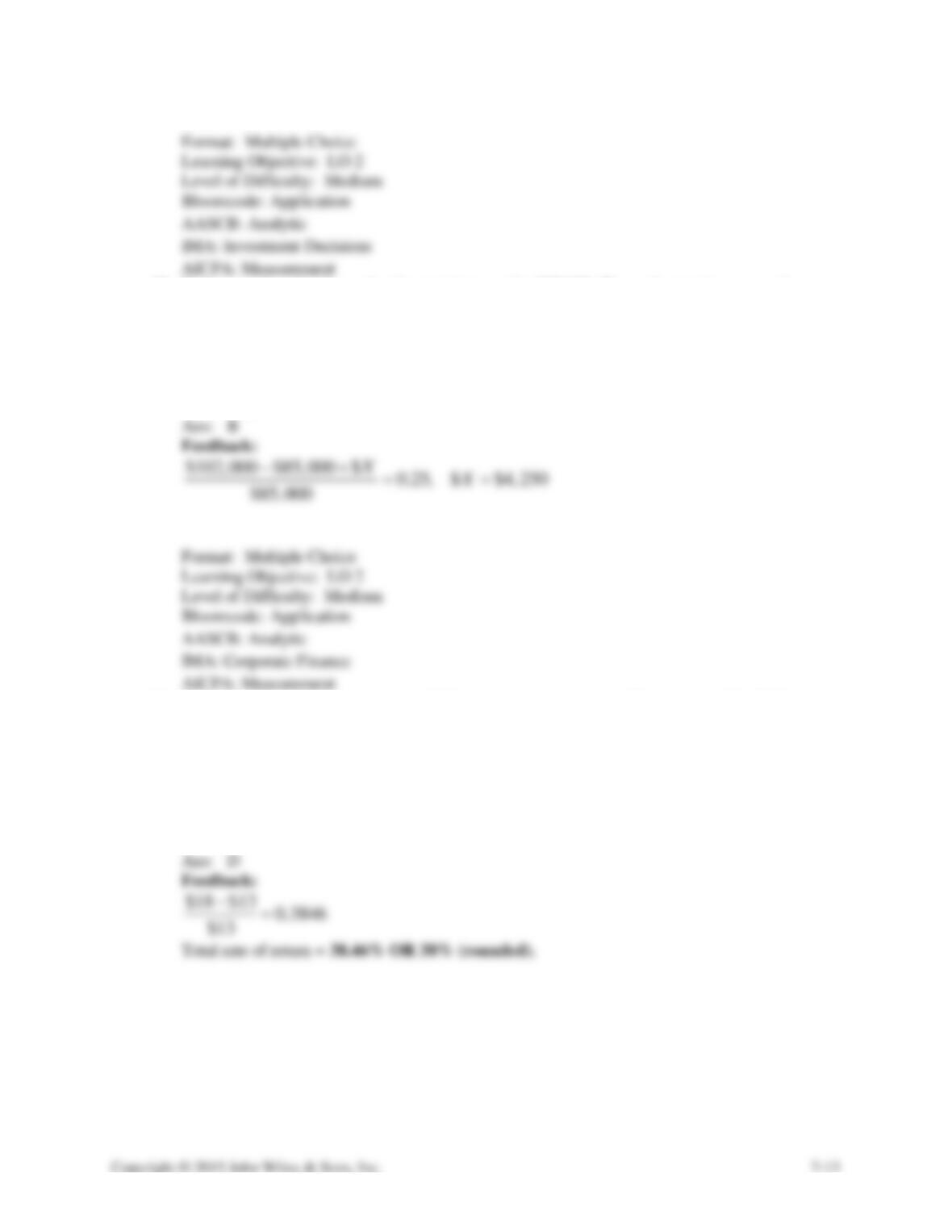
Barbra purchased a piece of real estate last year for $85,000. The real estate is now worth
$102,000. If Barbra needs to have a total return of 25 percent during the year, then what is the
dollar amount of income that she needs to have to reach her objective?
A)
$3,750
B)
$4,250
C)
$4,750
D)
$5,250
Ans:
B
38.
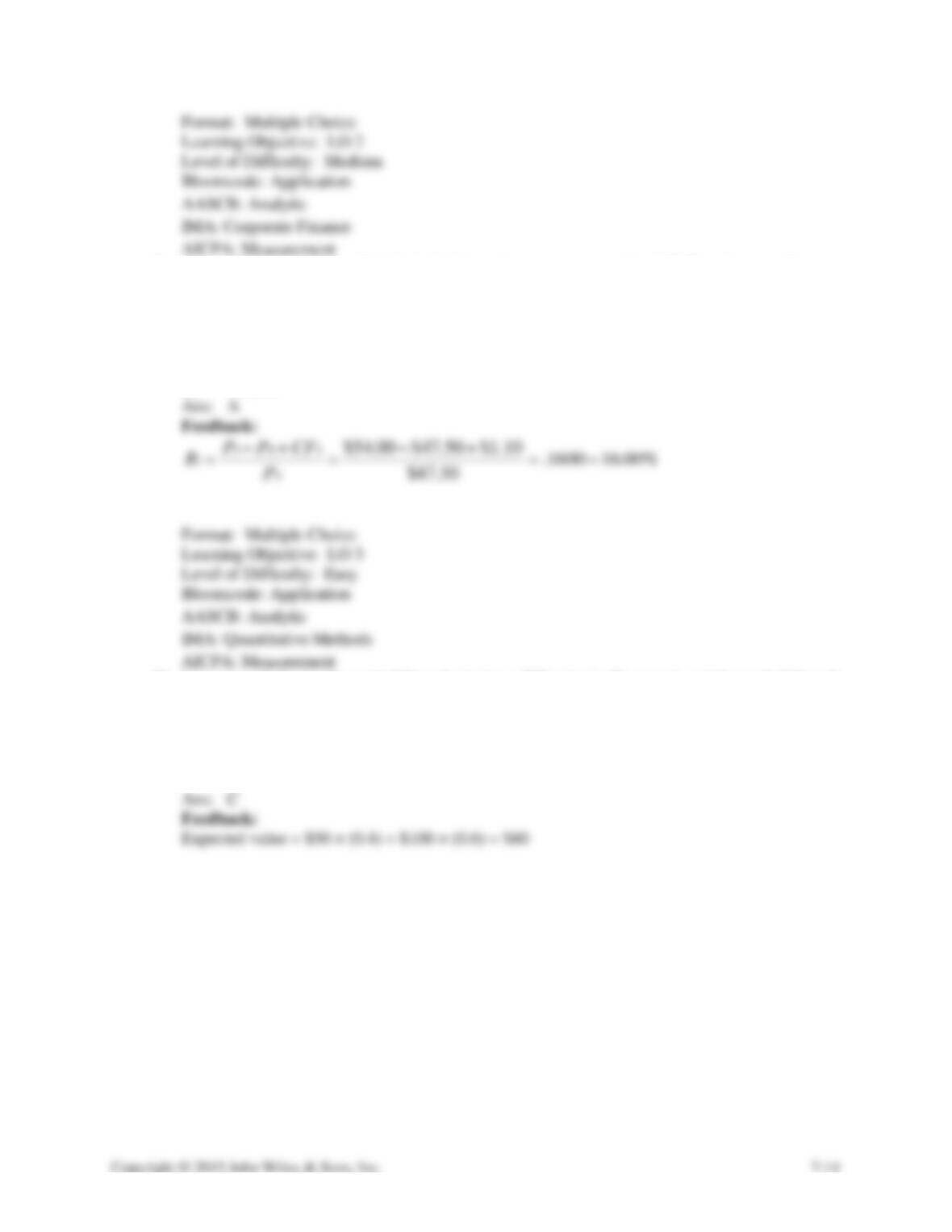
Books Brothers stock was priced at $15 per share two years ago. The stock sold for $13 last
year and now it sells for $18. What was the total return for owning Books Brothers stock during
the most recent year? Assume that no dividends were paid. Round your answer to the nearest
percent.
A)
17%
B)
20%
C)
23%
D)
38%
Ans:
D
Fundamentals of Corporate Finance 3e Test Bank
39.
George Wilson purchased Bright Light Industries common stock for $47.50 on January 31,
2010. The firm paid dividends of $1.10 during the last 12 months. George sold the stock today
(January 30, 2011) for $54.00. What is George’s holding period return?
A)
16.00%
B)
14.00%
C)
11.00%
D)
19.00%
Ans:
A
40.
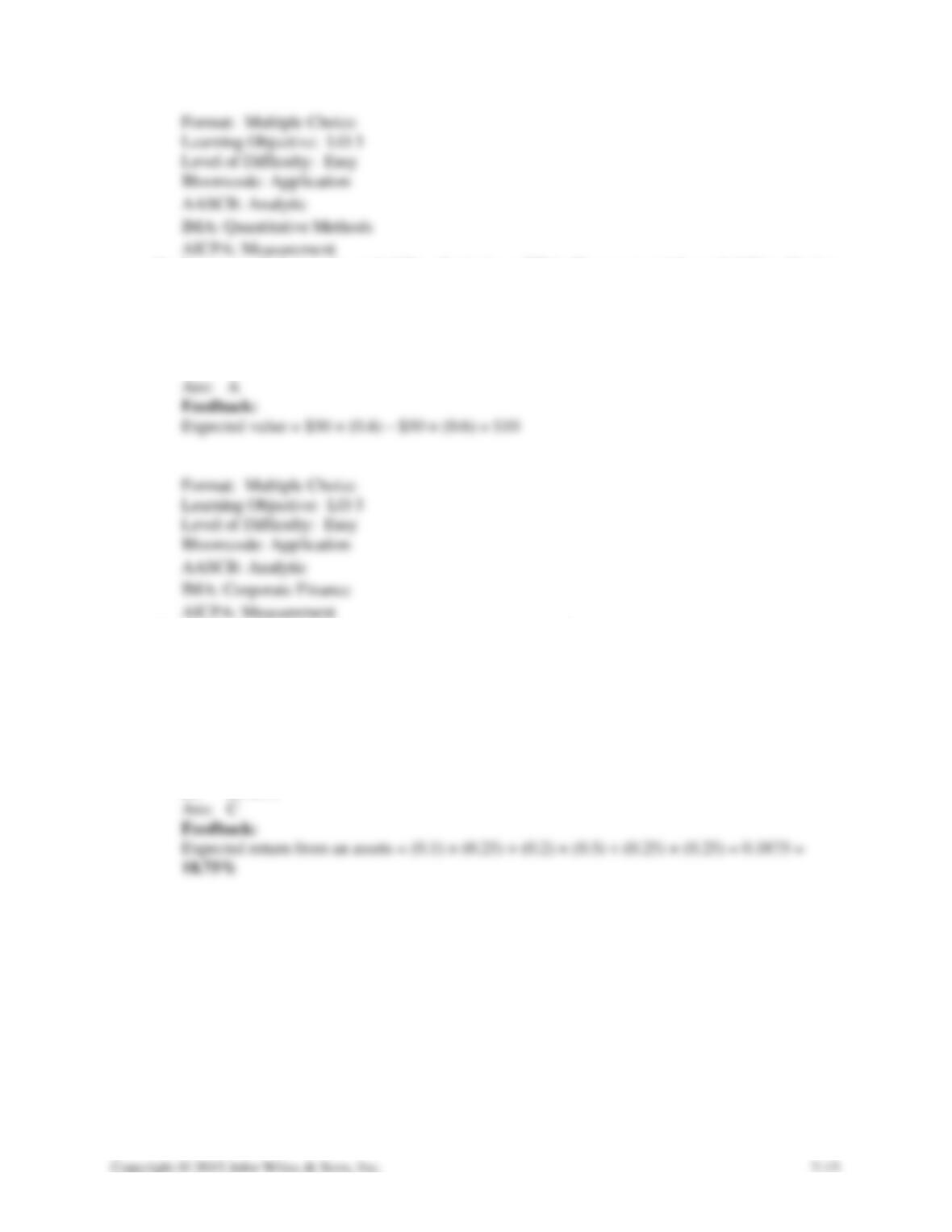
In a game of chance, the probability of winning a $50 prize is 40 percent, and the probability of
winning a $100 prize is 60 percent. What is the expected value of the prize in the game?
A)
$50
B)
$75
C)
$80
D)
$100
Ans:
C
Expected value = $50 × (0.4) + $100 × (0.6) = $80
Fundamentals of Corporate Finance 3e Test Bank
41.
In a game of chance, the probability of winning a $50 is 40 percent and the probability of losing
a $50 prize is 60 percent. What is the expected value of the prize in the game?
A)
$10
B)
$0
C)
$10
D)
$25
Ans:
A
Expected value = $50 × (0.4) – $50 × (0.6) = $10
42.
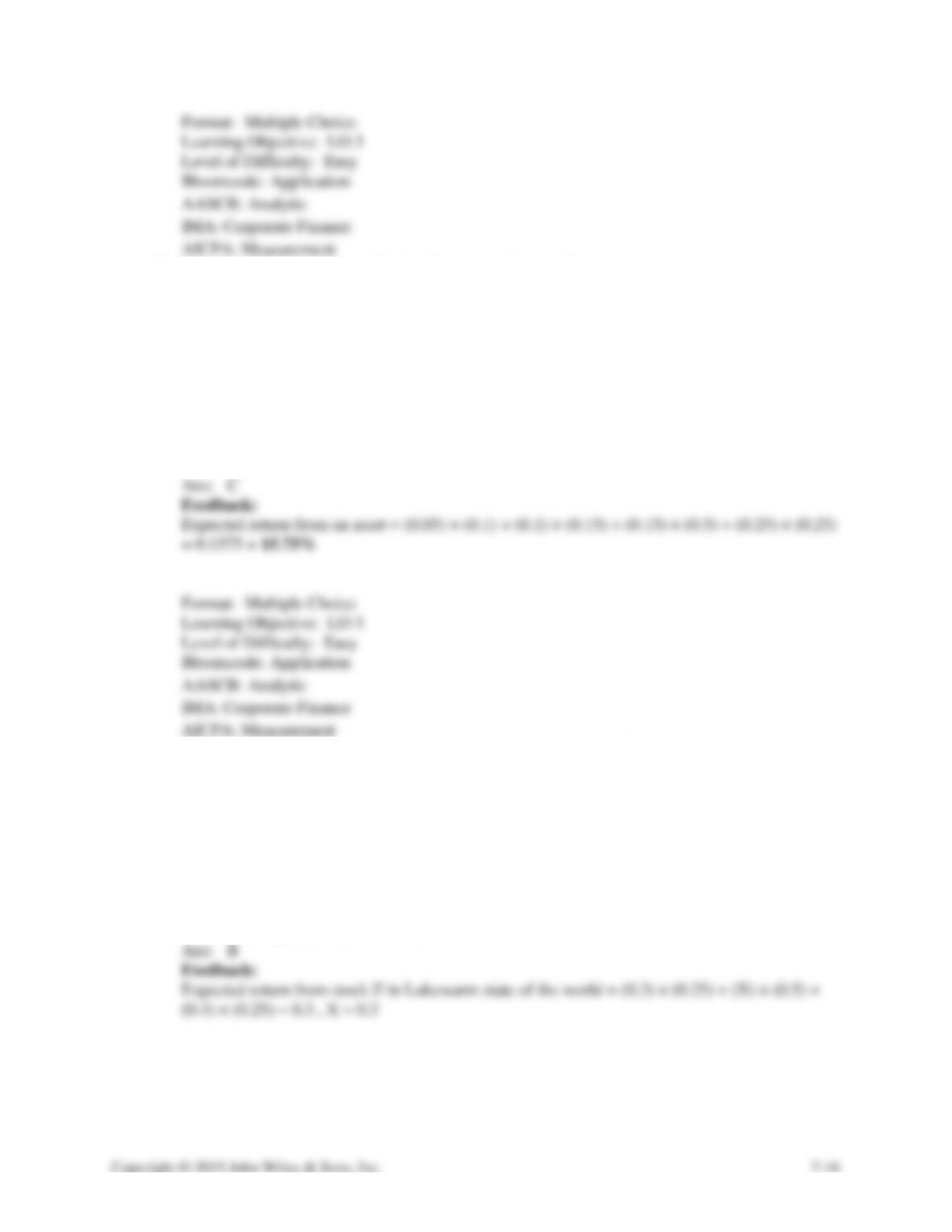
Use the following table to calculate the expected return from an asset.
Return
Probability
0.1
0.25
0.2
0.5
0.25
0.25
A)
15.00%
B)
17.50%
C)
18.75%
D)
20.00%
Ans:
C
Fundamentals of Corporate Finance 3e Test Bank
43.
Use the following table to calculate the expected return from an asset.
Return
Probability
0.05
0.1
0.1
0.15
0.15
0.5
0.25
0.25
A)
12.50%
B)
13.75%
C)
15.75%
D)
16.75%
Ans:
C
44.
The expected return for Stock Z is 30 percent. If we know the following information about
Stock Z, then what return will it produce in the Lukewarm state of the world?
Return
Probability
Poor
0.2
0.25
Lukewarm
?
0.5
Dynamite
0.4
0.25
A)
20%
B)
30%
C)
40%
D)
It is impossible to determine.
Ans:
B
Fundamentals of Corporate Finance 3e Test Bank
45.
The expected return for Stock V is 24.5 percent. If we know the following information about
Stock Z, then what is the probability of the Dynamite state of the world occurring?
Return
Probability
Poor
0.15
0.2
Lukewarm
0.28
0.7
Dynamite
0.19
?
A)
5%
B)
10%
C)
15%
D)
20%
Ans:
B
Probability of the Dynamite state of the world occurring = 0.2 + 0.7 + X = 1.0 ===> X = 0.1 or
10%
46.
Ahmet purchased a stock for $45 one year ago. The stock is now worth $65. During the year,
the stock paid a dividend of $2.50. What is the total return to Ahmet from owning the stock?
A)
5%
B)
44%
C)
35%
D)
50%
Ans:
D
Fundamentals of Corporate Finance 3e Test Bank
47.
Julio purchased a stock one year ago for $27. The stock is now worth $32, and the total return
to Julio for owning the stock was 37 percent. What is the dollar amount of dividends that he
received for owning the stock during the year? Round your final answer to nearest whole dollar.
A)
$4
B)
$5
C)
$6
D)
$7
Ans:
B
AICPA: Measurement
48.
Francis purchased a stock one year ago for $20, and it is now worth $24. The stock paid a
dividend of $3 during the year. What was the stock’s rate of return from capital appreciation
during the year?
A)
17%
B)
20%
C)
29%
D)
35%
Ans:
B
Capital appreciation percentage = 20 %
Fundamentals of Corporate Finance 3e Test Bank
49.
Gwen purchased a stock one year ago for $25, and it is now worth $31. The stock paid a
dividend of $1.50 during the year. What was the stock’s rate of return from dividend income
during the year?
A)
6%
B)
15%
C)
24%
D)
26%
Ans:
A
50.
Genaro needs to capture a return of 40 percent for his one-year investment in a property. He
believes that he can sell the property at the end of the year for $150,000 and that the property
will provide him with rental income of $25,000. What is the maximum amount that Genaro
should be willing to pay for the property?
A)
$112,500
B)
$125,000
C)
$137,500
D)
$150,000
Ans:
B
Fundamentals of Corporate Finance 3e Test Bank
AICPA: Measurement
51.
Serox stock was selling for $20 two years ago. The stock sold for $25 one year ago, and it is
currently selling for $28. Serox pays a $1.10 dividend per year. What was the rate of return for
owning Serox in the most recent year? (Round to the nearest percent.)
A)
12%
B)
16%
C)
32%
D)
40%
Ans:
B
52.
Security Analysts that have evaluated Concordia Corporation, have determined that there is a
15% chance that the firm will generate earnings per share of $2.40; a 60% probability that the
firm will generate earnings per share of $3.10; and a 25% probability that the firm will generate
earnings per share of $3.80. What are the expected earnings per share for Concordia
Corporation? (Round off to the nearest $0.01)
A)
$3.10
B)
$3.17
C)
$2.75
D)
$2.91
Ans:
B