Chapter 07 – Development and Sex Determination
True / False
1. Bruce Reimer was born with ambiguous genitalia.
a.
True
b.
False
False
2. Gonadal sex and sexual phenotype in males and females are produced by separate developmental pathways by the
action of different gene sets.
a.
True
b.
False
True
3. Because females carry two X chromosomes and males carry only one, females have higher levels of all products
encoded by genes on the X chromosome.
a.
True
b.
False
False
4. An embryo that is composed of a hollow ball of cells is called a blastocyst.
a.
True
b.
False
True
5. The brain and nervous system of a developing embryo can only be damaged during the very early stages of
development.
a.
True
b.
False
False
6. The inheritance of sex-influenced traits can be dominant in one sex but recessive in the other.
a.
True
b.
False
True
7. Sperm mature and are stored in the epididymis.
a.
True
b.
False
True
8. Teratogenic effects of alcohol only occur during the first 12 weeks of pregnancy.
a.
True
b.
False
False
9. Phenotypic sex is determined at the moment of fertilization.
a.
True
b.
False
False
10. Complete androgen insensitivity causes XY males to become phenotypic females.
a.
True
b.
False
True
Chapter 07 – Development and Sex Determination
Multiple Choice
11. The undifferentiated genitalia of an early human embryo develops into male genitalia under the influence of ____.
a.
oxytocin
b.
prostaglandin and DHT
c.
prolactin
d.
testosterone, AMH, and DHT
e.
Wolfian duct inhibitors
d
Bloom’s: Understand
7-6 Defining Sex in Stages: Chromosomes, Gonads, and Hormones
demonstrate how genes and hormones interact to product male and female phenotypes.
12. The hormone oxytocin stimulates ____.
a.
meiosis of oogonia
b.
ovulation
c.
implantation of the embryo
d.
development of the fetal heart
e.
contraction of uterine muscles during childbirth
e
Bloom’s: Understand
7-3 A Survey of Human Development from Fertilization to Birth
division in humans.
13. Sex-influenced traits are expressed ____.
a.
aftafter the formation of a Barr body
b.
more in males than in females
c.
as a result of hormone differences between males and females
d.
only in males
e.
only in females
c
Bloom’s: Understand
7-9 Sex-Related Phenotypic Effects
phenotypic expression of a trait, including sex-influenced traits and sex-limited traits
14. In addition to fertilizing the egg, sperm also ____.
a.
assist the fertilizing sperm in penetrating the egg
b.
trigger chemical changes in the egg
c.
dissolve the outer barriers surrounding the oocyte
from phenotypic sex and describe the phenotypes of two such genetic disorders.
Chapter 07 – Development and Sex Determination
d.
release chemicals to speed cell division in the zygote
e.
trigger chemical changes in the egg that prevent the entry of more than one sperm
e
Bloom’s: Understand
7-3 A Survey of Human Development from Fertilization to Birth
division in humans.
15. The part of the male reproductive system where sperm mature is known as the ____.
a.
epididymis
b.
bulbourethral gland
c.
testis
d.
seminal vesicle
e.
ejaculatory duct
a
Bloom’s: Understand
7-2 The Human Reproductive System
semen, identify the function of each in the male reproductive system.
16. A blastocyst ____.
a.
releases hormones in the myometrium
b.
releases the egg into the oviduct
c.
implants in the endometrium
d.
matures into a chorion
e.
metabolically supports embryonic and fetal development
c
Bloom’s: Understand
7-3 A Survey of Human Development from Fertilization
division in humans.
17. Teratogens affect the ____ more than any other part of the fetal body.
a.
central nervous system
b.
upper limbs
c.
heart
d.
lower limbs
e.
external genitalia
a
Bloom’s: Remember
fetus, and explain why first trimester embryos are especially sensitive to these agents.
18. A zygote is a(n) ____.
a.
diploid cell
b.
haploid cell
c.
gamete
d.
female gonad
e.
male gonad
a
Bloom’s: Understand
7-2 The Human Reproductive System
testis, and ovary, identify the function of each in the human reproductive system.
19. Seminal vesicles secrete fructose and ____ into the semen
a.
DHT
b.
oxytocin
c.
testosterone
d.
estrogen
e.
prostaglandins
e
Bloom’s: Understand
7-2 The Human Reproductive System
semen, identify the function of each in the male reproductive system.
20. Any physical or chemical agent that brings about an increase in congenital malformations is called a(n) ____.
a.
teratogen
b.
hormone
c.
ARX factor
d.
cytocin
e.
trophoblast
a
Bloom’s: Understand
7-4 Teratogens Are a Risk to the Developing Fetus
fetus, and explain why first trimester embryos are especially sensitive to these agents.
21. The inner lining of the uterus that is shed at menstruation if fertilization has not occurred is called the ____.
a.
cervix
b.
endometrium
c.
oogonium
d.
chorion
e.
epididymis
b
22. In humans, body size, muscle mass, and patterns of fat distribution are types of ____ sex characteristics.
a.
primary
b.
secondary
c.
tertiary
d.
initial
e.
mutable
b
Bloom’s: Understand
7-5 How Is Sex Determined?
HUHE.CUMM.16.7-5-1 – Identify the two factors involved in sex determination.
23. Pattern baldness is a(n) ____ trait.
a.
X-linked
b.
Y-linked
c.
sex-linked
d.
sex-limited
e.
sex-influenced
e
Bloom’s: Understand
7-9 Sex-Related Phenotypic Effects
phenotypic expression of a trait, including sex-influenced traits and sex-limited traits
24. In an XX embryo, ____ inactivation of one X chromosome usually occurs when the embryo has about 32 cells.
a.
phenotypic
b.
inhibited
c.
cascading
d.
selective
e.
random
e
Bloom’s: Understand
7-8 Equalizing the Expression of X Chromosome Genes in Males and Females
HUHE.CUMM.16.7-8-3 – Explain how and when X inactivation occurs.
25. A Barr body is a(n) ____.
a.
activated X chromosome
b.
inactivated X chromosome
c.
immature trophoblast
Bloom’s: Remember
7-2 The Human Reproductive System
Chapter 07 – Development and Sex Determination
d.
immature blastocyst
e.
mature blastocyst
b
Bloom’s: Remember
7-8 Equalizing the Expression of X Chromosome Genes in Males and Females
compensation in female mammals.
26. The pathway from ____ sex to ____ sex can be disrupted at several stages.
a.
chromosomal; phenotypic
b.
phenotypic; chromosomal
c.
gonadal; chromosomal
d.
gonadal; genotypic
e.
phenotypic; gonadal
a
Bloom’s: Understand
7-7 Mutations Can Uncouple Chromosomal Sex from Phenotypic Sex
from phenotypic sex and describe the phenotypes of two such genetic disorders.
27. During the 1968 Olympic Games, the International Olympic Committee performed an analysis of ____ on all female
athletes in order to verify their sex.
a.
Barr bodies
b.
hormone levels
c.
karyotypes
d.
genitalia
e.
phenotypes
a
Bloom’s: Remember
7-6 Defining Sex in Stages: Chromosomes, Gonads, and Hormones
demonstrate how genes and hormones interact to product male and female phenotypes.
28. The chorionic villi eventually form the placenta, a disc-shaped structure that ____.
a.
releases sex hormones at appropriate times throughout pregnancy
b.
initiates uterine contractions
c.
binds to the zygote to accelerate organ development
d.
nourishes the embryo throughout pregnancy
e.
prevents infection by blocking the passage of microorganisms through the cervix during pregnancy
d
Bloom’s: Understand
7-3 A Survey of Human Development from Fertilization to Birth
division in humans.
29. The most important events in human development occur during the ____.
a.
week before birth
b.
month before birth
c.
first trimester
d.
second trimester
e.
third trimester
c
Bloom’s: Understand
7-3 A Survey of Human Development from Fertilization to Birth
division in humans.
30. A fetus’s exposure to ____ is the leading preventable cause of birth defects.
a.
alcohol
b.
X-rays
c.
viruses
d.
thalidomide
e.
Toxoplasma gondii
a
Bloom’s: Remember
7-4 Teratogens Are a Risk to the Developing Fetus
LEARNING OBJECTIVES:
HUHE.CUMM.16.7-4-2 – Describe the teratogenic effects of alcohol on a fetus.
31. X inactivation can lead to ____________________ in females who are heterozygous for X-linked genes.
mosaic
Bloom’s: Understand
7-8 Equalizing the Expression of X Chromosome Genes in Males and Females
LEARNING OBJECTIVES:
HUHE.CUMM.16.7-8-3 – Explain how and when X inactivation occurs.
32. The process of ____________________ equalizes the dosage of functional genes carried on the X chromosome in
males and females.
X inactivation
Bloom’s: Understand
7-8 Equalizing the Expression of X Chromosome Genes in Males and Females
LEARNING OBJECTIVES:
HUHE.CUMM.16.7-8-3 – Explain how and when X inactivation occurs.
33. The duct between a testis and a seminal vesicle used for the transport of sperm is the ____________________.
vas deferens
Bloom’s: Understand
7-2 The Human Reproductive System
spermatogenesis, spermatocyte, epididymis, vas deferens, ejaculatory duct, urethra, seminal
34. The process of ____________________ equalizes the amount of X chromosome gene products in both sexes.
35. Most of the protein eaten by the mother during the third trimester of pregnancy is used for fetal brain and
____________________ system growth and development.
36. In the male reproductive system, the ____________________ secretes a milky, alkaline fluid that neutralizes acidic
vaginal secretions and enhances sperm viability.
37. The lower neck of the uterus opening into the vagina is the ____________________.
38. Children born with ____________________ have genital structures that are neither fully male nor fully female.
39. Females outnumber males in the tertiary sex ratio because genetic and ____________________ factors cause higher
death rates among males.
40. At term, ____________________ changes initiate and drive the events surrounding birth.
41. Female gametes complete meiosis II at ____________________.
42. The formation of _____ depends on gene action, interactions within the embryo, interaction with other embryos that
may be in the uterus, and interactions with the maternal environment.
43. A condition called ____________________ results in individuals having both male and female sexual structures at
different times in their lives.
44. Duchenne muscular dystrophy is, for all practical purposes, a(n) ____________________ trait.
45. The health effects of X-rays on a fetus depend on the amount of ____________________ and the
____________________ of the fetus.
46. By the end of the first trimester of pregnancy, all of the major ____________________ have formed and are
functional.
47. Chromosomal sex of a fetus with the sex chromosomes XXY is almost always ____________________.
48. A collection of birth defects caused by alcohol consumption during pregnancy is known as ____________________.
49. In 2012, the International Olympic Committee began using tests that measure the levels and the body’s response to the
male hormone ____________________ as a means of distinguishing females from males when sex was questionable.
50. The small region of an inactivated X chromosome that is not inactivated contains ____________________
homologous to those on the Y chromosome.
51. Describe the stages at which genetic sex, gonadal sex, and phenotypic sex are established.
52. Explain how X inactivation can result in female mosaicism and give examples.
53. Describe how the previous assumption regarding the development of sexual identity and the treatment for ambiguous
genitalia has changed in recent years.
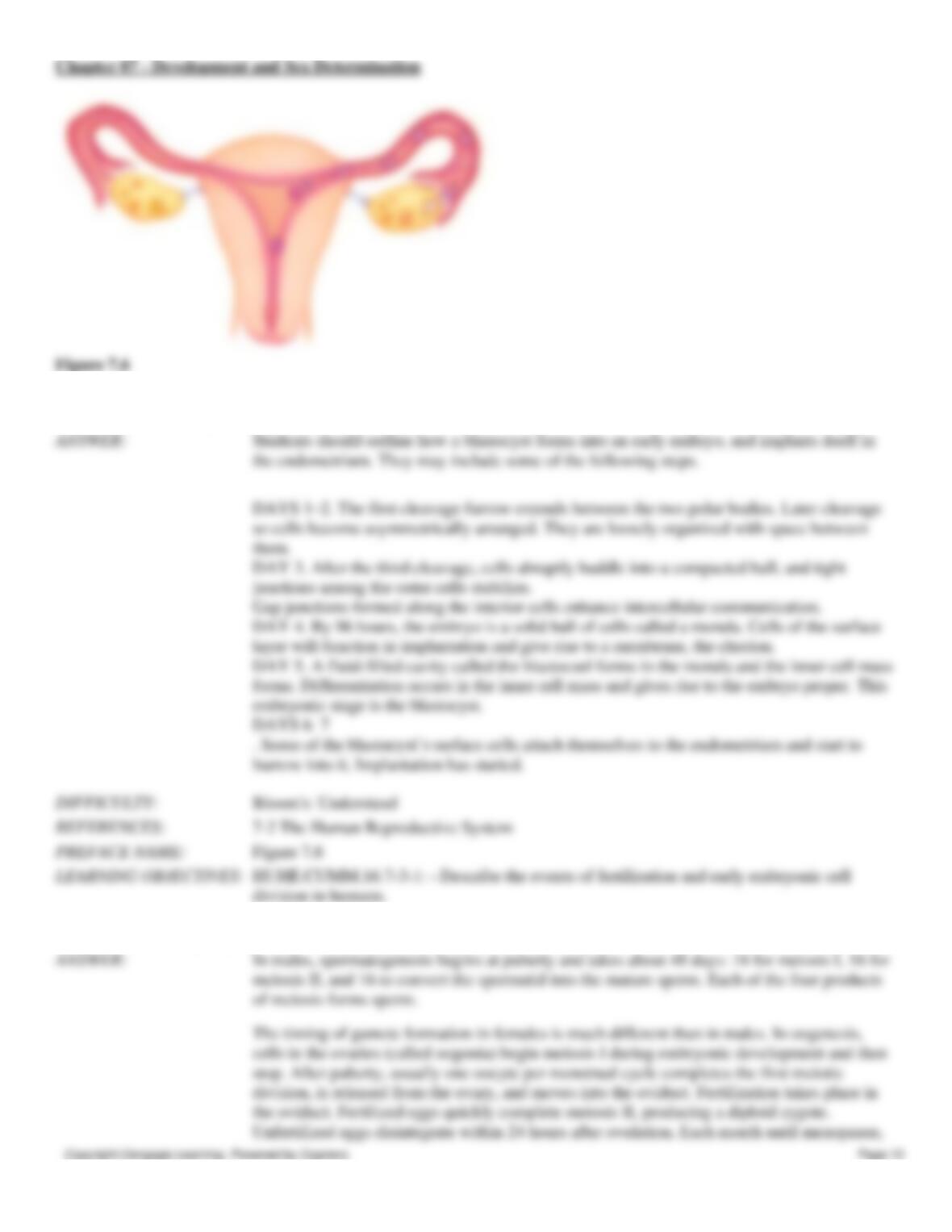
54. The accompanying figure illustrates the process of human development from fertilization to implantation. Describe
what happens from day 1 through days 6-7 of this process.
55. How is the timing of gamete formation in females different than that in males?
56. As sperm are transported through the ducts system, what secretions are added from which three sets of glands to make
up semen?
57. Explain why a pregnant woman should not have an abdominal X-ray and identify the possible consequences to the
fetus if she does.
58. Describe the interactions between genes and the environment in the sex determination of some reptiles; explain their
relevance to human sex determination.
59. Explain how sex-limited genes are inherited and give an example of this type of inheritance.
60. Describe the Lyon hypothesis.