
The Essential Cosmic Perspective, 8e (Bennett et al.)
Chapter 7 Earth and the Terrestrial Worlds
7.1 Multiple Choice Questions
1) Rank the five terrestrial worlds in order of size from smallest to largest.
A) Mercury, Venus, Earth, Moon, Mars
B) Mercury, Moon, Venus, Earth, Mars
C) Moon, Mercury, Venus, Earth, Mars
D) Moon, Mercury, Mars, Venus, Earth
E) Mercury, Moon, Mars, Earth, Venus
2) Under what circumstances can differentiation occur in a planet?
A) The planet must have a rocky surface.
B) The planet must be made of both metal and rock.
C) The planet must have an atmosphere.
D) The planet must be geologically active, that is, have volcanoes, planetquakes, and erosion
from weather.
E) The planet must have a molten interior.
3) The core, mantle, and crust of a planet primarily have differences in their
A) geological activity.
B) color.
C) strength.
D) density.
4) The lithosphere of a planet is the layer that consists of
A) material above the crust.
B) material between the mantle and the core.
C) the rigid rocky material of the crust and uppermost portion of the mantle.
D) the softer rocky material of the mantle.
E) the lava that comes out of volcanoes.
5) What is the most important factor that determines the thickness of a planet’s lithosphere?
A) pressure
B) composition
C) internal temperature
D) distance of planet from Sun

6) The terrestrial planet cores contain mostly metal because
A) the entire planets are made mostly of metal.
B) metals condensed first in the solar nebula and the rocks then accreted around them.
C) metals sank to the center during a time when the interiors were molten throughout.
D) radioactivity created metals in the core from the decay of uranium.
E) convection carried the metals to the core.
7) What process initially caused the terrestrial planets to be hot enough to be entirely molten?
A) accretion
B) differentiation
C) radioactivity
D) convection
E) conduction
8) Which of the following best describes convection?
A) It is the process by which rocks sink in water.
B) It is the process in which warm material expands and rises while cool material contracts and
falls.
C) It is the process in which warm material gets even warmer and cool material gets even cooler.
D) It is the process in which a liquid separates according to density, such as oil and water
separating in a jar.
E) It is the process in which bubbles of gas move upward through a liquid.
9) What are the circumstances under which convection can occur in a substance?
A) when the substance is subjected to a strong magnetic field
B) when dense material is being added to the substance
C) when the substance is strongly shaken or disturbed by a strong wind
D) when the substance is strongly cooled from underneath
E) when the substance is strongly heated from underneath
10) The two principal sources for the internal heating of terrestrial planets are
A) convection and accretion.
B) accretion and radioactivity.
C) accretion and eruption.
D) convection and radioactivity.
E) radiation and convection.

11) Why does the interior of a large planet take longer to cool than the interior of a smaller
planet?
A) Small planets have a larger surface area-to-volume ratio than larger planets.
B) Small planets have a smaller surface area-to-volume ratio than larger planets.
C) Convection happens faster in smaller planets.
D) Small planets have less radioactive material in their interiors.
E) Differentiation occurs more rapidly in small planets.
12) Which of the terrestrial worlds has the strongest magnetic field?
A) Mars
B) Earth
C) the Moon
D) Venus
E) Mercury
13) Why does Earth have the strongest magnetic field among the terrestrial worlds?
A) It is the only one that has a molten metallic outer core.
B) It rotates much faster than any other terrestrial world.
C) It is the only one that has both a molten metallic outer core and reasonably rapid rotation.
D) It is by far the largest terrestrial world.
E) It is the most volcanically active world.
14) Which of the following most likely explains why Venus does not have a strong magnetic
field?
A) It does not have a molten metallic outer core.
B) Its rotation is too slow.
C) It is too close to the Sun.
D) It is too large.
E) Its atmosphere is too thick.
15) What are the conditions necessary for a terrestrial planet to have a strong magnetic field?
A) a molten metallic core only
B) fast rotation only
C) a rocky mantle only
D) both a molten metallic core and reasonably fast rotation
E) both a molten metallic core and a rocky mantle

16) Which of the following has virtually no effect on the internal structure of a planet?
A) its composition
B) its size
C) its magnetic field
D) its mass
17) Which of the following does not have a major effect in shaping planetary surfaces?
A) impact cratering
B) volcanism
C) tectonics
D) erosion
E) magnetism
18) Approximately how large is an impact crater compared to the size of the impactor?
A) the same size
B) 10-20 percent larger
C) 10 times larger
D) 100 times larger
E) 1,000 times larger
19) Approximately how deep is an impact crater compared to its width?
A) 1-10%
B) 10-20%
C) 30-40%
D) 50-100%
E) 100-200%
20) The relatively few craters that we see within the lunar maria
A) were formed by impacts that occurred before those that formed most of the craters in the
lunar highlands.
B) were formed by impacts that occurred after those that formed most of the craters in the lunar
highlands.
C) were created by the same large impactor that led to the formation of the maria.
D) are volcanic in origin, rather than from impacts.
E) are sinkholes that formed when sections of the maria collapsed.

21) When we see a region of a planet that is not as heavily cratered as other regions, we conclude
that
A) there is little volcanic activity to create craters.
B) the planet is rotating very slowly and only one side was hit by impactors.
C) the planet formed after the age of bombardment and missed out on getting hit by leftover
planetesimals.
D) the surface in the region is older than the surface in more heavily cratered regions.
E) the surface in the region is younger than the surface in more heavily cratered regions.
22) Volcanism is more likely on a planet that
A) is closer to the Sun.
B) is struck often by meteors and solar system debris.
C) has high internal temperatures.
D) doesn’t have an atmosphere or oceans.
23) What type of stresses broke Earth’s lithosphere into plates?
A) impacts of asteroids and planetesimals
B) internal temperature changes that caused the crust to expand and stretch
C) the circulation of convection cells in the mantle, which dragged against the lithosphere
D) cooling and contracting of the planet’s interior, which caused the mantle and lithosphere to be
compressed
E) volcanism, which produced heavy volcanoes that bent and cracked the lithosphere
24) Which of the following best describes tectonics?
A) the excavation of bowl-shaped depressions by asteroids or comets striking a planet’s surface
B) the eruption of molten rock from a planet’s interior to its surface
C) the disruption of a planet’s lithosphere by internal stresses
D) the wearing down or building up of geological features by wind, water, ice, and other
phenomena of planetary weather
25) Which of the following best describes erosion?
A) the excavation of bowl-shaped depressions by asteroids or comets striking a planet’s surface
B) the eruption of molten rock from a planet’s interior to its surface
C) the disruption of a planet’s lithosphere by internal stresses
D) the wearing down or building up of geological features by wind, water, ice, and other
phenomena of planetary weather

26) Which of the following best describes volcanism?
A) the excavation of bowl-shaped depressions by asteroids or comets striking a planet’s surface
B) the eruption of molten rock from a planet’s interior to its surface
C) the disruption of a planet’s lithosphere by internal stresses
D) the wearing down or building up of geological features by wind, water, ice, and other
phenomena of planetary weather
27) Which of the following best describes impact cratering?
A) the excavation of bowl-shaped depressions by asteroids or comets striking a planet’s surface
B) the eruption of molten rock from a planet’s interior to its surface
C) the disruption of a planet’s lithosphere by internal stresses
D) the wearing down or building up of geological features by wind, water, ice, and other
phenomena of planetary weather
28) A planet is most likely to have tectonic activity if it has
A) low surface gravity.
B) high surface gravity.
C) low internal temperature.
D) high internal temperature.
E) a dense atmosphere.
29) What kind of surface features may result from tectonics?
A) mountains
B) valleys
C) volcanos
D) cliffs
E) all of the above
30) How did the lunar maria form?
A) Large impacts fractured the Moon’s lithosphere, allowing lava to fill the impact basins.
B) The early bombardment created heat that melted the lunar surface in the regions of the maria.
C) Volatiles escaping from the Moon’s interior heated and eroded the surface in the regions of
the maria.
D) The giant impact that created the Moon left smooth areas that we call the maria.
E) The maria are the result of gradual erosion by micrometeorites striking the Moon.

31) The Caloris Basin on Mercury covers a large region of the planet, but few craters have
formed on top of it. From this we conclude that
A) erosion destroyed the smaller craters that formed on the basin.
B) Mercury’s atmosphere prevented smaller objects from hitting the surface.
C) only very large impactors hit Mercury’s surface in the past.
D) the Caloris Basin formed toward the end of the solar system’s period of heavy bombardment.
E) the Caloris Basin was formed by a volcano.
32) Why do we think Mercury has so many tremendous cliffs?
A) They were probably carved in Mercury’s early history by running water.
B) They were probably formed by tectonic stresses when the entire planet shrank as its interior
cooled.
C) They probably formed when a series of large impacts hit Mercury.
D) They are probably volcanic in origin, carved by flowing lava.
E) They were probably formed by convection occurring in Mercury’s mantle.
33) The Tharsis Bulge on Mars is most likely the result of
A) rising material in the mantle of Mars.
B) numerous volcanoes that built up a large bulge on the surface of Mars.
C) a huge impact that occurred billions of years ago.
D) wind deposited material.
E) water deposited material.
34) How have we been able to construct detailed maps of surface features on Venus?
A) by studying Venus from Earth with powerful telescopes
B) by studying Venus with powerful telescopes on spacecraft that were sent to orbit Venus
C) by making computer models of geological processes on Venus
D) by using radar from spacecraft that were sent to orbit Venus
E) by landing spacecraft on the surface for close-up study
35) What is the most likely reason Venus does not experience plate tectonics like Earth?
A) Venus has a much cooler interior than Earth, which has inhibited convection.
B) Volcanoes have covered up any evidence of plate tectonics.
C) Venus’s lack of a magnetic field has interfered with the tectonic process.
D) Venus’s lithosphere is stronger and thicker than Earth’s.
E) The slow rotation of Venus causes it to have a thicker crust than Earth.

36) Which of the following show evidence of ancient river beds?
A) the Moon
B) Mercury
C) Venus
D) Mars
E) all of the above
37) Why is Mars red?
A) It is made primarily of red clay.
B) Its surface rocks were rusted by oxygen.
C) Its atmosphere scatters blue light more effectively than red light.
D) Its surface is made of ices that absorb blue light.
E) Its surface is made of ices that absorb red light.
38) Where is most of the water on Mars?
A) in its clouds
B) in its polar caps and subsurface ground ice
C) frozen on the peaks of its tall volcanoes
D) in frozen lakes and oceans on its surface
E) distributed evenly throughout its atmosphere
39) Spacecraft have landed on all the terrestrial worlds except
A) Mercury.
B) Venus.
C) Moon.
D) Mars.
40) Which of the following worlds has the thickest atmosphere?
A) Mercury
B) Venus
C) the Moon
D) Mars
E) Earth
41) Which of the following planets has the thinnest atmosphere?
A) Venus
B) Earth
C) Mars

42) Suppose Earth’s atmosphere had no greenhouse gases. This would cause Earth’s average
surface temperature to be
A) well below the freezing point of water.
B) at the freezing point of water.
C) at the boiling point of water.
D) the same temperature as it is now.
E) slightly warmer than it is now.
43) What are greenhouse gases?
A) gases that absorb visible light
B) gases that absorb ultraviolet light
C) gases that absorb infrared light
D) gases that transmit visible light
E) gases that transmit infrared light
44) Which of the following gases best absorbs ultraviolet light?
A) carbon dioxide
B) nitrogen
C) oxygen
D) hydrogen
E) ozone
45) Sunsets and sunrises often appear red because
A) the Sun emits more red light when it’s rising and setting.
B) sunlight must pass through more atmosphere, which scatters the shorter wavelengths more
than the longer wavelengths, allowing more red light to reach your eye.
C) sunlight must pass through more atmosphere, which scatters the longer wavelengths more
than the shorter wavelengths, allowing more red light to reach your eye.
D) the cooler atmosphere in the morning and evening absorbs more blue light.
E) none of the above
46) There are no auroras on Venus because it
A) lacks atmospheric oxygen.
B) is too hot.
C) lacks a strong magnetic field.
D) lacks strong winds.

47) How is the atmosphere of a planet affected by its rotation rate?
A) The rotation rate determines how much atmosphere a planet has.
B) The rotation rate determines how long the planet is able to retain its atmosphere.
C) Faster rotation rates raise surface temperatures and thus determine how much material is
gaseous.
D) Faster rotation rates raise the atmospheric temperature.
E) Faster rotation rates produce stronger winds.
48) Why does Mars have more extreme seasons than Earth?
A) because it is farther from the Sun
B) because it has a much larger axial tilt
C) because it has a more eccentric orbit
D) because it has more carbon dioxide in its atmosphere
E) all of the above
49) In what ways is Earth different from the other terrestrial planets?
A) Its lithosphere is broken into plates that move around.
B) It has a much higher percentage of oxygen in its atmosphere.
C) Most of its surface is covered with liquid water.
D) Life can be found almost everywhere on its surface.
E) All of the above are true.
50) Why do most scientists accept the claim that climate change is being caused by human
activity?
A) Levels of atmospheric carbon dioxide show a sharp increase since the industrial revolution.
B) Computer models correctly reproduce past climate variations.
C) Computer models that include the effects of human activity correctly predict the current trend
of increasing temperatures.
D) Computer models that do not include the effects of human activity do not correctly predict the
current trend of increasing temperatures.
E) all of the above
51) What process has shaped Earth’s surface more than any other?
A) impact cratering
B) volcanism
C) plate tectonics
D) wind erosion
E) acid rain

52) Why is continental crust lower in density than seafloor crust?
A) Continental crust is made from remelted seafloor crust, and the lower density material melts
first.
B) Continental crust is made from volcanic rock called basalt, which is lower in density than
what the seafloor crust is made from.
C) Continental crust is made of rock, while seafloor crust has more metals.
D) Seafloor crust is more compact due to the weight of the oceans, but it is made of the same
material as the continental crust.
E) Continental crust is actually denser than seafloor crust.
53) How fast do tectonic plates move on Earth?
A) a few centimeters per year
B) a few centimeters per century
C) a few kilometers per century
D) quite fast, but only during earthquakes
E) about 1 mile per hour
54) What drives the motion of the continental plates on Earth?
A) convection cells in the mantle
B) rotation of the liquid core
C) lava flows in trenches along the sea floor
D) Earth’s magnetic field
E) tidal forces
55) Ridges in the middle of the ocean are places where
A) one plate slides under another, returning older crust to the mantle.
B) hot mantle material rises upward, creating volcanic islands.
C) hot mantle material rises upward and spreads sideways, pushing the plates apart.
D) plates push together, creating ocean mountain chains.
E) plates slip sideways relative to one another.
56) Deep trenches in the ocean mark places where
A) one plate slides under another, returning older crust to the mantle.
B) plates pull apart, leaving great rifts in the crust.
C) hot mantle material rises upward and spreads sideways, pushing the plates apart.
D) plates push together, creating ocean mountain chains.
E) plates slip sideways relative to one another.

57) Which of the following is not directly a product of outgassing?
A) water
B) nitrogen
C) oxygen
D) carbon dioxide
58) Which of the following statements about the greenhouse effect is true?
A) Without the naturally occurring greenhouse effect, Earth would be too cold to have liquid
oceans.
B) A weak greenhouse effect operates on Mars.
C) The burning of fossil fuels increases the greenhouse effect on Earth because of the release of
carbon dioxide.
D) One result of an increased greenhouse effect on Earth may be an increased number of severe
storms.
E) All of the above are true.
59) Of the four gases CO2, H2O, N2, and O2, which are greenhouse gases?
A) only CO2
B) CO2 and H2O
C) CO2 and N2
D) all except O2
E) all four
60) What are fossil fuels?
A) any fuel that releases CO2 into the atmosphere upon burning
B) any fuel that is extracted from the interior of the Earth
C) mineral-rich deposits from ancient seabeds
D) the carbon-rich remains of plants that died millions of years ago
E) carbonate-rich deposits from ancient seabeds
61) Why does the burning of fossil fuels increase the greenhouse effect on Earth?
A) Burning fuel warms the planet.
B) Burning releases carbon dioxide into the atmosphere.
C) Burning depletes the amount of ozone, thereby warming the planet.
D) Burning produces infrared light, which is then trapped by existing greenhouse gases.
E) All of the above are true.

62) Considering just the effects of the carbon dioxide cycle, if the Earth were to warm up a bit,
what would happen?
A) More evaporation and rainfall would reduce the atmospheric CO2 levels, and the greenhouse
effect would weaken.
B) More evaporation and rainfall would increase the atmospheric CO2 levels, and the
greenhouse effect would strengthen.
C) Carbonate materials would form in the oceans more rapidly, the atmospheric CO2 content
would decrease, and the greenhouse effect would strengthen.
D) There would be a runaway greenhouse effect, with the Earth becoming ever hotter until the
oceans evaporated (as may have happened on Venus).
E) The ice caps would melt and cool the Earth back to its normal temperature.
63) Which of the following can act like a long-term “thermostat” for the Earth’s average
temperature?
A) radioactive elements trapped in the Earth’s mantle
B) heat stored in the Earth’s magnetosphere
C) heat stored in the Earth’s liquid core
D) the carbon dioxide cycle
64) Why would the weather become more severe as the greenhouse effect increased?
A) Warming would increase the evaporation of the oceans, leading to more water in the
atmosphere and more frequent and severe storms.
B) Warming would reduce the amount of water on the Earth.
C) Warming would dry out the atmosphere, leading to severe droughts.
D) Warming would deplete the ozone layer and let in more particles from the solar wind.
E) all of the above
65) Earth’s atmosphere contains only small amounts of carbon dioxide because
A) the Earth’s volcanoes did not outgas as much carbon dioxide as those on Venus and Mars.
B) most of the carbon dioxide was lost during the age of bombardment.
C) chemical reactions with other gases destroyed the carbon dioxide and replaced it with the
nitrogen that is in the atmosphere now.
D) carbon dioxide dissolves in water, and most of it is now contained in the oceans and
carbonate rocks.
E) Earth doesn’t have as strong a greenhouse effect as is present on Venus.

66) According to current climate models and given the current emission rate of carbon dioxide,
how much will the Earth’s average temperature increase by the end of this century?
A) 0°C
B) 0-2°C
C) 2-5°C
D) 5-7°C
E) 7-10°C
67) How is carbon dioxide initially removed from the atmosphere?
A) subduction
B) dissolving carbon dioxide in water
C) photosynthesis in plants
D) formation of carbonate-rich rocks at the seafloor
68) Given the rate at which human activity is increasing CO2 levels, why can we not depend on
the natural CO2 cycle to prevent global warming?
A) It operates too slowly.
B) It only removes small amounts of CO2 from the atmosphere.
C) The natural CO2 cycle no longer operates.
69) Mars’ atmosphere is mostly carbon dioxide. Why does it not experience a runaway
greenhouse effect like Venus?
A) Mars is protected by its magnetic field.
B) Mars does not have enough additional water to magnify the warming.
C) Mars’ atmosphere is too thin.
70) In the greenhouse effect, what is the direct cause of extra heating of the Earth’s surface?
A) Additional carbon dioxide makes the atmosphere more transparent to infrared light, allowing
the sun to more directly heat the surface.
B) Additional carbon dioxide makes the atmosphere more opaque to infrared light, trapping more
of the infrared light emitted by Earth.
C) Additional carbon dioxide makes the atmosphere more dense, so heat passes through it more
slowly.
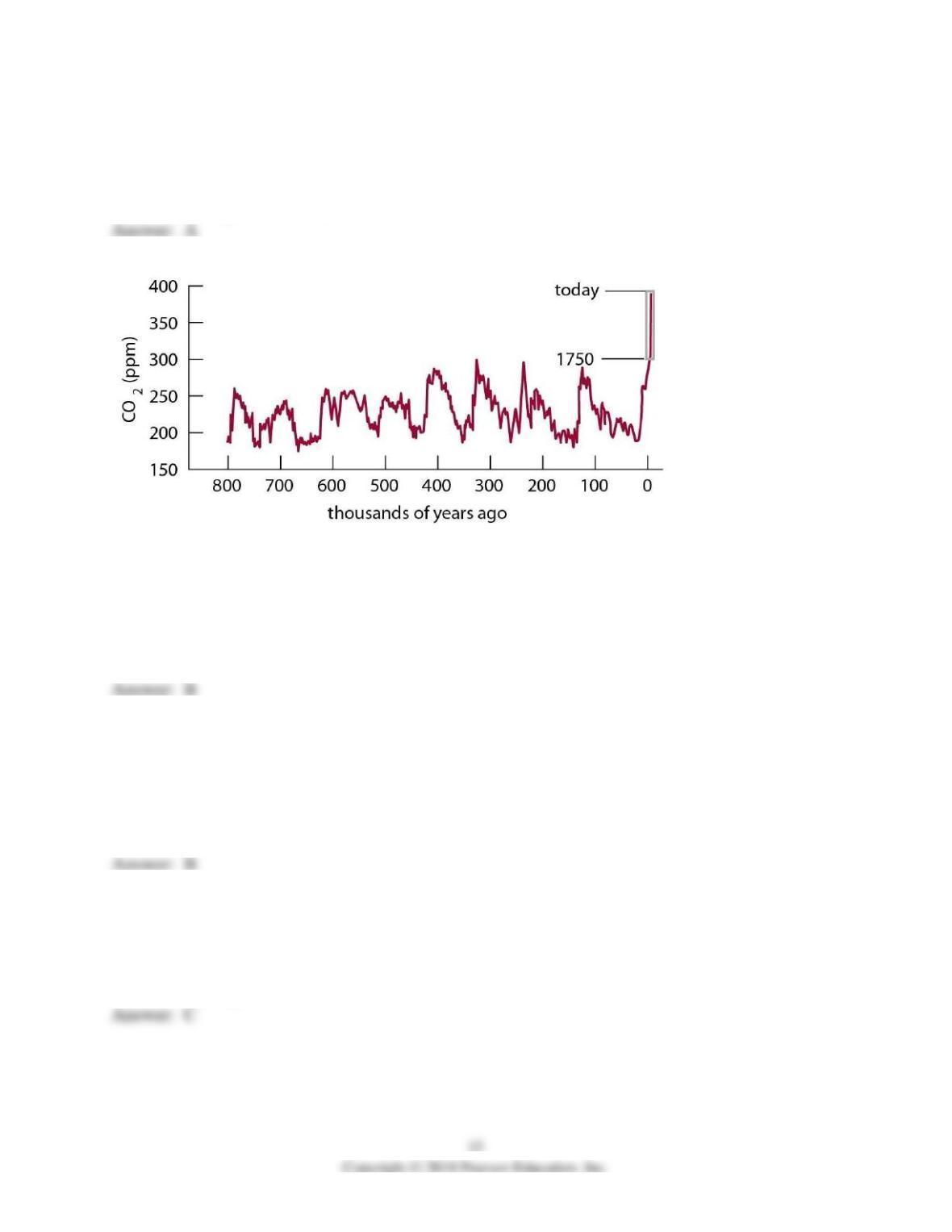
71) The greenhouse effect makes Earth warmer than it would be otherwise by about
A) 30 K.
B) 15 K.
C) -16 K.
D) There is no greenhouse effect.
72) The CO2 concentration of the atmosphere has increased by about ________ since 1750.
Refer to the figure above.
A) 10 parts-per-million
B) 100 parts-per-million
C) 1000 parts-per-million
D) None. It has decreased.
73) The total CO2 concentration of the atmosphere has increased by about ________ since 1750.
Refer to the figure above.
A) 2.5 %
B) 25%
C) 250%
D) None. It has decreased.
74) The footprints left on the moon by the Apollo astronauts will likely last for
A) no time; they were quickly erased by micrometeorites.
B) a few decades.
C) millions of years.
D) the remaining existence of the Moon.

75) Which of these upcoming observations will help test the idea that Mars’ atmosphere thinned
due to interactions with the solar wind?
A) The upcoming MAVEN orbiter will measure present-day gas loss from Mars’ atmosphere.
B) The Curiosity rover will measure the carbon content of rocks on Mars’ surface.
C) Astronomers will use spectrographs on the Keck telescope to measure the density of Mars’
atmosphere.
D) Geologists will measure the carbon content of Martian rocks that were transported to Earth by
asteroid impacts.
7.2 True/False Questions
1) Higher temperatures make rocks weaker.
2) Smaller worlds generally have thinner lithospheres.
3) Earth is the only planet in the solar system known to have active plate tectonics across its
entire surface.
4) The sky is blue because molecules in the atmosphere scatter blue light more effectively than
red light.
5) Sunsets are red because sunlight must pass through more atmosphere when the sun is low in
the sky, and the atmosphere scatters even more of the shorter wavelengths, leaving mostly red
light to color the sky.
6) Without greenhouse gases, water on Earth’s surface would be completely frozen.
7) The moon is much younger than the Earth.
8) Winter and summer differ in length on Mars because of its elliptical orbit.
9) Today, Mars has no planetary magnetic field.
10) Erosion is the most dominant geological process on Venus.