Chapter 7: Allocating Costs of Support Departments and Joint Products
160. Silver Chariots Trucking Company incurred $5,000 of indirect advertising costs for its operations. The following
data have been collected for 2016 for its three departments:
Determine the costs assigned to each department using the following activity drivers:
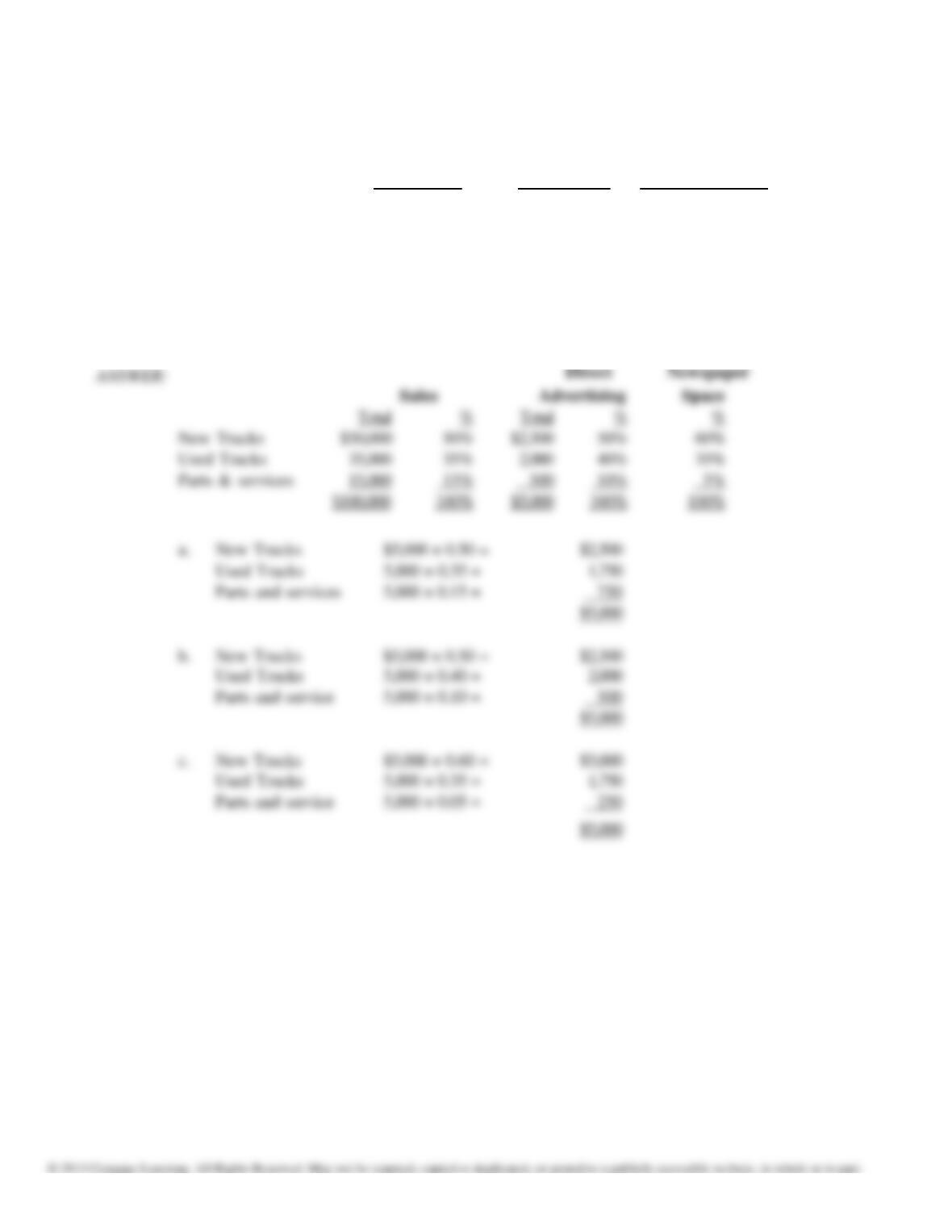
a. Sales
b. Direct advertising costs
c. Newspaper ad space
New Trucks
Used Trucks
Parts and Service
Sales
$50,000
$35,000
$15,000
Direct advertising costs
$2,500
$2,000
$500
Newspaper ad space
60%
35%
5%
Chapter 7: Allocating Costs of Support Departments and Joint Products
161. Citizens Bank has two bank locations: Main and Suburbs. The central office provides check-processing services for
the two banks. Information pertaining to the banks is as follows:
Check Processing
Main
Suburbs
Budgeted fixed costs
$100,000
–
–
Budgeted variable rate per hour
$20
–
–
Normal usage in hours
–
600
400
Actual fixed costs
$107,500
–
–
Actual variable costs
$ 17,500
–
–
Actual usage in hours
–
550
250
Required:
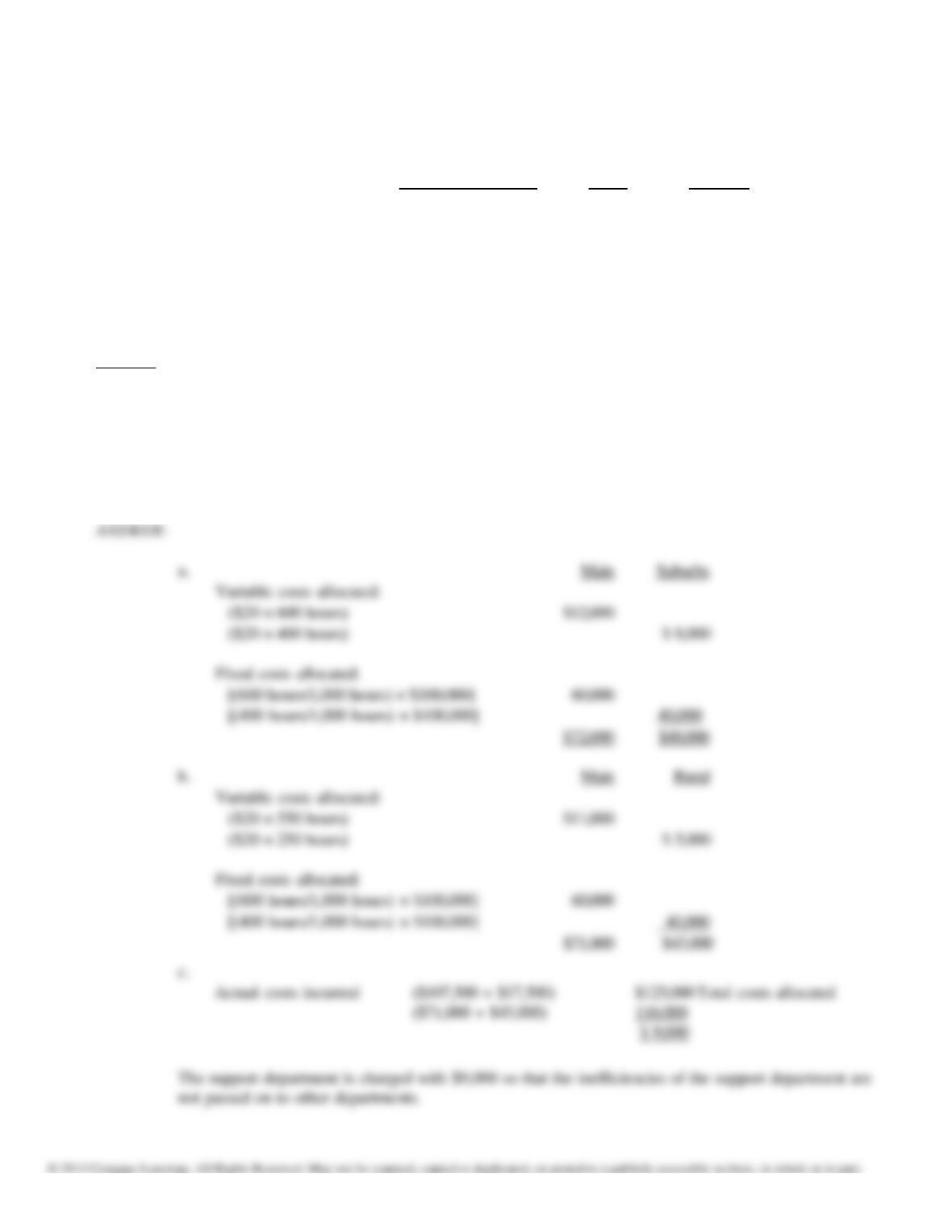
a. Use the direct method to allocate the check-processing center costs to each bank to provide information for
setting service charges.
b. Use the direct method to allocate the check processing center costs to each bank for performance evaluation
purposes.
c. Determine the costs of the check-processing center NOT allocated to the two banks. Why were these costs not
allocated to the operating units?
[(400 hours/1,000 hours) × $100,000]
40,000
Chapter 7: Allocating Costs of Support Departments and Joint Products
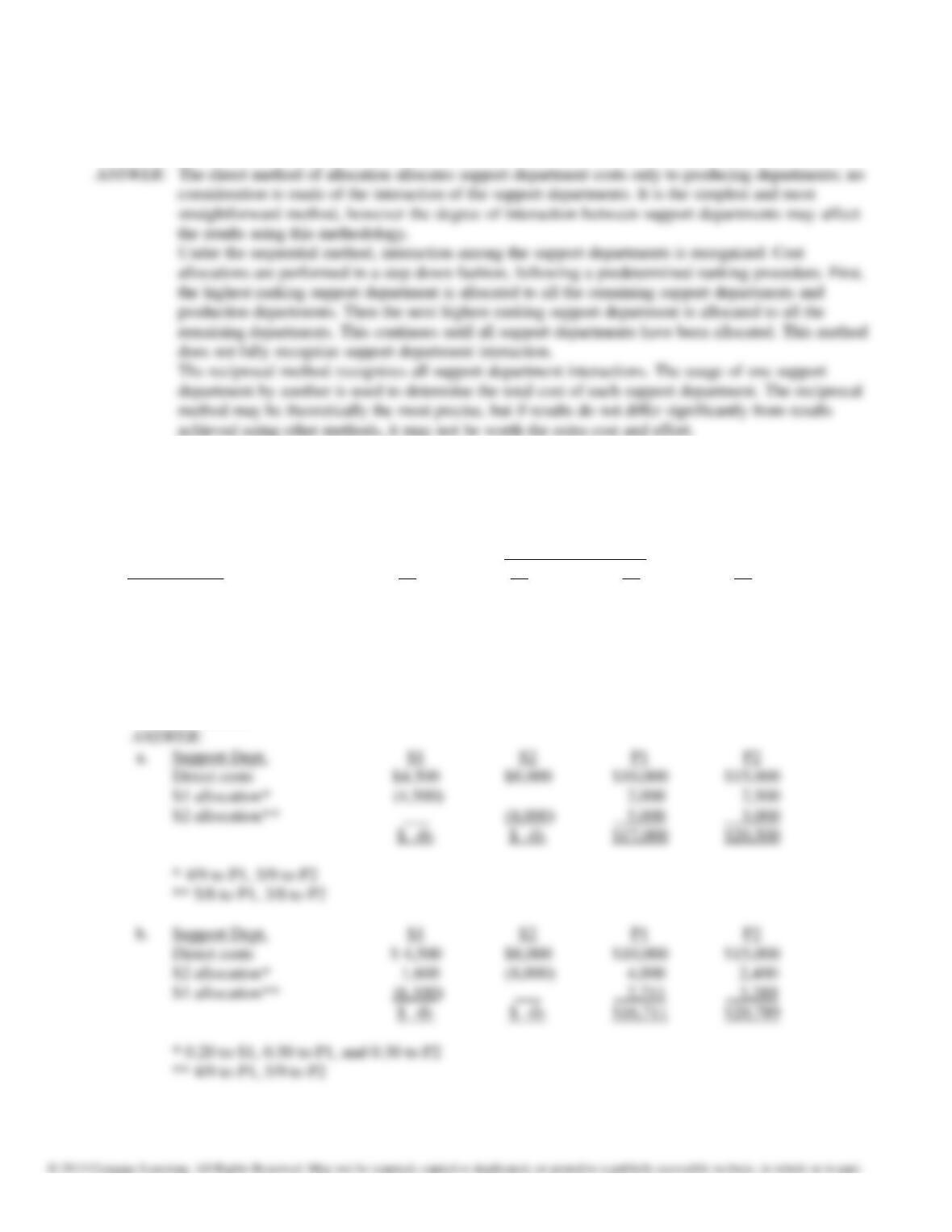
162. Describe the differences between the direct, sequential and reciprocal methods of allocating support department
costs to production departments.
163. Arctic Tundra Company has two support departments (S1 and S2) and two producing departments (P1 and P2).
Estimated direct costs and percentages of services used by these departments are as follows:
a. Prepare a schedule allocating the support department costs to the producing departments using the direct
allocation method.
b. Prepare a schedule allocating the support department costs to the producing departments using the sequential
allocation method.
Support Dept.
Direct costs
S1 allocation*
S2 allocation**
* 4/9 to P1, 5/9 to P2
** 5/8 to P1, 3/8 to P2
b.
Support Dept.
S1
S2
P1
P2
Direct costs
S2 allocation*
S1 allocation**
* 0.20 to S1, 0.50 to P1, and 0.30 to P2
** 4/9 to P1, 5/9 to P2
Used by Department
Support Dept.
S1
S2
P1
P2
S1
–
10%
40%
50%
S2
20%
–
50%
30%
Direct costs
$4,500
$8,000
$10,000
$15,000
Chapter 7: Allocating Costs of Support Departments and Joint Products
164. Albemarle, Inc., has two producing departments. Each producing department is held
responsible for a share of the costs of a support department.
Actual and budgeted data are as follows:
2011
Support department hours used:
Department X
8,000
Department Y
16,000
Total hours
24,000
Support department costs:
Actual support department costs
$72,000
Budgeted fixed service center costs
$24,000
Budgeted variable rate per hour
$3.00
Normal support department usage is 12,000 hours each for Department X and Department Y.
Required:
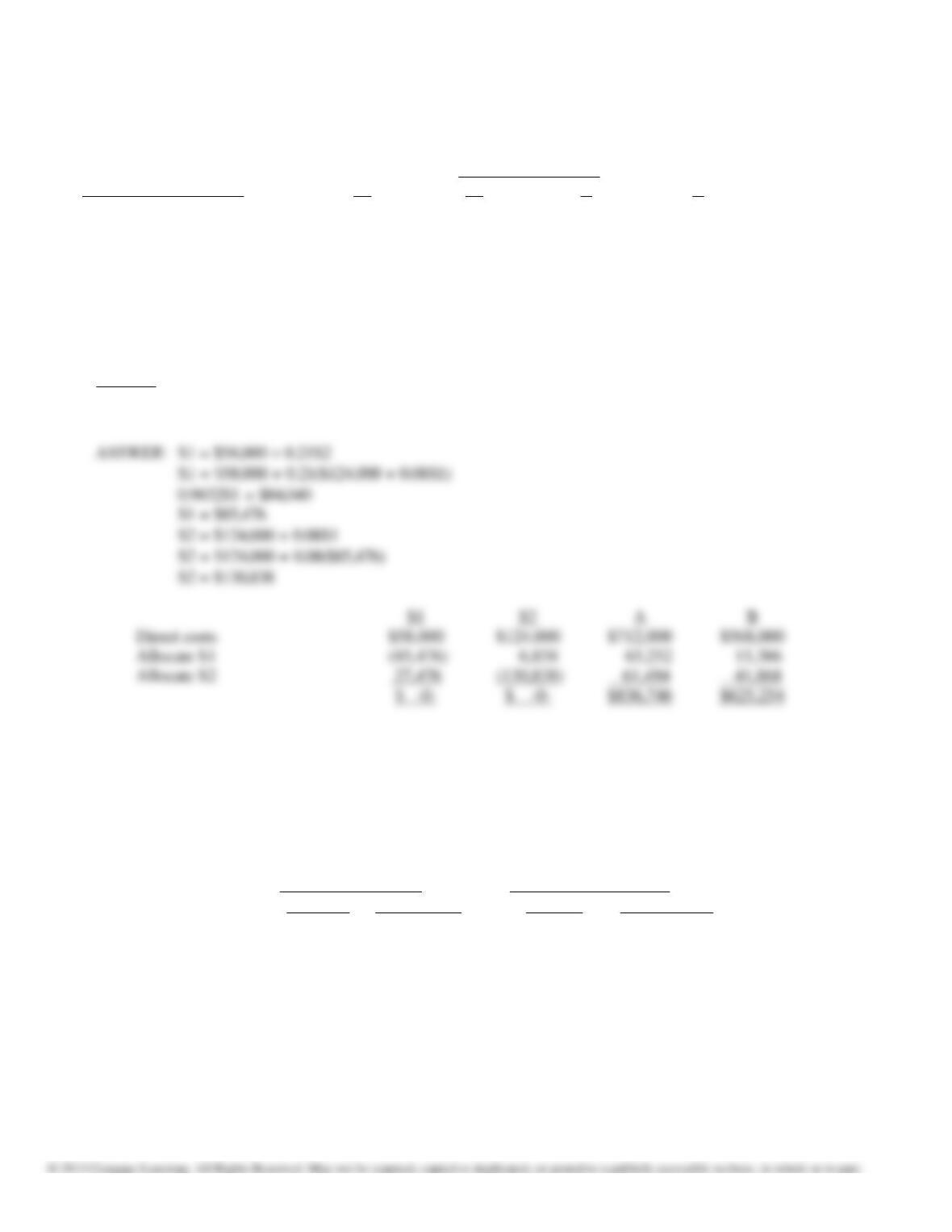
a. Assuming the purpose is product costing, allocate the costs of the support department using the direct method.
b. Assuming the purpose is to evaluate performance, allocate the costs of the support department.
Chapter 7: Allocating Costs of Support Departments and Joint Products
165. Chrome Enterprises has two support departments (S1 and S2) and two producing (A and B).
The distribution of services by the support departments is as follows:
Services Provided to
Services Provided from
S1
S2
A
B
S1
–
8%
74%
18%
S2
21%
–
47%
32%
Total department costs for the support and producing departments are as follows:
S1
$58,000
S2
124,000
A
712,000
B
568,000
Required:
Find the amount of total costs for A and B using the reciprocal method.
S1
S2
A
B
Direct costs
Allocate S1
Allocate S2
166. Eagle Company applies factory overhead in its two producing departments using a predetermined rate based on
budgeted machine hours in the Blending Department and based on budgeted labor hours in the Containerizing
Department. Variable cafeteria costs are allocated to the producing departments based on budgeted number of
employees, and fixed costs are allocated based on the capacity number of employees. Variable maintenance costs
are allocated on the budgeted number of direct labor hours, and fixed costs are allocated on labor hour capacity. The
data concerning next year’s operations are as follows:
Support Departments Producing Departments
Budgeted costs:
Cafeteria
Maintenance
Blending
Containerizing
Variable costs
$60,000
$84,000
$300,000
$324,000
Fixed costs
18,000
30,000
120,000
140,000
Other data:
Direct labor hours (capacity)
10,000
20,000
Direct labor hours (budgeted)
8,000
16,000
Number of employees (capacity)
30
60
Number of employees (budgeted)
20
40
Machine hours (capacity)
33,000
66,000
Machine hours (budgeted)
20,000
60,000
Chapter 7: Allocating Costs of Support Departments and Joint Products
Required:
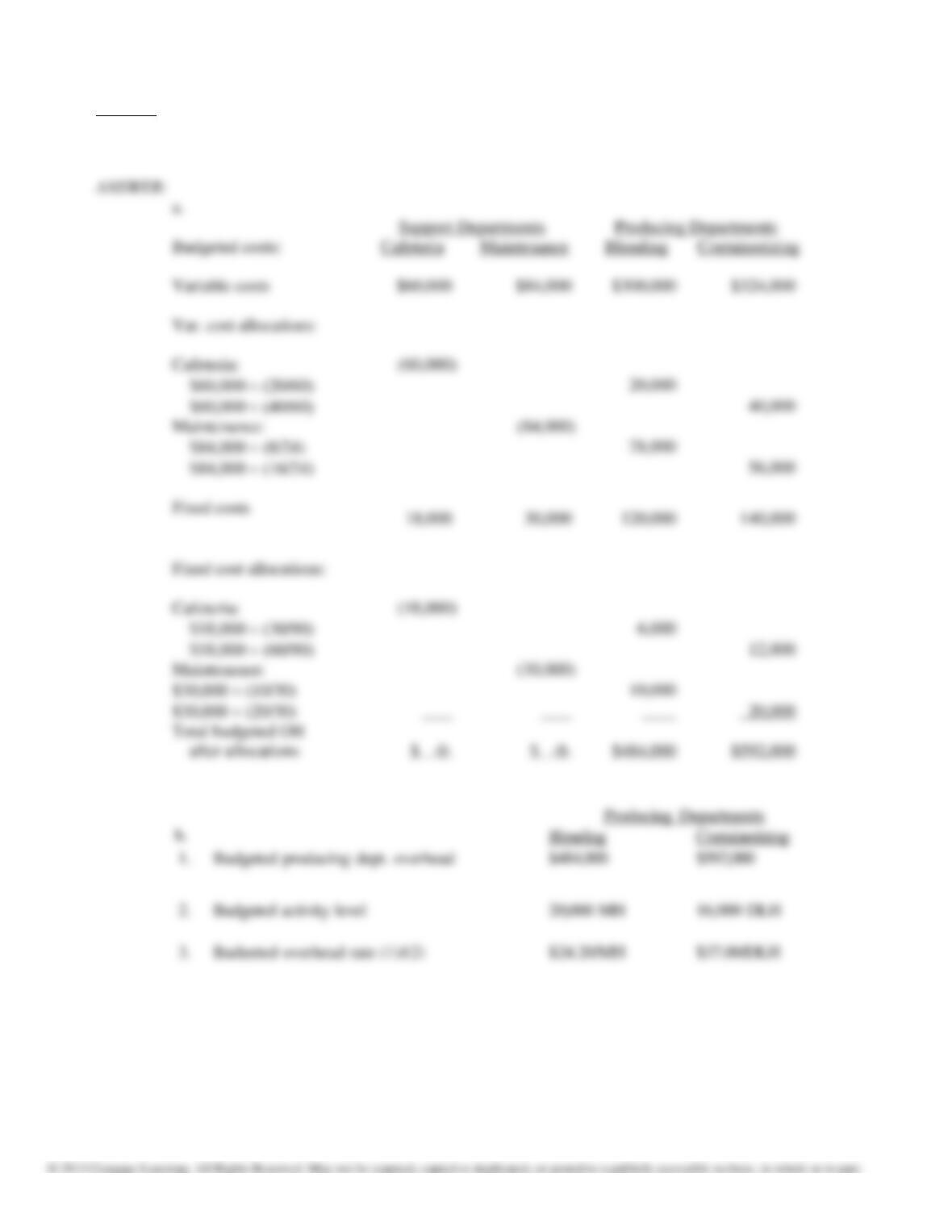
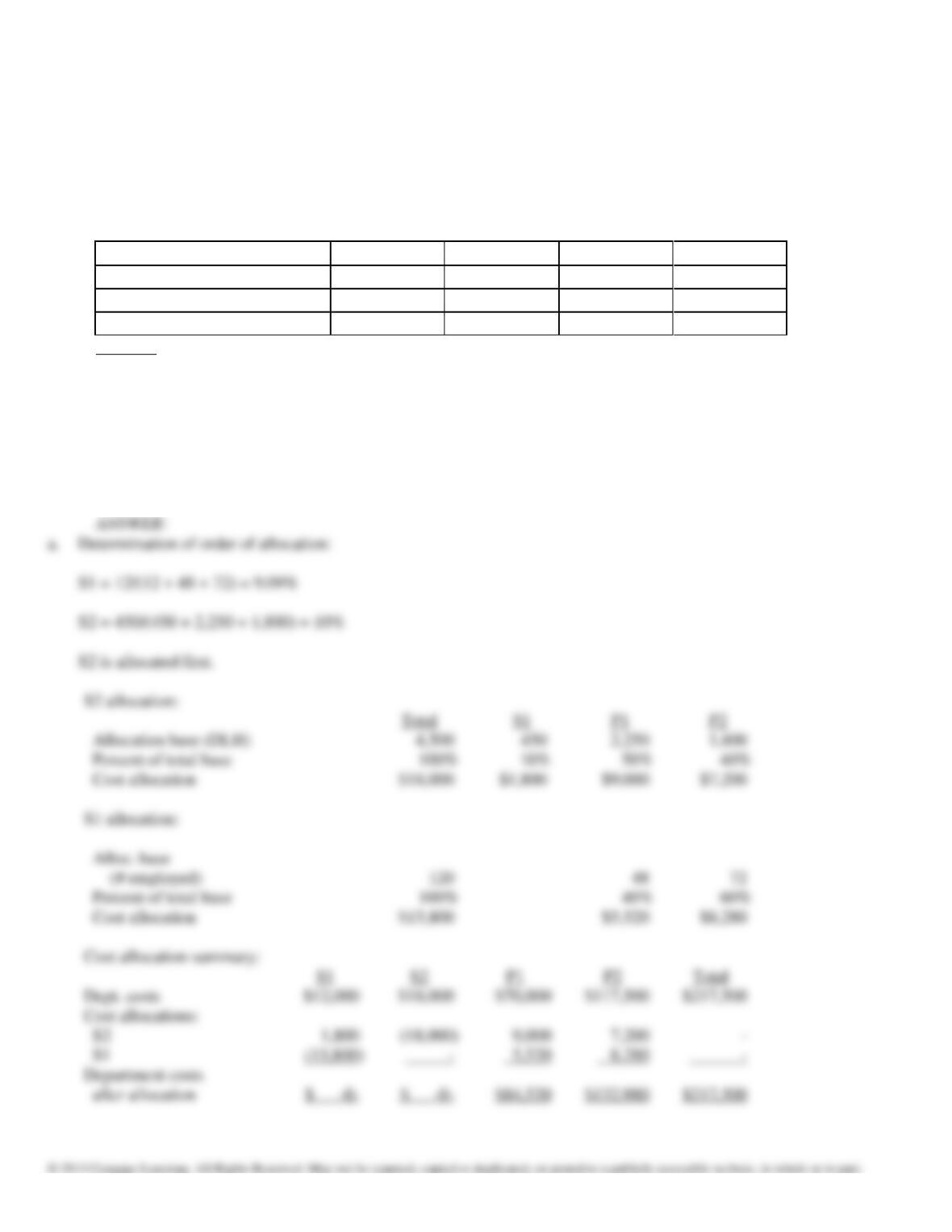
a. Prepare a schedule showing the allocation of budgeted support department costs to producing departments.
b. Determine the predetermined overhead rate for the producing departments.
Chapter 7: Allocating Costs of Support Departments and Joint Products
167. McDuff Company uses a job-order costing system to compute product costs. There are two producing departments
(P1 and P2) and two support departments (S1 and S2). The costs incurred in S1 and S2 are allocated to
Departments A and B and included in their factory overhead rates for costing products. S1 costs are allocated based
on the number of employees, S2 costs are allocated based on direct labor hours, and the production departmental
overhead rates are also based on direct labor hours. The following data are available for a recent period:
S1
S2
P1
P2
Direct department costs
$12,000
$18,000
$70,000
$117,500
Number of employees
8
12
48
72
Direct labor hours
450
325
2,250
1,800
Required:
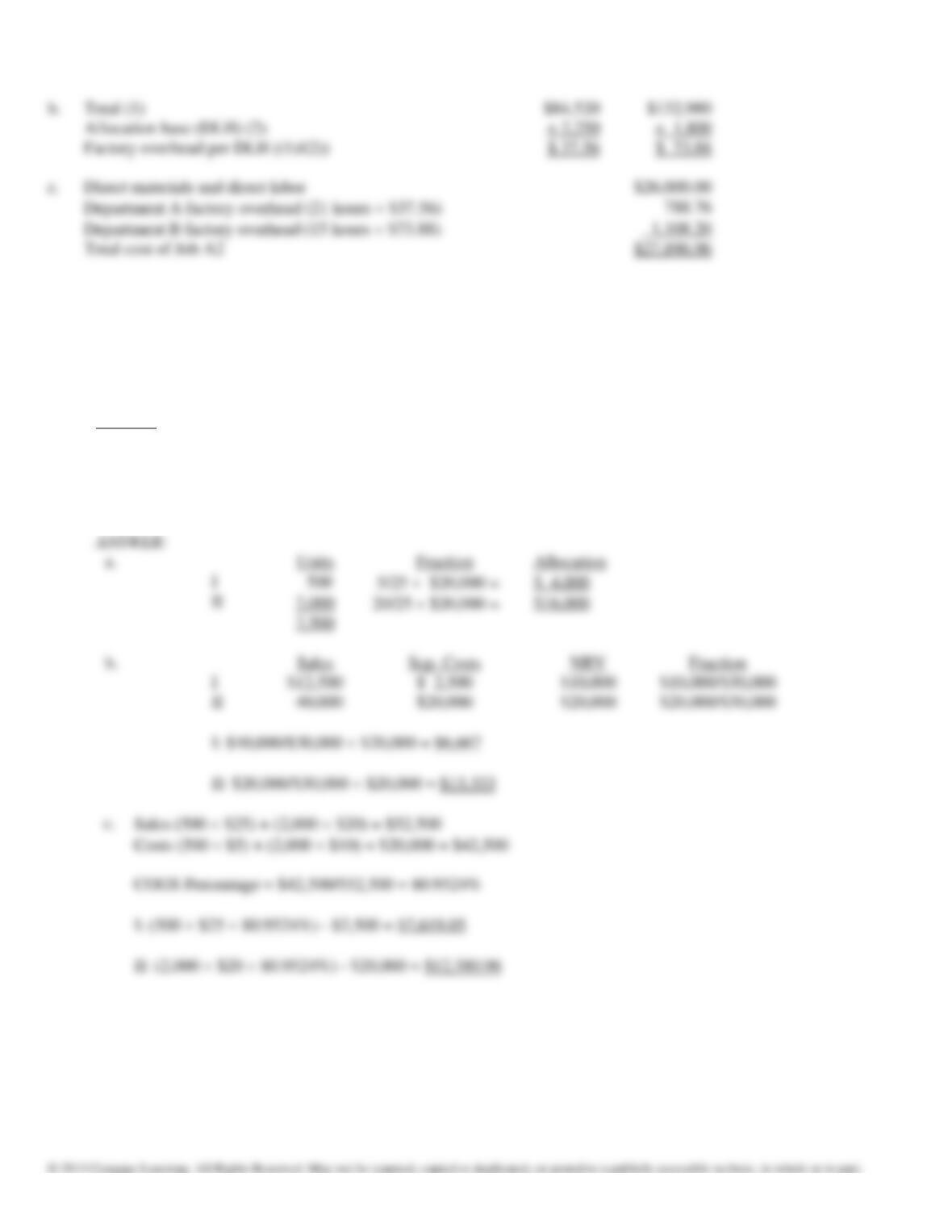
a. Prepare a schedule allocating the support department costs to the producing departments using the sequential
allocation method. The department with the greatest percentage of interdepartmental services should be
allocated first.
b. Determine the overhead rates per direct labor hour for P1 and P2.
c. Job A2 was completed during the period at a cost of $26,000 for direct materials and direct labor costs. This job
required 21 direct labor hours in Department P1 and 15 direct labor hours in Department P2. What was the total
cost of Job A2?
Chapter 7: Allocating Costs of Support Departments and Joint Products
168. Mainstream Corporation manufactures two products, I and II, from a joint process. A production run costs $20,000
and results in 500 units of I and 2,000 units of II.
Both products must be processed past the split–off point, incurring separable costs of $5 per unit for I and $10 per
unit for II. The market price is $25 for I and $20 for II.
Required:
a. Allocate joint production costs to each product using the physical units method.
b. Allocate joint production costs to each product using the net realizable value method.
c. Allocate joint production costs to each product using the constant gross margin percentage method.
Chapter 7: Allocating Costs of Support Departments and Joint Products
169. Soy Products produces two products, Soyburgers and Soy steaks, in a single process. In 2016, the joint costs of
this process were $36,000. In addition, 20,000 pounds of soyburgers and 10,000 pounds of soy steaks were
produced. Separable processing costs beyond the split-off point were: soyburgers, $7,500; soy steaks, $4,500.
Soyburgers sells for $2 per pound; Soy steaks sells for $4 per pound.
Required:
a. Allocate the joint costs using the net realizable value method.
b. Allocate the joint costs using the physical units method.
Chapter 7: Allocating Costs of Support Departments and Joint Products
170. Henderson Company pays a flat fee of $500 for the right to retrieve stray golf balls from lakes and ponds at
golf and country clubs. The recovered balls are then cleaned, graded as to quality (birdie, bogey, or duffer), and
sold to sporting goods stores at the following prices per dozen: birdie quality, $5; bogey quality, $4; and duffer
quality, $3. Last month $8,000 of cost was incurred retrieving the following quantities of golf balls: birdie quality,
1,000 dozen; bogey quality, 3,000 dozen; and duffer quality, 2,000 dozen.
Required: (Calculate relative quantity to three decimal points.)
a. Determine the cost and gross profit percent for each type of golf ball using the physical units method of
joint cost allocation.
b. Repeat part (a) using the sales-value-at-split–off method of joint cost allocation.
c. The company has an opportunity to sell bogey quality balls for $4.50 per dozen to a company that operates
golf driving ranges; however, the balls will have to be painted and striped. The company estimates that the
cost of painting and striping will be 60 cents per dozen. Assuming the physical unit method is used to
allocate joint costs, should the offer be accepted?
Chapter 7: Allocating Costs of Support Departments and Joint Products
171. Compare and contrast the various methods of accounting for joint product costs.
172. Saturn Company manufactures products X, Y, and Z in a joint process. The following information is available:
Products
X
Y
Z
Total
Units produced
12,000
?
?
24,000
Sales value
at split-off
?
?
$50,000
$200,000
Joint costs
$48,000
?
?
$150,000
Sales value if
processed further
$110,000
$90,000
$60,000
$260,000
Additional cost if
processed further
$18,000
$14,000
$10,000
$42,000
Joint product costs are allocated using the sales value at split-off approach.
Required:
a. What is the sales-value-at-split-off for Product X?
b. What is the amount of joint costs allocated to Product Y using the sales-value-at–split-off method?
c. If the company used the physical units method to allocate joint cost, how much joint cost would be
allocated to Product X?
Chapter 7: Allocating Costs of Support Departments and Joint Products
173. Vladimir, Inc. began the current period with no inventories. During the period, it processed 50,000 pounds
of materials costing $450,000. Conversion costs incurred during the period amounted to $660,000. The
firm ended the period with no work-in-process. During the period, the firm produced 16,000, 24,000, and
10,000 units of X, Y, and Z, respectively. All costs are considered joint costs. The firm sold 12,000 units of
X, 16,000 units of Y, and 9,000 units of Z. X sells for $30 per unit, Y for $44 per unit, and Z for $4 per
unit. The firm uses the net realizable value method for cost allocation. Z is considered a by-product.
Required:
a. Discuss the following methods to account for by–products:
• other income
• replacement cost
• joint cost proration
b. Give three examples of by–products.
Chapter 7: Allocating Costs of Support Departments and Joint Products
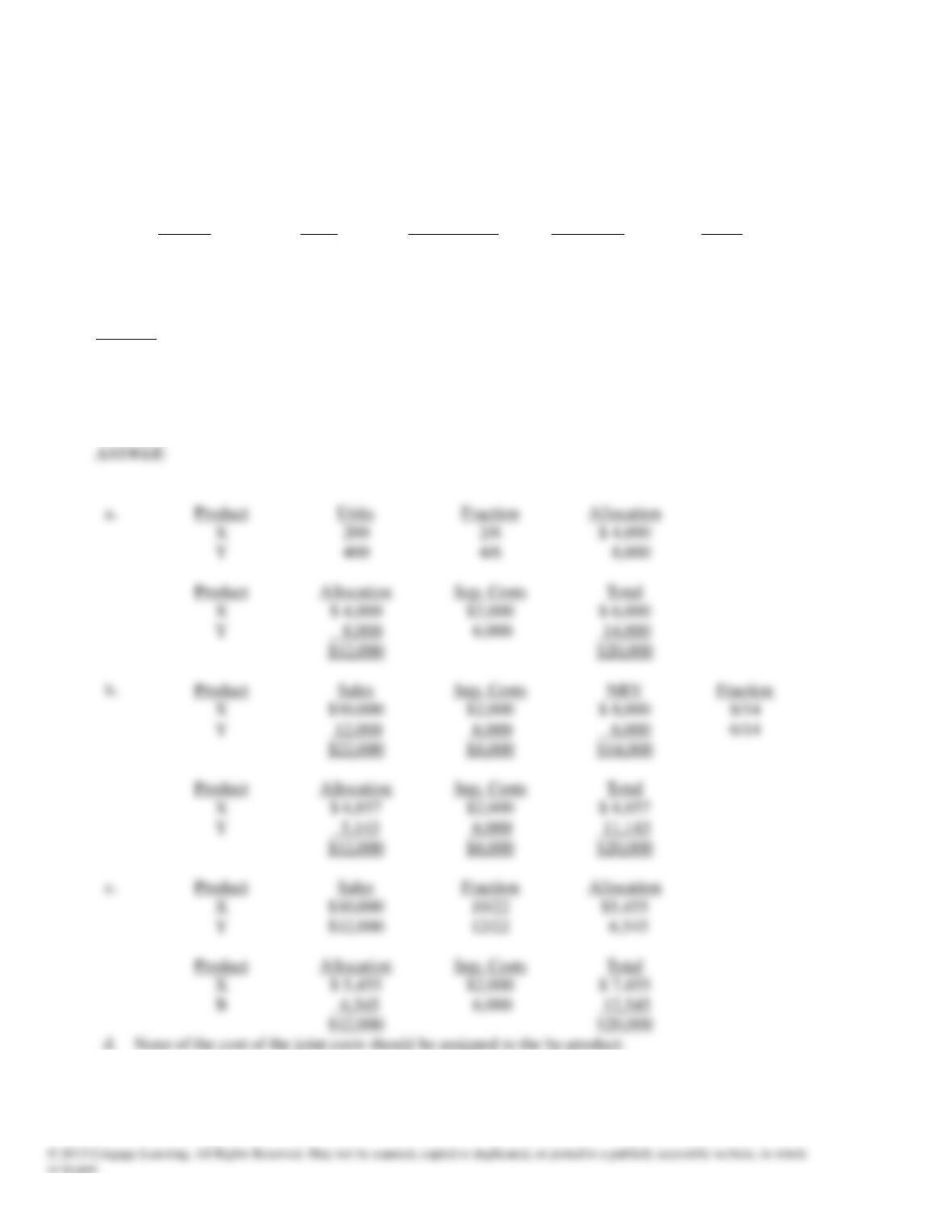
174. Mandala Inc. obtains two products and a by–product from its production process. By-product revenues
are treated as other income and a noncost approach is used to assign costs to them. During the period,
1,200 units were processed at a cost of $12,000 for materials and conversion costs, resulting in the
following:
Sales Value
Costs after
Final
Product
Units
at Separation
Separation
Value
X
200
$4,000
$2,000
$10,000
Y
400
5,000
6,000
12,000
By-product
150
500
500
1,500
Required:
a. Account for all costs using a physical basis for allocation.
b. Account for all costs using net realizable value as the basis for allocation.
c. Account for all costs using final sales value as the basis for allocation.
d. How much joint costs should be allocated to the by–product?
Product
Units
Allocation
X
200
$ 4,000
Y
400
8,000
Product
Allocation
Sep. Costs
Total
X
$ 4,000
$2,000
$ 6,000
Y
8,000
14,000
Product
Sales
Sep. Costs
X
$2,000
$ 8,000
Y
12,000
6,000
6/14
$8,000
Product
Allocation
Sep. Costs
Total
X
$ 6,857
$2,000
$ 8,857
Y
5,143
11,143
$8,000
Product
Allocation
X
$5,455
Y
6,545
Product
Allocation
Sep. Costs
Total
X
$ 5,455
$2,000
$ 7,455
6,545
12,545