
Exam
Name___________________________________
MULTIPLE CHOICE. Choose the one alternative that best completes the statement or answers the question.
1)
Which major component of detrital sedimentary rocks only rarely occurs as a primary mineral in
igneous rocks?
1)
A)
quartz
B)
clays
C)
ferromagnesian minerals
D)
carbonates
2)
What is the chemical formula for dolomite, the major mineral in dolostones?
2)
A)
CaSO4· 2H2O
B)
CaMg(CO3)2
C)
NaCl
D)
SiO2
3)
________ sandstone contains abundant feldspar, suggesting that the sand was derived by
weathering and erosion of granitic bedrock.
3)
A)
Arkosic
B)
Quartz–rich
C)
Lignitic
D)
Oolitic
4)
Which statement concerning sedimentary rocks is NOT true?
4)
A)
They may contain fossils that provide clues about ancient life forms.
B)
They probably show some evidence of stratification.
C)
They are composed of particles and constituents derived from weathering and erosion of
other rocks.
D)
They were originally deposited at depth below the bottom of the sea.

5)
What is the main difference between a conglomerate and a sedimentary breccia?
5)
A)
A breccia is well stratified; a conglomerate is poorly stratified.
B)
Breccia has a compacted, clay–rich matrix; conglomerate has no matrix.
C)
Breccia clasts are the size of baseballs; conglomerate clasts are larger.
D)
Breccia clasts are angular; conglomerate clasts are rounded.
6)
Detrital sedimentary rocks are classified (named) based on the ________.
6)
A)
grain sizes of the detrital particles
B)
degree of compaction and lithification
C)
colors of the cementing minerals
D)
compositions of soluble minerals
A
7)
Detrital grains of which mineral(s) are extremely rare in detrital sediments? Why?
7)
A)
Clays; they are rare in soils and regolith.
B)
Calcite; it is soft and relatively soluble.
C)
Feldspars; they occur only in granites.
D)
Quartz; it is very hard and insoluble.
B
8)
________ is a form of calcium carbonate.
8)
A)
Travertine
B)
Gypsum
C)
Lignite
D)
Chert
A
9)
________ is not a common cementing agent for sandstones.
9)
A)
Quartz
B)
Fluorite
C)
Iron oxides
D)
Calcite
B
D

10)
Which of the following best describes bedded gypsum and halite?
10)
A)
varieties of coal and peat
B)
detrital sedimentary rocks
C)
evaporates
D)
varieties of dolostone
11)
A cherty limestone would contain which major constituents?
11)
A)
iron oxide, calcite
B)
silica, calcite
C)
silica, iron oxide
D)
clay minerals
B
12)
Which of the following describes the correct order for relative solubility of minerals in sedimentary
rocks?
12)
A)
Evaporate minerals, quartz, and calcite all have the same relative solubility.
B)
Evaporate minerals are more soluble than calcite and quartz.
C)
Evaporate minerals are less soluble than quartz and calcite.
D)
Evaporate minerals are more soluble than quartz and less soluble than calcite.
B
13)
________, a common mineral found in igneous rocks, is the most abundant mineral in detrital
sedimentary rocks.
13)
A)
Quartz
B)
Biotite
C)
Calcite
D)
Orthoclase
A
14)
Which of the following sedimentary rocks would you expect to have originally been deposited by
fast–moving streams?
14)
A)
mudstone
B)
greywacke
C)
oolitic limestone
D)
conglomerate
D
C

15)
Which type of sediment undergoes the most compaction as it lithifies to sedimentary rocks?
15)
A)
desert dune sand
B)
coarse gravel
C)
marine mud
D)
reef limestone
16)
Nonclastic textures are common in which of the following sedimentary rocks?
16)
A)
boulder breccias
B)
cherty conglomerates
C)
limestones
D)
sandstones
C
Explanation:
17)
What is probably the single most important, original, depositional feature in sedimentary rocks?
17)
A)
sizes of the sand grains
B)
bedding or stratification
C)
compaction of the mud and clay
D)
degree of lithification
B
Explanation:
18)
Oolitic limestone is most likely to form in what type of depositional environment?
18)
A)
shallow, clear, marine waters with vigorous current activity
B)
acidic, organic–rich waters in freshwater swamps and bogs
C)
deep, marine waters below most wave action
D)
quiet, muddy, lagoons and bays
A
Explanation:
19)
Which characteristic is absolutely necessary for a sedimentary rock to have potential as a possible
reservoir rock for oil or gas?
19)
A)
high permeability
B)
good stratification
C)
chemical origin
D)
clastic texture
A
Explanation:
C
Explanation:

20)
Which one of the following is not a chemical sedimentary rock or evaporite?
20)
A)
oolitic limestone
B)
bedded gypsum
C)
cherty dolostone
D)
shale
21)
________ is the most common type of chemical sedimentary rock.
21)
A)
Quartz sandstone
B)
Limestone
C)
Phosphate rock
D)
Chert
B
22)
Flint, chert, and jasper are microcrystalline forms of ________.
22)
A)
calcite (CaCO3)
B)
halite (NaCl)
C)
hematite (Fe2O3)
D)
quartz; (SiO2)
D
23)
________ cement produces bright–red and yellow colors in some sandstone.
23)
A)
Quartz
B)
Iron oxide
C)
Clay
D)
Calcite
B
24)
A graywacke is ________.
24)
A)
a dark–gray, calcite–rich mudstone or shale containing pyrite
B)
a sandstone with the sand grains embedded in a clay–rich matrix
C)
a dark, organic–rich, chemical sedimentary rock containing small crystals of halite
D)
a limestone with abundant, sand–sized, quartz grains
B
D

25)
Which of the following sedimentary features would typically be found in shales but not in
sandstones?
25)
A)
cross stratification
B)
ripple marks
C)
mud cracks
D)
bedding
26)
________ are further concentrated in a residual brine after NaCl is crystallized.
26)
A)
Potassium, magnesium, and bromine
B)
Iron, sodium, and chlorine
C)
Calcium, sulfur, and titanium
D)
Magnesium, calcium, and sulfur
A
27)
Which of the following applies to the basic constituents of halite, gypsum, and sylvite?
27)
A)
transported as detrital mud; deposited by evaporation
B)
transported as dissolved ions; deposited by evaporation
C)
transported and deposited as mud–sized particles
D)
transported as dissolved ions; deposited as detrital mud
B
28)
Which of the following is not a type of limestone?
28)
A)
chalk
B)
travertine
C)
arkose
D)
coquina
C
29)
Which type of limestone consists mainly of tiny, marine fossils composed of calcite?
29)
A)
chalk
B)
coquina
C)
dolostone
D)
chert
A
C

30)
Coal beds originate in ________.
30)
A)
shallow lakes in a dry, desert region
B)
deep, marine basins below wave action
C)
freshwater coastal swamps and bogs
D)
channels of fast–moving streams
31)
Sedimentary rocks account for about what percentage of the Earth’s outermost 10 kilometers of
rock (first percentage). Also, what percentage of the Earth’s continental area is covered by
sedimentary rocks (second percentage)?
31)
A)
65% and 10%
B)
85% and 100%
C)
5% and 75%
D)
3.5% and 100%
32)
Which of the following sedimentary features can each be used to determine paleocurrent
directions?
32)
A)
grain size sorting and ripple marks
B)
ripple marks and cross stratification
C)
mud cracks and ripple marks
D)
fossils and mud cracks
SHORT ANSWER. Write the word or phrase that best completes each statement or answers the question.
33)
Red, brown and yellow sandstones are cemented by oxides of ________.
33)
34)
The sedimentary rocks, salt and gypsum, are deposited by what process?
34)
35)
________ is composed mainly of lithified, organic debris that accumulated in ancient,
heavily forested swamps.
35)
36)
Which variety of limestone consists mainly of sand–sized, mostly spherical grains of
calcium carbonate precipitated in shallow, marine waters?
36)

Word Analysis. Examine the words and/or phrases for each question below and determine the relationship among the
majority of words/phrases. Choose the option that does not fit the pattern.
37)
a. chert b. flint c. gypsum d. agate
37)
38)
Sandstones are lithified mainly by cementation. What is the major process involved in the
lithification of shales?
38)
39)
Which property of sediment describes the range of different grain sizes in a detrital
sedimentary rock?
39)
40)
What term describes the complex, original stratification pattern seen in sandstones
deposited in ancient sand dunes?
40)
41)
What is the general name for microcrystalline quartz in sedimentary rocks?
41)
chert
42)
What is the most characteristic, original, depositional feature preserved in sedimentary
rocks?
42)
43)
Which evaporite sedimentary rock, composed of calcium sulfate, is an important
component of plasters and wallboard?
43)
44)
What is the most abundant mineral in detrital sedimentary rocks?
44)
Word Analysis. Examine the words and/or phrases for each question below and determine the relationship among the
majority of words/phrases. Choose the option that does not fit the pattern.
45)
a. limestone b. chert c. coquina d. travertine
45)
46)
a. lithification b. cementation c. weathering d. compaction
46)
47)
Which is the most common chemical sedimentary rock?
47)
48)
Flint and jasper are microcrystalline forms of ________.
48)
49)
What are the three, most common, cementing agents for sandstones?
49)
TRUE/FALSE. Write ‘T’ if the statement is true and ‘F’ if the statement is false.
50)
Boulder conglomerates suggest deposition by strong winds in a desert.
50)
51)
Graywacke sandstones are typically better sorted than sandstones lithified from ancient beach
sands.
51)
52)
A feldspar–rich sandstone is called an arkose.
52)
53)
The mineral dolomite, which is the major mineral of the sedimentary rock dolostone, is a carbonate
of calcium and magnesium.
53)
54)
Clay and muddy sediments lithify to form shales and mudstones.
54)
55)
Detrital sedimentary rocks have clastic textures.
55)
56)
Chalk, coquina, and ancient coral reefs are primarily composed of microcrystalline quartz.
56)
57)
Water is gradually expelled from compacting clay and mud sediments.
57)
58)
Many limestones are of biochemical origin.
58)
59)
The chemical sedimentary rock, conglomerate, is composed of gravel–size, rounded, calcite oolites.
59)
60)
Detrital sedimentary rocks are classified according to clastic particle size; chemical sedimentary
rocks are named according to the most abundant minerals.
60)
61)
Mud cracks in a shale or mudstone indicate that the mud or clay was deposited in deep waters of
an offshore marine environment.
61)
62)
Peat is thought to be the original material from which coals are formed.
62)
63)
Clastic particles in a sedimentary breccia are rounded and are about the same size as fine–grained
sand.
63)
MATCHING. Choose the item in column 2 that best matches each item in column 1.
Match the sediment with the appropriate rock name.
64)
shale
65)
sandstone
66)
conglomerate
67)
mudstone
A)
all clay sediment
D)
clay and fine silt
64)
65)
66)
67)
ESSAY. Write your answer in the space provided or on a separate sheet of paper.
Critical thinking and discussion questions. Use complete sentences, correct spelling, and the information presented in
chapter 7 to answer the questions below.
68)
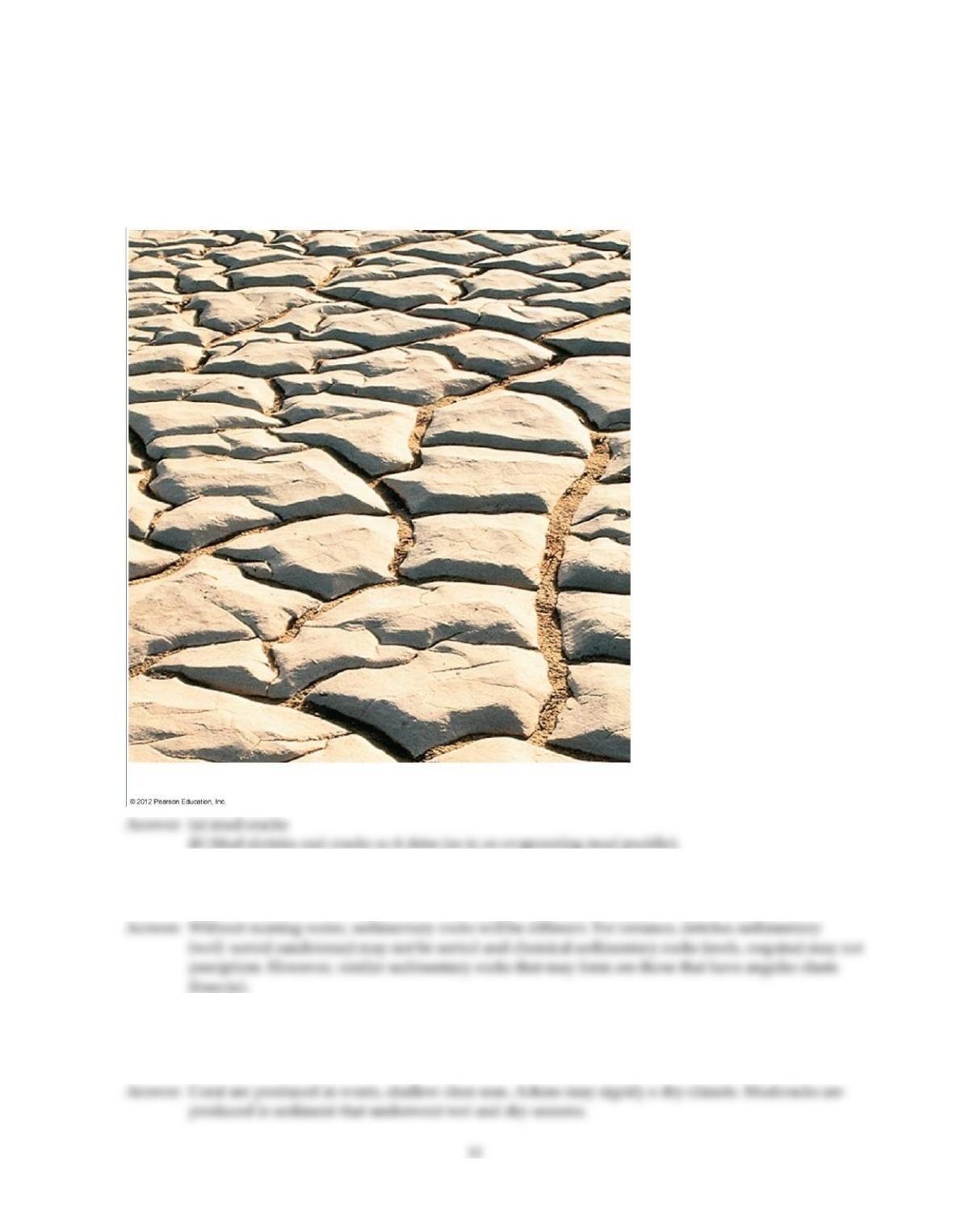
(a) What kind of sedimentary structure is pictured in the photograph below?
(b) Explain how this kind of sedimentary structure forms.
69)
Considering the factors that influence the formation of sedimentary rocks, how might sedimentary rocks be
different on another planet such as Mars or Venus? What about similarities?
70)
Fossils often provide valuable information about climatic conditions of the geologic past. How else might a
geologist infer ancient climatic conditions using sedimentary rocks? (Hint: Think in terms of the conditions
necessary to form certain rocks and also features/structures found in sedimentary rocks.)

71)
The study of depositional environments in sedimentary rocks is critical to understanding Earth’s history. What
features or characteristics of sedimentary rocks are unique to particular environments? What features are found
in a variety of environments and are therefore less definitive for interpreting paleoenvironments?

Answer Key
Testname: C7
13
Answer Key
Testname: C7
14