
CHAPTER 7: ALLOCATING COSTS OF SUPPORT DEPARTMENTS AND
JOINT PRODUCTS
1. Common costs are mutually beneficial costs, used in the output of two or more services or products.
a. True
b. False
2. Allocation increases total costs.
a. True
b. False
3. Producing departments create products and services to make and sell.
a. True
b. False
4. Producing departments provide essential services for support departments.
a. True
b. False
5. Causal factors are variables or activities within a producing department that stimulate the incurrence of support
costs.
a. True
b. False
6. A single changing rate uses the fixed costs of the support department.
a. True
b. False
7. The use of a multiple charging rate is needed, one for variable costs, and one for fixed costs.
a. True
b. False

Chapter 7: Allocating Costs of Support Departments and Joint Products
8. Dual rates combine the fixed and variable costs.
a. True
b. False
9. Support department fixed costs are allocated on the basis of original capacity.
a. True
b. False
10. Budgeted rates are allocated based on original capacity.
a. True
b. False
11. The three methods of allocating support center costs to producing departments are the direct, sequential, and
reciprocal methods.
a. True
b. False
12. The direct method is the most difficult way to allocate costs to the support departments.
a. True
b. False
13. The sequential method allocates costs in ranking order of support departments.
a. True
b. False
14. The reciprocal method of allocation recognizes only some of the support departments’ interactions.
a. True
b. False
15. Allocation is not necessary when using JIT manufacturing.
a. True
b. False

Chapter 7: Allocating Costs of Support Departments and Joint Products
16. The overhead rate may be computed once allocation from support service cost to producing department has been
performed.
a. True
b. False
17. Departmental overhead rate is computed by dividing the budgeted base by the total overhead in a producing
department.
a. True
b. False
18. Departmental overhead is applied to products passing through the department.
a. True
b. False
19. The choice of allocation method depends on an evaluation of costs and benefits, and circumstances.
a. True
b. False
20. Joint production processes result in the output of two or more products produced simultaneously.
a. True
b. False
21. Joint products are two or more products produced simultaneously by the same process.
a. True
b. False
22. The split–off point is the ending point of a joint product process.
a. True
b. False
Chapter 7: Allocating Costs of Support Departments and Joint Products
23. Costs that are easily traced to individual products are called separable costs.
a. True
b. False
24. Under the physical units method, joint costs are distributed to products on the basis of some physical measure.
a. True
b. False
25. The weight factor addresses the advantages of the physical units method.
a. True
b. False
26. are mutually beneficial costs to joint product costing.
27. Activities or variables within a producing department that provoke the incurrence of support costs are called
__________ .
28. The charging rate combines variable and fixed costs of support departments.
29. Support department costs are allocated on the basis of original capacity.
30. The method of allocating costs, allocates costs from support to producing departments.
31. The method of allocating costs assumes “step down” interdepartmental services.
32. After allocation, total overhead in producing department is divided by the budgeted measure of activity to get the
__________ overhead rate.
33. Departmental is applied to products passing through the department.

Chapter 7: Allocating Costs of Support Departments and Joint Products
34. Products produced simultaneously by the same process up to a point are called products.
35. A secondary product recovered during the manufacturing of a primary product during a joint process is called a(n):
__________ .
36. Support department cost to the producing departments is(are) called:
a. direct materials
b. direct labor
c. activity driver
d. common cost
37. A common cost occurs
a. when only one product or service is benefited.
b. when different resources are used to produce one output.
c. when the same resource is used in the output of two or more outputs.
d. when a resource is used by two or more companies.
38. Support departments
a. are responsible for manufacturing the products sold to customers.
b. work directly on the products of the firm.
c. provide services directly to customers.
d. provide essential services to the producing departments.
39. Examples of support departments include all of the following EXCEPT
a. maintenance.
b. personnel.
c. machining.
d. data processing.

Chapter 7: Allocating Costs of Support Departments and Joint Products
40. Which of the following departments is NOT a support department?
a. food services
b. bottling
c. health services
d. security
41. The activities or variables within a producing department that provoke the incurrence of support costs are called:
a. Causal factors
b. Common costs
c. Cost objectives
d. Activity output
42. Examples of producing departments include all of the following EXCEPT
a. mixing.
b. molding.
c. packaging.
d. accounting.
43. Support department costs are accounted for in which one of the following ways?
a. They are allocated directly to units of product.
b. They are allocated to producing departments and then allocated to units of product.
c. They are allocated to units of product and then allocated to the producing departments.
d. They are expensed as incurred.
44. Which of the following would be the most appropriate base for allocating the costs of the housekeeping
department?
a. machine hours
b. direct labor hours
c. square feet
d. number of employees

Chapter 7: Allocating Costs of Support Departments and Joint Products
45. Which of the following would be the most appropriate base for allocating the costs of the maintenance department?
a. machine hours
b. direct labor hours
c. number of employees
d. square feet
46. A possible causal factor to use when allocating cafeteria costs would be
a. number of square feet.
b. number of direct labor hours.
c. number of employees.
d. appraised value of square footage.
47. The major objective(s) of allocations are
a. to motivate managers.
b. to compute product line profitability.
c. to value inventory.
d. all of the above.
48. Which of the following is NOT a major objective of allocation as identified by the IMA?
a. to detect fraud
b. to obtain a mutually agreeable price
c. to compute product-line profitability
d. to value inventory
49. Which of the following cost categories would most likely use machine hours as its activity driver?
a. personnel
b. maintenance
c. purchasing
d. both a and b

Chapter 7: Allocating Costs of Support Departments and Joint Products
50. Which of the following cost categories would most likely use the number of employees or new hires as its activity
driver?
a. maintenance
b. purchasing
c. personnel
d. accounting
51. Which of the major objectives of allocation as identified by the IMA would NOT be relevant in a service
organization?
a. to obtain a mutually agreeable price
b. to compute product-line profitability
c. to predict the economic effects of planning and control
d. all of the above are objectives of allocation
52. The Ruling Company assigns plant administration costs to the production departments based on the number of
employees. Which of the following would NOT be a good combination of common costs with an activity driver?
a. personnel department costs based on number of employees
b. purchasing department costs based on machine hours
c. cafeteria costs based on meals served
d. warehouse costs based on the value of materials stored
53. If the costs of support departments are NOT allocated to producing departments,
a. product costs would be understated.
b. GAAP requirements would not be met.
c. managers of producing departments may tend to overconsume services.
d. all of the above.
54. Rules of financial reporting (GAAP) require
a. that direct manufacturing costs and a fair share of indirect manufacturing costs be assigned to products.
b. that only producing department costs be assigned to products.
c. that only direct manufacturing costs be assigned to products.
d. that only indirect manufacturing costs be assigned to products.
Chapter 7: Allocating Costs of Support Departments and Joint Products
55. What is one of the potential disadvantages of NOT allocating support department costs to production departments?
a. total costs would not be accumulated
b. managers may tend to overconsume these services
c. this would encourage managers to monitor support department performance
d. managers will use a support service at a more efficient level
56. Which of the following is NOT a benefit of the costs of support departments being allocated to production
departments?
a. The allocation assists producing departments’ use of support departments at a more efficient level.
b. Allocation of support department costs encourages managers of production departments to monitor performance
of the support department.
c. The allocation helps each department select the correct level of support service consumption.
d. Management will use the information to support out–sourcing all support services.
57. What is the most likely action to be taken by a company when a support department is NOT as cost effective as an
outside source?
a. The company may force managers to use the internal support department.
b. The company may force managers to use an external source for the service.
c. The company may elect not to supply the service internally.
d. all of the above
Figure 7-1
Luxurious Department Store incurred $6,000 of indirect advertising costs for its operations. The following data has
been collected for 2016 for its three departments:
Sportswear
Lingerie
Appliances
Sales
$160,000
$120,000
$120,000
Direct advertising costs
$7,000
$12,000
$3,000
Newspaper ad space
62%
20%
18%
58. Refer to Figure 7-1. How much of the indirect advertising costs will be allocated to the Sportswear Department if
newspaper ad space is the activity driver?
a. $6,000
b. $4,340
c. $3,720
d. $2,280
Chapter 7: Allocating Costs of Support Departments and Joint Products
59. Refer to Figure 7-1. How much of the indirect advertising costs will be allocated to the Lingerie Department if direct
advertising costs is the activity driver? (Round to the nearest dollar if necessary)
a. $3,000
b. $3,273
c. $6,000
d. $12,000
60. If a support department’s costs were budgeted to be $150,000 and actual costs incurred by the support department
were $200,000, the total amount of the support department’s costs that should be allocated to other departments is
a. $350,000.
b. $200,000.
c. $150,000.
d. $50,000.
Figure 7-2
Long Distance Company’s travel department had the following budgeted costs for the coming year:
Variable costs $34 per trip
Fixed costs $143,360
West Sales Territory
Yearly Trips
110 trips
Monthly Peak Trips
5
Midwest Sales Territory
170 trips
12
Southern Sales Territory
150 trips
15
Eastern Sales Territory
130 trips
8
The actual usage is given below:
West Sales Territory 100 trips
Midwest Sales Territory 150 trips
Southern Sales Territory 160 trips
Eastern Sales Territory 140 trips
Chapter 7: Allocating Costs of Support Departments and Joint Products
61. Refer to Figure 7-2. Using a single charging rate, determine the rate per trip.
a. $256
b. $290
c. $295
d. $261
e. $34
62. Refer to Figure 7-2. Using a single charging rate, how much will be charged to the West Sales Territory?
a. $29,000
b. $31,900
c. $29,500
d. $28,160
e. none of the above
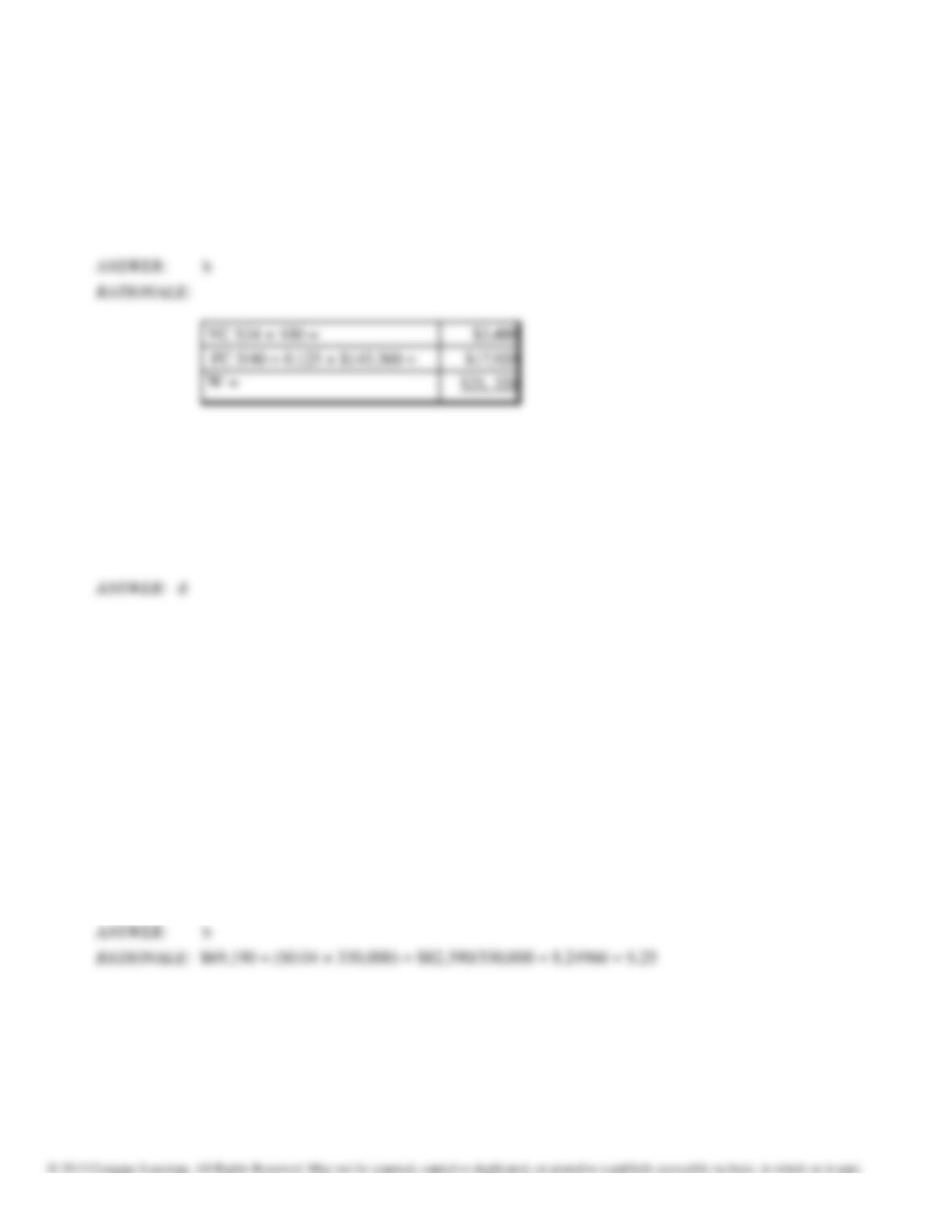
63. Refer to Figure 7-2. Using both a fixed and variable rate, what are the respective rates for fixed and variable per trip
for the West Sales Territory? Fixed costs are allocated on the basis of monthly peak trips.
a. 12.5%; $34
b. 19.6%; $34
c. 18.2%; $34
d. 19%; $34
e. none of the above
Chapter 7: Allocating Costs of Support Departments and Joint Products
64. Refer to Figure 7-2. Using both a fixed and variable rate with fixed costs allocated on the basis of monthly peak trips,
what will the West Sales Territory be charged for the year? (round to the nearest dollar)
a. $31,498
b. $21,320
c. $29,492
d. $30,638
e. none of the above
65. If the allocation is for product costing, the allocation of variable support department costs would be calculated as
a. Actual rate × Actual usage.
b. Actual rate × Budgeted usage.
c. Budgeted rate × Actual usage.
d. Budgeted rate × Budgeted usage.
Figure 7-3
Hanover and Trust, a large law firm, utilizes an internal centralized printing center to serve its three departments:
Individuals, Corporate, Trust. The costs of the printing department include fixed costs of $69,190 and variable costs of
$0.04 per page. Total estimated print pages are estimated to be 330,000 pages. Individuals are estimated to use
130,000; Corporate will use 165,000 and 35,000 from the trust area.
66. Refer to Figure 7-3. Assuming a single charging rate is used, what would be the charge per page? (round to the
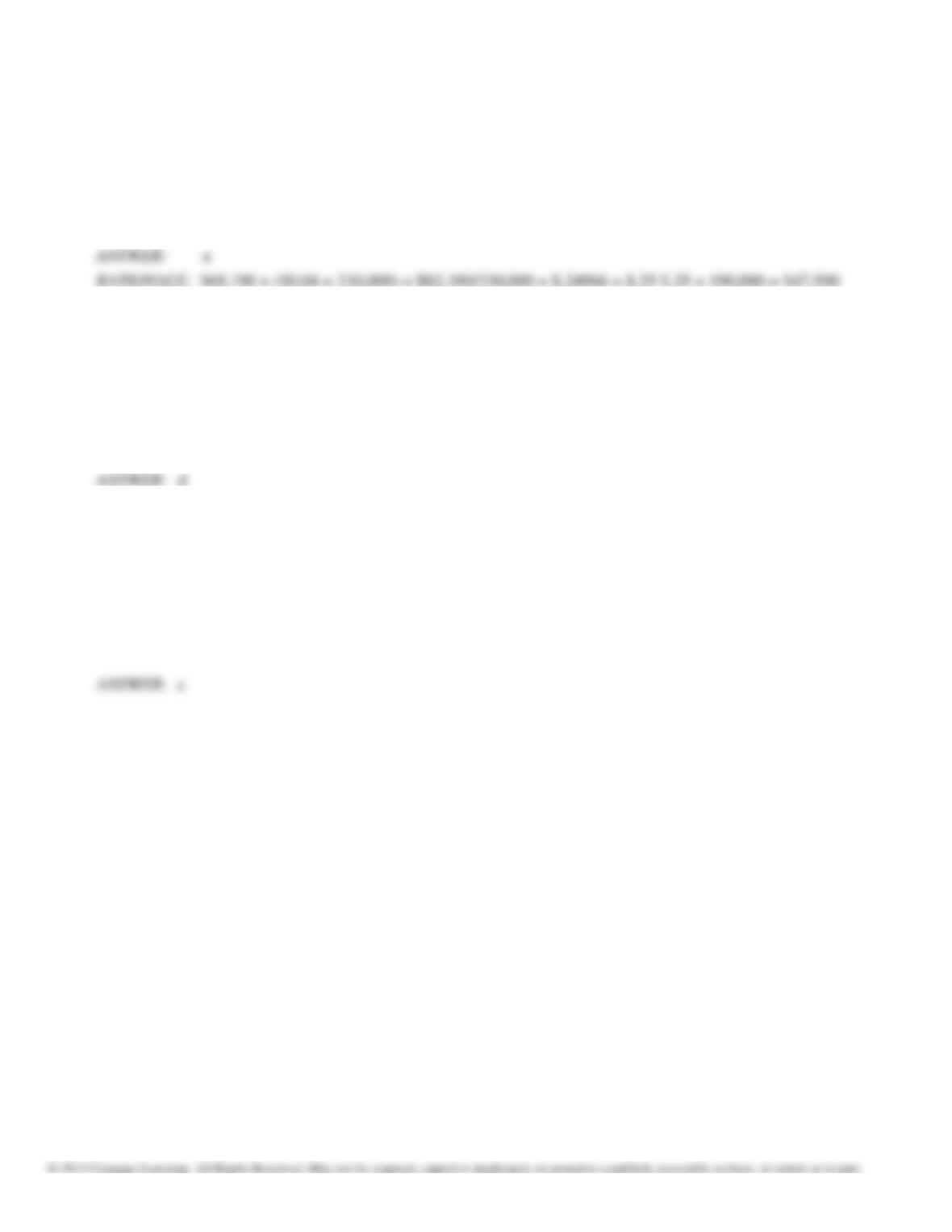
nearest cent)
a. $.04
b. $.25
c. $.21
d. none of the above amounts
Chapter 7: Allocating Costs of Support Departments and Joint Products
67. Refer to Figure 7-3. Assuming a single charging rate is used, if the Corporate Department used 190,000 pages, what
would be the printing charges for the Corporate Department? (Round to the nearest cent.)
a. $47,500
b. $39,900
c. $7,600
d. $42,195
68. Refer to Figure 7-3. Assuming a single charging rate is used, if the total pages printed were 340,000, which of the
following statements is correct?
a. The printing costs allocated to all departments would be $85,000.
b. The printing department would expect to incur costs of $82,790.
c. Any extra amount charged is due to the fixed costs being charged as if they were variable costs.
d. all of the above.
69. If the allocation is for performance evaluation, the allocation of variable support department costs would be
calculated as
a. Actual rate × Actual usage.
b. Actual rate × Budgeted usage.
c. Budgeted rate × Actual usage.
d. Budgeted rate × Budgeted usage.
FIGURE 7-4
Copies Plus Print operates a copy business at two different locations. Copies Plus Print has one support department
that is responsible for cleaning, service, and maintenance of its copying equipment. The costs of the support
department are allocated to each copy center on the basis of total copies made.
During the first month, the costs of the support department were expected to be $200,000. Of this amount, $60,000 is
considered a fixed cost. During the month, the support department incurred actual variable costs of $128,000 and
actual fixed costs of $72,000.
Normal and actual activity (copies made) are as follows:
Copy Center 1
Copy Center 2
Normal activity (copies)
600,000
400,000
Actual activity (copies)
500,000
440,000
Chapter 7: Allocating Costs of Support Departments and Joint Products
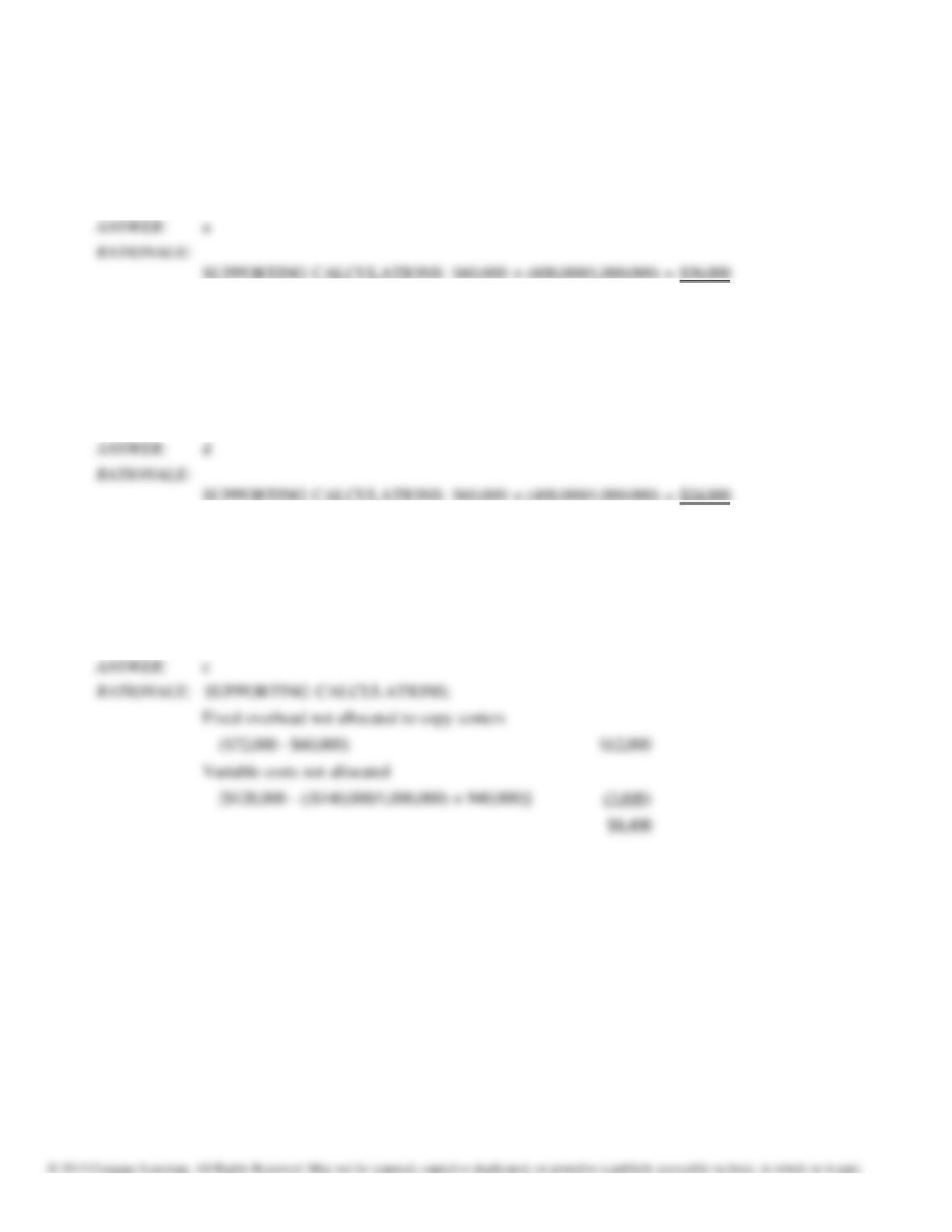
70. Refer to Figure 7-4. For purposes of performance evaluation, fixed costs allocated to Copy Center 1 are
a. $36,000.
b. $37,600.
c. $30,000.
d. $32,800.
71. Refer to Figure 7-4. For purposes of performance evaluation, fixed costs allocated to Copy Center 2 are
a. $28,800.
b. $60,000.
c. $51,200.
d. $24,000.
72. Refer to Figure 7-4. Support department costs NOT allocated to the two copy centers are
a. $22,000.
b. $9,840.
c. $8,400.
d. $6,000.
Chapter 7: Allocating Costs of Support Departments and Joint Products
A
800
640
B
480
640
73. A company incurred $40,000 of common fixed costs and $60,000 of common variable costs. These costs are to be
allocated to Departments A and B. Data on capacity provided and capacity used are as follows:
Capacity Provided Capacity Used
Department in Hours in Hours
Assume that common fixed costs are to be allocated to Departments A and B on the basis of capacity provided and
that common variable costs are to be allocated to Departments A and B on the basis of capacity used. The fixed and
variable costs allocated to Department A are
Fixed Variable
a. $20,000
$37,500
b. $20,000
$30,000
c. $25,000
$30,000
d. $25,000
$37,500
FIGURE 7-5
Stronghold, Inc., operates a brochure business at two different locations. Stronghold, Inc., has one support department
that is responsible for cleaning, service, and maintenance of its printing equipment. The costs of the support
department are allocated to each brochure center on the basis of total brochures made.
During the first month, the costs of the support department were expected to be $400,000. Of this amount, $120,000
is considered a fixed cost. During the month, the support department incurred actual variable costs of $256,000 and
actual fixed costs of $144,000.
Normal and actual activity (brochures made) are as follows:
Brochure Center 1
Brochure Center 2
Normal activity (brochures)
1,200,000
800,000
Actual activity (brochures)
1,000,000
880,000
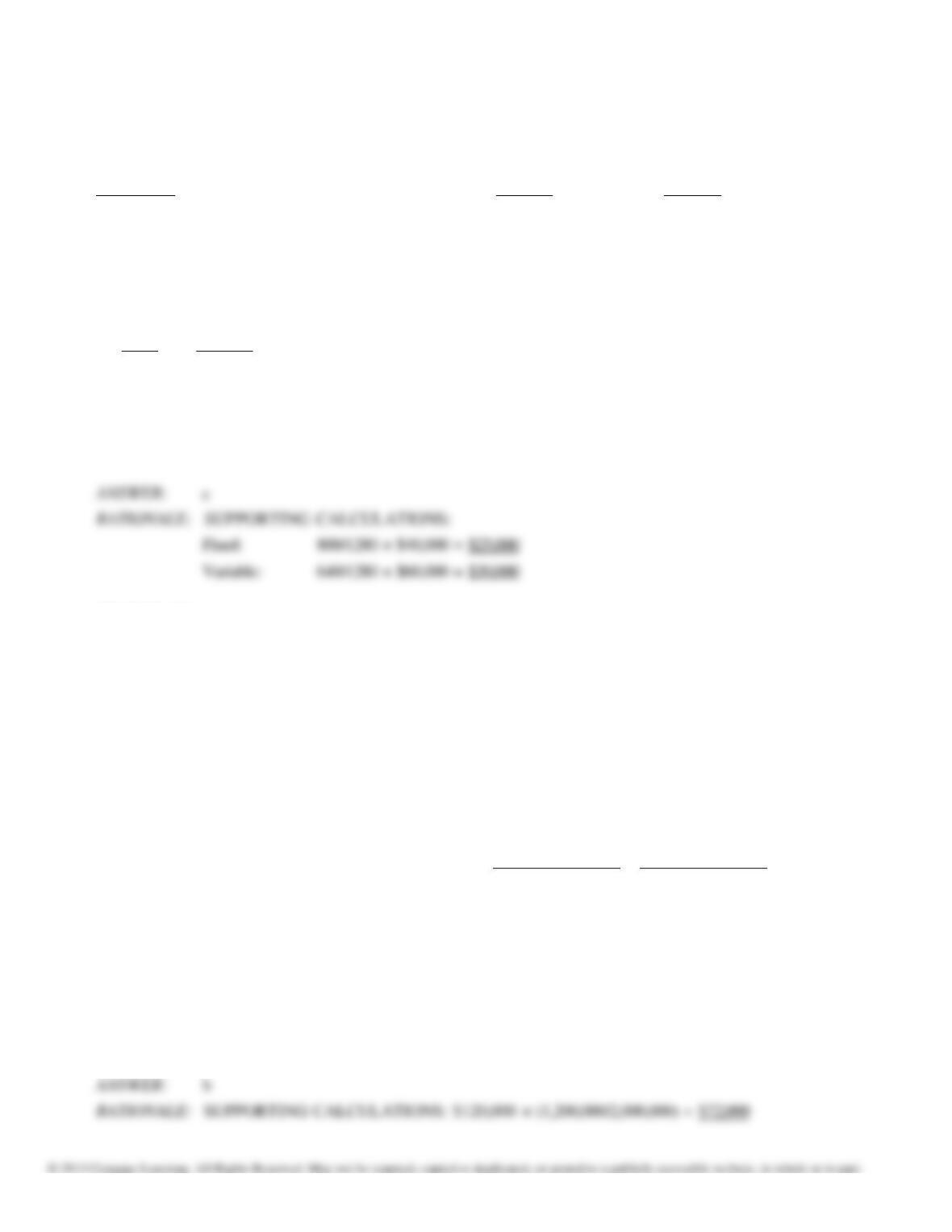
74. Refer to Figure 7-5.For purposes of performance evaluation, fixed costs allocated to
Brochure Center 1 are
a. $60,000.
b. $72,000.
c. $65,600.
d. $75,200.
Chapter 7: Allocating Costs of Support Departments and Joint Products
A
400
320
B
240
320
75. Refer to Figure 7-5. For purposes of performance evaluation, fixed costs allocated to Brochure Center 2 are
a. $57,600.
b. $120,000.
c. $48,000.
d. $102,400.
76. Refer to Figure 7-5. Support department costs NOT allocated to the two brochure centers are
a. $16,800.
b. $19,680.
c. $44,000.
d. $8,000.
77. A company incurred $80,000 of common fixed costs and $120,000 of common variable costs. These costs are to be
allocated to Departments A and B. Data on capacity provided and capacity used are as follows:
Capacity Provided Capacity Used
Department in Hours in Hours
Assume that both fixed and variable costs are allocated on the basis of capacity used. The fixed and variable costs
allocated to Department A are
Fixed Variable
a. $40,000 $60,000
b. $50,000 $60,000
c. $40,000 $75,000
d. $50,000 $75,000
Chapter 7: Allocating Costs of Support Departments and Joint Products
78. A company incurred $120,000 of common fixed costs and $180,000 of common variable costs. These costs are to be
allocated to Departments XX and YY. Data on capacity provided and capacity used are as follows:
Capacity Provided
Capacity Used
Department
in Hours
in Hours
XX
500
400
YY
300
400
Assume that common fixed costs are to be allocated to Departments XX and YY on the basis of capacity provided
and that common variable costs are to be allocated to Departments XX and YY on the basis of capacity used. The
fixed and variable costs allocated to Department XX are
Fixed Variable
a. $75,000 $112,500
b. $75,000 $90,000
c. $60,000 $112,500
d. $60,000 $90,000
79. A company incurred $120,000 of common fixed costs and $180,000 of common variable costs. These costs are to be
allocated to Departments XX and YY. Data on capacity provided and capacity used are as follows:
Capacity Provided
Capacity Used
Department
in Hours
in Hours
XX
500
400
YY
300
400
Assume that both fixed and variable costs are allocated on the basis of capacity used. The fixed and variable costs
allocated to Department XX are
Fixed Variable
a. $75,000 $112,500
b. $75,000 $90,000
c. $60,000 $112,500
d. $60,000 $90,000
Chapter 7: Allocating Costs of Support Departments and Joint Products
80. If a support department’s costs were budgeted to be $75,000 and actual costs incurred by the support department
were $70,000, the total amount of the support department’s costs that should be allocated to other departments is
a. $145,000.
b. $75,000.
c. $70,000.
d. $5,000.
81. Basic guidelines that should be followed when allocating support department costs include
a. actual costs should always be used for allocations.
b. budgeted costs, not actual costs, should be allocated.
c. service department costs should never be allocated at the beginning of the period.
d. both a and b.
82. Fixed support department costs should be allocated based on
a. current actual usage of service.
b. current budgeted usage of service.
c. practical capacity of user departments.
d. all of the above.
83. Which of the following methods allocates support department costs?
a. direct allocation method
b. reciprocal allocation method
c. sequential allocation method
d. all of the above
Chapter 7: Allocating Costs of Support Departments and Joint Products
84. The following information pertains to Famous Company:
Support Departments
Producing Departments
Personnel
Maintenance
Fabrication
Assembly
Budgeted overhead
$40,000
$72,000
$140,000
$160,000
Direct labor hours
2,000
2,500
8,000
10,000
Machine hours
–
–
12,000
8,000
Number of employees
4
5
15
25
Famous Company does not divide costs into fixed and variable components. Personnel costs are allocated based on
the number of employees, and maintenance costs are allocated based on machine hours.
Predetermined overhead rates for fabrication and assembly are based on direct labor hours.
What is the amount of maintenance costs allocated to the Assembly Department using the direct method? (Round
amounts to dollars.)
a. $14,400.
b. $48,000.
c. $28,800.
d. $38,160.
Chapter 7: Allocating Costs of Support Departments and Joint Products
85. The following information pertains to Longboat Company:
Support Departments
Producing Departments
Personnel
Maintenance
Fabrication
Assembly
Budgeted overhead
$40,000
$72,000
$140,000
$160,000
Direct labor hours
2,000
2,500
8,000
10,000
Machine hours
–
–
12,000
8,000
Number of employees
4
5
15
25
Longboat Company does not divide costs into fixed and variable components. Personnel costs are allocated based on
the number of employees, and maintenance costs are allocated based on machine hours.
Predetermined overhead rates for fabrication and assembly are based on direct labor hours. (Round amounts to
dollars.)
If the direct method is used to allocate support department costs, the predetermined overhead rate for the Fabrication
Department (rounded to two decimal places) would be
a. $28.80.
b. $24.78.
c. $7.28.
d. $5.40.
86. Fairfield Company allocates common Building Department costs to producing departments (P1 and P2) based on
space occupied, and it allocates common Personnel Department costs based on the number of employees. Space
occupancy and employee data are as follows:
Building
Personnel
Dept. P1
Dept. P2
Space occupied
2,000 ft.
10,000 ft.
120,000 ft.
70,000 ft.
Employees
6
10
80
50
If Fairfield Company uses the direct allocation method, the ratio representing the portion of building costs allocated to
Department P1 is
a. 190,000/202,000.
b. 2,000/120,000.
c. 120,000/202,000.
d. 120,000/190,000.