
Chapter 7: Allocating Costs of Support Departments and Joint Products
121. Products with substantial value which are produced simultaneously by the same process up to a split-off point are
called:
a. Joint products
b. Minor products
c. By–products
d. Both a and b
122. The cost of crude oil used in producing gasoline products is an example of
a. joint costs.
b. a by–product.
c. joint products.
d. common cost allocation.
123. Joint costs are
a. separable.
b. allocated on the basis of cause and effect relationships.
c. allocated arbitrarily.
d. all of the above.
124. The split-off point can best be defined as
a. the point at which a secondary product is recovered in the course of manufacturing a primary product.
b. the point at which joint products become separate and identifiable.
c. the point in the production process where no further processing is needed.
d. the point at which you can get more of one product and less of another product.
125. Joint costs are allocated because of
a. financial reporting requirements.
b. tax reporting requirements.
c. IMA requirements.
d. both b and a.

Chapter 7: Allocating Costs of Support Departments and Joint Products
126. A secondary product recovered in the course of manufacturing a primary product during a joint process is called a:
a. main product
b. joint product
c. by–product
d. both a and c
127. Which of the following is a by–product?
a. lumber
b. fresh fish
c. whole milk
d. sawdust
128. Which of the following would generally be a by–product?
a. canned fish
b. hamburger
c. cow hides
d. pineapples
129. Which of the following methods allocates joint production costs based on the pounds of product produced?
a. sales-value-at-split–off method
b. physical units method
c. constant gross margin percentage method
d. replacement cost method
130. A joint cost allocation method that would assign the same amount of cost per unit to two joint products that sell for
$10 and $40, respectively, is the
a. sales-value-at-split–off method.
b. direct allocation method.
c. net realizable value method.
d. physical unit method.
Chapter 7: Allocating Costs of Support Departments and Joint Products
131. Which joint cost allocation method is described by the following statement?
Joint cost is prorated to the products on the basis of each product’s share of units.
a. physical units method
b. weighted average method
c. sales-value-at-split–off method
d. net realizable value method
132. Laredo Corporation, which manufactures products W, X, Y, and Z through a joint process costing $24,000, has the
following data for 2016:
Total Sales Value
Product
Units Produced
at Split–Off
W
10,000
$5,000
X
6,000
2,500
Y
16,000
3,000
Z
8,000
4,500
What is the amount of joint costs assigned to product W using the physical units method?
a. $6,000
b. $8,000
c. $16,000
d. $18,000
133. Restaurant Products produces two products, X and Y, in a single process. In 2011, the joint costs of this process
were $25,000. In addition, 4,000 units of X and 6,000 units of Y were produced. Separable processing costs beyond
the split–off point were X – $10,000; Y – $20,000. X sells for $10.00 per unit; Y sells for $7.50 per unit.
What amount of joint costs will be allocated to Product X using the physical units method?
a. $-0-
b. $10,000
c. $25,000
d. $15,000
Chapter 7: Allocating Costs of Support Departments and Joint Products
134. Deli Products produces two products, X and Y, in a single process. In 2011, the joint costs of this process were
$25,000. In addition, 4,000 units of X and 6,000 units of Y were produced and sold. Separable processing costs
beyond the split–off point were: X – $10,000; Y – $20,000. X sells for $10.00 per unit; Y sells for $7.50 per unit.
What is the gross profit of product Y assuming the physical units method is used?
SUPPORTING CALCULATIONS: Joint cost allocation (6,000/10,000 × $25,000) = $15,000 Gross profit [(6,000 ×
$7.50) – $20,000 – $15,000] = $10,000
a. $25,000
b. $-0-
c. $10,000
d. $15,000
135. Which joint cost allocation method is described by the following statement?
Each product is assigned a weighting factor which is multiplied by the number of units. Joint cost is prorated to the
products on the basis of each product’s share of total weighted units.
a. physical units method
b. weighted average method
c. sales-value-at-split–off method
d. net realizable value method
136. Suppose that a sawmill processes logs into four grades of lumber totaling 500,000 board feet as follows at a joint
cost of $300,000:
Grade
Board Feet
Final Sales Value
First and second
75,000
$ 56,250
No. 1 common
200,000
180,000
No. 2 common
100,000
105,000
No. 3 common
125,000
127,500
What amount of joint costs will be allocated to first and second using the physical units method?
a. $300,000
b. $45,000
c. $36,000
d. $225,000
Chapter 7: Allocating Costs of Support Departments and Joint Products
137. Impacto Corporation produces four products in a joint process for $650,000. The following information is available
on total sales and production in units:
Products
Sales
Production
I
1,000
4,000
L
2,000
5,000
E
3,000
7,000
S
4,000
8,000
What amount of joint costs will be allocated to I based on the physical units method?
a. $100,000
b. $650,000
c. $108,355
d. $300,000
138. The sales-value-at-split–off method allocates joint production costs based on each product’s share of
a. sales value revenues have not been realized at the split-off point.
b. costs realized at the split-off point.
c. final sales value less further processing costs after the split-off point.
d. units produced at the split-off point.
139. Hibernation Company incurred $500,000 to manufacture the following products in a joint process:
Selling Price
Product
Units Produced
Weight per Unit
per Unit
I
1,250
8 lbs.
$ 5
J
2,500
6 lbs.
10
K
3,750
4 lbs.
10
L
5,000
2 lbs.
5
How much joint cost would be allocated to Product I based on the physical units method?
a. $50,000
b. $450,000
c. $33,333
d. $500,000
Chapter 7: Allocating Costs of Support Departments and Joint Products
140. Cumadin Corporation, which manufactures products W, X, Y, and Z through a joint process costing $18,000, has
the following data for 2016:
Sales Value
Product
Units Produced
at Split-Off
W
10,000
$5,000
X
6,000
2,500
Y
16,000
3,000
Z
8,000
4,500
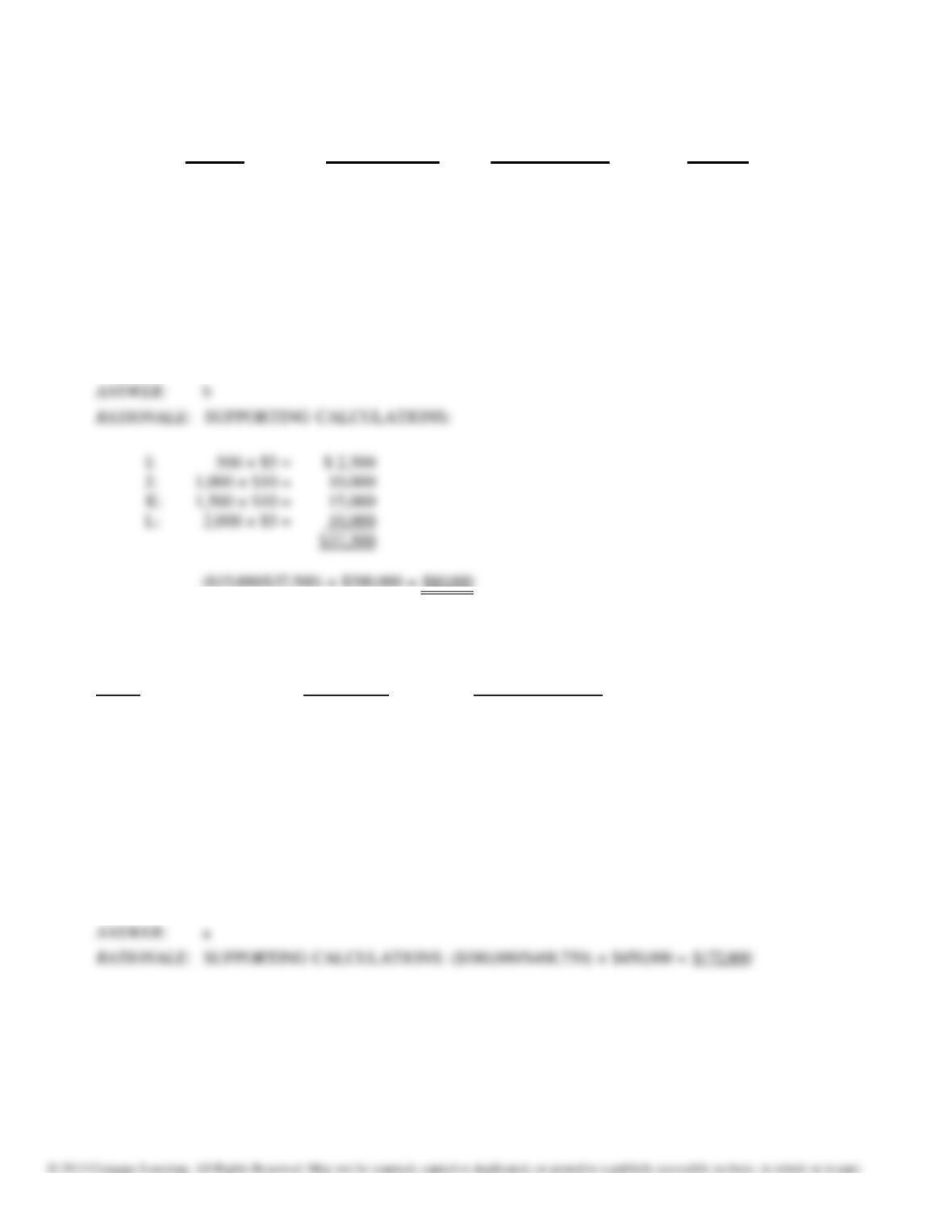
What is the amount of joint costs assigned to Product X using the sales–value-at-split-off method?
a. $18,000
b. $3,000
c. $10,000
d. $2,700
141. Cumadin Corporation, which manufactures Products W, X, Y, and Z through a joint process costing $18,000, has
the following data for 2016:
Sales Value
Product
Units Produced
at Split-Off
W
10,000
$5,000
X
6,000
2,500
Y
16,000
3,000
Z
8,000
4,500
What is the amount of joint costs assigned to Product Y using the sales-value-at-split–off method?
a. $3,600
b. $7,200
c. $18,000
d. $1,200
Chapter 7: Allocating Costs of Support Departments and Joint Products
142. Foster Company incurred $200,000 to manufacture the following products in a joint process:
Selling Price
Product
Units Produced
Weight per Unit
per Unit
I
500
8 lbs.
$ 5
J
1,000
6 lbs.
10
K
1,500
4 lbs.
10
L
2,000
2 lbs.
5
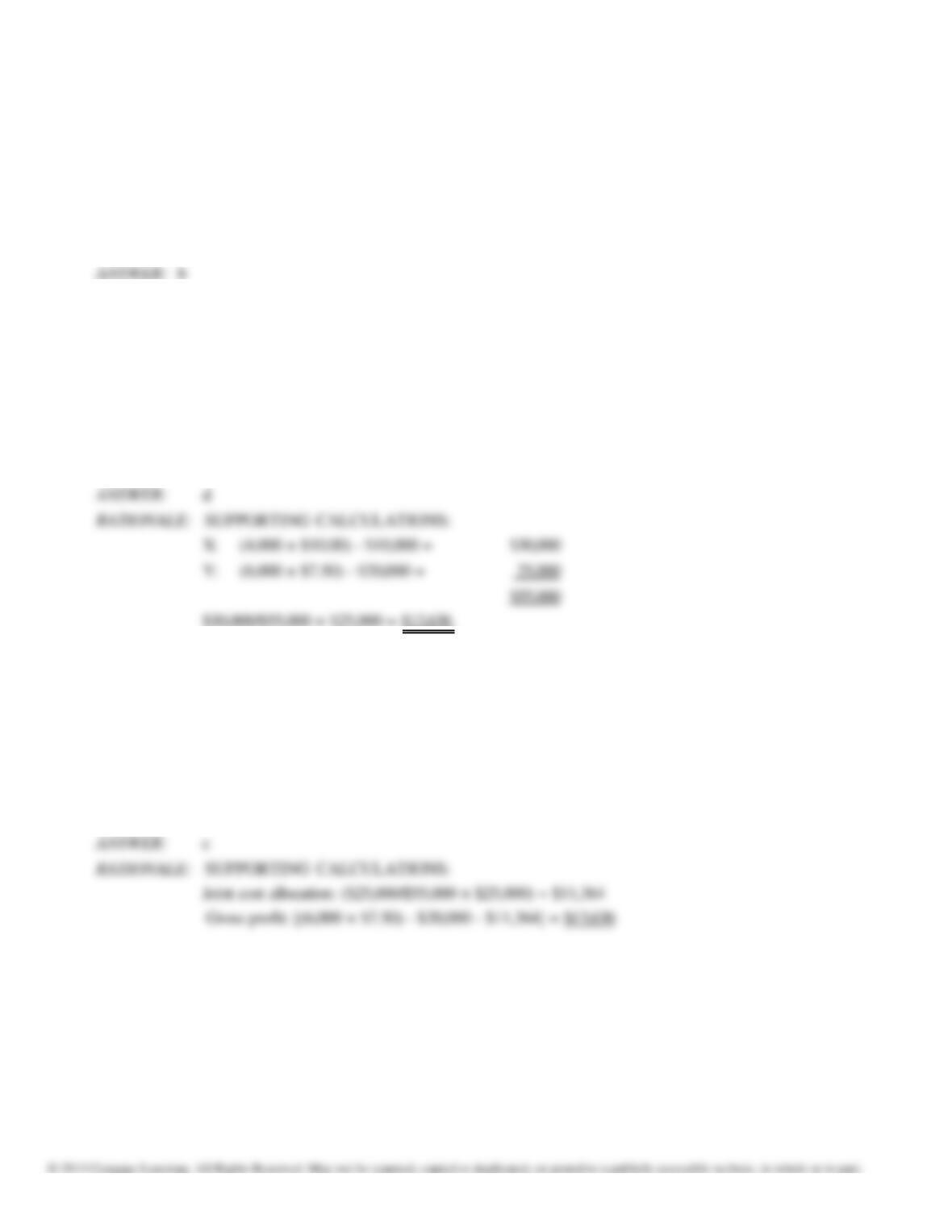
How much joint cost would be allocated to Product K based on the total sales value method?
a. $13,334
b. $80,000
c. $26,666
d. $60,000
143. Suppose that a Plywood manufacturer processes wood pulp into four grades of Plywood totaling 500,000 board feet
as follows at a joint cost of $450,000:
Grade
Board Feet
Final Sales Value
First and second
75,000
$ 56,250
No. 1 common
200,000
180,000
No. 2 common
100,000
105,000
No. 3 common
125,000
127,500
What amount of joint costs will be allocated to No. 1 common using the final sales value method?
a. $172,800
b. $450,000
c. $80,000
d. $24,000
Chapter 7: Allocating Costs of Support Departments and Joint Products
144. Which of the following methods allocates joint production costs based on their proportionate share of eventual
revenue less further processing costs?
a. sales-value-at-split–off method
b. net realizable value method
c. physical units method
d. replacement cost method
145. Algonquin Products produces two products, X and Y, in a single process. In 2011, the joint costs of this process were
$25,000. In addition, 4,000 units of X and 6,000 units of Y were produced. Separable processing costs beyond the
split–off point were: X–$10,000; Y-$20,000. X sells for $10.00 per unit; Y sells for $7.50 per unit.
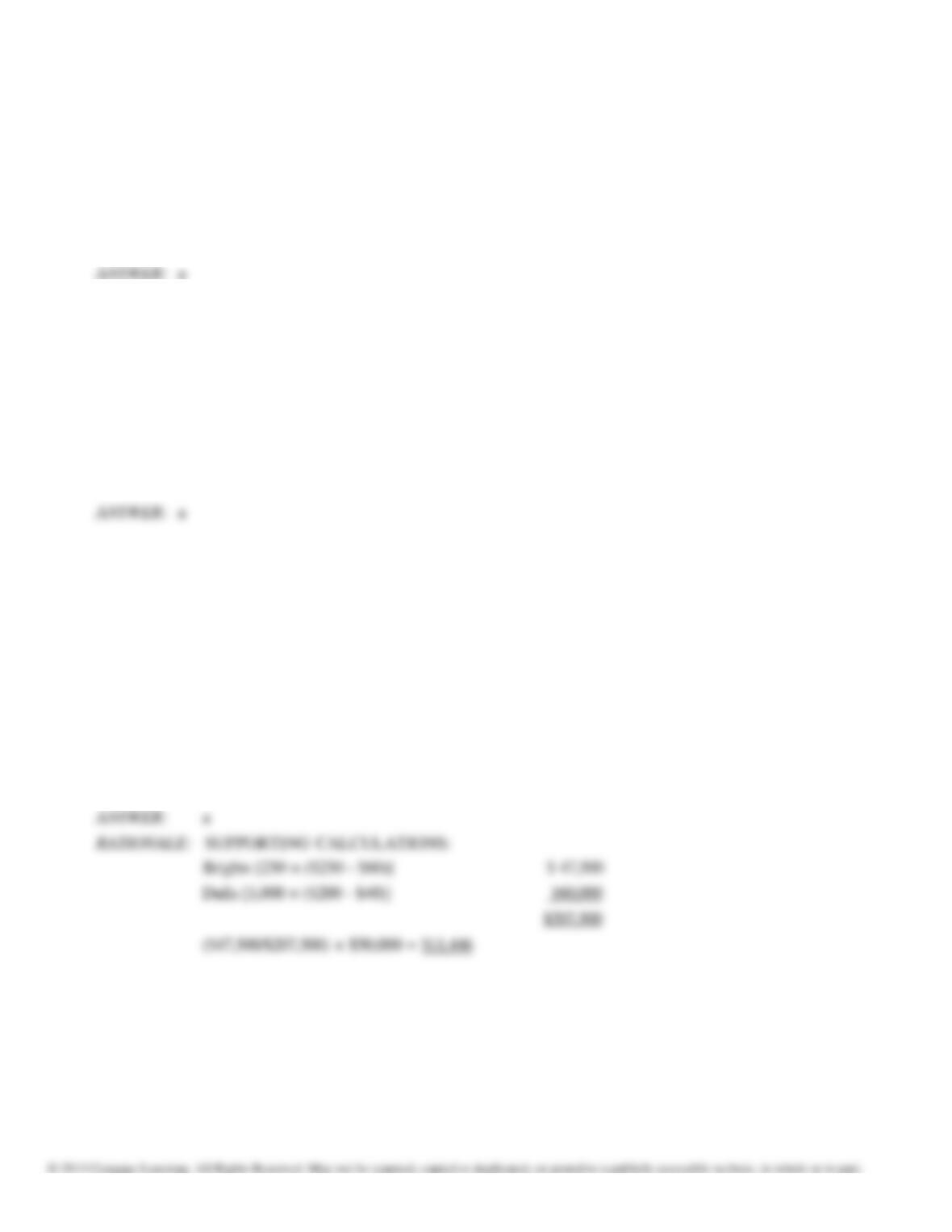
What amount of joint costs will be allocated to product X using the net realizable value net realizable value method?
a. $11,765
b. $40,000
c. $39,000
d. $13,636
146. Algonquin Products produces two products, X and Y, in a single process. In 2011, the joint costs of this process were
$25,000. In addition, 4,000 units of X and 6,000 units of Y were produced. Separable processing costs beyond the
split–off point were X-$10,000; Y-$20,000. X sells for $10.00 per unit; Y sells for $7.50 per unit.
What is the gross profit of product Y assuming the net realizable value method is used?
a. $45,000
b. $16,364
c. $13,636
d. $30,000
Chapter 7: Allocating Costs of Support Departments and Joint Products
147. Which of the following methods allocates a joint cost such that each product has the same cost of goods sold
percentage?
a. constant gross margin percentage method
b. net realizable value method
c. physical units method
d. replacement cost method
148. Which joint cost allocation method is described by the following statement?
Overall sales revenue minus overall costs (joint plus further processing costs) is calculated to yield gross profit and
the gross profit percentage. Each product is then assigned the same cost of goods sold percentage.
a. constant gross margin method
b. weighted average method
c. sales-value-at-split–off method
d. net realizable method
Figure 7-7
Garden of Eden Company manufactures two products, Brights and Dulls, from a joint process. A production run
costs $50,000 and results in 250 units of Brights and 1,000 units of Dulls. Both products must be processed past the
split–off point, incurring separable costs for Brights of $60 per unit and $40 per unit for Dulls. The market price is
$250 for Brights and $200 for Dulls.
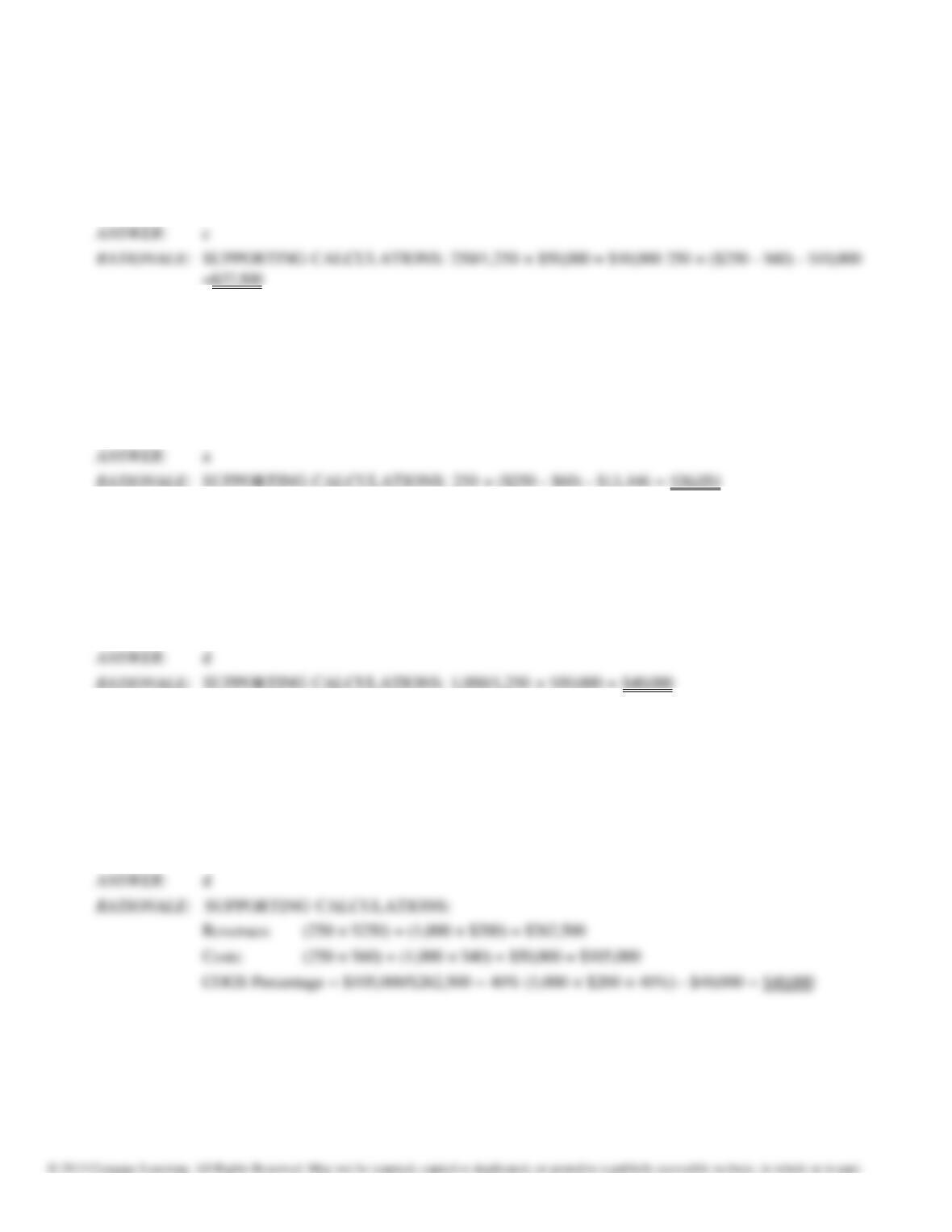
149. Refer to Figure 7-7. What is the amount of joint costs allocated to Brights using the net realizable value method?
a. $11,446
b. $11,906
c. $50,000
d. $-0-
Chapter 7: Allocating Costs of Support Departments and Joint Products
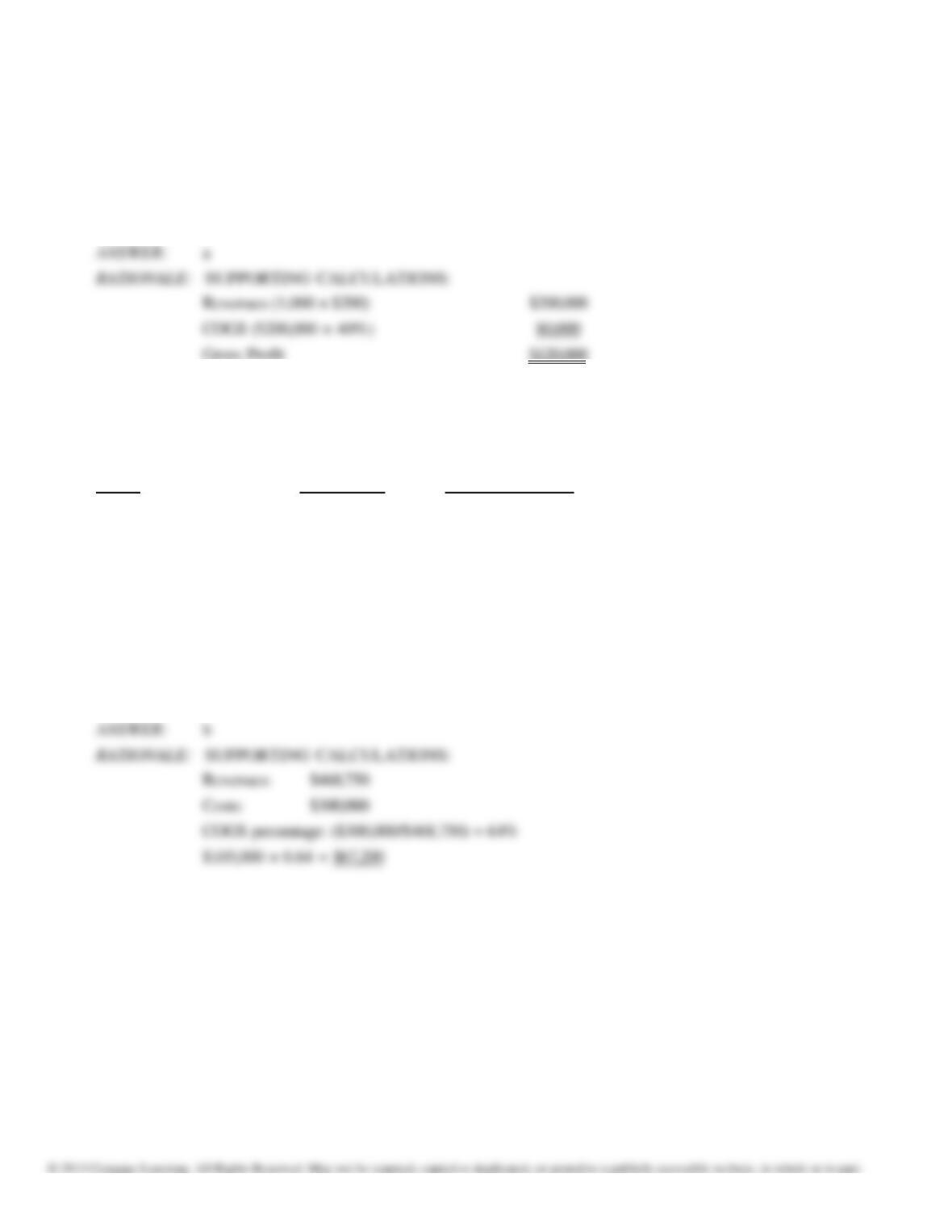
150. Refer to Figure 7-7. What is the gross profit for Brights assuming the physical units method is used?
a. $62,500
b. $12,500
c. $37,500
d. $47,500
151. Refer to Figure 7-7. What is the gross profit for Brights assuming the net realizable value method is used?
a. $36,054
b. $11,446
c. $47,500
d. $62,500
152. Refer to Figure 7-7. What is the amount of joint costs allocated to Dulls using the physical units method?
a. $50,000
b. $160,000
c. $38,554
d. $40,000
153. Refer to Figure 7-7. What is the amount of joint costs allocated to Dulls using the constant gross margin percentage
method?
a. $15,000
b. $10,000
c. $50,000
d. $40,000
Chapter 7: Allocating Costs of Support Departments and Joint Products
154. Refer to Figure 7-7. What is the gross profit for Dulls assuming the constant gross margin percentage method is
used?
a. $120,000
b. $150,000
c. $37,500
d. $200,000
155. Carson Wood Products processes logs into four grades of lumber totaling 500,000 board feet as follows at a joint cost
of $300,000:
Grade
Board Feet
Final Sales Value
First and second
75,000
$ 56,250
No. 1 common
200,000
180,000
No. 2 common
100,000
105,000
No. 3 common
125,000
127,500
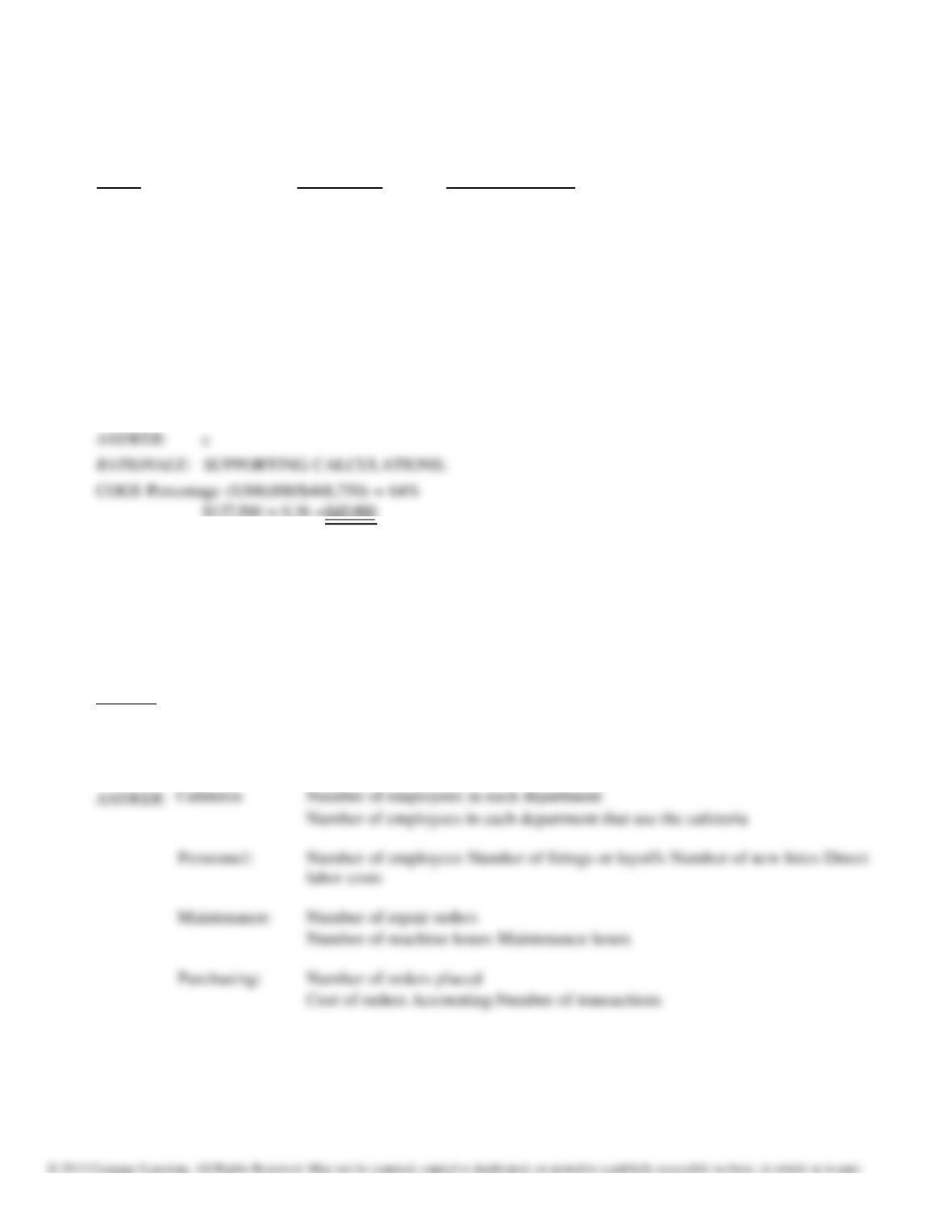
What amount of joint costs will be allocated to No. 2 common using the constant gross margin percentage method?
a. $300,000
b. $67,200
c. $37,800
d. $192,000
Chapter 7: Allocating Costs of Support Departments and Joint Products
156. Carson Wood Products processes logs into four grades of lumber totaling 500,000 board feet as follows at a joint
cost of $300,000:
Grade
Board Feet
Final Sales Value
First and second
75,000
$ 56,250
No. 1 common
200,000
180,000
No. 2 common
100,000
105,000
No. 3 common
125,000
127,500
What is the gross profit of No. 3 common if the constant gross margin percentage method is used?
a. $135,000
b. $81,600
c. $45,900
d. $168,750
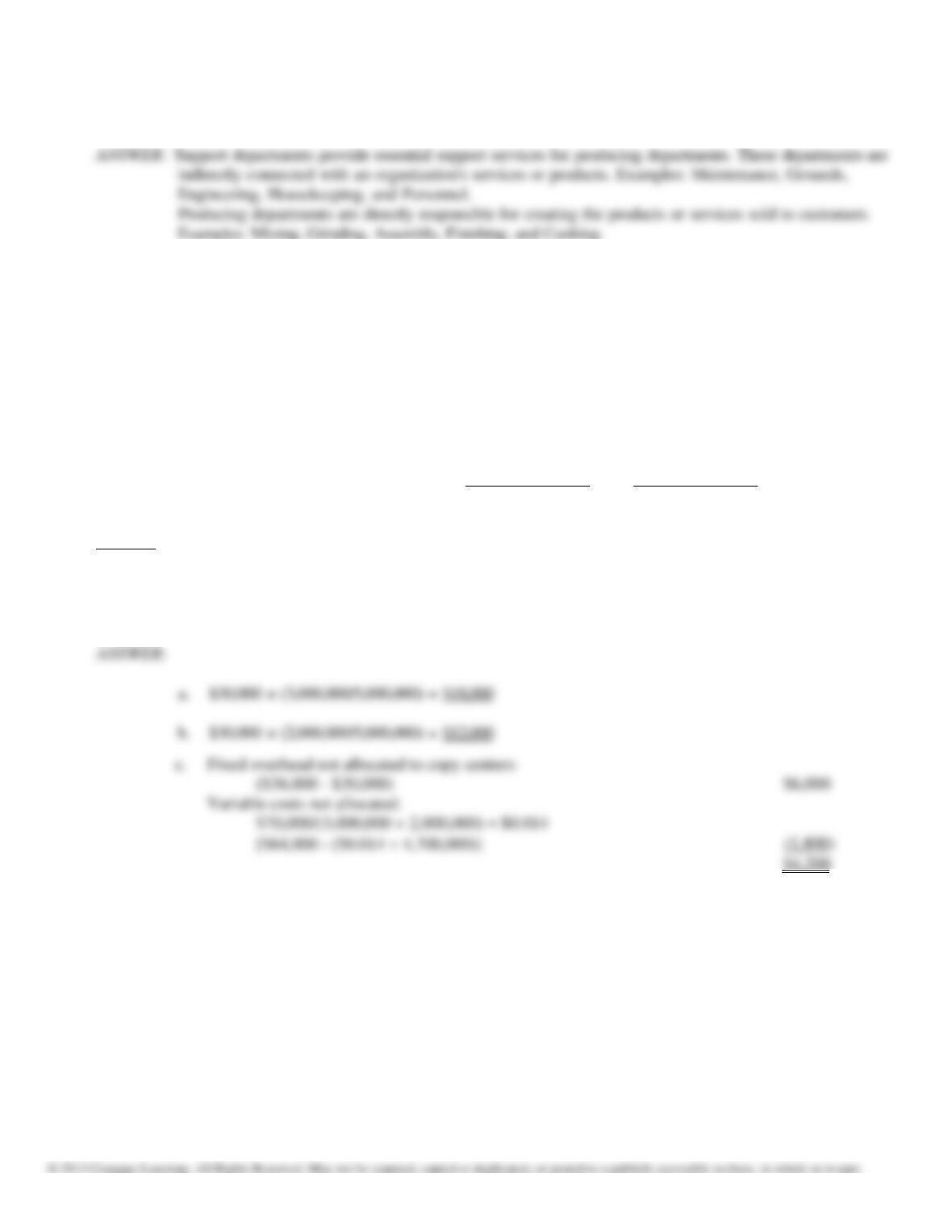
157. Some support departments typically found in manufacturing and nonmanufacturing organizations are as follows:
Cafeteria
Personnel
Maintenance
Purchasing
Accounting
Required:
For each of the preceding support departments, indicate potential bases that could be used to allocate costs to the
producing departments.
Chapter 7: Allocating Costs of Support Departments and Joint Products
158. Describe the differences between support and producing departments. Give three examples of each.
159. Consequence Printing operates a Graphics business at two different locations. Consequence Printing has one support
department that is responsible for cleaning, service, and maintenance of its printing equipment. The costs of the
support department are allocated to each Graphics Center on the basis of total prints made.
During the first month, the costs of the support department were expected to be $100,000. Of this amount, $30,000 is
considered a fixed cost. During the month, the support department incurred actual variable costs of $64,000 and
actual fixed costs of $36,000.
Normal and actual activity (prints made) are as follows:
Graphics Center 1
Graphics Center 2
Normal activity (graphics)
3,000,000
2,000,000
Actual activity (graphics)
2,500,000
2,200,000
Required:
a. For purposes of performance evaluation, calculate the fixed costs allocated to Graphics Center 1.
b. For purposes of performance evaluation, calculate the fixed costs allocated to Graphics Center 2.
c. Calculate the support department costs not allocated to the two Graphics Centers.