Chapter 7: Activity-Based Costing and Management
Learning Questions
True /
False
Multiple Choice
Matching
Exercises
Short
Answer
Problems
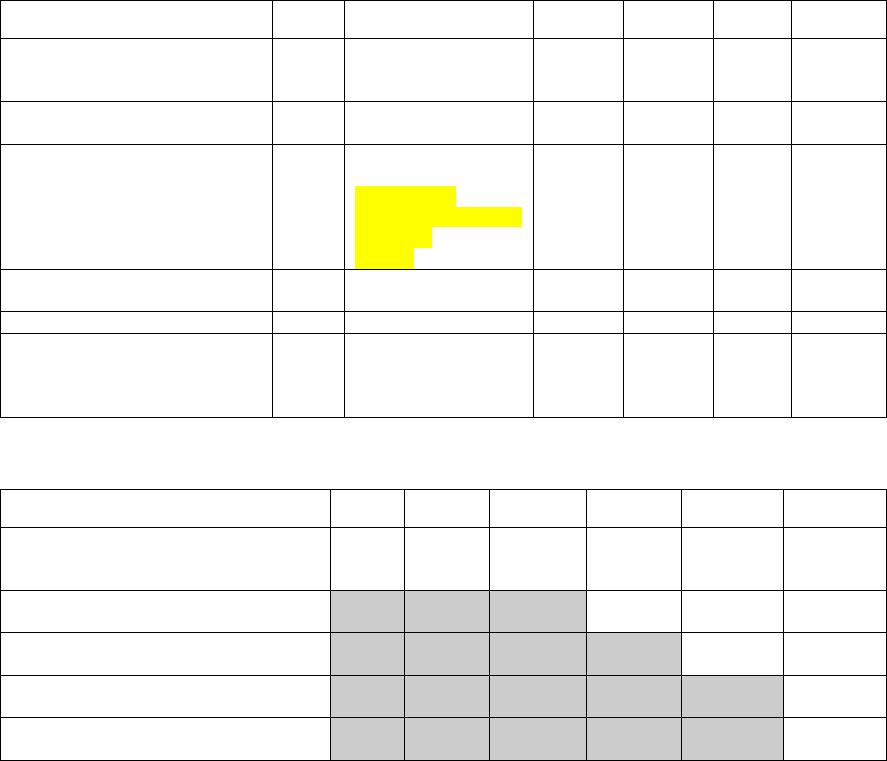
1. What is activity-based
costing (ABC)?
1-5
1-8, 81
S: 84, 86, 87, 94, 95
W: 109, 111
1
1
8
1, 2
2. What are activities, and how
are they identified?
6-8
9-17, 29
W: 99, 104-107
2
2
1, 2, 9
3
3. What process is used to
assign costs in an ABC
system?
9-17
18–28, 30, 31-46, 77-
80, 82, 83
S: 88-91, 96
W: 100, 101, 112, 113
S: 85, 92
W: 110
3, 4, 5, 7
3, 4
11
1, 2, 3
4. What is activity-based
management (ABM)?
18–24
47–58
W: 98, 102, 103
4, 6, 7
3, 4, 5,
7
1, 2, 3, 4
5. What are GPK and RCA?
28–29
12
6. How does information from
ABC, GPK, and RCA affect
managers’ incentives and
decisions?
25–27
59–76
S: 93
W: 97, 108
4
6, 10
2, 3, 4
S: Questions from the study guide
W: Questions from web quizzes on the student web site
Level of Complexity*
True /
False
Multiple
Choice
Matching
Exercises
Short
Answer
Problems
Foundation: Repeat or paraphrase
information; Reason to single correct
solution; Perform computations; etc.
All
All
All
All
1, 2, 4, 7
1, 2, 3, 4
Step 1: Identify the problem, relevant
information, and uncertainties
3, 4
5, 9
2, 3, 4
Step 2: Explore interpretations and
connections
3, 6, 8, 10,
11
1, 3, 4
Step 3: Prioritize alternatives and
implement conclusions
Step 4: Envision and direct strategic
innovation
*Based on level in Steps for Better Thinking (Exhibit 1.10, textbook p. 16):
Note: Step 1, 2, 3, and 4 questions in this test bank are intentionally open-ended and subjective, giving students the
opportunity to demonstrate skills such as judgment, reasoning, identification of uncertainties, identification or analysis of
pros and cons, and so on. Therefore, student answers may not exactly match those shown in the solutions.

7-2 Cost Management
True / False
1. Both activity-based costing and traditional costing allocate overhead costs to cost objects.
2. Activity-based costing increases the accuracy of cost measurement by using arbitrary cost allocation
bases for overhead.
3. Unlike activity-based costing, traditional costing systems never use multiple cost pools for overhead
allocation.
4. Generally speaking, activity-based costing traces direct costs more accurately than traditional costing.
5. An activity is a type of task or function performed in an organization.
6. In an activity-based costing system, both organization-sustaining and facility-sustaining activities are
assumed to be unaffected by the number of customers.
7. Product advertising for a new product is an example of a customer-sustaining cost in an ABC system.
8. Administrative salaries are an example of an organization-sustaining cost in an ABC system.
9. When applying ABC concepts to the determination of product costs, the first step is to identify
activities.
10. In an ABC system costs are first assigned to cost pools, then always to units of product.
11. Each cost pool in an ABC system has at least one cost driver.
12. Each cost pool in an ABC system has its own cost allocation rate.
13. In an ABC system, a “cost object” could be a unit of product, a product line, or a customer.
14. Ideally, activity costs in an ABC system are allocated to cost objects using a driver that explains
changes in activity costs.
15. The terms “cost driver” and “allocation base” are interchangeable.
16. Accountants normally can determine cost drivers for all cost pools on their own, without consulting
other employees in the organization.
17. Information about potential cost drivers may be requested from employees directly involved in
activities.
18. Activity-based management and activity-based costing are two ways of describing the same thing.
19. Organizations interested in using activity-based management must first implement an activity-based
costing system.
20. All organizations that use activity-based costing also use activity-based management.
21. Activity-based management can be used to manage both quality and constrained resources.
22. Managers can use activity-based management to control environmental costs.
23. ABC systems allow managers to focus on measurement at the activity level.
24. ABC systems measure resource flows in an organization.
25. The costs of designing and implementing an ABC system include employee time and training.
26. The availability of activity costs is inversely related to the cost of implementing an ABC system.
27. One of the uncertainties associated with ABC and ABM systems is employee response to design and
implementation.
28. Under GPK a cost center is a department or larger cost object.
29. GPK uses proportional costs, not variable costs.Multiple Choice

Chapter 7: Activity-Based Costing and Management 7-3
1. Cost accounting systems were originally developed to
a. Assign costs to products for financial reporting purposes
b. Assign costs to products for tax reporting purposes
c. Give managers better information for making decisions
d. Allocate direct costs to cost objects
2. Which method(s) do traditional accounting systems use to assign the following costs to cost objects
(departments or units)?
Direct Costs Overhead Costs
a. Allocate Trace
b. Trace Allocate
c. Allocate Allocate
d. Trace Trace
3. Which of the following statements about costing systems is true?
a. Both traditional and activity-based costing systems use a two-stage allocation process
b. Traditional costing systems use a two-stage allocation process, but ABC systems require three
stages
c. ABC systems typically use a two-stage allocation process, whereas traditional systems use a
single stage
d. Both traditional and activity-based costing systems use a three-stage allocation process
4. ABC systems are similar to traditional costing systems in the way they
a. Allocate direct costs to cost objects
b. Define cost allocation bases
c. Trace direct costs to cost objects
d. Trace indirect costs to activities
5. ABC systems differ from traditional systems in that ABC systems
a. Trace direct costs to cost objects
b. Use multiple cost pools and cost drivers to allocate direct costs
c. Use multiple cost pools and cost drivers to allocate overhead costs
d. Assign costs only to units of product
6. APL Corporation allocates overhead to cost objects using a two-stage process. From this
information, we can infer that APL
a. Uses a traditional costing system
b. Uses an activity-based costing system
c. May be using either a traditional or an activity-based costing system
d. Is reporting its product costs accurately
7. Compared to a traditional costing system, an activity-based costing system usually involves
a. Fewer cost pools
b. More cost pools
c. The same number of cost pools
d. Bigger cost pools
8. ABC systems differ from traditional costing systems because ABC systems use
a. Multiple activity cost pools and cost drivers to allocate overhead costs
b. Multiple activity cost pools and cost drivers to allocate direct costs
c. More automation and information technology to allocate overhead costs
d. Less automation and information technology to allocate overhead costs
7-4 Cost Management
Use the following information for the next 5 questions.
Le Pavilion is an historic hotel just outside the French Quarter in New Orleans. It is owned by Refined
Hotels, which operates additional properties in Chicago, Cincinnati, and San Antonio. Le Pavilion has 9
floors, with approximately 20 rooms per floor. Facilities also include a workout room, restaurant, and pool.
The hotel is organized in 5 departments: front desk, engineering, housekeeping, food & beverage, and
customer relations. As part of its operation, Le Pavilion regularly incurs the following costs:
General manager’s salary
Housekeeping supplies
Utility costs
Depreciation on workout room equipment
Advertising
Food and beverage costs
Depreciation on restaurant equipment
9. If Le Pavilion is the cost object, which of the following best describes the general manager’s salary?
a. Batch-level cost
b. Customer-sustaining cost
c. Facility-sustaining cost
d. Organization-sustaining cost
10. From the perspective of Refined Hotels, advertising specifically for Le Pavilion is best described as
a(n)
a. Unit-level cost
b. Customer-sustaining cost
c. Product-sustaining cost
d. Batch-level cost
11. Advertising for the Refined Hotels chain is best described as a(n)
a. Facility-sustaining cost
b. Organization-sustaining cost
c. Product-sustaining cost
d. Batch-level cost
12. Which cost listed above is most likely to be a customer-sustaining cost?
a. Depreciation on workout room equipment
b. Utility costs
c. Housekeeping supplies
d. General manager’s salary
13. Le Pavilion could define its cost objects as
I. Customers only
II. Departments only
III. Number of employees
a. I only
b. I and II only
c. II only
d. I, II, and III
14. Which of the following activities involves managing a plant, area, or location within an organization?
a. Organization-sustaining
b. Facility-sustaining
c. Customer-sustaining
d. Product-sustaining

Chapter 7: Activity-Based Costing and Management 7-5
15. In an ABC system, an activity is best defined as a
a. Type of task performed in an organization
b. Collection of activities in a particular department
c. Collection of cost drivers associated with a particular cost pool
d. Group of cost pools associated with a particular department
16. Which category of the ABC hierarchy has costs that are primarily fixed and activities with little or no
cause-and-effect relationship with costs?
a. Unit-level
b. Batch-level
c. Organization-sustaining
d. Product-sustaining
17. Managers are most likely to identify activities in an ABC system by
a. Examining the financial statements
b. Forecasting market demand using the high-low method
c. Consulting employees
d. Tracking general ledger account balances
18. Which of the steps listed below normally occurs first when assigning costs in an ABC system?
a. Assign costs to activity-based pools
b. Allocate activity costs to each cost object
c. Identify activities
d. Identify the relevant cost object
19. Which of the following is not part of the process used to assign costs in an ABC system?
a. Identify activities
b. Differentiate value-adding and non-value-adding activities
c. Identify the relevant cost object
d. Assign costs to activity-based pools
20. In an ABC system, a cost driver must be chosen for each
a. Activity
b. Cost pool
c. Cost object
d. Unit-level activity
Use the following information for the next 6 questions.
Tutors-R-Us provides academic enrichment and review activities for high school students in 4 subject areas:
English, mathematics, science, and history. In November 20x1, the firm’s information system produced the
following data: Number of Number of Percent of Direct
Tutors Students Faculty Costs
English 4 20 10% $ 6,000
Mathematics 3 24 25 8,000
Science 5 15 50 12,000
History 2 8 15 3,000
Regardless of subject area, clients pay $50 per hour for tutoring services. Costs associated with the Tutors-R-
Us operations for November 20×1 included:
Facility rent $2,500
Custodial services 1,800
Utilities 600
Computer equipment depreciation 800
Advertising 400
7-6 Cost Management
21. Which of the following could be a cost object for Tutors-R-Us?
I. A student
II. A subject area
III. A cost pool
a. I and II only
b. II and III only
c. I and III only
d. I, II, and III
22. The number of students in each area is most likely to be a cost driver for
a. Utility costs
b. Advertising costs
c. Cost for tutors
d. Price charged for tutoring
23. Which of the following is the most logical allocation base for facility rent if the relevant cost object is
a subject area (product line)?
a. Number of tutors
b. Direct costs
c. Percentage of square feet occupied
d. Direct labor hours
24. If the number of tutors in each area is the cost driver for custodial services, the total custodial services
cost allocated to history would be:
a. $450
b. $270
c. $257
d. None of the above
25. Which of the following groups of costs are most likely to have a common cost driver?
a. Advertising & computer equipment depreciation
b. Computer equipment depreciation & utilities
c. Utilities & custodial services
d. Utilities & advertising
26. Assume Tutors-R-Us allocates facility rent, custodial services, and utilities on the basis of square feet
occupied and computer equipment depreciation on the basis of number of students. Advertising is not
allocated. If students received 200 hours of mathematics tutoring in November 20x1, what will the
total profit from mathematics tutoring be for the same period?
a. $10,000
b. $8,775
c. $8,488
d.. $488
Use the following information for the next 5 questions.
The FSOJ Company undertakes the following activities in its production operation and incurred the following
costs during the first half of 20×2:
Harvest oranges $25,000
Prepare oranges for processing 20,000
Extract juice from oranges 18,000
Process juice into orange juice concentrate,
orange juice or orange popsicles 30,000
Package completed products 9,000
(continued on the next page)
Chapter 7: Activity-Based Costing and Management 7-7
Processing the juice into 3 final products involves the use of 2 machines, each of which incurred depreciation
costs of $15,000 for the first half of 20×2. Each product requires a different set up on the processing
machines, so FSOJ normally sets up the machines to produce concentrate for the first week of each month.
The machine is then set up to produce orange juice for the next 2 weeks. Finally, workers set up the same
machines to produce orange popsicles during the last week of each month.
During the first half of 20x2, 20% of the oranges harvested were turned into orange juice concentrate, 50%
were processed into orange juice, and 30% became orange popsicles. The relative sales values of each
product were: 75% for orange juice, 20% for orange juice concentrate, and 5% for popsicles. The orange
juice concentrate operation takes up 40% of FSOJ’s total factory space. Regular orange juice and orange
popsicles occupy 35% and 25%, respectively.
27. Which of the preceding costs would most likely have “number of setups” as its cost driver?
a. Harvest oranges
b. Package completed products
c. Process juice
d. Extract juice
28. Preparing oranges for processing involves peeling and removing seeds. The best cost driver for the
cost of preparing oranges for processing would be
a. Square feet occupied by the preparation equipment
b. Percent of oranges harvested for each product line
c. Direct labor hours
d. Total direct costs
29. Which of the following activities is likely to be classified as product-level?
a. Packaging
b. Harvesting
c. Extracting
d. Prepare oranges for processing
30. Assume processing costs are allocated on the basis of number of machine setups. How much
processing cost will be allocated to each product line?
a. $5,000 to each product line
b. $7,500 each to orange juice concentrate and orange popsicles, and $15,000 to orange juice
c. $10,000 to each product line
d. None of the above
31. If juice extraction costs are allocated to product lines based on relative sales values, that is, each
product line’s portion of total sales, the amount allocated to popsicles will be
a. $900
b. $5,400
c. $4,500
d. None of the above
32. At least one cost driver is required for each ABC cost
a. Activity
b. Pool
c. Object
d. Product line
33. Ideally, activity costs are allocated to cost objects using a ___ that explains changes in activity ___.
a. Pool, Cost
b. Pool, Driver
c. Driver, Cost
d. Driver, Pools
7-8 Cost Management
34. A cost driver is
a. A measure of activity that causes costs to fluctuate
b. Only used in ABC systems
c. Seldom related to cost changes in an ABC system
d. Usually related to cost changes in a traditional costing system
35. An allocation base is
a. Normally related to cost changes in a traditional costing system
b. A measure of activity that causes costs to fluctuate
c. Seldom related to cost changes in an ABC system
d. Often used incorrectly as a synonym for “cost driver”
36. Which of the following statements is true?
a. Cost drivers are a special kind of allocation base
b. Allocation bases are a special kind of cost driver
c. Cost drivers and allocation bases are two names for the same thing
d. Allocation bases are seldom used in traditional costing systems
37. The best allocation base choice for an ABC cost pool is a(n)
a. Cost driver
b. Activity dictionary
c. Allocation rate
d. Financial measure
Use the following information for the next 4 questions.
Suppose the Issaquah Blood Bank has identified an individual blood drive as its cost object. It has established
the following cost pools in developing an activity-based costing system:
Non-medical personnel costs. Salaries and wages of the office staff who organize blood
drives and keep donor records.
Medical personnel costs. Salaries and wages of doctors and nurses who staff a blood drive.
Medical supplies. Cost of needles, bandages, and containers for donated blood.
Non-medical supplies. Costs of refreshments for blood donors and recordkeeping supplies.
Blood drives typically require 5 to 7 beds for blood donors. Each donation requires one container (in the
medical supplies cost pool), one needle, and one set of bandages. The American Red Cross normally receives
donated space from a community organization (such as a university or company) for each blood drive.
38. The most likely cost driver for the medical personnel cost pool is
a. Number of blood donors
b. Number of beds
c. Percentage of square feet occupied by the blood drive
d. Dollar value of blood donated
39. The most likely cost driver for non-medical supplies is:
a. Number of blood donors
b. Number of beds
c. Hours available for blood donations
d. Percentage of square feet occupied by the blood drive
40. The most likely cost driver for the medical supplies cost pool is
a. Number of beds
b. Hours available for blood donations
c. Percentage of square feet occupied by the blood drive
d. Number of blood donors
Chapter 7: Activity-Based Costing and Management 7-9
41. Non-medical personnel costs would be most appropriately allocated using
a. Number of blood drives organized
b. Number of blood donors
c. Hours available for blood donations
d. Dollar value of blood donated
42. Cost drivers are most likely to be identified using information
a. From the financial statements
b. Elicited from customers
c. Elicited from employees involved in related activities
d. From textbooks
43. The managers of HRY Corporation are analyzing some of their corporate costs to determine the costs
of each department’s use of administrative services. The accountant wants to allocate the costs of
payroll processing using an activity-based costing system. The most appropriate cost driver for the
payroll processing cost pool is the
a. Number of pay periods per month
b. Number of employees
c. Average hourly wage for all employees
d. Maximum number of deductions from an individual employee’s paycheck
44. FNG Corporation employs 4 purchasing agents. Rick processes purchase orders for vendors starting
with the letters A through H, while Merrill does the same task for vendors from I through N. Esteban
deals with vendors in the O through R range, and Kathy handles the rest of the alphabet. The most
likely cost driver for the purchasing agents’ salaries is the
a. Number of vendors within each alphabetical segment
b. Number of purchase orders processed each month
c. Average dollar amount of each purchase order
d. Number of product lines FNG produces
45. MNK Corporation is a large public company that employs numerous accounts receivable clerks.
Their jobs involve processing invoices and keeping the accounting records updated. Which of the
following is the most likely cost driver for the accounts receivable activity cost pool?
a. Number of journal entries
b. Number of product lines produced by MNK
c. Number of invoices
d. Average dollar amount for each credit sale
46. Lookin’ for a Home is an animal shelter in Omaha, Nebraska. The shelter relies on government
grants and private donations for funding. It takes in homeless dogs and cats and keeps them until they
are adopted by qualified individuals. One of the shelter’s cost pools is animal recordkeeping, which
involves maintaining a database with details about each animal in the shelter. Which of the following
is the most appropriate cost driver for the animal recordkeeping cost pool?
a. Number of government grants sought
b. Number of employees who work in the shelter
c. Number of animal intake and adoption transactions
d. Square feet allocated to the recordkeeping operation
47. The process of using ABC information to evaluate the costs and benefits of production and internal
support activities is called
a. Activity-based management
b. Activity-based budgeting
c. Activity-based costing
d. Activity-based consulting

7-10 Cost Management
48. Activity-based management relies on
a. Accurate ABC information
b. Objective financial reporting
c. Outside consultants
d. Participative management techniques
49. Activity-based costing information can be used to identify the relative cost of maintaining different
customers. Managers can use that information, coupled with activity-based management techniques,
to manage
a. Customer quality
b. Customer profitability
c. Inventory levels
d. Staffing levels in the marketing department.
50. Managers can use ABM information to manage customer profitability. The most valuable groups of
customers are those having the following characteristics
Types of Service
Products Ordered Requirements
a. High-margin Extensive
b. High-priced Low
c. Low-margin Low
d. High-margin Low
51. Phuong is a customer of PVL Corporation. She consistently orders low-margin products, but requires
costly services from PVL. In employing ABM techniques to manage customer profitability, PVL’s
staff should
a. Make no changes in service to Phuong
b. Develop creative approaches to managing Phuong as a customer
c. Require Phuong to pay for all orders in cash
d. Classify Phuong as a value-added customer and increase the amount of services provided to her
52. Value-added activities
a. Increase revenues
b. Increase the worth of an organization’s goods and services to customers
c. Increase the worth of an organization’s goods and services to stockholders
d. Increase costs that are unrelated to customers
53. BVH Corporation manufactures and sells cellular phones. Which of the following activities is least
likely to be considered a value-added activity for BVH?
a. Repairing phones
b. Offering phones for sale in designer colors
c. Making phones smaller
d. Creating several ring-tone options for cellular phones
54. ABC can be used to determine the costs of quality and to help refine quality strategies. Quality
activities are commonly classified as
a. Internal or external
b. Value-added or non-value-added
c. Prevention, appraisal, production, or post-sales
d. Process-oriented or job-oriented
55. Activities performed to insure defect-free production are called
a. Post-sales activities
b. Production activities
c. Prevention activities
d. Appraisal activities

Chapter 7: Activity-Based Costing and Management 7-11
56. Product inspections are an example of
a. Appraisal activities
b. Production activities
c. Prevention activities
d. Post-sales activities
57. NRL Corporation’s accounting information system reported warranty repair and product replacement
costs totaling $12,000 in a recent accounting period. These costs are an example of which of the
following quality costs?
a. Period costs
b. Post-sales activity costs
c. Activity-based costs
d. Prevention activity costs
58. How can ABC information be used to manage constrained resources?
a. ABC information cannot be used to manage constrained resources
b. ABC information can help managers identify the best way to relax constraints
c. ABC information can help managers decrease the rate at which products get through the
manufacturing process
d. ABC information can help managers justify price increases due to constrained resources
59. Which of the following is not a benefit of an ABC system?
a. Helping managers focus on measurement at the activity level
b. Increasing profits
c. Improving accuracy in cost measurement
d. Motivating employees to find ways to improve performance
60. Costs associated with developing an ABC system most likely include
a. Reduced profits
b. Loss of market share
c. Employee time and consulting fees
d. Increased overhead costs
61. When implementing an ABC system, the accounting information system may require modifications to
a. Include fewer ledger accounts
b. Include only costs from the most recent periods
c. Gather and report activity and cost driver information
d. Include more ledger accounts
62. The cost of implementing an ABC system is likely to be lower if the number of times an activity is
performed
a. Is low
b. Is high
c. Does not fluctuate seasonally
d. Can easily be tracked
63. For small manufacturing firms, ABC systems are best with
Number of Number of
Activities Cost Drivers
a. Few Few
b. Many Few
c. Many Many
d. Few Many
7-12 Cost Management
64. ABC systems are typically associated with
a. Higher quality and improved cycle time
b. Manufacturing firms, but not service firms
c. Service firms, but not manufacturing firms
d. Higher profitability for all firms that implement them
65. Which of the following factors are associated with successful ABC implementations?
a. Top management support and high market share
b. Performance evaluations and low market share
c. Top management support and performance evaluations
d. Middle management support and high market share
66. Which of the following do managers use in choosing activities and cost drivers to include in an ABC
system?
a. Linear programming
b. Simple regression
c. Judgment
d. Activity-based management
67. As the number of activities in an ABC system increases, measurement error tends to
a. Increase
b. Decrease
c. Stay the same
d. Focus more on top management
68. In general, the risk of measurement error in an ABC system increases when
a. Costs are traced rather than allocated
b. Managers are uncertain about the relationship between costs and cost pools
c. The number of cost pools decreases
d. A company uses a team approach to systems design
69. Similar to other costing systems that include allocation, ABC cost information may be misleading for
decision making purposes. To combat this problem, costs within an activity can be classified as
a. Flexible or committed
b. Flexible or variable
c. Fixed or committed
d. Product or period
70. In an ABC system, flexible costs
a. Vary with activity levels
b. Remain fixed regardless of activity levels
c. Should not be included in ABC cost pools
d. Are related to capacity
71. In an ABC system, committed costs
a. Vary with capacity levels
b. Vary with activity levels
c. Should not be included in ABC cost pools
d. Are related to capacity

Chapter 7: Activity-Based Costing and Management 7-13
72. To provide better decision making information about products, ABC systems can be set up with
separate activity pools and cost rates for
I. Different levels of the ABC cost hierarchy
II. Committed and flexible costs within each cost pool
III. Different customers based on profitability levels
a. I and III only
b. II and III only
c. I and II only
d. I, II, and III
73. Uncertainties associated with ABC and ABM include
I. The appropriate choice of activities
II. The appropriate choice of cost drivers
III. Employee response to the system
a. I, II, and III
b. I and III only
c. I and II only
d. II and III only
74. Caring Change Medical Practice specializes in plastic surgery. Which of the following costs is most
likely to be a committed cost in its operations?
a. Medical supplies
b. Office supplies
c. Hourly wages paid to bookkeeper
d. Facility rental
75. Caring Change Medical Practice specializes in plastic surgery. Which of the following is least likely
to be a committed cost in its operations?
a. Facility rental
b. Hourly wages of custodial staff
c. CEO’s salary
d. Electricity for heat and lights
76. When managers use ABC cost allocation rates for decision making without distinguishing between
flexible and committed costs, their estimates of incremental costs are biased upward or downward. If
activity levels are steadily increasing over time, this bias would provide
a. Information that overstates costs
b. Information that understates costs
c. Accurate information
d. Reliable information
Use the following information for the next 4 questions.
Quick Start Engines has two departments, Assembly and Testing. You are given the following information
about the costs of 5 activities that occur at the manufacturing plant monthly:
Activity Total Costs Volume of Cost Driver
Material handling $100,000 200,000 parts
Supervision of direct labor 105,000 70 employees
Janitorial and cleaning 150,000 3,000 hours
Machining 240,000 6,000 machine hours
Total costs $595,000
(continued on the next page)

7-14 Cost Management
The above activities are used by the two departments as follows:
Assembly Testing
Material handling 150,000 parts 50,000 parts
Supervision of direct labor 30 employees 40 employees
Time spent cleaning 2,000 hours 1,000 hours
Number of machine hours 4,000 machine hours 2,000 machine hours
77. How much of the material handling cost will be allocated to Assembly?
a. $75,000
b. $25,000
c. $66,667
d. $33,333
78. What is the ABC allocation rate for supervision of direct labor?
a. $3,500 per employee
b. $1,500 per employee
c. $0.50 per part
d. $50 per hour spent in supervision
79. How much of the janitorial costs will be allocated to Testing?
a. $25,000
b. $75,000
c. $100,000
d. $50,000
80. How much of the total activity costs will be allocated to Assembly?
a. $300,000
b. $275,000
c. $380,000
d. $350,000
Use the following information for the next 2 questions.
Flowing Wells Corporation is preparing its annual budget. As part of its analysis of the contribution of
individual products to overall profitability, the controller estimates the amount of overhead that should be
assigned to the individual product lines. Budgeted inspection costs are $4,800. Additional information is as
follows:
Small Pumps Large Pumps
Units inspected 120 120
Hours spent inspecting 2.5 17.5
Direct labor hours per unit 2 2
81. Under a traditional costing system that assigns overhead on the basis of direct labor hours, the
inspection costs allocated to one small pump would be
a. $10
b. $15
c. $20
d. $24
82. Under activity-based costing (ABC), the inspection cost assigned to one small pump would be
a $2.50
b. $5.00
c. $12.50
d. $10.00

Chapter 7: Activity-Based Costing and Management 7-15
83. Costs assigned to an activity pool for teaching children to swim at the county park are $2,700 per
month. Number of students is chosen as the cost driver. On average, 300 students take swim lessons
monthly. What is the ABC allocation rate for this activity?
a. Not enough information given
b. $27.00
c. $9.00
d. $0.90
Multiple Choice from Study Guide
s84. A cost system will be improved if
a. As many costs as possible are classified as direct costs
b. Indirect cost pools include costs that have the same cost driver
c. Each indirect cost pool uses the same cost driver
d. Both (a) and (b)
s85. Which of the following is the best cost driver for the activity “distributing products” if the final cost
object is the product?
a. Number of trucks in the fleet of delivery vehicles
b. Total pounds of product delivered
c. Direct labor hours used in producing the products
d. The number of people who work in the distribution activity
s86. ABC provides more accurate product costs than traditional costing because
a. Traditional costing uses fewer cost pools for indirect costs
b. Traditional costing is less likely to have indirect cost pools with similar cost behavior
c. Activities are measurable events, and activity counts often make good cost drivers in ABC
because there is a better cause-and-effect relationship with costs
d. All of the above
s87. Product costs under traditional costing will be the most different than product costs under ABC when
the
a. Products consume different amounts of direct materials
b. Products consume different amounts of direct labor
c. Products are made at different times of the year
d. Products require differing amounts of special services during production
Use the following information for the next 4 questions.
Iowa Industries has two divisions, North and South. You are given the following information about the costs
of 5 activities that occur at corporate headquarters:
Activity Total Costs Activity-cost drivers
Managing accounts payable $100,000 4,000 hours
Managing human resources 200,000 700 employees
Managing accounts receivable 150,000 3,000 hours
Managing computer network 250,000 500 computers
Total costs $700,000
The above activities are used by the two divisions as follows:
North Division South Division
Accounts payable hours 1,500 hours 2,500 hours
Number of employees 300 employees 400 employees
Accounts receivable hours 2,000 hours 1,000 hours
Number of computers 200 computers 300 computers
7-16 Cost Management
s88. How much of the accounts payable cost will be allocated to North Division?
a. $262,500
b. $37,500
c. $62,500
d. $100,000
s89. How much of the human resource cost will be allocated to South Division?
a. $28,571
b. $150,000
c. $85,714
d. $114,286
s90. How much of the total activity costs will be allocated to South Division?
a. $323,214
b. $376,786
c. $341,463
d. $358,537
s91. How much of the total activity costs will be allocated to North Division?
a. $323,214
b. $376,786
c. $341,463
d. $358,537
s92. For which of the following is it more likely to be difficult to find a good cost driver?
a. Unit-level costs
b. Batch-level costs
c. Customer-sustaining costs
d. Organization-sustaining costs
s93. Regarding the use of ABC product cost information for short-term decision making, which of the
following is likely to be true?
a. Flexible costs should be excluded from the computation of product cost
b. Committed costs should be excluded from the computation of product cost
c. ABC product cost information should not be used for most short-term decisions
d. ABC product cost information cannot be used for decision making when there are constrained
resources
s94. In traditional costing, the cost allocation base used for overhead is most likely a
a. Unit-level cost driver
b. Batch-level cost driver
c. Customer-sustaining cost level driver
d. Facility-sustaining cost level driver
s95. Ted’s Manufacturing makes two products, B and C. They each take 2 direct labor hours and 2
machine hours to produce. A batch of Product B, however, uses twice the number of machine set-ups
and requires 3 times as many materials requisitions as does Product C. Which of the following is
most likely true?
a. The product cost of Product C will be higher under ABC than under traditional costing
b. Traditional costing assigns a product cost that is too low to Product B
c. Traditional costing assigns a product cost that is too low to Product C
d. The product cost of Product B will be higher under ABC than under traditional costing

Chapter 7: Activity-Based Costing and Management 7-17
s96. What is the correct order for the steps in the process to implement an ABC system?
1. Assign costs to the activity cost pools
2. Choose a cost driver for each activity cost pool
3. Calculate an allocation rate for each activity cost pool
4. Allocate activity costs to the final cost object
5. Identify activities
6. Identify the relevant cost object
a. 6, 2, 1, 3, 4, 5
b. 5, 6, 2, 1, 3, 4
c. 5, 6, 1, 2, 3, 4
d. 6, 5, 1, 2, 3, 4
Multiple Choice from Web Quizzes (Available on Student Web Site)
w97. Activity Based Costing can be used for
I. Allocating manufacturing overhead
II. Allocating nonmanufacturing department costs
III. Determining customer related costs
a. I and II only
b. II and III only
c. I, II, and III
d. II only
w98. All of the following are uses of Activity Based Management except
a. Determining costs for the general ledger
b. Determining quality costs
c. Determining customer profitability
d. Determining non-value-added activities
w99. Which costs are least likely to be allocated to units under ABC?
a. Facility-sustaining costs
b. Batch-level costs
c. Product-sustaining costs
d. Unit-level costs
w100. Costs assigned to an activity pool for vaccinating children at a well child clinic are $2,700 per month.
Number of vaccinations is chosen as cost driver. On average, 300 vaccinations are given monthly.
What is the ABC allocation rate for this activity?
a. Not enough information given
b. $27.00
c. $9.00
d. $0.90
w101. Which of the following is performed first in setting up an ABC system?
a. Identify relevant cost objects
b. Assign costs to the costs pools
c. Identify activities that are part of the manufacturing or service delivery process
d. Allocate activity costs to the cost objects
w102. All of the following are quality-related activities except
a. Prevention activities
b. Production activities (spoilage and rework)
c. Activities undertaken to advertise high quality
d. Post-sales activities
7-18 Cost Management
w103. Operating efficiency improves with ABM through the use of ABC information to better manage
a. Customer profitability
b. Direct material costs
c. Advertising costs
d. Budgets
w104. The cost hierarchy for an ABC system includes
I. Unit-level activities
II. Marketing activities
III. Product-sustaining activities
IV. Administrative activities
a. I and III only
b. II and IV only
c. I and II only
d. III and IV only
w105. Unit-level costs in ABC
a. Are the same as variable costs
b. Include the cost of advertising a product
c. Include the costs of setups for new batches of units
d. Include indirect materials for each unit
w106. Product-sustaining costs include
a. Raw materials
b. The cost of advertising a product
c. Depreciation of the manufacturing plant
d. Tooling for a custom job
w107. Batch-level costs include
a. Raw materials
b. The cost of advertising a product
c. Depreciation of the manufacturing plant
d. Tooling for a custom job
w108. Which is an advantage of an ABC system?
a. ABC results in true product costs
b. ABC has little measurement error
c. ABC systems allow accountants to identify non-value adding activities
d. ABC is inexpensive to implement
w109. One difference between a traditional costing system and an ABC system is
a. An ABC system allocates overhead to units of goods or services
b. An ABC system has more cost pools and more cost drivers
c. An ABC system traces direct materials to units and considers them to vary with volume
d. Information from an ABC system can be used for GAAP
w110. (CMA) Cost drivers are
a. Activities that cause costs to increase as the activity increases
b. Accounting techniques used to control costs
c. Accounting measurements used to evaluate whether or not performance is proceeding according
to plan
d. A mechanical basis, such as machine hours, computer time, size of equipment, or square feet of
factory, used to assign costs to activities

Chapter 7: Activity-Based Costing and Management 7-19
w111. What is the normal effect on the numbers of cost pools and allocation bases when an ABC system
replaces a traditional cost system?
Cost Pools Allocation Bases
a. Decrease Decrease
b. Decrease No effect
c. No effect Increase
d. Increase Increase
Use the following information for the next 2 questions.
(CMA) Flagler Corporation is preparing its annual profit plan. As part of its analysis of the profitability of
individual products, the controller estimates the amount of overhead that should be assigned to the individual
product lines from the information given as follows:
Wall Mirrors Specialty Windows
Units produced 25 25
Material moves per product line 5 15
Direct labor hours per unit 200 200
Budgeted materials handling costs are $50,000.
w112. Under a costing system that assigns overhead on the basis of direct labor hours, the materials handling
costs allocated to one unit of wall mirrors would be
a. $1,000
b. $500
c. $2,000
d. $5,000
w113. Under activity-based costing (ABC), the materials handling costs assigned to one unit of wall mirrors
would be
a. $1,000
b. $500
c. $1,500
d. $2,500
Matching
1. Traditional costing and activity-based costing share some similarities, but are also different in
significant ways. For each statement below, indicate whether it is a characteristic of: (A) activity-
based costing only, (T) traditional costing only, (B) both traditional and activity-based costing, or (X)
neither traditional nor activity-based costing.
____ 1. Allocates direct costs to cost of goods sold
____ 2. Assign manufacturing production costs to individual units in inventory
____ 3. Attempts to trace costs more accurately to products, product lines or departments
____ 4. Can employ multiple cost pools
____ 5. Commonly uses labor or machine hours as a cost allocation base
____ 6. Costs are assigned to units in the first stage; units to inventory in the second
____ 7. Requires judgment to develop allocation rates
____ 8. Multiple cost pools and drivers are used in the allocation process
____ 9. Originally developed primarily to assign costs to products for financial reporting
____ 10. Overhead costs are first assigned to pools, then allocated to individual units

7-20 Cost Management
2. Quality Limousines maintains a fleet of ten limousines: 5 extended sedans used for airport
transportation, 3 stretch limousines used for transportation to and from local events, and 2 ultra–
stretch limousines used for all-night parties. Quality considers its “units” as individual vehicle
bookings. Product lines are associated with the 3 types of vehicles. A “batch” of units constitutes all
of the bookings for a particular date.
Various costs associated with Quality’s operations are listed below. Indicate whether each cost most
likely relates to a(n): (A) organization- or facility-sustaining activity, (B) customer-sustaining
activity, (C) product-sustaining activity, (D) batch-level activity, or (E) unit-level activity.
____ 1. Cost of consultants who perform customer-satisfaction surveys for arriving airport
passengers
____ 2. Driver salaries for January 20×2
____ 3. Fuel costs for extended sedans during December 20×1
____ 4. General advertising campaign promoting all three product lines
____ 5. Supplies for an ultra-stretch limousine booked on February 14, 20×2
____ 6. Maintenance costs for ultra-stretch limousines
____ 7. Market research conducted in local high schools
____ 8. Salary of Quality’s chief operating officer
____ 9. Special advertising promotion in connection with a local football championship
____ 10. Consultant’s salary for designing Quality’s web page
3. The steps to assign costs in an ABC system are listed below in random order. Number the steps in
the correct order (1 through 6).
____ Assign costs to activity-based cost pools
____ Calculate an allocation rate for each cost pool
____ Choose a cost driver for each cost pool
____ For each ABC cost pool, allocate activity costs to the cost object
____ Identify activities
____ Identify the relevant cost object
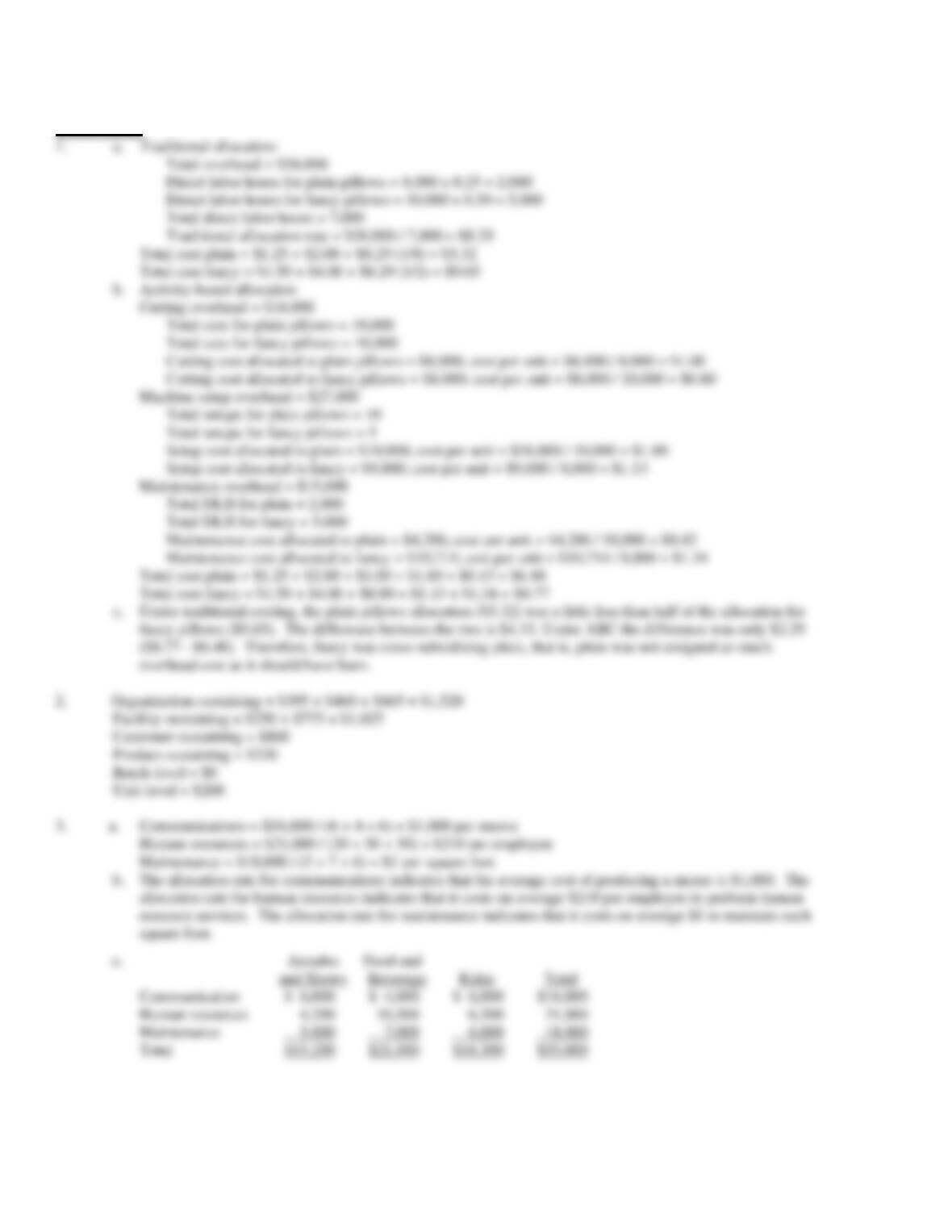
4. Reliable Reminders Inc. is a personal service firm located in Claremont, California. The firm collects
lists of birthdays, anniversaries and other memorable dates from its clients, and offers 3 levels of
service. Level One clients receive an e-mail reminder of their important dates at least a week in
advance. Level Two clients receive both an e-mail reminder and an appropriate greeting card. Level
Three clients receive an e-mail reminder, an appropriate greeting card, and a recommended gift.
Level One clients arrange their services through 3 customer service representatives. Reliable also
employs 4 customer service representatives for Level Two clients, and 2 representatives for Level
Three clients.
Reliable Reminders incurs the following costs as part of its operations, and it uses the following cost
drivers. Management wants to calculate the cost of each level of service.
Activity Total Cost Cost Driver
Facility rent $3,500 Square feet
Utilities 1,200 Number of customer service representatives
Office supplies 800 Number of clients

Chapter 7: Activity-Based Costing and Management 7-21
You may find the following information helpful:
Level One Level Two Level Three
Square feet 1,000 1,500 1,000
Number of clients 8 20 12
Average weekly hours for each
customer service representative 15 18 20
Average number of reminders per client 5 6 10
Direct costs $2,500 $4,200 $5,000
Based on the preceding information, match each item on the left below with the most appropriate item
on the right. Each numbered item has only one correct answer. Each lettered item may be used once,
more than once, or not at all. Round all unit and total costs to the nearest dollar.
____ 1. Total costs to be allocated
____ 2. Total indirect costs allocated to Level
One
____ 3. Total costs for Level Three
____ 4. Level with the lowest total cost per
client
____ 5. Total cost per client for Level One
____ 6. Level with the highest total cost
____ 7. Level Three’s indirect cost per client
____ 8. Level with the highest direct cost per
client
____ 9. Level One’s total direct costs per client
____ 10. Level with the lowest indirect cost per
client
A. $17,200
B. $11,700
C. $5,500
D. $313
E. $126
F. Between $6,500 and $6,600
G. Between $2,400 and $2,500
H. Between $1,500 and $1,600
I. Level One
J. Level Two
K. Level Three
L. Some other amount
5. Several activities commonly performed in manufacturing organizations are listed below on the left.
The right column contains potential cost drivers and / or allocation bases for those activities. Match
the most suitable cost driver with the best activity. Each numbered item has only one correct answer.
Each lettered item may be used once, more than once, or not at all.
____ 1. Administrative salaries
____ 2. Customer market research conducted in groups of 10
customers
____ 3. Customer sales representative salaries
____ 4. Departmental janitorial services
____ 5. General technical support salaries
____ 6. Headquarters housekeeping
____ 7. Material handling wages
____ 8. Salaries of product designers
____ 9. Shipping costs
____ 10. Single product line equipment depreciation
A. Typically not allocated
B. Square feet
C. Product weight
D. Number of engineering
change orders
E. Number of customer
phone calls
F. Number of customers
G. Number of questions
H. Machine hours
I. No suitable cost driver
or allocation base listed
7-22 Cost Management
6. Activity-based management information can be used in several ways, including managing quality
costs. Various quality-related costs are listed below. Indicate whether each cost most likely relates to
a(n): (A) prevention activities, (B) appraisal activities, (C) production activities, or (D) post-sales
activities.
____ 1. Routine equipment maintenance
____ 2. Finished product testing before shipment
____ 3. Customer satisfaction surveys
____ 4. Costs of spoilage and rework
____ 5. Warranty repairs
____ 6. Incoming raw materials testing
____ 7. Costs incurred to establish supplier qualifications
____ 8. Extra shipping costs incurred to meet customer deadlines
____ 9. Machinery repair costs
____ 10. Salaries of quality control inspectors
7. Several terms associated with activity-based costing and activity-based management are listed in the
right-hand column below; definitions are listed on the left. Match each definition with the term it best
describes. Each numbered item has only one correct answer. Each lettered item may be used only
once or not at all.
____ 1. The process of using ABC information
to evaluate the costs and benefits of
internal support activities
____ 2. Tasks undertaken to manage a location
____ 3. Related in a logical manner and consume
similar resources
____ 4. Managing customer profitability
____ 5. Increase the worth of an organization’s
services to customers
____ 6. Functions undertaken to oversee the
entire entity
____ 7. Assumes some downtime is unavoidable
for maintenance and holidays
____ 8. An activity that causes costs to fluctuate
____ 9. A system for assigning overhead costs
____ 10. A function performed in an organization
A. A use of activity-based management
B. Activity
C. Activity-based costing
D. Activity-based management
E. Cost driver
F. Customer-sustaining activities
G. Facility-sustaining activities
H. Homogeneous activities
I. Organization-sustaining activities
J. Value-added activities
K. None of the above

Chapter 7: Activity-Based Costing and Management 7-23
Exercises
1. BCH Corporation produces and sells two types of sofa pillows: plain and fancy. Currently, BCH
uses a traditional costing system with direct labor hours as the allocation base. Actual hours for 20×3
were 20,000. In anticipation of developing an activity-based costing system, BCH has identified the
following cost pools and activities associated with pillow production:
Estimated Costs Actual Costs
Activity Driver for 20×4 for 20×3
Material cutting Number of cuts $16,000 $13,665
Sewing machine setups Number of setups 27,000 24,800
Factory maintenance Number of direct labor hours 15,000 17,000
$58,000 $55,465
Direct costs for a plain sofa pillow are $1.25 for material and $2.00 for direct labor (15 minutes @
$8.00 per hour). Direct costs for a fancy sofa pillow are $1.50 for material and $4.00 (30 minutes @
$8.00 per hour). In 20×4, BCH expects to make 8,000 fancy pillows and 10,000 plain pillows. Those
output levels will require 5 setups for fancy pillows and 10 setups for plain pillows. For the material
cutting activity, the number of cuts is estimated at 10,000 for each type of pillow.
a. Calculate the cost per unit for each type of pillow under traditional costing
b. Calculate the cost per unit for each type of pillow under ABC
c. Under traditional costing, which type of pillow cross-subsidizes the other pillow? Explain.
2. International Rental Cars incurred the following costs in a recent fiscal period:
Re-fueling cost for reservation #081859 $ 200
Custodial services for branch office in St. Louis 250
Painting costs for luxury sports cars 320
Salaries for corporate accountants 395
Generalized advertising for the firm 460
Depreciation on home office computer equipment 665
Office equipment depreciation for Pasadena branch 775
Market research with business travelers 860
Total $3,925
Calculate the total cost in each of the following categories:
a. Organization-sustaining activities
b. Facility-sustaining activities
c. Customer-sustaining activities
d. Product-sustaining activities
e. Batch-level activities
f. Unit-level activities
3. Fun for All is an amusement park located in Yucaipa, California. It is organized into 6 departments:
arcades and shows, food and beverage, rides, communications, human resources, and maintenance.
Fun for All is implementing an ABC system to allocate the costs of the service activities
(communications, human resources, and maintenance) to product-line departments (arcades and
shows, food and beverage, and rides). Thus, the product-line departments are the cost objects. The
total costs and cost drivers for each service activity are:
Activity Total Cost Cost Driver
Communication $16,000 Number of department-specific memos prepared and
distributed
Human resources 21,000 Number of employees
Maintenance 18,000 Square feet

7-24 Cost Management
Information regarding cost drivers and allocation bases is as follows:
Number of Department-
Number Square Specific Memos
of Employees Feet Prepared & Distributed
Arcades & shows 20 5,000 6
Food & beverage 50 7,000 4
Rides 30 6,000 6
Communications 10 1,000 4
Human resources 10 1,000 3
Maintenance 30 1,000 1
Direct costs and revenues for each product-line department are as follows:
Revenues Direct Costs
Arcades & shows $50,000 $8,000
Food & beverage 125,000 6,000
Rides 150,000 4,000
a. Calculate the allocation rate for each service activity
b. Interpret the allocation rate for each service activity (i.e., explain what it means).
c. Calculate the total service activity costs allocated to each product-line department
d. Calculate the operating profit (revenues – direct costs – allocated costs) for each product-line
department
[Note to Professors: The data in exercise #4 is the same as the data in multiple choice questions #27-31.
However, the exercise questions differ from the multiple choice questions.]
4. The FSOJ Company undertakes the following activities in its production operation and incurred the
following costs during the first half of 20×2:
Harvest oranges $25,000
Prepare oranges for processing 20,000
Extract juice from oranges 18,000
Process juice into orange juice concentrate, orange
juice, or orange popsicles 30,000
Package completed products 9,000
In addition to the costs listed above, processing the juice into 3 final products involves the use of 2
machines, each of which incurred depreciation costs of $10,000 for the first half of 20×2. Each
product requires a different set up on the processing machines, so FSOJ normally sets up the
machines to produce concentrate for the first week of each month using 80 machine hours. The
machine is then set up to produce orange juice for the next 2 weeks using 160 machine hours.
Finally, workers set up the same machines to produce orange popsicles during the last week of each
month, using 80 machine hours.
During the first half of 20x2, 20% of the oranges harvested were turned into orange juice concentrate,
50% were processed into orange juice, and 30% became orange popsicles. The orange juice
concentrate operation takes up 40% of FSOJ’s total factory space. Regular orange juice and orange
popsicles occupy 35% and 25%, respectively.
a. Calculate the total costs included in the processing activity cost pool.
b. Choose a cost driver for the processing activity and explain your choice. Calculate the ABC
allocation rate for this activity.
c. Allocate processing costs to each product line using the ABC allocation rate developed in part
(b).

Chapter 7: Activity-Based Costing and Management 7-25
Short Answer
1. Describe customer-sustaining activities and give one example.
2. List the six ABC cost hierarchies and provide an example of one activity for each hierarchy.
3. Explain why ABM might be helpful in determining environmental costs.
4. List the four types of quality-related activities and give one example of each.
5. Why might an organization want to track customer-related costs?
6. List two benefits and two costs companies incur when they implement an ABC costing system.
7. Describe activity based management.
8. List two advantages and two disadvantages of implementing an ABC system compared to traditional
costing.
9. Describe two uncertainties that arise when managers are developing cost pools under an ABC system.
10. Explain why measurement error could increase as the number of cost pools increase in an ABC
system.
11. Discuss the pros and cons of using a team of individuals to develop an ABC / ABM system.
12. Discuss the similarities and differences between ABC, GPK, and RCA.
Problems
1. Tubac Savings and Loan collects fees for 3 service activities: credit risk assessment, loan processing,
and other services. During March, the overhead costs related to these three service activities totaled
$500,000. Activity information and direct costs for the month were as follows:
Service Events Employee Time Direct Costs
Credit risk assessment 60,000 150 hours $300,000
Loan processing 1,000 260 hours 130,000
Miscellaneous services 9,000 90 hours 70,000
a. Tubac allocates overhead using one office-wide rate based on employee time. Determine the rate
and the amount allocated to each department.
b. One of the commercial clients, Desert Dune Buggies, had 1,000 credit risk assessments, 50 loans
processed, and 80 miscellaneous services performed this month. The total employee time used
for Desert Dune Buggies was estimated to be about 11 hours, of which 8 hours were for
processing loans. How much overhead would be allocated to this client using the office-wide
rate?
c. The overhead costs can be separated by service activity, so that all costs are traced to the service
department where possible, and then costs that cannot be traced are allocated. Using this method,
check processing overhead costs were $120,000, loan processing costs were $200,000, and other
activities were $180,000. Number of credit risk assessments is used as the allocation base for
credit checks, number of events (services) is used for miscellaneous services, and employee hours
are used to allocate the costs of servicing loans. How much overhead would be allocated to
Desert Dune Buggies under this system?
d. Why are the amounts allocated in parts (b) and (c) different? Be specific in your answer.
e. Suppose Tubac’s managers would like to compare the profitability from Desert Dune Buggies
with the profitability from other commercial clients. Discuss whether the costs you calculated in
part (c) represent the incremental cost of overhead for the Desert Dune Buggies account.

7-26 Cost Management
2. Franklin Fireplace Inserts manufactures two premium models of fireplace inserts that provide more
BTUs of heat per cord of wood than any other wood burning fireplace insert or stove. One model, the
Heatilator, sells for $1,800, and the Heat Queen, a new model that sells for $1,200. Franklin’s
marketing department suggested that the company should concentrate on the new Heat Queen model
and begin to phase out the Heatilator model.
Franklin currently uses a traditional costing system. The following cost information has been used as
a basis for pricing decisions over the past year.
Per-Unit Data Heatilator Heat Queen
Direct materials $200 $280
Direct labor hours 1.5 1.5
Machine hours 5.0 4.0
Units produced 11,000 4,000
Direct labor cost is $20 per hour, and the machine usage cost is $18 per hour. Manufacturing
overhead costs were estimated at $4,800,000 and were allocated on the basis of machine hours.
Gwen Freely, the new company controller, suggested that an activity-based costing analysis first be
performed to obtain a better picture of the true manufacturing cost. The following data were
collected:
Activity Center Cost Driver Traceable Costs
Soldering Number of solder joints $ 942,000
Shipments Number of shipments 860,000
Quality control Number of inspections 1,240,000
Purchase orders Number of orders 950,400
Machining Machine hours 57,600
Machine setups Number of setups 750,000
Total traceable costs $4,800,000
Number of Events during the year:
Activity Heatilator Heat Queen Total
Soldering 296,250 96,250 392,500
Shipments 4,050 950 5,000
Quality control 14,050 5,325 19,375
Purchase orders 20,025 27,495 47,520
Machining 44,000 4,000 48,000
Machine setups 4,000 3,500 7,500
Selling, general, and administrative costs per unit sold are $175.00 for Heatilator and $125 for Heat
Queen.
a. Calculate the manufacturing cost per unit for Heatilator and Heat Queen under:
1. A traditional costing system
2. The ABC system
b. Explain the differences in manufacturing cost per unit calculated in part (A).
c. Which system would most likely do a better job of measuring costs for this product
emphasis/keep or drop decision? Explain.
d. Franklin’s controller points out that the ABC information could also be used to identify and
eliminate non-value added activities. Explain how ABC and ABM can be used for this purpose.
3. Offices-On-The-Go rents temporary office space to business travelers; provides copying and fax
services; and sells small amounts of office supplies, such as paper, pens and notebooks. It maintains
6 facilities in the Phoenix, Arizona area, all of which report to a single corporate office. You have
been hired by Priscilla Solara, the manager of Store #2, to analyze costs and make recommendations
regarding quality improvements. You decide to analyze Store #2’s activities and develop an activity–
Chapter 7: Activity-Based Costing and Management 7-27
based costing and activity-based management system to achieve those objectives. After reviewing
documents, interviewing employees, and observing daily operations, you have compiled the
following list of activities:
* Purchase office supplies. Two purchasing agents process approximately 50 purchase orders
per month from 5 vendors. Their salaries total $5,000 each month. Each purchasing agent
uses a computer and other office equipment, and monthly depreciation charges total $300.
The purchasing operation occupies 1,200 square feet of the store’s 8,500 square-foot facility.
Monthly purchases average $2,000, and about 60% of the supplies purchased are sold to
customers. The remaining 40% are used in the store’s operations.
* Provide office space to customers. The store’s main source of revenue is renting office
cubicles to customers. Each cubicle is 200 square feet and contains a desk, chair, filing
cabinet, computer with Internet access, printer, and telephone. Each Offices on the Go site
maintains 15 such cubicles, and the monthly depreciation on cubicle furniture and equipment
totals $500.
* Copy and fax documents for customers. The copy and fax center contains 5 self-service
copiers and 3 fax machines. Monthly depreciation on those items totals $250. The copy and
fax center occupies 1,500 square feet.
* Maintain company operations. Store #2 employs one bookkeeper at a salary of $3,000 per
month and one human resource manager at a salary of $2,800 per month. Their offices
contain the same equipment as the purchasing agents with the same depreciation charges;
both the bookkeeper and the human resource manager occupy 500 square-foot offices.
* Sell office supplies to customers. Office supply displays occupy 1,000 square feet. The
display racks were replaced at a cost of $1,500 last month and were expensed at that time.
* Ring up sales and collect payments. Priscilla employs 10 part-time customer service
representatives. Each representative works between 25 and 30 hours per month at $12 per
hour. The customer service counter and related equipment (such as cash registers) occupy the
remaining 500 square feet.
In addition to costs for the above activities, Store #2 incurs the following costs every month: rent,
$1500; utilities, $600; and maintenance, $800. Each month, 25% of profits are sent to the corporate
office to help cover corporate expenses.
a. Store #2 currently uses a traditional costing system, allocating indirect costs to its three product
lines (office space rental, copy and fax services, and office supplies sales) based on direct labor
hours. Analyze the strengths and weaknesses of the current system from the perspective of the
store manager. Explain why an activity-based costing system will or will not provide better
information for making decisions.
b. Store #2 currently uses a traditional costing system, allocating indirect costs to its three product
lines (office space rental, copy and fax services, and office supplies sales) based on the number of
customers in each area. If an individual customer purchases goods or services from more than
one area, they are counted with the area in which they provide the most revenue. Explain how the
current system is both similar to and different from an activity-based costing system.
c. Activities in an ABC system often are classified as one of six types: organization-sustaining,
facility-sustaining, customer-sustaining, product-sustaining, batch-level, or unit-level. Using the
list above and your own creativity, suggest one example of each activity type for Offices on the
Go. Your organization-sustaining activity should focus on the corporate office; all the others
should be focused on Store #2.
d. List and discuss the steps you would use to assign costs in Store #2’s ABC system.
e. One of the steps in designing an ABC system is assigning costs to ABC cost pools. Another step
is selecting a cost driver for each pool. Based on the preceding narrative, suggest two cost pools
7-28 Cost Management
for Priscilla’s store. For each cost pool, suggest two potential cost drivers. Explain your choices
of cost pools and cost drivers.
f. As you are completing the project for Priscilla, her bookkeeper shows some resistance to the
ABC system. He comments: “We’ve always done just fine allocating costs using direct labor
hours. Now you’re complicating matters by talking about cost pools, cost drivers, and allocation
bases. I don’t understand why we can’t just continue doing things the old way!” Explain the
similarities and differences between cost drivers and allocation bases, and respond to the
bookkeeper’s concerns.
g. You have completed the first part of your task, designing the ABC system. Priscilla also wants
you to begin working with her on an activity-based management system for Store #2. In your
own words, define activity-based management. If you and Priscilla work together to improve
operations using the ABC information, explain why it is impossible to be certain that Store #2
will achieve any benefits.
4. The Copy-Mart is a copy center located next to a university. The store provides a wide range of
services for faculty and students, including copying, digital photo printing, providing computer time
and technical support for word processing, and other miscellaneous services. The store manager has
been concerned about quality problems that have recently increased. Customers have been returning
copies because pages are missing or unreadable, and new copies must be made. Complaints have also
been received about the quality of technical support, and the computer systems have been subject to
frequent viruses and crashes.
ABC information can be used in an ABM system to manage quality. In such cases, quality costs are
often classified as related to prevention activities, appraisal activities, production activities, or
postsales activities.
a. Define each type of quality-related activity in your own words.
b. Based on the information above and your own creative thinking, give one example of each
activity type for Copy-Mart.
c. Suppose the managers of Copy-Mart implement an ABC system to measure the costs of quality.
How could they use information from this system to improve operations?
Chapter 7: Activity-Based Costing and Management 7-29
Answers
True / False
Multiple Choice
7-30 Cost Management
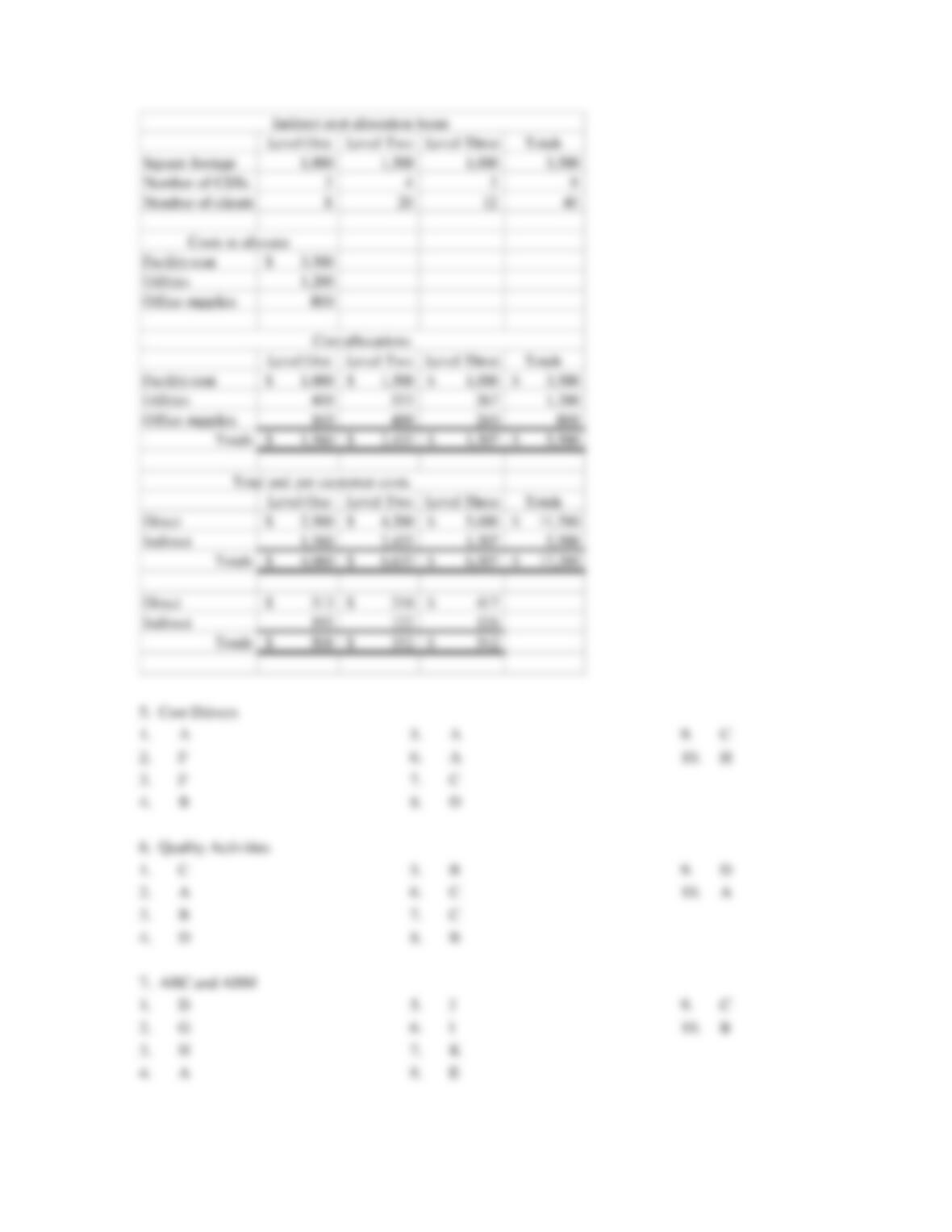
Matching
Chapter 7: Activity-Based Costing and Management 7-31
7-32 Cost Management
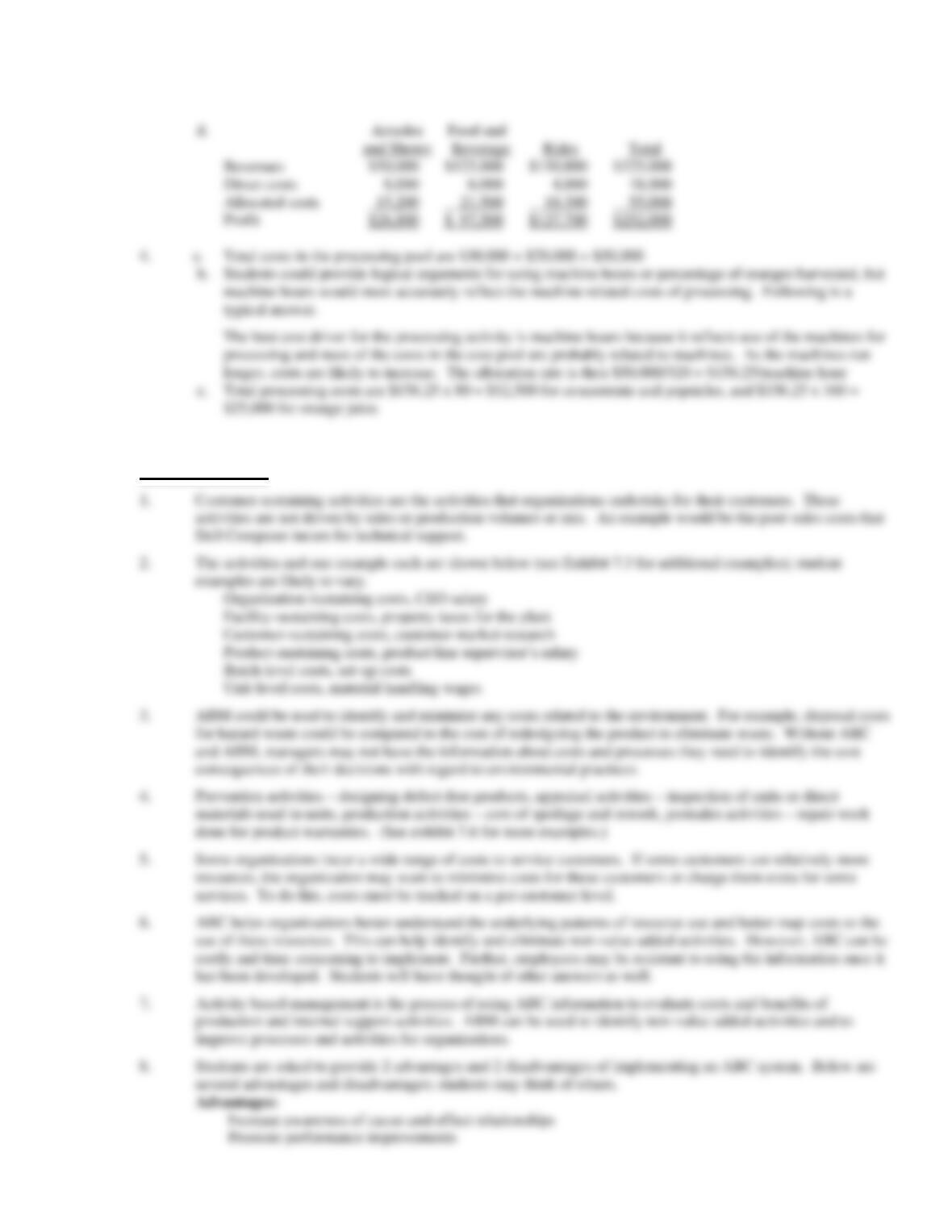
Exercises
Chapter 7: Activity-Based Costing and Management 7-33
Short Answer
7-34 Cost Management
Problems
Chapter 7: Activity-Based Costing and Management 7-35
7-36 Cost Management