
Chapter 7 — Translation of Foreign Financial Statements
MULTIPLE CHOICE
1. The functional currency approach adopted by FASB 52 requires:
a.
separate statements be maintained by the domestic parent company
and the foreign branch both in their own currencies
b.
separate statements be maintained by the domestic parent company
and the foreign branch with the foreign branch translated into the
functional currency
c.
results from foreign currency changes to be ignored
d.
a focus on whether the domestic reporting entity’s cash flows will
be indirectly or directly affected by changes in the exchange
rates of the foreign entity’s currency
2. In which of the following circumstances surrounding a Mexican
subsidiary of an US parent is the peso most likely to be considered the
functional currency?
a.
Sales are made globally and collected in US dollars. Plant uses
local materials and labor and pays in pesos. Intercompany
transaction volume is high.
b.
The Mexican subsidiary sells product only in Mexico and receives
pesos. The materials and labor are also secured in Mexico and paid
for with pesos.
c.
The Mexican subsidiary receives their debt capital from a US bank
in dollars and products produced are sold globally for US dollars.
d.
Raw materials are acquired from the parent and paid for in US
dollars. Labor is acquired locally and paid in pesos. Financing is
secured from the parent in US dollars.
3. A U.S. firm owns 100% of a Japanese automobile manufacturer. The cost
of automobile parts is typically 75% of the firm’s total product. In
which of the following circumstances would neither the U.S. dollar nor
the Japanese yen be considered the functional currency?
a.
The Japanese firm buys German automobile parts with marks to
produce cars sold in Latin America for dollars.
b.
The Japanese firm buys German automobile parts with dollars to
produce cars sold in Latin America for dollars.
c.
The Japanese firm buys German automobile parts with marks to
produce cars sold in Latin America for marks.
d.
The FASB requires that either the parent’s or the subsidiary’s
local currency be used as the functional currency.

Chapter 7
4. Which of the following best describes the normal required method of
accounting for statements of foreign entities in which a U.S. firm has
an equity interest?
a.
The functional method
b.
The monetary-nonmonetary method
c.
The current-noncurrent method
d.
The temporal method
5. When the functional currency is the foreign entity’s currency:
a.
exchange rate changes do not affect the economic well being of the
parent
b.
the subsidiary operates as an entity, independent of the parent
c.
Exchange rate changes do not have immediate impact on the cash
flows of the parent
d.
All of the above are correct
6. The translation (remeasurement)adjustment reported in a translation
when the functional currency is not the foreign currency is included
a.
as a separate component of other comprehensive income
b.
in the current liability section of the balance sheet as deferred
revenue
c.
in the calculation of net income
d.
none of the above
7. Assuming that a foreign entity is deemed to be operating in an
environment dominated by the local currency, the entity’s assets are
translated using
a.
the current rate.
b.
a simple average rate.
c.
a weighted average rate.
d.
a historical rate.
8. Assuming that a foreign entity is deemed to be operating in an
environment dominated by the local currency, the entity’s capital stock
is translated using
a.
the current rate.
b.
a simple average rate.
c.
a weighted average rate.
d.
a historical rate.

Chapter 7
7-3
9. If the functional currency is determined to not be the foreign entity’s
local currency, translation is done using
a.
the current rate method
b.
the functional method
c.
the remeasurement method
d.
the derivative method
10. In most cases, which of the following is NOT a component of translated
retained earnings?
a.
Translated retained earnings at the end of the prior period
b.
Income from the period translated at the historical rate
c.
The value of dividends translated at the exchange rate on the date
of declaration
d.
All are components of translated retained earnings
11. Which of the following is NOT true regarding foreign statement
translation using the current or temporal method?
a.
all assets and liabilities are translated at the current exchange
rate at the date of translation.
b.
only monetary assets and liabilities are translated at the current
exchange rate at the date of translation.
c.
Equity accounts other than retained earnings are translated at the
historic rate in effect on the date of the investment
d.
elements of income can be translated at a weighted average rate
for the period
12. Which of the following is NOT considered when directly computing the
translation adjustment for foreign financial statements?
a.
Beginning amount of net assets held by the domestic investor
b.
Increase or decrease in net assets for the period excluding
capital transactions
c.
Increase or decrease in net asset as a result of capital
transactions
d.
All are considered when directly computing the translation
adjustment
13. Exchange rates will not usually directly affect the cash flows of the
parent entity in which of the following cases?
a.
The foreign entity operates in a currency other than its own.
b.
The foreign entity operates in its local currency.
c.
The foreign entity functions in a currency other than its local
currency.
d.
The foreign entity functions in the parent’s currency.

Chapter 7
14. Which of the following suggests that the foreign entity’s functional
currency is the parent’s currency?
a.
Intercompany transaction volume is low.
b.
Debt is serviced through local operations.
c.
There is an active and primarily local market.
d.
Sale prices are influenced by international factors.
15. Which of the following foreign currency transactions would be included
in the equity section of a U.S. firm along with the cumulative
translation adjustments?
a.
Those used to hedge a net investment in a foreign entity
b.
Those used to speculate in foreign exchange rates
c.
Those used to hedge an exposed asset or liability position
d.
Those used to hedge a future foreign currency commitment
16. The eliminations and adjustment entries necessary to consolidate the
parent and subsidiary financial statements are translated as follows:
a.
all balances, profits, and losses at the current exchange rate on
the consolidation date
b.
intercompany balances translate at the rates used for other
accounts, profits and losses translate at an average rate
c.
intercompany balances translate at the current rates, profits and
losses translate at an average rate
d.
none of the above are correct
17. A U.S. parent purchased a foreign subsidiary last year at a price in
excess of the subsidiary’s book value. This excess is assumed to be
traceable to undervalued equipment. When the parent company prepares
its elimination entries for the excess, which of the following
combinations of exchange rates should be used?
Equipment Depreciation Expense
a.
Historical Current
b.
Current Historical
c.
Historical Average
d.
Current Average

18. Which of the following is true concerning the accounting for a foreign
investment under the cost method?
a.
Investment income is recorded using the exchange rate on the
dividend declaration date.
b.
Investment income is recorded using the average exchange rate for
the year.
c.
Investment income is based on the investee’s net income adjusted
for the excess of purchase price over book value.
d.
Investment income is based on the investee’s net income without
adjusting for the excess of purchase price over book value.
19. Rhante is a German company wholly owned by a U.S. firm. Its inventory
is valued at the lower of cost or market, with cost being measured by
the average cost method. Purchases of inventory occur evenly throughout
the period. In 2005 Rhante’s ending inventory was 50,000 euros at cost
and 48,000 euros at market. Assume the following exchange rates:
Jan. 1, 2005 1 euro = $1.40 U.S.
Dec. 31, 2005 1 euro = $1.53 U.S.
2005 average 1 euro = $1.45 U.S.
Determine the translated value of Rhante’s inventory to be included in
the consolidated balance sheet for the U.S. parent given Rhante’s
functional currency is the euro.
a.
$73,440
b.
$76,500
c.
$69,600
d.
$72,500
20. Rhante is a German company wholly owned by a U.S. firm. Its inventory
is valued at the lower of cost or market, with cost being measured by
the average cost method. Purchases of inventory occur evenly throughout
the period. In 2005 Rhante’s ending inventory was 50,000 euros at cost
and 48,000 euros at market. Assume the following exchange rates:
Jan. 1, 2005 1 euro = $1.40 U.S.
Dec. 31, 2005 1 euro = $1.53 U.S.
2005 average 1 euro = $1.45 U.S.
Determine the remeasured value of Rhante’s inventory to be included in
the consolidated balance sheet for the U.S. parent given Rhante’s
functional currency is the U.S. dollar.
a.
$72,500
b.
$73,440
c.
$69,600
d.
$76,500

21. A debit balance in a parent’s cumulative translation adjustment after
the first year of owning a foreign subsidiary suggests which of the
following is true?
a.
The exchange rate has strengthened relative to the U.S. dollar.
b.
The exchange rate has weak relative to the U.S. dollar.
c.
The foreign entity had net income but there was not a change in
exchange rates.
d.
The foreign entity had a net loss but there was not a change in
exchange rates.
22. Which of the following procedures would be necessary when a Swiss
subsidiary maintains its books in euros and its functional currency is
Japanese Yen and its parent is a US company?
a.
Remeasurement from euros to US Dollars
b.
Remeasurement from euros to Japanese Yen; translate from Yen to US
Dollars
c.
Remeasurement from Yen to euros; translate from euros to US
Dollars
d.
none of the above
23. Assuming that the functional currency of a foreign subsidiary is the
local currency, which of the following accounts would be translated at
the current rate?
a.
Additional Paid-in Capital
b.
Prepaid Insurance
c.
Allowance for Doubtful Accounts
d.
Cost of Goods Sold
24. Assuming that the functional currency of a foreign subsidiary is not
the local currency, which of the following accounts would be remeasured
at the historical rate?
a.
Long-term notes payable
b.
Accounts Payable
c.
Land
d.
Sales Revenue

25. Which of the following best describes the measurement of a gain or loss
from the sale of a depreciable asset by a foreign subsidiary whose
functional currency is not the local currency?
a.
Reconstruct the journal entry on the date of the sale using the
historical rate for cash and the depreciable asset and its
accumulated depreciation.
b.
Reconstruct the journal entry on the date of the sale using the
current rate for cash and the historical rate for the depreciable
asset and its accumulated depreciation.
c.
Translate the gain or loss using the historical rate.
d.
Translate gains at the current rate and losses at the historical
rate.
26. Which of the following best describes the accounting for a foreign
entity requiring translation or remeasurement if the local economy is
classified as highly inflationary?
a.
The entity’s financial statements are first adjusted for inflation
and then translated into the domestic currency.
b.
The entity’s financial statements are first adjusted for inflation
and then remeasured into the domestic currency.
c.
The unadjusted trial balance is translated if the functional
currency is the local currency.
d.
The unadjusted trial balance is remeasured regardless of the
functional currency.
27. The adjustment resulting from the remeasurement of an entity operating
in a highly inflationary environment would appear
a.
in the stockholders’ equity section of the balance sheet.
b.
as a component of other comprehensive income.
c.
as an ordinary income statement item.
d.
as an extraordinary item on the income statement.
28. FASB Statement #52 requires which of the following disclosures from
firms involved in foreign currency transactions?
a.
Beginning cumulative translation adjustments
b.
Ending cumulative translation adjustments
c.
The amount of income taxes for the period allocated to translation
adjustments
d.
All are required disclosures

29. In a company’s disclosure of foreign currency transactions and hedges
and translation adjustments, all of the following items should be
disclosed except
a.
beginning and ending cumulative translation adjustments.
b.
the amount of income taxes for the period allocated to translation
adjustments.
c.
the amount transferred from cumulative translation adjustment due
to changes in foreign exchange rates.
d.
the aggregate adjustment for the period resulting from translation
adjustment.
30. Sharp Company owns a Japanese subsidiary. On October 15, 20X5, when the
rate of exchange was 121 yen to $1, the Japanese subsidiary declared
and paid a dividend to Sharp of 24,000,000 yen. The dividend
represented the net income of the foreign subsidiary for the six months
ended June 30, 20X5, during which time the weighted average of exchange
rates was 125 yen to $1. The rate of exchange in effect at December 31,
20X5, was 135 yen to $1. What rate of exchange should be used to
translate the dividend for the December 31, 20X5 financial statements?
a.
121 yen to $1
b.
125 yen to $1
c.
135 yen to $1
d.
128 yen to $1
31. A foreign subsidiary of Dallas Jeans Corp. (a U.S. firm) has certain
balance sheet accounts on December 31, 20X9. The functional currency is
the U.S. dollar and currency of record is the peso and the parent’s
books are kept in U.S. dollars. Information relating to these accounts
in U.S. dollars is as follows:
Translated at
Current Historical
Rate Rate
Accounts Receivable……………….. $175,000 $190,000
Inventories ……………………… 400,000 450,000
Prepaid Insurance…………………. 40,000 45,000
Land…………………………….. 30,000 100,000
What amount should be included as total assets on Dallas Jean’s balance
sheet on December 31, 20X9 as the result of the above information?
a.
$645,000
b.
$765,000
c.
$770,000
d.
$785,000
e.
None of the above

32. A foreign subsidiary of Griffin Corp. (a U.S. firm) has certain balance
sheet accounts on December 31, 20X9. The functional currency is the yen
and the currency of record is the dollar and the parent’s books are
kept in U.S. dollars. Information relating to these accounts in U.S.
dollars is as follows:
Translated at
Current Historical
Rate Rate
Accounts Receivable …………….. $200,000 $220,000
Inventory ……………………… 300,000 275,000
Prepaid Assets …………………. 10,000 15,000
Land ………………………….. 100,000 25,000
What amount should be included in total assets on Griffin’s balance
sheet on December 31, 20X9 as the result of the above information?
a.
$610,000
b.
$535,000
c.
$715,000
d.
$540,000
33. The reconciliation of the annual translation adjustment usually
includes all of the following, EXCEPT
a.
net assets at the beginning of the period multiplied by the change
in exchange rates during the period.
b.
change in net assets (excluding capital transactions) multiplied
by the difference between the current rate and the average rate
used to translate income.
c.
change in net assets (excluding capital transactions) multiplied
by the difference between the historical rate and the average rate
used to translate income.
d.
change in net assets due to capital transactions multiplied by the
difference between the current rate and the rate at the time of
the capital transaction.
34. Exchange gains and losses resulting from translating (not remeasuring)
foreign currency financial statements into U.S. dollars should be
included as a(an)
a.
a component of other comprehensive income.
b.
extraordinary item in the income statement for the period in which
the rate changes.
c.
ordinary gain/loss item in the income statement.
d.
component of operating income.
35. Patents are on the books of a British subsidiary of a U.S. firm at a
value of 50,000 pounds. The patents were acquired in 20X3 when the
exchange rate was 1 pound = $1.50. The British subsidiary was acquired
by the U.S. firm in 20X0 when the exchange rate was 1 pound = $1.40.
The exchange rate on December 31, 20X4, the date of the most current
balance sheet, is 1 pound = $1.55. The average rate of exchange for
20X4 is $1.53. What exchange rate will be used to remeasure patents for
the consolidated statements dated December 31, 20X4?
a.
$1.40
b.
$1.50
c.
$1.53
d.
$1.55
PROBLEM
1. Discuss the factors that may be considered in determining if a Mexican
subsidiary of a U.S. firm has the peso or the dollar as its functional
currency. The subsidiary only manufactures component parts that are
shipped to the U.S. firm’s final production plant in Detroit.
Chapter 7
7-11
2. List the two primary objectives of translating foreign financial
statements according to the FASB #52, which emphasizes the concept of
the functional currency.
3. Hylie, a U.S. corporation, owns 100% of Frosan, a French firm. Assume
that the dollar is the functional currency, although the books are kept
in euros.
Required:
What currency exchange rate would be used to remeasure Frosan’s balance
sheet into U.S. dollars? Choose from current, simple average, weighted
average, or historical.
a.
Cash _____________________
b.
Accounts Receivable _____________________
c.
Inventory, carried at cost _____________________
d.
Equipment _____________________
e.
Accumulated Depreciation _____________________
f.
Bonds Payable _____________________
g.
Common Stock _____________________
h.
Sales _____________________
cash flows and equity.
U.S. generally accepted accounting principles.
Chapter 7
4. CableTech, a US corporation, owns 100% of the Canadian company, Fiber
Quebec. The Canadian dollar is the currency of record and the
functional currency.
Required:
What currency exchange rate would be used to translate Fiber Quebec’s
accounts into US Dollars? Choose from current, simple average,
weighted average, or historical.
a. Prepaid Insurance _______________________
b. Land _______________________
c. Common Stock _______________________
d. Bonds Payable _______________________
e. Sales _______________________
f. Goodwill _______________________
g. Allowance for Doubtful Accounts _______________________
h. Deferred Income Taxes _______________________

Chapter 7
7-13
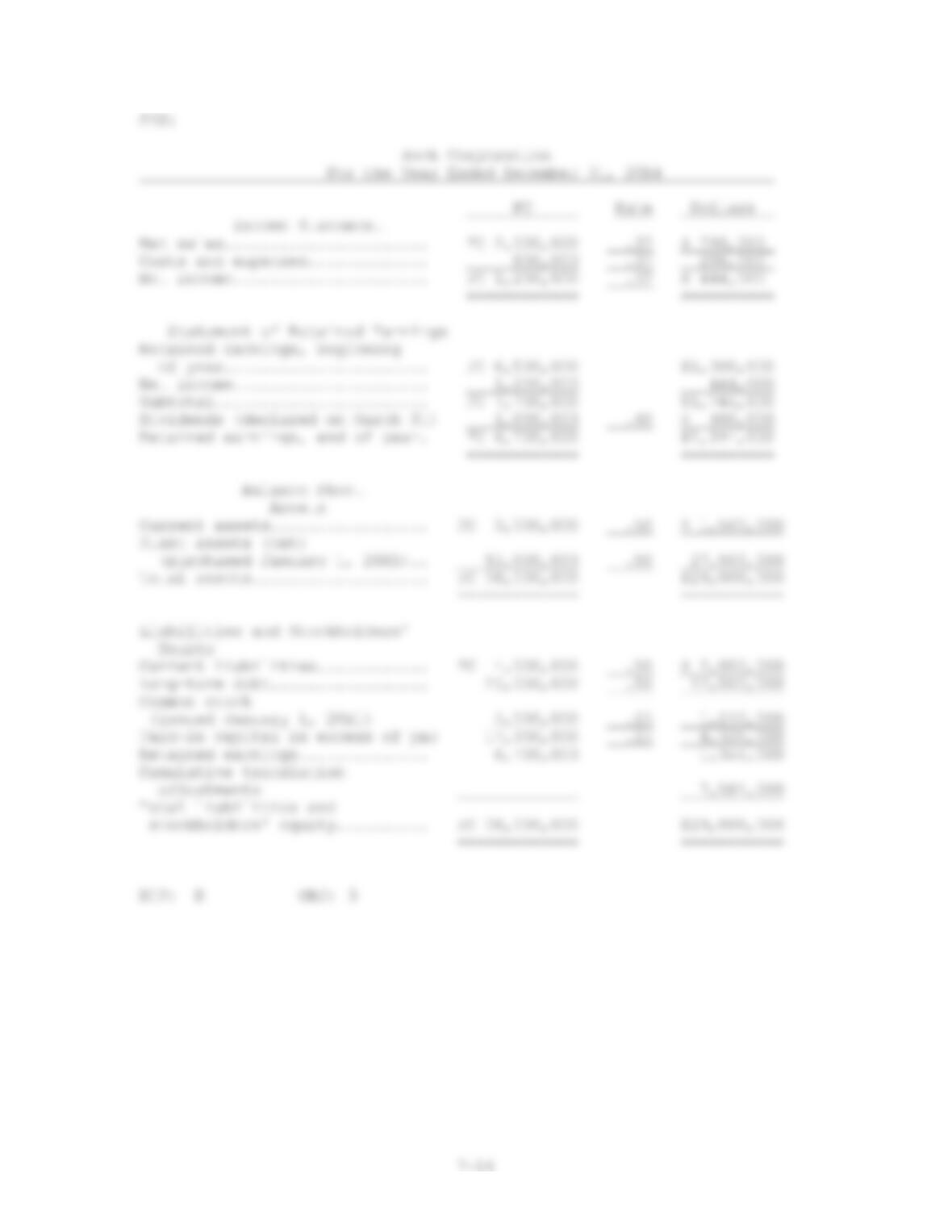
5. Complete the following worksheet, assuming that on January 1, 20X1,
Weiss Corporation purchased Rock Corporation. Rock’s functional
currency is the FC.
Date Relevant Exchange Rates
January 1, 20X1………………….. 1 FC = $0.25
January 1, 20X4………………….. 1 FC = $0.30
March 31, 20X4…………………… 1 FC = $0.40
December 31, 20X4………………… 1 FC = $0.50
Weighted average 20X4…………….. 1 FC = $0.37
Rock Corporation
For the Year Ended December 31, 20X4
FC Rate Dollars
Income Statement
Net sales…………………. FC 2,000,000 $
Costs and expenses…………. 800,000
Net income………………… FC 1,200,000 $
============ ==========
Statement of Retained Earnings
Retained earnings, beginning
of year…………………. FC 6,500,000 $1,300,000
Net income………………… 1,200,000
Subtotal………………….. FC 7,700,000 $
Dividends (declared on March 31) 1,000,000 $
Retained earnings, end of year. FC 6,700,000 $
============ ==========
Balance Sheet
Assets
Current assets…………….. FC 3,000,000 $
Plant assets (net)
(purchased January 1, 20X1).. 55,000,000
Total assets………………. FC 58,000,000 $
============= ==========
Liabilities and Stockholders’
Equity
Current liabilities………… FC 4,000,000 $
Long-term debt…………….. 25,000,000
Common stock
(issued January 1, 20X1) 5,000,000
Paid-in capital in excess of par 17,300,000
Retained earnings………….. 6,700,000
Cumulative translation
adjustments
Total liabilities and
stockholders’ equity………. FC 58,000,000 $
============= ==========
Chapter 7
Chapter 7
7-15
6. Abercrombe Co., a U.S. firm, formed a German company in 20X4 by
purchasing the common stock of the newly formed Dolce Inc. The
functional currency of Dolce is the euro. During their first three
years, Dolce experienced the following activity in retained earnings:
20X4…………………………… Net loss 100,000 euros
20X5…………………………… Net income 200,000 euros
January 1, 20X6…………………. Dividend 50,000 euros
20X6…………………………… Net income 75,000 euros
The following exchange rates could be relevant:
Date Rate
December 31, 20X3…………………….. 1 euro = $0.20
December 31, 20X4…………………….. 1 euro = $0.22
Average 20X4…………………………. 1 euro = $0.215
January 1, 20X6………………………. 1 euro = $0.245
Average 20X5…………………………. 1 euro = $0.24
December 31, 20X6…………………….. 1 euro = $0.26
Average 20X6…………………………. 1 euro = $0.25
Required:
What is the translated December 31, 20X6, balance of the retained
earnings for Dolce?
7. Green Corporation, a wholly owned British subsidiary of a U.S. firm
began the year with 1,300,000 British pounds in net assets. The
subsidiary incurred a 65,000 British Pound net loss for 20X1. The
subsidiary issued common stock for 100,000 British pounds on November
15, 20X1. Assume the following exchange rates for 20X1:
Date Rate
January 1, 20X1……………………… 1 British Pound = $1.10
November 15, 20X1…………………….. 1 British Pound = $1.15
December 31, 20X1…………………….. 1 British Pound = $1.13
20X1 average…………………………. 1 British Pound = $1.14
Required:
Compute the translation adjustment for 20X1 using the direct method.
Chapter 7
8. A U.S.-owned foreign subsidiary has the following beginning and ending
stockholders’ equity for 20X1:
January 1 December 31
Common stock…………………………. 120,000 FC 140,000 FC
Paid-in capital in excess of par……….. 30,000 40,000
Retained earnings…………………….. 60,000 100,000
210,000 FC 280,000 FC
======= =======
The change in common stock resulted from a sale of stock to the parent
firm on May 15. The change in retained earnings resulted from a July 1
dividend of 10,000 FC and net income for 20X1. Various exchange rates
were as follows:
Date Rate
January 1, 20X1……………………….. 1 FC = $1.10
May 15, 20X1…………………………. 1 FC = $1.12
July 1, 20X1…………………………. 1 FC = $1.13
December 31, 20X1…………………….. 1 FC = $1.15
20X1 average…………………………. 1 FC = $1.125
Required:
Compute the 20X1 translation adjustment for the foreign subsidiary.
7-17
9. For each of the following account balances, identify the exchange rate
used to translate or remeasure. The choices are current exchange rate,
historical rate, weighted average, other (specify).
Current Method Remeasurement Method
Accounts Receivable |
Prepaid Assets |
Accounts Payable |
Common Stock |
Land |
Goodwill |
Sales Revenue |
Depreciation |
10. A U.S. firm purchased 100% of a foreign firm on January 1, 20X1, when
the foreign firm had the following equity accounts:
Common stock………………………………. 150,000 FC
Paid-in excess of par value…………………. 50,000 FC
Retained earnings………………………….. 200,000 FC
400,000 FC
=======
The U.S. firm paid 420,000 FCs for the foreign firm. The payment in
excess of book value is traceable to undervalued land owned by the
foreign firm. The foreign firm had a net income of 25,000 FCs during
20X1. Assume that the following exchange rates are relevant:
Date Rate
January 1, 20X1……………………………. 1 FC = $2.00
December 31, 20X1………………………….. 1 FC = $1.80
20X1 average………………………………. 1 FC = $1.95
Required:
Chapter 7
7-18
Prepare all the journal entries to record and update the investment
account of the U.S. firm and the necessary eliminating and adjusting
entries for the 20X1 consolidated statement. Assume that the U.S. firm
used the simple equity method.
11. On January 1, 20X1, Rapid Corporation purchased 25% of a foreign firm
when its stockholders’ equity section totaled 240,000 FCs. Rapid
Corporation paid 75,000 FCs, with the excess over book value being
attributed to equipment with a 5-year useful life. The foreign firm
reported net income of 80,000 FCs for 20X1. Relevant exchange rates
were as follows:
Date Rate
January 1, 20X1…………………………. 1 FC = $0.30
December 31, 20X1……………………….. 1 FC = $0.35
Average 20X1……………………………. 1 FC = $0.33
Required:
Prepare the journal entries necessary to record the events concerning
Rapid’s investment in the foreign firm.
Chapter 7
7-19
12. Company A, an American company, owns Company B, a Canadian subsidiary.
Company A borrowed 1,000,000 Canadian dollars as a hedge on its net
investment in Company B. For 20X3, Company A recorded an exchange gain
of $40,000 due to exchange rate changes. The 20X3 translation
adjustment for Company B was a debit of $42,000.
Required:
Describe the accounting treatment required for the hedge on Company A’s
books.
13. In the temporal or current method of translation from functional
currency to reporting currency, what are the steps required and rates
to be used.
Chapter 7
7-20
14. An American firm owns 100% of a German firm that had the following
transactions occur relative to their equipment account:
January 1, 20X5 Purchased equipment for 50,000 euros
July 1, 20X5 Purchased equipment for 30,000 euros
January 1, 20X6 Purchased equipment for 75,000 euros
July 1, 20X6 Sold equipment purchased on January 1, 20X5 for
48,000 euros
The following exchange rates could be relevant:
Date euro/$ Date euro/$
January 1, 20X5………. $0.50 January 1, 20X6……. $0.53
July 1, 20X5…………. $0.52 July 1, 20X6………. $0.50
December 31, 20X5…….. $0.53 December 31, 20X6….. $0.49
Average 20X5…………. $0.515 Average 20X6………. $0.51
Required:
Assuming that the U.S. dollar is the functional currency and that the
German firm uses straight-line depreciation over a 5-year period with a
10% salvage value, determine the following for remeasurement purposes:
a.
The value of the equipment account on December 31, 20X6.
b.
The value of the depreciation expense for 20X6.
c.
The amount of the gain or loss resulting from the July 1,
20X6, sale.
Chapter 7
7-21
15. A French subsidiary of a U.S. firm keeps accounting records in euros.
The U.S. dollar is considered the subsidiary’s functional currency.
Assume the following exchange rates:
Date euro = $
January 1, 20X5……………………….. $1.05
July 1, 20X5………………………….. $1.07
Dec. 31, 20X5…………………………. $1.09
Average 20X5………………………….. $1.08
January 1, 20X6……………………….. $1.09
July 1, 20X6………………………….. $1.07
Dec. 31, 20X6…………………………. $1.06
Average 20X6………………………….. $1.08
Required:
Remeasure the following items from the December 31, 20X6 trial balance
of the subsidiary:
a.
Sales made evenly throughout 20X6 = 100,000 euros
b.
Cost of goods sold = 30,000 euros
5,000 euros purchased July 1, 20X5
25,000 euros purchased July 1, 20X6
c.
Salary expense for 20X6 = 40,000 euros
d.
Land = 1,000,000 euros
c.
Cash (48,000 x .50)…………………. 24,000
inflation, also may suggest a highly inflationary economy.
should be considered the functional currency.
currency, the proper method for remeasurement is the temporal
method.
Chapter 7
200,000 euros purchased January 1, 20X5
800,000 euros purchased July 1, 20X6
16. Foreign firms operating in highly inflationary economies received
special treatment under generally accepted accounting principles (GAAP)
relative to translating their financial statements.
Required:
a.
How does the FASB define a highly inflationary economy?
b.
Why is the method typically used for translating foreign
entities not permitted for these firms?
c.
What method is used for remeasuring or translating the
statements of these firms?
Sales: (100,000 x 1.08)…………………. $108,000
b.
Cost of goods sold:
Salary expense: (40,000 x 1.08)……………. $43,200
Land:

7-23
17. In January, 20X3, Dudwil Corporation acquired a foreign subsidiary,
Holman Company, by paying cash for all of the outstanding common stock
of Holman. On the purchase date, Holman Company’s accounts were stated
fairly in local currency units (FC). Subsequent sales of Holman’s
common stock have been purchased by Dudwil to maintain its 100%
ownership.
Holman’s trial balance, in functional currency units (same as the local
currency units), on December 31, 20X7, follows:
Debit Credit
Cash………………………………… 58,400
Marketable securities…………………. 32,500
Accounts receivable (net)……………… 51,370
Inventories………………………….. 108,000
Surrender value of life insurance………. 7,200
Intangible assets…………………….. 123,900
Property, plant, and equipment…………. 636,000
Accumulated depreciation………………. 93,850
Accounts payable……………………… 74,000
Accrued interest payable………………. 7,120
Notes payable………………………… 52,000
Bonds payable………………………… 80,000
Capital stock………………………… 83,000
Paid-in capital in excess of par……….. 190,300
Retained earnings…………………….. 390,400
Sales……………………………….. 936,300
Cost of goods sold……………………. 762,000
Interest expense……………………… 7,120
Depreciation expense………………….. 39,350
Amortization expense–intangibles………. 3,100
Other expenses……………………….. 84,230
Gain on sale of equipment……………… 2,400
Interest income………………………. 3,800
Total……………………………….. 1,913,170 1,913,170
========= =========
The following additional information is available:
a.
Holman uses the LIFO inventory method to account for its
inventory. Purchases took place uniformly throughout 20X7.
There were no intercompany sales during 20X7.
b.
During 20X7, Holman declared and paid a dividend of 7,000 FCs
at the end of each calendar quarter.
c.
The balances in the contributed capital accounts result from
the following transactions:
Capital Paid-in Capital
Date Stock in Excess of Par
January 1, 20X3, issuance…… 40,000 FC 80,000 FC
June 30, 20X5, issuance…….. 40,000 104,300

Chapter 7
7-24
January 1, 20X6, issuance…… 10,000 20,000
August 1, 20X6, retirement….. (7,000) (14,000)
83,000 FC 190,300 FC
====== =======
The August 1, 20X6, retirement of stock involves stock
originally issued on January 1, 20X3.
d.
The December 31, 20X6, retained earnings balance of 418,400
FC, translated into dollars, is $179,460.
e.
Selected translation rates are as follows:
Date Rate
January 1, 20X3……………………. 1 FC = $0.30
20X3 average………………………. 1 FC = 0.32
20X4 average………………………. 1 FC = 0.38
February 1, 20X5…………………… 1 FC = 0.42
June 30, 20X5……………………… 1 FC = 0.45
20X5 average………………………. 1 FC = 0.45
January 1, 20X6……………………. 1 FC = 0.50
February 1, 20X6…………………… 1 FC = 0.52
August 1, 20X6…………………….. 1 FC = 0.60
December 31, 20X6………………….. 1 FC = 0.61
20X6 average………………………. 1 FC = 0.56
March 31, 20X7…………………….. 1 FC = 0.63
June 30, 20X7……………………… 1 FC = 0.66
September 30, 20X7…………………. 1 FC = 0.70
December 31, 20X7………………….. 1 FC = 0.75
20X7 average………………………. 1 FC = 0.70
Required:
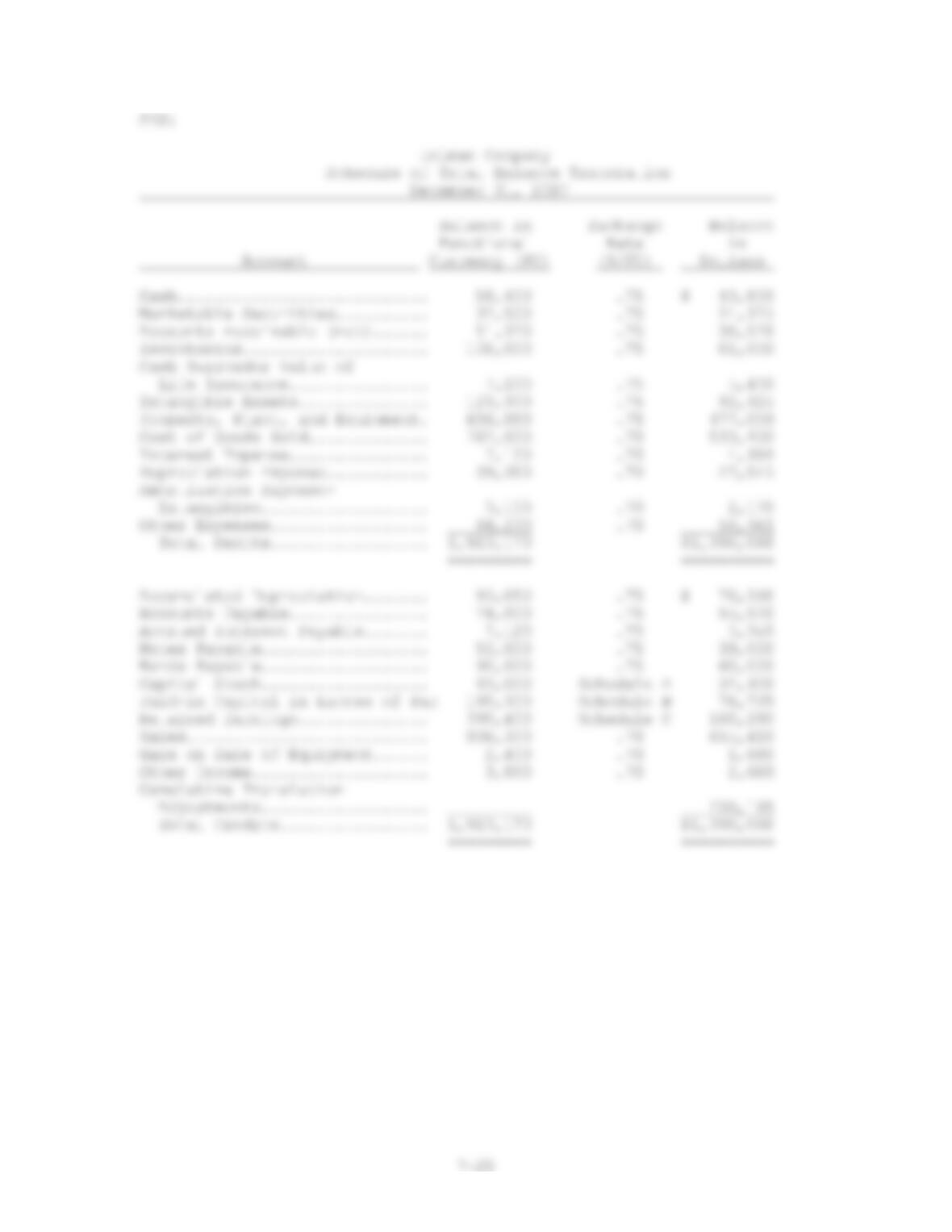
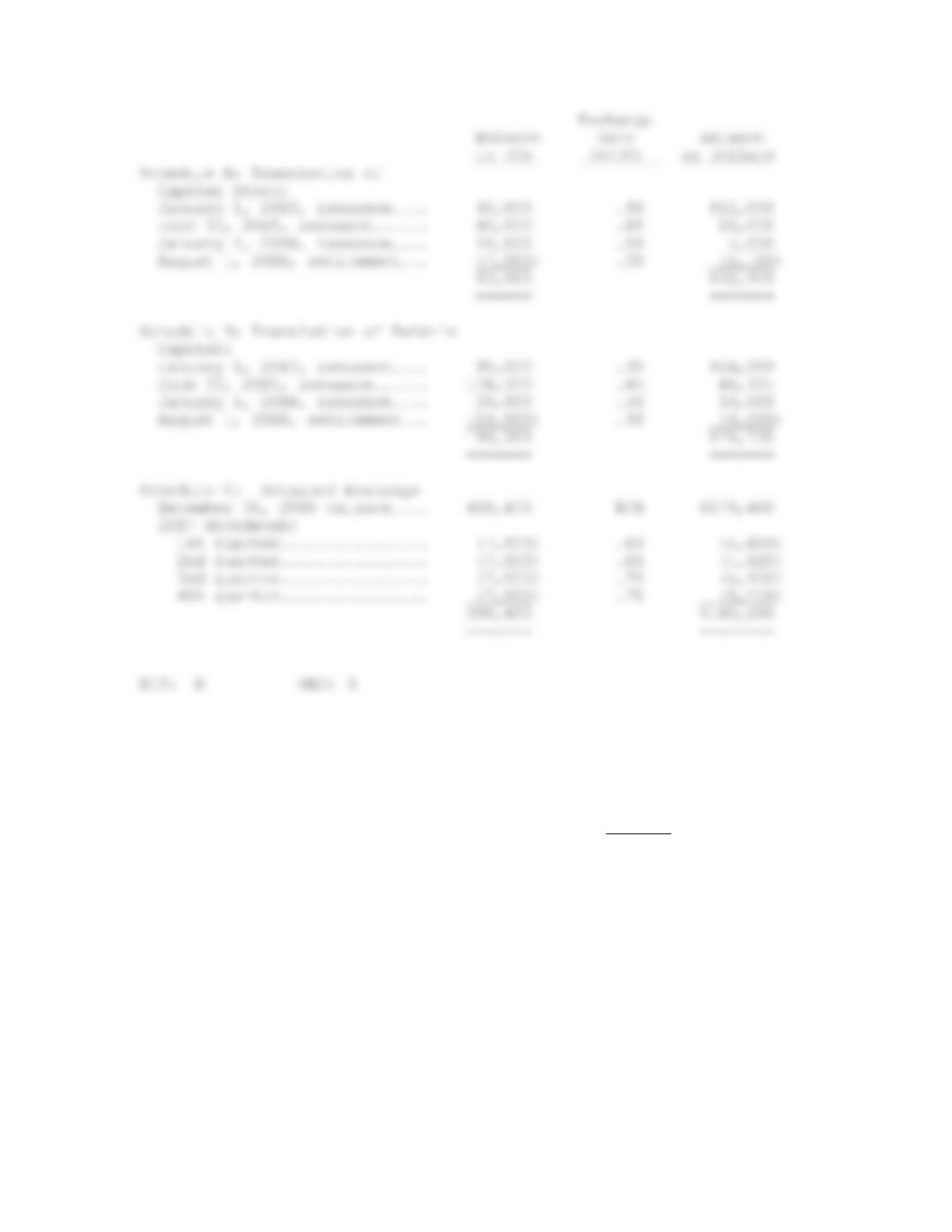
Prepare a schedule to translate the December 31, 20X7, trial balance of
Holman Company from local currency units to dollars. The schedule
should show the trial balance in FCs, the exchange rates, and the trial
balance. (Do not extend the trial balance to statement columns.
Supporting schedules should be in good form.)
Chapter 7
Chapter 7
7-26
18. On January 1, 20X5, Cayane Inc. purchased 90% of an German firm, Brosch
Manufacturing. On January 1, 20X5, Brosch’s equity consisted of the
following:
Common stock…………………………… 500,000 euros
Paid-in capital in excess of par…………. 100,000
Retained earnings………………………. 150,000
750,000 euros
=======
Cayane paid 800,000 euros for its 90% interest in Brosch. The excess
over book value was attributed to a building with a 20-year useful
life. On June 1, 20X5, Brosch declared a 50,000-euro dividend and paid
it on July 1, 20X5. Waterford reported net income for 20X5 of 150,000
euros. The year-end cumulative translation adjustment is $10,000.
Relevant exchange rates are as follows:
January 1, 20X5………………………… 1 euro = $.65
June 1, 20X5…………………………… 1 euro = .66
July 1, 20X5…………………………… 1 euro = .67
December 31, 20X5………………………. 1 euro = .68
20X5 average…………………………… 1 euro = .66
Chapter 7
Required:
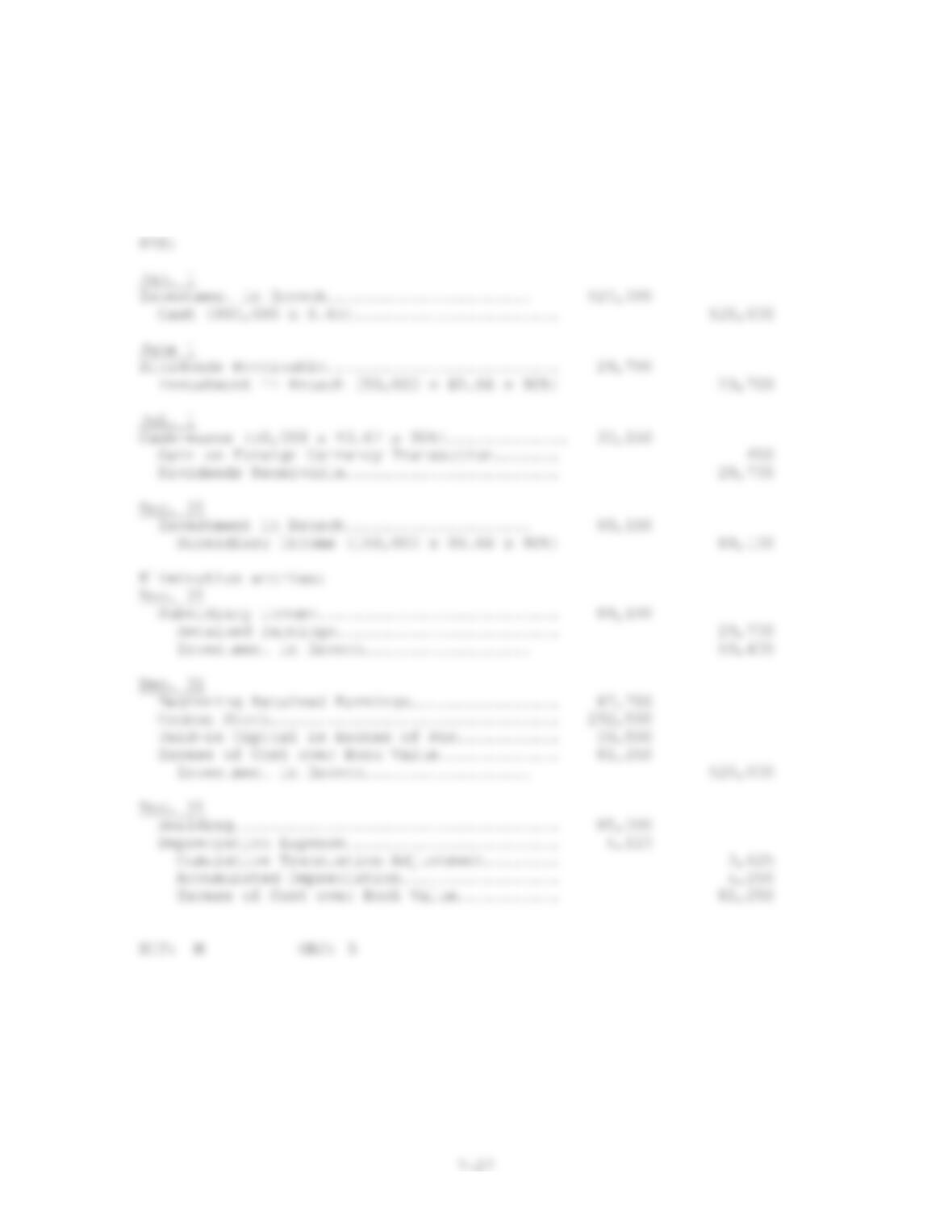
Prepare all the journal entries related to Cayane’s investment in
Brosch and all the necessary eliminating and adjusting entries for
consolidation of Brosch, assuming the use of the simple equity method.

Chapter 7
7-28
19. Kerry Manufacturing Company is a German subsidiary of a U.S. company.
Kerry records its operations and prepares financial statements in
euros. However, its functional currency is the British pound. Kerry was
organized and acquired by the U.S. company on June 1, 20X4. The
cumulative translation adjustment as of December 31, 20X6, was $79,860.
The value of the subsidiary’s retained earnings expressed in British
pounds and U.S. dollars as of December 31, 20X7, was 365,000 pounds and
$618,000, respectively. On March 1, 20X7, Kerry declared a dividend of
120,000 euros. The trial balance of Kerry in marks as of December 31,
20X7, is as follows:
Debit Credit
Cash…………………………………. 240,000
Accounts Receivable……………………. 2,760,000
Inventory (at cost)……………………. 3,720,000
Marketable Securities (at cost)…………. 2,040,000
Prepaid Insurance……………………… 210,000
Depreciable Assets…………………….. 8,730,000
Accumulated Depreciation……………….. 1,417,000
Cost of Goods Sold…………………….. 17,697,000
Selling, General, and
Administrative Expense………………. 4,762,000
Sales Revenue…………………………. 26,430,000
Investment Income……………………… 180,000
Accounts Payable………………………. 2,120,000
Unearned Sales Revenue…………………. 960,000
Loans and Mortgage Payable……………… 5,872,000
Common Stock………………………….. 1,500,000
Paid-in Capital in Excess of Par………… 210,000
Retained Earnings……………………… 1,470,000
Total………………………………. 40,159,000 40,159,000
========== ==========
The marketable securities were acquired on November 1, 20X6, and the
prepaid insurance was acquired on December 1, 20X7. The cost of goods
sold and the ending inventory are calculated by the weighted–average
method. The underlying costs have been incurred uniformly throughout
the year. On June 1, 20X4, 60% of the depreciable assets existed, and
the balance was acquired on March 1, 20X6. The depreciable assets are
amortized over a 10-year period by the straight-line method. Of the
total depreciation expense, 80% is traceable to the cost of goods sold
and the balance is in general expenses. On November 1, 20X6, Kerry
received a customer prepayment valued at 3,000,000 euros. On February
1, 20X7, 2,040,000 euros of the prepayment was earned. The balance
remains unearned as of December 31, 20X7.
Relevant exchange rates are as follows:
Pounds/Euro $/Pound
June 1, 20X4………………………….. 0.310 $1.600
March 1, 20X6…………………………. 0.300 $1.640
November 1, 20X6………………………. 0.305 $1.650
December 31, 20X6……………………… 0.310 $1.680
February 1, 20X7………………………. 0.302 $1.670
March 1, 20X7…………………………. 0.300 $1.660
December 1, 20X7………………………. 0.290 $1.640
December 31, 20X7……………………… 0.288 $1.640
20X7 average………………………….. 0.297 $1.660
Chapter 7
Required:
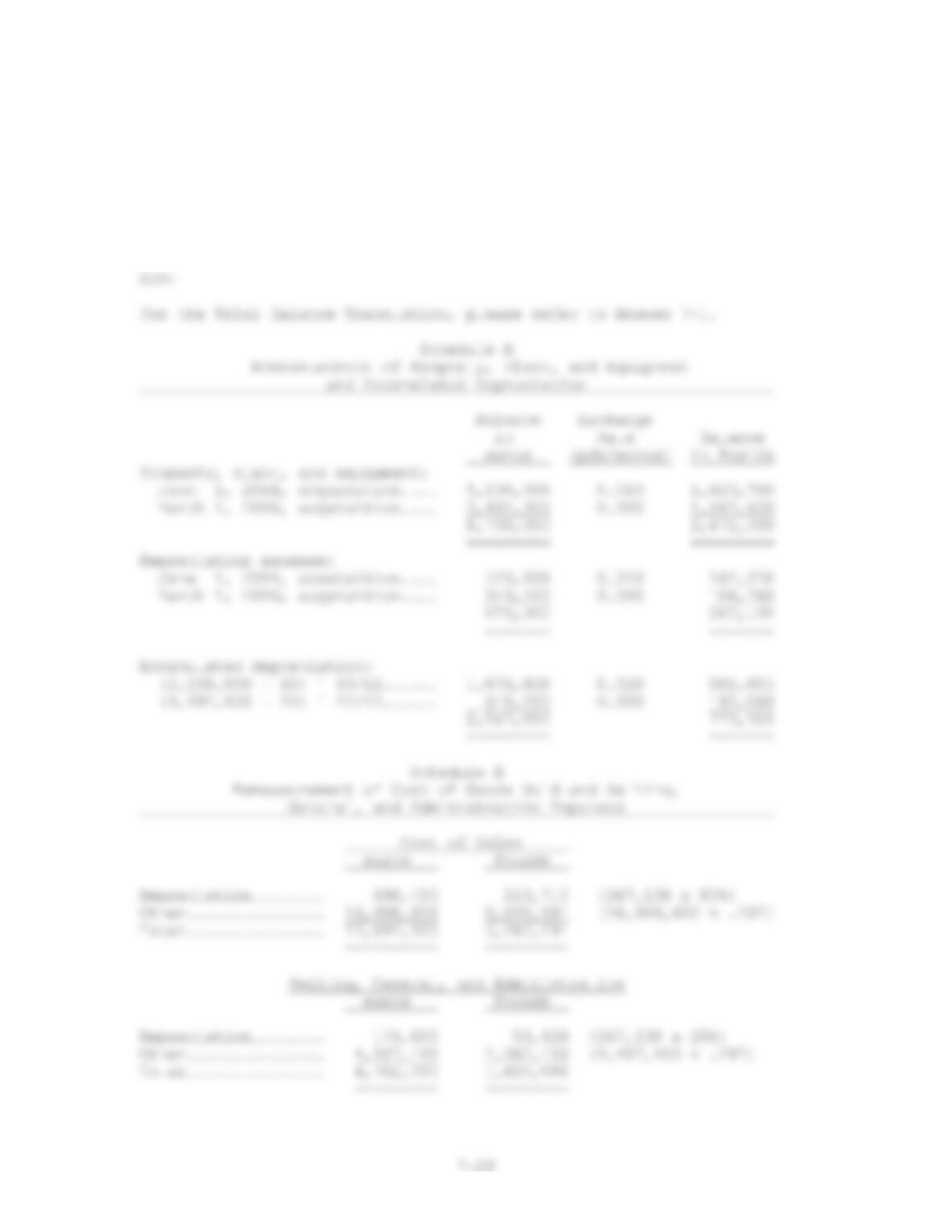
Prepare a remeasured and translated trial balance of the Kerry
Manufacturing Company as of December 31, 20X7. Provide supporting
schedules.

Chapter 7
7-30
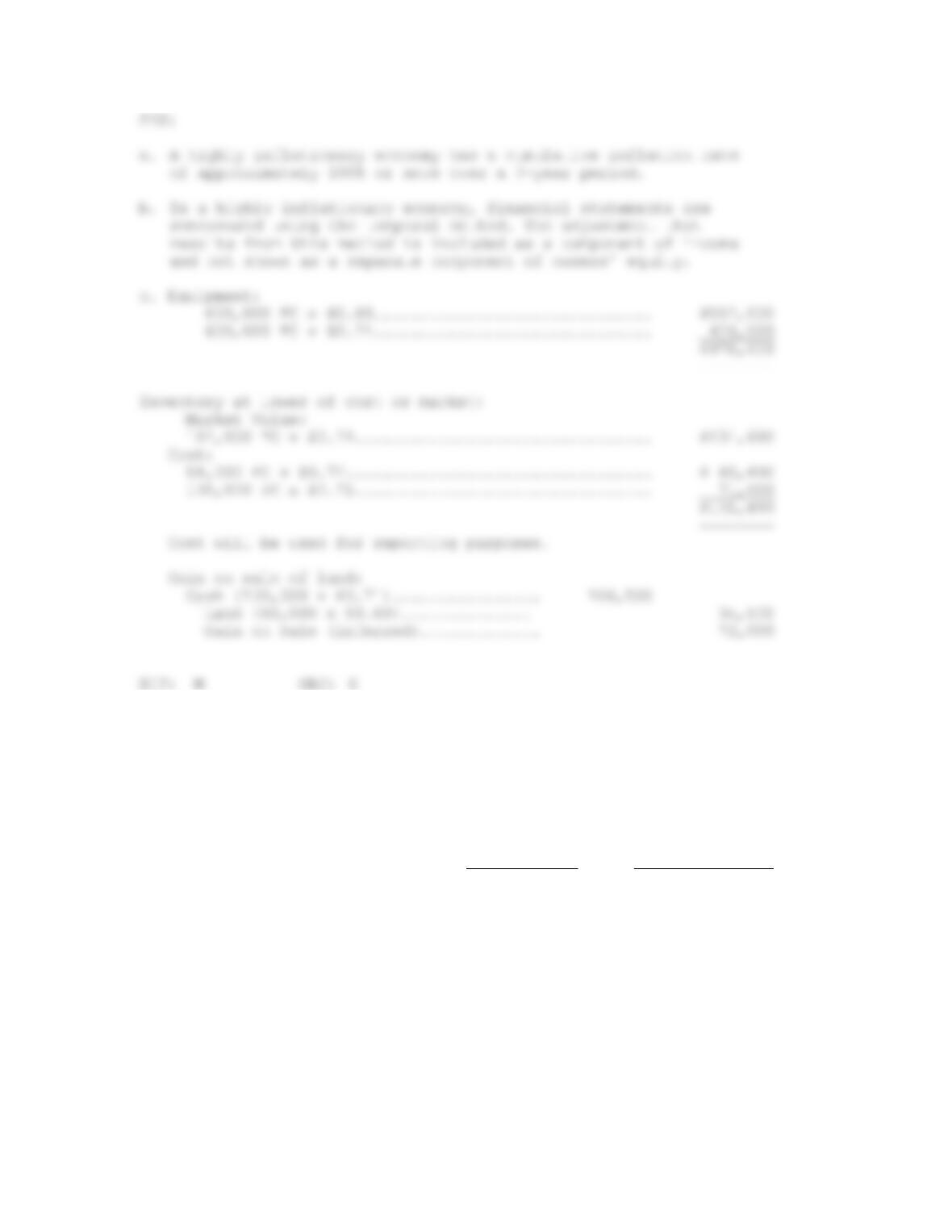
20. A foreign subsidiary operates in a highly inflationary economy. The
company’s December 31, 20X2, trial balance includes the following:
Equipment:
Acquired on June 1, 20X1……………………… 800,000 FC
Acquired on October 1, 20X2…………………… 600,000 FC
Inventory:
Valued at lower cost or market
Market Value………………………………… 182,000 FC
A cost of 184,000 FC represents 84,000 FC acquired
on December 1, 20X2, and 100,000 FC acquired on
October 1, 20X2.
Gain on sale of land:
This represents a gain from selling land that was
acquired on June 1, 20X1, at a cost of 50,000 FC,
on October 1, 20X2…………………………. 100,000 FC
Relevant exchange rates are as follows:
Date Rate
June 1, 20X1………………………………….. $0.69
July 1, 20X1………………………………….. $0.68
October 1, 20X2……………………………….. $0.71
December 1, 20X2………………………………. $0.72
December 31, 20X2……………………………… $0.74
20X2 average………………………………….. $0.70
Required:
a.
Discuss the criteria that must be satisfied in order to
qualify as a highly inflationary economy.
b.
Discuss how the remeasurement of statements of companies
operating in such economies affects net income.
c.
Calculate the dollar value of the trial balance accounts as of
December 31, 20X2.
Chapter 7
7-31
21. A Kuwaiti subsidiary of Hiawatha Corp. (a U.S. firm) has certain
balance sheet accounts on December 31, 20X4. The functional currency is
the U.S. dollar and currency of record is the dinar and the parents
books are kept in U.S. dollars.
Information relating to these account in U.S. dollars is as follows:
Translated at
Current Rate Historical Rate
Cash………………….. $150,000 $150,000
Accounts Receivable…….. 115,000 110,000
Inventories …………… 285,000 255,000
Prepaid Insurance………. 12,000 10,000
Land………………….. 90,000 180,000
Buildings……………… 500,000 800,000
Required:
From the above information, prepare the asset portion of the
subsidiary’s trial balance.

Chapter 7
7-32
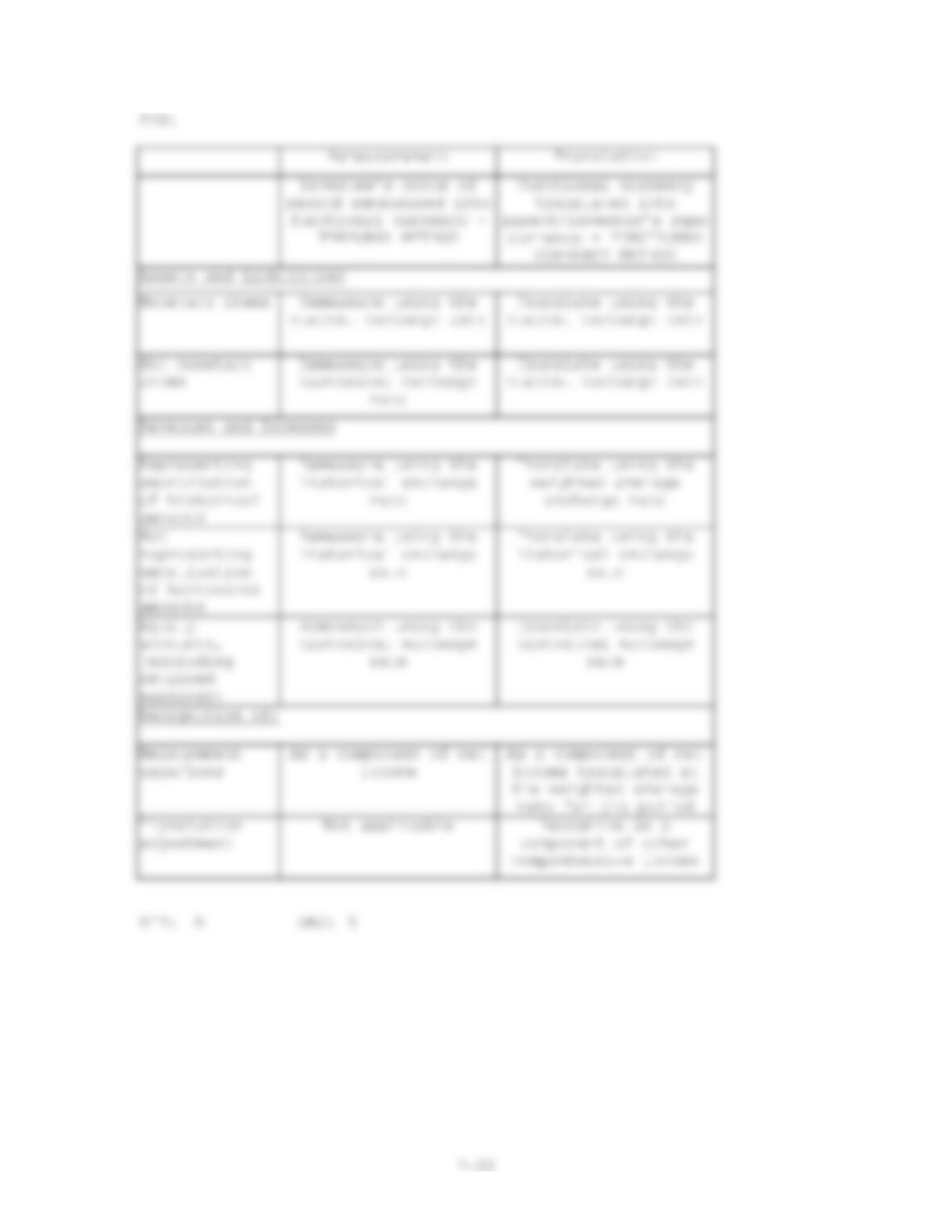
22. Complete the following table:
Remeasurement
Translation
Investee’s books of
record remeasured into
functional currency –
TEMPORAL METHOD
Functional currency
translated into
parent/investor’s repo
currency – FUNCTIONAL
CURRENCY METHOD
Assets and Liabilities
Monetary items
Not monetary
items
Revenues and Expenses
Representing
amortization of
historical
amounts
Not
representing
amortization of
historical
amounts
Equity
accounts,
(excluding
retained
earnings)
Recognition of:
Measurement
gain/loss
Translation
adjustment
Chapter 7
Chapter 7
7-34
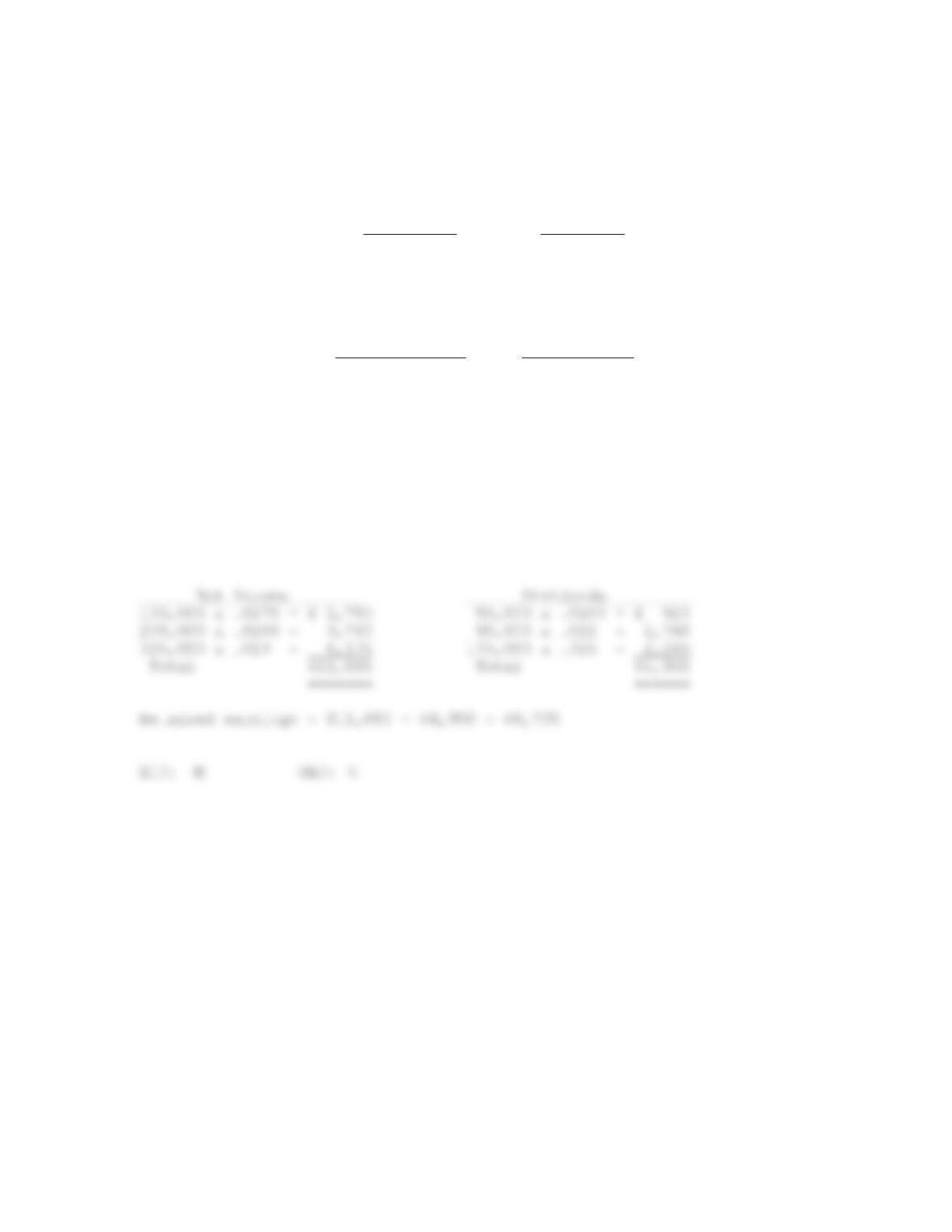
23. On January 1, 20X2, U.S.A. Inc. created an Algerian subsidiary, Niko,
Inc. The books are kept in Algerian dinars, but the functional currency
is the U.S. dollar. Dividends are paid on December 31, and income is
earned evenly throughout the year. The earnings and dividends of Niko
in dinars are as follows:
Net Income Dividends
20X2…………… 100,000 50,000
20X3…………… 200,000 80,000
20X4…………… 325,000 105,000
Exchange rates are given below.
Yearly Average Dec. 31 Spot
20X2…………… .0175 .0185
20X3…………… .0188 .022
20X4…………… .019 .025
Required:
Calculate the balance in retained earnings for Niko in dollars as of
December 31, 20X4.
ANS:
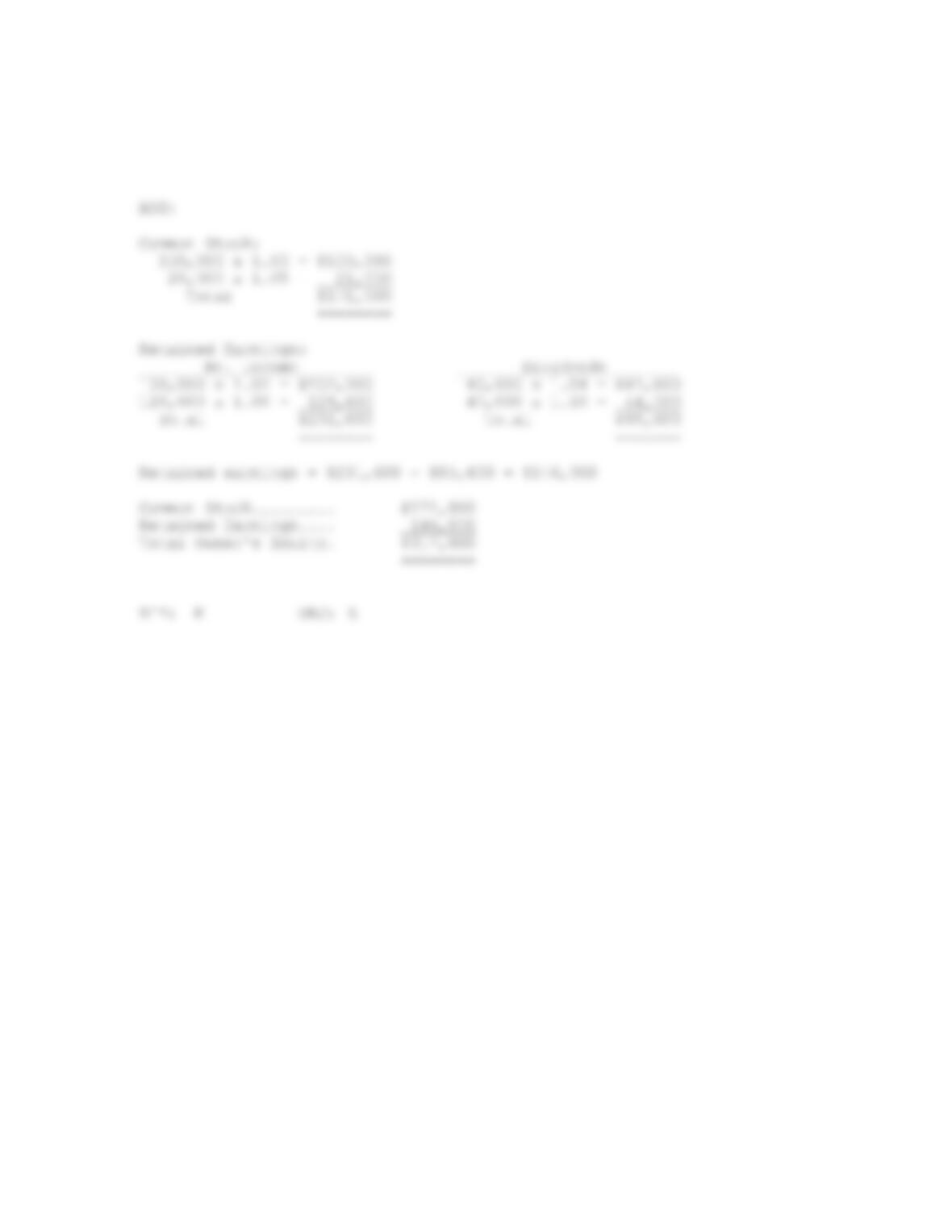
24. Renta USA, Inc. formed a foreign subsidiary on January 1, 20X3. The
subsidiary’s books are kept in their function currency. Income earned
in 20X3 and 20X4 totaled 100,000 FC and 120,000 FC, respectively.
Dividends of 400,000 FC have been paid on December 31 or each year. In
addition, 1000 shares of common stock (no par) were issued on July 1,
20X4 for 20 FC each.
Exchange rates relating this foreign currency to U.S. dollars are as
follows:
January 1, 20X3………….. 1.00
December 31, 20X3………… 1.04
Average 20X3…………….. 1.02
July 1, 20X4…………….. 1.05
December 31, 20X4………… 1.10
Average 20X4…………….. 1.08
Chapter 7
7-35
Required:
Calculate the owners’ equity of the subsidiary on December 31, 20X4.