1. Which of the following is NOT true about criterion-referenced testing?
a. They are used when one whishes to compare a test score to a predetermined value or a set criterion.
b. Many states have gone to using criterion-referenced testing as a result of the recent passing of No Child Left
Behind legislation.
c. They are useful when one is wishing to compare a score to an individual’s peer group.
d. As compared to norm-referenced testing, they are an alternative way of understanding test scores.
2. If you have the raw scores of two individuals on a norm-referenced test, which of the following is important in terms
of making meaning of those scores?
a. Measures of central tendency (mean, median, mode)
b. The relative positions of the scores to the rest of the group
c. Whether higher scores are better than lower scores
d. How an individual feels about his or her score
e. All of these are important.
3. On normally distributed curves, which of the following is NOT true?
a. The percentile rank mean is always p = 50.
b. The mean of z scores is always 0.
c. The mean of the standard deviation is 0.
d. The mean of standard scores vary as a function of the type of standard score (e.g., T score mean is 50, DIQ
mean is 100).
e. The mean of the publisher type score varies as a function of the publisher.
4. Which of the following is NOT always true?
a. If you know the z score, you can determine a percentile by looking at a conversion chart.
b. If you know the z score, you can determine most common standard scores (e.g., T score, DIQ, SAT, NCE,
etc.).
c. If you know the z score, you can determine the standard deviation of the test.
d. All of these are true.
Chapter7—StatisticalConcepts:CreatingNewScorestoInterpretTestData
5. Which of the following is NOT true?
a. DIQs are generally used with tests of intelligence.
b. T scores are generally used with personality tests.
c. Sten scores are generally used with personality inventories and questionnaires.
d. Stanines are generally used with achievement tests.
e. All of these are true.
6. Jill Jacobs receives a grade equivalent score of 10.6 on a national reading test. She is in the ninth grade. Which
statement is most true about Jill?
a. Her reading ability is equal to students at the 10th grade level.
b. Based on this score, no conclusions can be drawn.
c. Jill is doing better than the average student in her grade level.
d. Jill is doing worse than the average student in her grade level.
e. None of these are true.
7. If you convert a group of z-scores to DIQ’s, you will:
a. change the distribution on the curve.
b. decrease the mean.
c. decrease the median.
d. keep the original shape of the raw score distribution.
8. Which statement is usually NOT true about all norm-referenced standardized achievement tests?
a. About 50 percent of all those who take the test will be below the median.
b. The higher the standard error of measurement, the lower the reliability.
c. The standard deviations are always the same, regardless of test publishing company.
d. All of these are true.
9. Given N = 600, M = 40, SD = 10 (Normal Distribution), approximately how many individuals would you expect to
score between 20 and 30?
a. 12
b. 204
c. 300
d. 84
10. Which of the following represents the best description of a DIQ?
a. z(Mean) + SD (M = 15, SD = 100)
b. z(Mean) + SD (M = 100, SD = 15)
c. z(SD) + Mean (M = 15, SD = 100)
d. z(SD) + Mean (M = 100, SD = 15)
11. If z = −2.0, which of the following is NOT correct?
a. T = 30
b. DIQ = 70
c. Percentile = 2
d. SAT = 200
e. Stanine = 1
12. If z = 3.0, which of the following is NOT correct?
a. T = 80
b. DIQ = 145
c. SAT = 800
d. NCE = 99
e. Sten = 9
Chapter7—StatisticalConcepts:CreatingNewScorestoInterpretTestData
13. A test to measure psychotic tendencies was given to a group of 1,000 potential air force cadets who wished to work
in nuclear silos. Any cadet who scored at or over 64 would be eliminated. The mean of the test was 52 and the
standard deviation was 12. Out of the 1,000 cadets how many were accepted?
a. 160
b. 340
c. 560
d. 840
14. A test to measure psychotic tendencies was given to a group of 1,000 potential air force cadets who wished to work
in nuclear silos. Any cadet who scored at or over 64 would be eliminated. The mean of the test was 52 and the
standard deviation was 12. Of the following scores, which is the highest z-score someone could receive and still be
accepted to work in the silos?
a. 0
b. 1.5
c. 2
d. 2.5
e. 3
15. A personality test that measures self-actualizing values uses T-scores. On the “self-awareness” scale, Bethany
receives a score of 70 while Edwina obtains a score of 40. At approximately which percentiles do these scores fall?
a. Bethany: 98; Edwina: 34
b. Bethany: 95; Edwina: 16
c. Bethany: 95; Edwina: 34
d. Bethany: 98; Edwina: 16
Chapter7—StatisticalConcepts:CreatingNewScorestoInterpretTestData
16. Joshua obtained a score of 550 on the SATs (M=500, SD=100) and a score of 95 on the WAIS-III (M=100,
SD=15). On which test did he do better?
a. WAIS-III
b. SATs
c. He performed equally well on both tests.
d. This cannot be determined.
17. An individual receives a DIQ score of 73. Taking into account standard error of measurement (SEM), what is his
“true score” 68 percent of the time if test-retest reliability is .96?
a. 61 – 85
b. 67 – 79
c. 70 – 76
d. 71.5 – 74.5
e. None of these
18. An individual receives a DIQ score of 73. Taking into account standard error of measurement (SEM), what is his
“true score” 95 percent of the time if test-retest reliability is .96?
a. 12 points
b. 6 points
c. 3 points
d. 1.5 points
e. None of these
Chapter7—StatisticalConcepts:CreatingNewScorestoInterpretTestData
19. An individual receives a T score of 73 on a test that measures empathic ability. Taking into account standard error of
measurement (SEM), what is his “true score” 68 percent of the time if test-retest reliability is .75?
a. 25 points
b. 10 points
c. 5 points
d. 2.5 points
e. None of these
20. An individual receives a T score of 73 on a test that measures empathic ability. Taking into account standard error of
measurement (SEM), what is his “true score” 95 percent of the time if test-retest reliability is .75?
a. 25 points
b. 10 points
c. 5 points
d. 2.5 points
e. None of these
21. An individual being tested for a gifted program scores a 132 on the Cognitive Ability Test (CogAT), which has a
mean of 100 and a standard deviation of 16. There is a .40 correlation between the CogAT score and success as
measured by GPA in the gifted program, which has a weighted mean of 4.3 with a SD of .2. Use the Standard Error
of the Estimate (SEest) to predict where this students GPA will fall 68 percent of the time.
a. 4.7 ± .18
b. 4.3 ± .2
c. 4.5 ± .4
d. 4.7 ± .15
e. None of these
Chapter7—StatisticalConcepts:CreatingNewScorestoInterpretTestData
22. An individual being tested for a gifted program scores a 132 on the Cognitive Ability Test (CogAT), which has a
mean of 100 and a standard deviation of 16. There is a .40 correlation between the CogAT score and success as
measured by GPA in the gifted program, which has a weighted mean of 4.3 with a SD of .2. Use the Standard Error
of the Estimate (SEest) to predict where this students GPA will fall 95 percent of the time.
a. 4.7 ± .36
b. 4.3 ± .4
c. 4.5 ± .8
d. 4.7 ± .28
e. None of these
23. Which scale of measurement is being used when comparing achievement test scores of different school systems?
a. Nominal
b. Ordinal
c. Interval
d. Ratio
24. Which scale of measurement is being used if assigning numbers based on different professional affiliation (e.g.,
counselors, social workers, psychologists, psychiatrists)?
a. Nominal
b. Ordinal
c. Interval
d. Ratio
25. Which scale of measurement would you use if measuring height and weight differences among ethnic groups?
a. Nominal
b. Ordinal
c. Interval
d. Ratio
Chapter7—StatisticalConcepts:CreatingNewScorestoInterpretTestData
26. In norm referencing, test scores are compared to a group of individuals called the norm group or peer group.
a. True
b. False
27. If an individual’s percentile rank is 84, he or she got 84 percent of the items correct.
a. True
b. False
28. A standard deviation of 2 is a percentile rank of about 98.
a. True
b. False
29. Percentiles are a reflection of the distribution of scores along a curve.
a. True
b. False
30. NCEs range from 1 to 99 along the bell-shaped curve, but as opposed to percentiles, they are in equal units along
curve.
a. True
b. False
Chapter7—StatisticalConcepts:CreatingNewScorestoInterpretTestData
31. If a child is in grade 4.3 and receives a grade equivalent of 7.2 on an achievement test, he or she is achieving at the
7.2 grade level.
a. True
b. False
ANSWER: False
POINTS: 1
REFERENCES: Normative Comparisons and Derived Scores
32. A stanine of 4 falls at the same percentile as a DIQ of 72.
a. True
b. False
ANSWER: False
POINTS: 1
REFERENCES: Normative Comparisons and Derived Scores
33. The area between +1 and −1 standard deviations on a normal curve would include approximately 84 percent of the
population.
a. True
b. False
ANSWER: False
POINTS: 1
REFERENCES: Normative Comparisons and Derived Scores
34. Using z-scores gives an individual the potential of comparing test scores on different types of tests.
a. True
b. False
ANSWER: True
POINTS: 1
REFERENCES: Normative Comparisons and Derived Scores
35. A student received a score on a norm-referenced standardized test that was −2 z-scores below the mean. This
person scored better than approximately 16 percent of his or her norm group.
a. True
b. False
ANSWER: False
POINTS: 1
REFERENCES: Normative Comparisons and Derived Scores
36. Though the common usages of DIQs, percentiles, stanines, T-scores, and Grade Equivalents may imply a different
type of test, they all measure the relative position of an individual as compared to the norm group.
a. True
b. False
37. On a normally distributed curve, raw scores may become meaningful if you know the standard deviation and mean
of the group.
a. True
b. False
38. If your score on a test is 85 and the mean is 50, you have to have scored above the 84th percentile.
a. True
b. False
39. Age comparisons allow a person to compare his or her score at a specific age to the mean and standard deviation of
individuals in his or her age peer group.
a. True
b. False
40. No Child Left Behind shows how norm-referenced testing can be used to increase student scores and shows the
government’s financial commitment to assuring that all children can achieve.
a. True
b. False
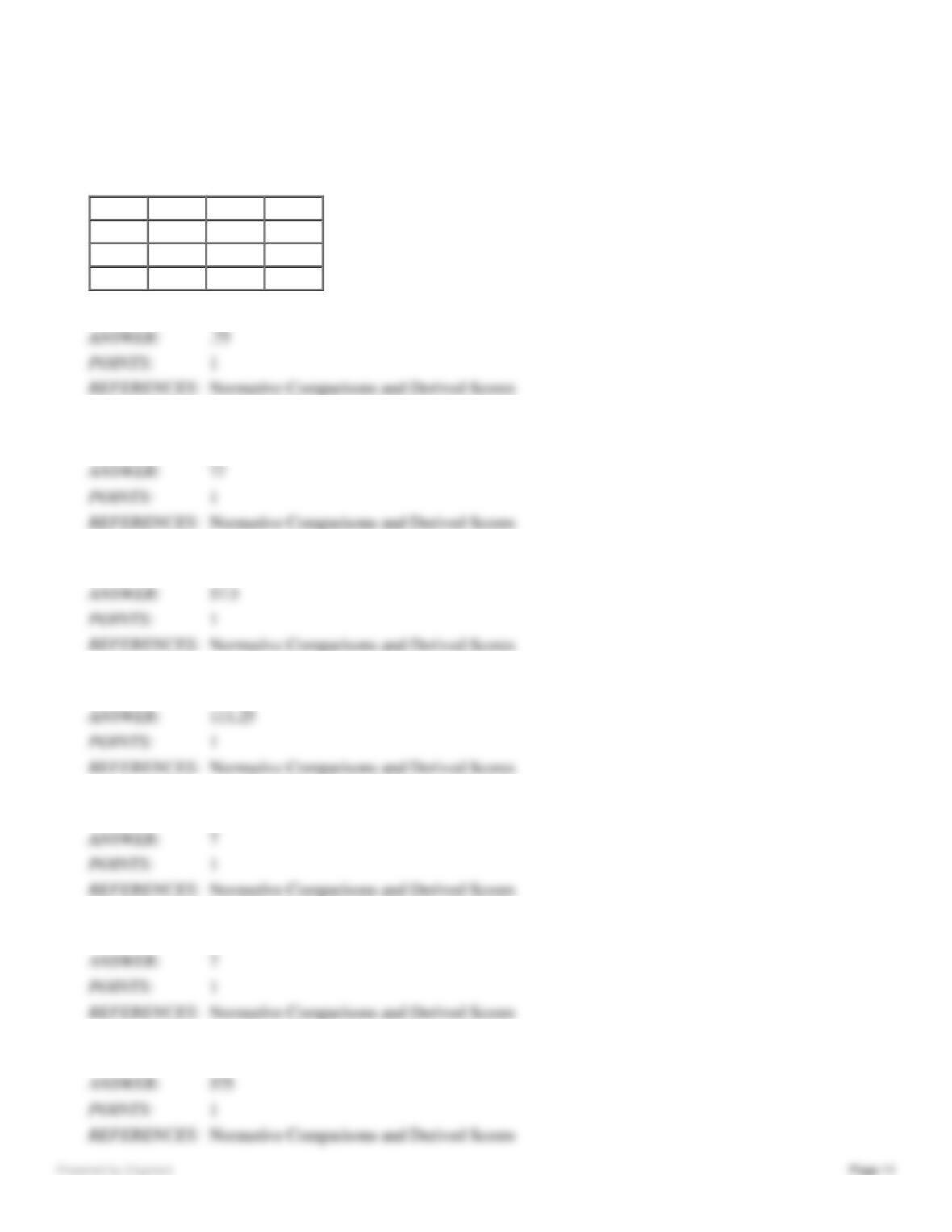
Exhibit 7-1
Assume a normal curve and that the mean of the raw scores is 8, the standard deviation is 2.65, and the test-retest
reliability is .84. If an individual who is in grade 5.6 received a score of 10, answer the following questions:
4788
14 12 10 9
8874
910 12 14
41. Refer to Exhibit 7-1. What is the z score?
42. Refer to Exhibit 7-1. What is the individual’s approximate percentile?
43. Refer to Exhibit 7-1. What is the T score?
44. Refer to Exhibit 7-1. What is the Deviation IQ?
45. Refer to Exhibit 7-1. What is the stanine?
46. Refer to Exhibit 7-1. What is the sten score?
47. Refer to Exhibit 7-1. What is the SAT Type Score?
Chapter7—StatisticalConcepts:CreatingNewScorestoInterpretTestData
48. Refer to Exhibit 7-1. What is the ACT Type Score?
49. Refer to Exhibit 7-1. What is the National Curve Equivalent (NCE)?
50. Refer to Exhibit 7-1. What is the Publisher Type Score (given that the M = 80 and SD = 20)?
51. Refer to Exhibit 7-1. Make a statement about the individual’s Grade Equivalent.
52. Refer to Exhibit 7-1. Based on a person’s Publisher Type Score (where the M = 80 and SD = 20), what range will
this person’s score likely fall within 68 percent of the time?
53. Refer to Exhibit 7-1. Based on a person’s Publisher Type Score (where the M = 80 and SD = 20), what range will
this person’s score likely fall 96 percent of the time?
54. Refer to Exhibit 7-1. Scores with this instrument correlate .50 with 6th grade GPA. If the 6th grade GPA has a mean
of 3.0 and a SD of .3, predict the GPA range this students grades will fall 68 percent of the time.
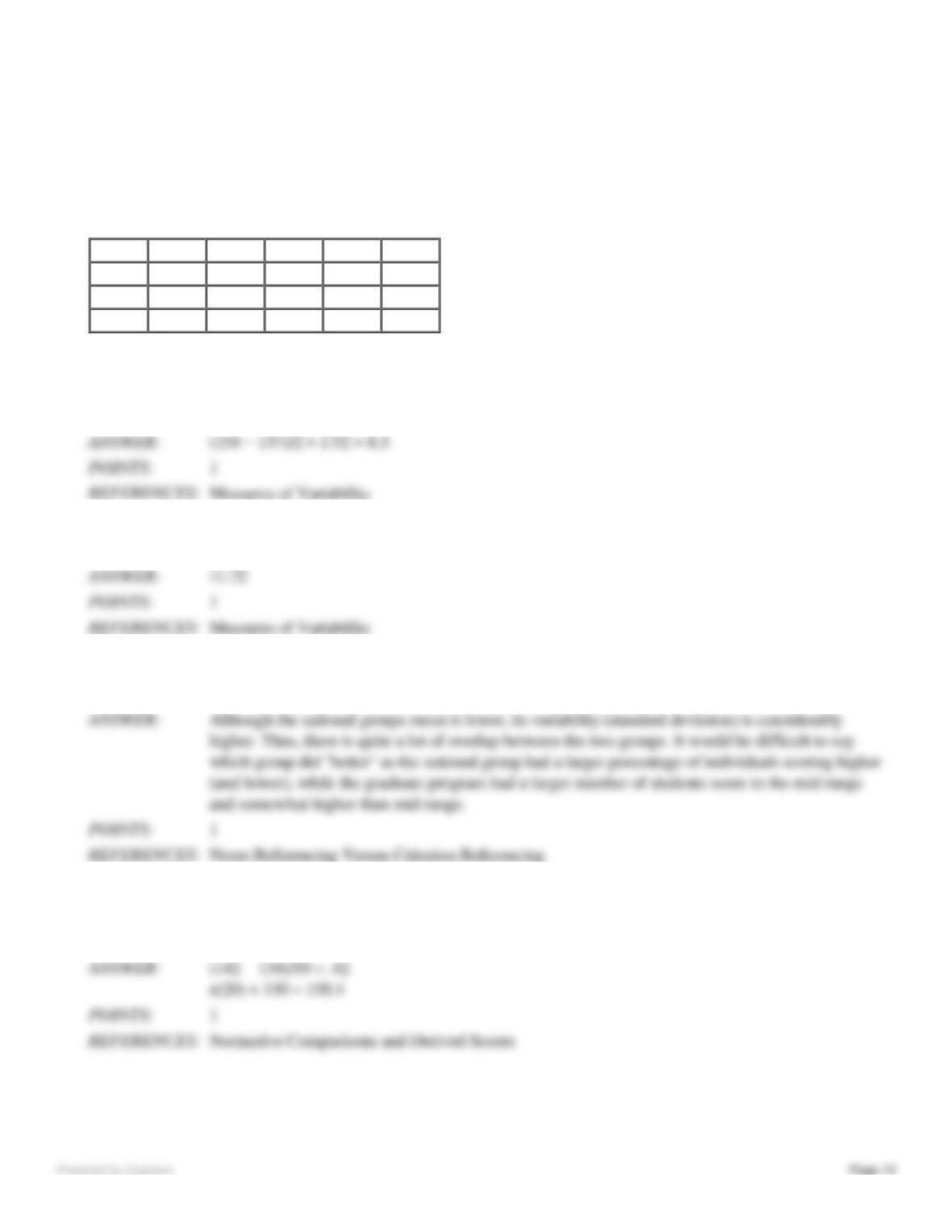
Exhibit 7-2
In order to evaluate a graduate program in psychology, a decision is made to compare the scores of the recent
graduates on the national licensure exam to scores nationally. The internal consistency reliability of the test = .84.
The program therefore follows up with their students and finds 24 students who have taken the exam in its most
recent form. The scores of the students in the program are as follows:
140 135 141 142 122 142
142 119 168 157 156 132
164 157 147 156 136 149
138 142 138 137 142 154
Given information:
Mean = 144; Median = 142; Mode = 142; Range = 50
55. Refer to Exhibit 7-2. Find the interquartile range.
56. Refer to Exhibit 7-2. Find the standard deviation of the students in the graduate program.
57. Refer to Exhibit 7-2. Knowing that the national mean is 134 with a SD of 19.0, write a statement as to how this
school’s students have done as compared to the national group.
58. Refer to Exhibit 7-2. Use the national mean of 134 and national standard deviation of 19.0. If an individual received a
raw score of 142, what is his or her standard score (publisher score) on the national test if the mean and standard
deviation of the publisher score was 150 and 20 respectively?
Chapter7—StatisticalConcepts:CreatingNewScorestoInterpretTestData
59. Refer to Exhibit 7-2. If a decision was made to use NCE type scores, what score would the individual who obtained
a raw score of 142 receive?
60. Refer to Exhibit 7-2. Approximately what percentage of the group scored higher than this individual?
61. Refer to Exhibit 7-2. Considering the fact that all tests have error, what is this individual’s standard score (publisher
score; M= 150, SD = 20) 68 percent of the time?
62. Refer to Exhibit 7-2. Considering the fact that all tests have error, what is this individual’s standard score (publisher
score; M = 150, SD = 20) 95 percent of the time?
63. Refer to Exhibit 7-2. A graduate psychology student has a 3.65 GPA, where the psychology program’s mean is 3.6
and SD is .1. Faculty have found a .60 correlation between students’ GPA and their national licensure exam
publisher score (M = 150, SD = 20). Knowing our students GPA, we could predict her score to fall in what range on
the national licensure exam 68 percent of the time?
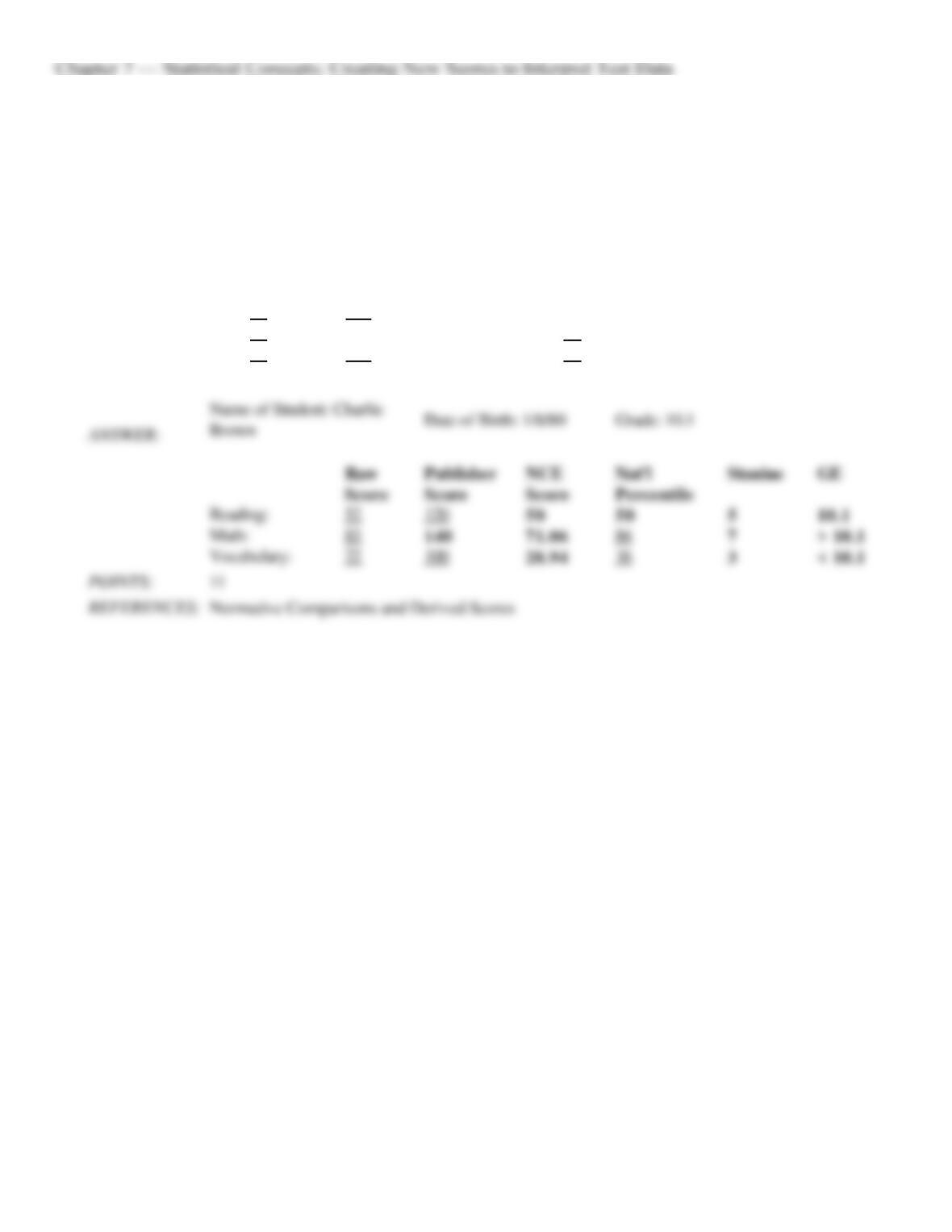
64. Fill in the blanks for the information listed below. Please note that the publisher uses the same mean and standard
deviation for the three types of tests. For grade equivalent, simply state if Charlie Brown scored at his grade
equivalent, or higher or lower than his grade equivalent. (Given: publisher mean = 120).
Name of Student: Charlie Brown Date of Birth: 1/8/80 Grade: 10.1
Raw Publisher NCE Nat’l Stanine GE
Score Score Score Percentile
Reading: 52 120 _____ _____ _____ _____
Math: 83 _____ _____ 84 _____ _____
Vocabulary: 22 100 _____ 16 _____ _____
PoweredbyCogneroPage15
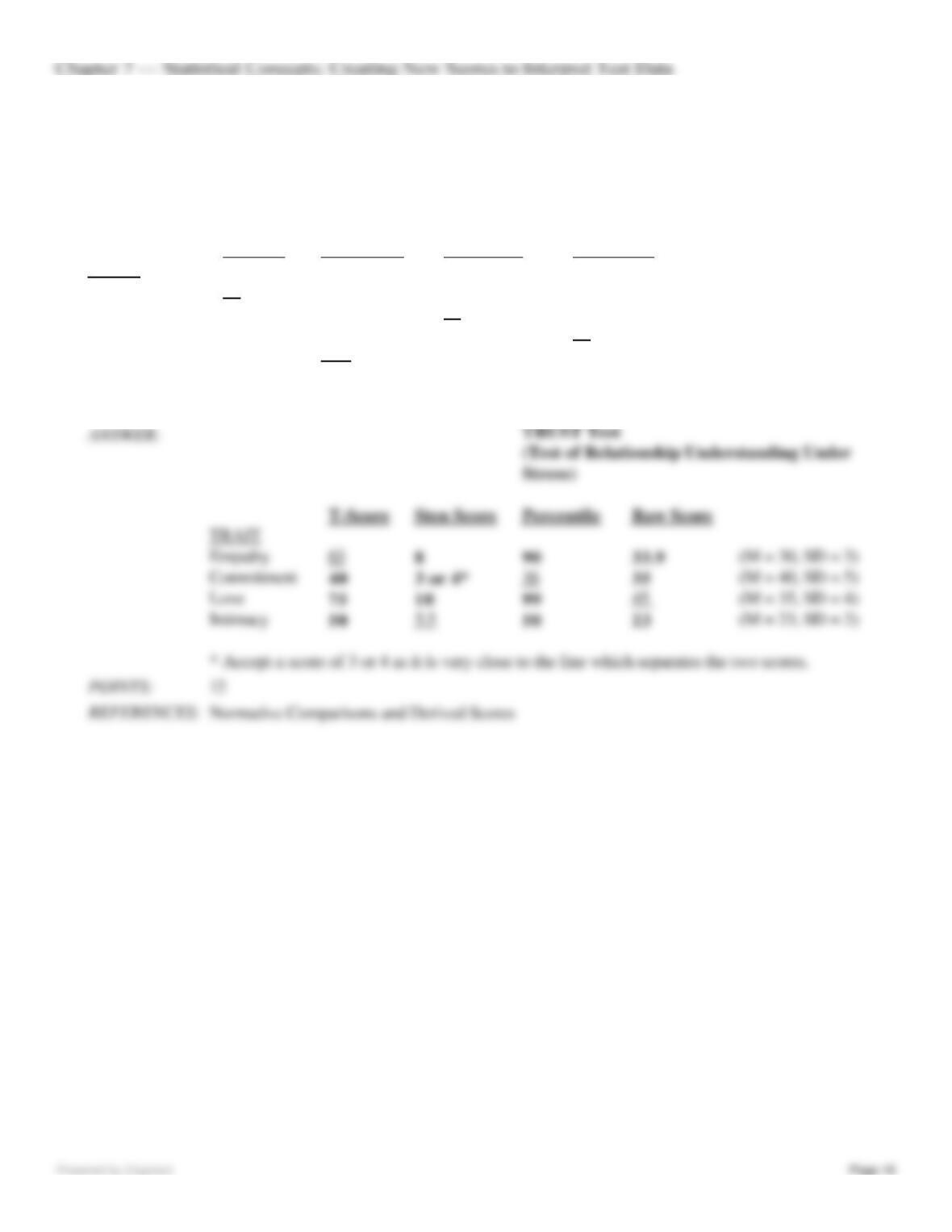
65. Fill in the blanks for the information listed below.
TRUST Test
(Test of Relationship Understanding Under Stress)
T-Score Sten Score Percentile Raw Score
TRAIT
Empathy 63 _____ _____ _____ (M = 30, SD = 3)
Commitment _____ _____ 16 _____ (M = 40, SD = 5)
Love _____ _____ _____ 45 (M = 35, SD = 4)
Intimacy _____ 5.5* _____ _____ (M = 23, SD = 2)
* Sten scores are generally rounded off, however, in this case, use the non-rounded number given.
Match the standard score with its mean and standard deviation.
a. Mean = 21, SD = 5
b. Mean = 50, SD = 10
c. Mean = 50, SD = 21.06
d. Mean = 5, SD = 2
e. Mean = 5.5, SD = 2
f. Mean = 100, SD = 15
g. Mean = 500, SD = 100
h. Mean = ?, SD = ?
REFERENCES: Normative Comparisons and Derived Scores
66. T score
67. DIQ
68. Stanine
69. Sten score
70. SAT
71. ACT
72. NCE
73. Publisher Type Score
Chapter7—StatisticalConcepts:CreatingNewScorestoInterpretTestData
Match the type of scale with the definition.
a. This scale has a meaningful zero point and equal intervals; therefore, it can be manipulated by all
mathematical principles.
b. In this scale, numbers are arbitrarily assigned to represent different categories or variables.
c. This scale establishes equal distances between measurements but has no absolute zero reference point.
d. With this scale, magnitude or rank order is implied; however, the distance between measurements is unknown.
REFERENCES: p. 146
74. Nominal scale
75. Ordinal scale
76. Interval scale
77. Ratio scale
Chapter7—StatisticalConcepts:CreatingNewScorestoInterpretTestData