Chapter 07 – How Cells Harvest Energy
Clarify Question
What is the key concept addressed by the question?
What type of thinking is required?
Gather Content
What do you already know about the Krebs cycle and ATP and NADH yield? What other
information is related to the question?
Choose Answer
Do you have all necessary information to determine which products would affect cellular
respiration?
Chapter 07 – How Cells Harvest Energy
Reflect on Process
Did your problem-solving process lead you to the correct answer? If not, where did the
process break down or lead you astray? How can you revise your approach to produce a
more desirable result?
22. What is an end-product of glycolysis?
Chapter 07 – How Cells Harvest Energy
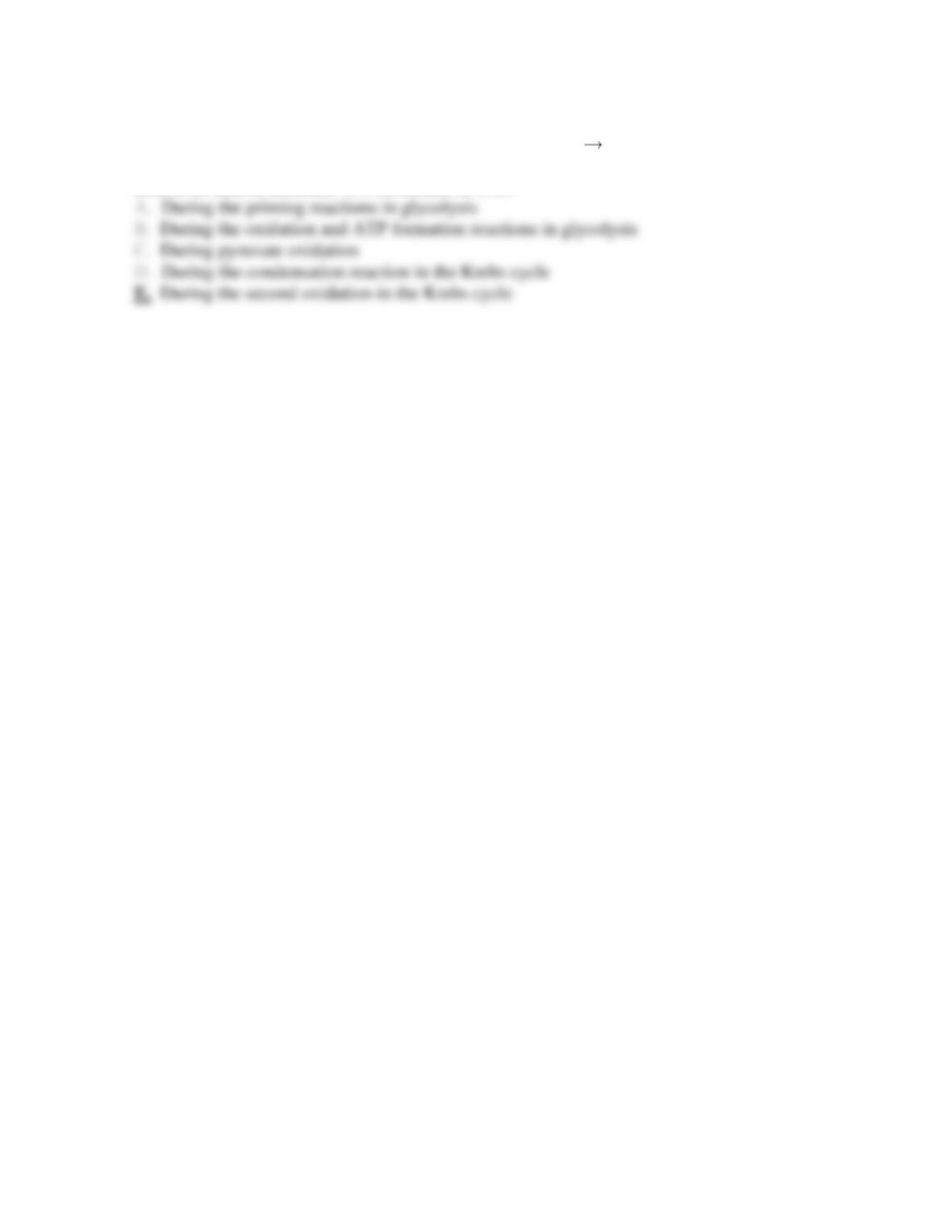
23. The equation for cellular respiration is: C6H12O6 + 6O2 6CO2 + 6H2O. At what
specific point in the cellular respiration process has glucose been broken down completely
from a six carbon molecule to 6 molecules of CO2?
Chapter 07 – How Cells Harvest Energy
Clarify Question
What is the key concept addressed by the question?
broken down to carbon dioxide during cellular respiration.
What type of thinking is required?
Gather Content
What do you already know about cellular respiration and the oxidation of carbon? What
other information is related to the question?
Choose Answer
Do you have all the information needed to determine at which point glucose is completely
oxidized to carbon dioxide?
Reflect on Process
Did your problem-solving process lead you to the correct answer? If not, where did the
process break down or lead you astray? How can you revise your approach to produce a
Chapter 07 – How Cells Harvest Energy
more desirable result?
24. Pyruvate oxidation in eukaryotic cells occurs in the ________.
Chapter 07 – How Cells Harvest Energy
25. What is common to all of the oxidation reactions in the Krebs cycle?

Chapter 07 – How Cells Harvest Energy
26. In the reaction catalyzed by aconitase, the conversion of citrate to isocitrate is inhibited
by fluoroacetate. Fluoroacetate is used as a pesticide. Why is this an effective pesticide?
Chapter 07 – How Cells Harvest Energy
Clarify Question
What is the key concept addressed by the question?
What type of thinking is required?
Gather Content
What do you already know about cellular respiration and when citrate is converted to
isocitrate? What other information is related to the question?
Choose Answer
Do you have all necessary information to determine why fluoroacetate is an effective
pesticide?
Reflect on Process
Did your problem-solving process lead you to the correct answer? If not, where did the
process break down or lead you astray? How can you revise your approach to produce a
more desirable result?

Chapter 07 – How Cells Harvest Energy
Chapter 07 – How Cells Harvest Energy
27. Arsenic poisoning can lead to organ failure and death. Though arsenic can inhibit or
interfere with a number of cellular enzymes, arsenic poisoning is thought to be mainly due to
indirect inhibition of enzymes involved in both pyruvate oxidation and the Krebs cycle. As a
result, this compound must be able to enter which cellular compartment?
Clarify Question
What is the key concept addressed by the question?
What type of thinking is required?
Gather Content
What do you already know about pyruvate oxidation and the Krebs cycle? What other
information is related to the question?
Choose Answer
Do you have all necessary information to determine where arsenic poisoning would have
its greatest impact within the cell?
Chapter 07 – How Cells Harvest Energy
28. What are the products of one turn of the Krebs cycle?
29. What is different about the way that NADH and FADH2 donate electrons to the electron
transport chain?
Chapter 07 – How Cells Harvest Energy
30. What happens to the oxygen that is used in cellular respiration?
31. As electrons move along the electron transport chain, they lose potential energy. How is
the energy that is released used by the cell?

Chapter 07 – How Cells Harvest Energy
32. Cardiac muscle cells need to generate significant amounts of ATP to allow for constant
contractile activity. As a result, they primarily depend upon beta-oxidation of fatty acids,
which has a higher energy yield than the catabolism of glucose. What would be the ATP yield
for beta-oxidation of a hypothetical 10-carbon fatty acid?
Chapter 07 – How Cells Harvest Energy
Clarify Question
What is the key concept addressed by the question?
What type of thinking is required?
Gather Content
What do you already know about cellular respiration and beta-oxidation of fatty acids?
How do these molecules plug into the process of cellular respiration? What other
information is related to the question?
Chapter 07 – How Cells Harvest Energy
Choose Answer
Do you have all necessary information to determine the ATP yield from beta-oxidation of
a 10-carbon fatty acid?
Chapter 07 – How Cells Harvest Energy
Reflect on Process
Did your problem-solving process lead you to the correct answer? If not, where did the
process break down or lead you astray? How can you revise your approach to produce a
more desirable result?
33. The energy released in the mitochondrial electron transport chain is used to transport
proteins into the.
Chapter 07 – How Cells Harvest Energy
34. If citrate levels are high in the cell, but ATP levels are low, what do you think will
happen in the cell?
Chapter 07 – How Cells Harvest Energy
Clarify Question
What is the key concept addressed by the question?
What type of thinking is required?
Gather Content
What do you already know about the stages of cellular respiration and how they are
regulated? What other information is related to the question?
Choose Answer
Do you have all the information needed to determine what would happen to cellular
respiration?
Reflect on Process
Did your problem-solving process lead you to the correct answer? If not, where did the
process break down or lead you astray? How can you revise your approach to produce a
Chapter 07 – How Cells Harvest Energy
more desirable result?
35. Regardless of the electron or hydrogen acceptor used, one of the products of fermentation
is always
36. Glucose is not our only food source, nor the only one we can utilize in our bodies to
generate energy. Other primary sources of energy include other sugars, proteins, and
fats.What metabolic intermediate are fats primarily converted into?

Chapter 07 – How Cells Harvest Energy
37. When amino acids are degraded in cells, into what intermediate(s) of the aerobic
respiration process are the carbon skeletons of amino acids primarily converted?