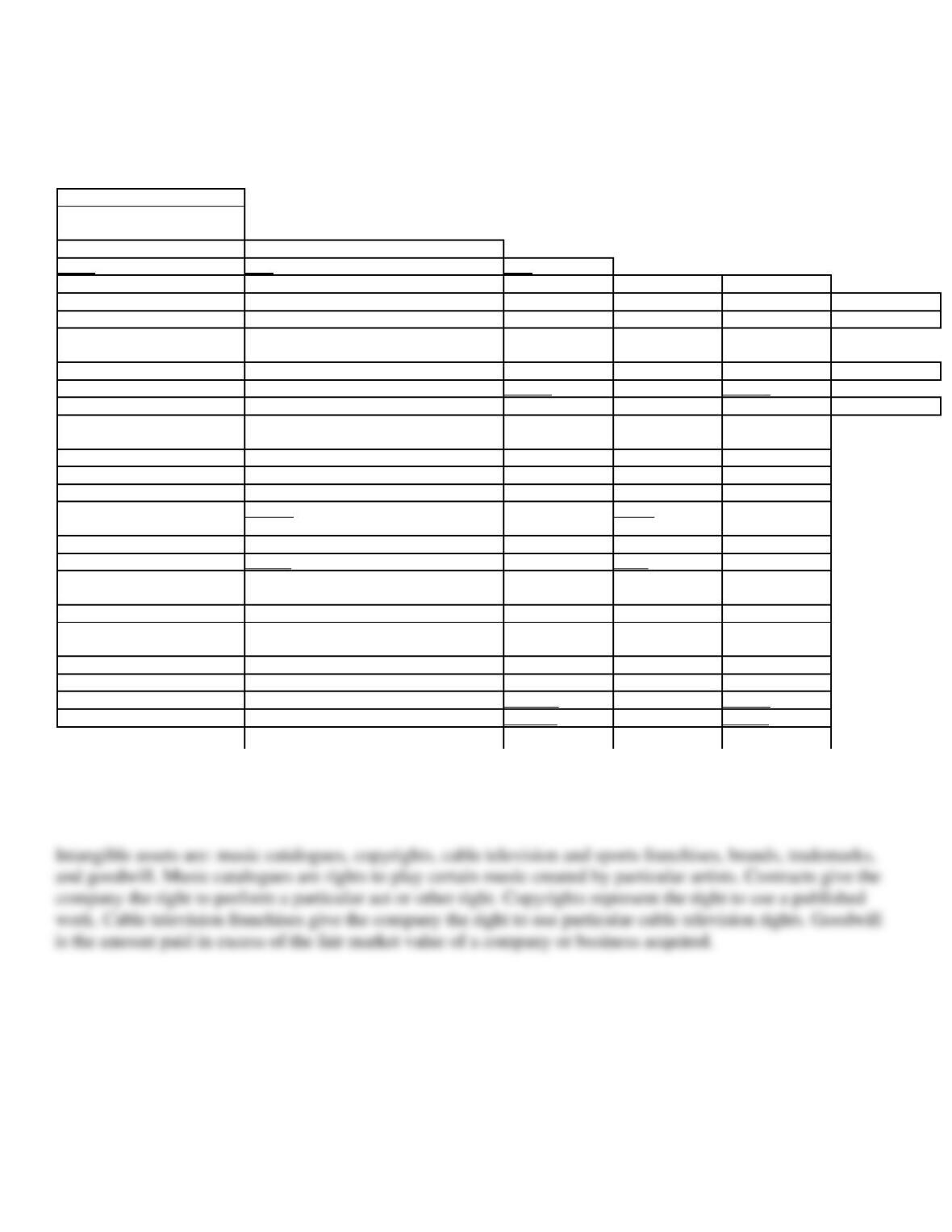
124. Fabulous Creations
The assets section of the company’s balance sheets for the years ended December 31, 2013 and 2012, is
provided below.
Fabulous Creations
Assets Section of Consolidated
Balance Sheets (in millions)
at December 31,
Assets
2013
2012
Current Assets
Cash and equivalents
$ 719
$ 2,610
Short-term investments
0
886
Receivables, less allowances of $1,889 and
$97
6,054
464
Inventories
1,791
0
Prepaid expenses and other current assets
1,710
711
Total Current Assets
$10,274
$ 4,671
Noncurrent inventories & film
costs
6,853
0
Investments
6,886
3,824
Land and buildings
$ 2,107
$ 440
Cable television equipment
9,966
0
Furniture, fixtures, and
equipment
4,329
1,297
Property, plant, and equipment
$16,402
$1,737
Less: Accumulated depreciation
(3,718)
(696)
Property, plant, & equipment
(net)
12,684
1,041
Music catalogue, and copyrights
2,927
0
Cable television and sport
franchises
27,109
0
Brands and trademarks
10,684
0
Goodwill and other intangibles
128,338
713
Other assets
2,804
578
Total assets
$208,559
$10,827
Refer to Fabulous Creations. Which items on the company’s balance sheet could be considered intangible assets? Explain the nature of each of
these.
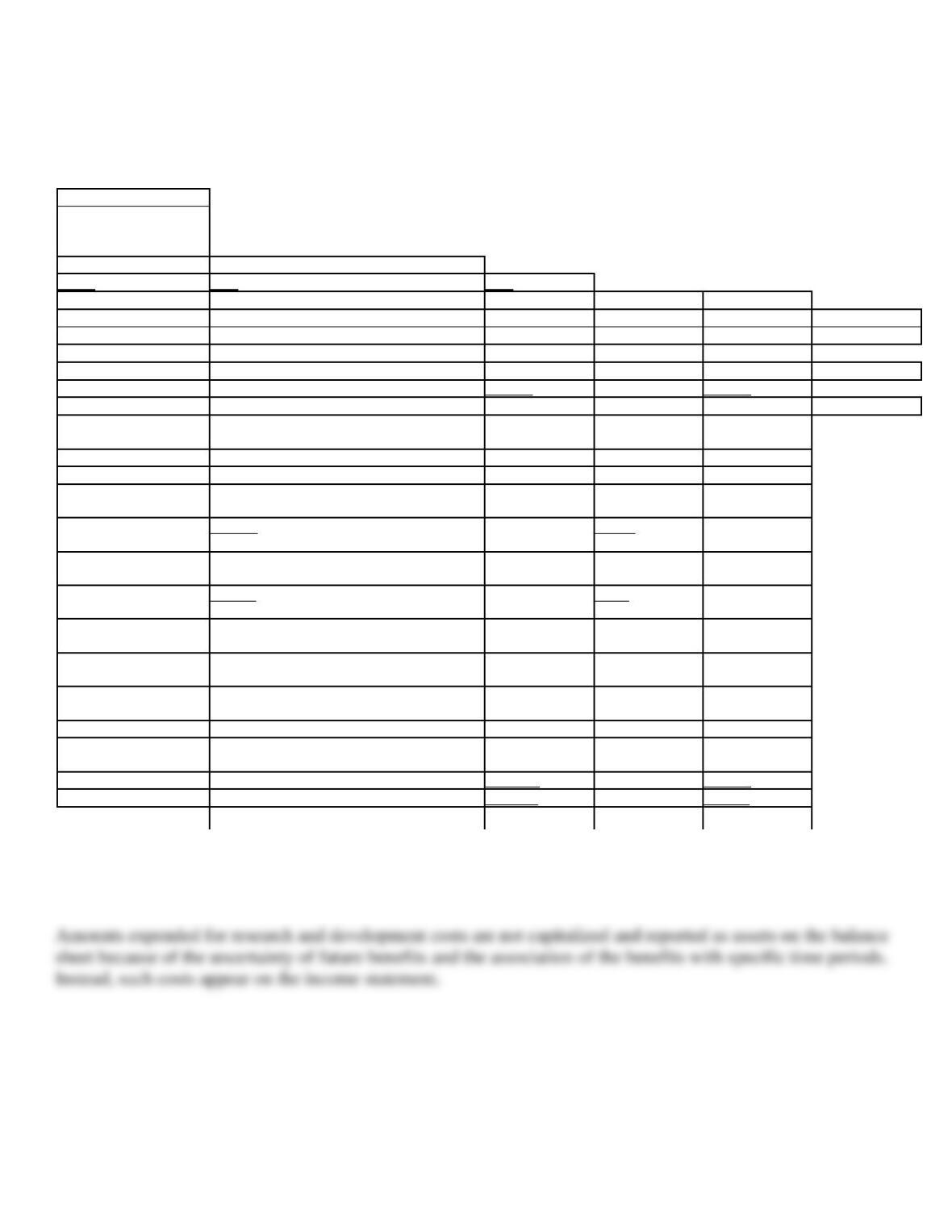
125. Fabulous Creations
The assets section of the company’s balance sheets for the years ended December 31, 2013 and 2012, is
provided below.
Fabulous Creations
Assets Section of
Consolidated Balance
Sheets (in millions)
at December 31,
Assets
2013
2012
Current Assets
Cash and equivalents
$ 719
$ 2,610
Short-term investments
0
886
Receivables, less allowances of $1,889 and $97
6,054
464
Inventories
1,791
0
Prepaid expenses and other current assets
1,710
711
Total Current Assets
$10,274
$ 4,671
Noncurrent inventories &
film costs
6,853
0
Investments
6,886
3,824
Land and buildings
$ 2,107
$ 440
Cable television
equipment
9,966
0
Furniture, fixtures, and
equipment
4,329
1,297
Property, plant, and
equipment
$16,402
$1,737
Less: Accumulated
depreciation
(3,718)
(696)
Property, plant, &
equipment (net)
12,684
1,041
Music catalogue, and
copyrights
2,927
0
Cable television and sport
franchises
27,109
0
Brands and trademarks
10,684
0
Goodwill and other
intangibles
128,338
713
Other assets
2,804
578
Total assets
$208,559
$10,827
Refer to Fabulous Creations. The company spends significant dollars on research and development initiatives each year to develop new products
that allow it to remain competitive. Yet, the company’s balance sheet does not reflect these costs. Why?
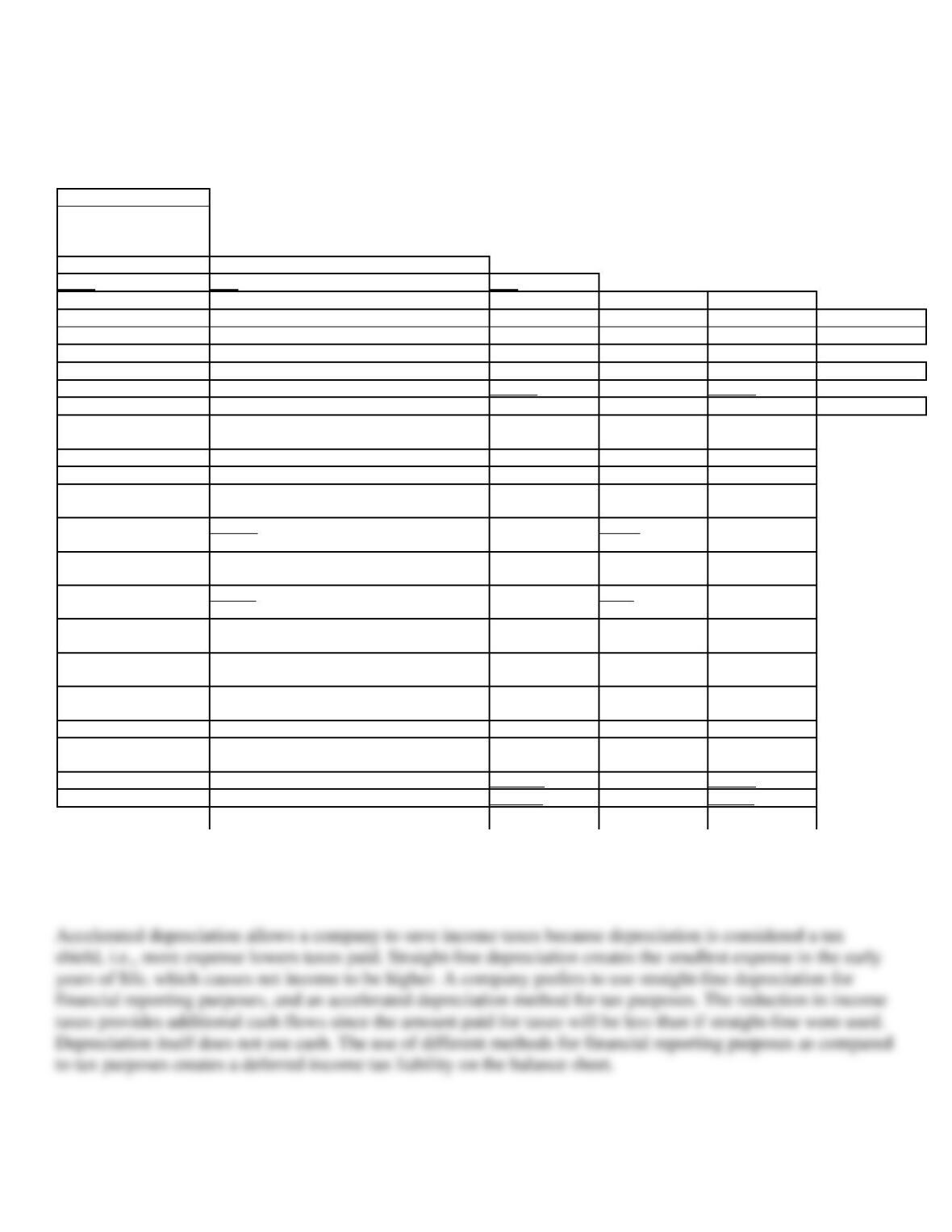
126. Fabulous Creations
The assets section of the company’s balance sheets for the years ended December 31, 2013 and 2012, is
provided below.
Fabulous Creations
Assets Section of
Consolidated Balance
Sheets (in millions)
at December 31,
Assets
2013
2012
Current Assets
Cash and equivalents
$ 719
$ 2,610
Short-term investments
0
886
Receivables, less allowances of $1,889 and $97
6,054
464
Inventories
1,791
0
Prepaid expenses and other current assets
1,710
711
Total Current Assets
$10,274
$ 4,671
Noncurrent inventories &
film costs
6,853
0
Investments
6,886
3,824
Land and buildings
$ 2,107
$ 440
Cable television
equipment
9,966
0
Furniture, fixtures, and
equipment
4,329
1,297
Property, plant, and
equipment
$16,402
$1,737
Less: Accumulated
depreciation
(3,718)
(696)
Property, plant, &
equipment (net)
12,684
1,041
Music catalogue, and
copyrights
2,927
0
Cable television and sport
franchises
27,109
0
Brands and trademarks
10,684
0
Goodwill and other
intangibles
128,338
713
Other assets
2,804
578
Total assets
$208,559
$10,827
Refer to Fabulous Creations. Explain the impact on net income and cash flows of using straight-line depreciation for financial reporting and
accelerated depreciation methods for income tax purposes.
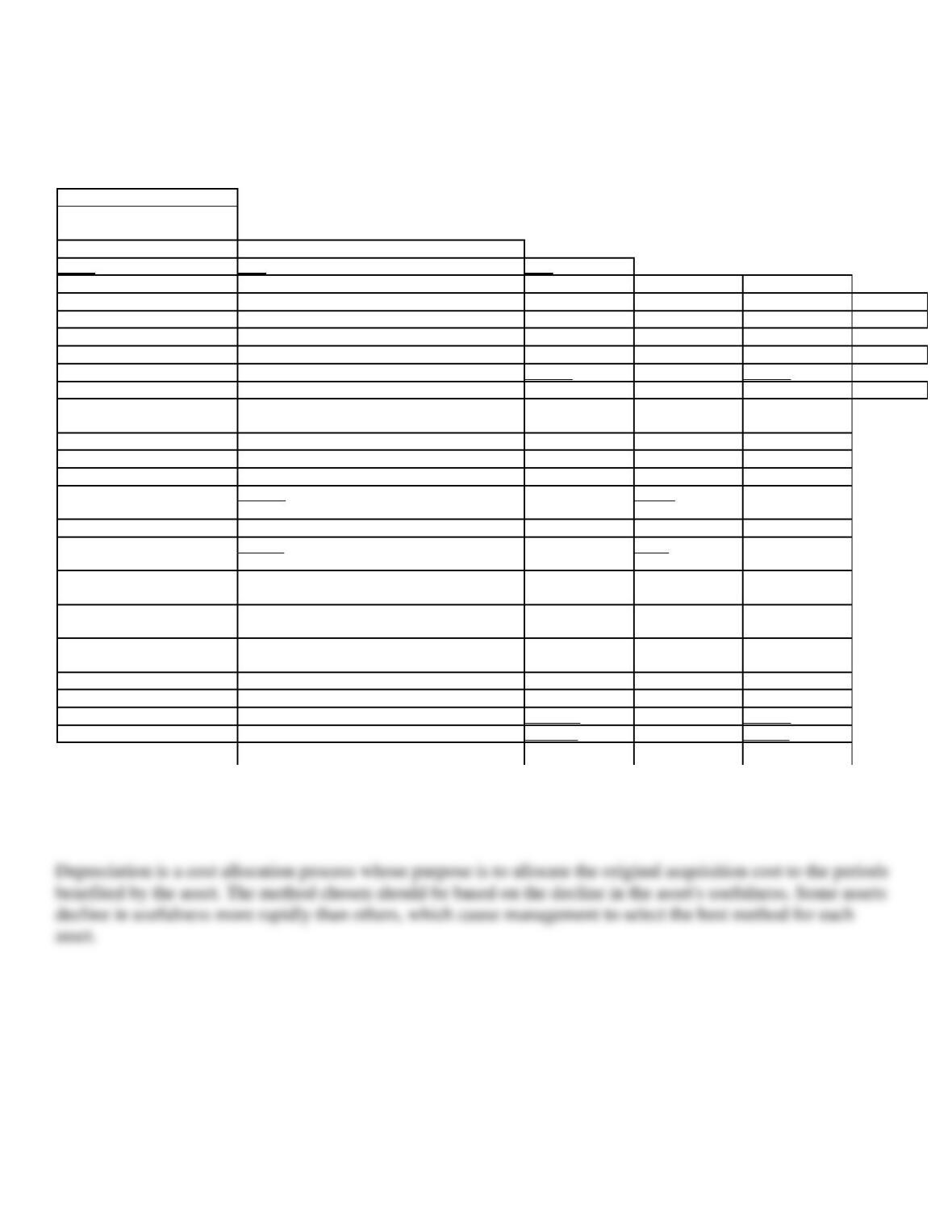
127. Fabulous Creations
The assets section of the company’s balance sheets for the years ended December 31, 2013 and 2012, is
provided below.
Fabulous Creations
Assets Section of Consolidated
Balance Sheets (in millions)
at December 31,
Assets
2013
2012
Current Assets
Cash and equivalents
$ 719
$ 2,610
Short-term investments
0
886
Receivables, less allowances of $1,889 and $97
6,054
464
Inventories
1,791
0
Prepaid expenses and other current assets
1,710
711
Total Current Assets
$10,274
$ 4,671
Noncurrent inventories & film
costs
6,853
0
Investments
6,886
3,824
Land and buildings
$ 2,107
$ 440
Cable television equipment
9,966
0
Furniture, fixtures, and
equipment
4,329
1,297
Property, plant, and equipment
$16,402
$1,737
Less: Accumulated
depreciation
(3,718)
(696)
Property, plant, & equipment
(net)
12,684
1,041
Music catalogue, and
copyrights
2,927
0
Cable television and sport
franchises
27,109
0
Brands and trademarks
10,684
0
Goodwill and other intangibles
128,338
713
Other assets
2,804
578
Total assets
$208,559
$10,827
Refer to Fabulous Creations. In the notes to the financial statements, the company indicates that it uses different depreciation methods for different
types of plant and equipment assets. Explain why the company might follow this policy.
128. Fanatics Company purchased a patent at the beginning of 2012 for $450,000. Economic benefits were
expected for only 10 years, but the patent’s legal life is 20 years. Also during 2012, the company incurred
research and development costs of $185,000.
A)
Determine the following amounts:
1.
Research and Development Expense for 2012
2.
Patent Amortization Expense for 2012
B)
Prepare the intangible assets section of the balance sheet
at December 31, 2012.
129. Farley Mills purchased new machinery at the beginning of 2012 for $200,000. The machines had an
estimated life of 5 years, an estimated residual value of $25,000, and were depreciated using the straight-line
method. At the beginning of 2013, the machines were sold for $150,000 because management was unhappy
with their performance.
Determine the following amounts:
A)
Book value of the machinery at the end of 2012.
B)
Gain (loss) on the disposal of the machinery at the beginning of 2013 (Indicate the amount and whether a gain or loss).
A)
Depreciation expense:
($200,000 – $25,000) / 5 years = $35,000
Book value:
$200,000 – $35,000 = $165,000
B)
$150,000 (proceeds) – $165,000 (book value) =
A)
Expense amounts for 2012
Research and development expense
$185,000
Patent amortization expense
45,000
Intangible Assets Section of Balance Sheet at December 31, 2012
Patents
$405,000
$450,000 – $45,000
130. Flossil Fossils Company purchased a tract of land containing coal in 2013 for $20,000,000 and then spent
$30,000,000 to get a mine ready for operation. The company estimates that there will be 10,000,000 tons of coal
available over the next 10 years. The land has a residual value of $500,000. During 2013, 1,000,000 tons of coal
were mined.
A)
Compute the cost of the natural resource and the depletion rate.
B)
Record the journal entry for the 2013 depletion.
131. Fields of Green, a turf farm, purchased equipment at the beginning of 2012 for $175,000. In addition, the
company paid $6,000 for delivery of the equipment and $4,000 for set up charges. The equipment has an
estimated residual value of $5,000 and an estimated life of 10 years or 50,000 hours of operation. The
equipment was operated for 5,200 hours in 2012 and 5,000 hours in 2013.
A)
Compute the depreciation expense for 2012 using the:
– straight line method;
– units-of-production method;
– double-declining-balance method
B)
Compute the book value of the equipment on December 31, 2013, assuming the use of:
– straight line method;
– units-of-production method; and
– double-declining-balance method
C)
Which method of depreciation produces the greatest total amount of depreciation?
D)
Which method of depreciation is considered accelerated?
E)
What are the advantages of using an accelerated depreciation method as compared to the straight-line method?
C)
All depreciation methods yield the same amount of total depreciation.
D)
Double-declining balance is an accelerated method.
Accelerated depreciation allocates more expense to the earlier accounting periods than straight-line depreciation. Accelerated
used.
B)
December 31, 2013
Inventory
4,950,000
Accumulated Depletion—coal mine
1,000,000 ´ $4.95 = $4,950,000
132. Finnegan’s Fixtures purchased molding machines at the beginning of 2012 for $10,000. The machines
have an estimated residual value of $2,000 and an estimated life of 5 years or 50,000 hours of operation. The
company is considering alternative depreciation methods. Calculate the following:
A)
Accumulated depreciation at December 31, 2013, using the straight-line depreciation method.
B)
Depreciation expense for 2012 using the units-of-production depreciation method. Assume that the machines are operated for 5,000
hours in 2012 and 8,000 hours in 2013.
C)
Book value of the equipment at December 31, 2013, using the double-declining-balance depreciation method.
D)
What are the advantages of using straight-line depreciation for financial reporting purposes?
133. Fiona’s Italian Market purchased a delivery truck for deliveries for $25,000 at the beginning of 2012. The
truck has an estimated life of 5 years, and an estimated residual value of $5,000. The company plans to use the
straight-line depreciation method. At the beginning of 2013, the company spent $4000 to replace the truck’s
transmission. This resulted in a 2-year extension of useful life, but no change in residual value.
A)
What type of cost is the $4,000? Explain.
B)
Calculate the asset’s book value at the end of 2012.
C)
Calculate depreciation expense for 2013.
B)
Depreciation:
Book value:
C)
($21,000 + $4,000 – $5,000) / 6 years = $3,333
A)
Depreciation per year:
($10,000 – $2,000) / 5 = $1,600
Total at 12/31/10:
$1,600 ´ 2 years* = $3,200
*
2012 and 2013
$.16 ´ 5,000 = $800
C)
2012:
$10,000 ´ (1/5 ´ 2) = $4,000
2013:
$6,000 ´ .40 = $2,400
Total accumulated depreciation:
$4,000 + $2.400 = $6,400
Book value:
$10,000 – $6,400 = $3,600
134. Distinguish between current assets and operating assets.
135. Explain the meaning or significance of the following ratios:
A)
Fixed asset turnover ratio
B)
Average age of property, plant, and equipment
A)
Measures how efficiently a company is using its fixed assets.
The average age indicates how old the plant assets are.
136. Distinguish between tangible and intangible operating assets.
137. Explain what costs are included in the acquisition cost of operating assets.
138. Describe the process that allocates the costs of the tangible and intangible operating assets to expense.
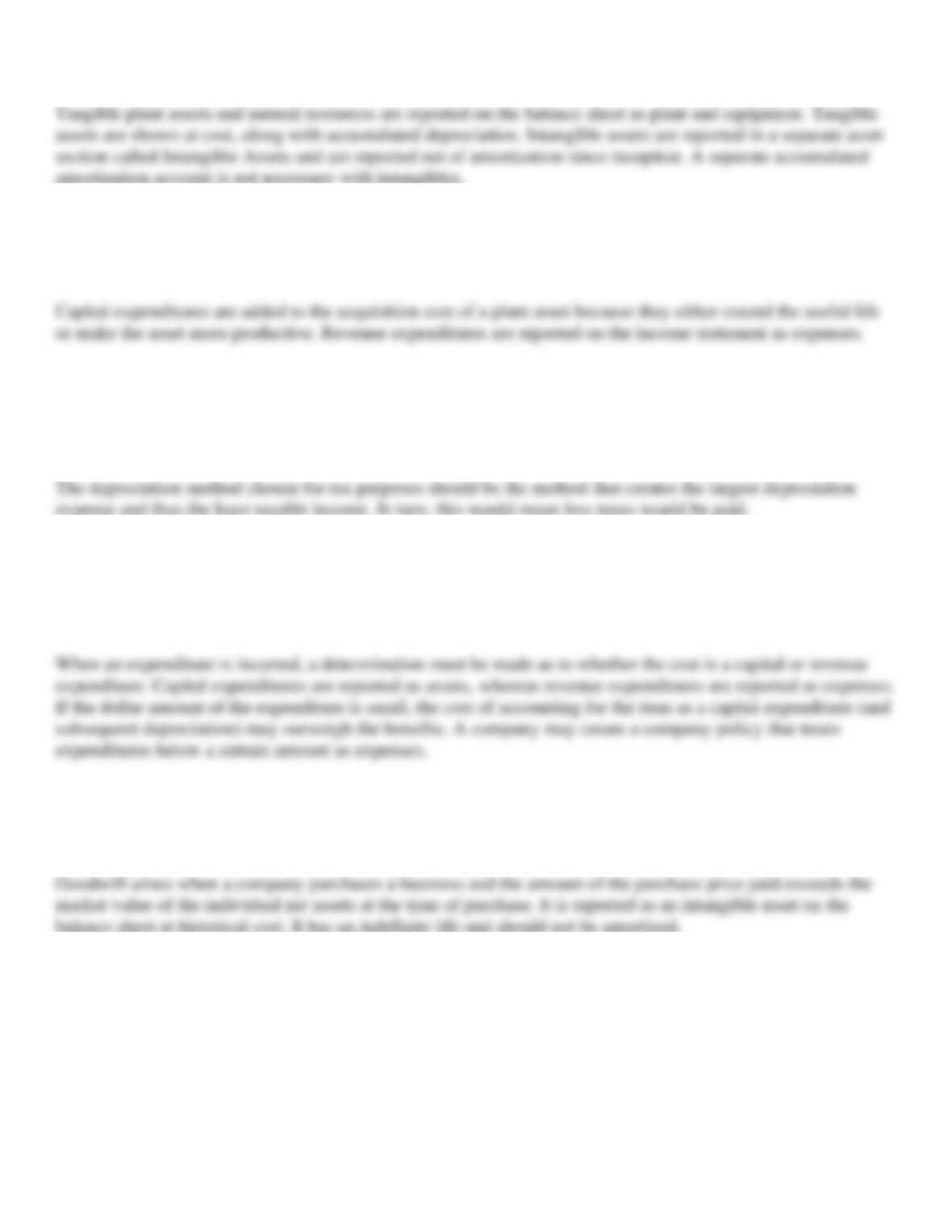
139. Explain how the costs associated with operating assets are reported on the balance sheet.
140. Distinguish between capital and revenue expenditures.
141. Describe the relationship between the depreciation method chosen and income taxes paid in the early years
of asset life.
142. What impact does materiality have on the determination of how a cost related to a plant asset is reported on
the financial statements?
143. How does goodwill arise? How is it accounted for and reported on the financial statements?
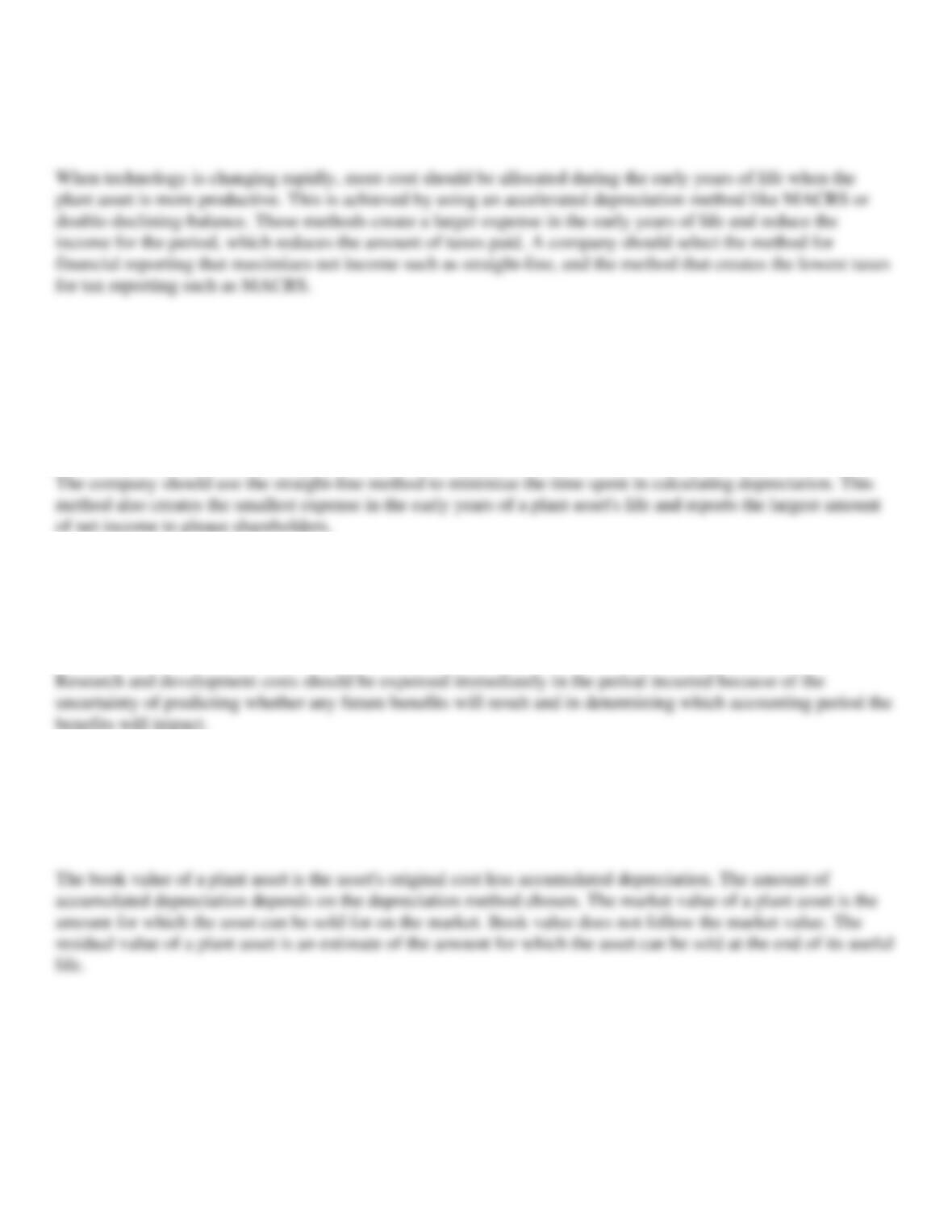
144. A research consortium has a large portion of its plant assets concentrated in an area where technology is
rapidly changing. The organization wants to minimize taxable income and maximize net income reported to
shareholders. Recommend a course of action for accomplishing this objective and provide support for your
recommendation.
145. A company wants to minimize the amount of time and effort its bookkeepers spend on calculating
depreciation. Since the company has not been profitable, taxes are not an issue, but maximizing the profit and
minimizing reported losses are major objectives. Recommend a course of action for this company and provide
support for your recommendation.
146. How are research and development costs reported in the financial statements? Why is this treatment
required?
147. What is the relationship between the book value of a plant asset, the market value of the plant asset, and
the salvage value of a plant asset? Explain.
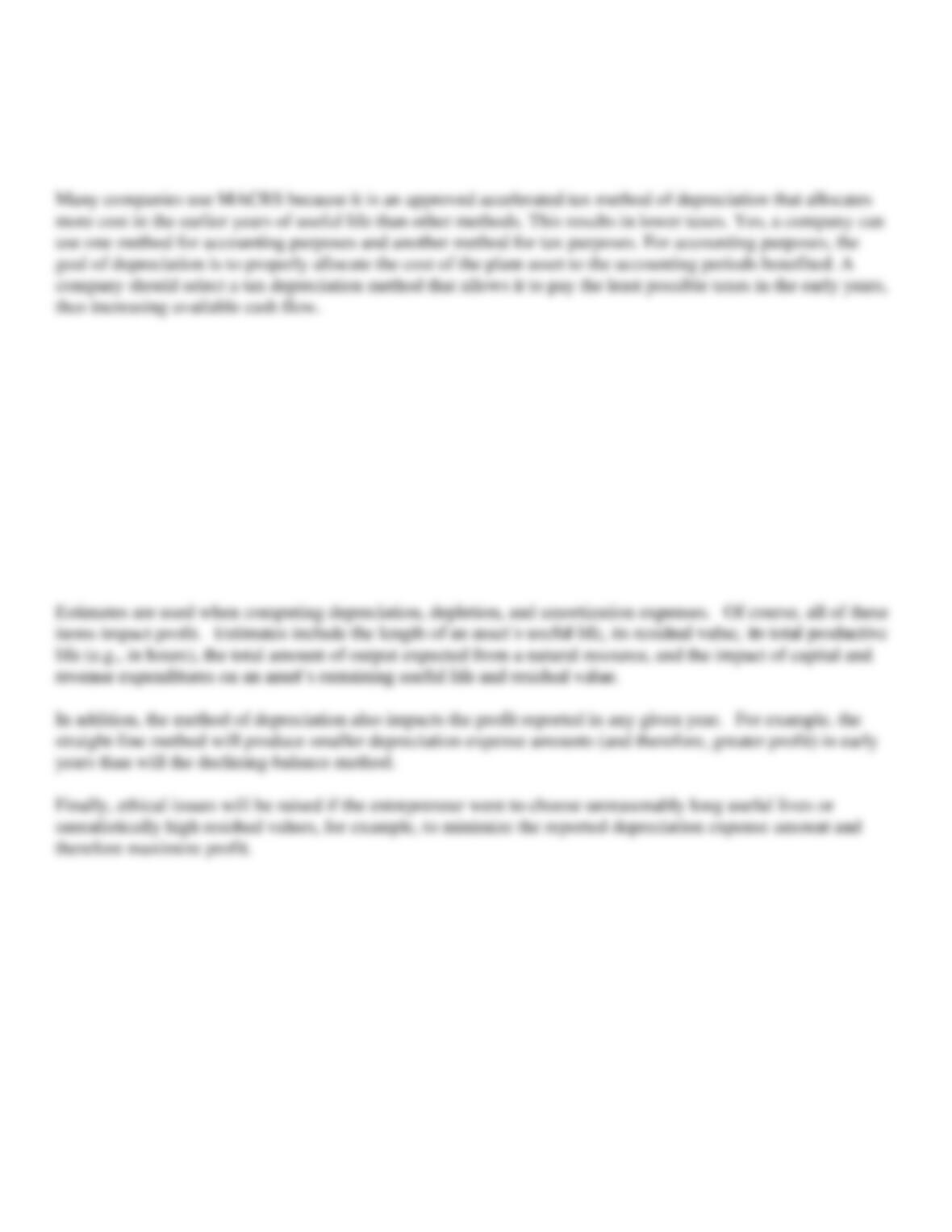
148. Why do many companies use MACRS (Modified Accelerated Cost Recovery System) depreciation for tax
purposes?
If a company uses MACRS for depreciation for tax purposes, can it use a different method for financial
reporting? Explain why or why not.
149. “You Decide” Essay
You are an entrepreneur with a great idea for a new business. In order to obtain financing, the loan officer at
First Second Third National Bank has requested a budgeted set of financial statements. An accountant friend of
yours has mentioned that there are several options associated with plant assets that are available to help you
improve your budgeted income.
Describe several decisions concerning property, plant, and equipment that have an impact on reported net
income. Are there any ethical concerns in this area?
150. “You Decide” Essay
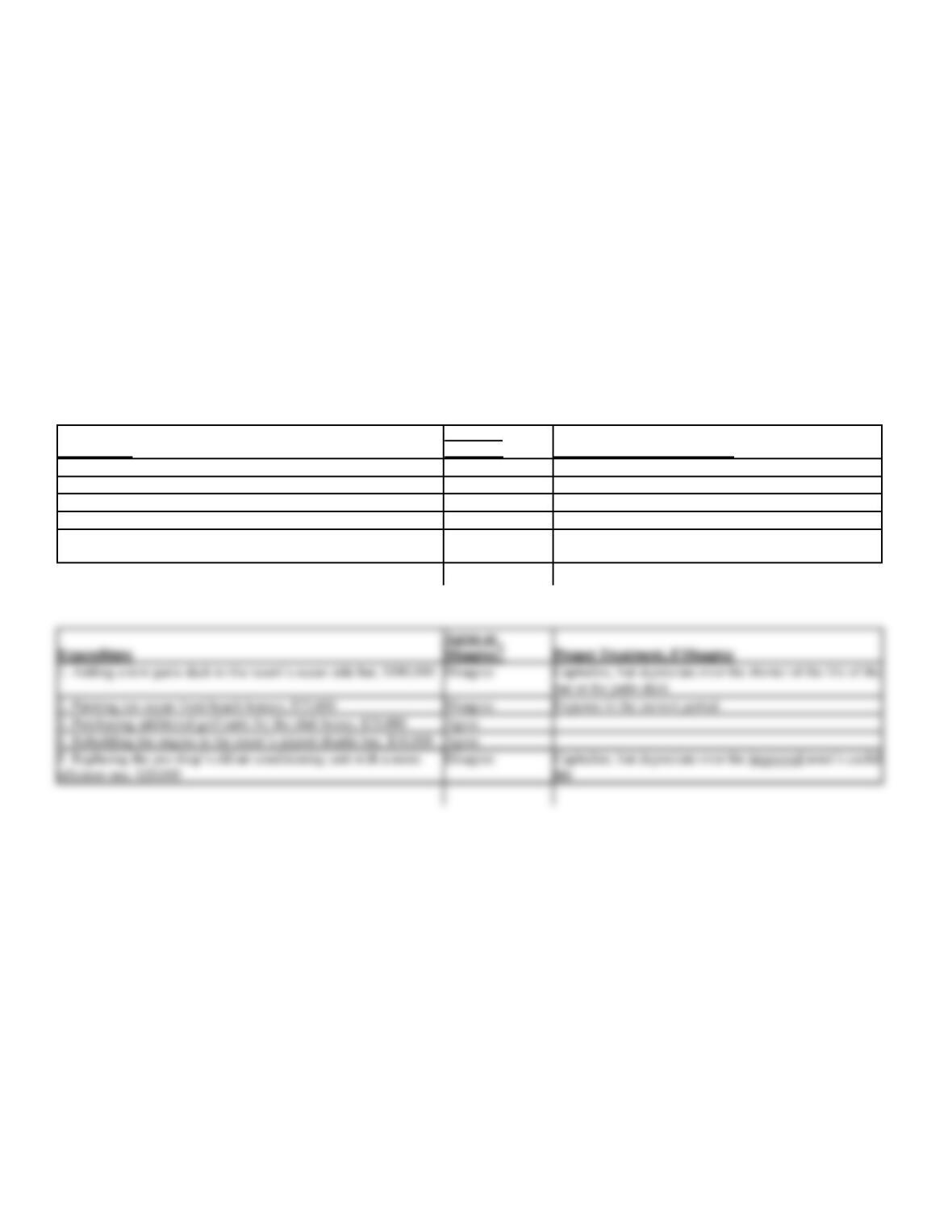
You are Chief Financial Officer for Five Star Resorts, Inc. You are reviewing the following transactions:
1. Adding a new patio deck to the resort’s upscale restaurant, $180,000
2. Painting the ocean side beach houses, $75,000
3. Purchasing additional golf carts, $25,000
4. Rebuilding the engine in the resort’s airport shuttle bus, $10,000
5. Replacing the old air conditioning unit in the golf shop with a more efficient one, $20,000
Your accountant has capitalized all of these items and intends to depreciate them over the appropriate asset’s
remaining useful life as originally estimated.
Indicate whether you agree or disagree with your accountant’s treatment of each item. In those cases where you
disagree, state the proper treatment of that expenditure. Use the following table:
Expenditure
Agree or
Disagree?
Proper Treatment, if Disagree
1. Adding a new patio deck to the resort’s ocean side bar, $180,000
2. Painting ten ocean front beach houses, $75,000
3. Purchasing additional golf carts for the club house, $25,000
4. Rebuilding the engine in the resort’s airport shuttle bus, $10,000
5. Replacing the pro shop’s old air conditioning unit with a more
efficient one, $20,000
1. Adding a new patio deck to the resort’s ocean side bar, $180,000
Disagree
Capitalize, but depreciate over the shorter of the life of the
bar or the patio deck
2. Painting ten ocean front beach houses, $75,000
Disagree
Expense in the current period
3. Purchasing additional golf carts for the club house, $25,000
Agree
4. Rebuilding the engine in the resort’s airport shuttle bus, $10,000
Agree
life