Chapter 7: Allocating Costs of Support Departments and Joint Products
87. Evergreen Company has two support departments (S1 and S2) and two producing departments (P1 and P2).
Department S1 costs are allocated on the basis of number of employees, and Department S2 costs are allocated on
the basis of space occupied expressed in square feet.
Data on direct department costs, number of employees, and space occupied are as follows:
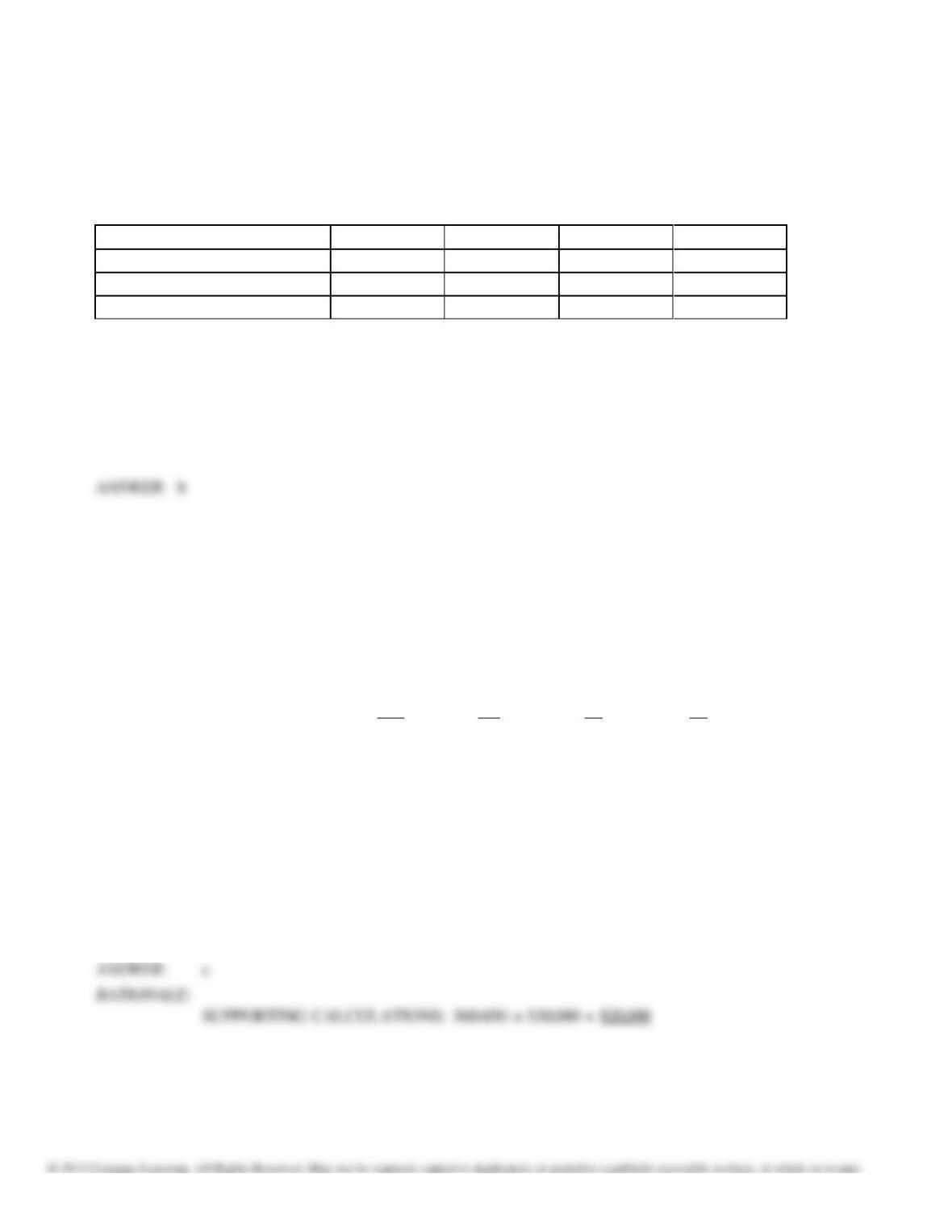
S1
S2
P1
P2
Direct dept. costs
$7,500
$11,000
$27,500
$30,000
Number of employees
10
5
20
25
Space occupied (sq. ft.)
1,000
500
1,500
2,500
If Evergreen uses the direct method, the ratio representing the portion of Department S2 allocated to P1 is
a. 1,500/5,000.
b. 1,500/4,000.
c. 1,500/5,500.
d. 1,500/2,000.
Figure 7-6
Golden Leaves Company has two support departments, Maintenance Department (MD) and Personnel Department
(PD), and two producing departments, P1 and P2. The Maintenance Department costs of $30,000 are allocated on
the basis of standard service used. The Personnel Department costs of $4,500 are allocated on the basis of number
of employees. The direct costs of Departments P1 and P2 are $9,000 and $15,000, respectively.
Data on standard service hours and number of employees are as follows:
MD
PD
P1
P2
Standard service hours used
100
50
300
150
Number of employees
10
20
90
90
Direct labor hours
50
50
250
250
88. Refer to Figure 7-6. Using the direct method, the cost of the Maintenance Department allocated to Department P1
is
a. $15,000.
b. $10,000.
c. $20,000.
d. $30,000.
Chapter 7: Allocating Costs of Support Departments and Joint Products
89. Refer to Figure 7-6. Using the direct method, the cost of the Personnel Department allocated to Department P1 is
a. $2,250.
b. $4,500.
c. $2,132.
d. $2,700.
90. Refer to Figure 7-6. Using the sequential method, if the support department with the highest percentage of
interdepartmental service is allocated first, the cost of the support departments allocated to Department P1 is
a. $12,750.
b. $24,000.
c. $21,750.
d. $20,295.
91. Refer to Figure 7-6. Using the sequential method, if the support department with the highest percentage of
interdepartmental service is allocated first, the cost of the Maintenance Department allocated to Department P1 is
a. $20,000.
b. $30,000.
c. $4,500.
d. $18,000.
92. Refer to Figure 7-6. What is the combined total department costs for the producing departments after allocation of
the support departments?
a. $24,000
b. $34,500
c. $58,500
d. $26,000
Chapter 7: Allocating Costs of Support Departments and Joint Products
Department X
12,000
Department Y
4,000
Total hours
16,000
Actual support department costs
$48,000
Budgeted fixed department costs
$20,000
Budgeted variable rate per hour
$2.50
93. Refer to Figure 7-6. What are the total overhead costs associated with P2 after allocating the Maintenance and
Personnel Departments using the direct method?
a. $37,250
b. $27,250
c. $25,000
d. $15,000
94. Andover, Inc., has two producing departments. Each producing department is held responsible for a share of the costs
of a support department.
Actual and budgeted data are as follows: Support department hours used:
Support department costs:
Normal support department usage is 8,000 hours each for Department X and Department Y. Assuming the direct
method is used and the purpose is performance evaluation, support department costs allocated to Department X are
a. $45,000.
b. $36,400.
c. $40,000.
d. $36,000.
Chapter 7: Allocating Costs of Support Departments and Joint Products
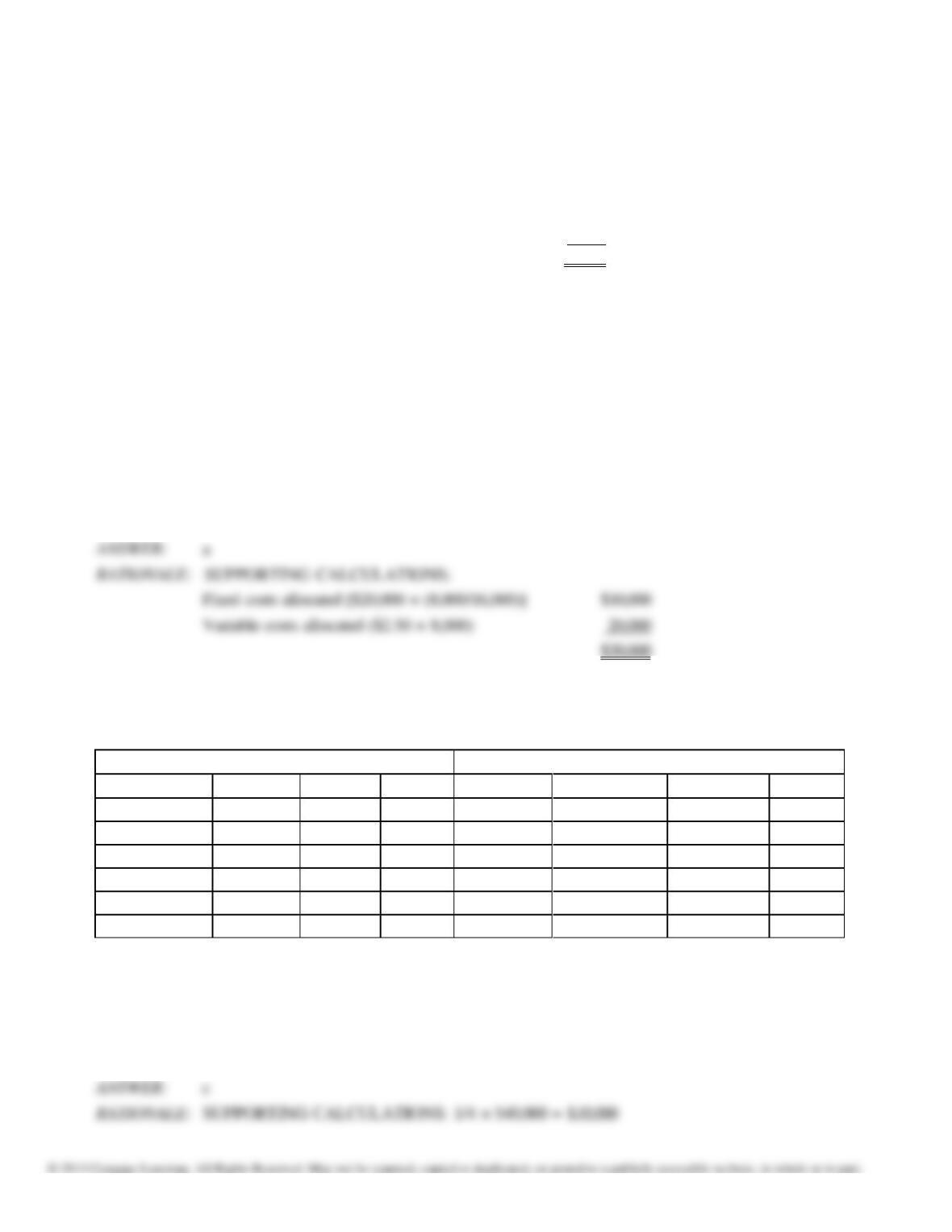
Actual support department costs
$48,000
Budgeted fixed department costs
$20,000
Budgeted variable rate per hour
$2.50
95. Andover,, Inc., has two producing departments. Each producing department is held responsible for a share of the
costs of a support department.
Actual and budgeted data are as follows:
Support department hours used:
Department L
12,000
Department M
4,000
Total hours
16,000
Support department costs:
Normal support department usage is 8,000 hours each for Department L and Department M. Assuming the direct
method is used and the purpose is product costing, support department costs allocated to Department L are
a. $30,000.
b. $20,400.
c. $24,800.
d. $20,000.
96. Astoria Savings & Loans of New York has three revenue-generating departments: Consumer accounts, Commercial
accounts, and Loans. The bank also has three service areas: administration, personnel, and accounting. The direct
costs per month and the interdepartmental service structure are shown below:
Percentage of Service Used by
Dept.
Costs
Admin.
Pers.
Acctg.
Consumer
Comm’l
Loans
Administration
$40,000
–
10
10
40
20
20
Personnel
23,000
10
–
10
20
40
20
Accounting
30,000
10
10
–
20
20
40
Consumer
41,000
Commercial
25,000
Loans
16,000
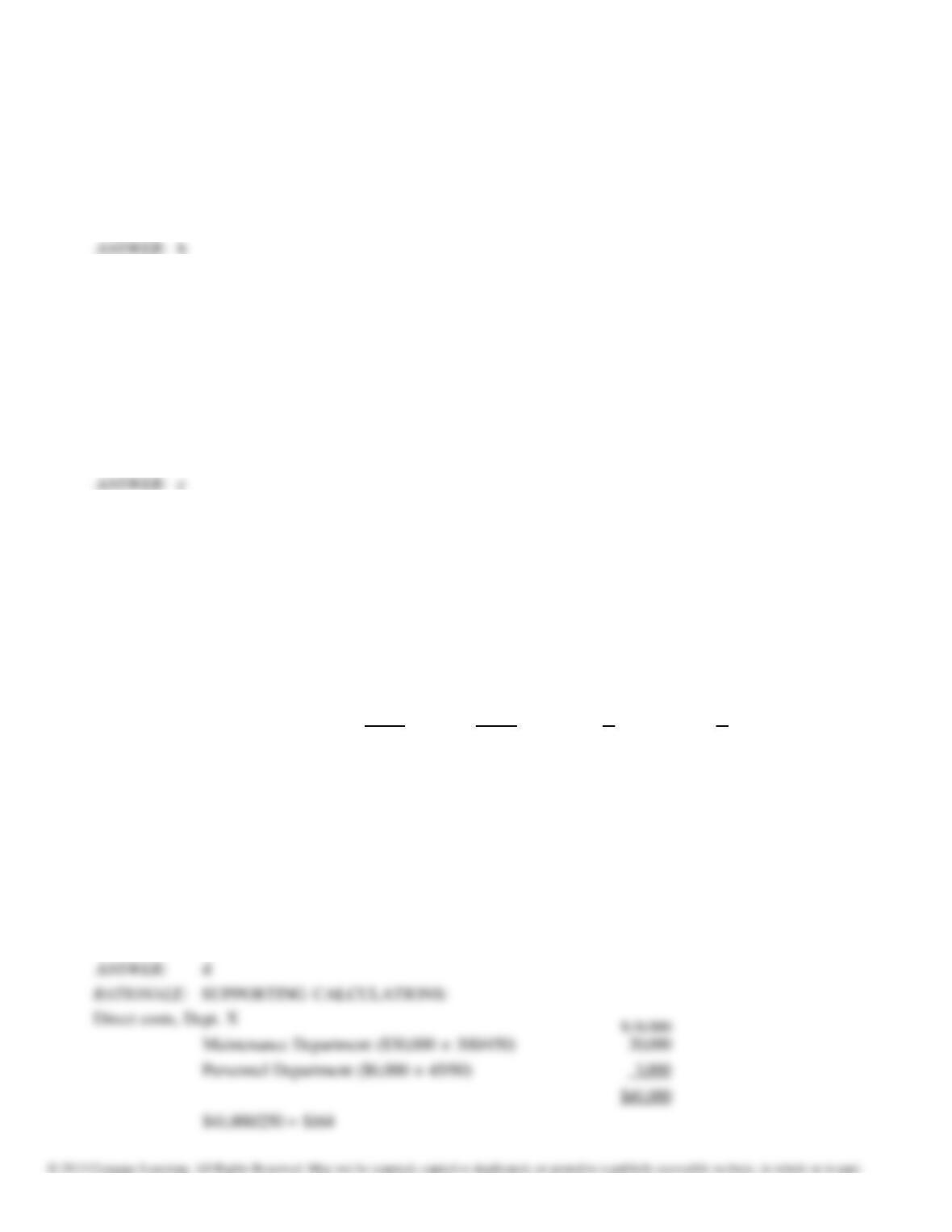
How much cost would be allocated to the Commercial account area from administration using the direct method?
a. $40,000
b. $5,000
c. $10,000
d. $20,000
Chapter 7: Allocating Costs of Support Departments and Joint Products
97. Which of the following allocation methods assumes “stepdown” interdepartmental services?
a. direct method
b. sequential method
c. reciprocal method
d. all of the above
98. Which of the following would NOT be a criteria used to rank departments to determine order of allocation under the
sequential method?
a. Rank the supporting departments in order of the amount of service rendered, from the greatest to the least.
b. Rank the supporting departments in order of the support services rendered, measured by the direct costs of each
support department with the department with the highest cost rendering the greatest service.
c. Determine the total cost of a support department, both direct and allocated from other support departments, before
ranking.
d. Rank the supporting departments based on a percentage of service they render to other service departments.
99. Lennon Company has two support departments, Maintenance Department and Personnel Department, and two
producing departments, X and Y. The Maintenance Department costs of $30,000 are allocated on the basis of
standard service used. The Personnel Department costs of $6,000 are allocated on the basis of number of employees.
The direct costs of Departments X and Y are $18,000 and $30,000, respectively.
Data on standard service hours and number of employees are as follows:
Maint.
Person.
Dept.
Dept.
Standard service hours used
Dept.
100
Dept.
50
X
300
Y
150
Number of employees
5
10
45
45
Direct labor hours
50
50
250
250
Predetermined overhead rates for Departments X and Y, respectively, are based on direct labor hours.
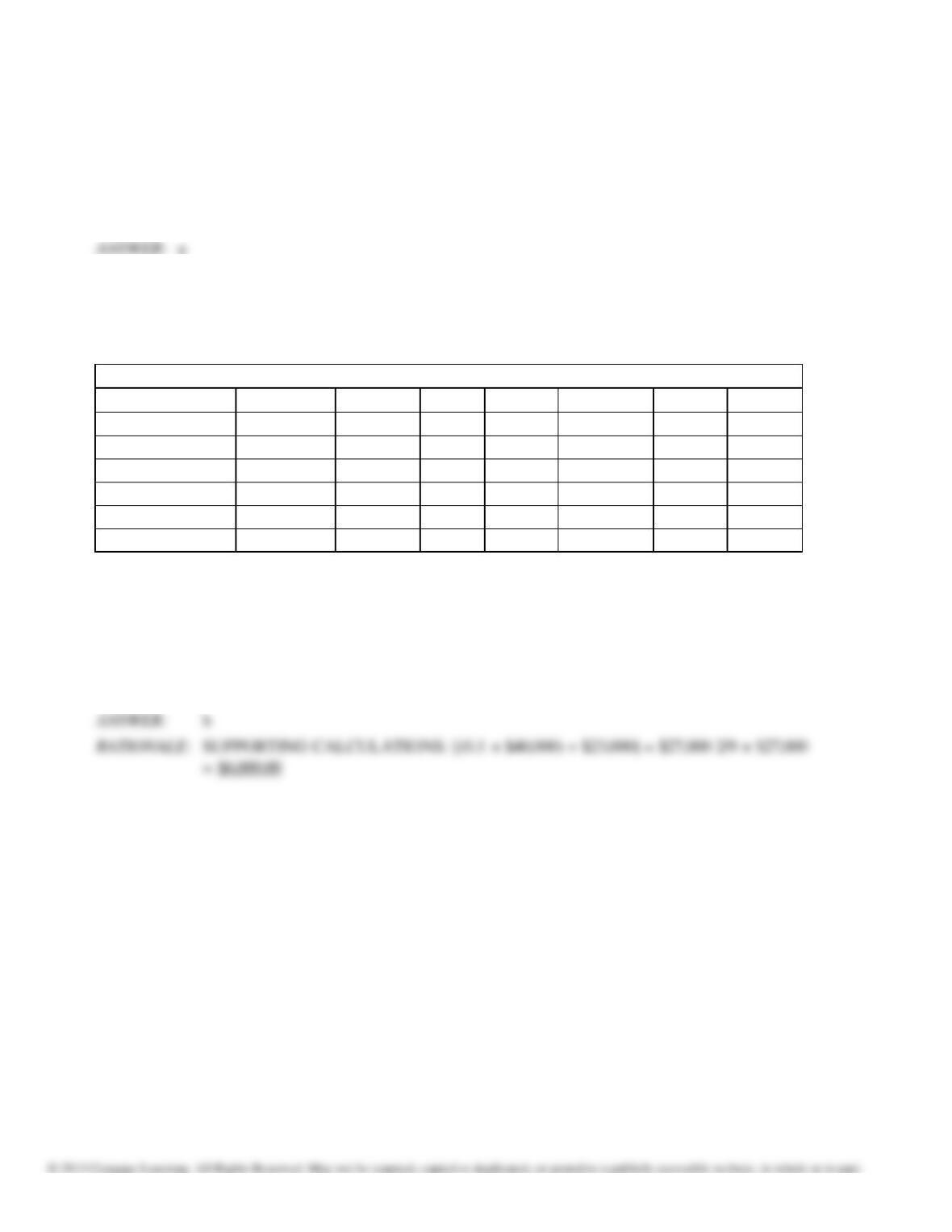
What is the overhead rate for Department X assuming the direct method is used?
a. $47.00
b. $82.00
c. $152.00 d. $164.00
Chapter 7: Allocating Costs of Support Departments and Joint Products
100. Which of the following allocation methods fully recognizes services that support departments provide to each other?
a. reciprocal method
b. sequential method
c. direct method
d. all of the above
101. The Savings Bank of Sarasota has three revenue-generating departments: checking accounts, savings accounts, and
loans. The bank also has three service areas: administration, personnel, and accounting. The direct costs per month
and the interdepartmental service structure are shown below:
Percentage of Service Used by
Dept.
Costs
Admin.
Pers.
Acctg.
Check.
Sav.
Loans
Administration
$40,000
–
10
10
40
20
20
Personnel
23,000
10
–
10
20
40
20
Accounting
30,000
10
10
–
20
20
40
Checking
41,000
Savings
25,000
Loans
16,000
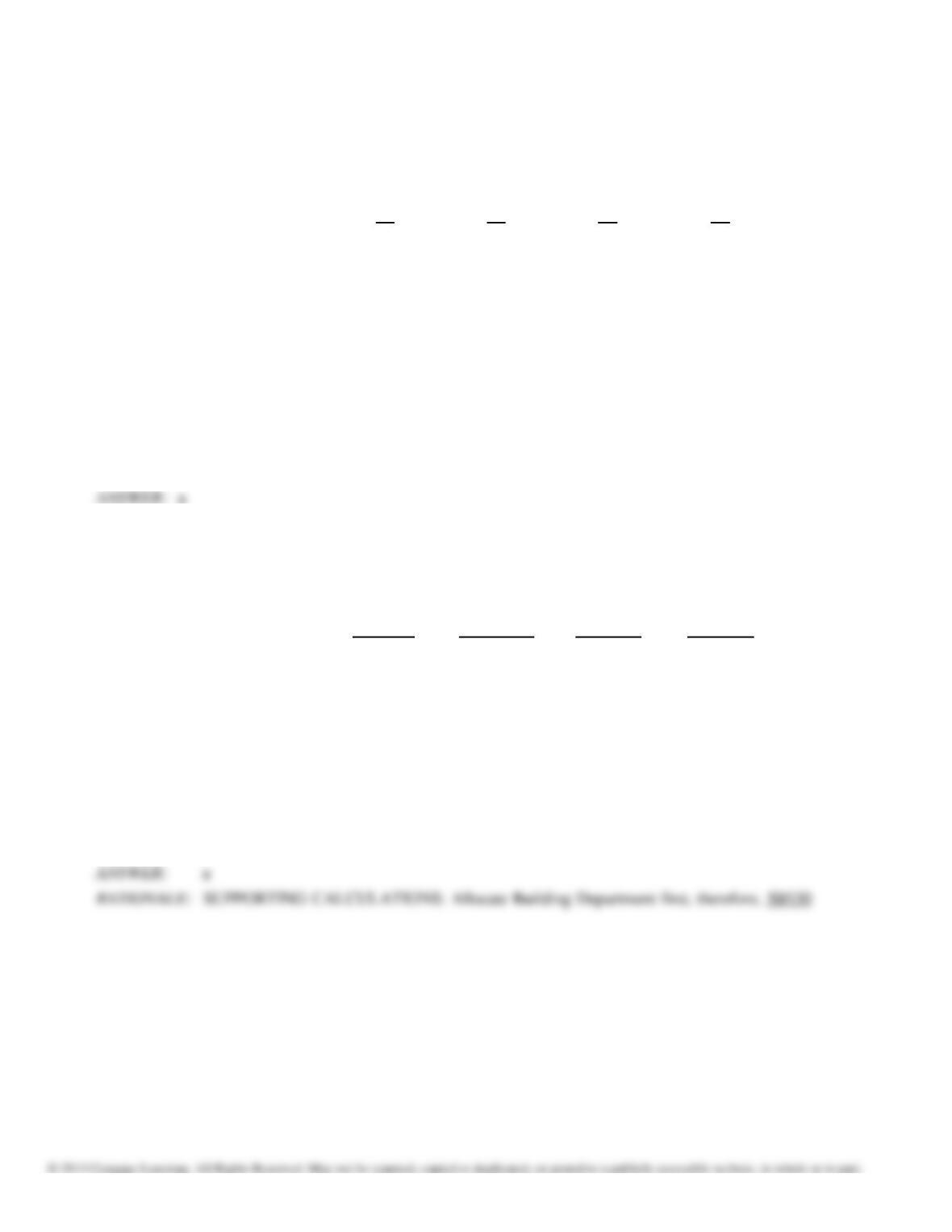
The Savings Bank of Sarasota uses the sequential (step) method and the service departments are allocated in the
following order: administration, personnel, and accounting. How much cost would be allocated to the loan area from
the personnel department using the sequential/step method? (Round to two decimal places.)
a. $4,600.00
b. $6,000.00
c. $5,111.11
d. $7,666.67
Chapter 7: Allocating Costs of Support Departments and Joint Products
102. Tec–Pro Company has two support departments (S1 and S2) and two producing departments (P1 and P2).
Department S1 costs are allocated on the basis of number of employees, and Department S2 costs are allocated on
the basis of space occupied expressed in square feet.
Data on direct department costs, number of employees, and space occupied are as follows:
S1
S2
P1
P2
Direct dept. costs
$7,500
$11,000
$27,500
$30,000
Number of employees
10
5
20
25
Space occupied (sq. ft.)
1,000
500
1,500
2,500
When Tec-Pro uses the sequential method, the support department allocated first is the one with the highest
percentage of interdepartmental service. The choice of the department allocated first is determined by the
comparison of the following ratio for S1 and S2, respectively:
a. 5/50; 1,000/5,000
b. 5/60; 1,000/5,500
c. 10/50; 1,000/5,000
d. 10/55; 500/4,500
103. McHugh Company allocates common Building Department costs to producing departments (P1 and P2) based on
space occupied, and it allocates common Personnel Department costs based on the number of employees. Space
occupancy and employee data are as follows:
Building
Personnel
Dept. P1
Dept. P2
Space occupied
2,000 ft.
10,000 ft.
120,000 ft.
70,000 ft.
Employees
6
10
80
50
If McHugh Company uses the sequential allocation method and the support department with the highest percentage
of interdepartmental services is allocated first, the ratio representing the portion of Personnel Department costs
allocated to Department P2 is
a. 50/130.
b. 90/140.
c. 50/140.
d. 50/146.
Chapter 7: Allocating Costs of Support Departments and Joint Products
104. Rodriguez Manufacturing prices its products at full cost plus 40 percent. The company operates two support
departments and two producing departments. Budgeted costs and normal activity levels are as follows:
Support Departments
Producing Departments
A
B
C
D
Overhead costs
$20,000
$50,000
$90,000
$120,000
Square feet
2,000
2,400
4,000
12,000
Number of employees
20
30
60
40
Direct labor hours
–
–
10,000
6,400
Machine hours
–
–
6,000
10,800
Support Department A’s costs are allocated based on square feet, and Support Department B’s costs are allocated
based on number of employees. Department C uses direct labor hours to assign overhead costs to products, while
Department D uses machine hours.
One of the products the company produces requires 4 direct labor hours per unit in Department C and no time in
Department D. Direct materials for the product cost $45 per unit, and direct labor is $20 per unit.
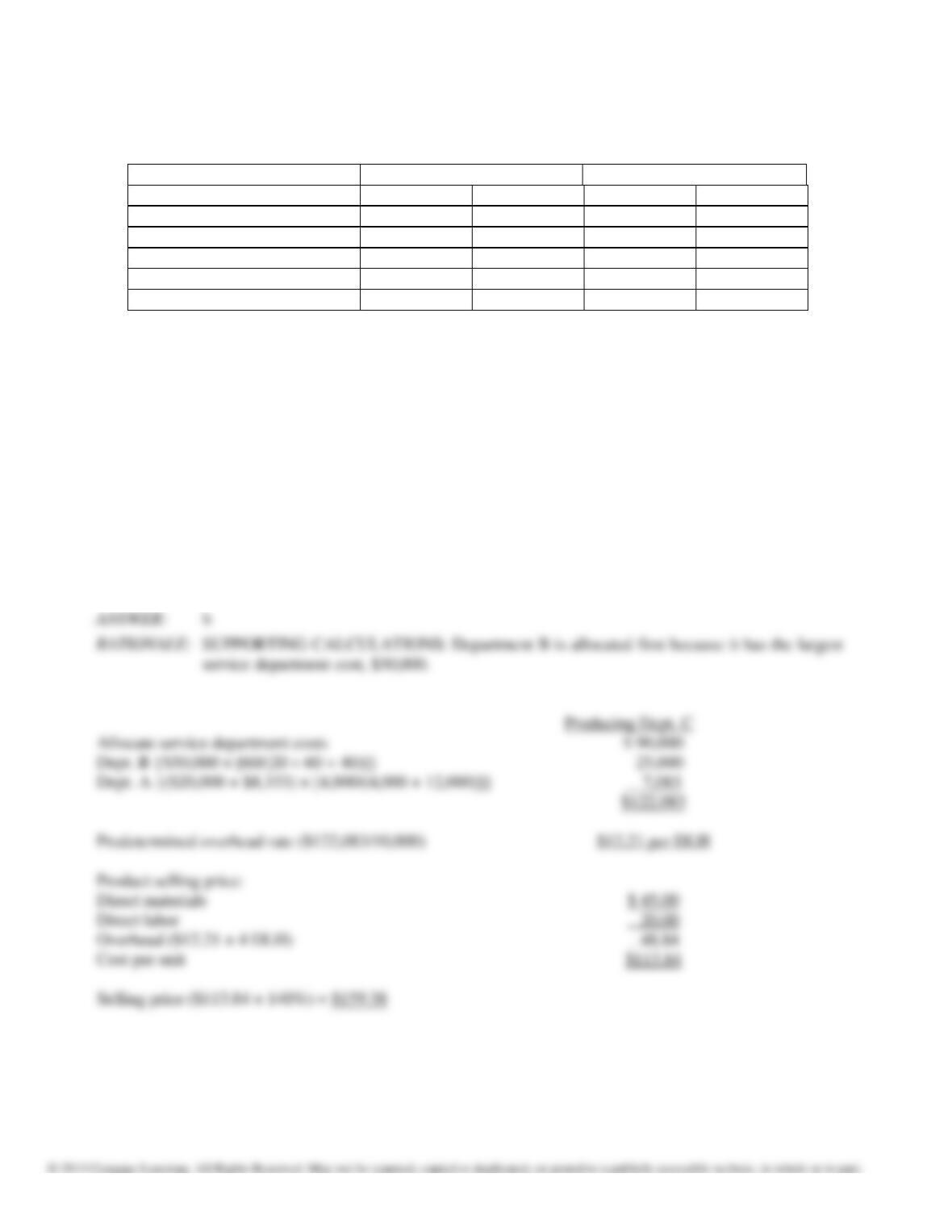
If the sequential method of allocation is used and the company follows its usual pricing policy, the selling price of the
product would be (round service allocations to the nearest whole dollar and the costs per unit to two decimal places)
a. $113.52.
b. $159.38.
c. $108.46.
d. $162.52.
Chapter 7: Allocating Costs of Support Departments and Joint Products
105. Oxide Company has two support departments (S1 and S2) and two producing departments (X and Y). Department S1
serves Departments S2, X, and Y in the following percentages, respectively: 10%, 35%, 55%. Department S2 serves
Departments S1, X, and Y in the following percentages, respectively: 6%, 50%, and 44%. Direct department costs for
S1, S2, X, and Y are $15,000, $8,000, $105,000, and $97,500, respectively.
What is S1′s cost equation?
a. S1 = $8,000 + 0.10S2
b. S1 = $8,000 + 0.06S2
c. S1 = $15,000 + 0.10S2
d. S1 = $15,000 + 0.06S2
106. Oxide Company has two support departments (S1 and S2) and two producing departments (X and Y). Department S1
serves Departments S2, X, and Y in the following percentages, respectively: 10%, 35%, 55%. Department S2 serves
Departments S1, X, and Y in the following percentages, respectively: 6%, 50%, and 44%. Direct department costs for
S1, S2, X, and Y are $15,000, $8,000, $105,000, and $97,500, respectively.
What is S2′s cost equation?
a. S2 = $8,000 + 0.10S1
b. S2 = $8,000 + 0.06S1
c. S2 = $15,000 + 0.10S1
d. S2 = $15,000 + 0.06S1
107. Hunghi Company has three support departments whose direct department costs are $35,000, $45,000, and $55,000,
respectively, and two producing departments whose direct department costs are $400,000 and $360,000, respectively.
The combined total department cost for the producing departments after allocation of the support departments is
a. $360,000.
b. $760,000.
c. $895,000.
d. $135,000.
Chapter 7: Allocating Costs of Support Departments and Joint Products
108. Howard Company has two support departments (S1 and S2) and two producing departments (P1 and P2).
Department S1 costs are allocated on the basis of number of employees, and Department S2 costs are allocated on
the basis of space occupied expressed in square feet.
Data on direct department costs, number of employees, and space occupied are as follows:
S1
S2
P1
P2
Direct dept. costs
$7,500
$11,000
$27,500
$30,000
Number of employees
10
5
20
25
Space occupied (sq. ft.)
1,000
500
1,500
2,500
If Howard used the reciprocal method, the algebraic equation expressing the total costs allocated from S1 is
a. S1 = $7,500 + 0.10S2.
b. S1 = $7,500 + 0.20S2.
c. S1 = $10,000 + 0.20S2.
d. S1 = $10,000 + 0.10S2.
109. Abound Company has two support departments (S1 and S2) and two producing departments (X and Y).
Department S1 serves Departments S2, X, and Y in the following percentages, respectively: 10%, 35%, 55%.
Department S2 serves Departments S1, X, and Y in the following percentages, respectively: 6%, 50%, and 44%.
Direct department costs for S1, S2, X, and Y are $15,000, $8,000, $105,000, and $97,500, respectively.
What are the total costs to be allocated from Department S1?
a. $15,573
b. $800
c. $9,500
d. $15,000
Chapter 7: Allocating Costs of Support Departments and Joint Products
110. Abound Company has two support departments (S1 and S2) and two producing departments (X and Y).
Department S1 serves Departments S2, X, and Y in the following percentages, respectively: 10%, 35%, 55%.
Department S2 serves Departments S1, X, and Y in the following percentages, respectively: 6%, 50%, and 44%.
Direct department costs for S1, S2, X, and Y are $15,000, $8,000, $105,000, and $97,500, respectively.
What are the total costs to be allocated from Department S2?
a. $8,000
b. $9,557
c. $900
d. $15,573
111. The following information pertains to Amon Schrock Corporation:
Support Departments
Producing Departments
Personnel
Maintenance
Fabrication
Assembly
Budgeted overhead
$80,000
$144,000
$280,000
$320,000
Direct labor hours
4,000
5,000
16,000
20,000
Machine hours
–
–
24,000
16,000
Number of employees
16
20
60
100
Amon Schrock Corporation does not divide costs into fixed and variable components. Personnel costs are allocated
based on the number of employees, and maintenance costs are allocated based on machine hours.
Predetermined overhead rates for fabrication and assembly are based on direct labor hours.
If the direct method is used to allocate support department costs, the predetermined overhead rate for the
Fabrication Department (rounded to two decimal places) is
a. $28.80.
b. $24.78.
c. $7.28.
d. $5.40.
Chapter 7: Allocating Costs of Support Departments and Joint Products
112. Ely Company has two support departments, Maintenance Department and Personnel Department, and two
producing departments, X and Y. The Maintenance Department costs of $60,000 are allocated on the basis of
standard service hours used. The Personnel Department costs of $9,000 are allocated on the basis of number of
employees. The direct costs of Departments X and Y are $18,000 and $30,000, respectively.
Data on standard service hours and number of employees are as follows:
Maint.
Person.
Dept.
Dept.
Standard service hours used
Dept.
100
Dept.
50
X
300
Y
150
Number of employees
5
10
45
45
Direct labor hours
50
50
250
250
Predetermined overhead rates for Departments X and Y, respectively, are based on direct labor hours.
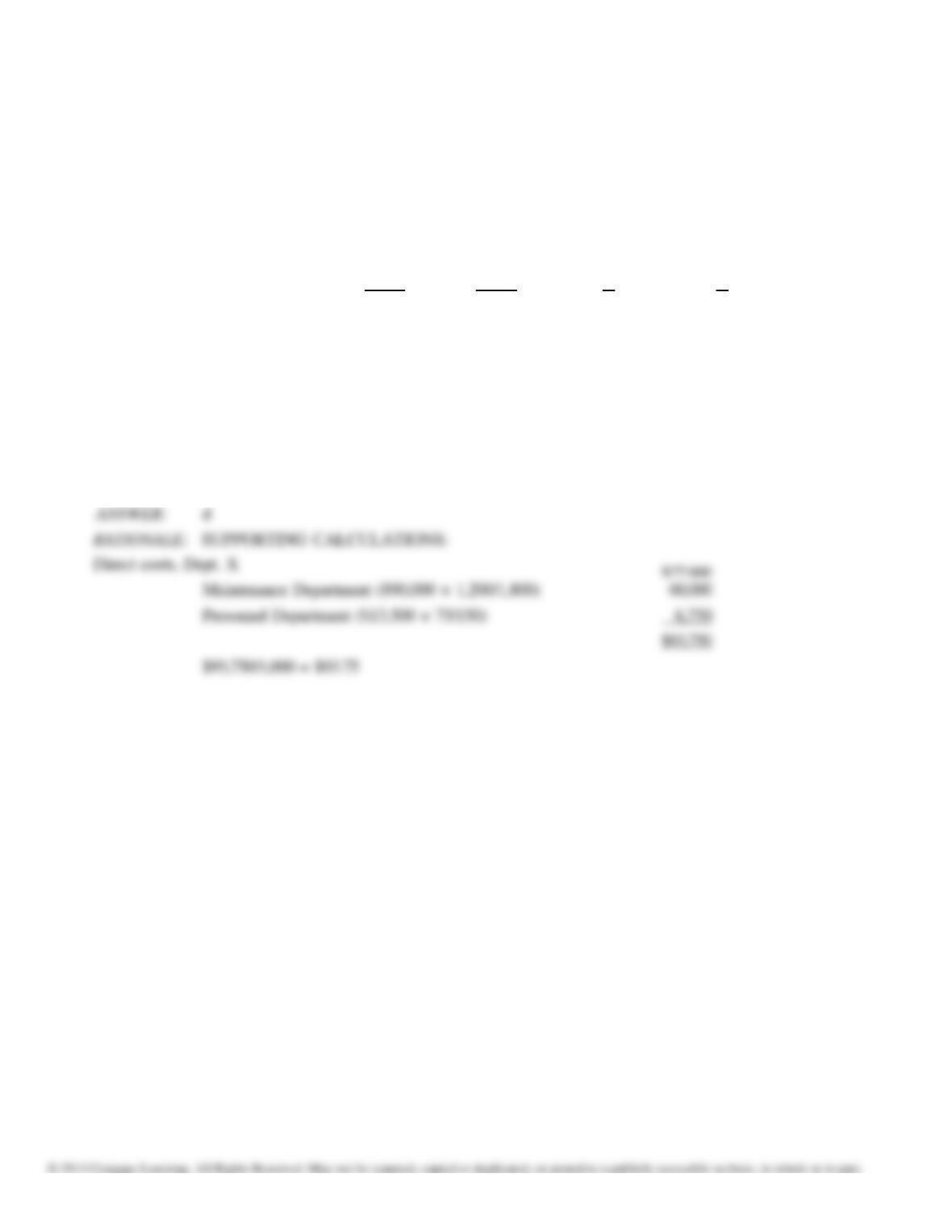
What is the overhead rate for Department Y assuming the direct method is used?
a. $109.00
b. $120.00
c. $250.00
d. $218.00
Chapter 7: Allocating Costs of Support Departments and Joint Products
113. Morton Manufacturing Company has two support departments, Maintenance Department and Personnel Department,
and two producing departments, X and Y. The Maintenance Department costs of $90,000 are allocated on the basis
of standard service hours used. The Personnel Department costs of $13,500 are allocated on the basis of number of
employees. The direct costs of Departments X and Y are $27,000 and $45,000, respectively.
Data on standard service hours and number of employees are as follows:
Maint.
Person.
Dept.
Dept.
Standard service hours used
Dept.
200
Dept.
150
X
1,200
Y
600
Number of employees
25
50
75
75
Direct labor hours
250
250
1,000
500
Predetermined overhead rates for Departments X and Y, respectively, are based on direct labor hours.
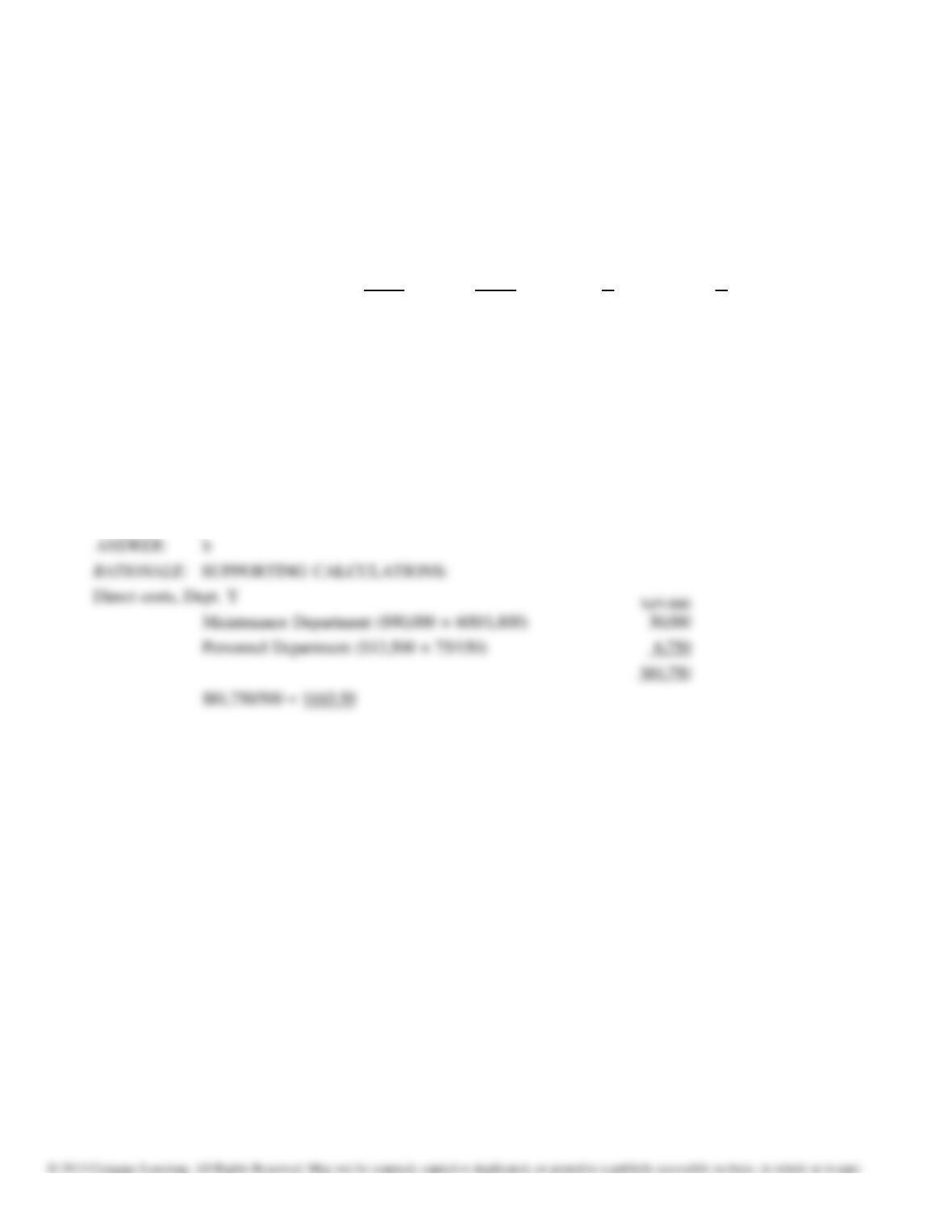
What is the overhead rate for Department X assuming the direct method is used?
a. $27.00
b. $81.00
c. $46.88
d. $93.75
Chapter 7: Allocating Costs of Support Departments and Joint Products
114. Alliance Manufacturing Company has two support departments, Maintenance Department and Personnel
Department, and two producing departments, X and Y. The Maintenance Department costs of $90,000 are allocated
on the basis of standard service hours used. The Personnel Department costs of $13,500 are allocated on the basis of
number of employees. The direct costs of Departments X and Y are $27,000 and $45,000, respectively.
Data on standard service hours and number of employees are as follows:
Maint.
Person.
Dept.
Dept.
Standard service hours used
Dept.
200
Dept.
150
X
1,200
Y
600
Number of employees
25
50
75
75
Direct labor hours
250
250
1,000
500
Predetermined overhead rates for Departments X and Y, respectively, are based on direct labor hours.
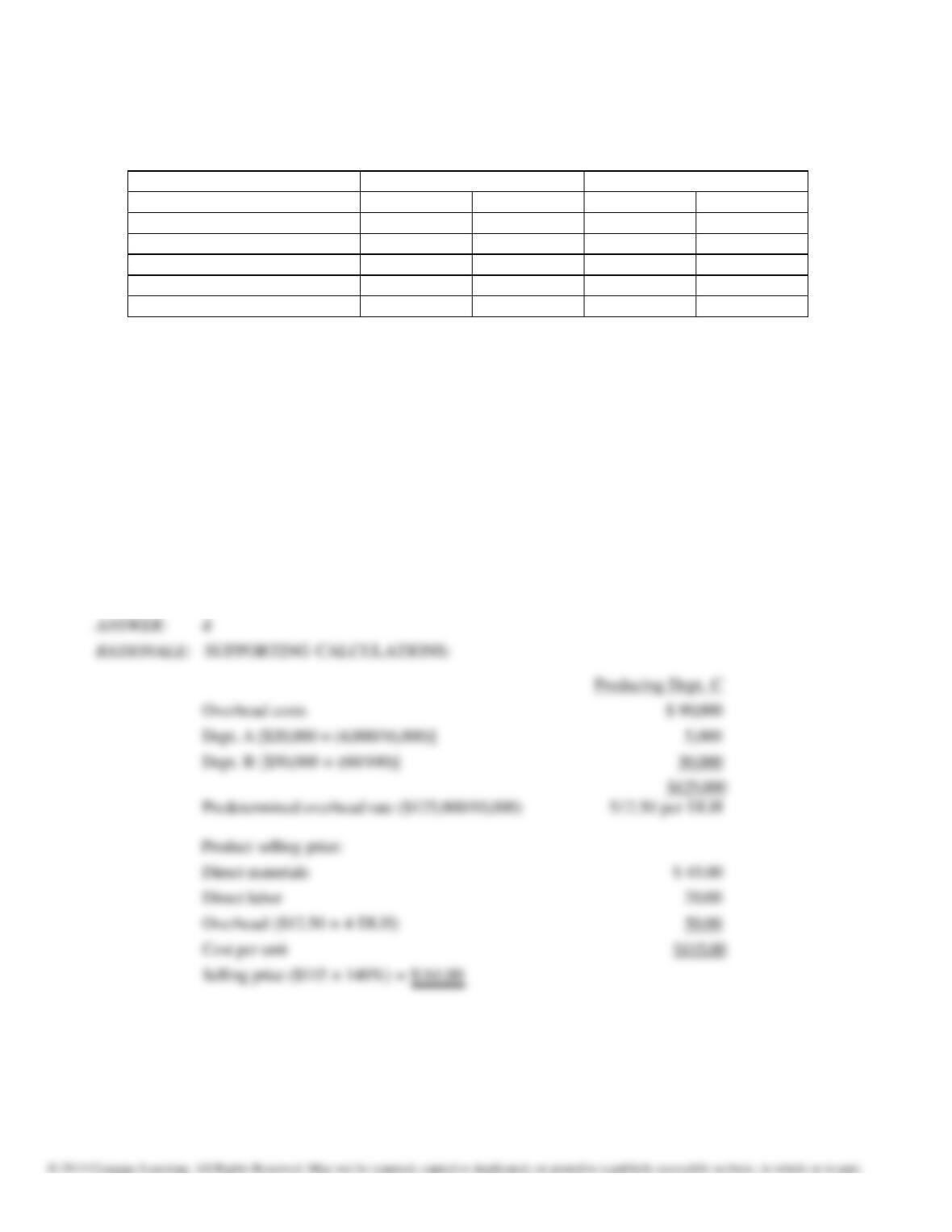
What is the overhead rate for Department Y assuming the direct method is used?
a. $90.00
b. $163.50
c. $187.50
d. $81.75
Chapter 7: Allocating Costs of Support Departments and Joint Products
115. Santiago Manufacturing prices its products at full cost plus 40 percent. The company operates two support
departments and two producing departments. Budgeted costs and normal activity levels are as follows:
Support Departments
Producing Departments
A
B
C
D
Overhead costs
$20,000
$50,000
$90,000
$120,000
Square feet
2,000
2,400
4,000
12,000
Number of employees
20
30
60
40
Direct labor hours
–
–
10,000
6,400
Machine hours
–
–
6,000
10,800
Support Department A’s costs are allocated based on square feet, and Support Department B’s costs are allocated
based on number of employees. Department C uses direct labor hours to assign overhead costs to products, while
Department D uses machine hours.
One of the products the company produces requires 4 direct labor hours per unit in Department C and no time in
Department D. Direct materials for the product cost $45 per unit, and direct labor is $20 per unit.
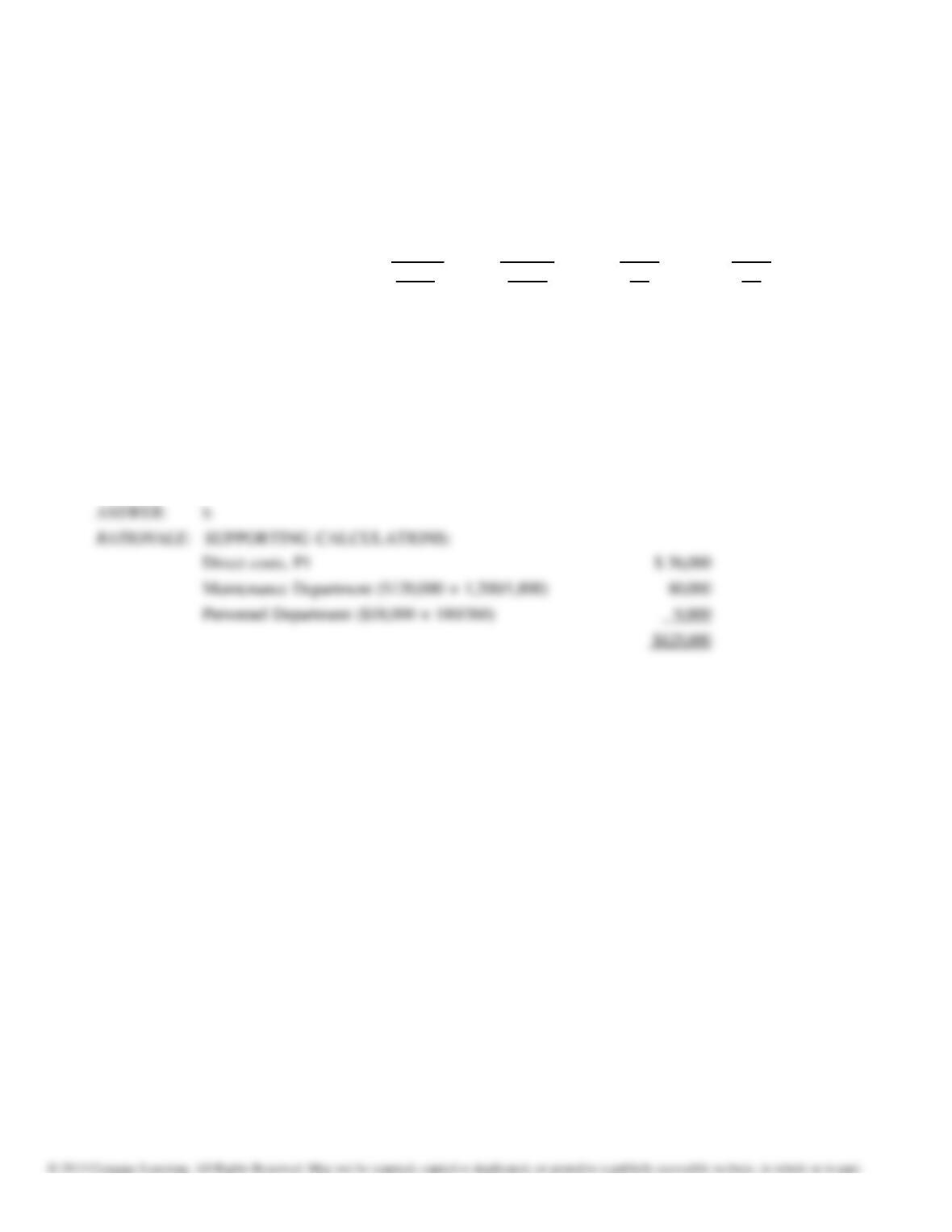
If the direct method of allocation is used and the company follows its usual pricing policy, the selling price of the
product would be
a. $102.00.
b. $111.00.
c. $115.00.
d. $161.00.
Chapter 7: Allocating Costs of Support Departments and Joint Products
116. Gravity Company has two support departments, Maintenance Department (MD) and Personnel Department (PD),
and two producing departments, P1 and P2. The Maintenance Department costs of $120,000 are allocated on the
basis of standard service hours used. The Personnel Department costs of $18,000 are allocated on the basis of
number of employees. The direct costs of Departments P1 and P2 are $36,000 and $60,000, respectively.
Data on standard service hours and number of employees are as follows:
Maint.
Dept.
Person.
Dept.
Dept.
P1
Dept.
P2
Standard service hours used
400
200
1,200
600
Number of employees
20
40
180
180
Direct labor hours
200
200
1,000
1,000
What are the total overhead costs associated with P1 after allocating the Maintenance and Personnel Departments
using the direct method?
a. $120,000
b. $125,000
c. $36,000
d. $18,000
Chapter 7: Allocating Costs of Support Departments and Joint Products
117. Hotchkiss Company has two support departments, Maintenance Department (MD) and Personnel Department (PD),
and two producing departments, P1 and P2. The Maintenance Department costs of $90,000 are allocated on the
basis of standard service hours used. The Personnel Department costs of $9,000 are allocated on the basis of
number of employees. The direct costs of Departments P1 and P2 are $36,000 and $60,000, respectively.
Data on standard service hours and number of employees are as follows:
Maint.
Dept.
Person.
Dept.
Dept.
P1
Dept.
P2
Standard service hours used 400 200 1,200 600
Number of employees 20 40 180 180
Direct labor hours 200 200 1,000 1,000
What are the total overhead costs associated with P2 after allocating the Maintenance and Personnel Departments
using the direct method?
a. $48,000
b. $90,000
c. $94,500
d. $99,000
Chapter 7: Allocating Costs of Support Departments and Joint Products
118. Diane’s Pottery Manufacturing Company has two support departments, Maintenance Department and Personnel
Department, and two producing departments, X and Y. The Maintenance Department costs of $30,000 are
allocated on the basis of standard service hours used. The Personnel Department costs of $4,500 are allocated on
the basis of number of employees. The direct costs of Departments X and Y are $9,000 and $15,000, respectively.
Data on standard service hours and number of employees are as follows:
Maint.
Person.
Dept.
Dept.
Standard service hours used
Dept.
100
Dept.
75
X
600
Y
300
Number of employees
50
100
150
150
Direct labor hours
125
125
500
250
What are the total overhead costs associated with Department X after allocating the Maintenance and Personnel
Departments using the direct method?
a. $31,250
b. $29,000
c. $11,250
d. $9,000
Chapter 7: Allocating Costs of Support Departments and Joint Products
119. Diane’s Pottery Manufacturing Company has two support departments, Maintenance Department and Personnel
Department, and two producing departments, X and Y. The Maintenance Department costs of $30,000 are
allocated on the basis of standard service hours used. The Personnel Department costs of $4,500 are allocated on
the basis of number of employees. The direct costs of Departments X and Y are $9,000 and $15,000, respectively.
Data on standard service hours and number of employees are as follows:
Maint.
Person.
Dept.
Dept.
Standard service hours used
Dept.
100
Dept.
75
X
600
Y
300
Number of employees
50
100
150
150
Direct labor hours
125
125
500
250
What are the total overhead costs associated with Department Y after allocating the Maintenance and Personnel
Departments using the direct method?
a. $15,000
b. $27,250
c. $25,000
d. $17,250
Chapter 7: Allocating Costs of Support Departments and Joint Products
120. Julius Manufacturing prices its products at full cost plus 30 percent. The company operates two support departments
and two producing departments. Budgeted costs and normal activity levels are as follows:
Support Departments
Producing Departments
A
B
C
D
Overhead costs
$40,000
$100,000
$180,000
$240,000
Square feet
1,000
1,200
2,000
6,000
Number of employees
20
30
60
40
Direct labor hours
–
–
10,000
6,400
Machine hours
–
–
6,000
10,800
Support Department A’s costs are allocated based on square feet, and Support Department B’s costs are allocated
based on number of employees.
Department C uses direct labor hours to assign overhead costs to products, while Department D uses machine
hours.
One of the products the company produces requires 4 direct labor hours per unit in Department C and no time in
Department D. Direct materials for the product cost $180 per unit, and direct labor is $80 per unit.
If the direct method of allocation is used and the company follows its usual pricing policy, the selling price of the
product would be
a. $260.00.
b. $431.60.
c. $468.00
d. $332.00.