
6. How can a firm avoid falling into the timing traps when prioritizing projects?
7. Calculate the NPV of a project with a i % cost of capital and annual end-of-year cash flows of -$y0
(YR0); $y1 (YR1); $y2(YR2); and $y3(YR3).
8. Calculate the IRR for the following cash flows. Is the project acceptable if the firm‘s cost of capital is
i%?
End of Year
Cash Flow ($)
0
-$cf0
1
cf1
2
cf2
3
cf3
9. Calculate the PI for the following cash flows assuming the firm’s cost of capital is i%. Is the project
acceptable?
End of Year
Cash Flow ($)
0
-$cf0
1
cf1
2
cf2
3
cf3
10. Calculate the payback period for an investment with annual end-of-year cash flows of –$cf0 (YR0);
$cf1 (YR1); $cf2 (YR2); $cf3 (YR3); $cf4 (YR4); and $cf5 (YR5).
11. Identify the three basic steps in the capital budgeting process.
12. What often-cited capital budgeting techniques are not tied to the firm’s wealth maximization goal?
13. What popular capital budgeting techniques explicitly consider the time value of money and are tied to
the firm’s wealth maximization goal?
14. What are the key problems associated with the use of the payback method?
15. Rich Computer Services has the following three investment projects available this year.
The firm’s cost of capital is i %.
Project
A
B
C
Initial cost
–$cf0
–$cfb0
–$cfc0
Year 1 CF
cf1
cfb1
cfc1
Year 2 CF
cf2
cfb2
cfc2
Year 3 CF
cf3
cfb3
cfc3
Year 4 CF
cf4
cfb4
cfc4
a.
Which projects are acceptable? Why?
b.
What is your decision if the projects are mutually exclusive?
The problem requires calculating the IRR, NPV, and PI.
shareholders.
16. Using the Internal Rate of Return decision criteria would the following project be acceptable if the
hurdle rate for the firm is i%?
Initial Cash Outflow
$c
End of Year
Cash Inflow
value maximization.
1
$cf1
2
$cf2
3
$cf3
17. Calculate the discounted payback period for the following project C: initial outlay = $c, cash inflow
year 1 = $cf1, cash inflow year 2 = $cf2, cash inflow year 3 = $cf3. The firm’s hurdle rate is i%.
18. Assume a financial manager is calculating the NPV and IRR for two mutually exclusive projects of
differing scale. Discuss how the IRR technique can still be utilized to obtain a valid result.
19. A firm has established a hurdle rate of i% for new investments. You have developed the following
information for two investment projects with cash flows occurring now and one year from now for
both projects.
Project
Cash Flow Now
Cash Flow in One Year
IRR
NPV (i%)
1
-$cf0
$cf1
irr%
$npv
2
$cf0
-$cf1
irr%
-$npv
Discuss lending versus borrowing projects, the problem created for using the IRR technique, and how
this impacts the decision criteria for projects.
20. Several techniques exist to evaluate projects for capital budgeting purposes. Discuss the pros and cons
of the payback period as a capital budgeting technique.
21. Evaluate the following projects, using the profitability index. Assume a cost of capital of i%.
Project A
Project B
Initial Cash Outflow
-$cfa0
-$cfb0
Year 1 Cash flow
cfa1
cfb1
Year 2 Cash flow
cfa2
cfb2
Year 3 Cash flow
cfa3
cfb3
a.
What is the profitability index for each project?
b.
If the projects are independent, which would you accept according to the profitability index
criterion?
c.
If these projects are mutually exclusive, which would you accept according to the PI criterion?
d.
Is there any problem with using the PI to evaluate these projects?
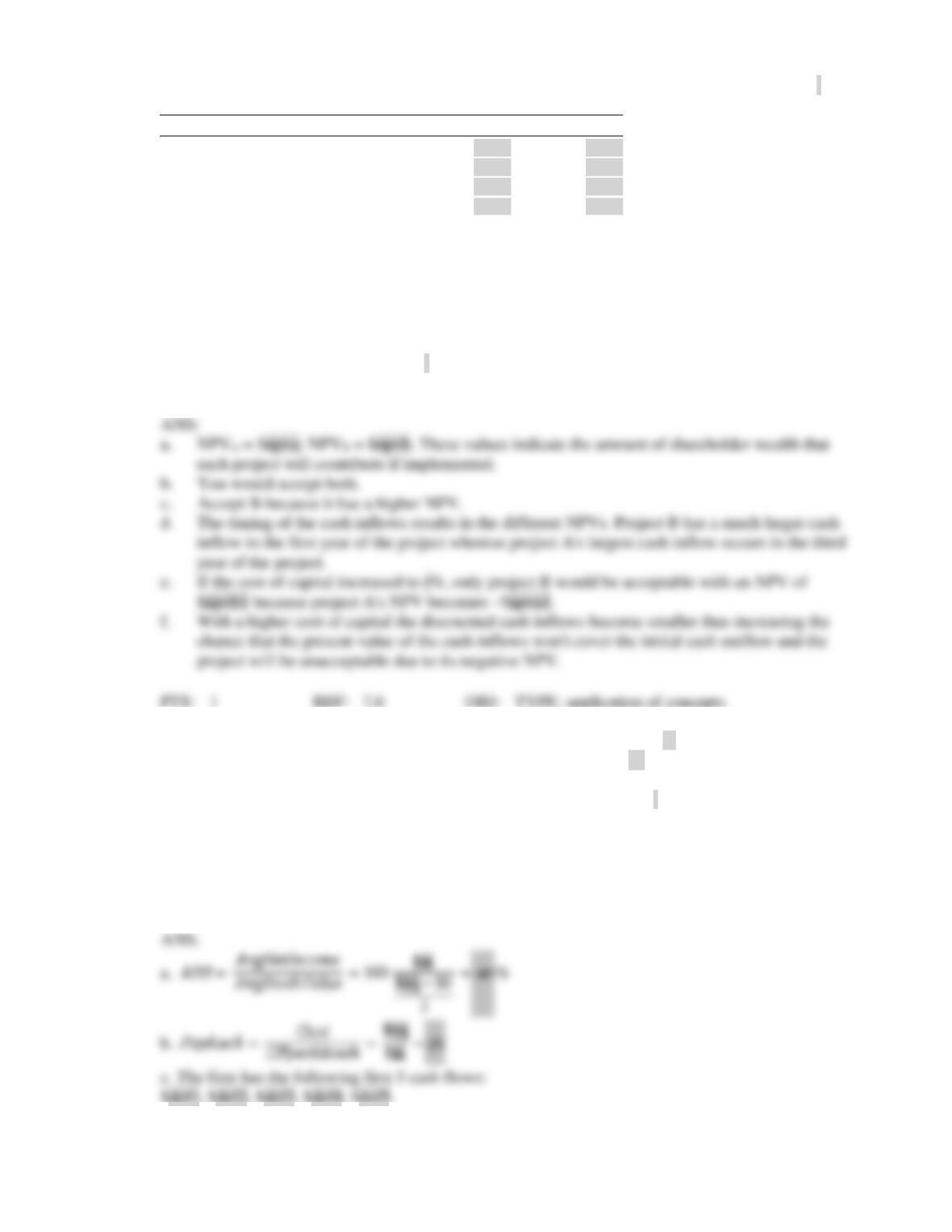
a.
b.
You would accept both projects because their PIs are greater than 1.00.
c.
You would accept project B because it has the higher PI
d.
No. Given their similar sizes and short lives, there is neither a scale nor a timing problem.
22. Evaluate the following projects, using the net present value criteria. Assume a cost of capital of i%.
Project A
Project B
Initial Cash Outflow
-$cfa0
-$cfb0
Year 1 Cash flow
cfa1
cfb1
Year 2 Cash flow
cfa2
cfb2
Year 3 Cash flow
cfa3
cfb3
a.
What are the NPVs for the projects and what do these numbers tell you?
b.
If the projects are independent, which would you accept according to the NPV criterion?
c.
If the projects are mutually exclusive, which would you accept according to the NPV
criterion?
d.
Both projects have in total $325,000 of cash inflows and the same initial cash outflow. Why
don’t both projects have the same NPV?
e.
If the cost of capital increased to r%, what impact would this have on your decision?
f.
Why does a change in the cost of capital have an impact on the NPV?
23. Johnson fisheries is considering a project that will boost Net Income by $ni each year for the next 8
years. The equipment associated with the project will cost the firm $eq. This equipment will be
straight line depreciated to zero over its 8 year life and have an expected salvage value of zero at the
end of the project. Calculate the following assuming a cost of capital of i%:
a.
Accounting rate of return
b.
Payback
c.
Discounted payback
d.
Profitability Index
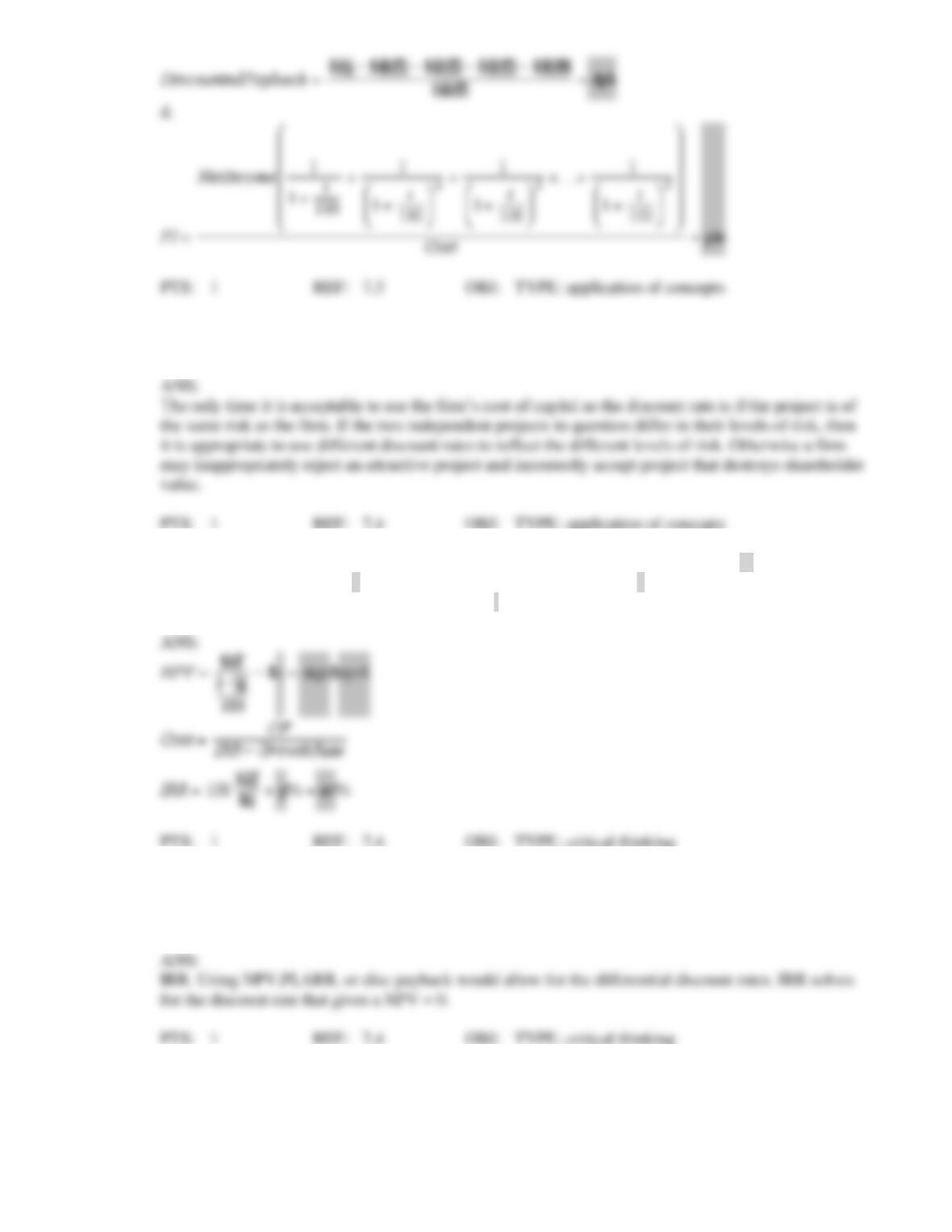
a.
b.
You would accept both.
c.
Accept B because it has a higher NPV.
inflow in the first year of the project whereas project A‘s largest cash inflow occurs in the third
e.
If the cost of capital increased to r%, only project B would be acceptable with an NPV of
$npvb1 because project A’s NPV becomes –$npva1.
24. If a firm is evaluating two independent projects, is it possible that a different discount rate is used for
each project? If so, why?
25. You firm has the opportunity to invest in a project that will generate a cash flow of $cf in the first year.
This cash flow will grow at g% per year, forever. If a firm must pay $c for this project today, what is
the IRR and NPV if the firm requires a return of i%?
26. Suppose a firm is considering a project. The risks associated with the cash flows of the project dictate
that a different discount rate should be used for years 1-5 and 6-10. What decision tool would this pose
a greater problem for?
27. Given the following cash flows, what equation would a financial manager solve to determine the IRR?

28. If a project has a year 0 cash flow of -d, a year 1 cash flow of zero, a year two cash flow of “X”, and
no other cash flows, how would you calculate the IRR of this investment in terms of “X”?
29. Consider two mutually exclusive projects of the same risk:
Project A
yr0 = -y0; yr1 = y1; yr2 = y2; yr3 = y3
Project B
yr0 = –b0; yr1 = b1; yr2 = b2; yr3 = b3
If the firm requires a return of i%, what project should they select based on the IRR criterion? Is there
any problem with this conclusion?
30. A project is independent of a firm’s other projects. It has an initial investment, followed by a series of
risk-free inflows and then a series of risky inflows. Does this present problems for analysis using
NPV? IRR? PI?
ESSAY
1. You have recently accepted a position at a large local manufacturer of electrical components. The
company has an accepted practice of using payback period to evaluate projects for investment
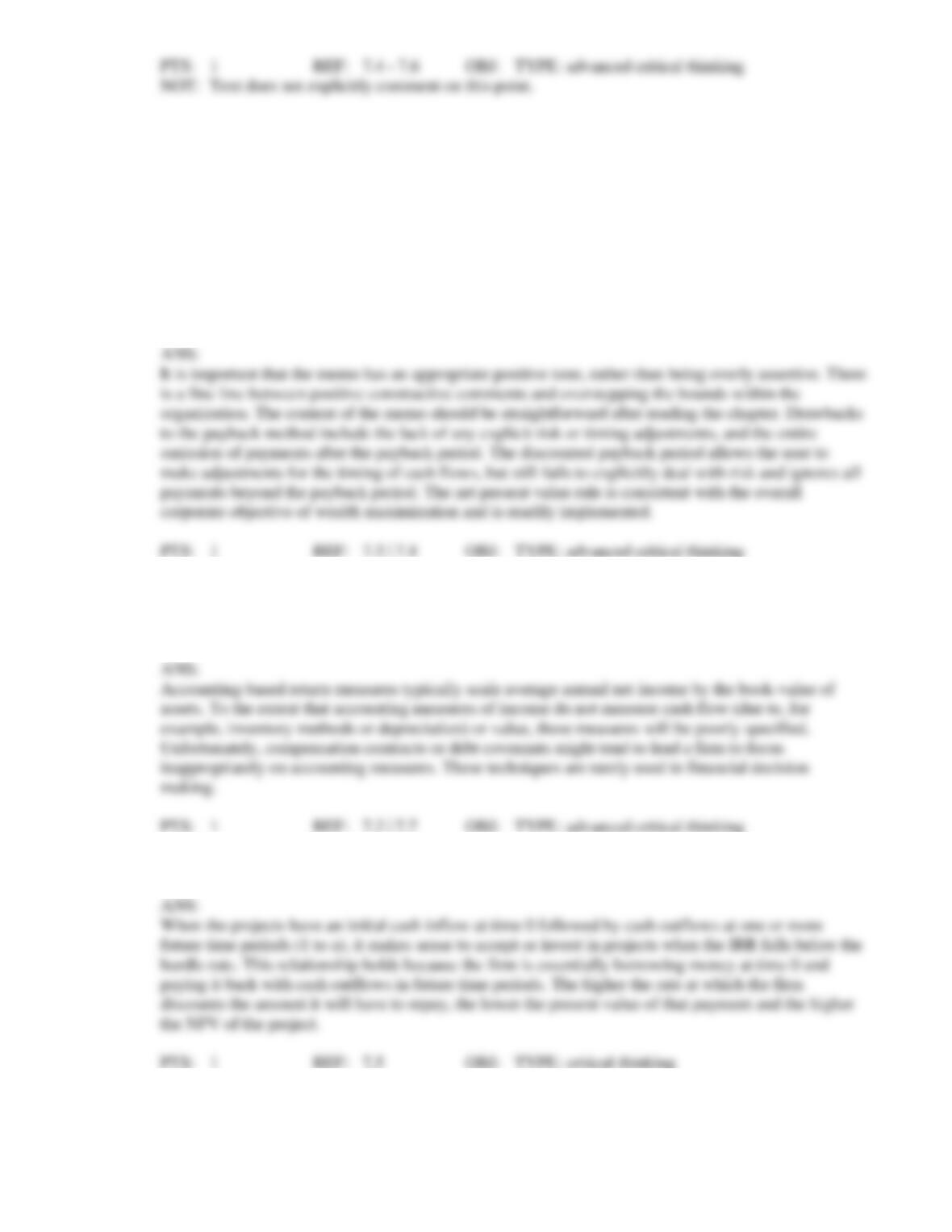
consideration. Write a memo to your boss, Assertive Al, detailing the potential drawbacks with using
payback to evaluate projects, how discounted payback can improve some of these errors, and how
NPV can improve yet again on the discounted payback method.
In your memo, it is important that your tone be one of improvement and recognition of the corporate
structure.
2. In a concise essay, discuss how accounting-based return measures may lead to poor financial
decisions. Can you think of any instances in which a financial manager might use accounting methods
when a more appropriate financial method is available? Fully explain your position.
3. When does it make sense to accept projects only when the IRR falls short of the firm’s hurdle rate?
4. Identify and explain the problems that can occur when projects are mutually exclusive.
5. Discuss the capital budgeting process and its importance to a corporation.