
Exam
Name___________________________________
MULTIPLE CHOICE. Choose the one alternative that best completes the statement or answers the question.
1)
Of the four gases CO2, H2O, N2, and O2, which are greenhouse gases?
1)
A)
all four
B)
all except O2
C)
only CO2
D)
CO2 and N2
E)
CO2 and H2O
2)
Which of the following gases absorbs ultraviolet light best?
2)
A)
nitrogen
B)
hydrogen
C)
carbon dioxide
D)
oxygen
E)
ozone
E
3)
How large is an impact crater compared to the size of the impactor?
3)
A)
100 times larger
B)
1,000 times larger
C)
the same size
D)
10 times larger
E)
10–20 percent larger
D
E

4)
What type of stresses broke Earth’s lithosphere into plates?
4)
A)
cooling and contracting of the planet’s interior, which caused the mantle and lithosphere to be
compressed
B)
internal temperature changes that caused the crust to expand and stretch
C)
volcanism, which produced heavy volcanoes that bent and cracked the lithosphere
D)
the circulation of convection cells in the mantle, which dragged against the lithosphere
E)
impacts of asteroids and planetesimals
5)
All of the following statements are true. Which one provides strong observational support for the
claim that greenhouse gases make a planet warmer than it would be otherwise?
5)
A)
Earth has a higher average temperature than Mars.
B)
Venus has a higher average temperature than Mercury.
C)
Mercury is much hotter than the Moon.
D)
Earth is the only planet with an ozone layer in its atmosphere.
6)
Valles Marineris is a(n)
6)
A)
large canyon on Venus.
B)
large canyon on Mars.
C)
extensive plain on Mars.
D)
huge series of cliffs on Mercury.
E)
large valley on the Moon.
7)
Which of the following best describes the geological histories of the Moon and Mercury?
7)
A)
Impact cratering shaped these worlds early in their histories. Then, during the past few
million years, they were reshaped by episodes of volcanism and tectonics.
B)
Early in their histories, they suffered many impacts and experienced some volcanism and
tectonics, but they now have little geological activity at all.
C)
All four geological processes were important in their early histories, but only impact cratering
still reshapes their surfaces today.
D)
Impact cratering is the only major geological process that has affected their surfaces.

8)
Rank the five terrestrial worlds in order of size from smallest to largest.
8)
A)
Mercury, Venus, Earth, Moon, Mars
B)
Mercury, Moon, Mars, Earth, Venus
C)
Mercury, Moon, Venus, Earth, Mars
D)
Moon, Mercury, Venus, Earth, Mars
E)
Moon, Mercury, Mars, Venus, Earth
9)
What kind of surface features may result from tectonics?
9)
A)
mountains
B)
cliffs
C)
valleys
D)
volcanos
E)
all of the above
E
10)
Sunsets are red because
10)
A)
sunlight must pass through more atmosphere, and this scatters even more light at bluer
wavelengths, transmitting mostly red light.
B)
the cooler atmosphere in the evening absorbs more blue light.
C)
the Sun emits more red light when it’s setting.
D)
sunlight must pass through more atmosphere, and this scatters more light at red wavelengths
than bluer wavelengths.
E)
none of the above
A
E

11)
A planet is most likely to have tectonic activity if it has
11)
A)
low internal temperature.
B)
high internal temperature.
C)
high surface gravity.
D)
low surface gravity.
E)
a dense atmosphere.
12)
What process has shaped Earth’s surface more than any other?
12)
A)
volcanism
B)
wind erosion
C)
plate tectonics
D)
acid rain
E)
impact cratering
13)
Why is Mars red?
13)
A)
Its surface is made of ices that absorb red light.
B)
Its atmosphere scatters blue light more effectively than red light.
C)
It is made primarily of red clay.
D)
Its surface is made of ices that absorb blue light.
E)
Its surface rocks were rusted by oxygen.
14)
Why is Earth’s continental crust lower in density than seafloor crust?
14)
A)
Continental crust is made as the lowest–density seafloor crust melts and erupts to the surface
near subduction zones.
B)
Continental crust is made from a low–density volcanic rock called basalt.
C)
Continental crust comes from Earth’s inner core while seafloor crust comes from the outer
core.
D)
Continental crust comes from volcanoes while seafloor crust comes from geysers.

15)
Suppose we represent Earth with a basketball. On this scale, most of the air in Earth’s atmosphere
would fit in a layer that is ________.
15)
A)
about an inch thick
B)
about 6 inches thick
C)
about a half–inch thick
D)
about the thickness of a sheet of paper
16)
Recent evidence suggests that Mars once had a global magnetic field. Assuming this is true, which
of the following could explain why Mars today lacks a global magnetic field like that of Earth?
16)
A)
Mars rotates much slower than the Earth.
B)
The Martian core is made of rock, while Earth’s core is made of metal.
C)
Mars’s interior has cooled so much its molten core layer no longer undergoes convection.
D)
Mars is too far from the Sun to have a global magnetic field.
17)
The terrestrial planet cores contain mostly metal because
17)
A)
the entire planets are made mostly of metal.
B)
convection carried the metals to the core.
C)
metals condensed first in the solar nebula and the rocks then accreted around them.
D)
metals sank to the center during a time when the interiors were molten throughout.
E)
radioactivity created metals in the core from the decay of uranium.
18)
Olympus Mons is ________.
18)
A)
a huge volcano on Mars
B)
a huge volcano on Venus
C)
a great canyon on Mars
D)
a large lava plain on the Moon

19)
Suppose Earth were to cool down a little. How would the carbon dioxide cycle tend to restore
temperatures to normal?
19)
A)
Cooler temperatures lead to slower formation of carbonate minerals in the ocean, so carbon
dioxide released by volcanism builds up in the atmosphere and strengthens the greenhouse
effect.
B)
Cooler temperatures cause volcanoes to become more active, so they release more carbon
dioxide into the atmosphere than they do when temperatures are warmer.
C)
Cooler temperatures mean more ice and more erosion, which somehow makes the planet
warm up.
D)
Cooler temperatures allow carbon dioxide to form rain and rain out of the atmosphere.
20)
Which of the following is the most basic definition of a greenhouse gas?
20)
A)
a gas that absorbs infrared light
B)
a gas that reflects a lot of sunlight
C)
a gas that makes a planet much hotter than it would be otherwise, even in small amounts
D)
a gas that keeps warms air from rising, and therefore warms the surface
Answer:
21)
Which of the following worlds has the most substantial atmosphere?
21)
A)
the Moon
B)
Earth
C)
Mercury
D)
Mars
E)
Venus
Answer:
22)
Suppose we use a baseball to represent Earth. On this scale, the other terrestrial worlds (Mercury,
Venus, the Moon, and Mars) would range in size approximately from that of ________.
22)
A)
a dust speck to a golf ball
B)
a dust speck to a basketball
C)
a golf ball to a beach ball
D)
a golf ball to a baseball
Answer:
Answer:

23)
Many scientists suspect that Venus has a stronger and thicker lithosphere than Earth. If this is true,
which of the following could explain it?
23)
A)
the slow rotation of Venus
B)
the high surface temperature that has “baked out” all the liquid water from Venus’s crust and
mantle
C)
the smaller size of Venus, which has allowed it to lose much more internal heat than Earth
D)
the apparent lack of plate tectonics on Venus
24)
Which of the following planets has the least substantial atmosphere?
24)
A)
Neptune
B)
Venus
C)
Mars
D)
Earth
E)
Mercury
Answer:
25)
What do we mean by a runaway greenhouse effect?
25)
A)
a process that heats a planet like a greenhouse effect, but that involves a completely different
mechanism of heating that doesn’t actually involve greenhouse gases
B)
a greenhouse effect that heats a planet so much that its surface rock melts
C)
a greenhouse effect that keeps getting stronger until all of a planet’s greenhouse gases are in
its atmosphere
D)
a greenhouse effect that starts on a planet but later disappears as gases are lost to space
Answer:
Answer:
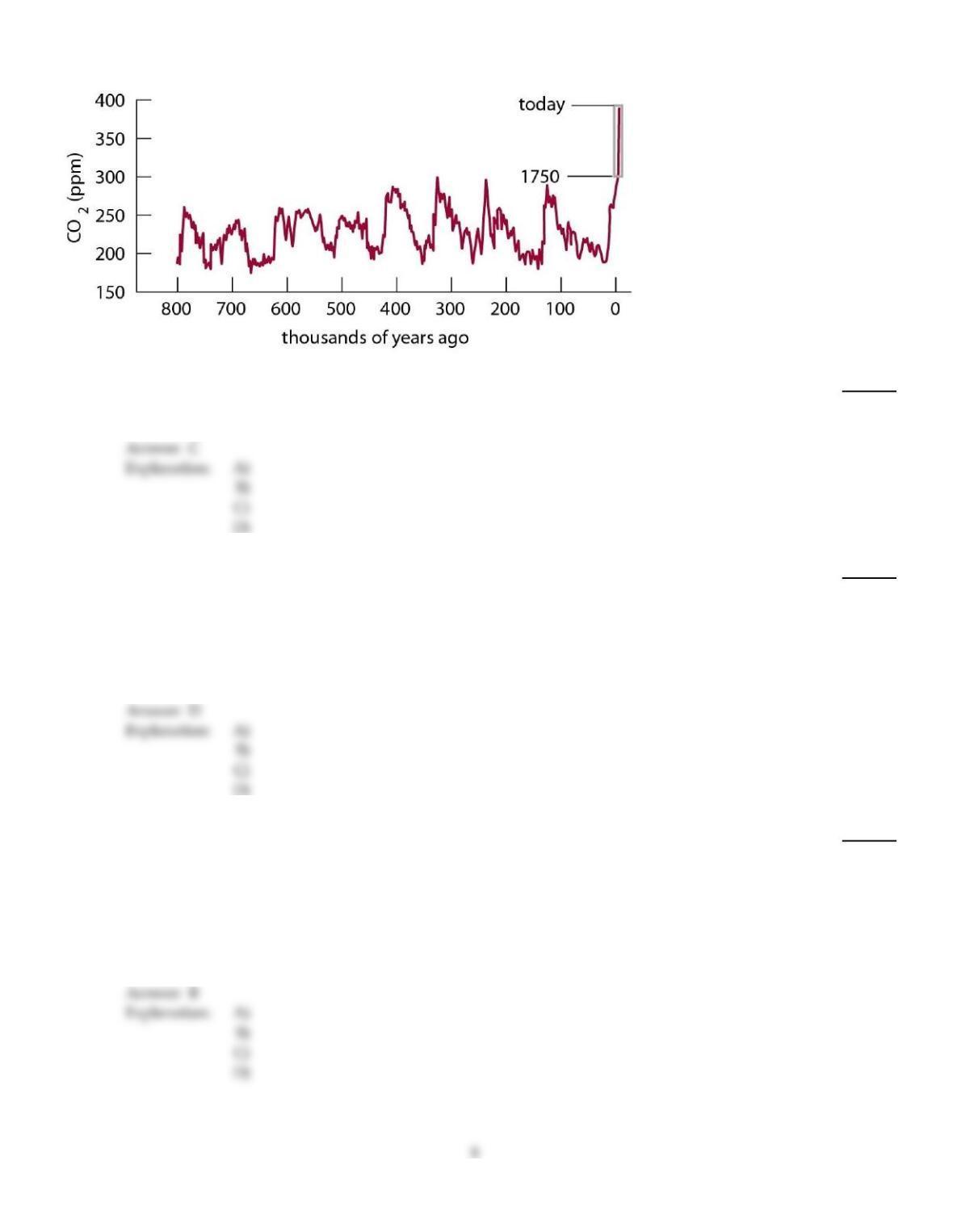
26)
The CO2 concentration of the atmosphere has increased by about ________ since 1750.
26)
A)
1000 parts–per–million
B)
10 parts–per–million
C)
100 parts–per–million
D)
None. It has decreased.
27)
Which of the following does not provide evidence that Mars once had abundant liquid water on its
surface?
27)
A)
the presence of features that look like dried up river beds
B)
the presence of what looks like sedimentary layers in some crater bottoms
C)
the presence of very old craters that appear to have been eroded by rain
D)
the presence of canali, discovered in the late 1800s by Giovanni Schiaparelli and mapped by
Percival Lowell
28)
All the following statements about Mars are true. Which one might have led to a significant loss of
atmospheric gas to space?
28)
A)
Mars probably once had a much higher density of greenhouse gases in its atmosphere than it
does today.
B)
Mars lost any global magnetic field that it may once have had.
C)
The axis tilt of Mars is thought to change significantly with time.
D)
Outgassed water molecules are split apart by ultraviolet light, and the oxygen then reacts
chemically with surface rock on Mars.

29)
Which two geological processes appear to have been most important in shaping the present surface
of Venus?
29)
A)
tectonics and erosion
B)
volcanoes and erosion
C)
impacts and tectonics
D)
impacts and volcanoes
E)
volcanoes and tectonics
30)
The choices below describe four hypothetical planets. Which one would you expect to have the
hottest interior? (Assume the planets orbit a star just like the Sun and that they are all the same age
as the planets in our solar system.)
30)
A)
Size: same as Venus. Distance from Sun: same as Mars. Rotation rate: once every 25 hours.
B)
Size: same as Mars. Distance from Sun: same as Earth. Rotation rate: once every 18 hours.
C)
Size: same as the Moon. Distance from Sun: same as Mars. Rotation rate: once every 10 days.
D)
Size: twice as big as Earth. Distance from Sun: same as Mercury. Rotation rate: once every 6
months.
31)
What are fossil fuels?
31)
A)
the carbon–rich remains of plants that died millions of years ago
B)
any fuel that releases CO2 into the atmosphere upon burning
C)
any fuel that is extracted from the interior of the Earth
D)
carbonate–rich deposits from ancient seabeds
E)
mineral–rich deposits from ancient seabeds

32)
What are the conditions necessary for a terrestrial planet to have a strong magnetic field?
32)
A)
fast rotation only
B)
a rocky mantle only
C)
a molten metallic core only
D)
both a molten metallic core and reasonably fast rotation
E)
both a metal core and a rocky mantle
33)
Why is continental crust lower in density than seafloor crust?
33)
A)
Continental crust is made from volcanic rock called basalt, which is lower in density than
what the seafloor crust is made from.
B)
Continental crust is made of rock, while seafloor crust has more metals.
C)
Seafloor crust is more compact due to the weight of the oceans, but it is made of the same
material as the continental crust.
D)
Continental crust is made from remelted seafloor crust and therefore only the lower–density
material rises to form it.
E)
Continental crust is actually denser than seafloor crust.
34)
In general, which things below are affected by a magnetic field?
34)
A)
charged particles or magnetized materials (such as iron)
B)
rocks of all types
C)
gases and liquids
D)
iron–bearing minerals only
35)
Which of these is the dominant mechanism for the removal of carbon dioxide from the atmosphere?
35)
A)
formation of carbonate–rich rocks at the seafloor
B)
dissolving carbon dioxide in seawater
C)
photosynthesis in plants
D)
subduction

36)
What is the importance of the carbon dioxide (CO2) cycle?
36)
A)
It makes the growth of continents possible.
B)
It regulates the carbon dioxide concentration of our atmosphere, keeping temperatures
moderate.
C)
It will prevent us from suffering any consequences from global warming.
D)
It allows for an ultraviolet–absorbing stratosphere.
37)
Ridges in the middle of the ocean are places where
37)
A)
hot mantle material rises upward and spreads sideways, pushing the plates apart.
B)
plates slip sideways relative to one another.
C)
hot mantle material rises upward, creating volcanic islands.
D)
plates push together, creating ocean mountain chains.
E)
one plate slides under another, returning older crust to the mantle.
38)
What are the two geological features that appear to set Earth apart from all the other terrestrial
worlds?
38)
A)
a dense core and plate tectonics
B)
mantle convection and a thick atmosphere
C)
significant volcanism and tectonics
D)
plate tectonics and widespread erosion
39)
Which of these upcoming observations will help test the idea that Mars’ atmosphere thinned due to
interactions with the solar wind?
39)
A)
The upcoming MAVEN orbiter will measure present–day gas loss from Mars’ atmosphere.
B)
Astronomers will use spectrographs on the Keck telescope to measure the density of Mars’
atmosphere.
C)
The Curiosity rover will measure the carbon content of rocks on Mars’ surface.
D)
Geologists will measure the carbon content of Martian rocks that were transported to Earth by
asteroid impacts.

40)
The footprints left on the moon by the Apollo astronauts will likely last for
40)
A)
no time; they were quickly erased by micrometeorites.
B)
the remaining existence of the Moon.
C)
a few decades.
D)
millions of years.
41)
Why can we not depend on the natural CO2 cycle to lower carbon–dioxide levels?
41)
A)
It operates too slowly.
B)
It only removes small amounts of CO2 from the atmosphere.
C)
There is no natural CO2 cycle.
A
42)
Why does increasing the amount a greenhouse gas increase the temperature of a planet?
42)
A)
Greenhouse gases absorb infrared light.
B)
Greenhouse gases absorb visible light.
C)
Greenhouse gases emit infrared light.
D)
Greenhouse gases emit visible light.
A
43)
Which of the following best describes convection?
43)
A)
It is the process in which warm material gets even warmer and cool material gets even cooler.
B)
It is the process in which a liquid separates according to density, such as oil and water
separating in a jar.
C)
It is the process in which warm material expands and rises while cool material contracts and
falls.
D)
It is the process by which rocks sink in water.
E)
It is the process in which bubbles of gas move upward through a liquid.
C
D

44)
The Antarctic ice–core plot of carbon dioxide (ppm) shows peaks and valleys at about the same
times as the temperature plot has peaks and valleys, over 400,000 years. What can we conclude
based on this fact alone?
44)
A)
There is a correlation between the carbon dioxide concentration and the average temperature.
B)
The carbon dioxide concentration is inversely related to the global average temperature.
C)
Higher carbon dioxide concentrations cause higher global average temperatures.
D)
Higher global average temperatures cause higher global carbon dioxide concentrations.
45)
Earth’s atmosphere contains only small amounts of carbon dioxide because
45)
A)
the Earth’s volcanoes did not outgas as much carbon dioxide as those on Venus and Mars.
B)
Earth doesn’t have as strong a greenhouse effect as is present on Venus.
C)
carbon dioxide dissolves in water, and most of it is now contained in the oceans and
carbonate rocks.
D)
most of the carbon dioxide was lost during the age of bombardment.
E)
chemical reactions with other gases destroyed the carbon dioxide and replaced it with the
nitrogen that is in the atmosphere now.
46)
Why is Venus so much hotter than Earth?
46)
A)
Venus has significant amounts of carbon dioxide in its atmosphere.
B)
Venus rotates more slowly.
C)
Venus is closer to the Sun.
D)
Venus is more massive.
E)
Venus was formed before the Earth was.
47)
Which of the following has virtually no effect on the internal structure of a planet?
47)
A)
its size
B)
its magnetic field
C)
its mass
D)
its composition

48)
Which two factors are critical to the existence of the carbon dioxide (CO2) cycle on Earth?
48)
A)
plate tectonics and liquid water oceans
B)
life and active volcanism
C)
active volcanism and active tectonics
D)
life and atmospheric oxygen
49)
Where is most of the water on Mars?
49)
A)
frozen on the peaks of its tall volcanoes
B)
in deep underground deposits
C)
distributed evenly throughout its atmosphere
D)
in its polar caps and subsurface ground ice
E)
in its clouds
50)
Why is the sky blue (on Earth)?
50)
A)
because molecules scatter red light more effectively than blue light
B)
because molecules scatter blue light more effectively than red light
C)
because the Sun emits mostly blue light
D)
because deep space is blue in color
E)
No one knowsthis is one of the great mysteries of science.
51)
Which of the following statements about the greenhouse effect is true?
51)
A)
One result of an increased greenhouse effect on Earth may be an increased number of severe
storms.
B)
Without the naturally occurring greenhouse effect, Earth would be too cold to have liquid
oceans.
C)
A weak greenhouse effect operates on Mars.
D)
The burning of fossil fuels increases the greenhouse effect on Earth because of the release of
carbon dioxide.
E)
All of the above are true.

52)
Which of the following is the underlying reason why Venus has so little wind erosion?
52)
A)
its slow rotation
B)
its relatively close distance to the Sun
C)
its thick atmosphere
D)
its small size
53)
Why is Venus so much hotter than the Earth?
53)
A)
because its clouds have a very high reectivity
B)
because it has much more carbon dioxide in its atmosphere
C)
because it rotates backwards compared to its orbital rotation
D)
because it is closer to the Sun
54)
Based on all we know about the terrestrial worlds, what single factor appears to play the most
important role in a terrestrial planet’s geological destiny?
54)
A)
its size
B)
its composition
C)
whether or not it has liquid water
D)
its distance from the Sun
55)
Why would the weather become more severe as the greenhouse effect increased?
55)
A)
Warming of the planet would lead to terrible droughts and reduce the amount of water on the
Earth.
B)
Warming would dry out the atmosphere and the crust, leading to devastation of the Earth
through more meteor bombardment and volcanism.
C)
Warming would increase the evaporation of the oceans, leading to more water in the
atmosphere and more frequent and severe storms.
D)
The depleted ozone layer would let in more particles from the solar wind.
E)
all of the above

56)
If the Earth were to warm up a bit, what would happen?
56)
A)
Carbonate materials would form in the oceans more rapidly, the atmospheric CO2 content
would decrease, and the greenhouse effect would strengthen.
B)
The ice caps would melt and cool the Earth back to its normal temperature.
C)
Carbonate materials would form in the oceans more slowly, the atmospheric CO2 content
would increase, and the greenhouse effect would strengthen.
D)
There would be a runaway greenhouse effect, with the Earth becoming ever hotter until the
oceans evaporated (as may have happened on Venus).
E)
Carbonate materials would form in the oceans more rapidly, the atmospheric CO2 content
would decrease, and the greenhouse effect would weaken.
57)
Which two factors are most important to the existence of plate tectonics on Earth?
57)
A)
the existence of life and oxygen in the atmosphere
B)
mantle convection and a thin lithosphere
C)
oxygen in the atmosphere and mantle convection
D)
Earth’s liquid outer core and solid inner core
58)
When we see a region of a planet that is not as heavily cratered as other regions, we conclude that
58)
A)
the planet is rotating very slowly and only one side was hit by impactors.
B)
there is little volcanic activity to create craters.
C)
the surface in the region is older than the surface in more heavily cratered regions.
D)
the planet formed after the age of bombardment and missed out on getting hit by leftover
planetesimals.
E)
the surface in the region is younger than the surface in more heavily cratered regions.

59)
How did the lunar maria form?
59)
A)
The maria are the result of gradual erosion by micrometeorites striking the Moon.
B)
The early bombardment created heat that melted the lunar surface in the regions of the maria.
C)
Large impacts fractured the Moon’s lithosphere, allowing lava to fill the impact basins.
D)
The giant impact that created the Moon left smooth areas that we call the maria.
E)
Volatiles escaping from the Moon’s interior heated and eroded the surface in the regions of
the maria.
60)
Which of the following show evidence of ancient river beds?
60)
A)
Venus
B)
the Moon
C)
Mercury
D)
Mars
E)
all of the above
D
61)
Why is Mars red?
61)
A)
The red color is caused by water ice chemically bound in surface rock.
B)
Martian volcanoes released a much redder lava than volcanoes on Earth.
C)
Chemical reactions between surface rock and atmospheric oxygen literally rusted the surface.
D)
The red color of Mars is a result of the scattering of light in the Martian sky.
C
62)
How does seafloor crust differ from continental crust?
62)
A)
Seafloor crust is thinner, older, and lower in density.
B)
Seafloor crust is thicker, younger, and lower in density.
C)
Seafloor crust is thicker, older, and higher in density.
D)
Seafloor crust is thinner, younger, and higher in density.
D
C

63)
What kind of thermal radiation does the Earth emit?
63)
A)
visible and ultraviolet light
B)
infrared and visible light
C)
infrared, visible, and ultraviolet light
D)
visible light
E)
infrared light
64)
Which of the terrestrial worlds has the strongest magnetic field?
64)
A)
Mars
B)
the Moon
C)
Venus
D)
Mercury
E)
Earth
Answer:
65)
Which of the following best describes the lunar maria?
65)
A)
densely cratered regions on the Moon
B)
mountainous regions on the Moon
C)
frozen oceans of liquid water on the Moon
D)
relatively smooth, flat plains on the Moon
Answer:
66)
How fast do tectonic plates move on Earth?
66)
A)
a few centimeters per century
B)
a few kilometers per century
C)
about 1 mile per hour
D)
a few centimeters per year
E)
quite fast, but only during earthquakes
Answer:
Answer:

67)
From center to surface, which of the following correctly lists the interior layers of a terrestrial
world?
67)
A)
core, crust, lithosphere
B)
mantle, crust, core
C)
mantle, core, crust
D)
core, mantle, crust
68)
Volcanism is more likely on a planet that
68)
A)
is closer to the Sun.
B)
has high internal temperatures.
C)
is struck often by meteors and solar system debris.
D)
doesn’t have an atmosphere or oceans.
69)
Why are there fewer large impact craters on the Earth’s seafloor than on the continents?
69)
A)
Seafloor crust is younger than continental crust, so it has had less time in which to suffer
impacts.
B)
Erosion erases impact craters must faster on the ocean bottom than on land.
C)
The oceans slow large impactors and prevent them from making craters.
D)
Most impacts occur on the land.
70)
What observational evidence supports the idea that Mercury once shrank by some 20 kilometers in
radius?
70)
A)
the presence of many long, tall cliffs
B)
the characteristics of the Caloris Basin
C)
Mercury’s unusually high density
D)
the presence of many impact craters

71)
How is the atmosphere of a planet affected by the rotation rate?
71)
A)
The rotation rate determines how much atmosphere a planet has.
B)
Faster rotation rates produce stronger winds.
C)
The rotation rate determines how long the planet is able to retain its atmosphere.
D)
Faster rotation rates raise surface temperatures and thus determine how much material is
gaseous versus icy or liquid.
E)
Faster rotation rates raise the atmospheric temperature.
72)
Which of the following most likely explains why Venus does not have a strong magnetic field?
72)
A)
Its rotation is too slow.
B)
It is too close to the Sun.
C)
It has too thick an atmosphere.
D)
It is too large.
E)
It does not have a metallic core.
A
73)
Which of the following is not an example of tectonics?
73)
A)
the formation of a cliff when the lithosphere shrinks
B)
the gradual disappearance of a crater rim as a result of wind and rain
C)
the slow movement of Earth’s lithospheric plates
D)
the stretching of the crust by underlying mantle convection
B
74)
Which of the following best explain what we think happened to outgassed water vapor on Venus?
74)
A)
It turned into carbon dioxide by reacting with nitrogen in Venus’s atmosphere.
B)
Ultraviolet light split the water molecules, and the hydrogen then escaped to space.
C)
Water was removed from the atmosphere by chemical reactions with surface rock.
D)
It is frozen as water ice in craters near the poles.
B
B

75)
A terrestrial world‘s lithosphere is ________.
75)
A)
a thin layer of rock that lies between the mantle and crust
B)
a layer of relatively strong, rigid rock, encompassing the crust and part of the mantle
C)
the interior region in which the planet’s magnetic field is generated
D)
a layer of hot, molten rock encompassing the core and part of the mantle
76)
In the context of planetary geology, what do we mean by outgassing?
76)
A)
the loss of atmospheric gas to outer space
B)
another name for a volcanic eruption
C)
the evaporation of water that adds water vapor (a gas) to an atmosphere
D)
the release by volcanism of gases that had been trapped in a planetary interior
77)
Which of the following describes volcanism?
77)
A)
the excavation of bowl–shaped depressions by asteroids or comets striking a planet’s surface
B)
the eruption of molten rock from a planet’s interior to its surface
C)
the disruption of a planet’s surface by internal stresses
D)
the wearing down or building up of geological features by wind, water, ice, and other
phenomena of planetary weather
78)
What is a magnetosphere?
78)
A)
a region of space around a planet in which the planet’s magnetic field can trap charged
particles
B)
the region in a planet’s atmosphere in which auroras occur
C)
the uppermost layer of any planetary atmosphere
D)
the layer of a planet in which its magnetic field is generated

79)
If Earth had no atmosphere, its temperature would be
79)
A)
about the same temperature it is now.
B)
well below freezing, about –50 degrees Celsius.
C)
somewhat warmer than the freezing temperature of water.
D)
extremely hot, about 50 degrees Celsius.
E)
somewhat below the freezing temperature of water.
80)
What is one piece of scientific evidence for human contributions to global climate change?
80)
A)
Humans burn forests, drive cars, and build power plants that directly heat the planet.
B)
There is no compelling evidence for human contributions to climate change; the correlations
do not show what causes them.
C)
Climate models show that extra carbon dioxide contributed by humans is enough to match
the temperature data.
D)
Humans deplete the ozone layer, allowing more ultraviolet radiation to reach the Earth.
E)
Humans are responsible for every possible change to the planet, since humans are the only
intelligent life forms.
81)
What is the most important factor that determines the thickness, and therefore strength, of the
lithosphere?
81)
A)
pressure
B)
composition
C)
distance of planet from Sun
D)
internal temperature
82)
Which of the following describes erosion?
82)
A)
the excavation of bowl–shaped depressions by asteroids or comets striking a planet’s surface
B)
the eruption of molten rock from a planet’s interior to its surface
C)
the disruption of a planet’s surface by internal stresses
D)
the wearing down or building up of geological features by wind, water, ice, and other
phenomena of planetary weather

83)
In the greenhouse effect, what is the direct cause of extra heating of the Earth’s surface?
83)
A)
Additional carbon dioxide makes the atmosphere more transparent to infrared light, allowing
the sun to more directly heat the surface.
B)
Additional carbon dioxide makes the atmosphere denser, and thus heat passes through it
more slowly.
C)
Additional carbon dioxide makes the atmosphere more opaque to infrared light, trapping
part of the blackbody radiation that would normally escape into space.
84)
What are the circumstances under which convection can occur in a substance?
84)
A)
when the substance is strongly shaken or disturbed by a strong wind
B)
when the substance is strongly heated from underneath
C)
when the substance is strongly cooled from underneath
D)
when the substance is subjected to a strong magnetic field
E)
when dense material is being added to the substance
85)
Which of the following best describes how the greenhouse effect works?
85)
A)
Greenhouse gases absorb infrared light coming from the Sun, and this absorbed sunlight
heats the lower atmosphere and the surface.
B)
A planet’s surface absorbs visible sunlight and returns this absorbed energy to space as
infrared light. Greenhouse gases slow the escape of this infrared radiation, which thereby
heats the lower atmosphere.
C)
Greenhouse gases absorb X–rays and ultraviolet light from the Sun, and this absorbed
radiation then heats the atmosphere and the surface.
D)
The greenhouse effect is caused primarily by ozone, which absorbs ultraviolet light and
thereby makes the atmosphere much hotter than it would be otherwise.
86)
How deep is an impact crater compared to its width?
86)
A)
30–40%
B)
1–10%
C)
50–100%
D)
100–200%
E)
10–20%

87)
Which of the following can act like a long–term “thermostat” for the Earth’s average temperature?
87)
A)
heat stored in the Earth’s magnetosphere
B)
heat stored in the Earth‘s liquid core
C)
the carbon dioxide cycle
D)
radioactive elements trapped in the Earth’s mantle
88)
Under what circumstances can differentiation occur in a planet?
88)
A)
The planet must be made of both metal and rock.
B)
The planet must have a molten interior.
C)
The planet must have an atmosphere.
D)
The planet must have a rocky surface.
E)
The planet must be geologically active, that is, have volcanoes, planetquakes, and erosion
from weather.
B
89)
The Caloris Basin on Mercury covers a large region of the planet, but few smaller craters have
formed on top of it. From this we conclude that
89)
A)
only very large impactors hit Mercury’s surface in the past.
B)
erosion destroyed the smaller craters that formed on the basin.
C)
the Caloris Basin was formed by a volcano.
D)
the Caloris Basin formed toward the end of the solar system’s period of heavy bombardment.
E)
Mercury’s atmosphere prevented smaller objects from hitting the surface.
D
90)
Suppose we had a device that allowed us to see Earth’s interior. If we looked at a typical region of
the mantle, what would we see happening?
90)
A)
dense metals falling downward while low–density rock rises upward
B)
Not muchon human time scales, the mantle looks like solid rock.
C)
a rapid, up and down churning of the material in the mantle
D)
hot molten rock rising upward throughout the mantle and cool, solid rock falling downward
B
C

91)
The three principal sources of the internal heat of terrestrial planets are
91)
A)
accretion, differentiation, and eruption.
B)
convection, differentiation, and eruption.
C)
conduction, convection, and eruption.
D)
accretion, differentiation, and radioactivity.
E)
conduction, differentiation, and accretion.
92)
Which of the following does not have a major effect in shaping planetary surfaces?
92)
A)
tectonics
B)
magnetism
C)
erosion
D)
volcanism
E)
impact cratering
93)
What’s the fundamental reason that Mars, unlike the Earth, has become virtually geologically
dead?
93)
A)
its small size compared to Earth
B)
its closer distance than Earth to the Sun
C)
its farther distance than Earth to the Sun
D)
its rapid rotation compared to the Earth
E)
its slow rotation compared to the Earth
F)
its large size compared to the Earth
94)
On average, how fast do the plates move on the Earth?
94)
A)
about 1 mile per hour
B)
a few millimeters per century
C)
a few centimeters per year
D)
a few kilometers per year

95)
The reason that small planets tend to lose interior heat faster than larger planets is essentially the
same as the reason that ________.
95)
A)
gas bubbles form and rise upward in boiling water
B)
thunderstorms tend to form on hot summer days
C)
a large baked potato takes longer to cool than a small baked potato
D)
Earth contains more metal than the Moon
96)
What drives the motion of the continental plates on Earth?
96)
A)
lava flows in trenches along the sea floor
B)
rotation of the liquid core
C)
tidal forces
D)
convection cells in the mantle
E)
Earth‘s magnetic field
97)
The relatively few craters that we see within the lunar maria
97)
A)
were created by the same large impactor that led to the formation of the maria.
B)
were formed by impacts that occurred after those that formed most of the craters in the lunar
highlands.
C)
were formed by impacts that occurred before those that formed most of the craters in the
lunar highlands.
D)
are sinkholes that formed when sections of the maria collapsed.
E)
are volcanic in origin, rather than from impacts.
98)
From where did the oxygen in the Earth’s atmosphere originate?
98)
A)
outgassing from volcanoes
B)
chemical reactions between gas in the upper atmosphere and the solar wind
C)
oxidation of surface rocks
D)
photosynthesis from plant life and single–celled organisms
E)
atmospheric bombardment

99)
The two most important processes in heating the interiors of the terrestrial worlds are ________.
99)
A)
(1) heat from convection; (2) heat from thermal radiation
B)
(1) heat deposited by the process of formation; (2) heat that came from the gravitational
potential energy of incoming planetesimals
C)
(1) heat deposited by the process of formation; (2) heat released by radioactive decay
D)
(1) volcanism; (2) tectonics
100)
Which of the following worlds have the thinnest lithospheres?
100)
A)
Mercury and Venus
B)
Venus and the Moon
C)
Earth and Venus
D)
Earth and Mars
E)
Earth and the Moon
C
101)
The lithosphere of a planet is the layer that consists of
101)
A)
the softer rocky material of the mantle.
B)
material above the crust.
C)
the rigid rocky material of the crust and uppermost portion of the mantle.
D)
material between the crust and the mantle.
E)
the lava that comes out of volcanoes.
C
102)
If the polar ice decreases, what would happen, and why?
102)
A)
warming, because more sunlight is reflected
B)
cooling, because melted ice cools things off
C)
warming, because more sunlight is absorbed
D)
cooling, because more sunlight is reflected
C
C

103)
Which of the following is not an expected consequence of global warming?
103)
A)
melting of polar ice and glaciers
B)
The entire Earth will warm up by the same amount.
C)
an increase in the severity of winter blizzards
D)
an increase in the number and intensity of hurricanes
104)
Why does Earth have the strongest magnetic field among the terrestrial worlds?
104)
A)
It is the only one that has a metallic core.
B)
It is by far the largest terrestrial world.
C)
It is the most volcanically active world.
D)
It rotates much faster than any other terrestrial world.
E)
It is the only one that has both a partially molten metallic core and reasonably rapid rotation.
105)
Suppose that Earth’s atmosphere had no greenhouse gases. Then Earth‘s average surface
temperature would be ________.
105)
A)
well below the freezing point of water
B)
slightly cooler, but still above freezing
C)
slightly warmer, but still well below the boiling point of water
D)
about the same as it is now
106)
The choices below describe four hypothetical planets. Which one’s surface would you expect to be
most crowded with impact craters? (Assume the planets orbit a star just like the Sun and that they are
all the same age as the planets in our solar system.)
106)
A)
Size: same as the Moon. Distance from Sun: same as Mars. Rotation rate: once every 10 days.
B)
Size: same as Mars. Distance from Sun: same as Earth. Rotation rate: once every 18 hours.
C)
Size: twice as big as Earth. Distance from Sun: same as Mercury. Rotation rate: once every 6
months.
D)
Size: same as Venus. Distance from Sun: same as Mars. Rotation rate: once every 25 hours.

107)
Which of the following general statements about Earth’s atmosphere is not true?
107)
A)
Gas high in the atmosphere absorbs dangerous X–rays from the Sun.
B)
The nitrogen and oxygen in Earth’s atmosphere keep the surface pleasantly warm.
C)
Without the relatively rare gas called ozone, Earth’s surface would be bathed in dangerous
ultraviolet light from the Sun.
D)
The oxygen in our atmosphere was released by living organisms.
108)
Earth has been gradually warming over the past few decades. Based on a great deal of evidence,
scientists believe that this warming is caused by ________.
108)
A)
human activities that are increasing the concentration of greenhouse gases in Earth’s
atmosphere
B)
the fact that our politicians spout a lot of hot air
C)
the human release of chemicals called CFCs into the stratosphere
D)
the increase in forest fires during recent years
Explanation:
109)
All of the statements below are true. Which one gives the primary reason why the surface of Venus
today is some 450°C hotter than the surface of Earth?
109)
A)
Venus has a much higher reflectivity than Earth.
B)
Venus is only about 73% as far from the Sun as Earth.
C)
Venus has a much stronger greenhouse effect than Earth.
D)
Venus has a higher atmospheric pressure than Earth.
Explanation:
110)
Spacecraft have landed on all the terrestrial worlds except
110)
A)
Mars.
B)
Moon.
C)
Mercury.
D)
Venus.
Explanation:
Explanation:

111)
There are no auroras on Venus because it
111)
A)
lacks strong winds.
B)
is too hot.
C)
lacks atmospheric oxygen.
D)
lacks a strong magnetic field.
112)
Which of the following describes tectonics?
112)
A)
the excavation of bowl–shaped depressions by asteroids or comets striking a planet’s surface
B)
the eruption of molten rock from a planet’s interior to its surface
C)
the disruption of a planet’s surface by internal stresses
D)
the wearing down or building up of geological features by wind, water, ice, and other
phenomena of planetary weather
C
113)
Which of the following describes impact cratering?
113)
A)
the excavation of bowl–shaped depressions by asteroids or comets striking a planet’s surface
B)
the eruption of molten rock from a planet’s interior to its surface
C)
The disruption of a planet’s surface by internal stresses
D)
the wearing down or building up of geological features by wind, water, ice, and other
phenomena of planetary weather
A
114)
Why does the burning of fossil fuels increase the greenhouse effect on Earth?
114)
A)
Burning releases carbon dioxide into the atmosphere.
B)
Burning depletes the amount of ozone, thereby warming the planet.
C)
Burning produces infrared light, which is then trapped by existing greenhouse gases.
D)
Burning fuel warms the planet.
E)
All of the above are true.
A
D

115)
What are greenhouse gases?
115)
A)
gases that absorb visible light
B)
gases that transmit infrared light
C)
gases that absorb ultraviolet light
D)
gases that absorb infrared light
E)
gases that transmit visible light
116)
In the context of plate tectonics, what is a subduction zone?
116)
A)
a place where a seafloor plate is sliding under a continental plate
B)
a place where two continental plates are colliding
C)
a place where two plates are pulling apart
D)
a place where two plates are slipping sideways against one another
117)
In what ways is Earth different from the other terrestrial planets?
117)
A)
Most of its surface is covered with liquid water.
B)
Life can be found almost everywhere.
C)
It has oxygen in its atmosphere.
D)
Its lithosphere is broken into plates that move around.
E)
All of the above are true.
118)
Why does Mars have more extreme seasons than Earth?
118)
A)
because it has more carbon dioxide in its atmosphere
B)
because it is farther from the Sun
C)
because it has a larger axis tilt
D)
because it has a more eccentric orbit
E)
all of the above

119)
The choices below describe four hypothetical planets. Which one would you expect to have the most
features of erosion? (Assume the planets orbit a star just like the Sun and that they are all the same
age as the planets in our solar system.)
119)
A)
Size: same as Mars. Distance from Sun: same as Earth. Rotation rate: once every 18 hours.
B)
Size: same as Venus. Distance from Sun: same as Mars. Rotation rate: once every 25 hours.
C)
Size: same as the Moon. Distance from Sun: same as Mars. Rotation rate: once every 10 days.
D)
Size: twice as big as Earth. Distance from Sun: same as Mercury. Rotation rate: once every 6
months.
120)
Deep trenches in the ocean mark places where
120)
A)
plates slip sideways relative to one another.
B)
hot mantle material rises upward and spreads sideways, pushing the plates apart.
C)
one plate slides under another, returning older crust to the mantle.
D)
plates pull apart, leaving great rifts in the crust.
E)
plates push together, creating ocean mountain chains.
121)
The processes responsible for virtually all surface geology are ________.
121)
A)
accretion, differentiation, and radioactive decay
B)
eruptions, lava flows, and outgassing
C)
convection, conduction, and radiation
D)
impact cratering, volcanisms, tectonics, and erosion
122)
What do we mean when we say that the terrestrial worlds underwent differentiation?
122)
A)
When their interiors were molten, denser materials sank toward their centers and lighter
materials rose toward their surfaces.
B)
Their surfaces show a variety of different geological features resulting from different
geological processes.
C)
The five terrestrial worlds all started similarly but ended up looking quite different.
D)
They lost interior heat to outer space.
123)
All the following statements about Venus are true. Which one offers evidence of a global repaving
about a billion years ago?
123)
A)
Venus appears to lack any water that could lubricate the flow of rock in its crust and mantle.
B)
Venus’s largest features are three elevated regions that look somewhat like continents.
C)
Venus has relatively few impact craters and these craters are distributed fairly evenly over the
entire planet.
D)
Venus has many circular features, called coronae, which appear to be tectonic in origin.
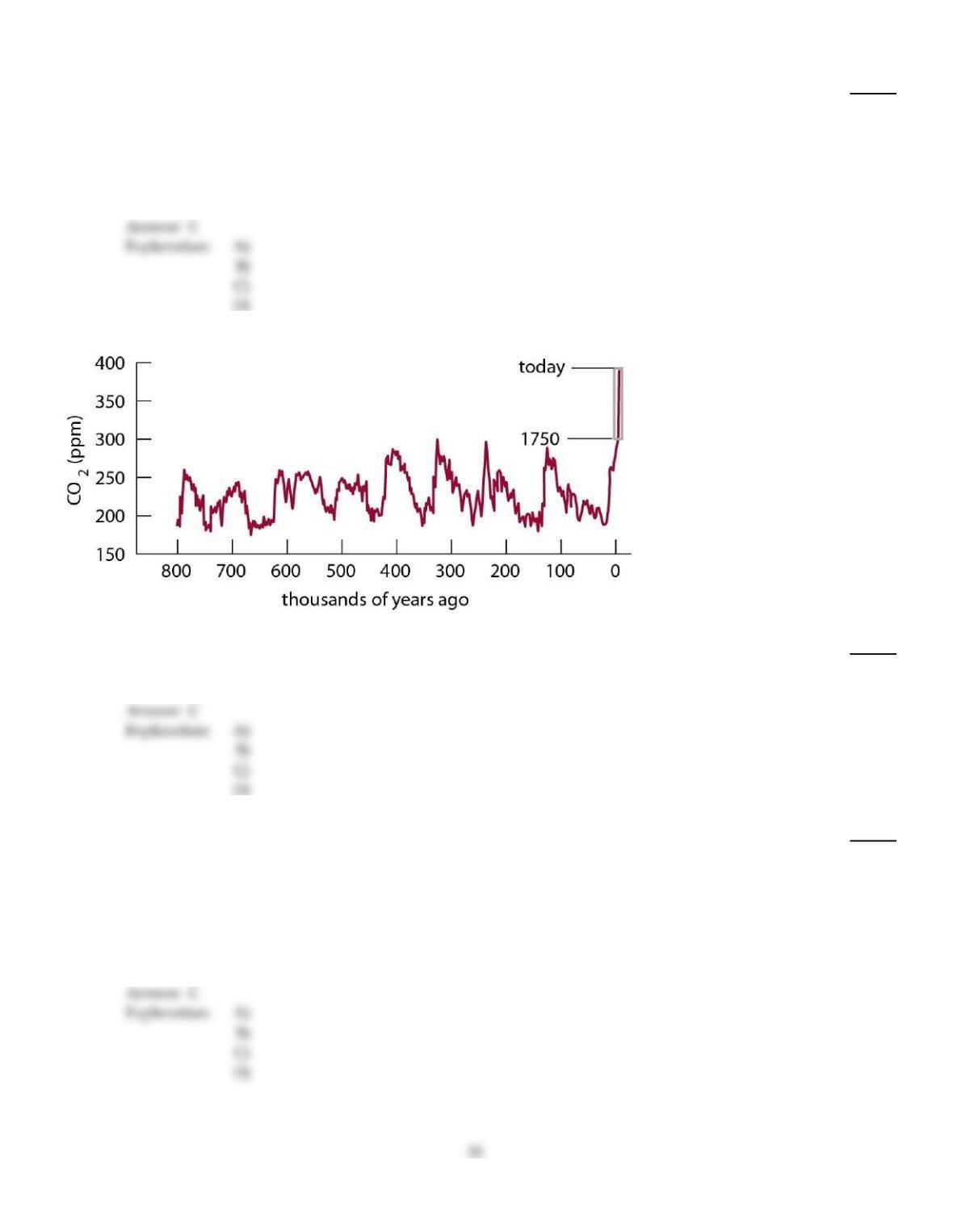
124)
The CO2 concentration of the atmosphere has increased by about ________ since 1750.
124)
A)
2.5 %
B)
250%
C)
25%
D)
None. It has decreased.
125)
The Sun is gradually increasing in luminosity as it ages. It is 20% more luminous than it was when
it was born. Why isn’t this considered to be an explanation for global warming?
125)
A)
The scientists are covering up this potentially valid explanation.
B)
What the Sun was doing millions of years ago is what determines Earth’s temperature, since
the Earth doesn’t respond directly to what the Sun is doing today.
C)
The Sun is increasing in luminosity much too slowly, over many millions of years.
D)
The amount of energy the Earth receives from the Sun remains constant regardless of what
the Sun does.

126)
Which of the following is not a product of outgassing?
126)
A)
oxygen
B)
carbon dioxide
C)
water
D)
nitrogen
127)
What makes us think that Mars must once have had an atmosphere that was warmer and had
higher surface pressure?
127)
A)
We think it for purely theoretical reasons, based on calculations showing that the Sun has
brightened with time.
B)
The atmosphere is too cold and thin for liquid water today, yet we see evidence that water
flowed on the surface in the past.
C)
The fact that parts of Mars have a lot of craters tell us that Mars must once have been much
warmer.
D)
The presence of inactive volcanoes on Mars tells us that there must once have been a lot of
outgassing, and hence a thicker atmosphere.
Explanation:
128)
Suppose Earth’s atmosphere had no greenhouse gases. Then Earth’s average surface temperature
would be
128)
A)
20°C, or about 5°C warmer than it is now.
B)
15°C, or about the same as it is now.
C)
10°C or about 5°C cooler than it is now.
D)
–16°C, which is well below freezing.
E)
0°C, or about the freezing point for water.
Explanation:
129)
Which of the following is an example of convection?
129)
A)
gas bubbling upward through a liquid
B)
different kinds of material separating by density, like oil and water
C)
rocks sinking in water
D)
warm air expanding and rising while cooler air contracts and falls
Explanation:
Explanation:

130)
The core, mantle, and crust of a planet are defined by differences in their
130)
A)
strength.
B)
geological activity.
C)
density.
D)
temperature.
131)
Rank these planets in order of the strength of the greenhouse effect on the planet, from the least to
the greatest.
131)
A)
Mars, Mercury, Earth, Venus
B)
Mercury, Earth, Mars, Venus
C)
Mars, Earth, Venus, Mercury
D)
Mercury, Mars, Earth, Venus
E)
Mercury, Venus, Earth, Mars
132)
Most of the Moon’s surface is densely covered with craters, but we find relatively few craters
within the lunar maria. What can we conclude?
132)
A)
The maria formed within the past 1 billion years.
B)
The regions of the maria were hit by fewer impacts than the densely cratered regions.
C)
The maria formed after the heavy bombardment ended.
D)
Erosion affects the maria more than it affects other regions of the Moon.
133)
Why does the Moon have a layer of “powdery soil” on its surface?
133)
A)
It exists because the Moon accreted from powdery material after a giant impact blasted the
Earth.
B)
It is made by the same processes that make powdery sand on Earth.
C)
It is the result of countless tiny impacts by small particles striking the Moon.
D)
Recent, large impacts shattered lunar rock to make this soil.

134)
Mars’ atmosphere is mostly carbon–dioxide. Why does it not experience a runaway greenhouse
effect like Venus?
134)
A)
Its atmosphere is too thin.
B)
It is protected by its magnetic field.
C)
It does not have enough additional water to magnify the warming.
135)
Which of the following statements does not lend support to the idea that carbon dioxide is a cause
of global warming?
135)
A)
Models of Earth‘s climate that include recent increases in carbon dioxide concentration match
the observed temperature increases better than those that do not include it.
B)
We understand the physical mechanism of the greenhouse effect, by which carbon dioxide
increases cause an increase in the planet’s temperature.
C)
Isotope ratios in atmospheric carbon dioxide show that much of the carbon dioxide in Earth’s
atmosphere today comes from the burning of fossil fuels.
D)
Models of the greenhouse effect successfully predict the actual temperatures of Mars and
Venus from their atmospheric carbon dioxide amounts.
C
136)
Sim–Planet: Make the difference between the night and day temperatures larger.
136)
A)
Increase the tilt of the planet’s rotation axis.
B)
Make the planet rotate more slowly.
C)
Move the planet closer to the Sun.
D)
Increase the greenhouse gas content of the planet’s atmosphere.
B
137)
Why do we think Mercury has so many tremendous cliffs?
137)
A)
They were probably formed by tectonic stresses when the entire planet shrank as its core
cooled.
B)
They are almost certainly volcanic in origin, carved by flowing lava.
C)
They probably formed when a series of large impacts hit Mercury one after the other.
D)
They were probably carved in Mercury’s early history by running water.
E)
They represent one of the greatest mysteries in the solar system, as no one has suggested a
reasonable hypothesis for their formation.
A
A

138)
The cores of the terrestrial worlds are made mostly of metal because ________.
138)
A)
the terrestrial worlds as a whole are made mostly of metal
B)
the core contained lots of radioactive elements that decayed into metals
C)
metals sunk to the centers a long time ago when the interiors were molten throughout
D)
over billions of years, convection gradually brought dense metals downward to the core
139)
Which internal heat source still generates heat within the terrestrial worlds today?
139)
A)
heat from radioactive decay
B)
heat from differentiation
C)
heat of accretion.
D)
heat from convection
140)
The greenhouse effect makes Earth warmer than it would be otherwise by about
140)
A)
–16 K.
B)
15 K.
C)
30 K.
D)
There is no greenhouse effect.
141)
Why is Mars so much colder than the Earth?
141)
A)
because the albedo of Mars is higher than the Earth
B)
because Mars is farther from the Sun
C)
because Mars has a much thinner, more diffuse atmosphere
D)
because Mars has a little less gravity than the Earth
142)
If the Earth rotated much more slowly, which of the following would be a consequence of that?
142)
A)
Seasons would last longer.
B)
Days would get hotter and nights would get colder.
C)
Seasons would be more extreme.
D)
Days would be shorter.

143)
Which in its gaseous form is not a greenhouse gas?
143)
A)
methane
B)
carbon dioxide
C)
water
D)
molecular nitrogen
144)
Based on its surface features, the most important event on Venus in the past billion years or so was
________.
144)
A)
a global “repaving” that erased essentially all the surface features that had existed earlier
B)
the eruption of a giant volcano that formed one of Venus’s “continents”
C)
the onset of mantle convection, which caused Venus’s lithosphere to split into plates like those
on Earth
D)
the impact of an unusually large asteroid that left a deep scar on one side of the planet
145)
Which of the following most likely explains why Venus does not have a global magnetic field like
Earth?
145)
A)
Unlike Earth, Venus does not have a liquid outer core.
B)
Its rotation is too slow.
C)
It does not have a metallic core.
D)
It has too thick of an atmosphere.
146)
Why does Earth have so little carbon dioxide in its atmosphere compared to Venus?
146)
A)
Earth’s volcanoes outgassed far less carbon dioxide than those on Venus.
B)
Chemical reactions turned Earth’s carbon dioxide into nitrogen.
C)
Earth once had a lot of carbon dioxide, but it was lost to space during the heavy
bombardment early in our solar system’s history.
D)
Earth has just as much carbon dioxide as Venus, but most of it is locked up in carbonate rocks
rather than being free in the atmosphere.
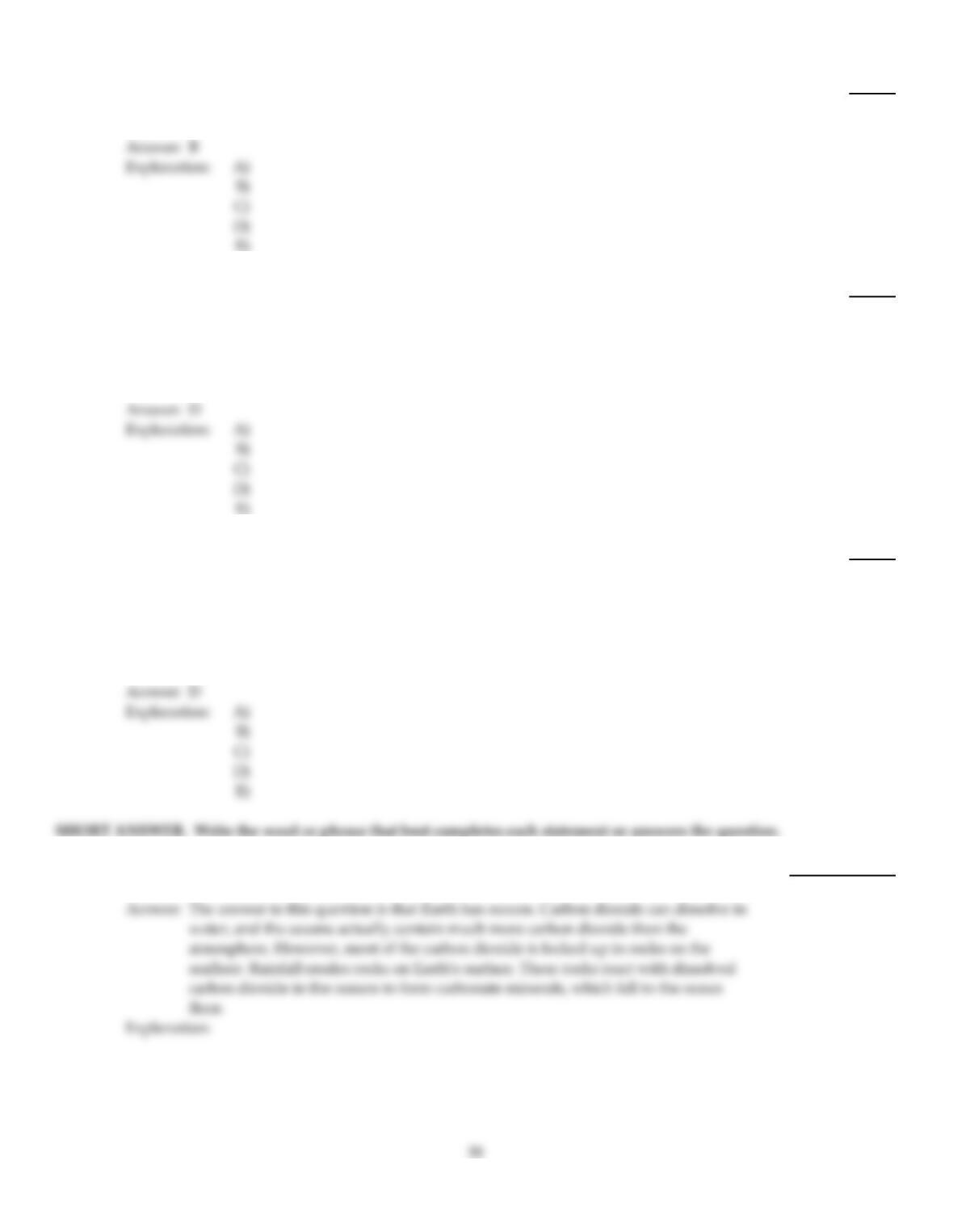
147)
Given the current emission rate of carbon dioxide, how much will the Earth’s average temperature
increase over the next century?
147)
A)
0°C
B)
3–5°C
C)
7–10°C
D)
5–7°C
E)
0–3°C
148)
How have we been able to construct detailed maps of surface features on Venus?
148)
A)
by studying Venus with powerful telescopes on spacecraft that were sent to orbit Venus
B)
by studying Venus from Earth with powerful telescopes
C)
by making computer models of geological processes on Venus
D)
by using radar from spacecraft that were sent to orbit Venus
E)
by landing spacecraft on the surface for close–up study
149)
Which internal energy source produces heat by converting gravitational potential energy into
thermal energy?
149)
A)
differentiation
B)
accretion
C)
radioactivity
D)
both A and B
E)
all of the above
150)
Why does Earth have so little carbon dioxide in its atmosphere, when Earth should have
outgassed about as much of it as Venus?
150)
151)
Why did Earth retain most of its water while Venus and Mars lost theirs?
151)
152)
Suppose Mars had turned out to be significantly smaller than its current size, say about the
size of our Moon. How would this have affected the number of geological features due to
each of the four major geological processes?
152)
153)
Why do we think Mercury contracted after it formed?
153)
154)
Explain how we can estimate the geological age of a planetary surface from its number of
impact craters.
154)
155)
Earth and Venus both presumably had similar gases outgassed from their volcanoes.
Briefly explain how their atmospheres ended up so different.
155)
156)
What is the “runaway greenhouse effect”?
156)
157)
Summarize some of the evidence suggesting that Mars once had flowing water.
157)
158)
What is a magnetosphere and how are magnetospheres related to planetary atmospheres?
158)
159)
Briefly describe how the greenhouse effect makes a planetary surface warmer than it would
be otherwise.
159)
160)
Briefly explain why Mercury, Venus, and the Moon do not have significant erosion. Relate
erosional activity to planetary size and distance from the Sun.
160)
161)
Why does Earth have so much more oxygen (O2) than Venus or Mars?
161)
162)
How does the size of a planet determine its internal temperature?
162)
163)
What is the main visual difference between the lunar maria and the rest of the lunar
surface? What are the implications of this observation?
163)
164)
Briefly describe at least three likely consequences of continued human burning of fossil
fuels adding to Earth’s greenhouse effect.
164)
165)
What are some of the things that make Earth unique among the terrestrial planets?
165)
166)
Briefly describe how the solar wind affects magnetospheres and how auroras are
produced.
166)
167)
Why does Earth have an ultraviolet–absorbing stratosphere, while Venus and Mars do not?
167)
168)
Describe the three sources of internal heat of the terrestrial planets.
168)
TRUE/FALSE. Write ‘T’ if the statement is true and ‘F’ if the statement is false.
169)
In the inner solar system, the largest surface features (such as volcanoes or valleys) are found on the
largest planets.
169)
170)
Historically, there is no link between increased CO2 levels and higher average temperatures.
170)
171)
Winter and summer differ in length on Mars because of its elliptical orbit.
171)
172)
The rise of life on the planet Earth some 4 billion years ago was made possible, in part, by the
plentiful oxygen in Earth’s early atmosphere.
172)
173)
Without greenhouse gases, Earth’s surface would be frozen over.
173)
174)
There is no erosion of surface features on the Moon.
174)
175)
Earth outgassed as much carbon dioxide as Venus, but it is locked up in the oceans and rocks.
175)

176)
We are confident that rising CO2 levels are caused by the burning of fossil fuels because
atmospheric CO2 now has the same carbon isotope ratio as fossil fuels.
176)
177)
Sunsets are red because sunlight must pass through more atmosphere then, and the atmosphere
scatters even more light at bluer wavelengths, leaving mostly red light to color the sky.
177)
178)
Earth is the only planet in the solar system known to have plate tectonics.
178)
179)
Earth is habitable because of the greenhouse effect.
179)
180)
Smaller worlds generally have thinner lithospheres.
180)
181)
The process in which one plate slides under another is called subduction and occurs where seafloor
crust descends into the mantle below continental crust.
181)
182)
The sky is blue because molecules in the atmosphere scatter blue light more effectively than red
light.
182)
183)
Erosion is the most important geological process on Venus.
183)
184)
Current CO2 levels are higher than they have been at any other time during the history of the
human species.
184)
185)
Higher temperatures make rocks weaker.
185)
186)
Earth is the only terrestrial planet to have experienced tectonic stresses and volcanic activity.
186)
187)
The presence of oxygen and ozone in Earth’s atmosphere can be explained only through biology.
187)
188)
The current atmospheric concentration of carbon dioxide on Earth is at its highest in over a million
years.
188)
189)
Venus has a thicker atmosphere than Earth.
189)
190)
Today, Mars has virtually no magnetic field.
190)
ESSAY. Write your answer in the space provided or on a separate sheet of paper.
191)
Evidence for Life: Imagine that recent advances in technology have allowed the discovery of several very low
mass (much less than the mass of Jupiter) planets around nearby, Sun–like stars. Assume all that is known
about these planets is their mass, their size, and the characteristics of their orbits (i.e., semi–major axis and
eccentricity). You are asked to speculate on whether or not life (similar to that on Earth) might exist on these
planets. How would you answer this question? You are then asked what new observations we might make to
help settle this question. How would you respond?
192)
Comparative planetology: Describe at least one way in which comparisons of Earth with the Moon, Mercury,
Venus, and / or Mars have helped us to better understand our own planet.
193)
Public Policy Informed by Science: Research the Montreal Protocol (1987) that led to a world–wide ban in the use
of chlorofluorocarbon compounds (CFCs). What was the scientific case for the ban? Why do you think such
coordinated, world–wide action was possible in this case, yet a global consensus has not emerged on how to
respond to the challenge of climate change?
194)
The Gaia Hypothesis: The Gaia hypothesis, due to James Lovelock, maintains that the Earthits atmosphere, the
oceans, the land, and liferepresents a complex interacting system that will always seek to maintain a
life–supporting environment. Discuss the operation of the Earth’s carbon dioxide cycle and how it might relate
to the Gaia hypothesis. The Gaia hypothesis is still quite controversial. Perform some research (either in your
library or on reputable internet reference sites) and summarize in a few paragraphs the arguments for and
against Gaia.

Answer Key
Testname: C7

Answer Key
Testname: C7

Answer Key
Testname: C7
Answer Key
Testname: C7
49
Answer Key
Testname: C7
50

Answer Key
Testname: C7