Managerial Decision Modeling w/ Spreadsheets, 3e (Balakrishnan/Render/Stair)
Chapter 7 Project Management
7.1 Chapter Questions
Use this information to answer the following questions.
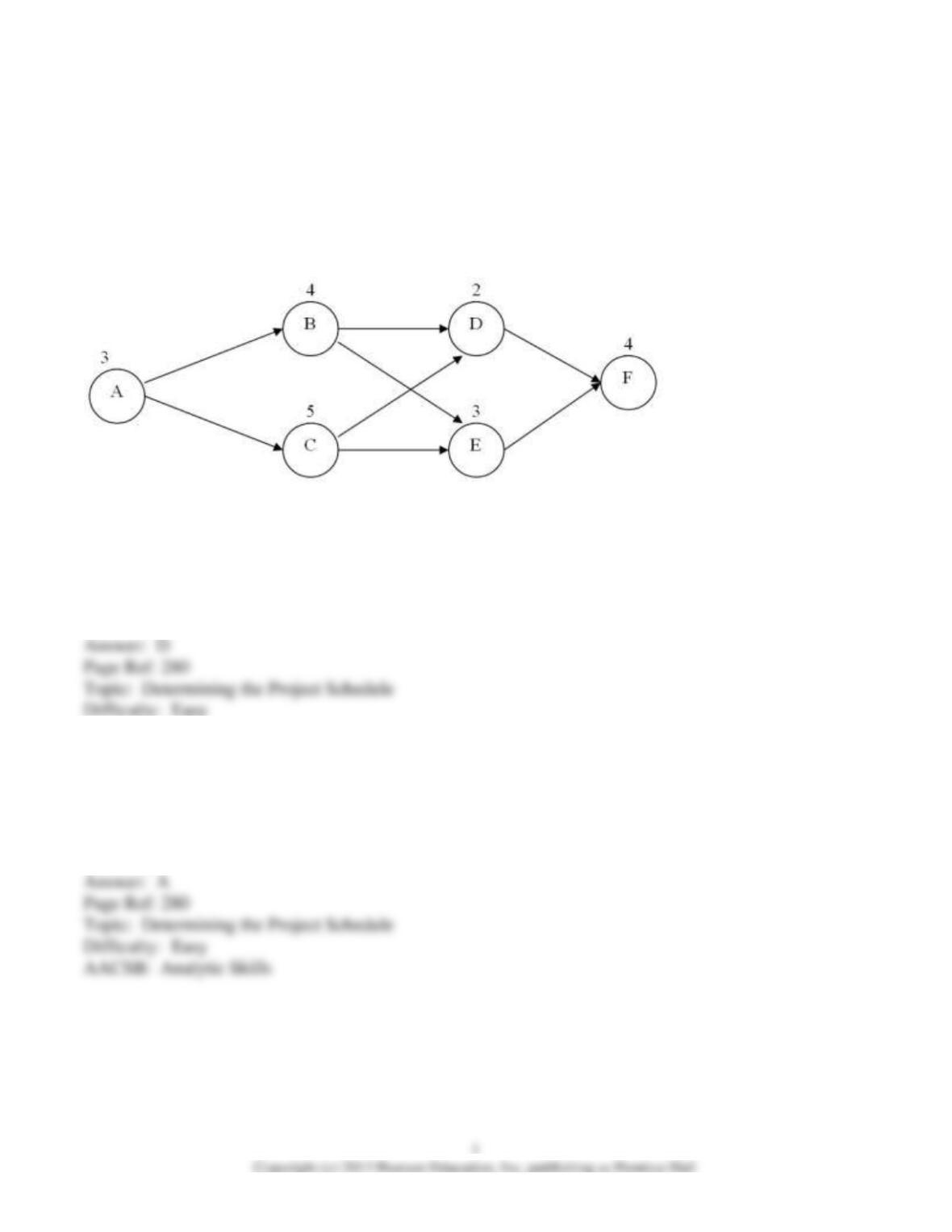
Consider the following Activity-On-Node (AON) project (activity completion times are in days).
1) Refer to the figure. What is the critical path?
A) ABDF
B) ABEF
C) ACDF
D) ACEF
E) none of the above
2) Refer to the figure. How long will take to complete the project?
A) 15 days
B) 14 days
C) 13 days
D) 12 days
E) 11 days

3) Refer to the figure. What is the slack time, in days, associated with activity E?
A) 1
B) 2
C) 0
D) 3
E) 4
4) Refer to the figure. What is the slack time, in days, associated with activity D?
A) 0
B) 1
C) 2
D) 3
E) 4
5) Refer to the figure. What is the earliest start time (EST) and earliest finish time (EFT) of activity E?
A) EST = 7, EFT = 10
B) EST = 10, EFT = 7
C) EST = 11, EFT = 8
D) EST = 8, EFT = 10
E) EST = 8, EFT = 11
6) Refer to the figure. Determine the latest start time (LST) and latest finish time (LFT) of activity B.
A) LST = 9, LFT = 5
B) LST = 5, LFT = 9
C) LST = 8, LFT = 4
D) LST = 4, LFT = 8
E) LST = 8, LFT = 10

7) Refer to the figure. Suppose that additional resources are provided to crash the project completion
time below its expected normal completion time. Which activities would be potential candidates for
crashing?
A) B
B) D
C) A and B
D) A and D
E) F
8) Refer to the figure. What are the immediate successor(s) of activity C?
A) D
B) E
C) D and E
D) A
E) B and D
9) Refer to the figure. What are the immediate predecessor(s) of activity D?
A) B and C
B) B
C) C
D) C and E
E) B and E
Use this information to answer the following questions.
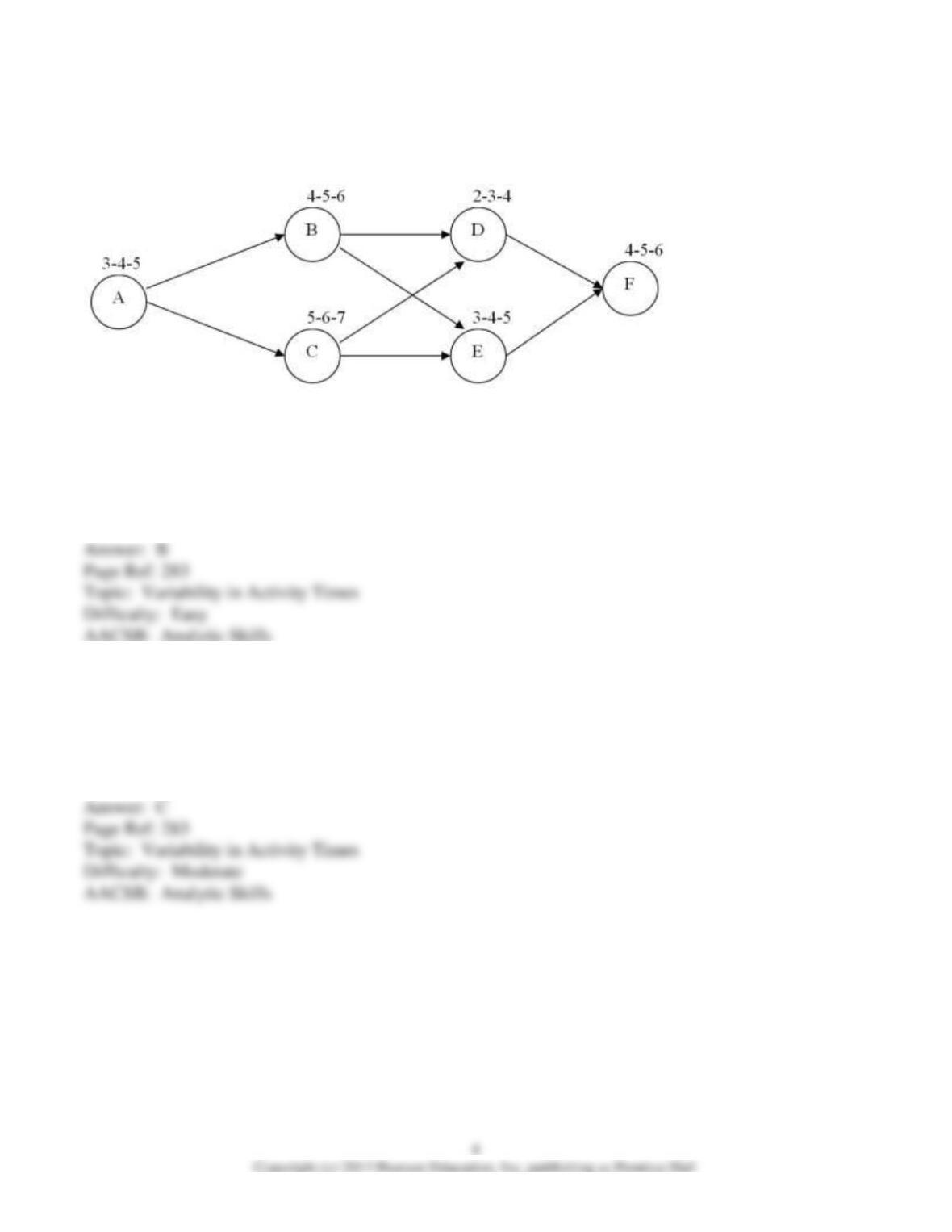
Consider the following Activity-On-Node (AON) PERT project. The three values that represent each
activity’s completion time (in days) correspond to an optimistic time, most likely time, and pessimistic
time, respectively.
10) Refer to the figure. What is the expected completion time of activity A?
A) 3
B) 4
C) 5
D) 2.7
E) 2.5
11) Refer to the figure. What is the standard deviation associated with the completion time of activity B?
A) 0.1111
B) 0.2222
C) 0.3333
D) 2
E) 5

12) Refer to the figure. What is the expected completion time of the critical path?
A) 16 days
B) 17 days
C) 18 days
D) 19 days
E) 20 days
13) Refer to the figure. What is the probability of completing the project within 18 days?
A) 0.0668
B) 0.4332
C) 0.9332
D) 0.4878
E) 0.0122
14) Refer to the figure. What is the probability of not completing the project within 18 days?
A) 0.0668
B) 0.4332
C) 0.9332
D) 0.4878
E) 0.0122
15) Refer to the figure. What deadline should be set to ensure a 99% probability that the project will be
completed within the deadline date?
A) 19.45 days
B) 19 days
C) 18 days
D) 20.56 days
E) 18.54 days

16) Which of the following statements about the project budgeting process is TRUE?
A) The weekly budget is formed by only using the early start times of each activity.
B) The weekly budget is formed by only using the late start times of each activity.
C) The weekly budget is formed by only using the early start time of each activity on the critical path.
D) The weekly budget is formed by using both the early start and finish times of each activity on the
critical path.
E) The weekly budget is formed by using both the early start and finish times of each activity.
17) A graph that plots the total resources needed per period vs. time is called a(n) ________.
A) Gantt Chart
B) Resource Loading Chart
C) Work Breakdown Structure
D) Project Network Chart
E) PERT/CPM Chart
18) Activity A has a standard cost of $500 and the standard time to complete Activity A is 5 weeks. The
crash time for Activity A is 3 weeks and the crash cost is $600. What is the crash cost per week for
Activity A?
A) $50
B) $100
C) $150
D) $200
E) $300
19) Which of the following statements about project crashing is FALSE?
A) The overall project time is reduced by crashing activities on one or more critical paths.
B) It is best to crash an activity with the cheapest cost to crash per week.
C) As activities are crashed in a project network, it is possible for more than one path to be critical.
D) In order to reduce the overall project time, it may be necessary to crash more than one activity.
E) Project crashing problems can be solved using linear programming.

20) Crash time is the longest time it would take to finish an activity if additional resources were
allocated.
21) Project scheduling is the phase that involves identifying required resources and precedence
relationships between activities.
22) The Critical Path Method (CPM) is appropriate for projects where the time required to perform each
activity is a random variable.
23) Using the backward pass, we can compute the Late Finish time (LFT) and Early Finish time (EFT)
for each activity.
24) Slack for a given activity is computed as Late Finish minus Early Finish.
25) All activities on the critical path have zero slack.
26) The crash cost per period is computed as: (crash cost – standard cost)/(standard time – crash time).

27) Using the forward pass, the Early Start time (EST) and Early Finish time (EFT) for each activity are
determined.
28) To find the expected activity time, t, the Beta distribution weighs a, m, and b equally.
29) Dummy activities may be needed in Activity-On-Node networks to preserve precedence
relationships between activities.
30) In managing project costs, a weekly budget is only formed using EST values.
31) PERT is a probabilistic technique, whereas CPM is a deterministic technique.
32) In an Activity-On-Node (AON) network, arcs denote activities.
33) Any activity in the project network can be crashed in order to reduce the overall expected
completion time.
34) Crashing activities can lead to the formation of more than one critical path in a project network.
9
35) In minimizing total crashing costs, it is best to first crash the activity in a project network with the
cheapest cost to crash per period.
7.2 Excel Problems
Use this information to answer the following questions.
Jamie is planning a trip overseas. A variety of activities must be completed before her departure. The
following table describes the relationships between these activities.
Immediate
Activity Predecessors
A –
B A
C A
D B, C
E B, C
F D, E
G F
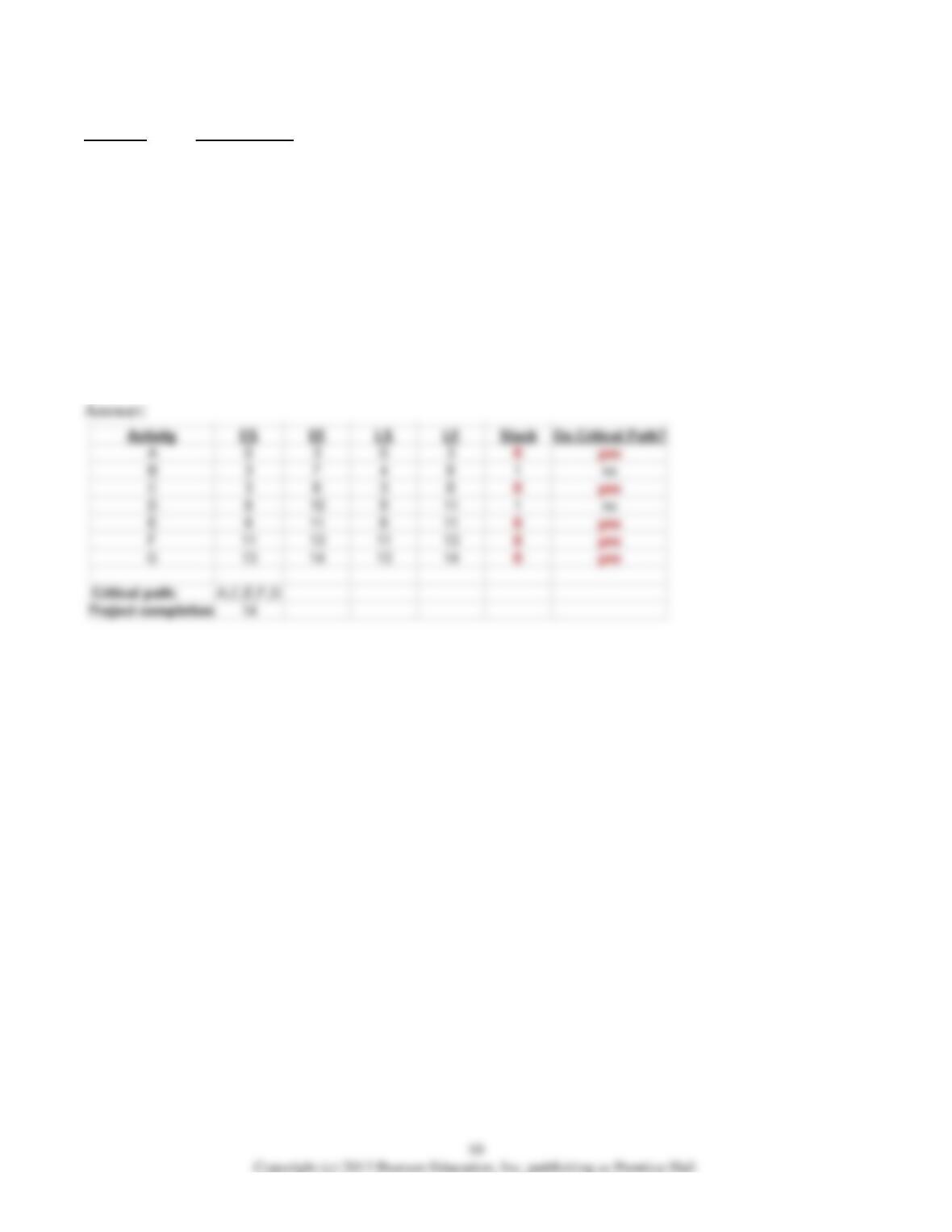
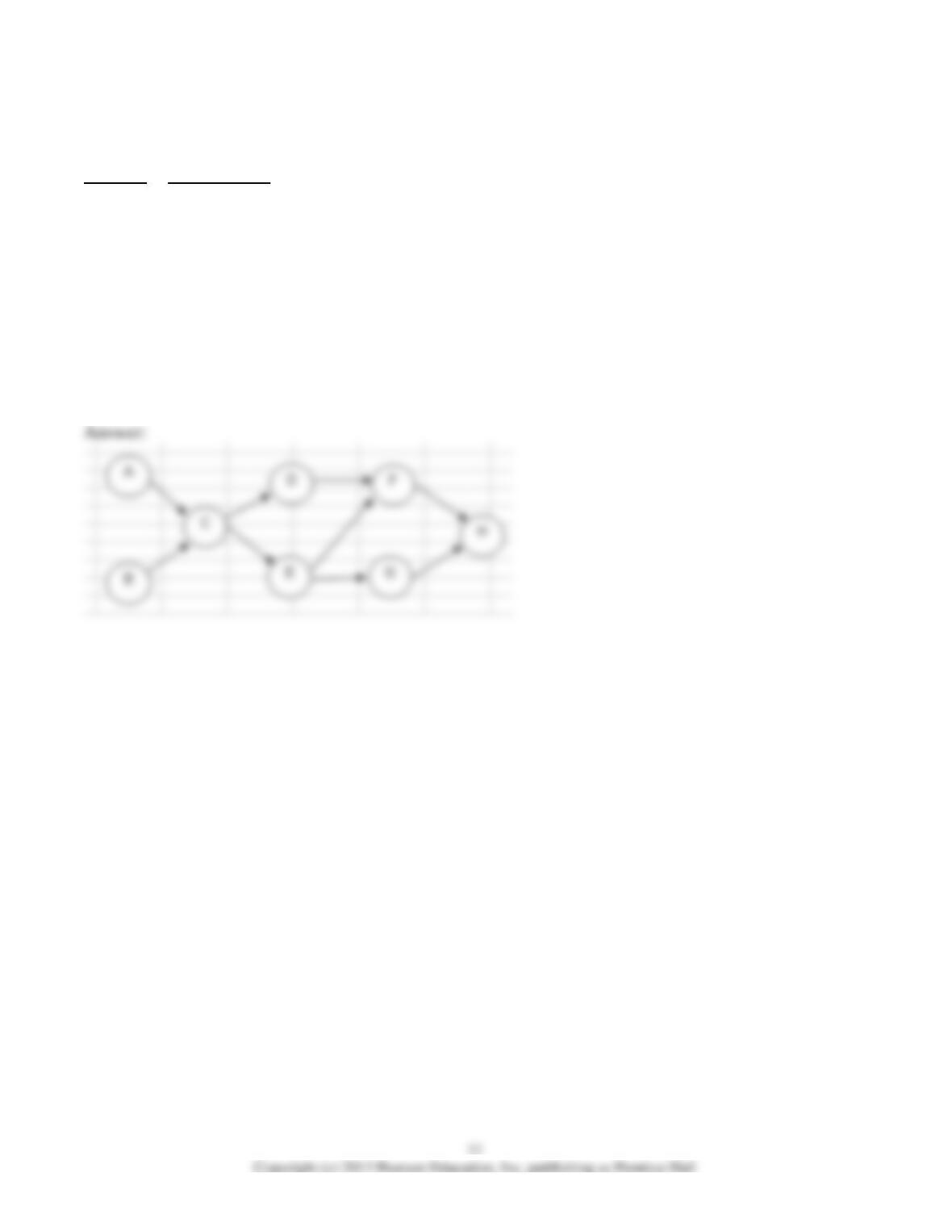
1) Using this data above, develop a network for this project.
2) Refer to the information above. Jamie was able to estimate the activity times as shown in the table
below.
Activity Time (Days)
A 4
B 4
C 5
D 3
E 3
F 2
G 1
a. Calculate the earliest and latest start and finish times for each activity.
b. Calculate the slack for each activity.
c. Determine the critical path.
d. Determine the length of the project.
Use this information to answer the following questions.
Consider the following set of activities that must be completed in order to prep a new home for painting.
Immediate
Activity Predecessors
A –
B –
C A, B
D C
E C
F D, E
G E
H F, G
3) Using this data above, develop a network for this project.
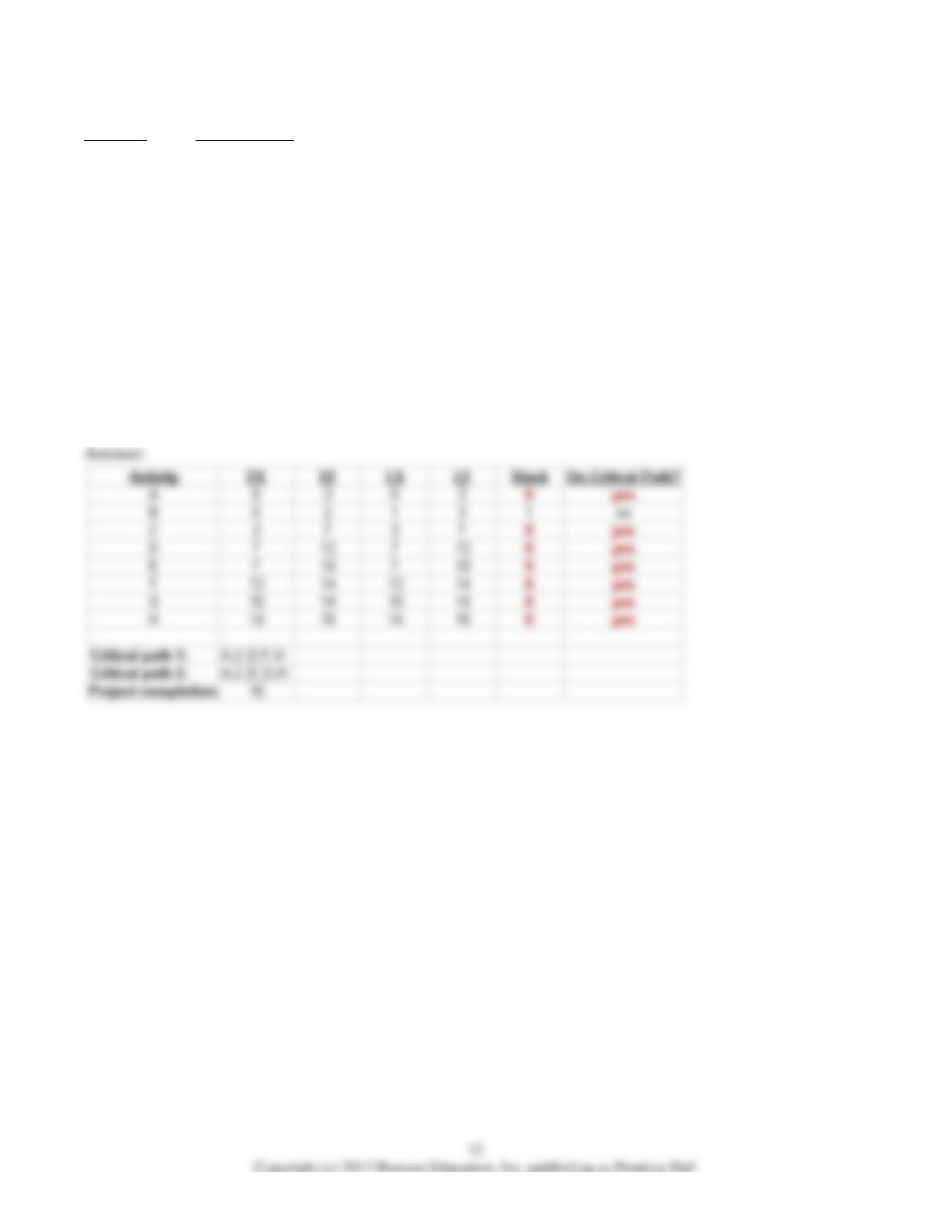
4) Refer to the information above. Assume that the painters were able to estimate the activity times as
shown in the table below.
Activity Time (Days)
A 3
B 2
C 4
D 5
E 3
F 2
G 4
H 2
a. Calculate the slack for each activity.
b. Calculate the earliest and latest start and finish times for each activity.
c. Determine the critical path.
d. Determine the length of the project.
13
Use this information to answer the following questions.
Consider the following set of activities.
Immediate
Activity Predecessors
A –
B –
C –
D A, B
E C
F D, E
G E
H F, G
I F
J I, H
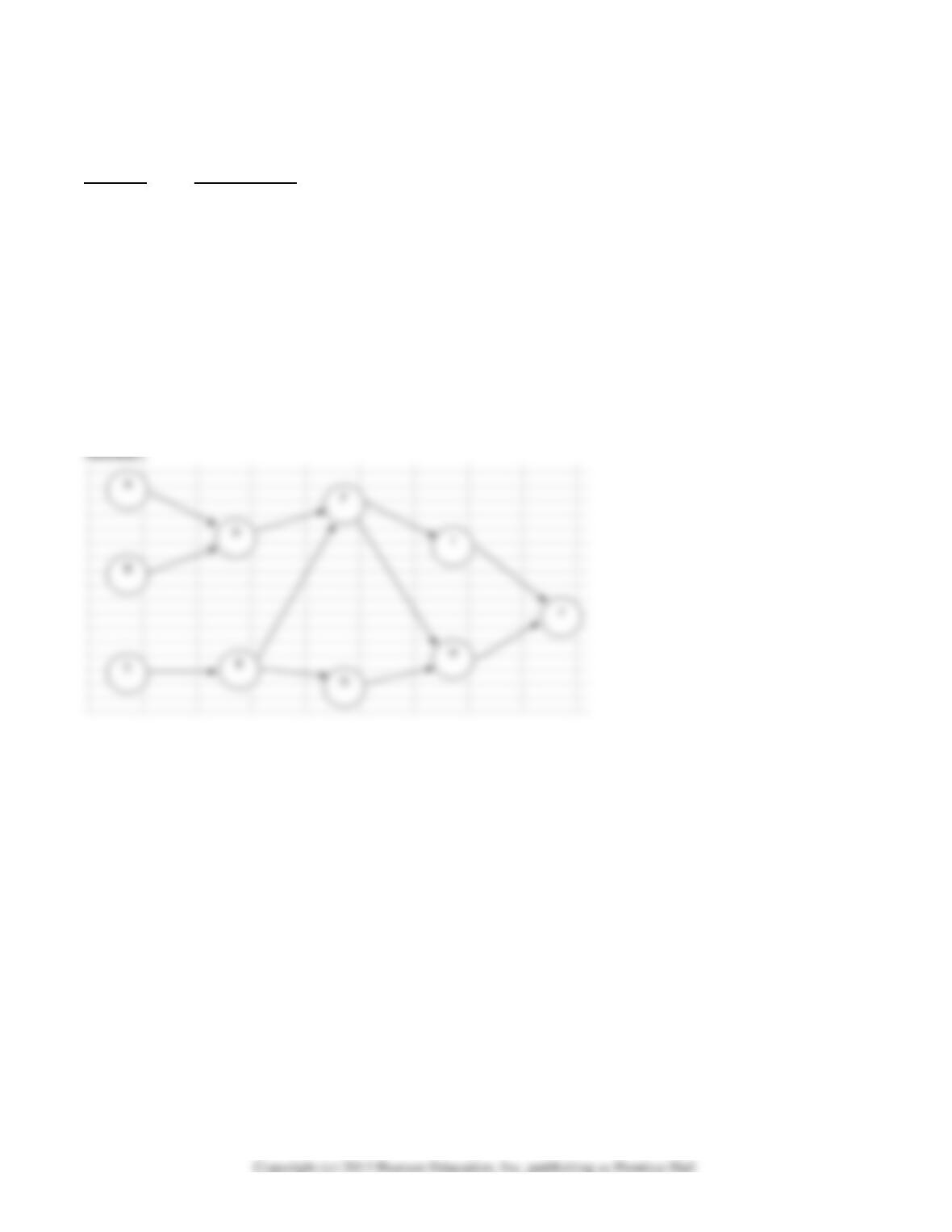
5) Using the data above, develop a network for this project.