Cost Accounting: A Managerial Emphasis, 6e
Chapter 7 – Flexible Budgets, Variances, and Management Control: I
7.3 Distinguish between Levels 3 and 4 variance analyses for substitute inputs, and
calculate Level 4 direct mix and yield variances.
1) The direct materials yield variance is the difference between: 1) the budgeted cost for the actual mix of
the total quantity of direct materials used, and 2) the budgeted cost of the budgeted mix of the actual total
quantity of direct materials used.
2) The direct materials mix variance is the difference between: 1) the actual cost of direct materials based
on the actual total quantity of all direct material inputs used, and 2) the flexible-budget cost of direct
materials based on the budgeted total quantity of direct material inputs for the actual output.
3) An unfavourable direct materials mix variance results when cheaper direct materials are substituted
for more expensive direct materials.
4) A favourable direct materials yield variance results when less direct materials are used than planned.
5) More insight into the efficiency variance for direct materials can be gained by subdividing it into the
direct materials
A) mix and volume variances.
B) market-share and market-size variances.
C) rate and usage variances.
D) price and efficiency variances.
E) mix and yield variances.
Cost Accounting: A Managerial Emphasis, 6e
Chapter 7 – Flexible Budgets, Variances, and Management Control: I
6) The direct materials mix variance will be favourable when
A) the flexible-budget contribution margin is greater than the actual contribution margin.
B) the actual direct materials input mix is less expensive than the budgeted direct materials input mix.
C) the actual quantity of total inputs used is greater than the flexible budget for total inputs.
D) actual unit sales are less than budgeted unit sales.
E) the input-efficiency variance is favourable.
7) The materials yield variance will be unfavourable when
A) the flexible-budget contribution margin is greater than the actual contribution margin.
B) the actual direct materials input mix is less expensive than the budgeted direct materials input mix.
C) the input-efficiency variance is favourable.
D) the actual quantity of total inputs used is greater than the flexible budget for total inputs.
E) actual unit sales are less than budgeted unit sales.
8) The direct materials mix variance is the
A) average of the direct materials mix variances for each input.
B) sum of the direct materials mix variances for each input.
C) difference between the direct materials mix variances for each input.
D) multiple of the direct materials mix variances for each input.
E) lesser of the direct materials yield variance and the direct materials efficiency variance.
Cost Accounting: A Managerial Emphasis, 6e
Chapter 7 – Flexible Budgets, Variances, and Management Control: I
Use the information below to answer the following question(s).
Jenny’s Condiments makes a specialty mustard for street vendors that is composed of wet ingredients
and dry ingredients. Two parts of wet ingredients at a standard cost of $12, and three parts of dry
ingredients at a standard cost of $9, are required for every batch. In the first week of July, Jenny produced
two hundred thirty batches of mustard using 450 units of wet ingredients and 750 units of dry
ingredients.
9) What are the direct materials quantity variances for the wet and dry ingredients respectively?
A) $120 favourable/$540 unfavourable
B) $90 favourable/$720 unfavourable
C) $2,880 favourable/$2,610 unfavourable
D) $120 unfavourable/$540 favourable
E) $90 unfavourable/$720 favourable
10) For the wet ingredients what are the material mix and yield variances respectively?
A) $270 favourable/$180 unfavourable
B) $240 unfavourable/$360 favourable
C) $240 favourable/$360 unfavourable
D) $360 favourable/$240 unfavourable
E) $360 unfavourable/$240 favourable
Cost Accounting: A Managerial Emphasis, 6e
Chapter 7 – Flexible Budgets, Variances, and Management Control: I
11) For the dry ingredients what are the material mix and yield variances respectively?
A) $270 favourable/$270 unfavourable
B) $360 unfavourable/$360 unfavourable
C) $360 favourable/$360 unfavourable
D) $360 favourable/$360 favourable
E) $270 unfavourable/$270 unfavourable
7.4 Undertake variance analysis in activity-based costing systems.
1) Flexible budget quantity computations should be focused at the appropriate level of the cost hierarchy.
2) Price variances can be calculated for batch-level costs as well as for output unit-level costs.
3) Performance variance analysis can be used in activity-based costing systems.
Cost Accounting: A Managerial Emphasis, 6e
Chapter 7 – Flexible Budgets, Variances, and Management Control: I
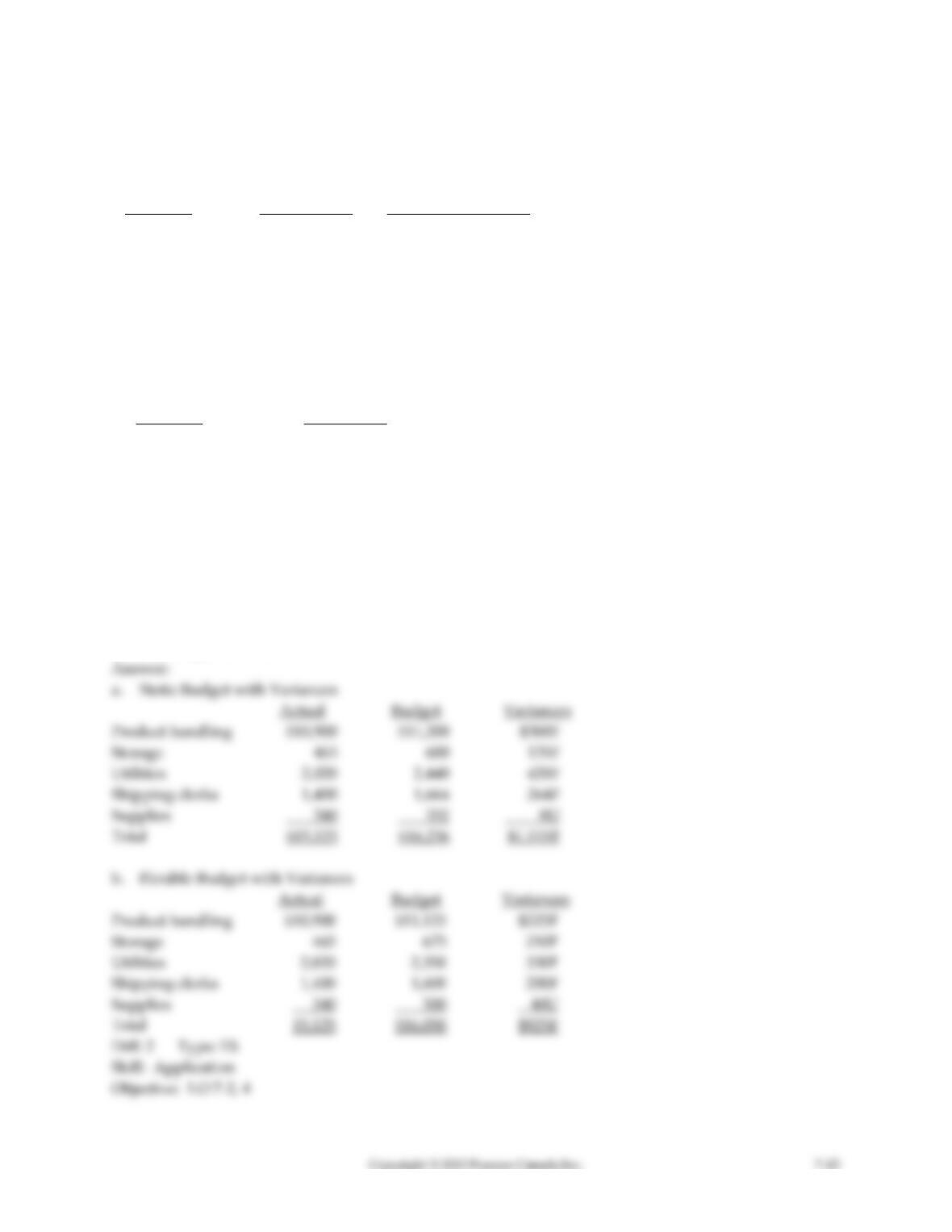
4) Tyson’s Hardware, a retailing company with several locations, anticipated that it would have 96,000
sales units for 664 customer shipments. Average storage bin usage for various inventories was estimated
to be 200 storage bins per day. The costs and cost drivers were determined to be as follows:
Cost Item Fixed Portion Variable Cost/Driver
Product handling $10,000 $1.25 per 100 units
Storage 3.00 per storage bin
Utilities 1,000 1.50 per 100 units
Shipping clerks 1,000 1.00 per shipment
Supplies 0.50 per shipment
During the year the warehouse processed 90,000 units for 600 customer shipments. The workers used 225
storage bins on average each day to sort, store, and process goods for shipment. The actual costs for were:
Cost Item Actual costs
Product handling $10,900
Storage 465
Utilities 2,020
Shipping clerks 1,400
Supplies 340
Required:
a. Prepare a static-budget and show the static-budget variances for each cost item and the total static–
budget variance.
b. Prepare a flexible-budget and show the flexible-budget variances for each cost item and the total
flexible-budget variance.
Cost Accounting: A Managerial Emphasis, 6e
Chapter 7 – Flexible Budgets, Variances, and Management Control: I
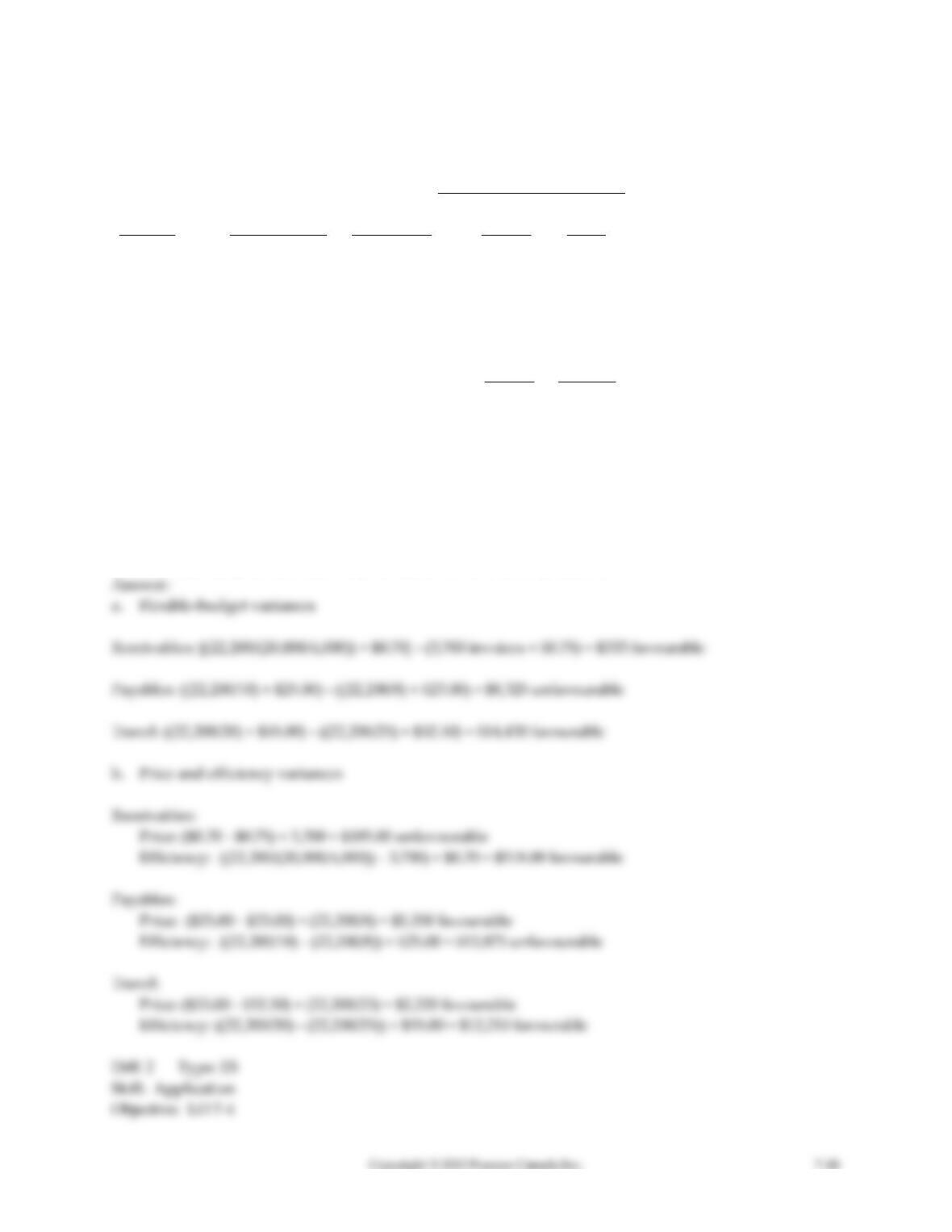
5) Jackson Autoparts is a company that delivers automobile repair parts to service garages. The following
information is for three of the company’s activities in 2012:
Rate per Output unit/Batch
Static Actual
Activity Activity Level Cost Driver Budget Cost
Receivables Output unit Sales invoices $0.70 $0.75
Payables Batch Purchase invoices $25.00 $23.00
Travel expenses Batch Travel claims $55.00 $52.50
The output measure is the number of deliveries.
Static Actual
Budget Amount
Number of deliveries 20,000 22,200
Number of sales invoices 4,000 3,700
Batch size in terms of deliveries:
Purchase invoices 10 8
Travel expense claims 20 25
Required:
a. Calculate the flexible-budget variance for each activity in 2012.
b. Calculate the price and efficiency variances for each activity in 2012.
Cost Accounting: A Managerial Emphasis, 6e
Chapter 7 – Flexible Budgets, Variances, and Management Control: I
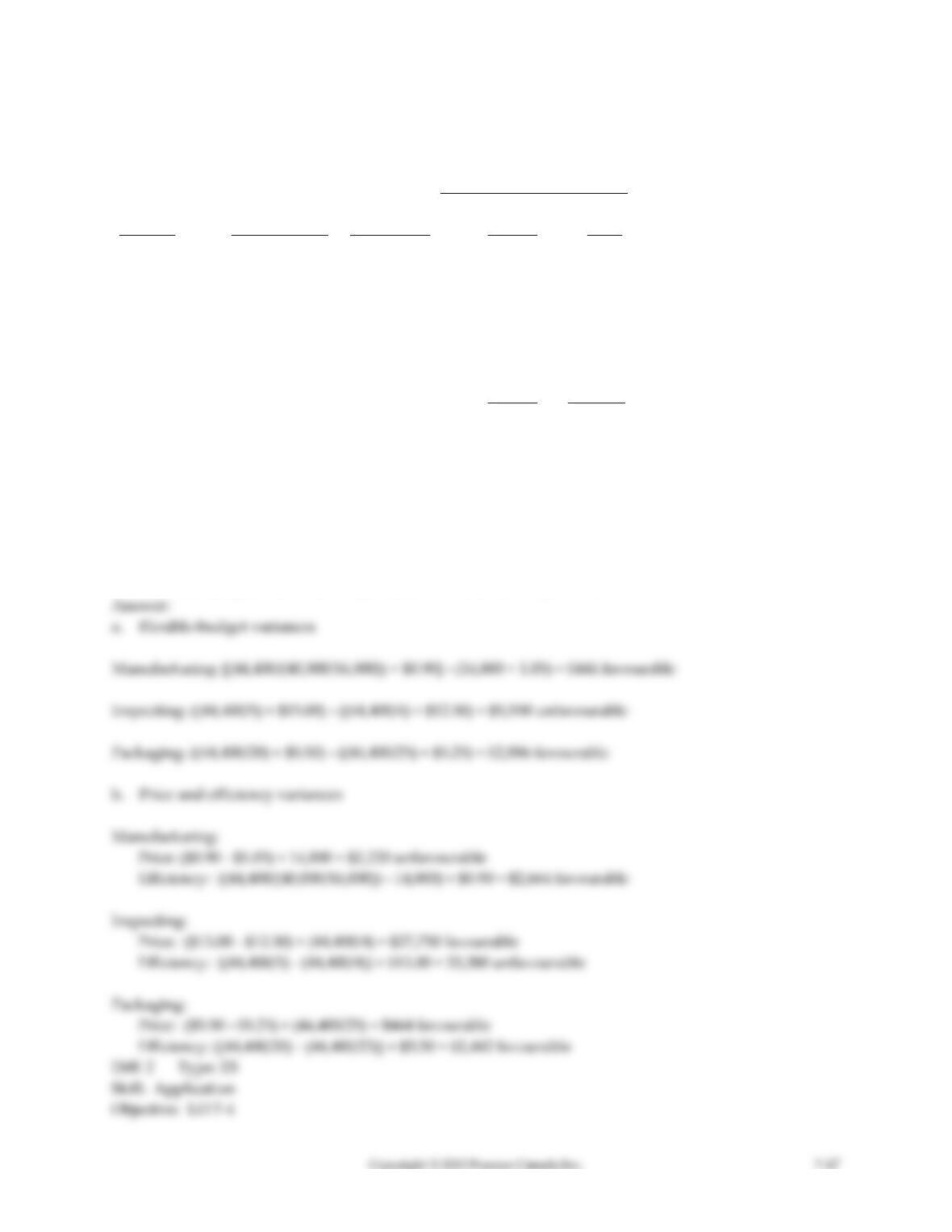
6) Samson Equipment Ltd. is a company that manufactures an abdominal exerciser called The Ab
Rippler. The following information is for three of the company’s activities in 2012:
Rate per Output unit/Batch
Static Actual
Activity Activity Level Cost Driver Budget Cost
Manufacturing Output unit Machine hours $0.90 $1.05
Inspecting Batch Inspection hours $15.00 12.50
Packaging Batch Packaging hours $5.50 $5.25
The output measure is the number of units produced.
Static Actual
Budget Amount
Number of units produced 40,000 44,400
Number of machine hours 16,000 14,800
Batch size in terms of units produced:
Inspection 5 4
Packaging 20 25
Required:
a. Calculate the flexible-budget variance for each activity in 2012.
b. Calculate the price and efficiency variances for each activity in 2012.
Cost Accounting: A Managerial Emphasis, 6e
Chapter 7 – Flexible Budgets, Variances, and Management Control: I
7) Explain how variance analysis is used in conjunction with activity-based costing.
7.5 Describe how managers use variance analyses.
1) The most important task in variance analysis is to understand why variances occur, and then to use
that knowledge to promote learning and continual improvement.
2) A cost of a given activity decreases over continuous time periods. This is considered to be a continuous
improvement variable cost.
3) A favourable variance can be automatically interpreted as “good news.”
4) Managers generally have more control over efficiency variances than price variances.
Cost Accounting: A Managerial Emphasis, 6e
Chapter 7 – Flexible Budgets, Variances, and Management Control: I
5) To prepare budgets based on actual data from past periods is preferred since past inefficiencies are
excluded.
6) The use of high-quality raw materials is likely to result in a favourable efficiency variance and an
unfavourable price variance.
7) The direct manufacturing labour price variance is likely to be favourable if higher-skilled workers are
put on a job.
8) If variance analysis is used for performance evaluation, managers are encouraged to meet targets using
creativity and resourcefulness.
9) Which of the following is likely to be related to an unfavourable direct materials price variance?
A) Standard costs were determined correctly.
B) the negotiating skills of the marketing manager
C) unexpected price decreases in direct materials
D) Actual direct material purchases were in larger quantities than normal, resulting in receiving volume
discounts.
E) Materials were purchased based on a competitive bid.
Cost Accounting: A Managerial Emphasis, 6e
Chapter 7 – Flexible Budgets, Variances, and Management Control: I
10) If a purchasing agent is able to negotiate a price lower than that set by the current budget by
purchasing direct materials of similar quality,
A) a reduction in customer service costs will result.
B) the effect on the direct materials efficiency variance will be favourable.
C) the effect on the direct labour efficiency variance will be favourable.
D) the effect on the purchase price variance will be favourable.
E) the effect on the direct materials efficiency variance will be unfavourable.
11) Which of the following reasons is unlikely to be related to an unfavourable variance for labour costs?
A) labour used was less skilled than usual
B) poor work scheduling
C) excessive equipment downtime
D) inappropriate standards
E) price variance in direct materials purchased at the standard quality
12) In a manufacturing area of an organization; poor product design, problems with the quality of
materials, and scheduling conflicts could result in
A) a favourable materials efficiency variance.
B) a favourable labour efficiency variance.
C) a favourable materials effectiveness variance.
D) an unfavourable materials effectiveness variance.
E) an unfavourable materials efficiency variance.
13) If a company only reached 85% of their production goal, the 85% may be called the company’s
A) effectiveness rate.
B) efficiency rate.
C) goal achievement rate.
D) standard production rate.
E) variance rate.
Cost Accounting: A Managerial Emphasis, 6e
Chapter 7 – Flexible Budgets, Variances, and Management Control: I
14) The relative amount of inputs used to reach a given level output is a measure of which of the
following?
A) effectiveness
B) selling price
C) purchase price
D) marketing efforts
E) efficiency
15) Which of the following statements is true?
A) A favourable variance always benefits a company.
B) Managers attempt to maintain unfavourable variances.
C) Favourable variances are typically not preferred by management.
D) Only a flexible budget can be used to determine a variance.
E) A favourable variance is not always beneficial for an organization.
16) Cost variances should be investigated when
A) the results are favourable but within acceptable limits.
B) costs incurred must be reduced.
C) expected costs of investigation exceed expected benefits.
D) the results are unfavourable but within acceptable limits.
E) the amounts are immaterial.
17) A continuous improvement budgeted cost, in terms of variances and standard costs,
A) is held constant regardless of external factors, thus enabling management to isolate internal variance
factors.
B) is successively reduced over succeeding time periods.
C) ensures that managers will avoid unfavourable materials (or labour) variances that are due to external
factors.
D) is easier to achieve for older, more established production runs, than for new products.
E) is achieved as easily for older, more established production runs, as for for new products.
Cost Accounting: A Managerial Emphasis, 6e
Chapter 7 – Flexible Budgets, Variances, and Management Control: I
18) During February the Lungren Manufacturing Company’s costing system reported several variances
that the production manager was surprised to see. The following information is for the manufacture of
garden gates, its only product:
1. Direct materials price variance, $800 unfavourable.
2. Direct materials efficiency variance, $1,800 favourable.
3. Direct manufacturing labour price variance, $4,000 favourable.
4. Direct manufacturing labour efficiency variance, $600 unfavourable.
Required:
a. Provide the manager with some ideas as to what may have caused the price variances.
b. What may have caused the efficiency variances?
Cost Accounting: A Managerial Emphasis, 6e
Chapter 7 – Flexible Budgets, Variances, and Management Control: I
19) Your company hired a summer student as an accounting intern to prepare variance analysis for the
plant manager (the student’s father), so that the entire organization could become more effective and
efficient. Up to this time, the company used a budget but only one that specified sales and production in
units, and each department gauged and reported on its own performance based on historical rules of
thumb developed over the years. The plant manager instructed every department manager to assist the
new accountant as achieving favourable results would ensure he got a good bonus. For the month of
May, the student met with the department heads of each functional area, obtaining from them the data
and estimates to come up with: standard costs and prices; and, standard direct material usage and
standard direct labour usage. Then in June, July and August the student collected; and, analyzed the
variance results, and prepared a report for the plant manager. The report indicated favourable variances
in virtually every functional area, allowing the plant manager to receive a larger bonus than usual.
Required:
Comment on the above process, in terms of variance analysis.
Cost Accounting: A Managerial Emphasis, 6e
Chapter 7 – Flexible Budgets, Variances, and Management Control: I
20) You have been promoted to management accountant at a hospital. One of the things you noted from
reviewing past internal reports is that the quality of the data is poor at times, and there is no objective
standard for evaluating performance. When you asked about this at a board of directors meeting, the
consensus reply was that the hospital’s operations were too subjective and service orientated, and that it
was a non-profit organization, so setting profit goals was of no value.
Required:
Comment on a possible approach that could be taken to provide objective criteria for performance
evaluation in this situation.
21) On the line in front of each variance, put the letter of the department that is most likely responsible for
that variance. A letter may be used more than once or not at all.
A. Production department
B. Marketing department
C. Purchasing department
D. Personnel department
________ Direct material price variance
________ Direct labour price variance
________ Direct labour efficiency variance
________ Sales volume variance
________ Direct material efficiency variance
Cost Accounting: A Managerial Emphasis, 6e
Chapter 7 – Flexible Budgets, Variances, and Management Control: I
7.6 Appendix: Distinguish among standards, budgets, benchmarks.
1) Benchmarking is the continuous process of measuring products, services, and activities against the best
possible levels of performance.
2) Companies use both internal and external benchmarks.
3) When benchmarking, the best levels of performance are typically found in companies that are totally
different.
4) When benchmarking,
A) the best levels of performance are usually found in companies that are within different industries.
B) finding appropriate benchmarks is a minor issue.
C) it is important to set standards at industry averages.
D) comparisons can highlight areas for improved cost management.
E) a broader scope allows for easier comparison.
5) Which of the following is part of the benchmarking process?
A) standard setting against industry averages
B) establishing legal processes
C) sharing information with other companies
D) obtaining a benchmarking license
E) setting up bench mark variances
Cost Accounting: A Managerial Emphasis, 6e
Chapter 7 – Flexible Budgets, Variances, and Management Control: I
6) The process in which a company’s products or services are measured relative to the best possible levels
of performance is known as
A) benchmarking.
B) measuring the performance gap.
C) standard measurement.
D) variance measurement.
E) budgeting.
7) Which of the following statements about benchmarks is true?
A) They may be financial or nonfinancial.
B) They are used to compute variances.
C) Broad benchmarks have more relevance.
D) Obtaining benchmarks has no legal or ethical issues.
E) Benchmarks are the main driver of strategic planning.
8) In a journal entry for a standard costing system that records favourable variances, to increase the
relevant variance account
A) causes a credit to Cost of Goods Sold.
B) decreases the Operating Income Account.
C) the variance account must be debited.
D) the variance account must be credited.
E) reduces the contra account.
9) When a journal entry is made in a standard cost system to record the liability for direct manufacturing
labour costs, the difference between the debit to the work–in-process control account and the credit to the
payroll payables is
A) only the efficiency variance.
B) only the price variance.
C) the difference between the actual wage rate and the budgeted rate, times the actual hours.
D) the difference between the actual wage rate and the budgeted rate, times the budget hours.
E) the total of the price and efficiency labour variances.
Cost Accounting: A Managerial Emphasis, 6e
Chapter 7 – Flexible Budgets, Variances, and Management Control: I
10) The input standard cost per completed unit may be calculated by
A) multiplying the budgeted number of outputs for one input by the budgeted price per output unit.
B) multiplying the budgeted price per input by the budgeted number of inputs for one unit of output.
C) dividing the variable price per input by the budgeted number of inputs for one unit of output.
D) dividing the budgeted number of outputs for one input by the budgeted price per output unit.
E) dividing the budgeted price per input by the budgeted number of inputs for one unit of output.
11) Compute the total standard cost per book for Publisher’s Company using the following information:
Direct Materials: 1 ream of paper allowed per output unit manufactured, at $5.00 per ream.
Direct Mfg. Labour: 0.35 labour-hours of input allowed per output unit finished, at $17.50 standard cost
per hour.
Variable Manufacturing Overhead: assigned on the basis of 0.25 per hour at $25 standard cost per hour
per output unit finished.
A) $11.13 per output unit
B) $14.63 per output unit
C) $17.38 per output unit.
D) $47.50 per output unit
E) $48.60 per output unit
12) A standard is
A) usually expressed on a per unit basis.
B) consistently calculated in manufacturing companies.
C) always the same as a budgeted amount.
D) only set within the company.
E) never expressed on a per unit basis.
Cost Accounting: A Managerial Emphasis, 6e
Chapter 7 – Flexible Budgets, Variances, and Management Control: I
13) ________ is a carefully predetermined amount usually expressed on a per-unit basis.
A) Variable marketing overhead
B) A flexible budget
C) A standard
D) Fixed factory overhead
E) A static budget
14) It’s year-end and you have the task of clearing up the final accounting entries for management
accounting. There is an unfavourable direct materials price variance of $25,000 which needs to be closed
from the manufacturing overhead account. The company uses the proration approach in this situation,
and it has been determined that half of the variance should be charged to finished goods and half to cost
of goods sold.
Required:
Prepare the necessary entry for the end of period adjustment.
Cost Accounting: A Managerial Emphasis, 6e
Chapter 7 – Flexible Budgets, Variances, and Management Control: I
15) Waddell Productions makes separate journal entries for all cost accounting related activities. It uses a
standard cost system for all manufacturing items. For the month of June the following activities have
taken place:
Direct Manufacturing Materials Purchased $300,000
Direct Manufacturing Materials Used $250,000
Direct Materials Price Variance $10,000 unfavourable
Direct Materials Efficiency Variance $15,000 favourable
Direct Manufacturing Labour Price Variance $6,000 favourable
Direct Manufacturing Labour Efficiency Variance $4,000 favourable
Direct Manufacturing Labour Payable $170,000
Required:
Record the necessary journal entries to:
1. Record the materials purchases assuming that materials price variances are recorded at the time of
purchase.
2. Record the materials placed into production.
3. Record the direct labour used in production.
Cost Accounting: A Managerial Emphasis, 6e
Chapter 7 – Flexible Budgets, Variances, and Management Control: I
16) Mayberry Company had the following journal entries recorded for the end of June. Unfortunately, the
company’s only accountant quit on July 10 and the president is at a loss as to the company’s performance
for the month of June.
Materials Control 150,000
Direct Materials Price Variance 5,000
Accounts Payable Control 145,000
Work-in-Process Control 60,000
Direct Materials Efficiency Variance 4,000
Materials Control 64,000
Work-in-Process Control 425,000
Direct Manufacturing Labour Price Variance 7,500
Direct Manufacturing Labour Efficiency Variance 9,000
Wages Payable Control 423,500
Required:
a. What kind of performance did the company have for June? Explain each variance.
b. Why is Direct Materials given in two entries?
17) What is benchmarking, and how is it useful to a company?