Exam
Name___________________________________
MULTIPLE CHOICE. Choose the one alternative that best completes the statement or answers the question.
1)
As distance from the equator increases, seasonal variation in temperature tends to
1)
A)
decrease.
B)
increase.
C)
remain constant.
2)
Humid subtropical hot summer climates in ________ typically experience ________.
2)
A)
North America; wet summers due to monsonal conditions.
B)
Asia; dry winters due to monsoonal conditions.
C)
Asia; wet summers due to cyclonic storm tracks.
D)
North America; dry winters due to cold ocean currents.
3)
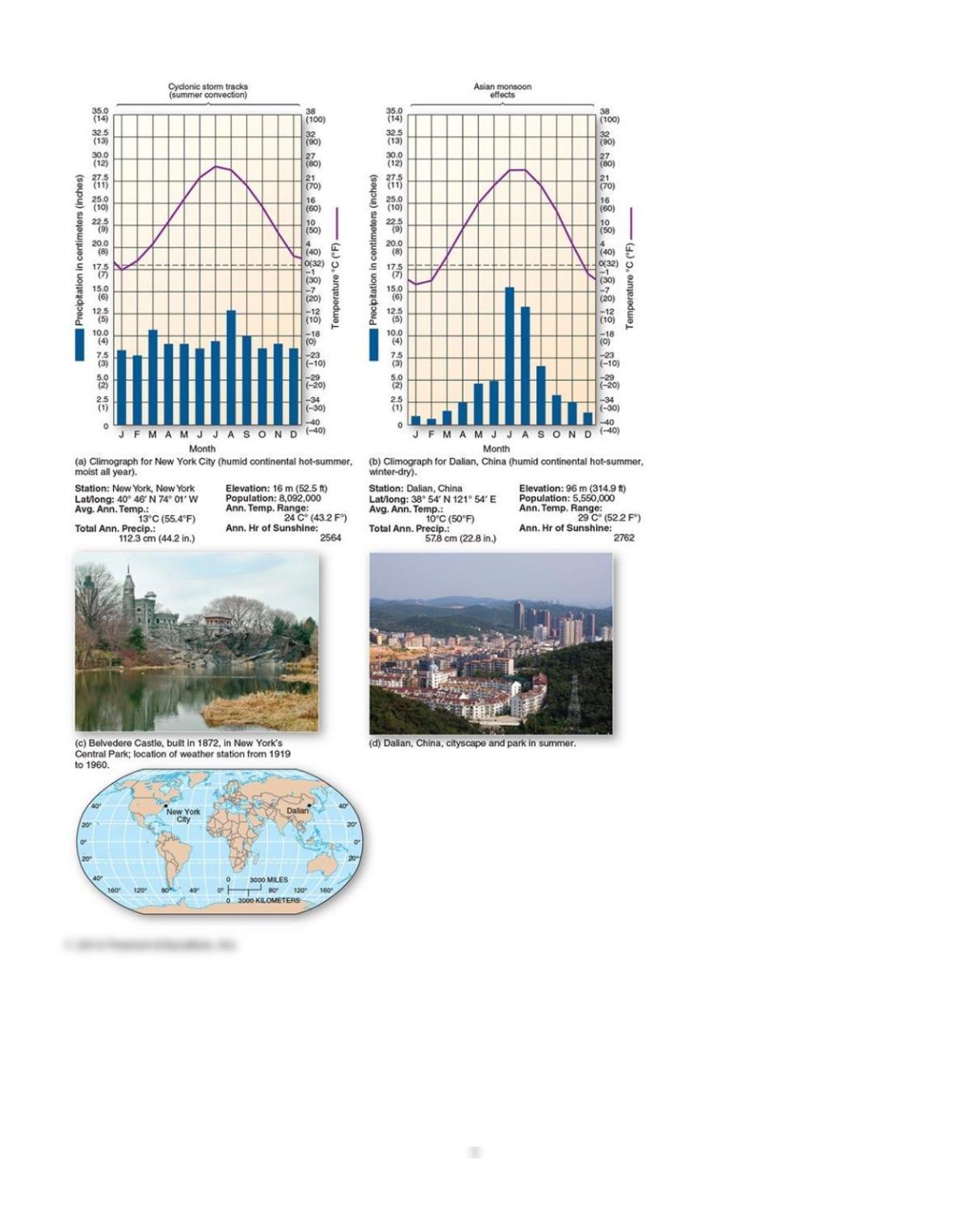
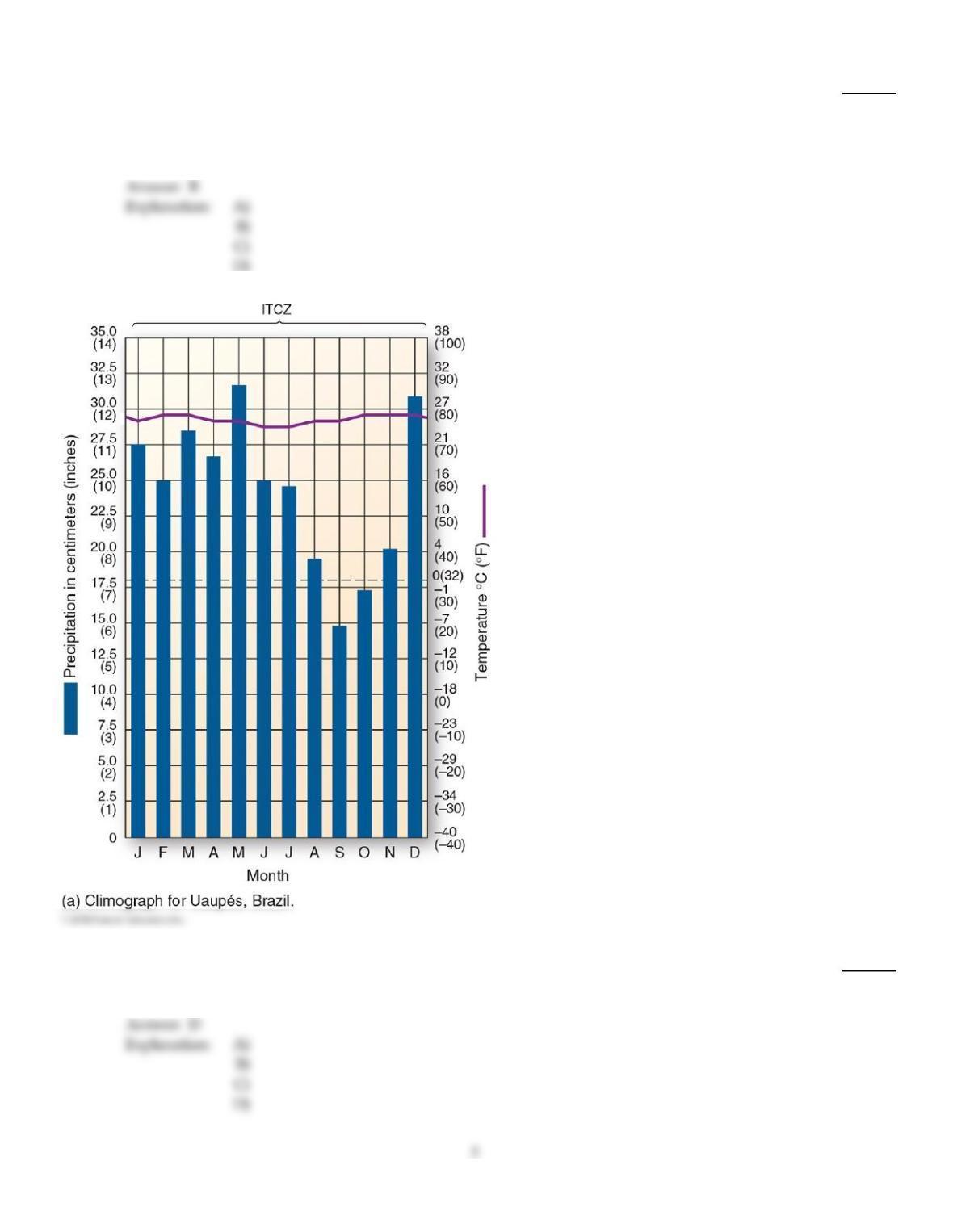
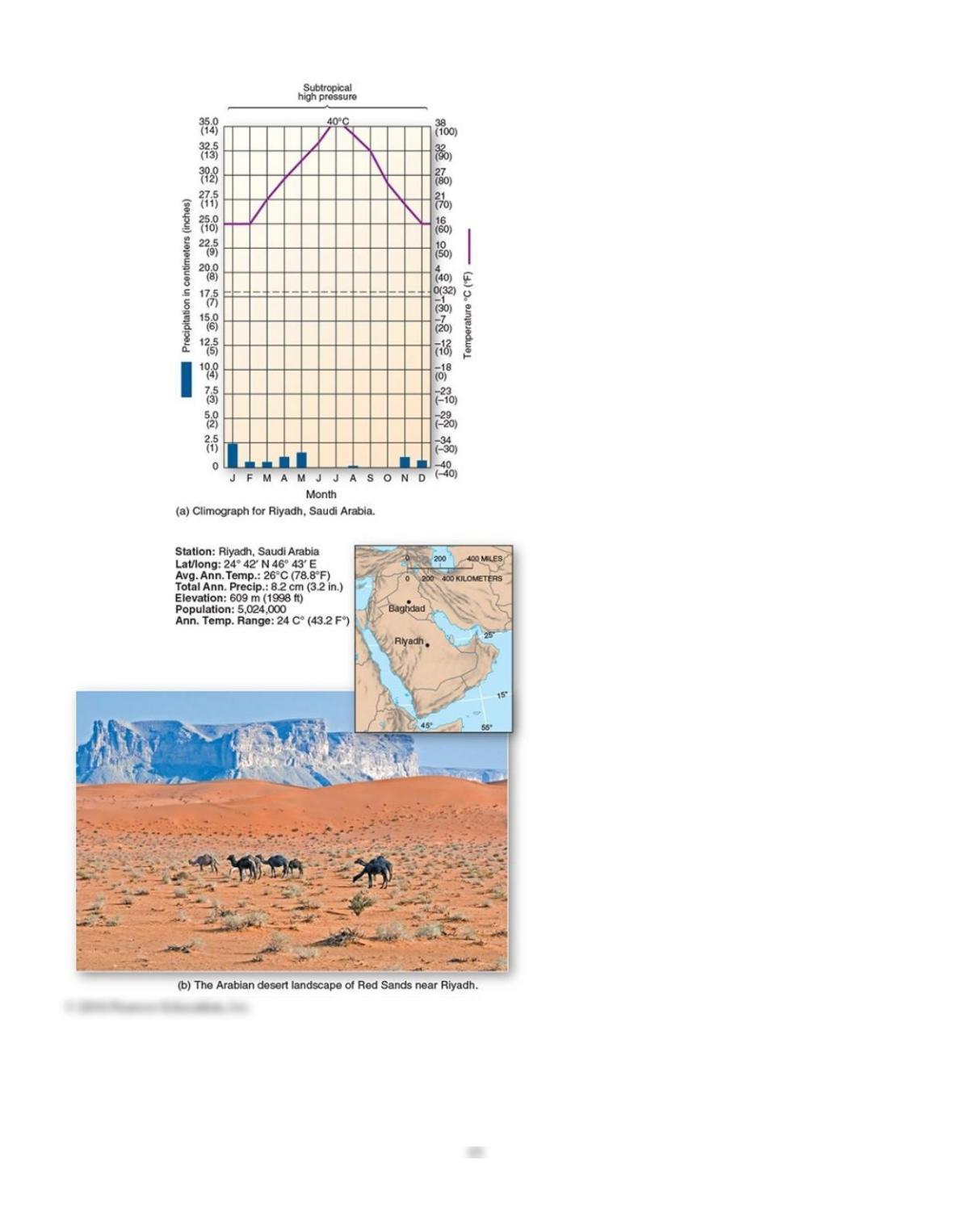
This climograph is characteristic of which climate type?
3)
A)
Mediterranean
B)
Subtropical hot desert
C)
Tundra
D)
Humid continental hot–summer
4)
Which of the following is TRUE of microthermal climates?
4)
A)
They occupy the largest land area of any climate.
B)
They have a small seasonal temperature range.
C)
They are only in highland regions.
D)
All of the subtypes of this climate have a uniform annual precipitation regime.
5)
Mediterranean dry–summer climates
5)
A)
are bordered poleward by steppe climates.
B)
experience dry conditions in summer due to the subtropical high overhead.
C)
experience wet conditions in summer due to the ITCZ overhead.
D)
experience wet conditions in winter due to the ITCZ overhead.
6)
Humid subtropical hot–summer climates receive ________ precipitation during the summer and
________ precipitation in winter.
6)
A)
convectional; ITCZ
B)
convectional; frontal
C)
frontal; convectional
D)
orographic; frontal
7)
A climate classification based on causative factors, such as the interactions of air masses is a(n)
7)
A)
empirical classification.
B)
genetic classification.
C)
combined classification.
8)
Which is TRUE of humid subtropical hot–summer climates?
8)
A)
Their rainy season is limited to winter months.
B)
They have cold ocean currents off shore.
C)
They are influenced by the monsoons in Asia.
D)
Cyclonic storms account for all the precipitation for this climate in North America.
9)
Which of the following is NOT a characteristic of tropical climates.
9)
A)
Warm ocean temperatures
B)
Short, though relatively mild, winters
C)
Unstable air masses
D)
Consistent day lengths
B
10)
Which of the following is NOT a causal element of dry climates?
10)
A)
Cool, stabilizing ocean currents along the western margins of continents.
B)
Dry, subsiding air associated with subtropical high pressure systems.
C)
Seasonal influence of the ITCZ.
D)
Location in the rain shadow of mountains.
C
11)
A climate classification based on moisture using a water budget approach is an example of a(n)
11)
A)
empirical classification.
B)
genetic classification.
C)
combined classification.
A
12)
A climate classification system based on causative factors is an example of a(n)
12)
A)
combined classification.
B)
genetic classification.
C)
empirical classification.
A
C
13)
Tropical climates are typically located
13)
A)
in all areas of Earth influenced by a subtropical high pressure system.
B)
straddling the equator between 20° N/S.
C)
in higher latitudes influenced by continental tropical air masses.
D)
primarily in areas associated with cold ocean currents.
14)
This climograph is characteristic of which climate type?
14)
A)
Tropical savanna
B)
Mediterranean
C)
Marine west coast
D)
Tropical rain forest
15)
Areas dominated by maritime air masses will be relatively ________, and that those dominated by
continental air masses will be relatively ________.
15)
A)
dry; dry
B)
wet; wet
C)
wet; dry
D)
dry; wet
16)
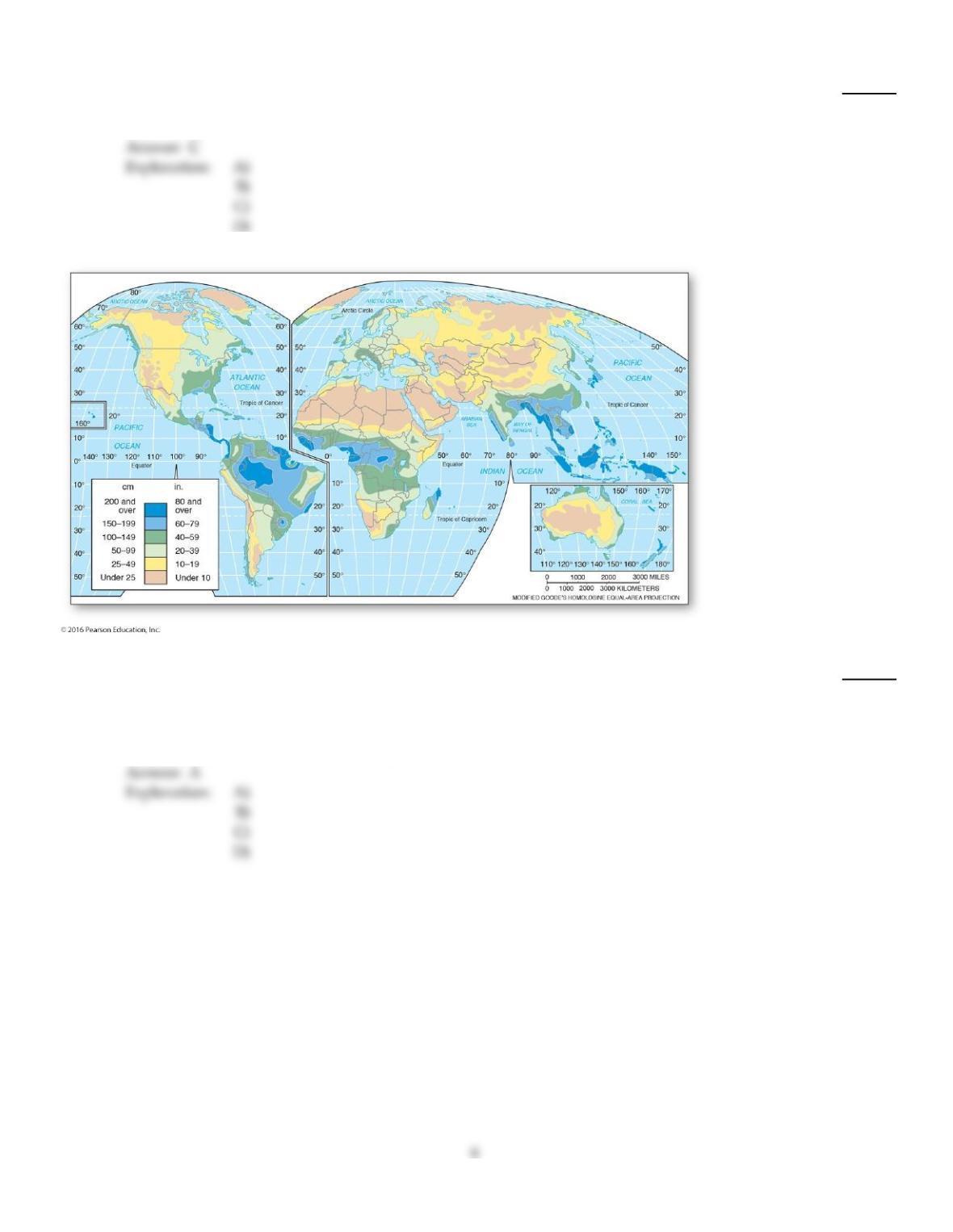
Regarding average annual precipitation, which of the following is CORRECT?
16)
A)
The highest average values occur along the equator.
B)
The drier regions are associated with the eastern portions of major landmasses.
C)
The precipitation tends to increase with latitude toward the poles.
D)
The highest amounts occur throughout subtropical latitudes.
A
C
17)
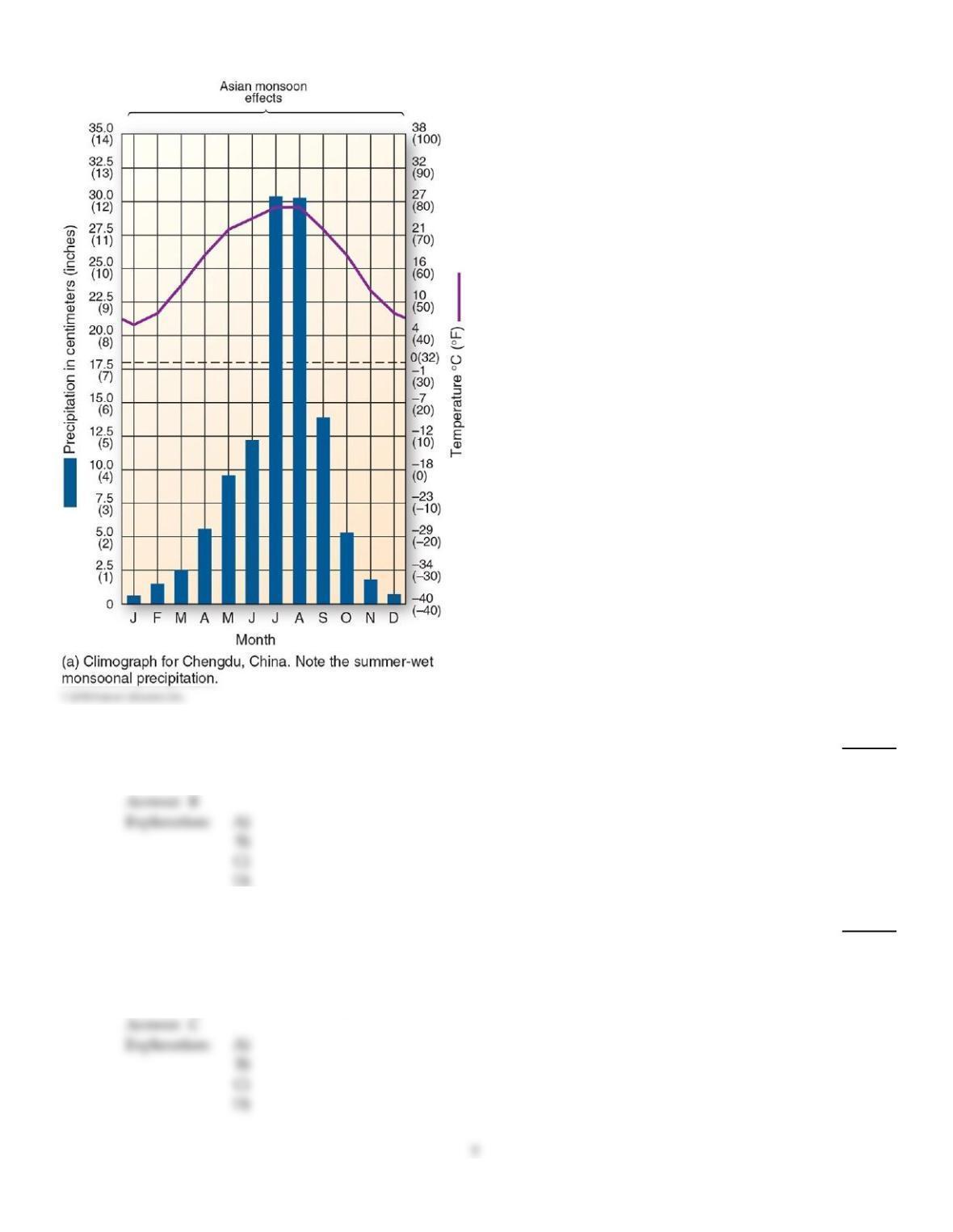
This climograph is characteristic of which climate type?
17)
A)
Mediterranean
B)
Humid subtropical winter–dry
C)
Humid subtropical hot–summer
D)
Tropical monsoon
18)
Which of the following is a causal element of polar climates?
18)
A)
High precipitation, primarily in the form of snow.
B)
High sun altitude during the summer months.
C)
Extremes of daylength between summer and winter.
D)
Low surface albedo due to ground cover.
19)
Which type of vegetation grows in the Mediterranean climate?
19)
A)
Rain forest
B)
Boreal forest
C)
Chaparral
D)
Taiga
20)
Which of the following is NOT a causal element of microthermal climates?
20)
A)
Very limited continentality.
B)
Increasing seasonality.
C)
Cyclonic activity.
D)
Latitudinal; effects on temperature.
21)
A climate that is mesothermal and has a long, hot, dry summer would be designated by which of
the following?
21)
A)
Tropical savanna
B)
Humid continental hot–summer
C)
Humid subtropical hot–summer
D)
Mediterranean
E)
Semiarid steppe
22)
The annual temperature range of South Georgia Island is low despite its high latitude because the
island’s climate
22)
A)
is influenced by the ocean.
B)
is dominated by dry, frigid air masses year–round.
C)
receives blasts of Antarctic air in the winter months.
D)
has higher than average precipitation that mitigates against the extreme cold weather.
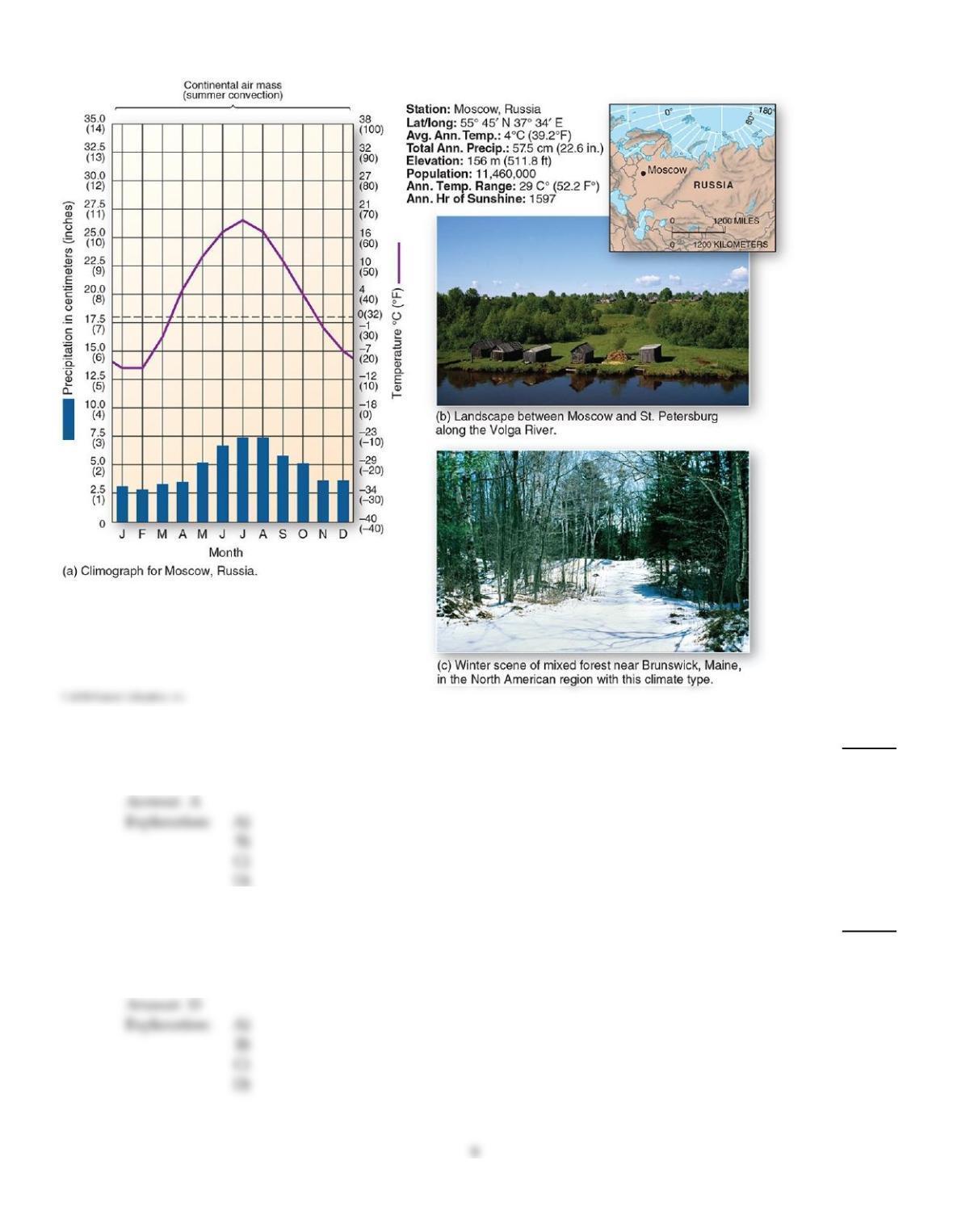
23)
This climograph is characteristic of which climate type?
23)
A)
Humid continental mild–summer
B)
Midlatitude cold desert
C)
Polar maritime
D)
Tundra
24)
In terms of total land and ocean area, which of the following climate classifications is the most
extensive?
24)
A)
Dry climates
B)
Microthermal climates
C)
Mesothermal climates
D)
Tropical climates
25)
Major ecosystems determined largely by climatic regions and classified largely based on
predominant vegetation are called
25)
A)
associations.
B)
zoogeographic regions.
C)
climate zones.
D)
biomes.
26)
A genetic classification system can be based partly on
26)
A)
statistics or other data used to determine general categories.
B)
the interaction of air masses.
C)
mean annual precipitation.
D)
mean annual temperature.
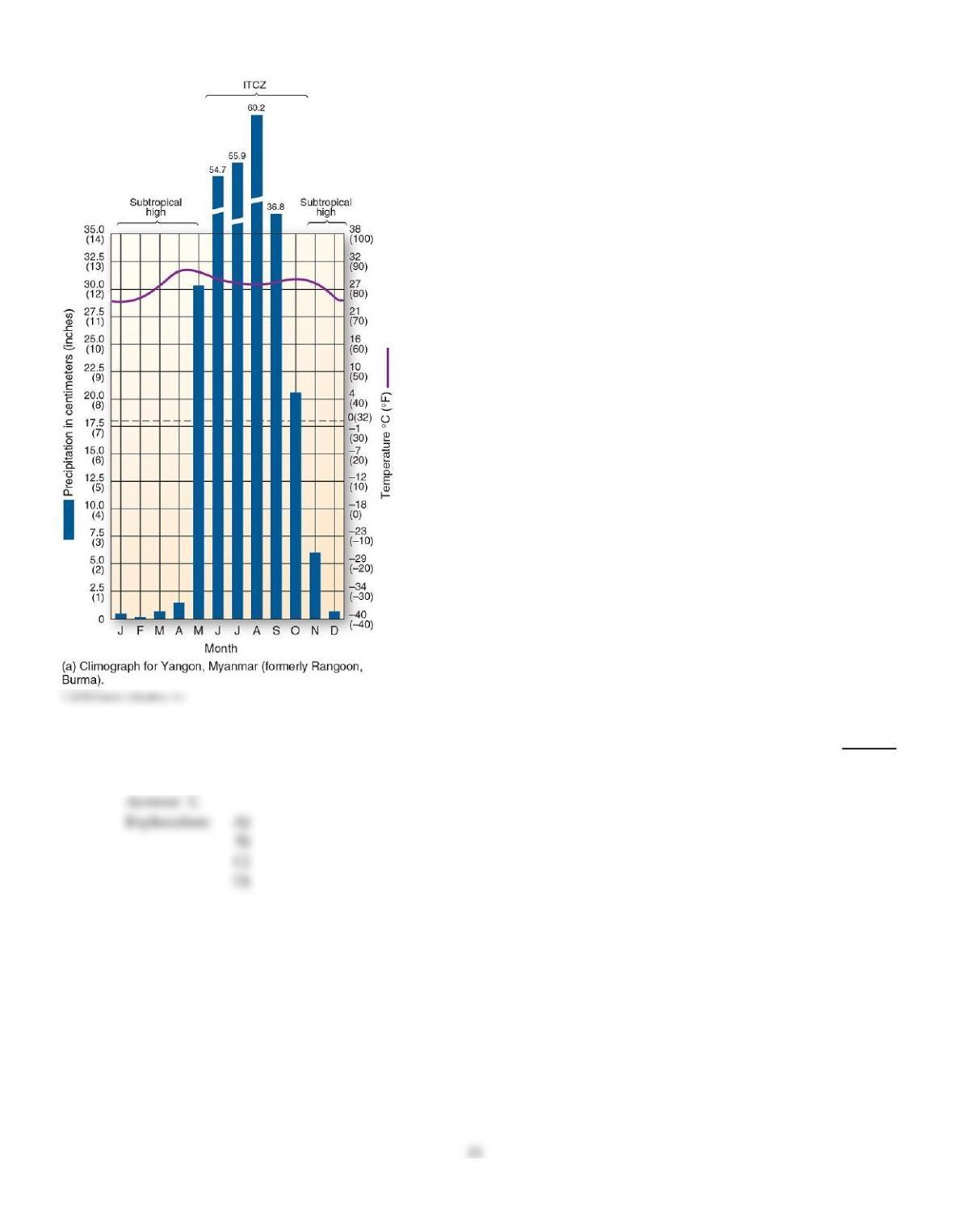
27)
This climograph is characteristic of which climate type?
27)
A)
Mediterranean
B)
Humid subtropical winter–dry
C)
Tropical monsoon
D)
Semiarid steppe
28)
Which of the following lists the CORRECT, generalized sequence of climates from the equator to
the poles?
28)
A)
Polar
Microthermal
Dry
Mesothermal
Tropical
B)
Tropical
Dry
Mesothermal
Microthermal
Polar
C)
Tropical
Mesothermal
Dry
Microthermal
Polar
D)
Tropical
Dry
Mesothermal
Microthermal
Highland
E)
Dry
Tropical
Mesothermal
Microthermal
Polar
29)
Which of the following best describes the difference between weather and climate?
29)
A)
Climate refers specifically to the temperature of a given place at a given time, whereas
weather refers to temperature, humidity, pressure, and wind conditions of a given place at a
given time.
B)
Weather is the collective pattern of atmospheric conditions in a given region over long
periods of time, whereas climate is the atmospheric conditions at a given time and place.
C)
Climate is the collective pattern of atmospheric conditions in a given region over long periods
of time, whereas weather is the atmospheric conditions at a given time and place.
D)
Weather refers specifically to the temperature of a given place at a given time, whereas
climate refers to temperature, humidity, pressure, and wind conditions of a given place at a
given time.
E)
Weather and climate are essentially the same thing.
30)
Which of the following is an element of weather and climate?
30)
A)
Temperature
B)
Atmospheric moisture
C)
Air pressure
D)
Insolation
E)
Insolation, temperature, atmospheric moisture, and air pressure are all elements of weather
and climate.
31)
Dengue fever, an infectious tropical disease carried by mosquitos, has
31)
A)
never been reported in the U.S., but scientists fear it may arrive due to expansion of Aedes
aegypti mosquitoes.
B)
been nearly wiped out because of climate change related shifts in subtropical high pressure
cells.
C)
shifted equatorward due to desertification in the subtropics.
D)
spread previously unaffected areas due to changes in climatic conditions.
32)
Which of the following is INCORRECT regarding tundra climates?
32)
A)
There is no true summer in this region.
B)
Summer temperatures are never higher than 10°C (50°F).
C)
The land is under continuous snow cover from 8 to 10 months.
D)
Spruce, fir and larch trees survive in this climate zone.
33)
The only interruption to the distribution of tropical forest climates across equatorial regions are
33)
A)
in highland areas, such as the Andes and Mt. Kilimanjaro.
B)
several equatorial deserts caused by rain shadows.
C)
the tropical savannas of Africa and South America.
D)
the five distinct mediterranean climates.
34)
The two principle climate components are
34)
A)
pressure and wind speed.
B)
temperature and precipitation.
C)
temperature and pressure.
D)
precipitation and pressure.

35)
Which of the following is NOT true of marine west–coast climates?
35)
A)
The weather is quite unpredictable.
B)
These climates experience very cold winters because of their high latitude (about 45° to 55°
north).
C)
They are dominated by mP air masses.
D)
The air masses in this region are unstable.
36)
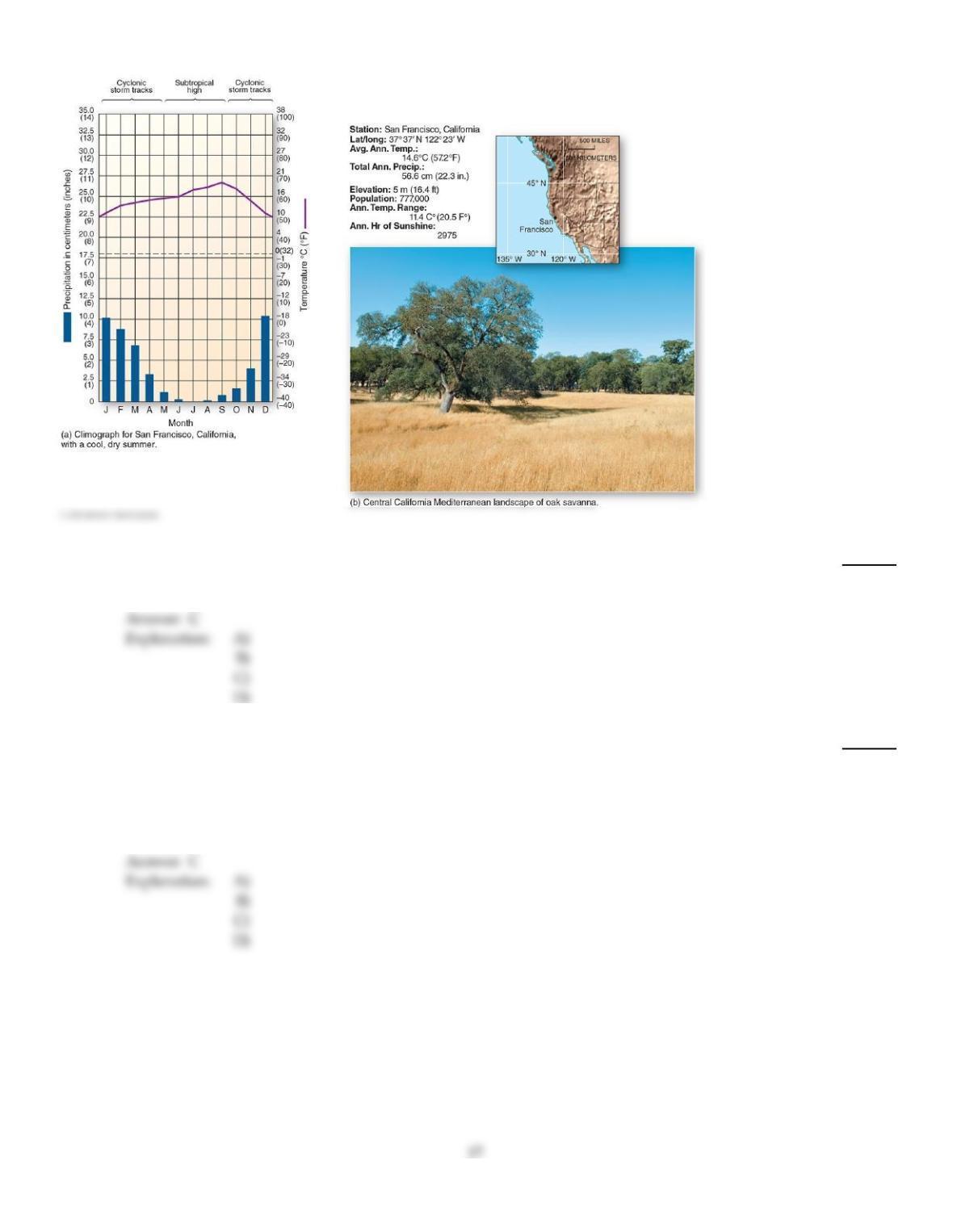
This climograph is characteristic of which climate type?
36)
A)
Humid subtropical hot–summer
B)
Tropical rain forest
C)
Marine west coast
D)
Subtropical hot desert
37)
Which of the following is NOT true of the subarctic climate regions of Canada and Asia?
37)
A)
Broadleaf deciduous trees, such as maple and sweetgum, dominate the area.
B)
The area can experience summer temperatures in the nineties.
C)
This climatic zone experiences exceptionally large annual temperature ranges.
D)
This climate zone constitutes the maximum poleward extent of forests.
E)
Permafrost occurs here.
38)
This climograph is characteristic of which climate type?
38)
A)
Highland
B)
Tropical monsoon
C)
Mediterranean
D)
Humid subtropical winter–dry
39)
Los Angeles, located in a Mediterranean climate zone, is kept ________ during the summer because
of the presence of ________.
39)
A)
wet; mountains along the western side of the city
B)
wet; the warm California current off the coast
C)
dry; the cold California current off the coast
D)
dry; mountains along the western side of the city
Explanation:
Explanation:
40)
An area defined by characteristic, long–term weather patterns is called
40)
A)
an ecosystem.
B)
a climatic region.
C)
a biome.
D)
an average weather place.
41)
Which is TRUE of humid subtropical winter–dry climates?
41)
A)
The wettest summers month receive approximately 2 to 3 times more precipitation than the
driest winter month.
B)
The winter dry season is related to the seasonal pulse of the monsoons.
C)
The “driest” winter months still have at least 7.5 cm (3 inches) of precipitation.
D)
Few natural hazards occur throughout the humid subtropical winter–dry climates.
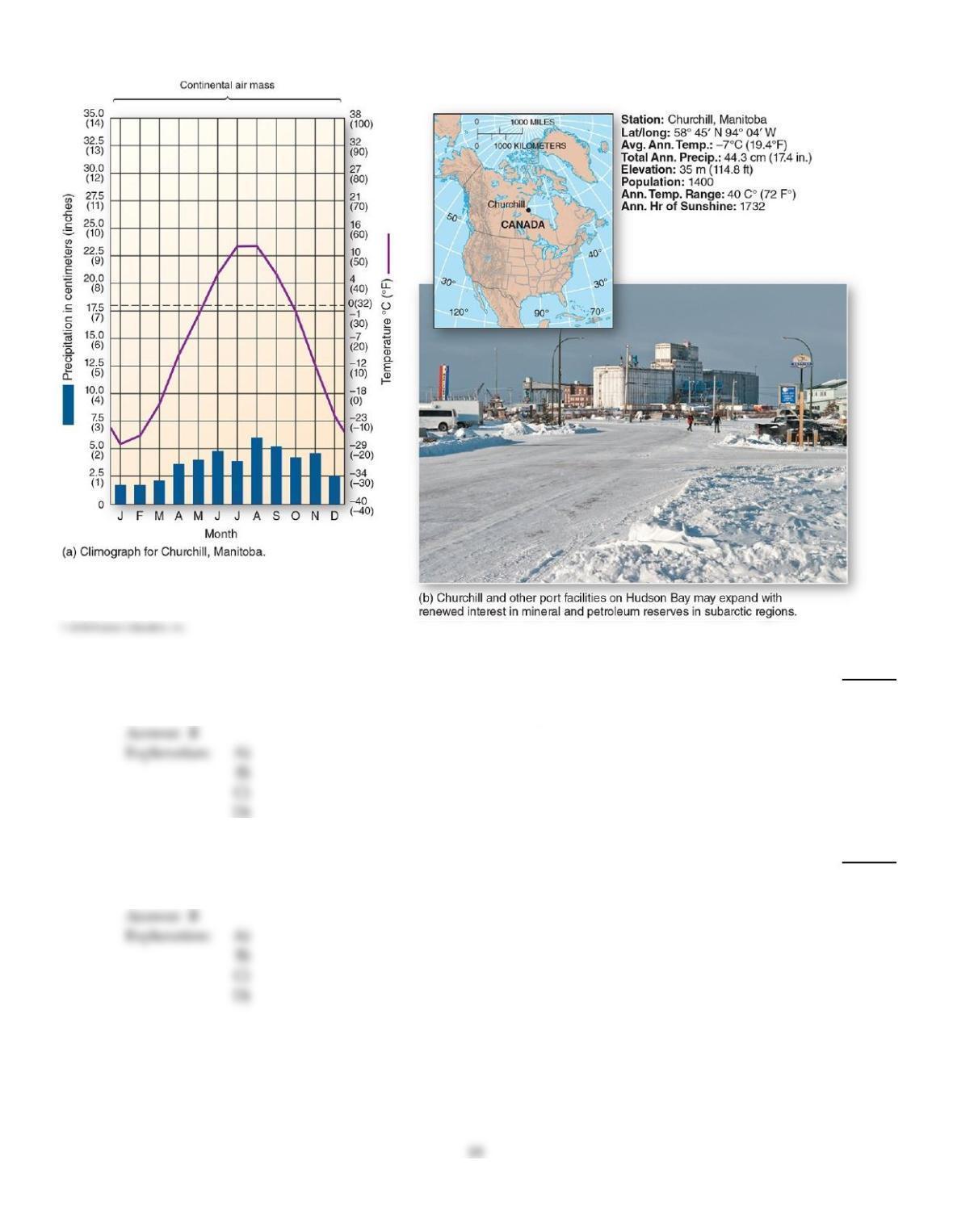
42)
This climograph is characteristic of which climate type?
42)
A)
Marine west coast
B)
Subarctic cold–winter
C)
Humid subtropical winter–dry
D)
Tropical rain forest
43)
Which of the following has a typical subarctic,very cold winter climate?
43)
A)
Dalian, China
B)
Verkhoyansk, Siberia, Russia
C)
Duluth, Minnesota
D)
Churchill, Manitoba
44)
Potential evapotranspiration exceeds precipitation in all parts of which climate type?
44)
A)
Mediterranean
B)
Semiarid steppe
C)
Humid subtropical winter–dry
D)
Tropical savanna
45)
World temperature patterns are primarily controlled by the following control EXCEPT
45)
A)
continentality.
B)
elevation.
C)
urban heat islands.
D)
latitude.
46)
An empirical classification is based on, among other factors
46)
A)
the interaction of air masses.
B)
the mean annual temperature and precipitation of an area.
C)
causative factors.
D)
the origin or genesis of the climate.
47)
Mesothermal climates
47)
A)
are sparsely populated by humans.
B)
occupy more land and sea surface area than any other climate region.
C)
have a high degree of air mass interaction.
D)
are essentially seasonless.
48)
The tropical savanna climate has
48)
A)
the polar front all year–round.
B)
the ITCZ all year–round.
C)
the ITCZ in summer and the subtropical high in winter.
D)
the polar front in winter and the subtropical high in summer.
49)
The dry season in the tropical monsoon climate occurs when
49)
A)
cold air masses dominate the region.
B)
cold ocean currents shift into the region.
C)
the ITCZ moves away from the region.
D)
a continental polar air mass influences the region.
50)
Which of the following is FALSE regarding the tropical monsoon climate?
50)
A)
Thorn forests occur on the dry margins of this region.
B)
The transition from wet to dry conditions is the result of the shifting of the ITCZ.
C)
It is located along coastal areas.
D)
The summer (high Sun season) is the driest time of the year.
E)
The wind direction shifts from one time of the year to the next.
51)
Along the periphery of hot deserts, where shifting subtropical high pressure cells create a distinct
summer–dry and winter–wet pattern, one finds
51)
A)
tropical, subtropical hot steppe climates.
B)
humid subtropical hot–summer climates.
C)
marine west coast climates.
D)
tropical monsoon climates.
52)
Which of the following characterizes a tropical savanna climate?
52)
A)
All months receive precipitation in excess of 6 cm (2.4 in.).
B)
The sun’s direct rays are overhead (subsolar point) are overhead twice each year.
C)
It experiences a summer wet season, and is dominated by the ITCZ for nearly 12 months of
the year.
D)
Its annual temperature variability is less than that of the tropical rain forest.

53)
Which of the following is NOT true of tropical and subtropical hot desert climates?
53)
A)
In most years, they do not receive any precipitation.
B)
They are under the influence of subtropical high pressure systems.
C)
Annual average temperatures are above 18°C (64.4°F).
D)
They are generally found on the western side of continents.
A
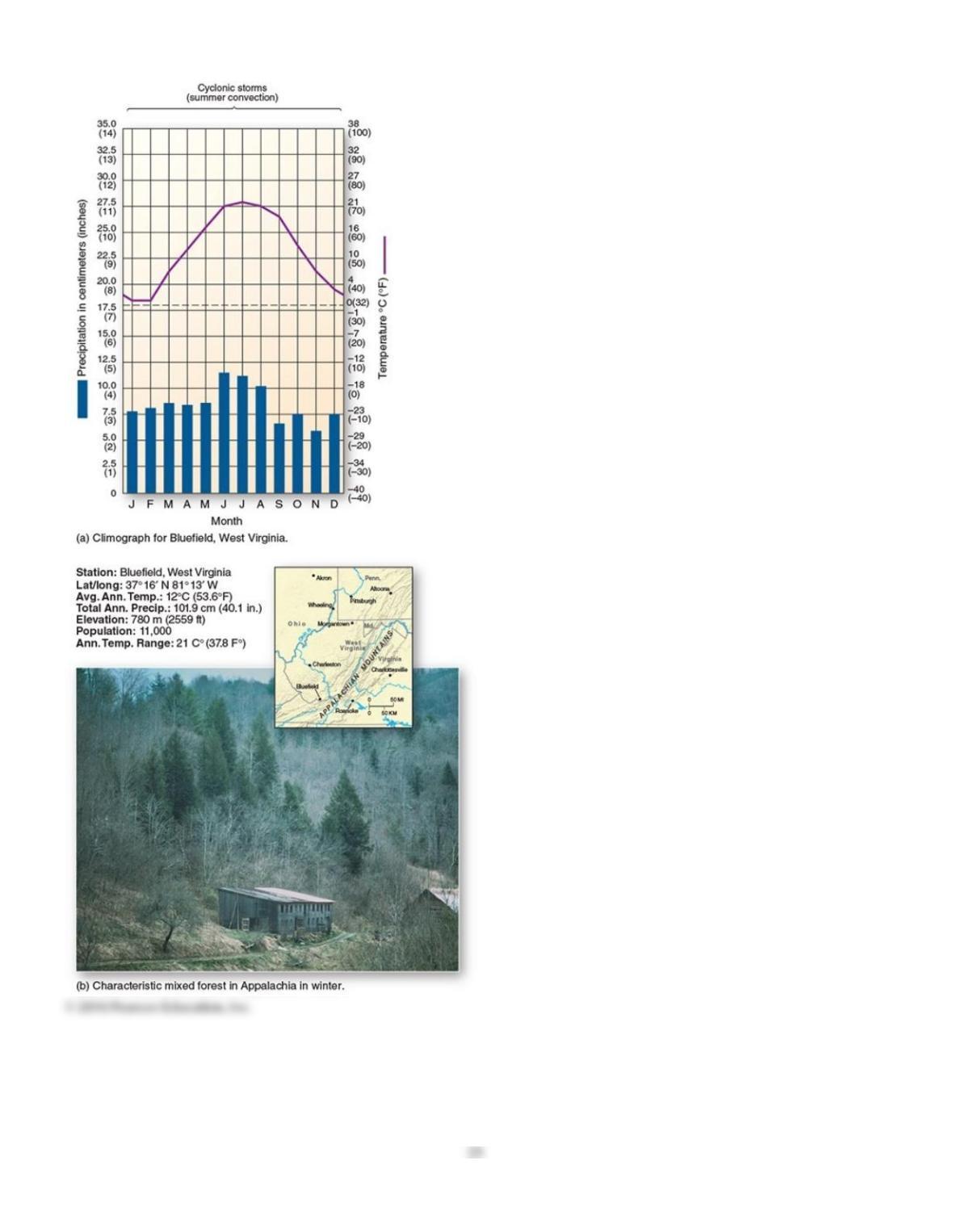
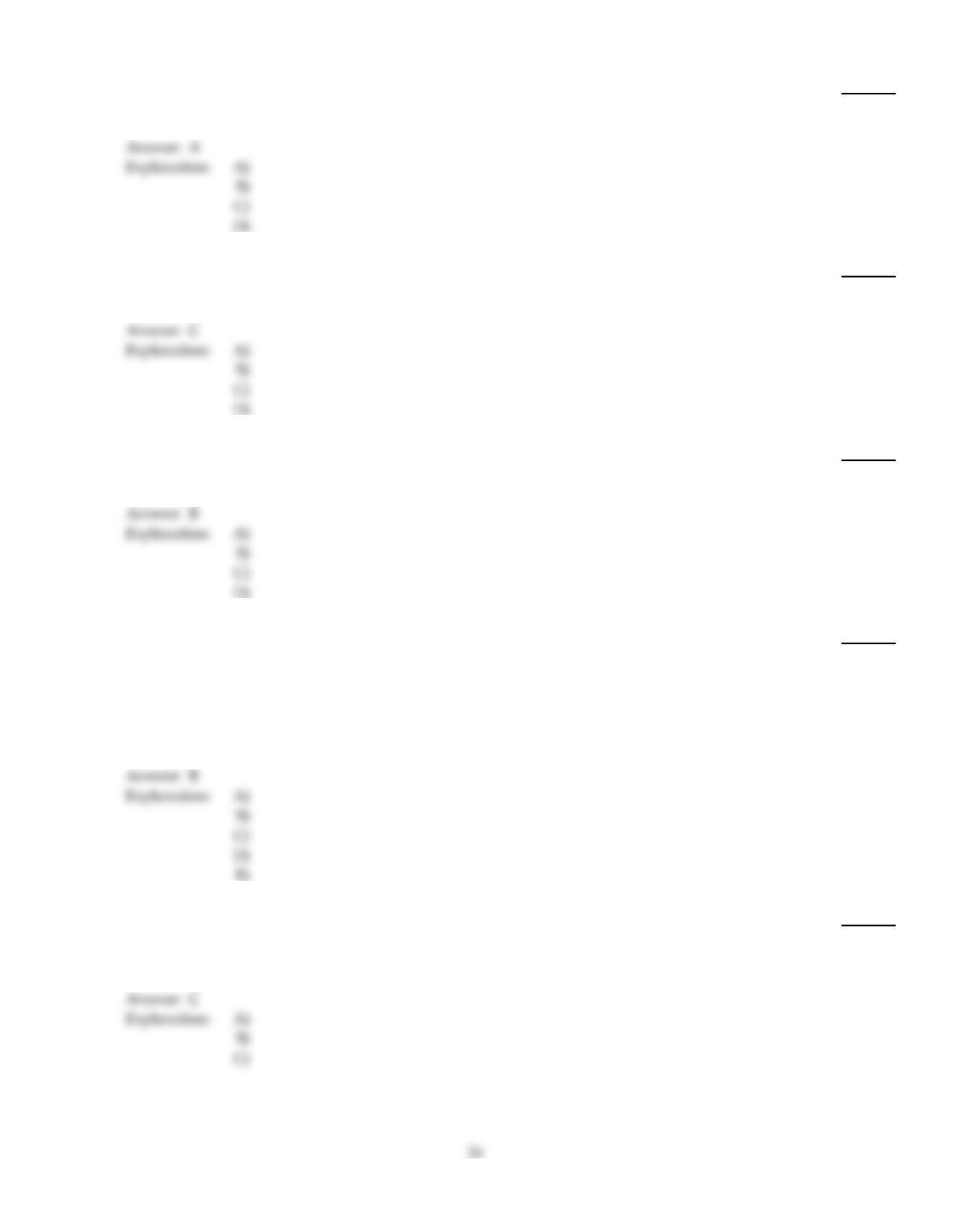
54)
This climograph is characteristic of which climate type?
54)
A)
Marine west coast
B)
Humid subtropical winter–dry
C)
Humid continental hot–summer
D)
Mediterranean
55)
Marine west coast climates are dominated by what air mass?
55)
A)
Continental polar (cP)
B)
Continental tropical (cT)
C)
Maritime polar (mP)
D)
Maritime tropical (mT)
C
56)
The study of the climate and its variability is
56)
A)
weather science.
B)
climatology.
C)
meteorology.
D)
weatherology.
B
57)
Which of the following is NOT related to the 98th meridian in the United States?
57)
A)
Tall grass prairies occur to the east of it, and short grass prairies to the west.
B)
The land is drier to the east of the meridian and wetter to the west.
C)
It corresponds closely to the 51 cm (20 in.) isohyet of mean annual precipitation
D)
The area bordering this meridian was originally dominated by native grasses growing in a
deep–sod cover.
E)
Corn, wheat, and soybean production occur in this area.
B
58)
Humid subtropical hot–summer climates
58)
A)
air moist all year.
B)
have a pronounced dry period.
C)
can be either moist all year or have a pronounced dry period.
C
A
59)
A climate classification based on statistics or other data determined by measurements of observed
effects is a(n)
59)
A)
empirical classification.
B)
genetic classification.
C)
combined classification.
60)
Dry climates are divided into two types according to moisture. These are
60)
A)
chaparral and tundra.
B)
steppe and chaparral.
C)
deserts and tundra.
D)
deserts and steppe.
61)
A climate classification based on the geographic determinants of climate, such as latitude or
elevation, is an example of a(n)
61)
A)
empirical classification.
B)
genetic classification.
C)
combined classification.
62)
Which climatic region occupies the most extensive area of land on Earth?
62)
A)
Dry climates
B)
Microthermal climates
C)
Mesothermal climates
D)
Polar climates
63)
The tropical rain forest climate receives most of its rainfall as a result of
63)
A)
orographic uplift.
B)
convectional uplift.
C)
frontal uplift.
D)
both convectional and frontal uplift.
64)
Which of the following is FALSE regarding the tropical rain forest climate?
64)
A)
It does not experience a winter season.
B)
It is influenced by the ITCZ year–round.
C)
The annual temperature range is larger than the daily temperature range.
D)
Thunderstorms occur almost daily.
65)
Which of the following is FALSE regarding the Mediterranean climate?
65)
A)
Summers are hot.
B)
The bulk of precipitation occurs in the summer months.
C)
Summers are influenced by shifting subtropical high cells.
D)
Seventy percent of the precipitation occurs in the winter months.
66)
The wet season of the tropical monsoon climate of SE Asia occurs during the season of ________
Sun due to the presence of the ________ over the continent. (low Sun = “winter” and high Sun =
“summer”)
66)
A)
high; subtropical high
B)
low; ITCZ
C)
high; ITCZ
D)
low; subtropical high
67)
Vegetation in the tropical savanna is
67)
A)
deciduous forest.
B)
desert–like succulents.
C)
lush (thick and green year–round).
D)
dominated by grassland.

68)
Climate is
68)
A)
the weather of a region.
B)
the long–term atmospheric conditionincluding extremes that may occur.
C)
the short–term condition of the atmosphere.
D)
a reference to temperature patterns only.
69)
Which of the following is INCORRECT regarding climate regions and climate change?
69)
A)
Many areas are becoming more prone to drought.
B)
Tropical climates are expanding to higher latitudes.
C)
The boundaries of climate regions are fairly static.
D)
Subtropical high pressures systems and associated dry conditions are moving to higher
latitudes.
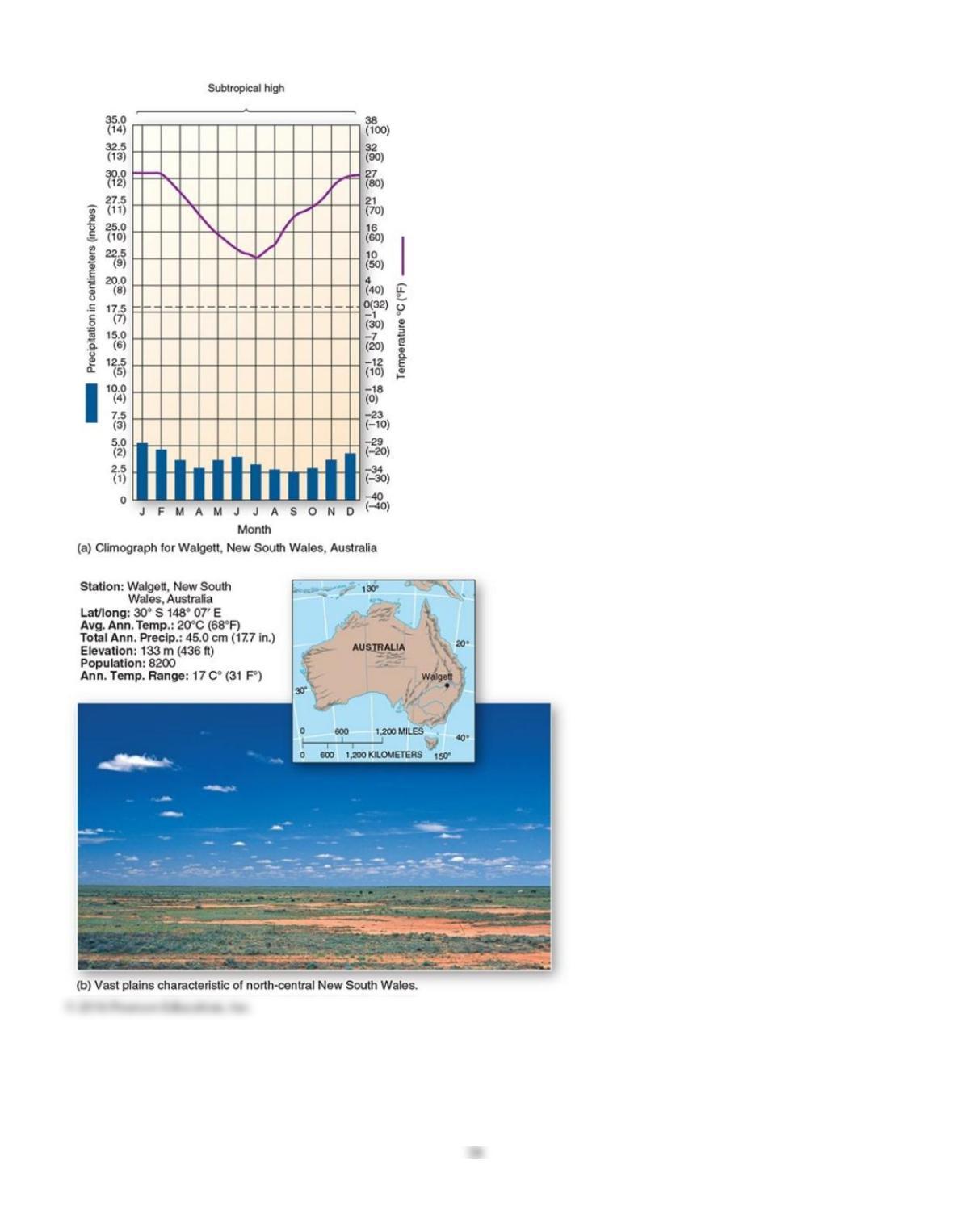
70)
This climograph is characteristic of which climate type?
70)
A)
Tropical savanna
B)
Subtropical hot steppe
C)
Marine west coast
D)
Mediterranean
71)
Which of the following is TRUE regarding humid continental hot–summer and humid continental
mild–summer climates?
71)
A)
Agriculture is not feasible in humid continental mild–summer climates due to the cooler
weather, whereas it is very important in humid continental hot–summer climates.
B)
Snowfall is notably heavier in humid continental mild–summer climates than in humid
continental hot–summer climates.
C)
Humid continental mild–summer climates are located further equatorward than humid
continental hot–summer climates are.
D)
Overall, humid continental mild–summer climates receive more precipitation than humid
continental hot–summer climates do.
72)
The Amazon equatorial rain forest of South America, which extends from the east coast far into the
interior, has developed in response to the ________ air mass pulling air inland from the ________
air mass.
72)
A)
mT; E to W
B)
cT; NE to SW
C)
mP; E to W
D)
mT; W to E
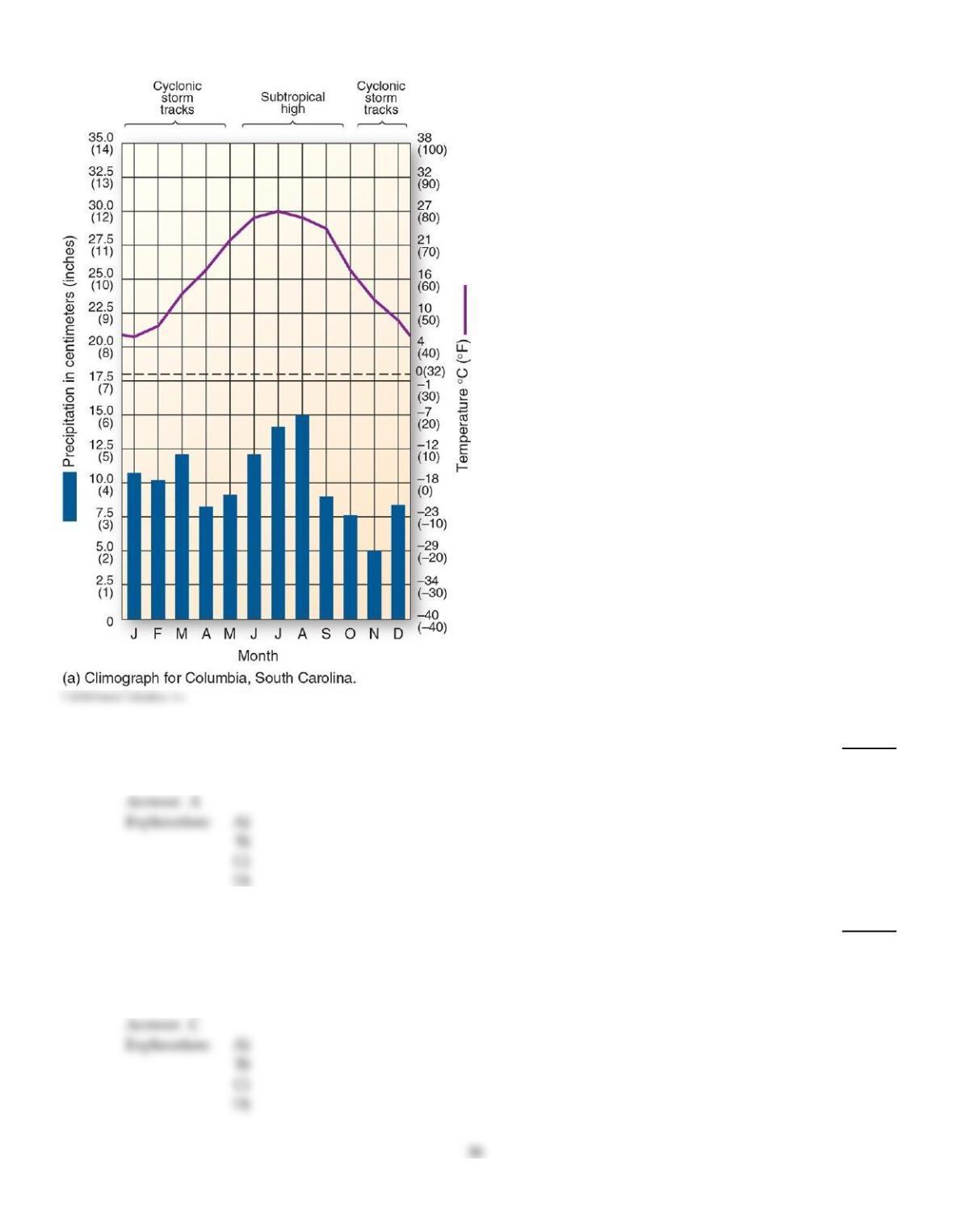
73)
This climograph is characteristic of which climate type?
73)
A)
Humid subtropical hot–summer
B)
Humid continental mild–summer
C)
Tropical rain forest
D)
Humid subtropical winter–dry
74)
Which air masses influence the humid continental hot–summer climates in North America?
74)
A)
Continental polar in summer (cP) and continental Arctic (cA) in winter
B)
Continental polar (cP) in winter; continental tropical (cT) in summer
C)
Continental polar (cP) in winter; maritime tropical (mT) in summer
D)
Continental polar (cP) year–round
75)
The low–latitude hot desert climates occur
75)
A)
in the tropics and subtropics.
B)
along the midlatitude, west coasts of continents.
C)
in polar regions.
D)
only in midlatitude rainshadow positions.
76)
Global circulation patterns of winds and ocean currents, which drive weather systems and,
ultimately, climate patterns are created by
76)
A)
imbalances created by energy surpluses and deficits at the equator and poles, respectively.
B)
the coriolis force.
C)
the differential heating properties of land and water.
D)
frictional force caused by Earth’s spinning on its axis.
77)
The bulk of the Amazon River drainage basin is dominated by which one of the following climate
classifications?
77)
A)
Humid subtropical
B)
Tropical rainforest
C)
Tropical monsoon
D)
Tropical savanna
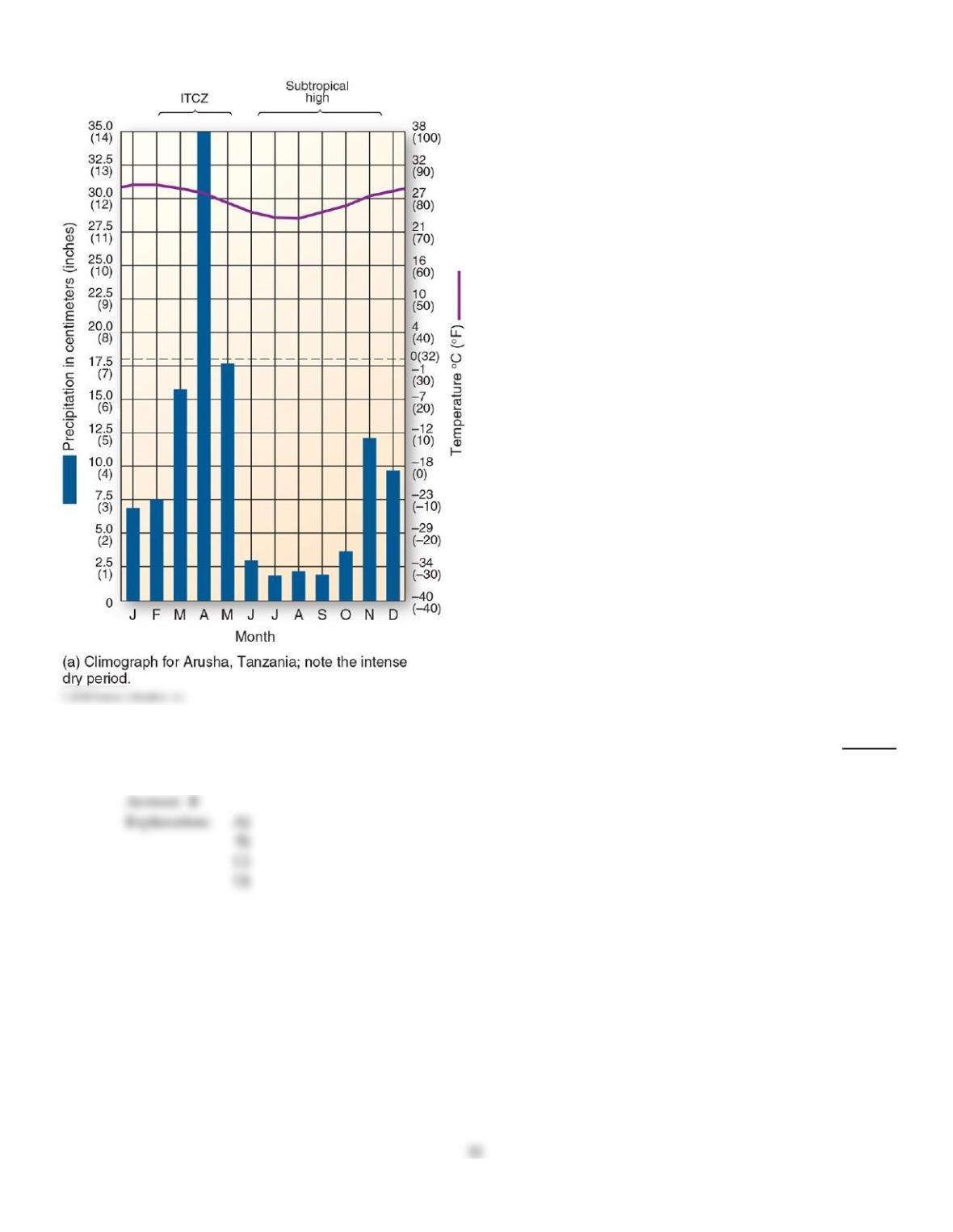
78)
This climograph is characteristic of which climate type?
78)
A)
Humid subtropical
B)
Tropical savanna
C)
Highland
D)
Tropical rain forest
Explanation:
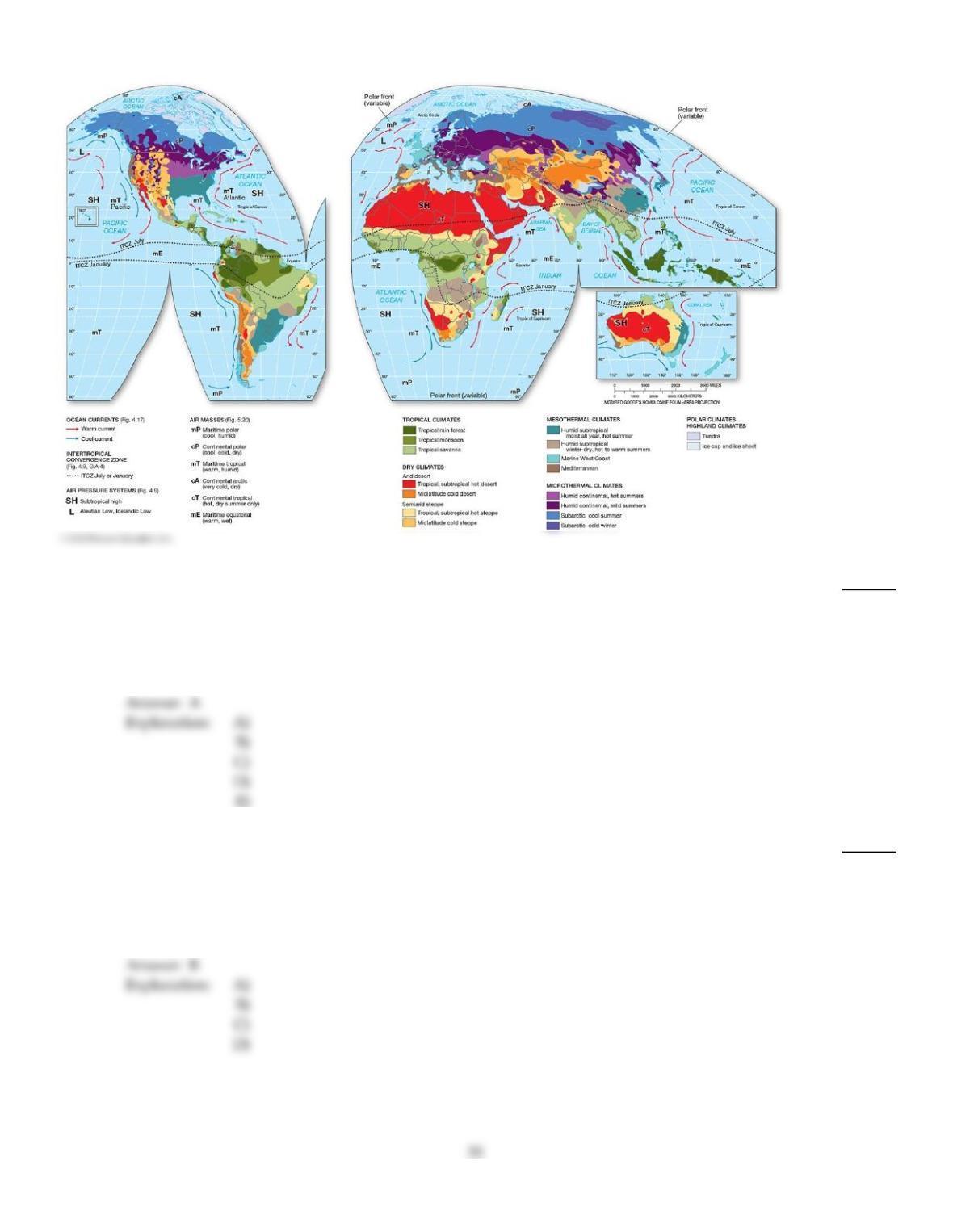
79)
Which air mass appears to predominately influence the humid subtropical region?
79)
A)
Maritime tropical (mT)
B)
Maritime polar (mP)
C)
Maritime equatorial (mE)
D)
Continental tropical (cT)
E)
Continental polar (cP)
80)
Which of the following is INCORRECT regarding ice–sheet climates?
80)
A)
There are vast expanses that never warm above freezing.
B)
The only month with an average temperature above freezing corresponds to the summer
solstice (June in the Northern Hemisphere, December in the Southern Hemisphere).
C)
There is very little precipitation.
D)
The climate is dominated by dry, frigid airmasses.
81)
The largest percentage of Earth’s population lives within the
81)
A)
Microthermal climates.
B)
Desert climates.
C)
Mesothermal climates.
D)
Tropical climates.
TRUE/FALSE. Write ‘T’ if the statement is true and ‘F’ if the statement is false.
82)
Climatic regions are characterized by distinctive weather patterns.
82)
83)
All months average below freezing in ice–cap and ice–sheet climates.
83)
84)
Mosquito–borne illnesses, such ad dengue fever, are spreading into new areas as climatic
conditions change.
84)
85)
Marine west coast climates are unusually mild for their latitude.
85)
86)
Diurnal temperature ranges are often greater than annual temperature ranges in tropical rain forest
climates.
86)
87)
Both tropical and subtropical conditions are contracting and moving to lower latitudes.
87)
88)
Climate is a statistical construction based on defining assumptions (i.e., criteria) and is, therefore,
not directly observable.
88)
89)
A climate classifications based on monthly temperature and precipitation averages is an example of
an empirical classification.
89)
90)
Once developed, a climate classification system can be considered complete; i.e., it needs no further
revision.
90)
91)
Dry climates are by far the most extensive climate over land.
91)
92)
Causal factors of dry climates include subsiding air hot, dry air associated with the subtropical high
pressure systems, rain shadow effect, continentality, and cold ocean currents.
92)
93)
Potential evapotranspiration exceeds precipitation in the tropical savanna winter leading to water
budget deficits.
93)
94)
Marine west coast climates occur only along the west coasts of continents.
94)
95)
Heave annual snowfalls is a common occurrence in Antarctica.
95)
96)
The largest repository of freshwater in the world is in ice–covered Antarctica.
96)
97)
The condition of the atmosphere at any given time and place is called climate.
97)
98)
Microthermal climates are predominately influenced by continental tropical (cT) air masses.
98)
99)
Polar climates have extremely low humidity and precipitation and are often considered “frozen
deserts.”
99)
100)
Tropical climates have inconsistent daylengths and insolation throughout the year.
100)
101)
Drought in subtropical regions is one consequence of poleward shifts of warmer climates.
101)
102)
Owing to the small diurnal and annual temperature ranges, tropical climates are considered
“winterless.”
102)
103)
The evergreen conifers of the taiga are the characteristic vegetation of tundra climates.
103)
104)
Climates can be stable over several human generations, and also change over longer time periods
(thousands to millions of years).
104)
105)
The warmest months in tundra climates never average above 10°C (50°F).
105)
106)
The boundaries of climate regions are changing worldwide.
106)
107)
Despite very high latitudes, polar marine climates have low annual temperature ranges due to the
moderating effects of the ocean.
107)
108)
Tropical savanna climates can have two temperature maximums during the year as the subsolar
points moves overhead both before and after the summer solstice.
108)
109)
Subarctic climates have a long growing season owing to the long summer days.
109)
110)
Maritime tropical air masses influence the marine west coast climates.
110)
111)
Tropical rain forest climates are influenced by subtropical high pressure cells year–round.
111)
112)
The climate of an area can be classified in different ways depending on the criteria used to define it.
112)
113)
Shifting cells of subtropical high pressure contribute to the dry–summer conditions in the
Mediterranean dry–summer climates.
113)
114)
Tropical, subtropical hot steppe climates experience seasons characterized by dry summers and
somewhat wetter winters brought about by the shifting of the subtropical high.
114)
115)
Tropical, subtropical hot desert climates are generally found on the eastern side of continents.
115)
116)
A climograph is a mechanical instrument used for measuring climates.
116)
117)
The ITCZ migrates with the subsolar point and influences tropical monsoon climates.
117)
118)
Temperature and precipitation are the principal components of climate.
118)
119)
Climatic regions determine largely the location of biomes.
119)
120)
Despite limited precipitation in subarctic climates, subsurfaces are often partially or totally frozen.
120)
121)
Climatic conditions on Earth are determined based solely on latitude.
121)
122)
Shifting subtropical high pressure systems may create drier conditions in otherwise humid
mesothermal climates.
122)
123)
Taller trees in tundra climates may increase albedo.
123)
124)
The seasonal pulse of the monsoons contribute to the drier weather conditions in the marine west
coast climates.
124)
125)
Subarctic climate with very cold winters are common in the Southern Hemisphere.
125)
126)
The bulk of the world’s population lives within the Tropical climates.
126)
127)
Chaparral is a type of vegetation found in subarctic climates.
127)
128)
No two places on Earth’s surface experience exactly the same climatic conditions.
128)
129)
Earth‘s climate system is the result of interaction of temperature, atmospheric pressure,
atmospheric moisture, and wind and ocean currents.
129)
130)
In general, as one moves to higher latitudes, summers transition from hot to warm to cool.
130)
131)
Tropical climates are the most extensive climate regions, occupying 36% of Earth’s land and ocean
areas.
131)
132)
Snow melt is an important component to soil–moisture recharge in humid continental
mild–summer climates.
132)
133)
Tropical monsoon climates are found principally in the interior of continents in the equatorial
region.
133)
134)
Microthermal climates are characterized by increasing seasonality and greater daily and annual
temperature ranges.
134)
135)
North American humid continental hot–summer climates are affected by conflicting maritime
tropical (mT) and continental polar (cP) air masses.
135)
136)
Weather and climate are essentially different terms for the same phenomenon.
136)
137)
Humid subtropical climates experience convectional showers in the summer and frontal showers in
the fall, winter and spring, creating year–round precipitation.
137)
138)
Tropical monsoon climates have a dry season that lasts one month or more.
138)
139)
A climate classifications based on the interaction of air masses is an example of an empirical
classification.
139)
140)
The Mediterranean climates are characterized by winter precipitation maximums.
140)
141)
Shifting maritime and continental air masses are a causal factor of mesothermal climates.
141)
ESSAY. Write your answer in the space provided or on a separate sheet of paper.
142)
Elemental Geosystems list several potential outcomes from shifting climatic zones, such as increased ranges of
dengue fever carrying mosquitoes and increased drought in subtropical regions. What are some other possible
adverse effects associated with climate change and shifting climate zones? Are there any potential benefits?
143)
You have been asked to design a new climate classification system. Will it be a genetic or empirical classification
system, or a combination thereof? What factors will you consider in your classification.
144)
Describe the weather components that combine to produce climate of the area in which you live.

145)
The climate types discussed in Elemental Geosystems are broad scale with the various climate types covering
large (relatively speaking) geographic areas. However, local conditions, the so–called microclimatology may
differ from the broad generalizations. Locate the climatic regime in your city or town. Compare and contrast the
characteristics of this climate to localized climate of your city or town.
146)
Construct a climograph for your city or town.
Answer Key
Testname: C7
Answer Key
Testname: C7
Answer Key
Testname: C7
Answer Key
Testname: C7