Chapter 7
Chapter Focus
Student academic progress in school can be detected early through the examination of classroom
performance. When students are not responding as expected, classroom teachers implement
specific interventions and monitor progress frequently to determine if the student responds to the
changes in instruction. This chapter focuses on the techniques that teachers use to measure
progress in a response to intervention (or RTI) framework. This chapter addresses the use of RTI
to make educational decisions and provides context for how data from RTI can be used to
determine if a referral might be needed for an evaluation for special education consideration.
Check Your Understanding
Activity 7.1
1. Tier I is a tier that includes universal strategies and is thought to be effective for
academic instruction and behavioral expectations for ___ of students.
2. For interventions that are included in Tier II, the interventions must be different from
Tier I interventions in ___ or ___.
3. One study indicated that along with school psychologists, special education teachers
should be involved in the ___ of the students they teach.
4. School district personnel should be aware of the requirements of ___ rather than relying
on state policy manuals alone for the implementation of RTI.
5. The following scenarios include students who are receiving 504 accommodations, Tier I
instruction, Tier II instruction, and Tier III instruction. Determine which students are
most likely receiving which type of instruction.
A. Leonard has his oral reading fluency instruction in a group including two other
students. The instruction is provided three times per week in addition to the regular
reading instruction. Leonard is receiving ___.

B. Mary receives her reading and language arts instruction in a 2nd-grade classroom.
She participates in oral reading to increase her fluency in one of three groups of
students. The teacher rotates between the three groups to assist with the oral reading.
Mary is most likely receiving ___.
C. José has asthma that occasionally requires that he miss school for breathing
treatments. When he returns to school, he is provided with extended time to complete
assignments. He is receiving ___.
D. Marcus has experienced behavioral challenges in the classroom and has been on a
behavior plan that includes visits regularly to the counselor, although he receives his
core academic instruction with his age peers. Marcus is receiving ___.
E. Maria is an English Language Learner whose primary language is Spanish. She
receives support for her language instruction through bilingual services. Her language
skills are approaching fluency for academics. In addition, she receives all instruction
for her core classes in a general education setting with her age peers. Maria is ___.
Check Your Understanding
Activity 7.2
1. Measurement of change by examining the appearance of data charts to determine the
trend of the data is called ___.
2. One method to determine whether change has occurred is to set a cut-off point that must
be met by the student. One problem with this method is ___.
3. A measure that uses the standard error of the difference in the calculation is called the
___.
4. A calculation that uses only the data points above the highest baseline point is called
___.
5. Calculate the percent change for the following data. Baseline mean = 5, intervention
mean = 18. Percent change = ____. If the committee wanted the student to reach a
percent change of 80%, did this student reach that criterion?
6. Read the following scenarios and indicate which students have made progress and which
students may require a change in intervention:
A. Jackie’s RTI committee determined that Jackie would need to demonstrate an
increase in reading comprehension by responding correctly to 9 of 10 probe questions
following her reading passages for a period of at least 6 weeks to indicate that she
was responding to the intervention. Jackie’s results for the past 8 weeks are:
Week 1– 6/10
Week 2 – 5/10
Week 3 – 6/10
Week 4 – 7/10
Week 5 – 8/10
Week 6 – 8/10
Week 7 – 8/10
Week 8 – 9/10
Has Jackie met the requirement? ____
Would Jackie’s intervention need to change? _____
B. Kent’s teacher and the other members of the RTI committee designed an intervention
for math. The committee included a percent change criterion of 90% for a period of 4
weeks. At the end of the first 4-week period, Kent had an 80% change. At the end of
the second 4-week period, Kent had a 78% change. Has Kent met the requirement set
by the committee? ___________ Would Kent’s intervention need to change?
________
C. John participates in a behavioral intervention plan to increase positive social
interactions with his peers. The committee examined his PNDs and noted that his
PNDs for the last intervention period reached 95%. At what level of effectiveness is
the response to intervention? Would John’s intervention need to change?
D. Lupita is a kindergarten student who has been participating in a program to decrease
tantrum behavior when she is asked to comply with teacher directions. Lupita’s RTI
committee set the requirement that response to intervention would be indicated when
Lupita had a percent change of 95% across a period of 8 weeks. At the end of the 8-
week period, Lupita reached the 95% mark; however, school staff noted that the
behavior improvements were realized only when Lupita was in the classroom setting
and only when her teacher was present. They noted that Lupita’s tantrum behavior
continued when she was asked to comply with instructions from the librarian, the
cafeteria staff, and during recess when other teachers provided instructions.
Has Lupita met the requirement set by the committee? ________
Would Lupita’s intervention need to change? _________

Think Ahead Exercises
Part I
1. A simple method to compare a student’s performance based on examining the baseline
score and the score after the intervention period to determine absolute change.
2. This method uses content from the actual curriculum for the assessment.
3. This method of examining change uses the standard error of the difference to calculate
student progress.
4. This general term is a type of measurement that uses the content of the curriculum.
5. In this model, all students who are in Tier II for reading would receive similar
interventions and would likely have progress monitored using a computer-based
commercial program.
6. Measuring change with this method subtracts the mean intervention score from the mean
baseline score and divides this by the mean baseline score.
7. This method considers the data points that are not included in the baseline data.
8. When a teacher or the RTI team determines that a specific score or level of performance
must be met to determine progress.
9. Students who continue to have difficulty in Tier II would be considered for this.
10. A student who is not making progress in Tier I in math would be discussed by the RTI
and an individually designed intervention would be used in this model.

Part II
1. An RTI team decided to use absolute change by examining the performance scores of a
student who was receiving Tier II interventions for math. The scores used are:
Baseline = 18
Post-Intervention = 35
Total Math Digits in Probes = 40
Using the absolute change, what is the absolute change score? ___
If the team determined that effectiveness of intervention would be determined by the
percentage correct and that percentage of digits correct must be 90%, did the student
make enough progress to change the instruction back to Tier I? ___
2. A team is using the PNDs to determine if enough progress has been made in a behavioral
intervention that was implemented for Jorge. Jorge’s highest baseline data point was 3 for
positive behaviors and there were 12 data points above the baseline point of 3 during his
Tier II intervention. There were a total of 15 data points during the intervention period.
The PND calculation would be: ________
Using the guidelines provided in this chapter, has Jorge made enough progress in the
behavior intervention program to return to Tier I? ______

3. A teacher is monitoring her Tier II interventions by using percent change. She has two
students who are receiving reading interventions. Calculate the percent change of these
two students and determine if either student, or both students, have made progress
according to percent change.
Marie John
Mean Baseline = 22 Mean Baseline = 8
Mean of Intervention = 43 Mean of Intervention = 46
Percent Change = ________ Percent Change = _______
Which student, if any, made enough progress according to the percent change
calculation? ___
Chapter 7 Test Bank
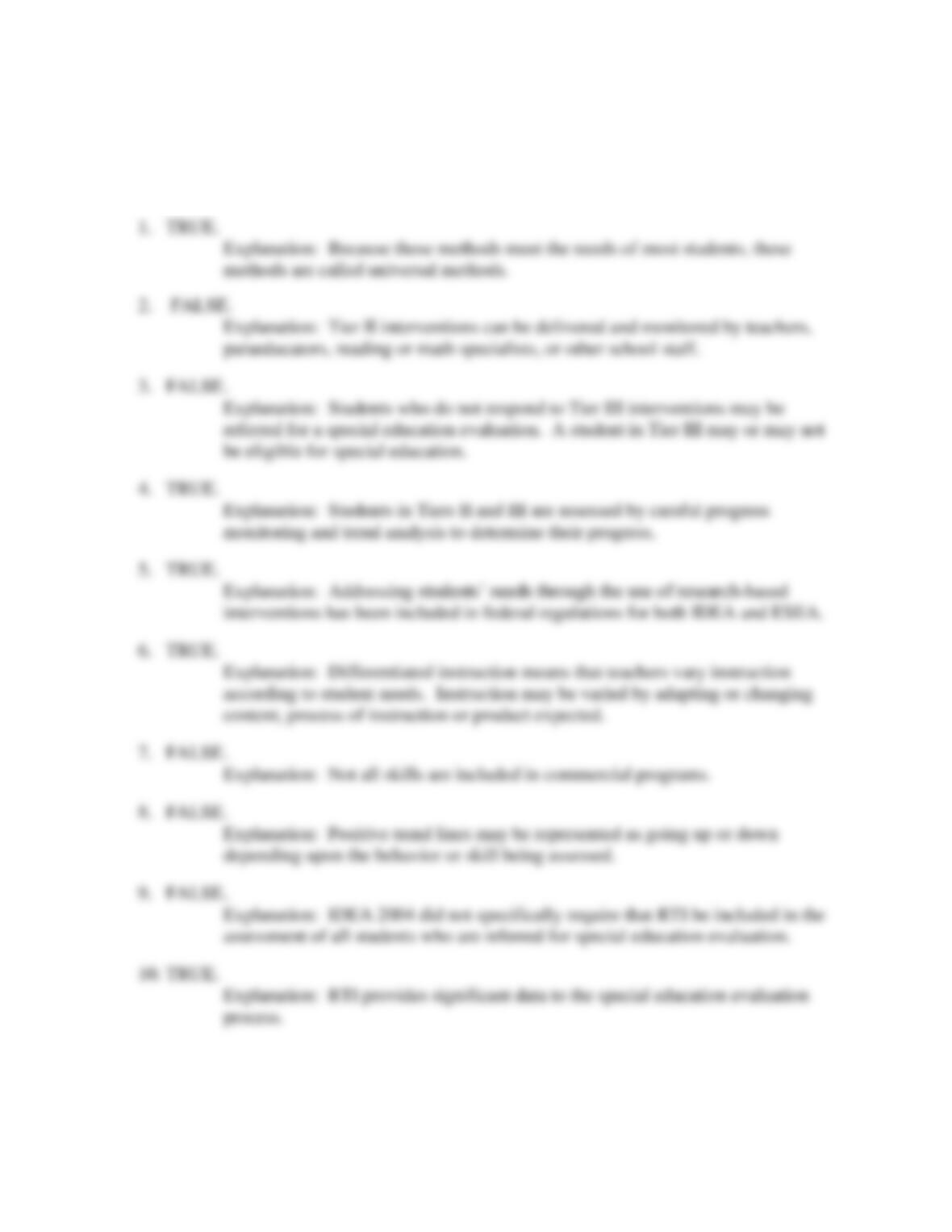
True and False
1. The term universal methods is often used synonymously with interventions provided at
the Tier I level of the RTI model.
2. Only a certified teacher may provide interventions for a student under the Tier II RTI
model.
3. All students who fail to make progress at the Tier III level of the RTI model receive
special education services.
4. Detailed progress monitoring and trend analysis is required of students who are receiving
RTI services under Tiers II and III.
5. The use of research-based interventions is required of all teachers, not just special
educators.
6. Differentiating instruction requires teachers to change content, instruction or assessments
in order to meet individual student needs.
7. Commercially available progress monitoring programs are complete and include
everything you need to assess students on to ensure progress in the general education
curriculum.
8. When using visual inspection to evaluate intervention effectiveness, progress is indicated
only when a trend line is going in an upward direction.
9. IDEA 2004 requires the use of RTI when evaluating every child for special education
services.
10. The RTI process provides substantial information to the special education evaluation
process in the event a student continues to be unsuccessful in the general education
classroom.
Multiple Choice
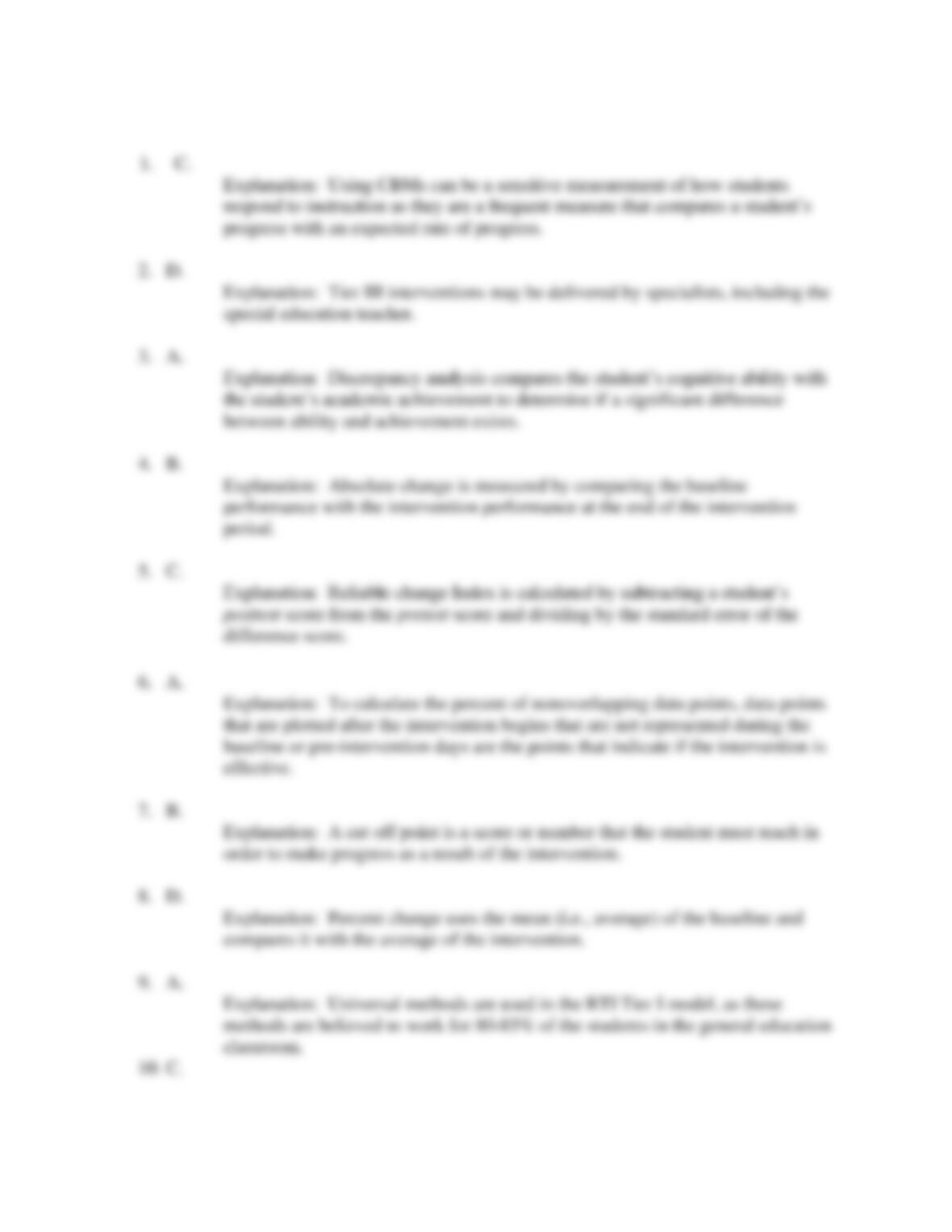
1. Which of the following assessments is an example of a sensitive measure that would
provide detailed information regarding a student’s response to instruction?
A. Universal Screening
B. Standardized Assessment
C. Curriculum-Based Measurement
D. Student Essay
2. Tier III interventions in the RTI model are typically delivered by what type of school
personnel? A. General education teacher
B. Paraeducators
C. Parent volunteer
D. Specialists
3. This process was used to identify students with disabilities and compares a student’s
ability scores with achievement scores.
A. Discrepancy Analysis
B. Response to Intervention
C. Universal Screening
D. Progress Monitoring
4. Which of the following measurement methods compares a baseline score with a post–
intervention score?
A. Percent change
B. Absolute change
C. Reliable change index
D. Percent of nonoverlapping data points
5. By subtracting a student’s posttest score from the pretest score and dividing by the
standard error of the difference score, you achieve this score.
A. Cut-off point
B. Absolute change
C. Reliable change index
D. Percent of nonoverlapping data points
6. This measure considers data points that are above the highest baseline data point as
demonstrating intervention effectiveness.
A. Percent of nonoverlapping data points
B. Absolute change
C. Reliable change index
D. Percent change
7. A score or number that the student must reach in order to make progress as a result of the
intervention.
A. Absolute change
B. Cut-off point
C. Percent of nonoverlapping data points
D. Percent change
8. This measure uses the mean (i.e., average) of the baseline and compares it with the mean
of the intervention.
A. Cut-off point
B. Absolute change
C. Reliable change index
D. Percent change
9. These strategies are used in the Tier I RTI model and meet the needs of the majority of
students. A. Universal methods
B. Universal screenings
C. Interventions
D. Progress monitoring
10. These measures provide information about student achievement and are used to make
decisions about instruction at the global level.
A. Progress monitoring
B. Curriculum-based assessment
C. Universal screenings
D. Curriculum-based measures
11. This assessment is given weekly or bi-weekly to determine how a student is performing
and if program changes are warranted.
A. Universal screening
B. Progress monitoring
C. Curriculum-based assessment
D. Curriculum-based measure
12. Margot is experiencing difficulty with decoding using the general education curriculum
so the reading specialist began to provide services for her in a small group in the
classroom to provide more intensive practice. At what level of the RTI model is Margot
being served? A. General education classroom
B. Tier I
C. Tier II
D. Tier III
13. Billy is a third-grade student who is receiving services at the Tier III level of the RTI
model. He has reached the criterion score of 85% for four consecutive weeks on his math
progress monitoring probes. What should happen next?
A. Billy continues to receive services at Tier III.
B. Billy moves to Tier II and continues to receive less intense services.
C. Billy returns to the general education classroom (i.e., Tier I).
D. He should be referred for a special education evaluation.
14. When teachers adapt or modify the content of the curriculum, the instructional methods
they use, or the assessment used with a student, it is called
A. Progress monitoring
B. Response to intervention
C. Special education
D. Differentiated instruction
15. Mr. Kiddle believes that each child who is experiencing difficulty in school should be
individually evaluated to determine what interventions might address their unique needs.
Mr. Kiddle’s philosophy is most closely aligned with which RTI model?
A. Problem solving model
B. Standard model
C. Special education model
D. Standard protocol model
16. Which of the following progress monitoring tools is not commercially available and
provided with norm-referenced data?
A. DIBELS
B. AIMSWeb
C. Read Naturally
D. Curriculum-based assessments
17. Utilizing the PNDs measurement of progress, which of the following would be
considered the cut-off score for an effective intervention?
A. 90%
B. 80%
C. 70%
D. 50%
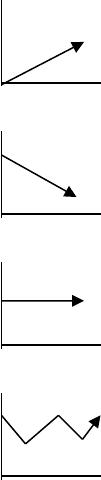
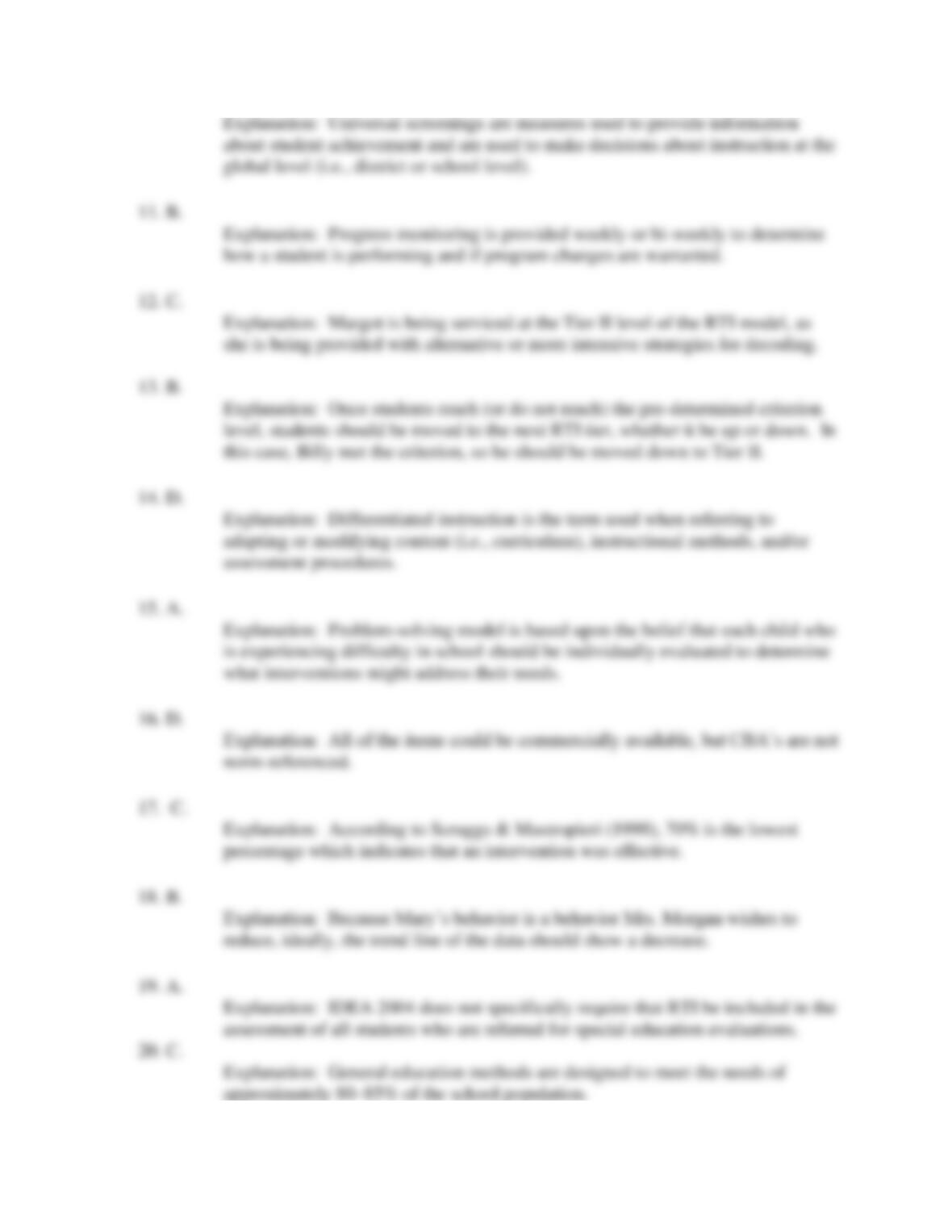
18. Mrs. Morgan is using visual inspection to determine if Mary has made progress on her
behavior goals. Mary’s goal was to reduce out-of-seat behavior to no more than 2
occurrences each day. Which of the following graphs ideally represents Mary’s trend
line? A.
B.
C.
D.
19. Which of the following is not a requirement under IDEA 2004?
A. The use of RTI for all students.
B. That a child’s disability impact educational performance.
C. That a child’s difficulties do not stem from a lack of instruction.
D. That classroom performance be considered in the evaluation process.
20. General education instruction is designed to meet the needs of what percentage of the
school population?
A. 100%
B. 90–95%
C. 80–85%
D. 70–75%
21. Which type of instruction are you most likely to see at Tier III in the RTI model?
A. Whole group
B. Small groups
C. Cooperative learning groups
D. One-on-one
22. Who is most likely to deliver the Tier III instruction in the RTI model?
A. Specialists
B. General education teacher
C. Paraeducator
D. Parent volunteer
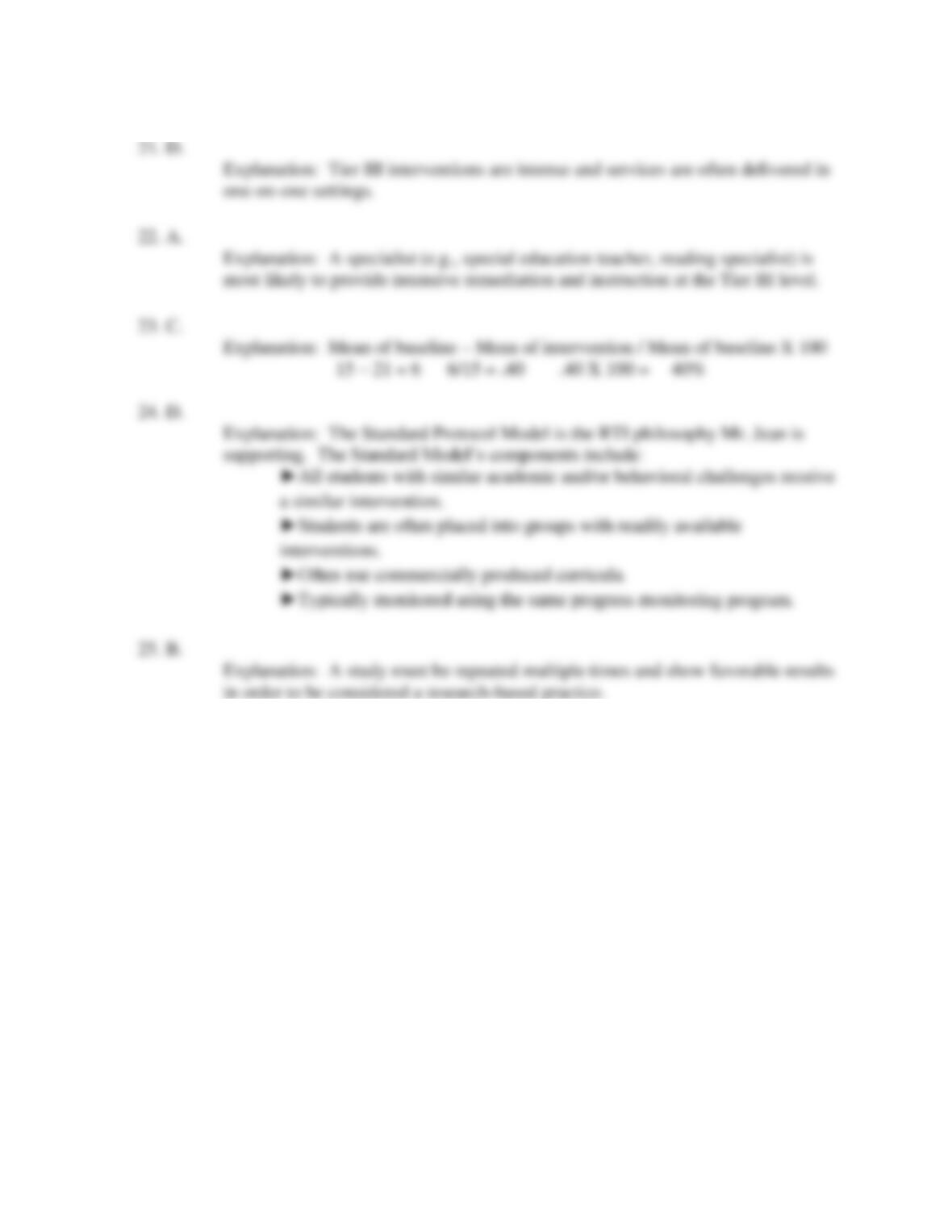
23. Michael receives additional reading interventions in a small group. His mean baseline
score is 15 and the mean intervention score is 21. What is Michael’s percent change?
A. 18%
B. 28.6%
C. 40%
D. 60%
24. Mr. Jean, the principal at Mountain Top School, wants to streamline the RTI process in
his building. He’s requiring all students with similar reading challenges to be grouped
together and receive interventions through a commercial curriculum the district has
purchased. All students will be progress-monitored using the materials that come with
the curriculum. Mr. Jean’s philosophy is most closely aligned with which RTI model?
A. Problem solving model
B. Progress monitoring model
C. Special education model
D. Standard protocol model
25. Which of the following is not a characteristic of what constitutes a research-based
intervention?
A. Interventions that include large samples.
B. Studies that were completed once.
C. Random selection of subjects.
D. Studies that provide positive results.
Short Answer
1. Provide an example of an intervention that could typically occur under each Tier of the
RTI model.
2. Identify two primary reasons why RTI was developed as a pre-special education
methodology to identify students with mild disabilities and behavioral challenges.
3. Identify the criteria of what constitutes a teaching methodology being a research-based
intervention.
4. Which measurement of progress would you choose to use in your classroom? Why?
5. Your school is adopting RTI and you have been tasked with educating the faculty on the
two predominate models (Standard Model or Problem-Solving Model). Provide an
explanation of each model and present an argument for the model you would personally
like selected.
6. Discuss the importance of using a quantitative measure of progress in addition to using a
noticeable progress in application approach.
7. Why is the use of RTI especially important for the evaluation process of identifying
children with learning disabilities and emotional disturbance?
8. As RTI continues to develop and be implemented in schools, teachers are finding
themselves taking on new roles and responsibilities. Discuss at least three of these roles
and/or responsibilities.
9. The data collected through the RTI methodology can provide the special education team
with important information. This information can be used to determine the answers to
these four important questions.
10. Given the fact that general education methods are designed to meet the needs of 80-85%
of the school population, present an argument supporting RTI as a pre-special education
process.
11. Mrs. Rodriguez is using the PNDs to determine whether her students have made progress
while receiving intensive instruction in identifying story grammar elements. Christina’s
highest baseline point was 5 questions correct. There were a total of 15 data points taken,
8 of which were above the baseline point. Determine the PND calculation and if the
intervention was effective.
12. Explain the difference between a CBM and a CBA. What is the value of each for
progress monitoring purposes?
Chapter 7 Test Bank Answer Key
True and False
1. TRUE.
Multiple Choice
Short Answer