Chapter 7
HELPING YOUNG CHILDREN DEVELOP MOTOR
AND SELF-HELP SKILLS
OUTLINE
I. The Development of Motor Skills
A. Sequential Trends of Motor Development
B. Helping Parents Understand
II. Atypical Motor Development
III. Assessment of Motor Abilities
A. Infants and Toddlers
B. Severe Motor Impairments
C. General Considerations for Assessment of All Young Children
D. Play-Based Assessment
IV. Physical Therapy Intervention
A. Role of Therapists
B. Approaches to Therapy
V. Development of Adaptive Behavior Skills
A. Use of Task Analysis
B. Dressing
C. Toileting
D. Feeding
VI. Adapting the Environment
A. The Classroom or Center
B. The Home
C. Movement Skills and Movement

D. Movement Skills and Imagination
E. Adaptations in Movement Education
VII. Summary
VIII. Discussion and Activities
ESSENTIAL CONCEPTS AND VOCABULARY
Athetoid movement patterns
Backward chaining
Branching
Cephalocaudal pattern
Chaining
Fine motor skills
Fluctuating muscle tone
Forward chaining
Gross motor skills
Handedness
Hyperreactivity
Quadriplegia
Reverse chaining
Self-regulation
Sensorimotor observations
Sensory defensiveness
Sensory integration
Spasticity
Course Assignment
Task Analysis Assignment
Task Analysis Rubric Rating Sheet
TASK ANALYSIS ASSIGNMENT
Students will synthesize their learning by creating a four page paper consisting of a task analysis
embedded into a lesson plan with appropriate adaptations. Students will need to choose one
specific task that can be broken down into smaller steps and explain how to use a lesson plan to
teach the task during a daily classroom activity. Students will also need to include appropriate
adaptations for a variety of different disabilities. In order to evaluate and monitor progress
students will need to create a data collection sheet. Finally, students will demonstrate and present
their task analysis to the class with assembled curriculum materials including one piece of
original adapted equipment/material to teach that particular skill.
Task Analysis (page 1)
A. List the developmental domain area:
B. Write the terminal behavioral objective making sure to state correctly all 3 components:
behavior, conditions, and criteria. (IEP goal)
C. List all the enroute behavioral objectives: (the specific steps of the task analysis broken
Lesson Plan (page 2)
D. List the daily activity of the classroom schedule that you have chosen to teach the task
analysis. A daily activity is a natural occurring opportunity throughout the day such as
art activities, transitions, cleanup, learning centers, cooking or mealtimes in which the
task analysis can be embedded and taught.
E. Write a short description of the activity: (one paragraph)
Adaptations (page 3)
H. Create and explain some adaptations (materials or prompts) based on your task analysis
that might be needed for a variety of different disabilities. The student will make and
show at least one of the adaptations during the presentation.
Data Collection (page 4)
I. Create a data collection chart with a designated key to monitor the progress that students
are making on the task analysis.
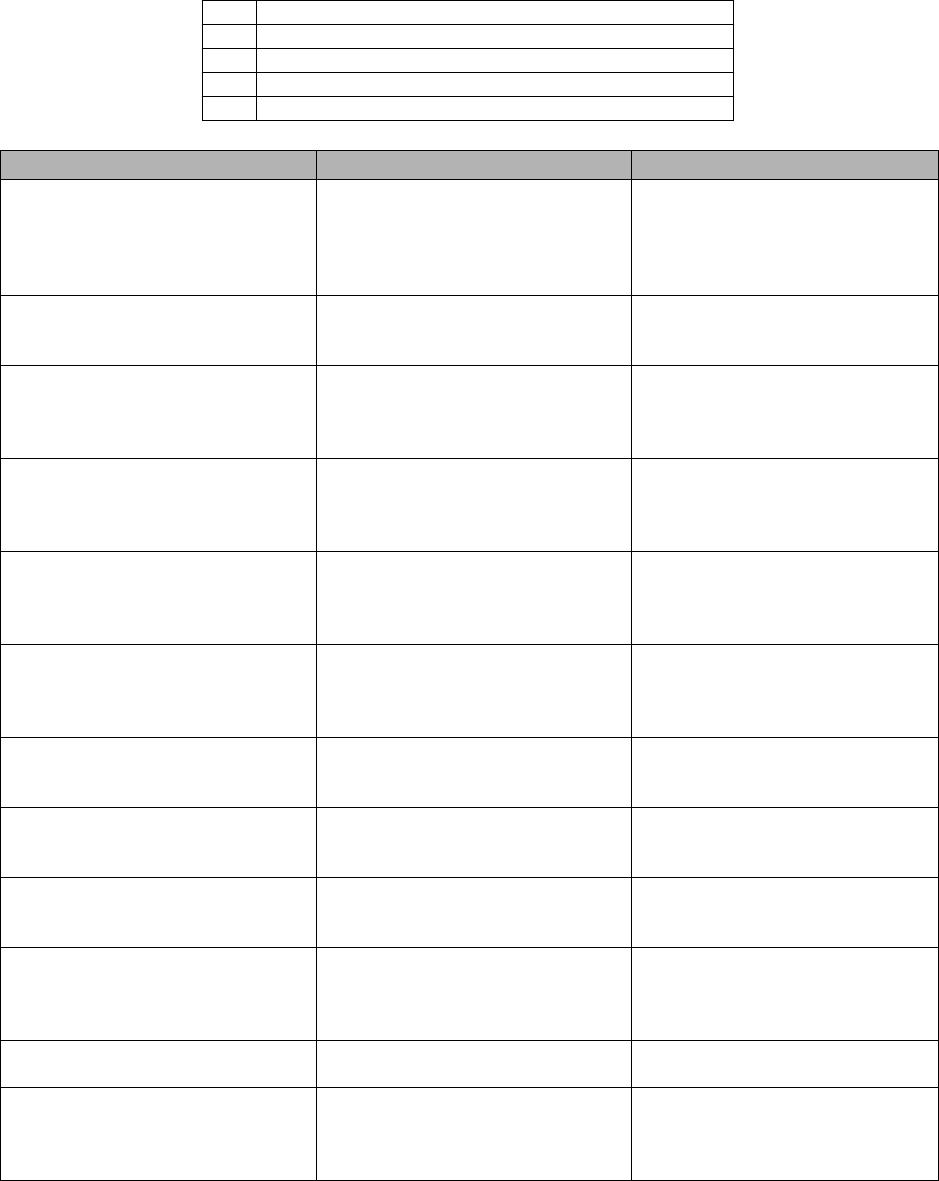
Task Analysis Rubric Grading Sheet
Name: ________________________________________
A
Exceeds standards
B
Meet standards
C
Majority meet standards some below standard
D
A few meet standards some below standards
F
Below standard
Exceeds Standard
Meets standard
Below standard
Terminal objective is correctly
stated, thoughtful , includes all
relevant baseline skills, &
developmental area is correctly
stated for objective (A/B) ____
Terminal behavioral objective is
correctly stated with the behavior,
conditions, and criteria and has
some relevant baseline skills:
Developmental area is correct____
Terminal behavioral objective is
missing any one of the main parts
or baseline skills. Developmental
area might be incorrect. ____
All of the steps in the enroute
behavioral objective are in correct
sequential order (C) ____
Most of the steps in the enroute
behavioral objective are in correct
sequential order ____
Some of the steps are in sequential
order ____
Task is thoroughly broken down to
its smallest parts that are all relevant
to the designated skill. (C) ____
Task is broken down to smaller
parts—missing very few steps.
Most steps are relevant to the
designated skill. ____
Task is missing several steps or
steps are not relevant to task ____
Activity is embedded in the most
natural occurring opportunity during
the daily routine for this specific
skill (D) ____
Activity is embedded in a natural
occurring opportunity during a day
for this specific skill. ____
Activity is embedded in an
incorrect or not so appropriate time
in the daily schedule. ____
Description of activity is specific,
thorough, clearly written answering
-what, when, where, how, list all
materials (E/F). ___
Description of activity is clearly
written answering most of the “wh”
questions and states materials
needed. ____
Description of activity is vague,
poorly written, or some materials
are missing. ____
Activity is relevant to and consistent
with the specific skill of the
terminal behavioral objective
(D/E/F) ____
Activity is somewhat relevant with
the specific skill of the terminal
behavioral objective. ____
Activity is not relevant or does not
specifically work on the skill listed
in the terminal behavioral
objective. ____
Teaching sequence is thorough,
varied, and with almost all 3
sections correct (G) ____
Teaching sequence is mostly correct
with very few missing elements
from the 3 sections ____
Teaching sequence has incorrect
information or missing elements
from any of the 3 sections ____
All of the adaptations are
thoughtful, creative, and functional
(H) ____
Most of the adaptations are
functional and thoughtful. ____
The adaptations are vague and
unoriginal. ____
All of adaptations are relevant and
correctly stated for the specific
disability (H)
Most of the adaptations are relevant
and correctly stated for the specific
disability.
Adaptations are not meaningful or
correctly stated for the specific
disability. ____
Almost all adaptations remain
within the realm of the terminal
behavioral objective and
developmental area (H). ____
Most of the adaptations remain
within the realm of the terminal
behavioral objective and
developmental area. ____
Some adaptations are too far away
from the terminal objective or
actually change the scope to a
different skill. ____
At least 7 disabilities had
adaptations (H) ____
At least 5 disabilities had
adaptations ____
4 or less disabilities had
adaptations ____
Data collection chart is well thought
out, easy to use, organized, useful,
shows all steps & has meaningful
key (I) ____
Data collection chart is thoughtful,
organized, shows most steps and has
a designated key that makes sense.
____
Data collection chart is missing
elements of organization, steps, or
a designated key____

CHAPTER 7
Multiple Choice
1. If you were asked to prepare a lesson involving the development of fine motor skills, which of
the following would not be considered?
a. Pasting colored strips of paper together
b. Following the movement of a penlight
c. Kicking a ball toward a target
d. Assembling a wooden puzzle
2. How does a child who experiences tactile defensiveness react to being touched?
a. The child feels self-conscious
b. The child feels happy
c. The child feels in danger
d. The child feels pain
3. If you were asked to prepare a lesson involving the development of gross motor skills, which
of the following would not be considered?
a. Outlining with stencils or templates
b. Walking on a balance beam
c. Throwing a ball to a partner
d. Playing “Simon Says”
4. Hand dominance is often not achieved until the age of
a. 4 years
b. 5 years
c. 6 years
d. 7 years
5. A useful technique to employ when teaching self-help skills is
a. Reverse chaining
b. Behavior modification
c. Concrete reinforcement
d. Shaping
6. The fact that children increasingly learn to eliminate unnecessary body movement
demonstrates which of the following basic principles of growth?
a. Bilateral to unilateral development
b. Gross motor to fine motor development
c. Proximo-distal growth
d. Maximum to minimum muscle involvement

7. The most useful way to assess motor skills primarily involves
a. Norm-referenced tests
b. Criterion-referenced tests
c. Observation
d. Standardized tests
8. The rate and quality of physical and motor development are influenced most by
a. Age and environmental factors
b. Physiological maturation and environmental factors
c. Age and internal motivation
d. Internal motivation and physiological maturation
9. The pattern of voluntary movement that begins in the shoulder, then moves on to the elbow
area, wrist, and finally the fingers is called the
a. Proximo-distal pattern
b. Mass-to-specific pattern
c. Bilateral-to-unilateral pattern
d. Maximum-to-minimum muscle-involvement pattern
10. Another word for “spasticity” as a motor disability is
a. Athetosis
b. Hypotonic
c. Hypertonic
d. Floppy
True-False
1. In the preschool years, girls appear to perform better on fine motor tasks while boys tend to
be more adept at large motor tasks.
2. If a child has a significant motor disability he or she is highly likely to have a cognitive
deficit as well.
3. Apgar scores indicate the intelligence levels of newborns.
4. Research reveals a significant relationship between visual-perceptual training and improved
academic performance.
5. A child who is hypotonic is often called a child who is “floppy.”
6. Motor development follows a highly predictable sequential and overlapping pattern.
7. Growth and development tend to proceed from the outer extremities to the spine.

8. The focus of therapeutic intervention has shifted from developmental goals to functional
independence.
9. Creating en route objectives are not necessary to prevent children from experiencing failure.
10. Physical therapists are usually concerned with large muscle movement while occupational
therapists are more often involved with fine motor function and activities of daily living.
Short Answer
1. How might a child behave who has difficulty with tactile defensiveness?
2. Compare motor development within the cephalocaudal and proximo-distal patterns.
3. Discuss some general characteristics of children who have cerebral palsy.
4. In task analysis, why would a teacher use reverse chaining?
5. Briefly discuss what is assessed when medical professionals use an Apgar score for a
newborn baby.
6. Write a task analysis with at least 4 enroute behaviors for the motor skill of pouring liquid
from a small pitcher into a cup independently.
7. What adaptations might be used for a child who has difficulty grasping the pitcher and cup
from the task analysis above?
8. Think about the typical movement games that young children like to play in groups. Pick two
games and describe the specific motor skills that can be assessed while the children play the
games.
9. Compare and contrast the difference between hypotonia and hypertonia.
10. How can environment factors influence the rate and quality of physical and motor
development?
Comprehensive Essay
1. Describe three playground activities that you could use with young children in the informal
evaluation of their motor skills. Be specific in stating exactly what a teacher should observe
and what can be learned about the children being observed.
2. Identify four observable behaviors which might indicate problems in motor development.
3. What are some of the ways in which atypical motor development will influence what a child
can and cannot do in the center? Select two or three adaptations that will have to be made
and discuss them.
4. Define “sensory integration.” What happens when there is dysfunction in sensory
integration?
5. Identify four observable behaviors that might indicate problems in sensory integration.
6. Identify four guidelines to keep in mind when handling a child with disabilities with the goal
of normalizing muscle tone and facilitating movement.
7. Compare and contrast developmental motor goals and functional motor goals.
8. Compose five steps of reverse chaining for the task of washing hands.
9. Identify at least three activities that involve gross motor skills and at least three activities that
involve fine motor skills.
10. Write a task analysis for putting on a jacket and zipping it up. What adaptations would you
make for a child who has difficulty with the fine motor skills of grasping the zipper and
pulling up? What adaptations would you make for a child who is having difficulty following
the sequence of the steps of the task? What adaptations would you make for a child who has
a limited range of motion in his arms?

Chapter 7 :