Chapter 7—Carbohydrates and the Glycoconjugates of Cell Surfaces
MULTIPLE CHOICE
1. Carbohydrate characteristic chemical features include all EXCEPT:
a.
the potential to form multiple hydrogen bonds.
b.
the existence of one or more asymmetric centers.
c.
the capacity to form polymeric structures.
d.
the ability to exist in either linear or ring structures.
e.
all are true.
2. Which of the following sugars is an aldopentose?
a.
galactose
b.
ribulose
c.
ribose
d.
xylulose
e.
mannose
3. If carbon 1 is the carbonyl group of an aldohexose, which carbon determines if the sugar is a D- or L-
stereoisomer?
a.
1
b.
2
c.
3
d.
4
e.
5
4. The enantiomer of D-mannose would be:
a.
D-galactose.
b.
L-glucose.
c.
D-glucose.
d.
L-mannose.
e.
L-arabinose.
5. Mannose is an epimer of:
a.
ribose
b.
galactose
c.
glucose
d.
xylose.
e.
fructose.
6. The formation of cyclic structures in sugars with creation of an additional asymmetric center results
from an alcohol reacting with a(n):
a.
secondary alcohol.
b.
phosphate group.
c.
thiol group.
d.
aldehyde or ketone.
e.
primary alcohol.
7. A cyclic hemiacetal with a six-membered oxygen-containing ring is referred to as a(n):
a.
aldehyde.
b.
pyranose.
c.
ketopentose.
d.
furanose.
e.
sorbitol.
8. Glucose most commonly forms which of the following structures?
a.
a pyranose using the hydroxyl group on carbon 4
b.
a pyranose using the hydroxyl group on carbon 5
c.
a pyranose using the hydroxyl group on carbon 6
d.
a furanose using the hydroxyl group on carbon 3
e.
a furanose using the hydroxyl group on carbon 4
9. Which of the following is correctly paired with its most prevalent cyclization product?
a.
fructose: pyranose
b.
glucose: furanose
c.
ribose: pyranose
d.
galactose: does not cyclize
e.
none of the above
10. As a result of mutarotation, D-glucose exists in all of the following forms EXCEPT:
a.
L-glucopyranose.
b.
-anomer.
c.
free aldehyde.
d.
-anomer.
e.
all are true.
11. –D-glucopyranose in the chair form is the most widely occurring form of glucose in nature and it has
the following characteristics EXCEPT:
a.
forms a six-membered ring.
b.
carbon 6 is above the plane of the chair.
c.
all of the −OH groups are equatorial.
d.
the anomeric carbon has a hydroxyl that is below the plane of the chair.
e.
all axial positions are occupied by −H.
12. All of the statements about the following pairs of sugars are correct EXCEPT:
a.
Galactose and mannose are diastereomers.
b.
L-galactose and D-galactose are enatiomers.
c.
Glyceraldehyde and dihydroxyacetone are stereoisomers.
d.
Glucose and mannose are epimers.
e.
Glucose has fewer chiral centers than fructose.
13. Individuals with uncontrolled diabetes mellitus may have ____ levels of blood ____ so they test their
blood for ____.
a.
elevated; fructose; gluconic acid
b.
depressed; glucose; oxidizing sugars
c.
elevated; glucose; fructose
d.
depressed; gluconic acid; reducing sugars
e.
elevated; glucose; reducing sugars
14. Sugar alcohols include all of the following EXCEPT:
a.
ribitol.
b.
sorbitol.
c.
fucose.
d.
mannitol.
e.
glycerol.
15. A constituent of the flavin coenzymes is
a.
sorbitol
b.
mannitol
c.
xylitol
d.
ribitol
e.
glycerol
16. Honey is characteristically composed predominantly of
a.
sucrose
b.
glucose and ribose
c.
fructose and glucose
d.
sucrose and sorbitol
e.
all of the above
17. All of the following are parts of the honeybee’s processing of honey EXCEPT:
a.
producing a small amount of gluconic acid.
b.
concentrating the sugars to a supersaturated state.
c.
conversion of some glucose and fructose into sucrose.
d.
conversion of most of the fructose to the -D-fructopyranose form.
e.
producing an emulsion of glucose hydrate and fructose hydrate crystals in a thick syrup.
18. ____ and ____ are glycosamines linked to three-carbon acids at the C-1 or C-3 positions, and
components of the polysaccharides of cell higher organisms and bacterial cell walls.
a.
Glucosides; galactosides
b.
Muramic acid; neuraminic acid
c.
Gluconic acid; glucuronic acid
d.
Sorbitol; ribitol
e.
None of the above
19. A glycosidic bond would be present in:
a.
-D-galactosamine.
b.
methyl--D-glucoside.
c.
2-deoxy--D-ribose.
d.
-D-glucose-6-phosphate.
e.
-D-fructose-1, 6-bisphosphate.
20. Which of the following disaccharides contains an (1→4) O-glycosidic bond?
a.
sucrose
b.
lactose
c.
maltose
d.
cellobiose
e.
cellulose
21. All of the following disaccharides are reducing sugars EXCEPT:
a.
lactose.
b.
maltose.
c.
sucrose.
d.
cellulose.
e.
isomaltose.
22. Which of the following explains why the disaccharide sucrose is not a reducing sugar?
a.
the primary hydroxyl groups are oxidized to carboxylic acids
b.
both anomeric carbons are involved in formation of the glycosidic bond
c.
the glycosidic bond is in the configuration
d.
it is composed of a furanose and a pyranose
e.
none of the above
23. All of the following are homodisaccharides EXCEPT:
a.
lactose.
b.
maltose.
c.
isomaltose.
d.
cellobiose.
e.
all are homodisaccharides.
24. Glucuronic acid is formed by oxidation of which carbon of glucose?
a.
C-1
b.
C-2
c.
C-4
d.
C-6
e.
both a and b
25. The cyclization of gluconic acid produces what type of structure?
a.
lactam
b.
lactone
c.
pyranose
d.
cyclic ether
e.
none of the above
26. ____ is typical of the oligosaccharide components found in beans, etc., that are not digested in the
stomach, but are digested by bacteria in the intestines causing flatulence.
a.
Melezitose
b.
Amygdelin
c.
Laetrile
d.
Stachyose
e.
Dextrantriose
27. Cellulose is homopolysaccharide composed of ______ linked together by ______ glycosidic bonds.
a.
galactose; –(1→4)
b.
galactose; –(1→4)
c.
glucose; –(1→4)
d.
glucose; –(1→4)
e.
none of the above
28. Mucopolysaccharides such as ____ form protective coats on animal cells.
a.
chitin
b.
cellulose
c.
glycogen
d.
hyaluronic acids
e.
glucuronic acids
29. Because osmotic pressure depends only on ____, the osmotic pressure is greatly reduced by formation
of polysaccharide molecules from monosaccharide molecules.
a.
molecular weight
b.
number of hydroxyl groups
c.
numbers of molecules
d.
numbers of hydrogen bonds
e.
none are true
Garrett/Grisham 5e Test Bank 6
30. In plant cells, starch is hydrolyzed by ____ to release ____ and a starch molecule with ____.
a.
starch phosphorylase; glucose-1-phosphate; one less glucose unit
b.
salivary -amylase; maltose 1-phosphate; two less glucose units
c.
starch phosphorylase; maltose 1-phosphate; two less glucose units
d.
(1→6) glucosidase; glucose-6-phosphate; one less glucose unit
e.
starch hydrolase; glucose; one less glucose unit
31. Cooked starch is more digestible because:
a.
it has been partially hydrolyzed during cooking.
b.
the amylopectin is converted to amylose during cooking.
c.
the enzymes that hydrolyze the starch are only active when the starch is hot.
d.
the starch granules take up water, swell and are more accessible to the enzymes.
e.
all are true.
32. The enzymes -amylase and -amylase can cleave the ____ bonds of amylopectin but not the ____
bonds.
a.
(1→6)-; (1→4)-
b.
(1→6)–; (1→4)-
c.
(1→4)-; (1→4)–
d.
(1→4)-; (1→6)-
e.
(1→6)-; (1→4)–
33. ____ is an enzyme found in liver and muscle tissue used to catalyze the phosphorolysis of glycogen to
____.
a.
(1→6)-Glucosidase; glucose-1-phosphate
b.
-Amylase; glucose-1-phosphate
c.
-Amylase; glucose
d.
Glycogen maltase; maltose
e.
Glycogen phosphorylase; glucose-1-phosphate
34. All of the following statements about the nature of glycogen are true EXCEPT:
a.
It is a polysaccharide used for storage.
b.
It is a branched polymer of linked glucose residues.
c.
It has all non-reducing ends.
d.
The highly branched structure allows the rapid mobilization of glucose during metabolic
need.
e.
It is found primarily in the liver and skeletal muscles.
35. All are true statements about dextrans EXCEPT:
a.
They are used in research laboratories as a support for column chromatography (Sephadex
or BioGel).
b.
They are repeating units of isomaltose.
c.
The branches may be 1→2, 1→3 or 1→4 in various species.
d.
They are an important component of dental plaque.
e.
All are true.
36. Which of the following statements about cellulose fiber is true?
a.
It is a linear polymer of (1→4) glycosidic linked glucose and galactose residues.
b.
It is extremely susceptible to hydrolysis.
c.
It is water-soluble.
d.
It is made up of very weak microfibrils.
e.
Intermolecular hydrogen bonds play a major role in stabilization of the microfibrils.
37. All are true for cellulose and -amylose EXCEPT:
a.
Both are linear homopolymers of glucose.
b.
Both have (1→4) linkages.
c.
Both form extended ribbon most stable conformations.
d.
Both have extensive intramolecular hydrogen bonding.
e.
All are true.
38. Cellulose is extremely resistant to hydrolysis, but cellulase catalyzes the hydrolysis and comes from:
a.
the pancreas.
b.
bacteria that live in the rumen.
c.
the liver.
d.
H+ secreted into the rumen.
e.
the intestinal wall.
39. Cellulase is considered a(n) ____.
a.
–(1→4) glucosidase
b.
–(1→4) glucosidase
c.
–(1→6) glucosidase
d.
–(1→4) glucosidase
e.
–(1→1) glucosidase
40. Cellulose and chitin are similar in all of the following ways EXCEPT:
a.
Both are polymers of glucose.
b.
Both are structural polysaccharides.
c.
Both have extended ribbon conformations.
d.
Both have extensive hydrogen bonding.
e.
All are true.
Garrett/Grisham 5e Test Bank 8
41. All are true for agarose EXCEPT:
a.
Forms a double helix with a central core large enough to accommodate large quantities of
water.
b.
Consists of only a linear component.
c.
Is a chain of alternating D-galactose and 3,6-anhydro-L-galactose, with side-chains of 6-
methyl-D-galactose.
d.
Readily forms gels that are up to 99.9% water.
e.
All are true.
42. Glycosaminoglycans are unbranched polysaccharides consisting of alternating residues of uronic acid
and hexosamine. Which of the following is NOT a glycosaminoglycan?
a.
agaropectin
b.
heparin
c.
dermatan sulfate
d.
hyaluronate
e.
chondroitin-4-sulfate
43. ____ and ____ are found in tendons, cartilage and other connective tissue.
a.
Heparin; chondroitins
b.
Chondroitins; keratin sulfate
c.
Keratin sulfate, dermatan sulfate
d.
Hyaluronate, keratin sulfate
e.
All are true.
44. ____ are important components of the vitreous humor of the eye and of synovial fluid that lubricates
the joints.
a.
Heparin
b.
Hyaluronates
c.
Chondroitins
d.
Keratin sulfates
e.
All are true
45. Proteoglycans are a group of macromolecules formed from:
a.
proteases and monosaccharides.
b.
proteins and glycosaminoglycans.
c.
proteins and polysaccharides.
d.
proteases and glycosaminoglycans.
e.
proteins and glycogen.
46. Which of the following represents an example of a proteoglycan?
a.
attachment of several molecules of heparin to the peptide antithrombin III
b.
attachment of a Gal-(1,3)-GalNAc disaccharide to the fish antifreeze protein
c.
attachment of a small oligosaccharide to an immunoglobulin
d.
attachment of a small antigenic determinant to a membrane bound protein of a cell
e.
none of the above
47. The core protein of a proteoglycan is noncovalently attached to:
a.
oligosaccharides.
b.
glycosaminoglycans.
c.
keratin sulfate.
d.
an outer protein.
e.
hyaluronic acid backbone.
48. Cartilage-matrix proteoglycan has all of the following properties EXCEPT:
a.
responsible for the flexibility and resiliency of cartilage.
b.
has a hyaluronic acid binding domain.
c.
has reversible hydration-dehydration properties.
d.
contains both N-linked and O-linked oligosaccharides.
e.
is an integral transmembrane protein.
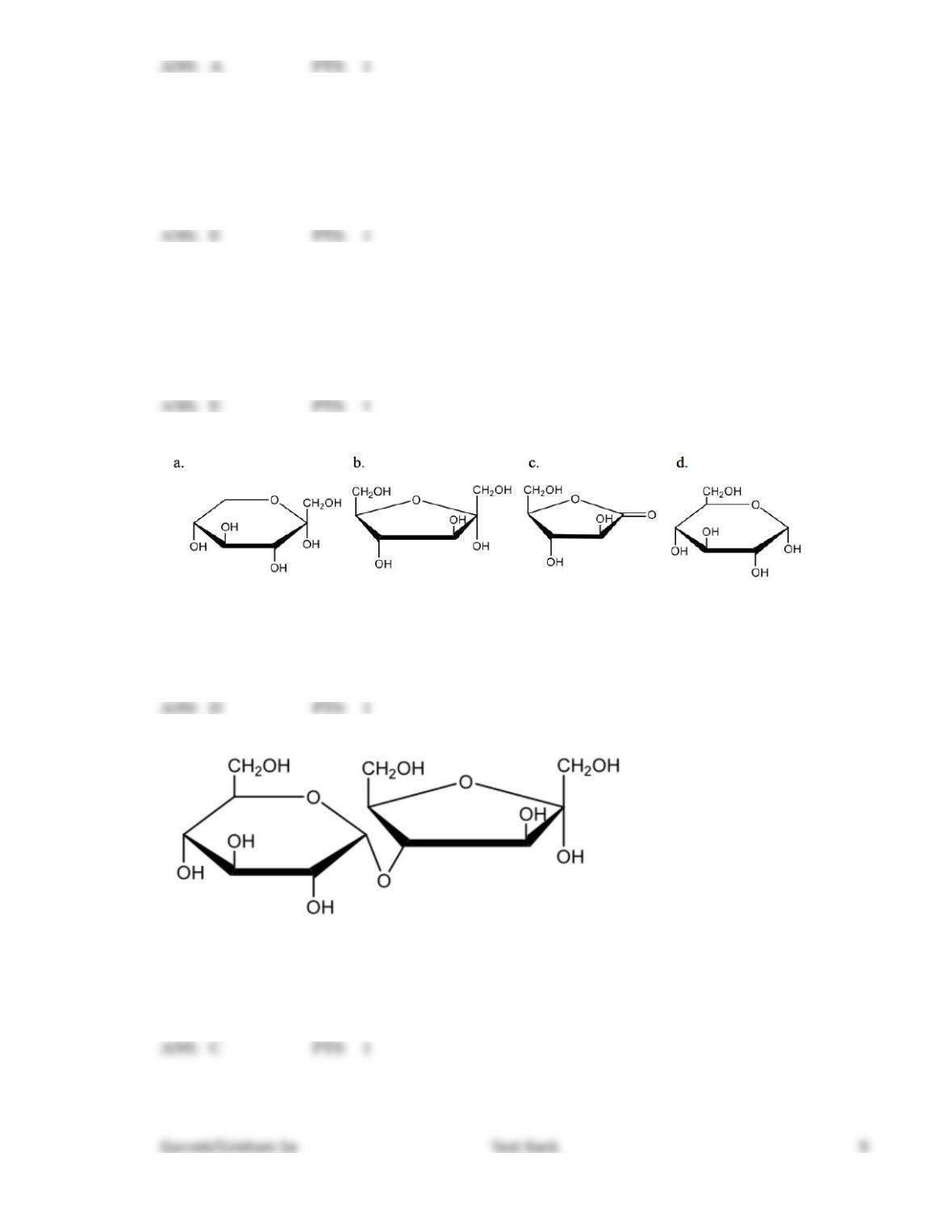
49. Which of the following monosaccharides is an aldose?
a.
a
b.
b
c.
c
d.
d
e.
none of the above
50. Which of the following best describes the glycosidic bond below?
a.
(2→4)
b.
(1→3)
c.
(1→4)
d.
(1→3)
e.
(2→4)
51. Which of the following statements is true regarding glycogen?
a.
the branches are formed by (2→6) glycosidic bonds
b.
glycogen is the primary energy storage molecule for animals
c.
most of the glycosidic bonds are (1→4)
d.
glycogen is considered a heteropolysaccharide
e.
none of the above are true
52. Amylose and glycogen are both glucose polymers, yet they have somewhat different properties. What
is one important difference between them?
a.
One is made with D-glucose and the other with L-glucose
b.
One is used as a structural polymer in insects; the other for energy in plants
c.
One contains glycosidic bonds while the other contains glycosidic bonds
d.
One is a linear polymer while the other is highly branched
e.
none of the above explain the difference between amylose and glycogen
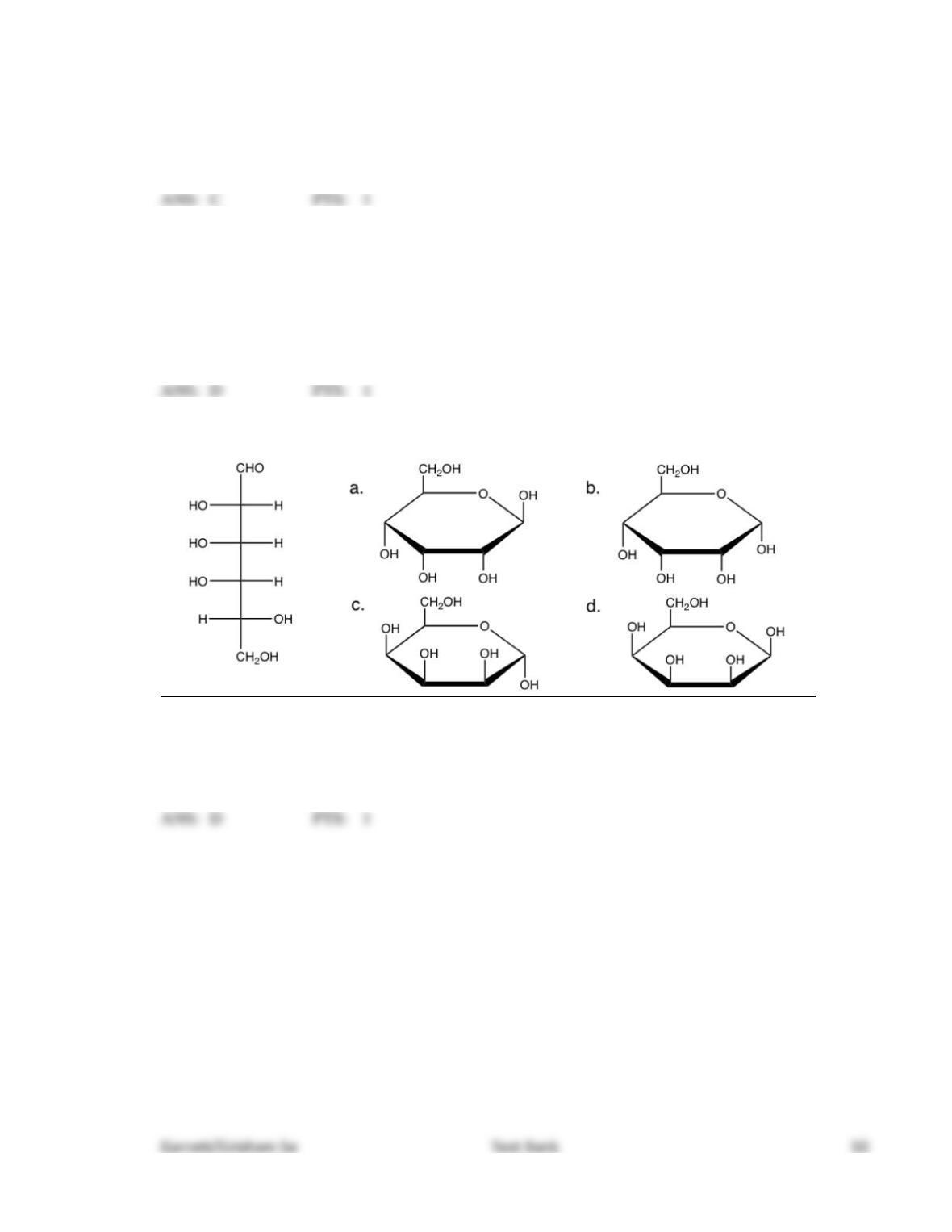
53. Which of the following would be the correct Haworth projection for –D-talose (linear form is shown
on the left)?
a.
a
b.
b
c.
c
d.
d
e.
none of the above