Chapter 7: Receivables and Investments
79. On February 1, 2015, Vermont Corp. pays $50,000 for shares of Stream, Inc. common stock and another $1,000 in
commissions.
Assume that Vermont sells the Stream stock on May 20, 2015, for $53,000. In this case, Vermont recognizes
a. An increase in assets and stockholders‘ equity for $2,000.
b. An decrease in assets and an increase in stockholders’ equity for $2,000.
c. An increase and decrease in assets by the same amount.
d. An increase in assets and stockholders’ equity for $3,000.
80. Which of the following statements is true regarding dividend income?
a. Dividend income is accrued at year-end.
b. Dividend income is reported on the income statement.
c. Dividend income appears in the stockholders’ equity section of the balance sheet.
d. Dividend income is recognized by companies that own debt securities.
81. The comparative balance sheets for Flagler Co. for 2015 and 2014 indicate that accounts receivable decreased
during 2015. Flagler uses the indirect method of preparing the operating activities section of its statement of cash
flows. How will the decrease in accounts receivable be reported on the statement of cash flows?
a. It will be included in the amount of cash and cash equivalents at the end of 2015.
b. It will be deducted from net income in the operating activities section.
c. It will be added to net income in the operating activities section.
d. It will be reported as a cash outflow in the investing activities section.
82. The comparative balance sheets of Midnite Corp. for 2015 and 2014 indicate that short-term trade notes receivable
increased from $5,000 in 2014 to $75,000 in 2015. How will this change be reported on Midnite’s statement of cash
flows, if Midnite uses the indirect method?
a. It will be included in the amount of cash and cash equivalents at the end of 2015.
b. It will be reported as a deduction from net income in the operating activities section.
c. It will be reported as a cash outflow in the investing activities section.
d. It will be added to net income in the operating activities section.
83. What is the impact on the cash flow statement from an increase in short-term notes receivable, assuming the
indirect method is used?
a. A decrease in the cash flow from operating activities
b. An increase in the cash flow from operating activities
c. An increase in the cash flow from financing activities
d. An increase in the cash flow from investing activities
Chapter 7: Receivables and Investments
84. What is the impact on the cash flow statement from a decrease in accounts receivable, assuming the indirect
method is used?
a. A decrease in the cash flow from operating activities
b. An increase in the cash flow from operating activities
c. An increase in the cash flow from financing activities
d. None. A decrease in accounts receivable has an impact only if the direct method is used
85. Which one of the following is an investing activity on the statement of cash flows?
a. Collection of accounts receivable
b. Purchase of long-term investments
c. Receipt of interest
d. Receipt of dividends
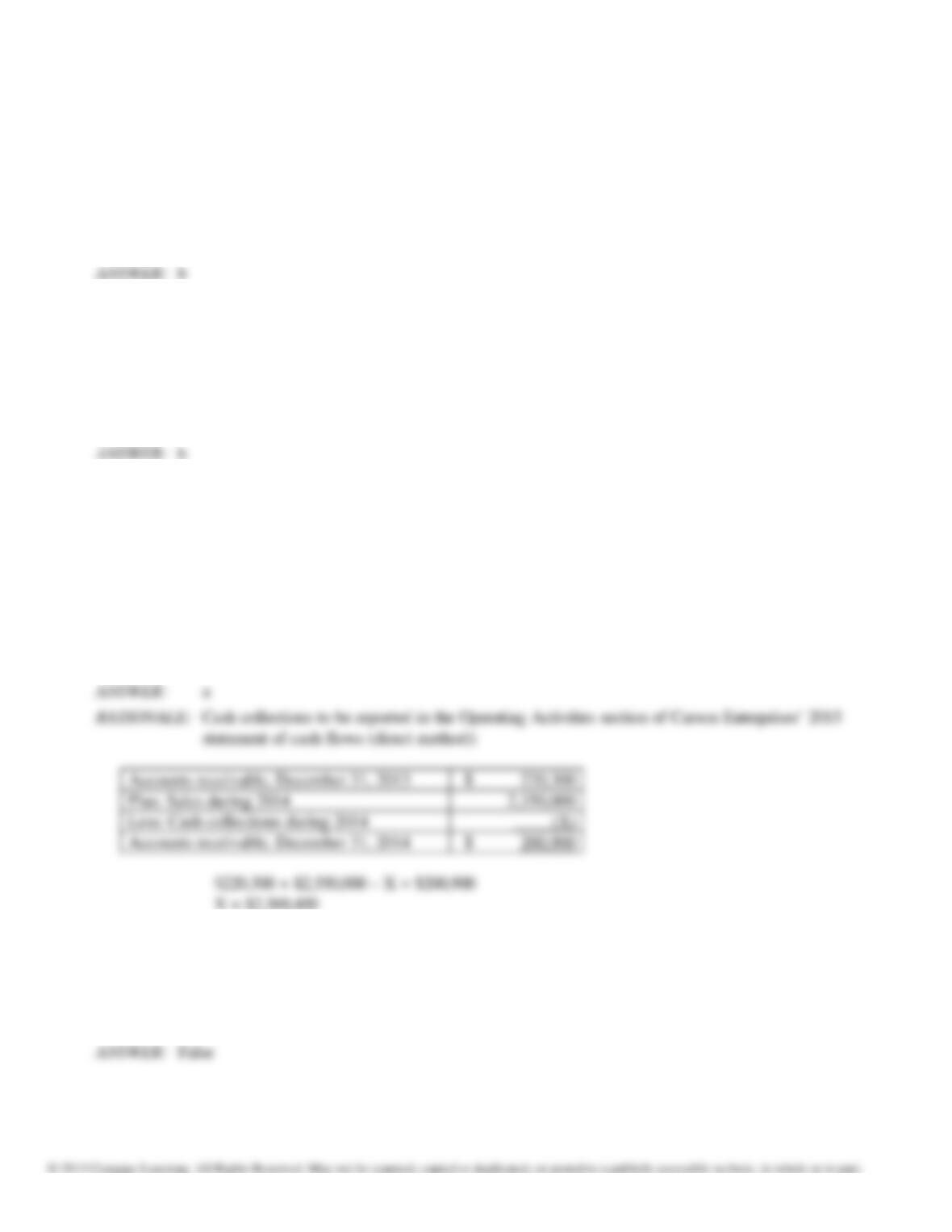
86. Carson Enterprises’ comparative balance sheets included accounts receivable of $220,300 at December 31, 2014,
and $200,900 at December 31, 2015. Sales reported on Carson’s 2015 income statement amounted to $2,350,000.
What is the amount of cash collections that Carson will report in the Operating Activities category of its 2015
statement of cash flows assuming that the direct method is used?
a. $2,369,400
b. $2,350,000
c. $2,771,200
d. $2,330,600
87. The reason the allowance method of recognizing bad debts is used is primarily because it recognizes the maximum
amount of write-off in each period.
a. True
b. False

Chapter 7: Receivables and Investments
88. Bad Debts expense is increased and Accounts Receivable is decreased at the end of the period to recognize bad
debts under the allowance method.
a. True
b. False
89. The percentage of net credit sales approach for recognizing bad debts considers any existing balance in Allowance
for Doubtful Accounts.
a. True
b. False
90. Selling on credit protects a company from the risk that some of its receivables will never be collected.
a. True
b. False
91. Accounts receivable are shown on the balance sheet at their net realizable amount.
a. True
b. False
92. The use of the allowance method is an attempt by accountants to match bad debts as an expense with the revenue
of the period in which a sale on credit takes place.
a. True
b. False
93. One of the problems with the use of the allowance method to account for bad debts is that it often violates the
matching principle.
a. True
b. False
94. Under the allowance method of accounting for bad debts, the company estimates the amount of bad debts before
those debts actually occur.
a. True
b. False

Chapter 7: Receivables and Investments
95. Bad Debts Expense is a contra account that is used to reduce accounts receivable to its net realizable value.
a. True
b. False
96. Because the allowance method results in better matching, accounting standards require its use rather than the direct
write-off method, unless bad debts are immaterial.
a. True
b. False
97. An aging schedule typically categorizes the various accounts by the length of time each invoice is outstanding.
a. True
b. False
98. The accounts receivable turnover ratio is a measure of how well a company manages its receivables.
a. True
b. False
99. The accounts receivable turnover ratio is computed by dividing net income by average accounts receivable.
a. True
b. False
100. Typically, the lower the accounts receivable turnover ratio, the better.
a. True
b. False
101. If Ash Company had sales during the year of $10,000,000, an average accounts receivable of $2,000,000, and net
income of $500,000, its accounts receivable turnover ratio would be 0.25.
a. True
b. False
102. If accounts receivable turnover is faster, this means that fewer days are required to collect receivables.
a. True
b. False

Chapter 7: Receivables and Investments
103. The accounts receivable turnover ratio is used to evaluate how well a company does in collecting its accounts
receivable.
a. True
b. False
104. A high accounts receivable turnover ratio could mean that the company’s credit policies may be too stringent.
a. True
b. False
105. Twin Cities Corp. had sales during the year of $15,000,000 and an average accounts receivable of $5,000,000. Its
accounts receivable turnover ratio is 0.33 times.
a. True
b. False
106. The maker of a note recognizes a note receivable on the balance sheet and interest revenue on its income
statement.
a. True
b. False
107. The maker of a note recognizes a note payable on the balance sheet and interest expense on its income statement.
a. True
b. False
108. The payee of a note recognizes a note payable on the balance sheet and interest expense on its income statement.
a. True
b. False
109. The payee of a note recognizes a note receivable on the balance sheet and interest revenue on its income
statement.
a. True
b. False

Chapter 7: Receivables and Investments
110. When a note is discounted at a bank, it is normally done with recourse.
a. True
b. False
111. If a company accepts a major credit card such as VISA from a customer, then the company is responsible for the
amount of the sale in a case of nonpayment from a cardholder.
a. True
b. False
112. When a company discounts a promissory note at the bank, it receives cash at the same time it would if it held the
note to maturity.
a. True
b. False
113. The alternate term for a credit card draft is an invoice.
a. True
b. False
114. Promissory notes are non-negotiable.
a. True
b. False
115. A note discounted with recourse means that if the original customer fails to pay the bank the total amount due on
the maturity date of the note, the company that transferred the note to the bank is liable for the full amount.
a. True
b. False
116. Whether investments are reported as current assets or noncurrent assets depends on the company’s intent.
a. True
b. False

Chapter 7: Receivables and Investments
117. A subsidiary is a separate legal entity that is owned or controlled by another entity.
a. True
b. False
118. Securities issued by corporations as a form of ownership in the business, such as common and preferred stock, are
called equity securities.
a. True
b. False
119. When Company X buys stock in Company Y, Company X is referred to as the investee.
a. True
b. False
120. The equity method of accounting is used if the investor owns at least 20% of the investee and the investor is able to
secure influence over the investee.
a. True
b. False
121. Purchases and sales of cash equivalents are reported as investing activities on a statement of cash flows.
a. True
b. False
122. Baggs buys $100,000 of Vista Company bonds on January 1, 2014 at face value. The bonds pay 10% interest
semiannually on June 30 and December 31. If Baggs sells the bonds at 99 on July 1, 2014, there will be a loss
reported on the income statement.
a. True
b. False
123. Both stock and bond investments have maturity dates.
a. True
b. False

Chapter 7: Receivables and Investments
124. A company invests excess cash in a certificate of deposit. At the end of an accounting period before the CD
matures, the company will recognize interest expense.
a. True
b. False
125. A decrease in accounts receivable represents an increase in a company‘s cash flow from operating activities.
a. True
b. False
126. An increase in accounts receivable is reported on the statement of cash flows under the indirect method as an
addition.
a. True
b. False
127. The mechanism that keeps track of the balances owed by individual customers is called a(n)
_________________________.
128. A general ledger account that is supported by a subsidiary ledger is called a(n) .
129. The gross accounts receivable less the allowance for doubtful accounts is known as the
_________________________.
130. A(n) categorizes the various accounts receivable amounts by the length of time
outstanding.
131. The accounts receivable turnover ratio is computed by dividing by average accounts receivable.
132. The the accounts receivable turnover ratio, the quicker the each dollar of accounts receivable
can be collected.

Chapter 7: Receivables and Investments
133. Over the life of a note, the maker of a note recognizes on the balance sheet and
on the income statement.
134. A(n) is a written promise to repay a definite sum of money either upon demand,
or at a fixed or determinable date in the future.
135. The party that agrees to repay is the of the note.
136. A company that holds a promissory note from another company has an asset, called a(n)
____________________.
137. The company that makes or gives a promissory note to another company has a liability, called a(n)
____________________.
138. The maker of a note recognizes on its income statement.
139. The payee of a note recognizes on its income statement.
140. The amount of money received, or the fair value of the products or services received by the maker when a
promissory note is issued is called the .
141. The length of time a note is outstanding (that is, the period of time between the date it is issued and the date it
matures) is called the ____________________.

Chapter 7: Receivables and Investments
142. The party that receives the payment due from a note is called the .
143. The date that a promissory note is due is the .
144. The difference between the principal amount of a note and its maturity value is called .
145. The amount of cash the maker is to pay the payee on the maturity date of the note is called the
____________________.
146. The process of assigning a note due in the future to a bank before its maturity date is called
____________________.
147. If a company discounts a note at a bank, but still is contingently liable for the maturity value, then the note was
discounted with ____________________.
148. When an investor is able to secure significant influence over an investee, the method of
accounting is used.
149. Securities issued by corporations as a form of ownership in the business, such as common or preferred stock, are
called _________________________.
150. Bonds issued by corporations or governmental bodies as a form of borrowing are called
____________________.
151. Cash flows from purchases, sales, and maturities of investments are usually classified as
activities.
152. Changes in accounts and notes receivable are reported in the Activities section of a statement of
cash flows prepared using the indirect method.
Chapter 7: Receivables and Investments
153. When using the indirect cash flow method, a decrease in accounts receivable or notes
receivable must be to net income to arrive at the increase or decrease in cash flows.
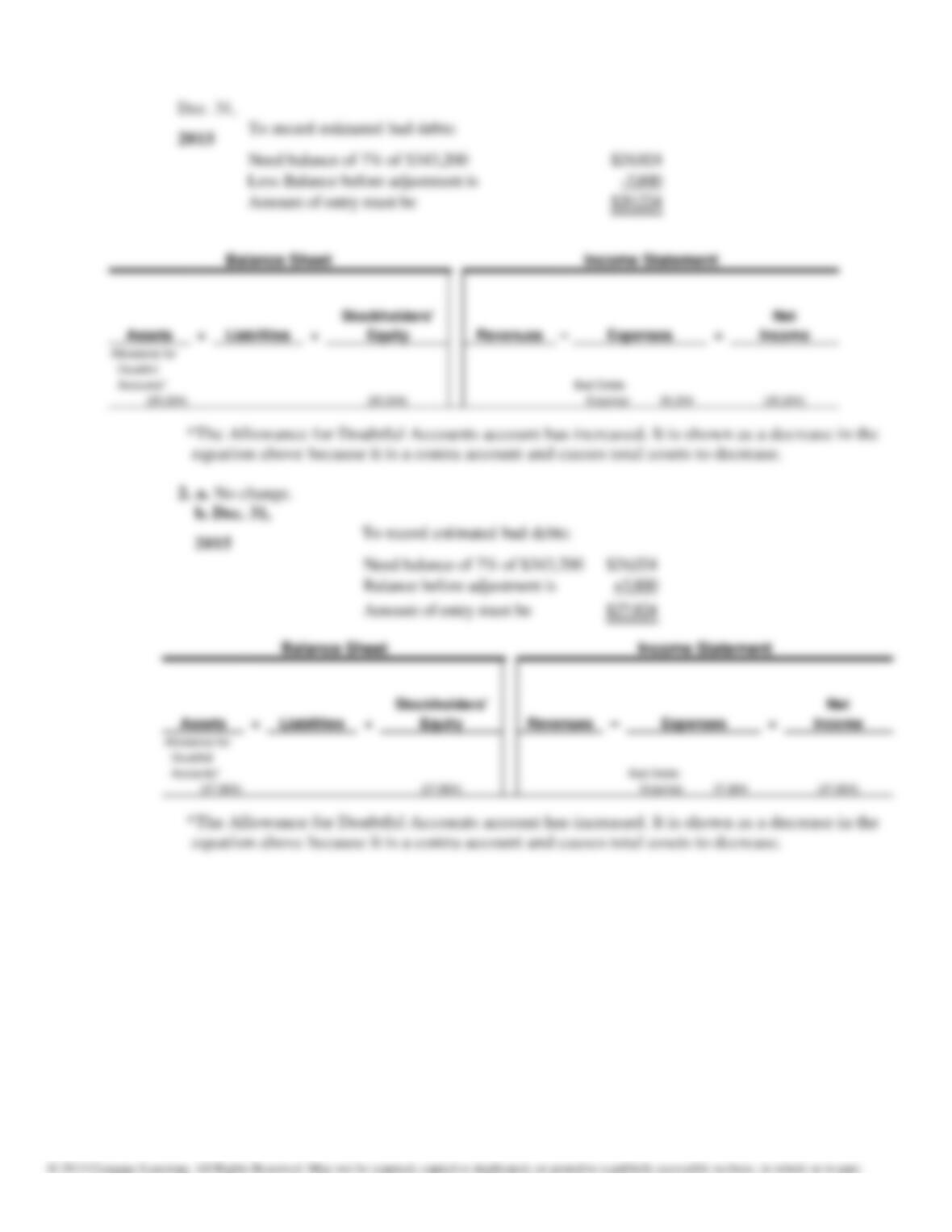
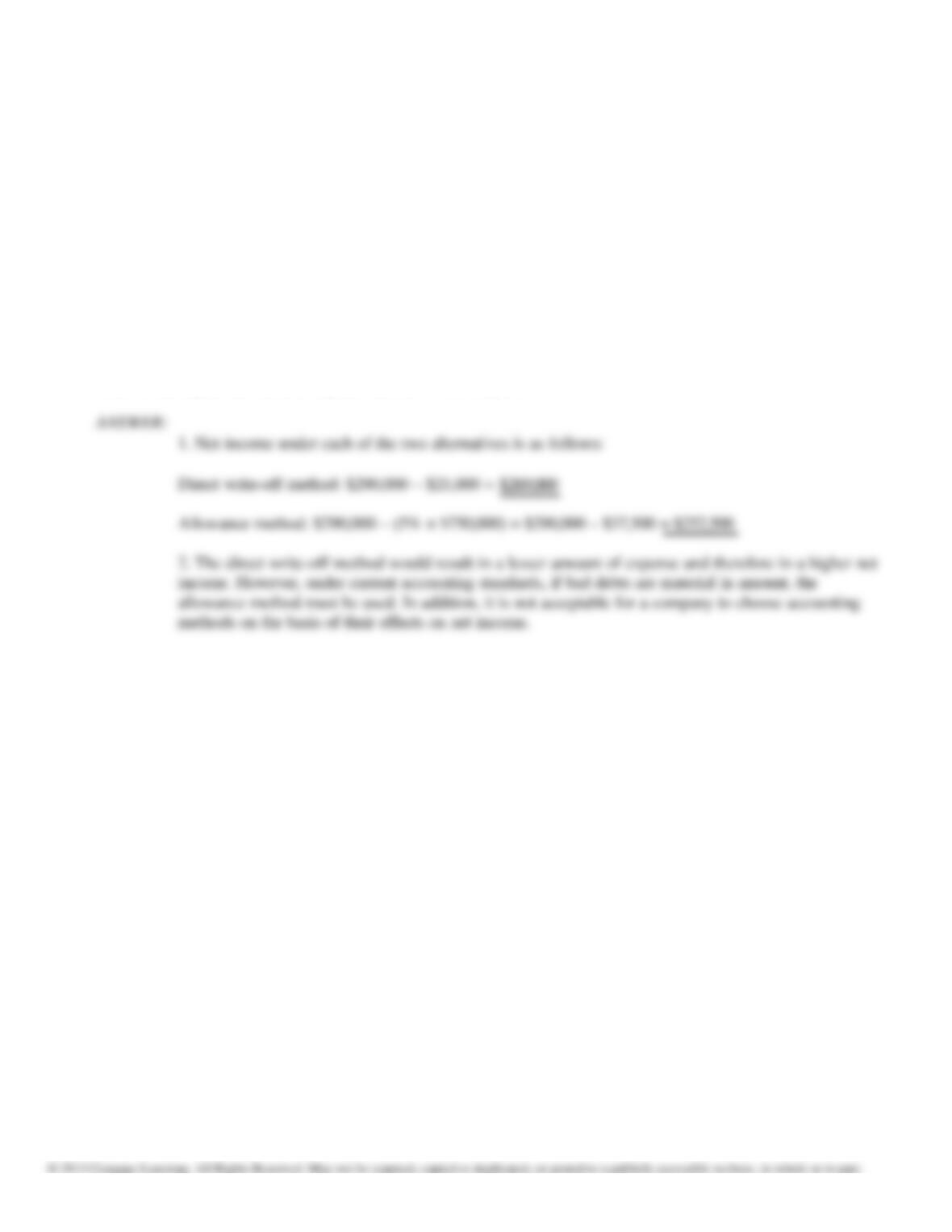
154. Grant Company had the following data available for 2015 (before making any adjustments):
Accounts receivable, 12/31/15
$343,200
Less Allowance for doubtful accounts
(3,800)
Net Accounts Receivable 12/31/15
$339,400
Net credit sales, 2015
REQUIRED:
829,000
1. Based on this information identify the effects of the transaction on the accounting equation to recognize bad
debts under the following assumptions:
(a) Bad debts expense is expected to be 3% of net credit sales for the year and
(b) Grant expects it will not be able to collect 7% of the balance in accounts receivable at year-end.
2. Assume instead that the balance in the allowance account of $3,800 is added to the accounts receivable balance
to arrive at net accounts receivable for 12/31/15, before adjustment. How will this affect your answers to (1)?
Chapter 7: Receivables and Investments
Chapter 7: Receivables and Investments
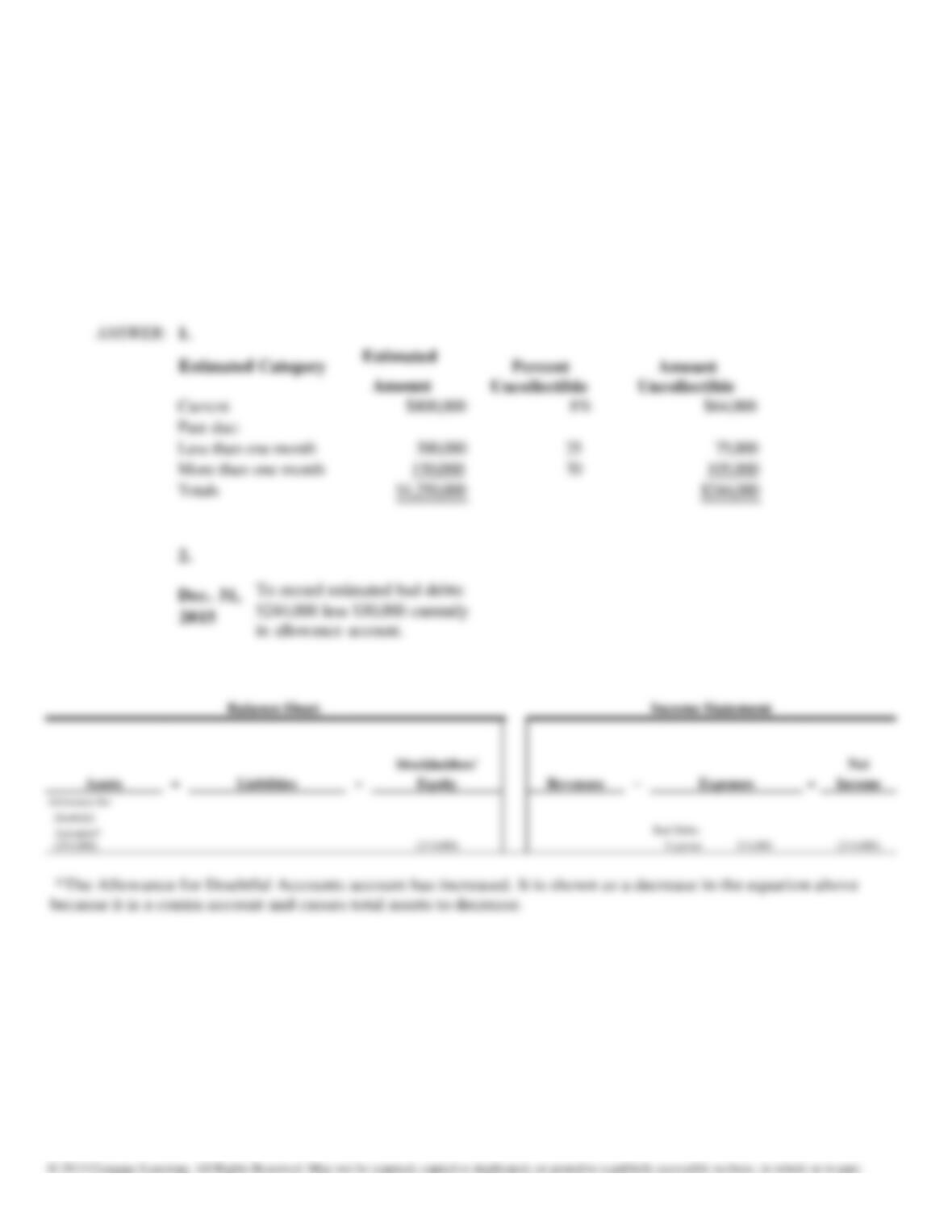
155. In its first year of business, Mariman Company has net income of $290,000, exclusive of any adjustment for bad
debts expense. The president of the company has asked you to calculate net income under each of two alternatives
of accounting for bad debts: the direct write-off method and the allowance method. The president would like to use
the method that will result in the higher net income. So far, no adjustments have been made to write off
uncollectible accounts or to estimate bad debts. The relevant data are as follows:
Write-offs of uncollectible accounts during the year
$ 21,000
Net credit sales
750,000
Estimated percentage of net credit sales that will be uncollectible
5%
REQUIRED:
1. Compute net income under each of the two alternatives.
2. Does Mariman have a choice as to which method to use? If so, should it base its choice on which method will
result in the higher net income? (Ignore income taxes.) Explain.
Chapter 7: Receivables and Investments
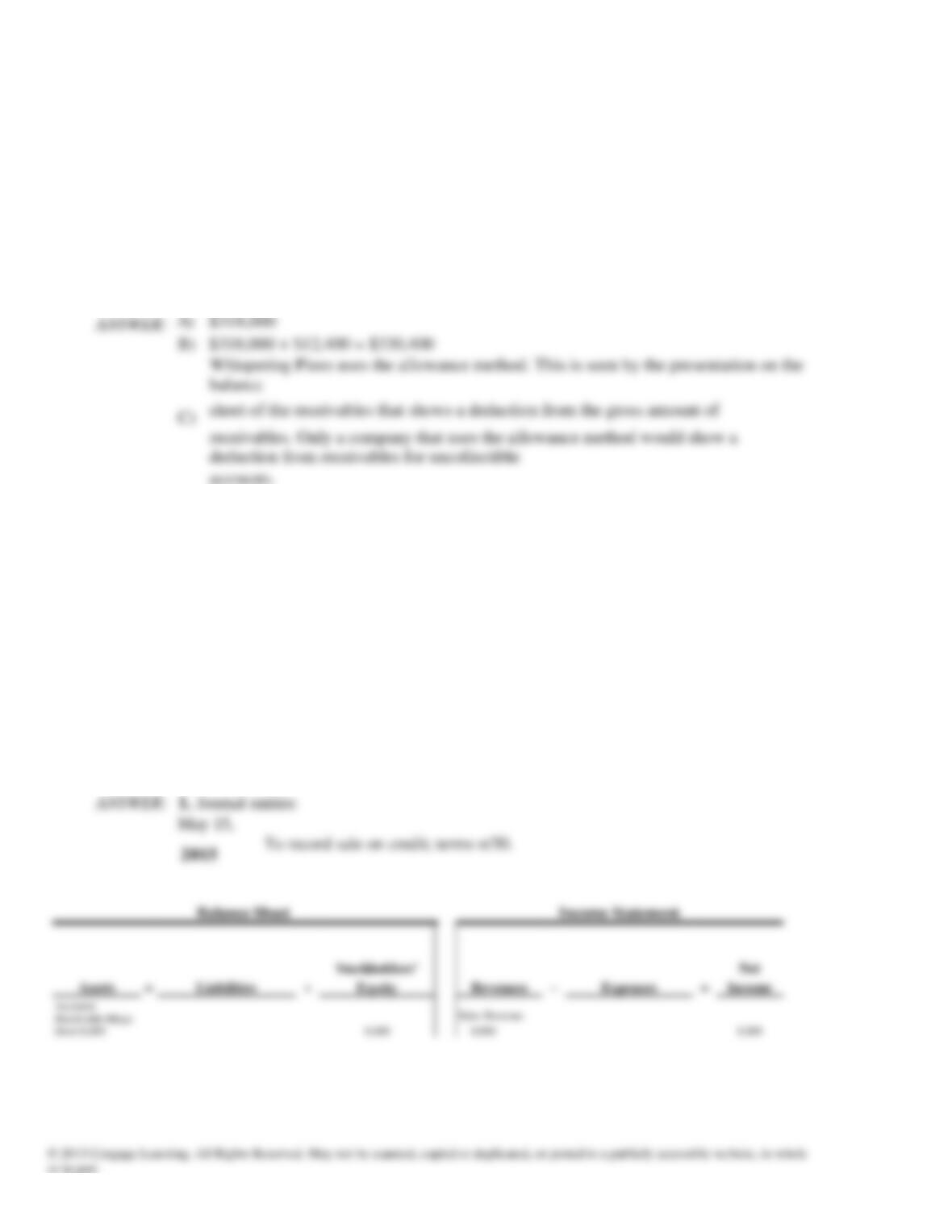
156. Marion Company sells on credit with terms of n/30. For the $800,000 of accounts at the end of the year 2015 that
are not overdue, there is a 92% probability of collection. For the $300,000 of accounts that are less than a month
past due, Marion estimates the likelihood of collection going down to 75%. The probability of collecting the $150,000
of accounts more than a month past due is estimated to be 30%.
REQUIRED:
1. Prepare an aging schedule to estimate the amount of uncollectible accounts.
2. On the basis of the schedule in (1), identify the effects on the accounting equation to estimate bad debts as of
December 31, 2015. Assume that the credit balance in Allowance for Doubtful Accounts is $30,000.
Chapter 7: Receivables and Investments
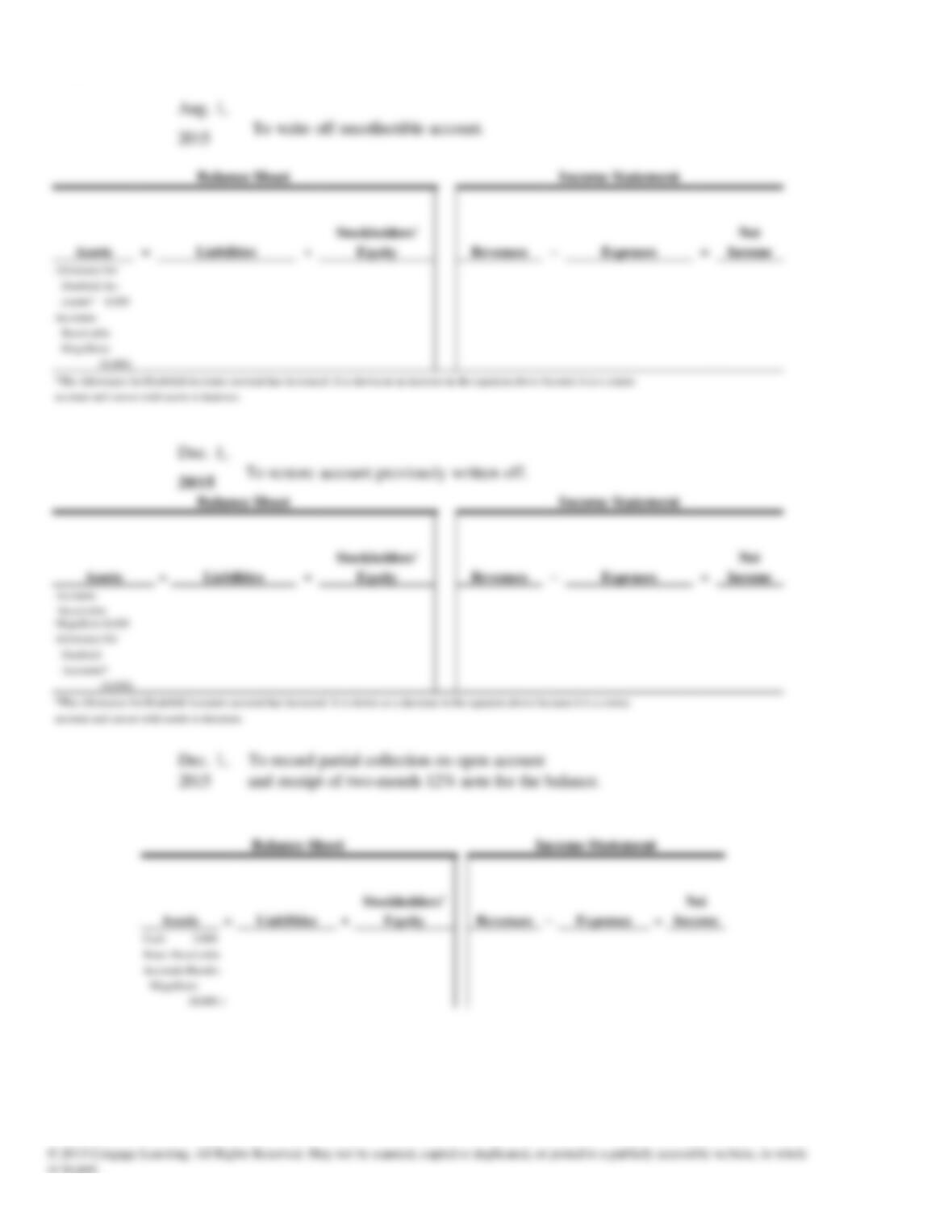
157. Whispering Pines Company reported the following on its balance sheet at December
31, 2014: Accounts receivable, less allowance of $12,400 $318,000
A) How much is the net realizable value of Whispering Pines’ receivables?
B) What is the balance of the accounts receivable account?
C) Are you able to determine whether Whispering Pines uses the allowance method or
the direct write off method for uncollectibles? Why or why not?
158. Star Corp. sold merchandise for $8,000 to MegaStore on May 15, 2015, with payment due in 30 days.
Subsequent to this, MegaStore experienced cash flow problems and was unable to pay its debt. On
August 10, 2015, Star stopped trying to collect the outstanding receivable from MegaStore and wrote off
the account as uncollectible. On December 1, 2015, MegaStore sent Star a check for $2,000 and offered
to sign a two-month, 12%, $6,000 promissory note to satisfy the remaining obligation. MegaStore paid
the entire amount due Star, with interest, on January 31, 2016. Star ends its accounting year on
December 31 each year and uses the allowance method to account for bad debts.
REQUIRED:
1. Identify the effects on the accounting equation for Star’s transactions from May 15, 2015 to January 31,
2016.
2. Why would MegaStore bother to send Star a check for $2,000 on December 1 and agree to sign a
note for the balance, given that such a long period of time had passed since the original purchase?
Chapter 7: Receivables and Investments
Chapter 7: Receivables and Investments
Slammer Sports
The following information is for Slammer Sports at the end of 2014:
Sales
$800,000
Sales returns and allowances
8,000
Accounts Receivable – December 31, 2014
Allowance for Doubtful Accounts – December 31, 2014
[Credit Balance] (Before adjustment for bad debts)
175,000
1,000
(per aging schedule at December 31, 2014)
7,500
Estimated Uncollectible Accounts
Chapter 7: Receivables and Investments
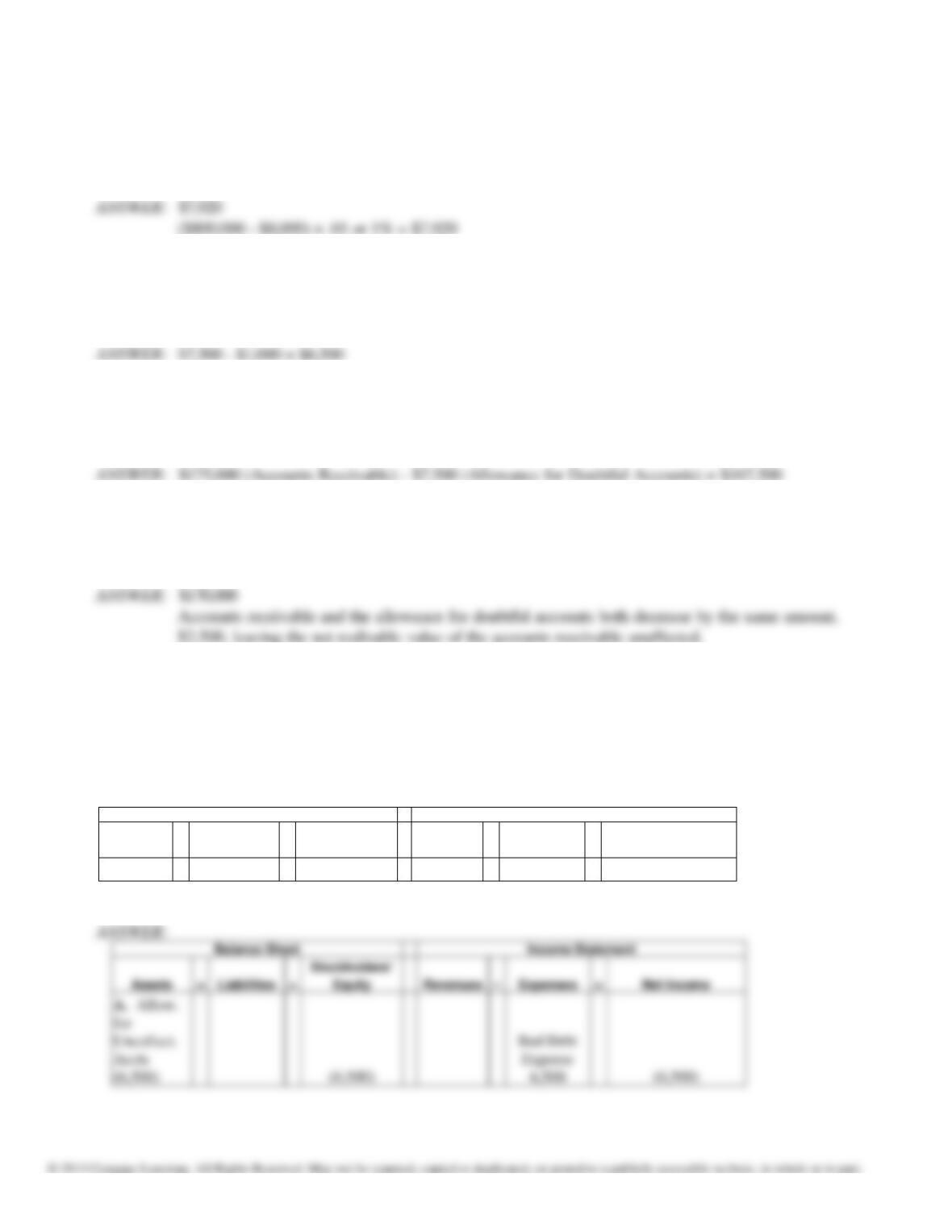
159. Refer to the data for Slammer Sports.
If bad debts are estimated at 1% of net sales, how much will Slammer Sports report as bad debts expense for
2014?
160. Refer to the data for Slammer Sports.
If the aging approach is used to estimate bad debts, how much bad debts expense will Slammer Sports report for
2014?
161. Refer to the data for Slammer Sports.
If the aging approach is used to estimate bad debts, how much is the net realizable value of the accounts receivable
at December 31, 2014?
162. Refer to the data for Slammer Sports.
Assume that the net realizable value is $170,000 after the adjustment for bad debts in 2014. How much is the net
realizable value of accounts receivable after a customer‘s account of $2,500 is written off? Explain why.
163. Refer to the data for Slammer Sports.
Determine the effect on Slammer Sports’ accounting equation of the year-end adjustment of bad debts using the
aging approach.
Balance Sheet
Income Statement
Assets
=
Liabilities
+
Stockholders’
Equity
Revenues
–
Expenses
=
Net Income
Chapter 7: Receivables and Investments
Beatrice Equipment
Beatrice Equipment sells merchandise only on credit. For the year ended December 31, 2014, the following data is
available:
Sales
$2,400,000
Sales returns and allowances
60,000
Accounts Receivable – January 1, 2014
270,000
Allowance for doubtful accounts – January 1, 2014
25,600
Collections during 2014
2,426,300
Accounts written off as uncollectible during 2014
23,700
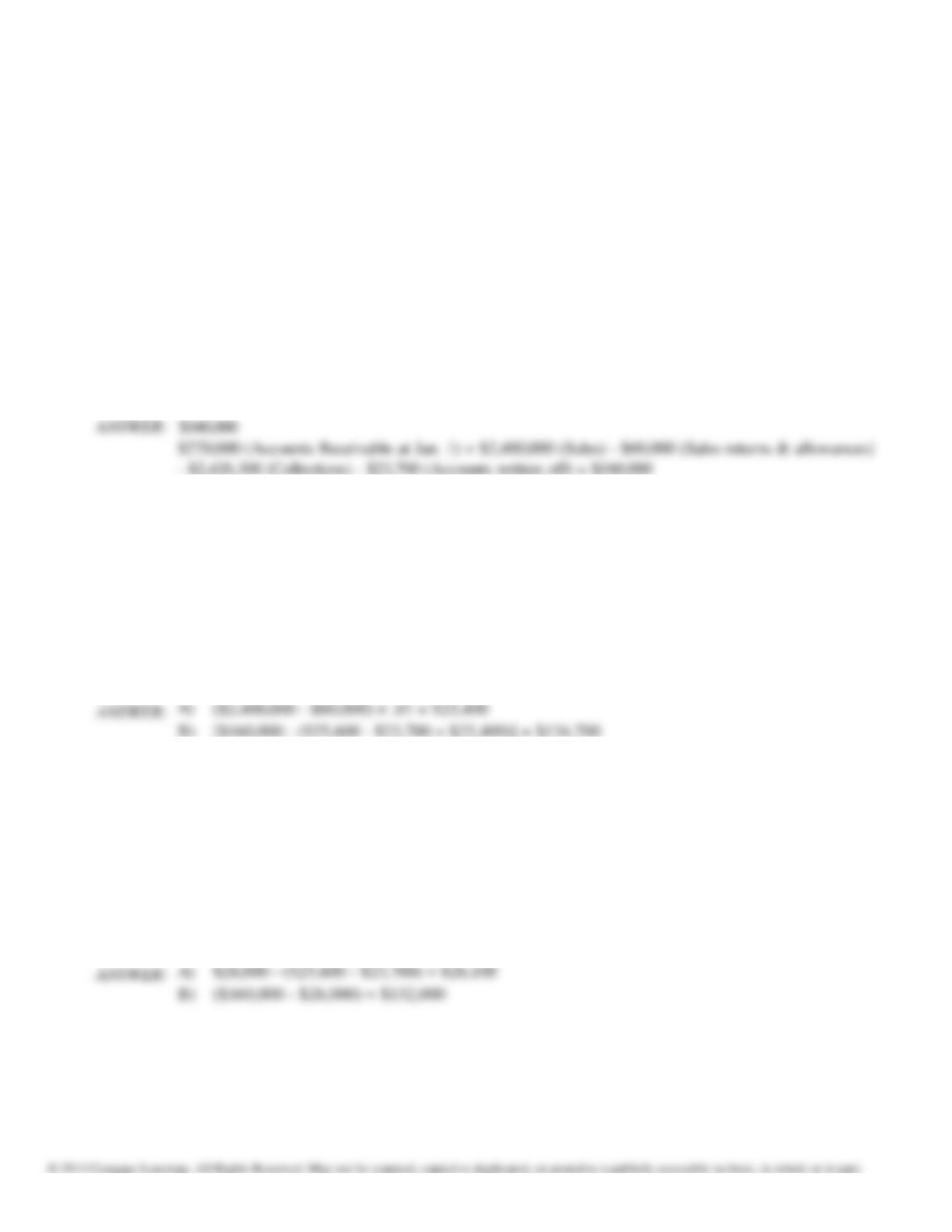
164. Refer to the data for Beatrice Equipment.
Determine the balance of Accounts Receivable at December 31, 2014.
165. Refer to the data for Beatrice Equipment.
Assume that Beatrice Equipment estimates bad debts at 1% of net credit sales.
A) What amount will Beatrice Equipment record as bad debts expense for 2014?
B) How much is the net realizable value of accounts receivable reported on Beatrice
Equipment’s balance sheet at December 31, 2014?
166. Refer to Beatrice Equipment.
Assume that Beatrice Equipment estimates bad debts on an aging analysis, and the aging schedule indicates that
$28,000 of the December 31, 2014 accounts receivable will be uncollectible.
A) What amount will Beatrice Equipment recognize as bad debts expense for 2014?
B) How much is the net realizable value of the receivables to be reported on Beatrice
Equipment’s balance sheet at December 31, 2014?
Chapter 7: Receivables and Investments
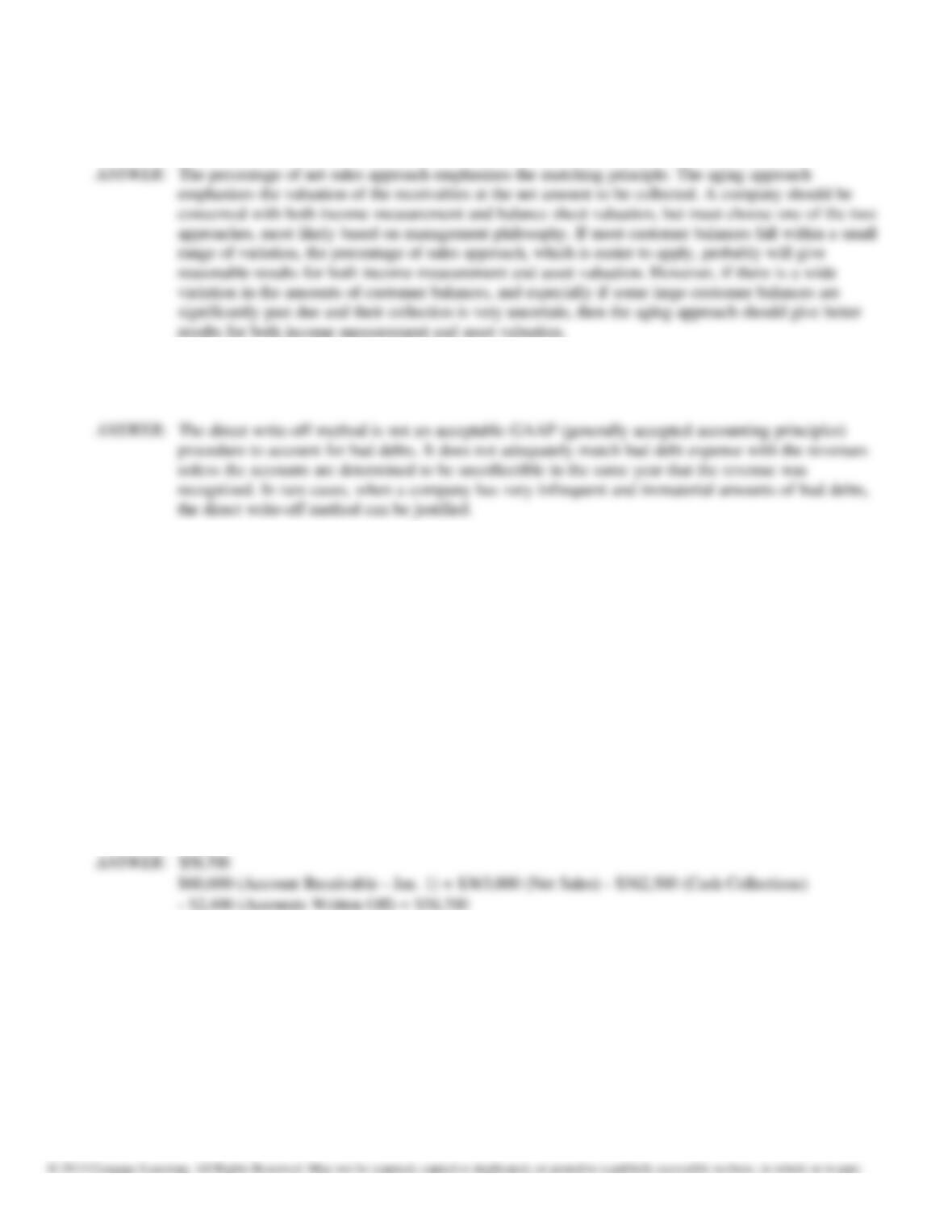
167. If a company has a choice of acceptable methods to estimate bad debts, what factors should be considered in the
selection?
168. Can a company use the direct write-off method rather than the allowance method to account for bad debts
expense? Explain why or why not.
Sliders Company
Sliders Company sells its merchandise only on credit. The following data is available at December 31, 2014:
Sales
$375,000
Sales returns and allowances
12,000
Accounts receivable at January 1, 2014
60,600
Allowance for doubtful accounts at January 1, 2014
3,200
Cash collections during 2014
362,500
Accounts written off as uncollectible during 2014
2,400
169. Refer to data for Sliders Company.
Determine the balance of Accounts Receivable at December 31, 2014.