1
Chapter 7
Multiple Choice
1. On a balance sheet, what is the preferable presentation of notes or accounts receivable from
officers, employees, or affiliated companies?
2. The basis for classifying assets as current or noncurrent is the period of time normally elapsed
from the time the accounting entity expends cash to the time it converts
3. The valuation basis used in conventional financial statements is
4. A transaction that would appear as an application of funds on a conventional funds statement
using the all-financial-resources concept, but not on a statement using the traditional working
capital concept would be the
5. There would probably be a major difference between a statement of source and application of
working capital and a cash flow statement in the treatment of
2
6. A basic objective of the statement of cash flows is to
7. A statement of cash flows should be issued by a profit-oriented business
8. When preparing a statement of changes in financial position using the cash basis for defining
funds, an increase in ending inventory over beginning inventory will result in an adjustment to
reported net earnings because
9. Which of the following should theoretically be presented in a statement of changes in financial
position only because of the all-financial-resources concept?
10. When preparing a funds statement using the all financial resources concept, the retirement of
long-term debt by the issuance of common stock should be presented in a statement of changes in
financial position as a
11. The working capital format is one possible format for presenting a statement of changes in
financial position. Which of the following formats is (are) also theoretically acceptable?
Cash Quick Assets
12. A gain on the sale of plant assets in the ordinary course of business should be presented in a
statement of cash flows as a (an)
13. Which of the following should be presented in a statement of cash flows?
Conversion of Conversion of
Long-term debt preferred stock
14. The balance sheet discloses
15. Which of the following is not a balance sheet element?
16. Which of the following is not a component of equity?
17. Which of the following is not an important aspects of SFAS No. 157(FASB ASC 820)?
18. The definition of fair value in SFAS No 157(FASB ASC 820) is
19. The SFAS No 157 (FASB ASC 820) fair value hierarchy contains
20. Which of the following s the lowest level of the SFAS 157 (FASB ASC 820) fair value
hierarchy?
21. The calculation net income/sales is the formula for which of the following ratios
22. The calculation sales/average total assets is the formula for which of the following ratios
23. The calculation net income/average total assets is the formula for which of the following ratios
24. The firm’s ability to use its financial resources to adapt to change is the definition of
25. A firm’s ability to obtain cash for business operations change is the definition of
26. The firm’s ability to convert an asset to cash or to pay a current liability change is the definition
of
27. Net cash provided (used) by operating activities − net cash used in acquiring property, plant is
the calculation for
28. Which of the following is a difference between IAS No. 7 and SFAS No. 95 (FASB ASC 230)?
29. Investments in equity securities are disclosed as current assets on a company’s balance sheet if
30. What is reported on the statement of cash flows?
Essay
1. Discuss the following balance sheet elements as defined by SFAC No. 6:
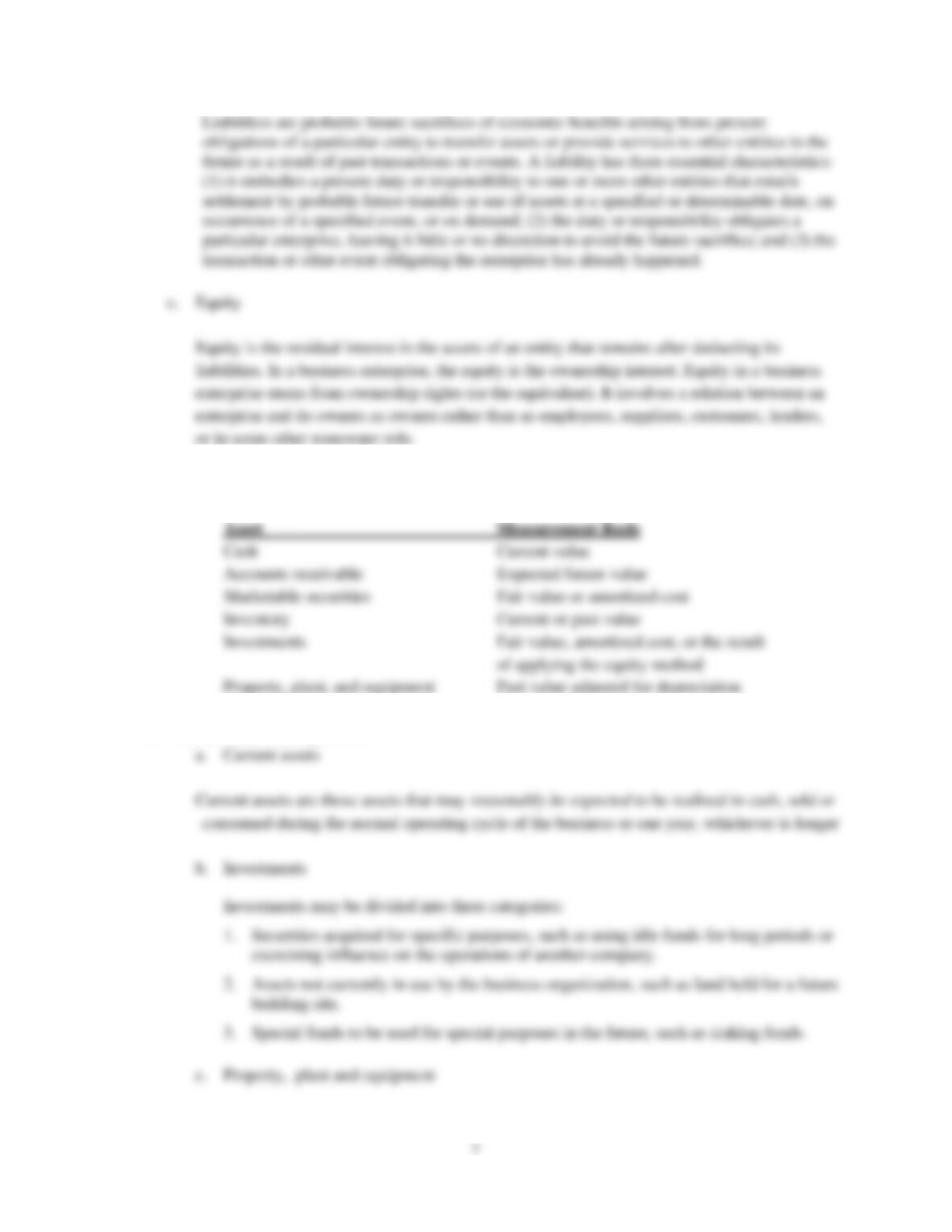
2. List three valuation techniques currently used on the balance sheet and discuss how each are used
(What accounts?).
3. Define the following terms:
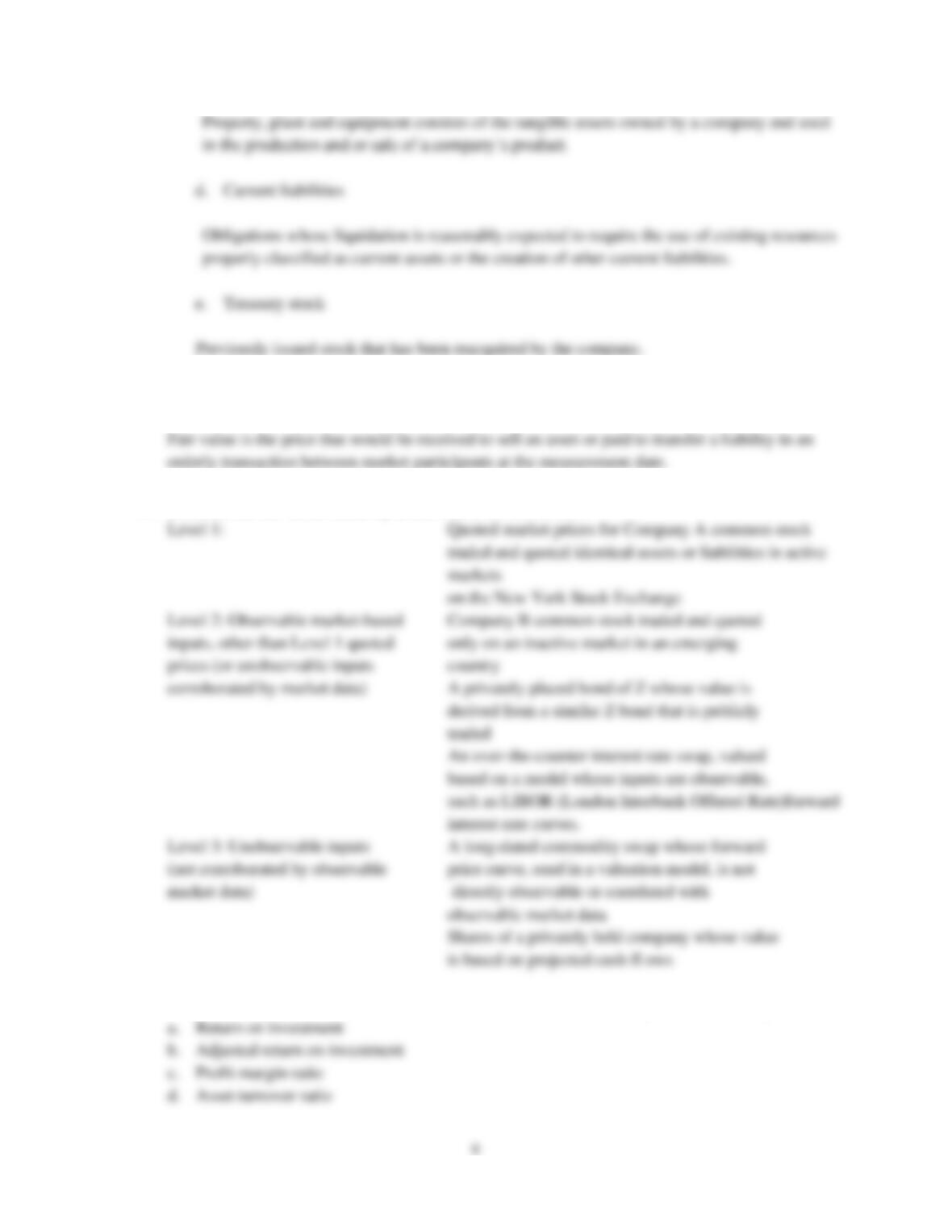
4. How is fair value defined in SFAS No. 157 (FASB ASC 820)?
5. Describe the fair value hierarchy as defined in SFAS No.157.
6. Obtain a company’s financial statements and ask the students to compute the following:
7. What questions does the statement of cash flows enable financial statement users to answer?
9. Discuss the direct vs. indirect methods of preparing the statement of cash flows.
10. Define and discuss the three major sections of the statement of cash flows.