Chapter 7: Electricity
TRUE/FALSE
1. An atom with fewer electrons than protons is a negative ion.
2. All three types of particles found in atoms are electrically charged.
3. An object that has zero resistance is a semiconductor.
4. Current is the rate of flow of electric charge.
5. The SI unit of electric charge is e, the charge on the electron.
6. Electrons are negatively charged.
7. Superconductivity is lost when a certain critical temperature is exceeded.
8. Voltage is a measure of the energy per unit charge supplied by a battery.
9. Voltage can also be called potential.
10. Current is the opposition to the flow of charge.
11. Voltage is the force on a charged object divided by the charge on the object.

12. Larger batteries have higher output voltages.
13. Two charged bodies separated by a distance d exert an electrical force on each other. The
distance d is doubled. The electrical force on each body is now 1/2 of the original force.
14. Two charged bodies separated by a distance d exert a repulsive electrical force on each
other. The signs of the charges on the two bodies are + and –.
15. The resistance of a conducting material depends on its composition, length, diameter, and
temperature.
16. If the length of a wire increases, its resistance decreases.
17. If the diameter of a wire increases, its resistance decreases.
18. The resistance of a wire does not change when its temperature changes.
19. Solids that are good conductors of heat tend also to be good conductors of electricity.
20. Semiconductor technology has been the basis for many new electronic devices.
21. An electrostatic precipitator uses an electric field to remove smoke from the air.
22. If the current drawn from a 12 volt car battery is 100 amperes when it is short circuited with
a wire, the resistance of the wire is 0.12 ohms.
23. A battery operating a large flashlight produces a current of 2 amperes in a light bulb that has
a resistance of 4 ohms. The voltage of the battery is 2 volts.
24. A battery stores electric charge in the same way that a bottle stores water.
25. If an electric toaster operating on 120 volts draws a current of 6 amperes, the resistance of
the toaster is 20 ohms.
26. In a parallel circuit, the size of the current flowing through each device may be different.
27. A light bulb designed for use with AC would still work if hooked up to DC of the proper
voltage.
28. The resistance of the light bulb is 20 ohms.
29. The power consumed by the light bulb is 20 watts.
30. If two slide projectors are connected in parallel across the same 120 volt source, the current
drawn from the source remains at 6 amperes.
31. If two slide projectors are connected in series across the same 120 volt source, the current
drawn from the source remains at 6 amperes.
32. The energy used by a 100 watt light bulb in 1 hour is 360,000 joules
33. The energy used by a 100 watt light bulb in 1 hour is 100 kilowatt-hours.
34. The current drawn by the heater is 10 amperes.
35. The resistance of the heater is 10 ohms.
36. If two heaters are connected in parallel across the 120 volt source, the total power drawn
from the source increases to 2400 watts.
37. If two heaters are connected in parallel across the 120 volt source, the current drawn from
the source is 10 amperes.
38. In a circuit connected to a battery, the current flows from negative pole toward the positive
pole of the battery.
39. In a parallel circuit with three resistors all the same size, the current flow though each leg of
the circuit will be equal.
40. An alternate equation for power in an electric circuit is P = IR.
41. In general, an insulator will have a low resistance to current flow.
MULTIPLE CHOICE
1. A positive ion is formed when

a.
a neutral atom gains an electron
c.
a negative ion loses an electron
b.
a neutral atom loses an electron
d.
all of the above
2. An atom with fewer electrons than protons is a
a.
semiconductor
b.
superconductor
c.
positive ion
d.
negative ion
e.
none of the above
3. An electric current can consist of
a.
positive ions flowing in a liquid
c.
electrons flowing in a wire
b.
negative ions flowing in a liquid
d.
all of the above
4. An object that has zero resistance is a
a.
semiconductor
b.
superconductor
c.
diode
d.
transistor
e.
positive ion
5. The rate of flow of electric charge is
a.
voltage
b.
current
c.
resistance
d.
electric field
e.
critical temperature
6. Suppose current is flowing in a wire from right to left. Which way do the electrons in the
wire move?
a.
right to left
b.
left to right
c.
in circles
d.
It is impossible to tell.
7. The SI unit of electric charge is
a.
e, the charge on the electron
b.
the coulomb
c.
the ampere
d.
the ohm

e.
the volt
8. What is meant by ‘like charges?’
a.
charges that are both positive
b.
equal amounts of charge
c.
charges that are both negative
d.
A and C
9. What is meant by ‘net charge?’
a.
the total amount of positive charge on an object
b.
the total amount of negative charge on an object
c.
the total amount of neutral charge on an object
d.
A minus B
10. Superconductivity is lost when a certain ____is exceeded.
a.
voltage
d.
electric field
b.
current
e.
critical temperature
c.
resistance
11. The energy per unit charge supplied by a battery is its
a.
voltage
b.
current
c.
resistance
d.
electric field
e.
critical temperature
12. A quantity that is measured in ohms is
a.
voltage
b.
current
c.
resistance
d.
electric field
e.
critical temperature
13. A quantity that measures the opposition to the flow of charge is
a.
voltage
b.
current
c.
resistance
d.
electric field
e.
critical temperature

14. Voltage can also be called
a.
potential
b.
pressure
c.
work
d.
energy
e.
none of the above
15. If you think of a battery as an electric charge ‘pump,’ the battery voltage is analogous to
a.
rate of fluid flow
b.
pressure
c.
flow velocity
d.
water
e.
none of the above
16. A car headlight and an interior dome light use the same voltage, but the headlight consumes
much more power because
a.
its resistance is lower
b.
the current in it is larger
c.
it uses energy faster
d.
all of the above
17. Why do we use fuses?
a.
to eliminate shock hazards
b.
to prevent fires
c.
to save on the cost of electricity
d.
to store charge
18. If three identical bulbs are connected in parallel across a 12V battery, the voltage across
each bulb will be
a.
12V
b.
4V
c.
different
d.
none of the above
19. If three identical bulbs are connected in series across a 12V battery, the voltage across each
bulb will be
a.
12V
b.
4V
c.
different
d.
none of the above
20. The force on a charged object divided by the charge on the object is
a.
voltage
b.
current
c.
resistance
d.
electric field
e.
critical temperature
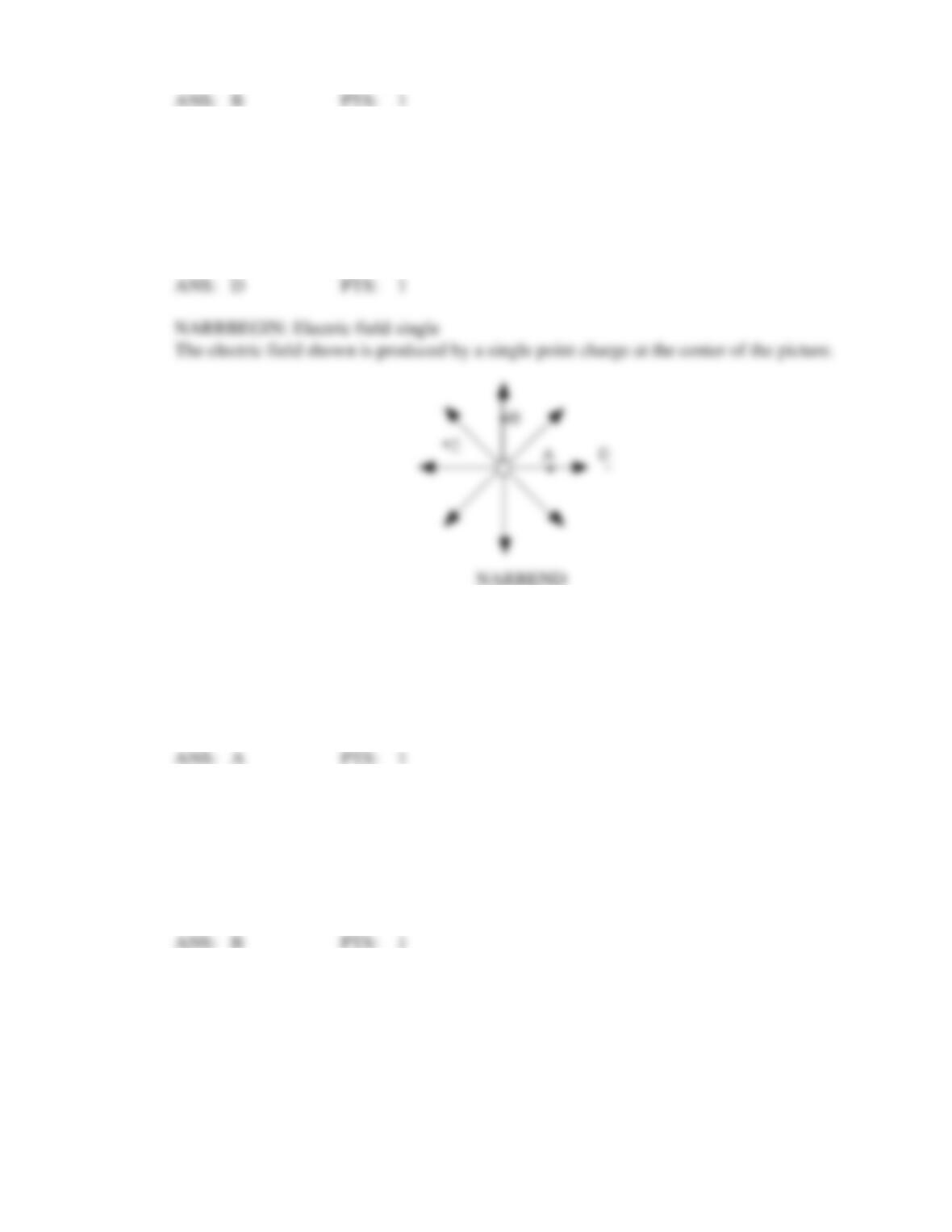
21. What type of charge produces the electric field shown?
a.
positive
b.
negative
c.
neutral
d.
impossible to tell
22. If a new positive point charge is placed at location A directly to the right of the one pictured,
the force on it will
a.
be zero
b.
push it to the right
c.
push it to the left
d.
be in an unknown direction
23. If a new negative point charge is placed at location B directly above the one pictured, the
force on it will
a.
be zero
b.
push it upward
c.
push it downward
d.
be in an unknown direction

24. What force will a negative charge placed at location C feel?
a.
zero
b.
a force up and to the left
c.
a force up and to the right
d.
a force down and to the left
e.
a force down and to the right
25. Suppose both of the new charges from questions 41 and 41 are in their respective positions
simultaneously. The forces on each of them are
a.
still zero
b.
in the same directions as they were when each was alone
c.
both in new directions
d.
the same as before for the positive charge but different for the negative charge
26. Two charged bodies separated by a distance d exert an electrical force on each other. The
charge on one of the bodies is doubled. The electrical forces on each body now
a.
double
b.
decrease by 1/2
c.
stay the same
d.
differ—the force on the other body doubles, but the force on the body whose
charge was changed stays the same as before
e.
increase by a factor of four
27. What is the usual symbol used to represent an amount of charge?
a.
C
c.
e
b.
q
d.
none of the above
28. When we say charges are ‘positive’ or ‘negative’ we are speaking of
a.
two intrinsically different types of charge found in nature
b.
an excess vs. a deficiency of charge
c.
charges existing vs. not existing
d.
none of the above
29. Two charged bodies separated by a distance d exert an electrical force on each other. The
distance d is doubled. The electrical force on each body now
a.
decreases by 1/4
b.
decreases by 1/2
c.
stays the same
d.
increases by 2 times

e.
increases by 4 times
30. Electrons are
a.
positively charged
c.
uncharged
b.
negatively charged
d.
variably charged
31. The resistance of a conducting material depends on its
a.
composition
b.
length
c.
diameter
d.
temperature
e.
all of the above
32. If the length of a wire increases, its resistance
a.
increases
b.
decreases
c.
does not change
d.
will increase or decrease depending on the composition
e.
will change in a way that can not be determined
33. If the diameter of a wire increases, its resistance
a.
increases
b.
decreases
c.
does not change
d.
will increase or decrease depending on the composition
e.
will change in a way that can not be determined
34. If the temperature of a wire increases, its resistance
a.
increases
b.
decreases
c.
does not change
d.
will increase or decrease depending on the composition
e.
will change in a way that can not be determined
35. If I short out a D cell and draw a current of 7 A for 5 s, how many coulombs of charge move
through the circuit?
a.
7 C
c.
7/5 C
b.
5 C
d.
35 C
36. The kilowatt-hour is a unit of
a.
power
c.
voltage
b.
energy
d.
current
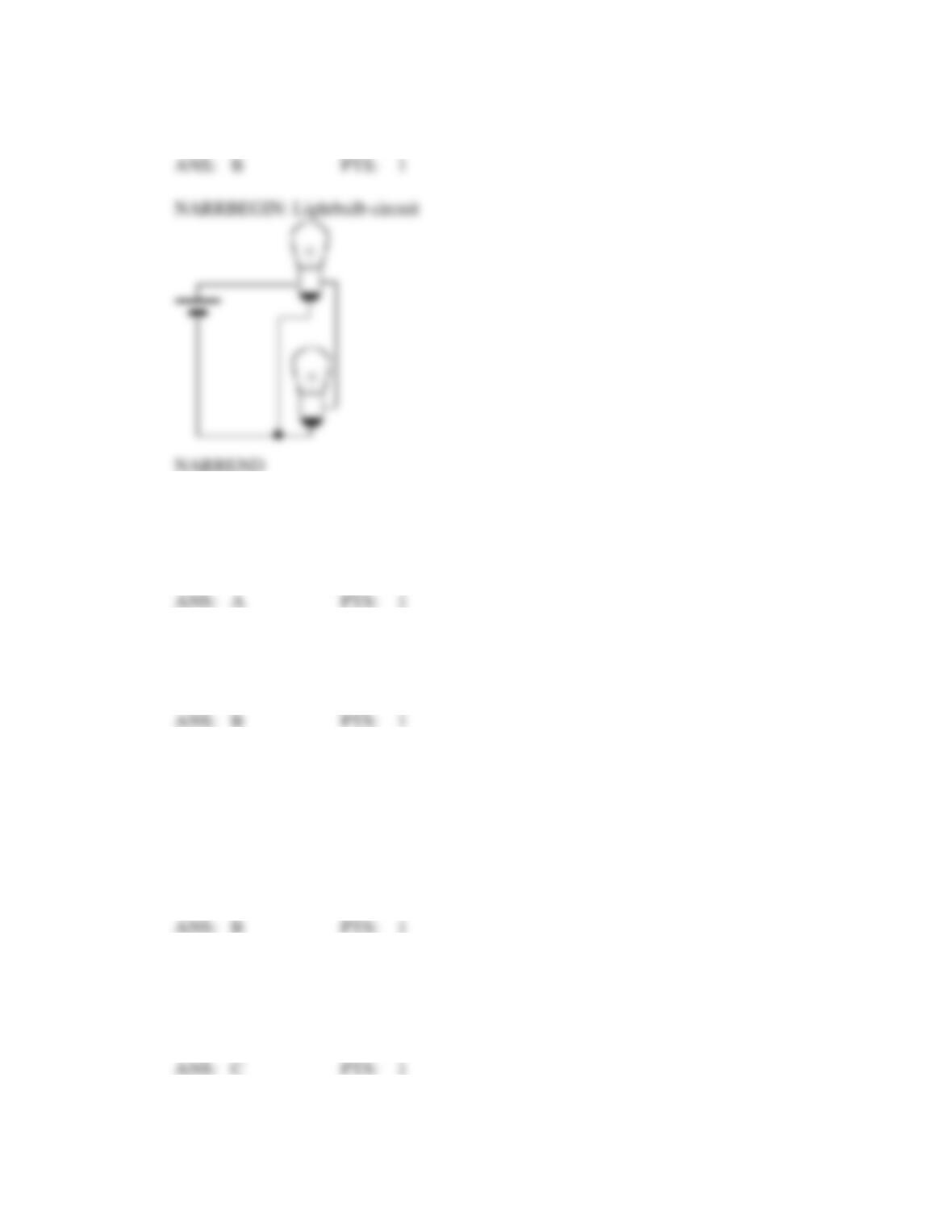
37. The light bulbs in this circuit are connected in
a.
parallel
c.
neither parallel nor series
b.
series
d.
a short circuit
38. The light bulbs in this circuit are connected in
a.
parallel.
c.
neither parallel nor series.
b.
series.
d.
a short circuit
39. When a 12 volt car battery is short circuited with a wire, the current drawn from the battery
is 100 amperes. The resistance of the wire is
a.
zero
b.
0.12 ohms
c.
100/12 = 8.33 ohms
d.
1200 ohms
e.
none of the above
40. A battery operating a large flashlight produces a current of 2 amperes in a light bulb that has
a resistance of 4 ohms. The voltage of the battery is
a.
0.5 volts
c.
8 volts
b.
2 volts
d.
none of the above
41. An electric toaster operating on 120 volts draws a current of 6 amperes. The resistance of
the toaster is
a.
0.05 ohms
c.
720 ohms
b.
20 ohms
d.
none of the above
42. In the U.S. AC line voltage oscillates at a frequency of
a.
50 Hz
c.
120 Hz
b.
60 Hz
d.
none of the above
43. The resistance of the light bulb in ohms is
a.
0.05
c.
720
b.
20
d.
none of the above
44. The power consumed by the light bulb in watts is
a.
0.05
c.
720
b.
20
d.
none of the above
45. If two slide projectors are connected in parallel across the same 120 volt source, the current
drawn from the source in amperes is
a.
3
b.
6
c.
9
d.
12
e.
none of the above
46. If two slide projectors are connected in series across the same 120 volt source, the current
drawn from the source in amperes is
a.
3
b.
6
c.
9
d.
12
e.
none of the above
47. The energy used by a 100 watt light bulb in 1 hour is