Chapter 7: Receivables and Investments
186. Write a short paragraph explaining the following:
1. When bad debts are estimated, why is the balance in Allowance for Doubtful Accounts considered when the
percentage of accounts receivable approach is used but not when the percentage of net credit sales approach is
used?
2. When estimating bad debts on the basis of a percentage of accounts receivable, what is the advantage of using
an aging schedule?
187. What is the purpose of an accounts receivable subsidiary ledger?
188. What is the purpose of an aging schedule?
189. Earl’s Company reported its accounts receivable turnover ratio at 10 times. Its credit terms are 2/10, n/20. What
does this ratio tell you about Earl’s Company?
190. Explain the distinction between a note receivable and an account receivable.
Chapter 7: Receivables and Investments
191. Identify two methods of accelerating cash from sales.
192. Why does the discounting of a note receivable with recourse result in a contingent liability? Should the liability be
reported on the balance sheet? Explain.
193. Corrigan Corp. purchased 1,000 shares of Microsoft common stock. What will determine whether the shares are
classified as current assets or noncurrent assets?
194. Why are increases in accounts receivable reported as an adjustment to net income in the operating activities section
of a statement of cash flows?
195. Evanston Inc. started the year with $35,000 in accounts receivable and ended the year with
$50,000 in the account. Describe how information regarding the company’s accounts
receivable should be reflected on its statement of cash flows, assuming use of the indirect
method.

Chapter 7: Receivables and Investments
For each item listed below, identify how it will be reported on the Statement of Cash Flows under the
indirect method.
a. Operating activity
b. Investing activity
c. Financing activity
d. Not reported separately on the cash flow statement
196. Write-off of a customer’s account receivable under the allowance method
197. Decrease in accounts receivable
198. Increase in short-term notes receivable
Select the term from the list below that matches each of the following six descriptions.
a. Interest
b. Maturity value
c. Principal
d. Payee
e. Discounting
f. Term
g. Recourse
h. Implicit
i. Maker
199. The sale of a note
200. The length of time a note is outstanding — the period of time between the date it is issued and the date it matures
201. The party that receives payment due from a note
202. Transfer a note with a contingent liability

Chapter 7: Receivables and Investments
203. The difference between the principal amount of the note and its maturity value
204. The amount of cash the maker is to pay the payee on the maturity date of the note
205. The most common type of receivables is accounts receivable.
a. True
b. False
206. A contra-asset account used to reduce accounts receivable to its net realizable value is known as a(n)
____________________.
207. Accountants use the to overcome the deficiencies of the direct write-off method for
bad debts.
208. The direct write-off method estimates the amount of bad debts before they occur.
a. True
b. False
209. Which one of the following is not an accurate statement regarding the direct write-off method of accounting for
bad debts?
a. The direct write-off method has some deficiencies when accounting for bad debts.
b. The direct write–off method ignores the possibility that partial collection of a company’s outstanding accounts
receivable may occur.
c. Under the direct write-off method, an expense is increased.
d. The allowance method for bad debts violates the matching principle, but the direct write-off method does not.

Chapter 7: Receivables and Investments
Match the following definitions with their appropriate terms in the next eight questions.
a. A receivable arising from the sale of goods or services with a verbal promise to pay.
b. A form used to categorize the various individual accounts receivable according to the length of time
each has been outstanding.
c. A method of estimating bad debts on the basis of either the net credit sales of the period or the
accounts receivable at the end of the period.
d. A measure of the number of times receivables are collected in a period.
e. The general ledger account that is supported by a subsidiary ledger.
f. A contra-asset account used to reduce accounts receivable to its net realizable value.
g. The detail for a number of individual items that collectively make up a single general ledger account.
h. The recognition of bad debts expense at the point an account is written off as uncollectible.
210. Account receivable
211. Subsidiary ledger
212. Control account
213. Direct write-off method
214. Allowance method
215. Allowance for doubtful accounts
216. Aging schedule
217. Accounts Receivable turnover

Chapter 7: Receivables and Investments
Match the following definitions with their appropriate terms in the next 14 questions.
a. A liability resulting from the signing of a promissory note.
b. A measure of how long it takes to collect receivables.
c. A written promise to repay a definite sum of money on demand or at a fixed or determinable date in the future.
d. The length of time a note is outstanding, that is, the period of time between the date it is issued and the date
it matures.
e. The party that will receive the money from a promissory note at some future date.
f. The process of selling a promissory note.
g. The date the promissory note is due.
h. The amount of cash the maker is to pay the payee on the maturity date of the note.
i. The difference between the principal amount of the note and its maturity value.
j. An asset resulting from the acceptance of a promissory note from another company.
k. Securities issued by corporations and governmental bodies as a form of borrowing.
l. Securities issued by corporations as a form of ownership in the business.
m. The party that agrees to repay the money for a promissory note at some future date.
n. The amount of cash received, or the fair value of the products or services received, by the maker when a
promissory note is issued.
218. Promissory note
219. Maker
220. Payee
221. Note receivable
222. Note payable
223. Principal
224. Maturity date

Chapter 7: Receivables and Investments
225. Term
226. Maturity value
227. Interest
228. Discounting
229. Number of days’ sales in receivables
230. Equity securities
231. Debt securities
232. Cash flows from purchases, sales, and maturities of investments are usually classified as operating activities.
a. True
b. False
Chapter 7: Receivables and Investments
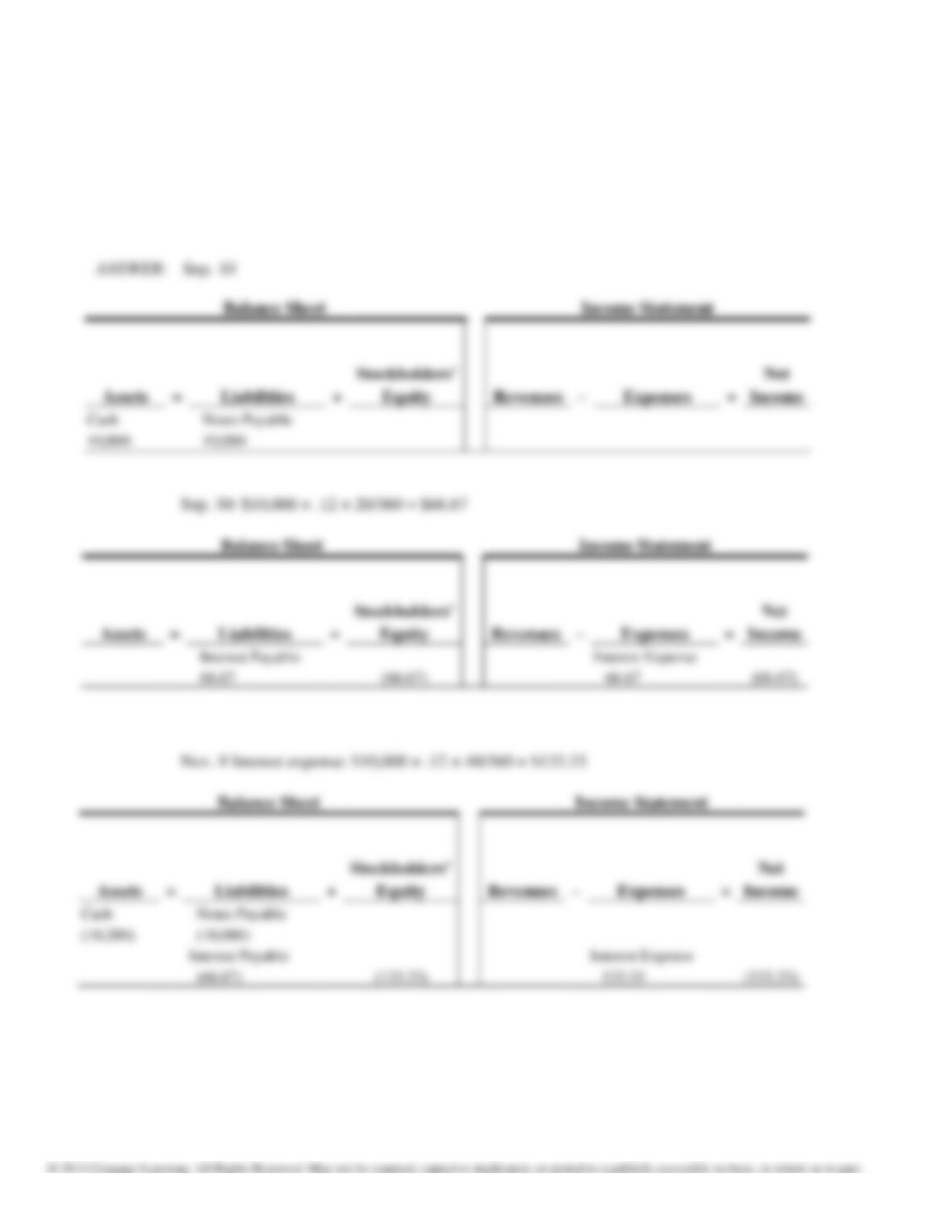
233. Identify the effects on the accounting equation for the following transactions involving notes payable for Marcus Co
year ends September 30. Round all numbers to the nearest penny.
Sept. 10 Received cash for a 60-day, 12 percent, $10,000 note payable. Interest is in addition to the face value.
30 Made end-of–year adjusting entry to accrue interest expense for the note.
Nov. 9 Paid amount due on the note plus interest.
Chapter 7: Receivables and Investments
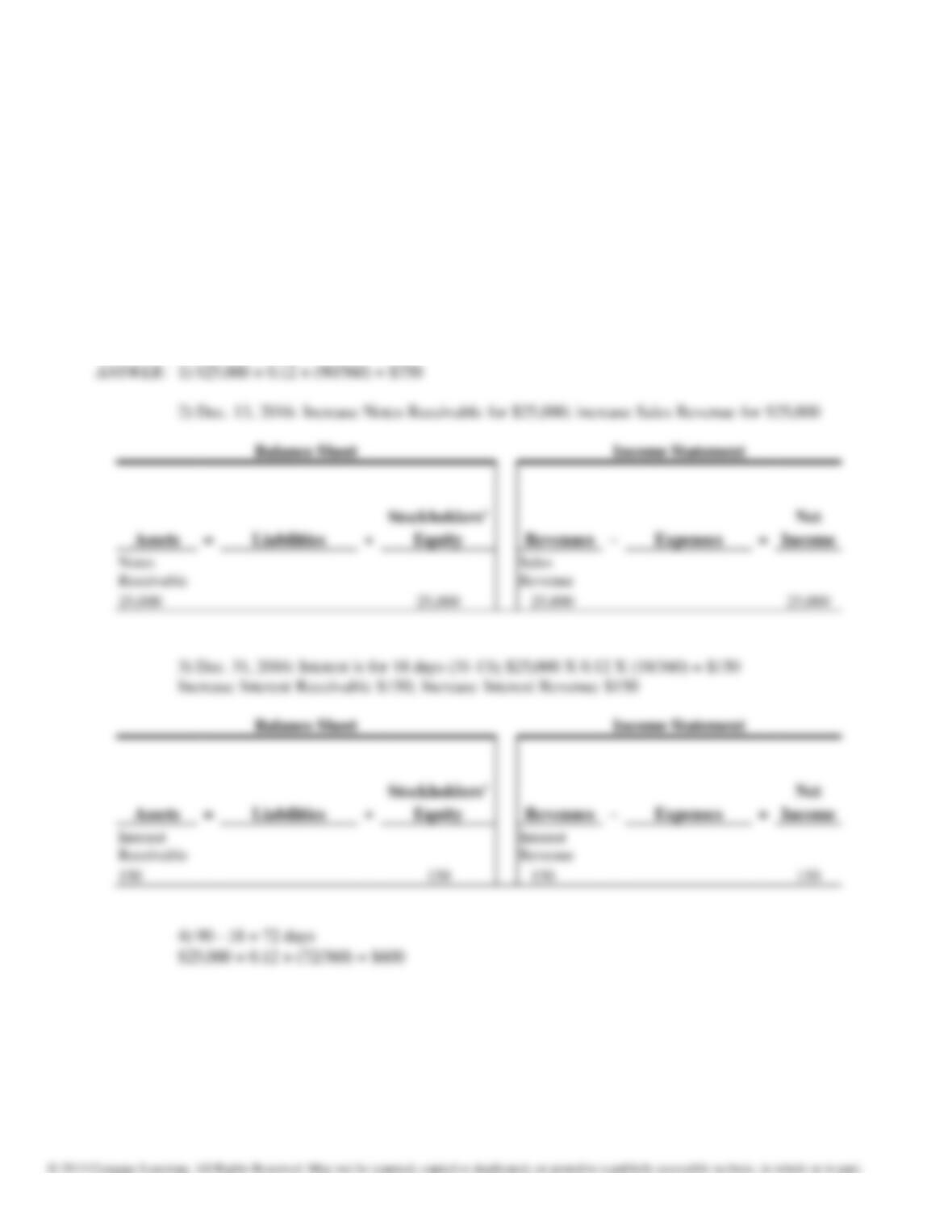
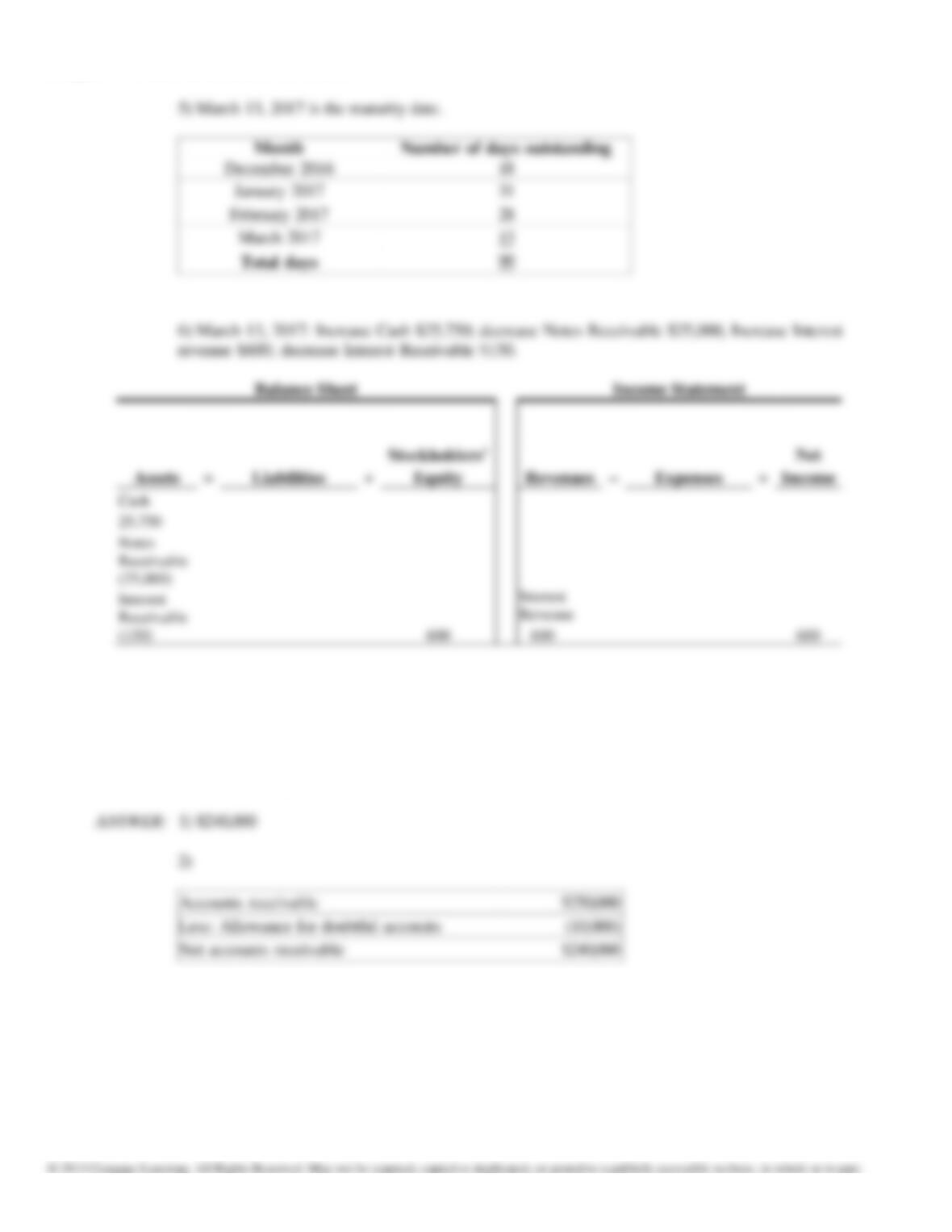
234. Assume that on December 13, 2016, Royal Company sells a computer to Savco Corp. at an invoice price of $25,000.
Because Savco is short of cash, it gives Royal a 90-day, 12% promissory note. [Assume a 360 day year for interest
calculations.]
Required:
1) What is the total amount of interest that will be due on the maturity date?
2) What are the effects on the accounting equation for Royal’s transaction to record receipt of the note?
3) If Royal has a December 31 year-end, what is the effect of the adjustment needed to record interest due but not
yet received?
4) How much interest will Royal earn in 2017?
5) On what day will the note mature?
6) What are the effects on the accounting equation for Royal’s transaction recorded on the maturity date?
Chapter 7: Receivables and Investments
235. Assume that Momentum Inc. has total accounts receivable of $250,000 and an associated allowance for doubtful
accounts of $10,000 at the end of 2015.
1) What is the net realizable value of receivables for Momentum?
2) How should Momentum present this information on its balance sheet?