Cost Accounting: A Managerial Emphasis, 6e
Chapter 7 – Flexible Budgets, Variances, and Management Control: I
Chapter 7 Flexible Budgets, Variances, and Management Control: I
7.1 Distinguish between a static budget and a flexible budget.
1) A variance is the difference between the actual result and a budgeted amount.
2) Variances and flexible budgets help managers gain insights into why actual results differ from planned
performance.
3) A static budget is a budget that can be changed or altered after it is developed.
4) A flexible budget is a budget that is developed using budgeted revenue or cost amounts and is not
adjusted at the end of the budgeted period.
5) A variance is the difference between the actual cost for the current and previous year.
6) The only difference between the static budget and flexible budget is that the static budget is prepared
using planned output.
Cost Accounting: A Managerial Emphasis, 6e
Chapter 7 – Flexible Budgets, Variances, and Management Control: I
7) A variance is considered to be
A) the gap between an actual result and a benchmark amount.
B) the required number of inputs for one standard output.
C) the difference between an actual result and a budget amount.
D) the difference between a budgeted amount and a standard amount.
E) a standard.
8) The type of budget that is based on one level of output, without adjustment for any operational or
financial changes is called
A) a balanced budget.
B) a cost budget.
C) a flexible budget.
D) a static budget.
E) a standard budget.
9) A budget that is adjusted in accordance with changes in actual output is called
A) a balanced budget.
B) a cost budget.
C) a flexible budget.
D) a trial balance budget.
E) a static budget.
10) Some financial variances show increases in operating income relative to a budgeted or allocated
amount, and others show decreases in operating income. Respectively, these variances are
A) budgeted, standard.
B) favourable, unfavourable.
C) standard, budgeted.
D) unfavourable, favourable.
E) fixed, variable.
Cost Accounting: A Managerial Emphasis, 6e
Chapter 7 – Flexible Budgets, Variances, and Management Control: I
11) General Insurance Company had a static budgeted operating income of $4.6 million; however, actual
income was $3.0 million. What is the static budget variance of operating income?
A) $1,000,000 favourable
B) $1,000,000 unfavourable
C) $1,600,000 favourable
D) $3,000,000 favourable
E) $1,600,000 unfavourable
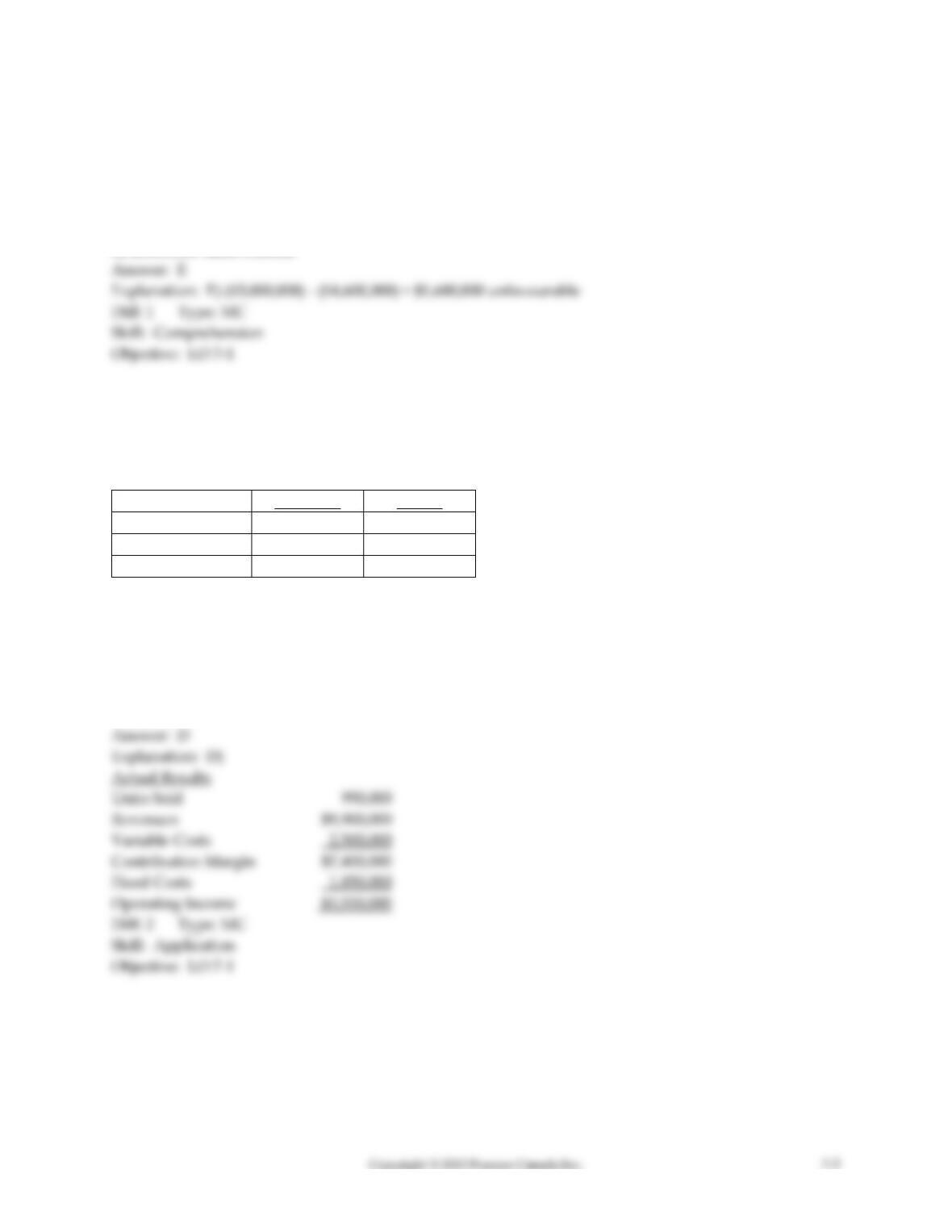
Use the information below to answer the following question(s).
Ames Golf Company used the following data to evaluate their current operating system. The company
sells 1 pack of golf balls for $10 per pack. The $10 selling price is also the budgeted selling price.
Budgeted
Actual
Units Sold
1,000,000
990,000
Variable Costs
$3,000,000
$2,500,000
Fixed Costs
$1,800,000
$1,850,000
12) What is the actual operating income for Ames Golf Company using the actual results?
A) <$3,360,000>
B) $4,750,000
C) $5,200,000
D) $5,550,000
E) $5,970,000
Cost Accounting: A Managerial Emphasis, 6e
Chapter 7 – Flexible Budgets, Variances, and Management Control: I
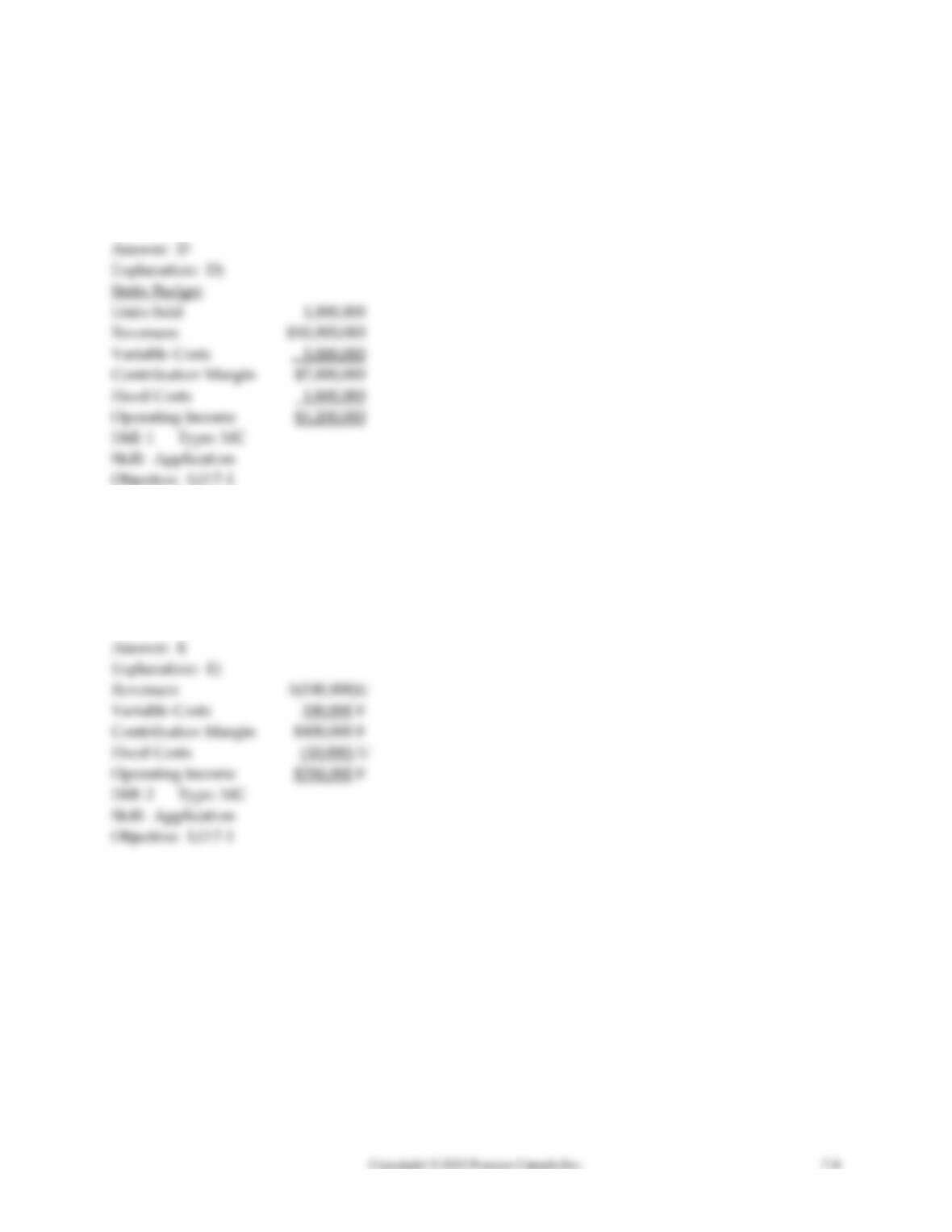
13) What is the budgeted operating income for Ames Golf Company?
A) $7,000,000
B) $5,970,000
C) $5,550,000
D) $5,200,000
E) $4,750,000
14) What is the total static budget variance for Ames Golf Company?
A) $650,000 favourable
B) $450,000 unfavourable
C) $400,000 favourable
D) $390,000 unfavourable
E) $350,000 favourable
Cost Accounting: A Managerial Emphasis, 6e
Chapter 7 – Flexible Budgets, Variances, and Management Control: I
15) A company uses a static budget approach and the previous management accountant calculated the
following information: Fixed costs variance $10,000 U; revenues variance $400,000 F; contribution margin
variance $60,000 F
Required: What is the total static-budget variance?
A) $50,000 F
B) $50,000 U
C) $230,000 F
D) $230,000 U
E) $390,000 F
Answer the following question(s) using the information below.
Abernathy Corporation used the following data to evaluate their current operating system. The company
sells items for $10 each and used a budgeted selling price of $10 per unit.
Actual
Budgeted
Units sold
92,000 units
90,000 units
Variable costs
$450,800
$432,000
Fixed costs
$95,000
$100,000
16) What is the static-budget variance of revenues?
A) $20,000 favourable
B) $20,000 unfavourable
C) $2,000 favourable
D) $2,000 unfavourable
E) $25,000 unfavourable
Cost Accounting: A Managerial Emphasis, 6e
Chapter 7 – Flexible Budgets, Variances, and Management Control: I
17) What is the static-budget variance of variable costs?
A) $1,200 favourable
B) $18,800 favourable
C) $20,000 favourable
D) $1,200 unfavourable
E) $18,800 unfavourable
18) What is the static-budget variance of operating income?
A) $3,800 favourable
B) $1,200 unfavourable
C) $6,200 favourable
D) $6,200 unfavourable
E) $1,200 favourable
Cost Accounting: A Managerial Emphasis, 6e
Chapter 7 – Flexible Budgets, Variances, and Management Control: I
Use the information below to answer the following question(s).
Bates Corporation used the following data to evaluate their current operating system. The company sells
items for $10 each and used a budgeted selling price of $10 per unit.
Actual
Budgeted
Units sold
495,000 units
500,000 units
Variable costs
$1,250,000
$1,500,000
Fixed costs
$925,000
$900,000
19) What is the static-budget variance of revenues?
A) $50,000 favourable
B) $50,000 unfavourable
C) $5,000 favourable
D) $5,000 unfavourable
E) $25,000 unfavourable
20) What is the static-budget variance of variable costs?
A) $200,000 favourable
B) $50,000 unfavourable
C) $50,000 favourable
D) $250,000 unfavourable
E) $250,000 favourable
Cost Accounting: A Managerial Emphasis, 6e
Chapter 7 – Flexible Budgets, Variances, and Management Control: I
21) What is the static-budget variance of operating income?
A) $175,000 favourable
B) $195,000 unfavourable
C) $225,000 favourable
D) $200,000 unfavourable
E) $200,000 favourable
7.2 Develop flexible budgets, and calculate flexible-budget Level 2 and Level 3
variances for direct manufacturing costs.
1) Variances can be expected to vary within some normal limits, as standards represent a range of
possible acceptable outcomes.
2) The static-budget variance can be subdivided into the flexible-budget variance and the sales-volume
variance.
3) A flexible budget enables managers to compute a richer set of variances than a static budget does.
Cost Accounting: A Managerial Emphasis, 6e
Chapter 7 – Flexible Budgets, Variances, and Management Control: I
4) Determining the actual quantity of the revenue driver is one step in the development of a flexible
budget.
5) The sales-volume variance is the difference between the flexible-budget amount and the static-budget
amount; unit selling prices, unit variable costs, and fixed costs are held constant.
6) The flexible-budget variance is the difference between the actual results and the flexible–budget
amount for the actual levels of the revenue and cost drivers.
7) The flexible-budget variance pertaining to revenues is also called the variance of operating income.
8) An input-price variance is the difference between actual quantity of input used and the budgeted
quantity of input that should have been used, multiplied by the budgeted price.
9) The sales-volume variance of operating income is a measure of efficiency.
10) Price variances are considered to be the difference between the actual price and the budgeted price
multiplied by the actual quantity of input goods or services.
Cost Accounting: A Managerial Emphasis, 6e
Chapter 7 – Flexible Budgets, Variances, and Management Control: I
11) Rate variances are the difference between actual inputs used and budgeted inputs that should have
been used, multiplied by the budgeted price.
12) The terms, usage variances and efficiency variances mean the same thing.
13) If a company has a favourable efficiency variance, it uses less inputs than were budgeted for the
output units achieved.
14) A flexible-budget variance can be decomposed into an efficiency variance and a price variance.
15) The flexible-budget variance may be the result of inaccurate forecasting of units sold.
16) Decreasing demand for a product may create a favourable sales–volume variance.
17) The term efficiency variance is the direct cost portion of the flexible-budget variance.
Cost Accounting: A Managerial Emphasis, 6e
Chapter 7 – Flexible Budgets, Variances, and Management Control: I
18) The flexible budget contains
A) budgeted amounts for alternative levels of output.
B) actual amounts for budgeted output.
C) revenue based on budgeted quantity and actual unit price.
D) actual costs for planned output.
E) the difference between flexible and static budget fixed costs.
19) A packaging company produces a variety of cardboard boxes in an automated process. Expected
production per month is 160,000 units. The required direct materials costs $0.30 per unit. Variable
manufacturing overhead costs are $24,000 per month and are allocated based on units of production.
Direct labour is budgeted to be $6,400. The company only produces based on customer orders, so all
production is considered sold as it is produced. Revenue for the month will be $240,000.
What is the budgeted contribution margin per unit?
A) $1.50 per unit
B) $1.31 per unit
C) $1.16 per unit
D) $1.05 per unit
E) $1.01 per unit
Cost Accounting: A Managerial Emphasis, 6e
Chapter 7 – Flexible Budgets, Variances, and Management Control: I
20) A packaging company produces cardboard boxes in an automated process. The required direct
materials costs $0.30 per unit. Fixed manufacturing overhead costs are budgeted at $24,000 per month
and are allocated based on units of production. The budgeted contribution margin per unit is $0.85, and
administration fixed costs are budgeted at $7,500 per month.
What is the flexible-budget amount for operating income for 40,000 and 20,000 units, respectively?
A) $26,000; $20,000
B) $36,000; $30,000
C) $40,000; $34,000
D) $44,000; $38,000
E) $2,500; <$14,500>
21) The flexible-budget variance measures
A) what the costs and revenues should have been for the budgeted number of outputs.
B) the difference between budgeted expenditures and actual expenditures for the budgeted number of
outputs.
C) the difference between budgeted and actual variable costs.
D) [expected expenditures for the actual number of outputs] + [ the actual expenditures for the actual
number of outputs].
E) [actual cost for the actual level of the revenue or cost driver] – [budget unit amount × the actual level of
the revenue or cost driver].
Cost Accounting: A Managerial Emphasis, 6e
Chapter 7 – Flexible Budgets, Variances, and Management Control: I
Use the information below to answer the following question(s).
The following data for a pottery company pertain to the production of 2,000 clay pots during July.
Direct Materials (all materials purchased were used):
Standard cost: $6.00 per kilogram of clay
Total actual cost: $11,200
Standard cost allowed for units produced was $12,000
Materials efficiency variance was $240 unfavourable
Direct Manufacturing Labour:
Standard cost is 2 pots per hour at $24.00 per hour
Actual cost per hour was $24.50
Actual labour was 972 hours
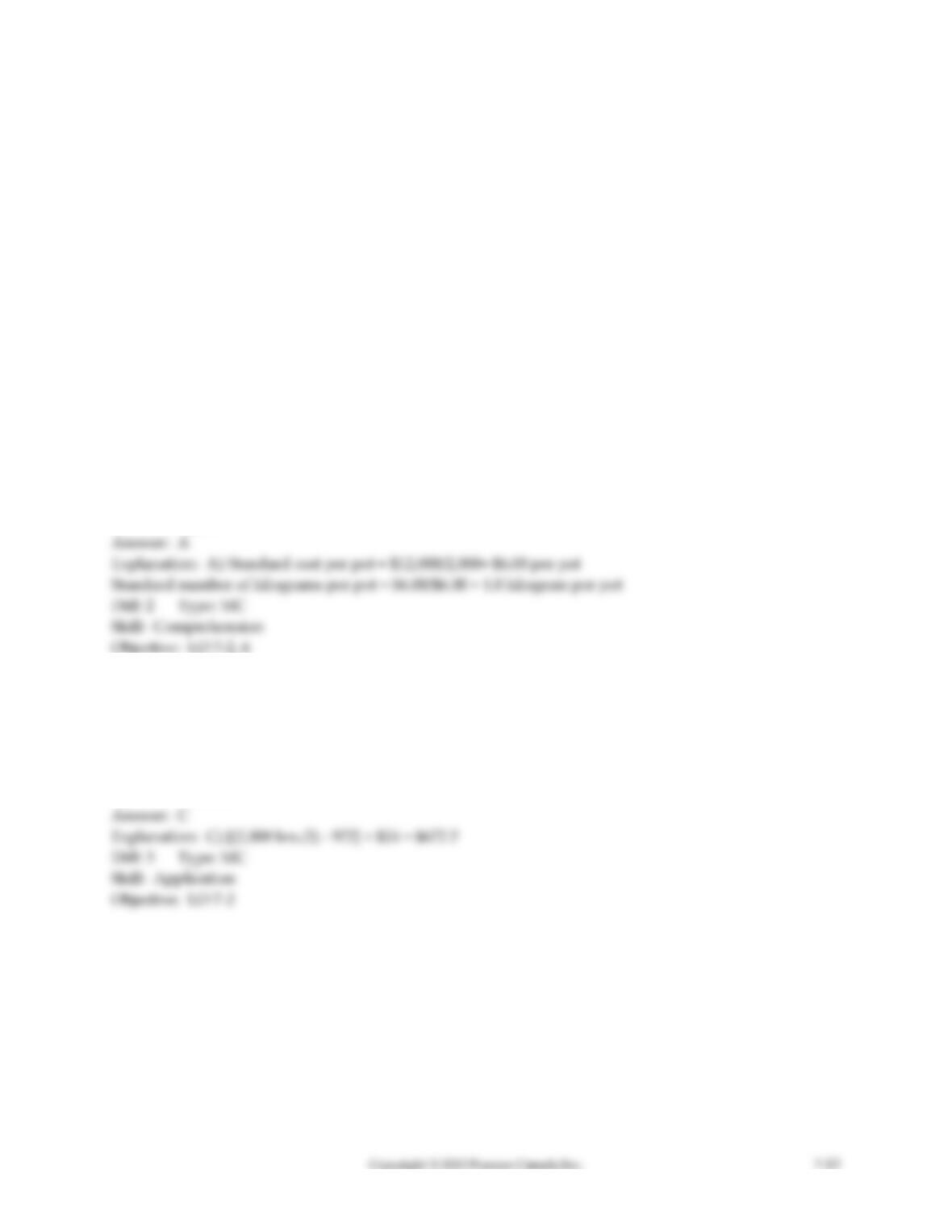
22) What is the standard direct material amount per pot?
A) 1.00 kilogram
B) 1.88 kilograms
C) 2.12 kilograms
D) 3.00 kilograms
E) 4.00 kilograms
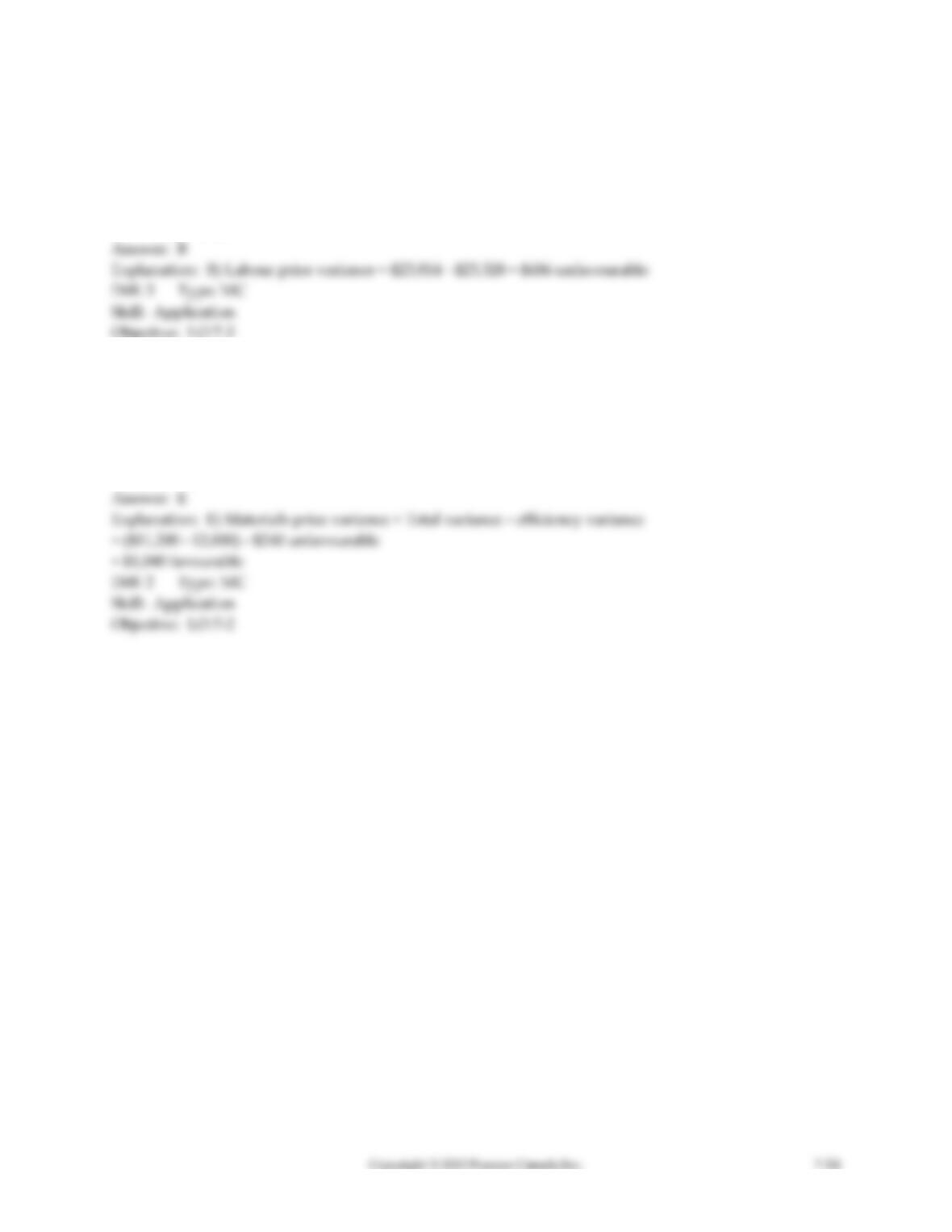
23) What is the direct manufacturing labour efficiency variance?
A) $672 unfavourable
B) $500 favourable
C) $672 favourable
D) $500 unfavourable
E) $28 favourable
Cost Accounting: A Managerial Emphasis, 6e
Chapter 7 – Flexible Budgets, Variances, and Management Control: I
24) What is the direct manufacturing labour price variance?
A) $186 favourable
B) $486 unfavourable
C) $486 favourable
D) $672 unfavourable
E) $672 favourable
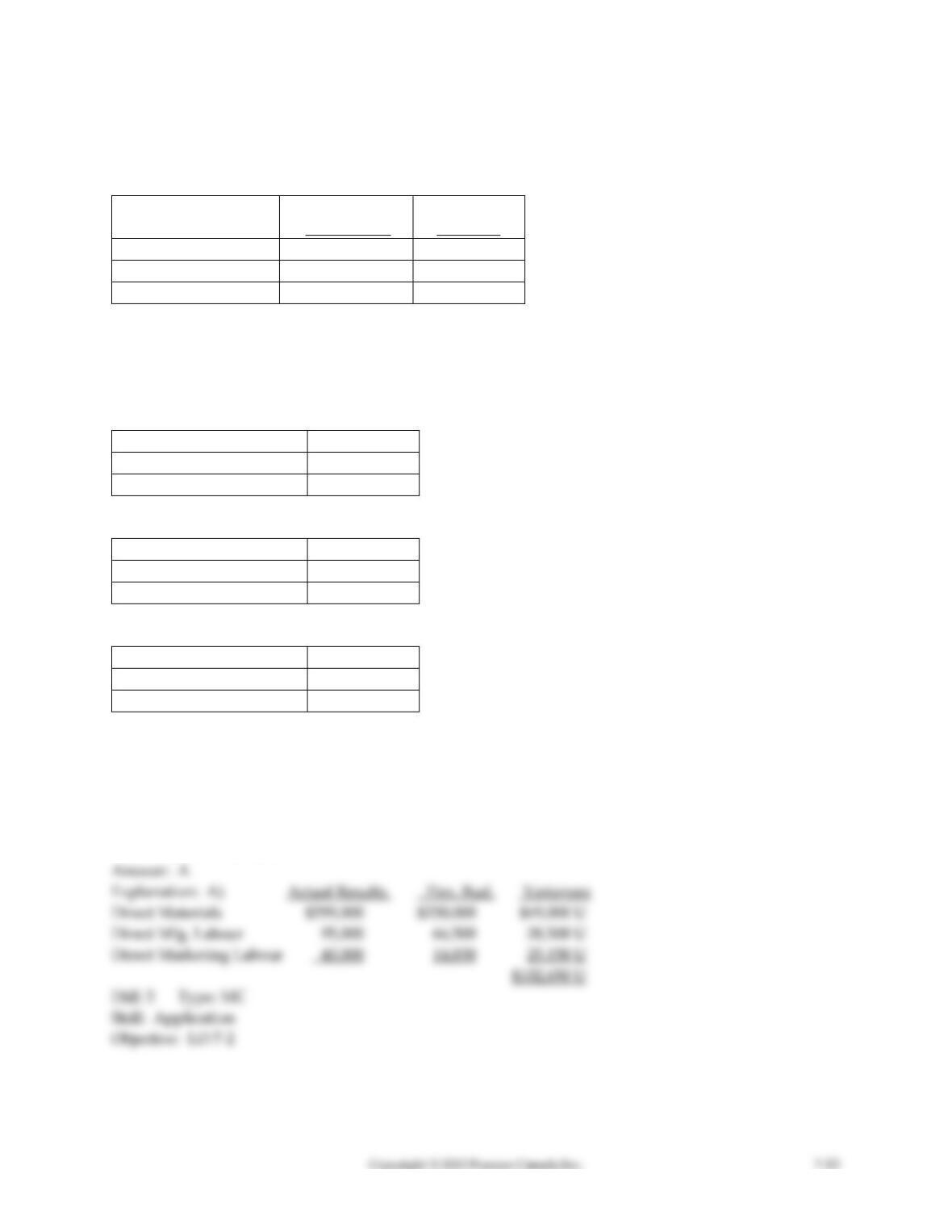
25) What is the direct materials price variance for the clay pots?
A) $560 unfavourable
B) $560 favourable
C) $800 unfavourable
D) $800 favourable
E) $1,040 favourable
Cost Accounting: A Managerial Emphasis, 6e
Chapter 7 – Flexible Budgets, Variances, and Management Control: I
Use the information below to answer the following question(s).
Tractor Corporation produces toy tractors. The company uses the following direct cost categories:
Category
Standard Inputs
for 1 output
Std. Cost
per input
Direct Materials
4.00
$12.50
Direct Labour
1.40
9.50
Direct Marketing
0.54
5.50
Actual performance and budgeted performance for the company is shown below:
Actual output: (in units) 5,000
Direct Materials:
Materials costs
$299,000
Input purchased and used
23,000
Actual price per input
$13.00
Direct Manufacturing Labour:
Labour costs
$95,000
Labour-hours of input
9,500
Actual price per hour
$10.00
Direct Marketing Labour:
Labour costs
$40,000
Labour-hours of input
5,000
Actual price per hour
$8.00
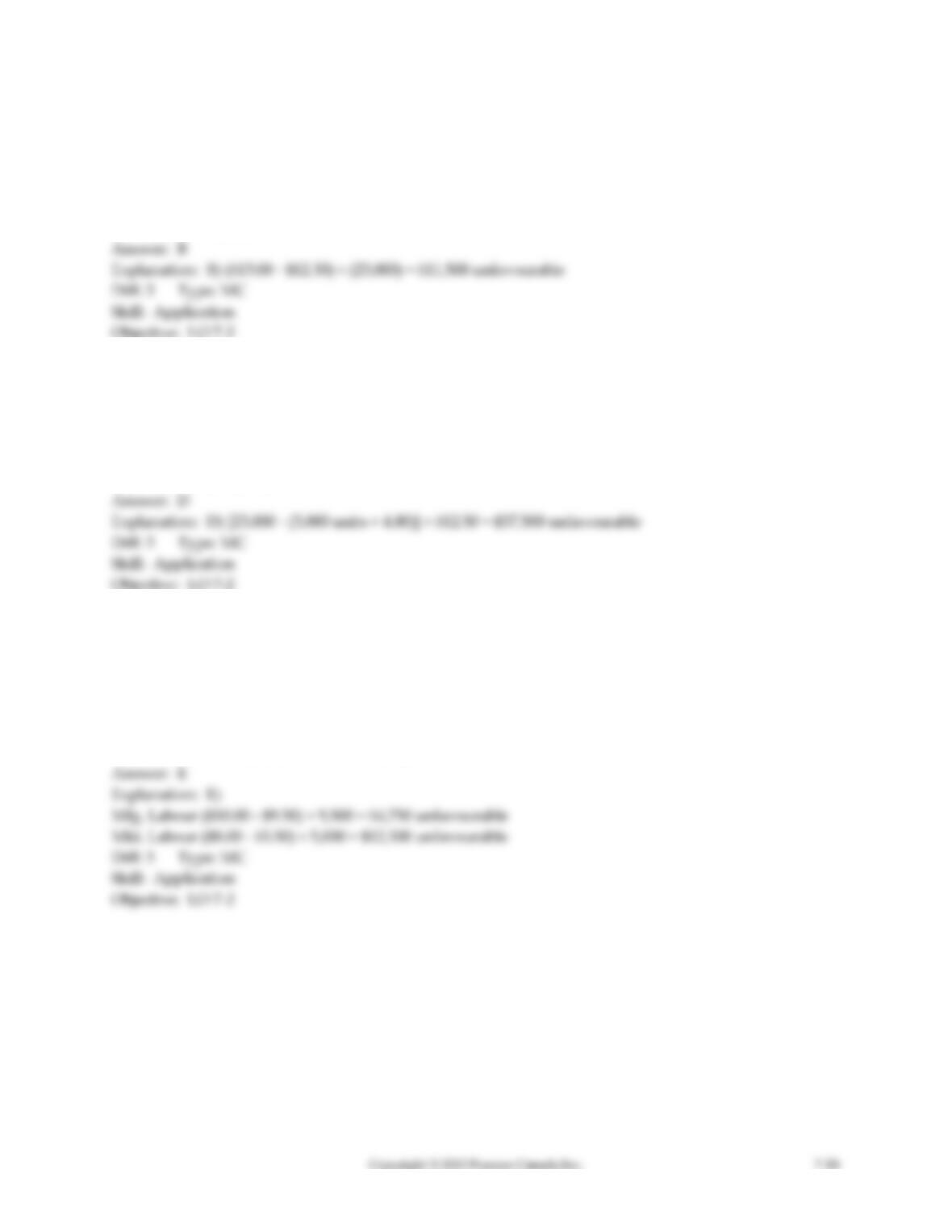
26) What is the combined total of the flexible budget variances?
A) $102,650 unfavourable
B) $99,000 unfavourable
C) $78,500 unfavourable
D) $75,150 favourable
E) $75,150 unfavourable
Cost Accounting: A Managerial Emphasis, 6e
Chapter 7 – Flexible Budgets, Variances, and Management Control: I
27) What is the price variance of the direct materials?
A) $10,000 favourable
B) $11,500 unfavourable
C) $11,500 favourable
D) $10,000 unfavourable
E) $11,000 favourable
28) What is the efficiency variance for direct materials?
A) $47,350 favourable
B) $36,000 unfavourable
C) $36,000 favourable
D) $37,500 unfavourable
E) $23,750 unfavourable
29) What is the price variance of the direct manufacturing labour, and the direct marketing labour,
respectively?
A) $4,750 favourable; $12,500 favourable
B) $8,000 favourable; $10,000 favourable
C) $3,500 unfavourable; $6,750 unfavourable
D) 3,500 favourable; $6,750 favourable
E) $4,750 unfavourable; $12,500 unfavourable
Cost Accounting: A Managerial Emphasis, 6e
Chapter 7 – Flexible Budgets, Variances, and Management Control: I
30) What are the efficiency variances for direct manufacturing labour and direct marketing labour,
respectively?
A) $25,000 favourable; $18,400 favourable
B) $23,750 favourable; $12,650 unfavourable
C) $25,000 unfavourable; $18,400 unfavourable
D) $23,750 unfavourable; $12,650 unfavourable
E) $23,750 favourable; $12,650 favourable
Use the information below to answer the following question(s).
A company makes table lamps, for which the following standards have been developed:
Standard Inputs
Expected for Each
Unit of Output
Standard Price
Expected per
Unit of Output
Direct materials
20 kilograms
$2 per kilogram
Direct labour
6 hours
$8 per hour
During January, production of 100 lamps was expected, but 110 lamps were actually completed.
Direct materials purchased and used were 2,100 kilograms at an actual price of $2.20 per kilogram.
Direct labour cost for the month was $5,310, and the actual pay per hour was $9.00.
31) The direct-material price variance for January is
A) $420 unfavourable.
B) $420 favourable.
C) $400 favourable.
D) $400 unfavourable.
E) $20 favourable.
Cost Accounting: A Managerial Emphasis, 6e
Chapter 7 – Flexible Budgets, Variances, and Management Control: I
32) The direct-labour efficiency variance for the month of January is
A) $630 unfavourable.
B) $560 unfavourable.
C) $630 favourable.
D) $560 favourable.
E) $70 favourable.
33) For any actual level of output, the difference between the input that was actually used and the input
should have been used is
A) an effectiveness variance.
B) a purchase cost variance.
C) the variance rate.
D) a price variance.
E) an efficiency variance.
34) When a journal entry is made to record the direct materials used, a debit to the Direct Materials
Efficiency Variance
A) indicates the variance is unfavourable.
B) indicates the variance is favourable.
C) is the difference between the actual Costs of Goods Sold and the budgeted Materials Control accounts.
D) is the difference between the debits and credits of all materials related entries.
E) also requires a debit to the materials control account.
Cost Accounting: A Managerial Emphasis, 6e
Chapter 7 – Flexible Budgets, Variances, and Management Control: I
Use the information below to answer the following question(s).
All Good Things Ltd. planned on producing 600 units for the year. However, actual production was 400
units.
Information concerning the direct labour cost for All Good Things Ltd. is as follows: actual results 1,000
hours at $25 per hour; static budget amounts were 1,200 hours at $21 per hour.
35) What is the All Good Things Ltd. static-budget variance?
A) $400 F
B) $400 U
C) $600 F
D) $200 F
E) $200 U
36) What is the All Good Things Ltd. flexible-budget variance?
A) $8,400 F
B) $8,400 U
C) $8,200 U
D) $8,200 F
E) $200 U
Cost Accounting: A Managerial Emphasis, 6e
Chapter 7 – Flexible Budgets, Variances, and Management Control: I
37) What is the All Good Things Ltd. sales-volume variance?
A) $8,400 F
B) $8,400 U
C) $8,200 U
D) $8,200 F
E) $200 F
38) What is the All Good Things Ltd. direct labour input-price variance?
A) $4,200 U
B) $4,200 F
C) $200 F
D) $4,000 F
E) $4,000 U
39) What is the All Good Things Ltd. direct labour input-efficiency variance?
A) $4,200 U
B) $4,200 F
C) $5,000 U
D) $5,000 F
E) $200 U