CHAPTER 7— STOCKS—CHARACTERISTICS AND VALUATION
TRUE/FALSE
1. The additional paid-in capital account represents the difference between a stock’s par value and
the funds actually received from the sale of new common stock.
2. Founders’ shares is a type of classified stock where the shares are owned by the firm’s founders
and they retain the sole voting rights to those shares but have restricted dividends for a specified
time period.
3. A publicly owned corporation is simply a company whose shares are held by the investing public,
which may include other corporations and institutions.
4. After a new issue is brought to market it is the marginal investor who determines the price at
which the stock will trade.
5. A stock’s par value is equal to the market value of the stock on the last day of the fiscal year for a
firm.
6. The book value per share is computed by taking the sum of common stock, additional paid in
capital, and retained earnings and dividing the number by the number of shares outstanding.
7. A proxy fight is an attempt by a group to gain control of a firm by convincing its stockholders to
give the group the authority to vote their shares in order to elect a new management team.
8. A preemptive right is a provision in the corporate charter or by laws that gives common
stockholders the right to purchase on a pro rata basis new issues of common stock.
9. Preemptive rights are important to stockholders because they provide protection against a dilution
of value when new shares are issued.
10. One advantage of using common stock as a source of funds is that common stock does not legally
obligate the firm to make payments to stockholders.
11. One advantage of common stock as a source of funds is that the underwriting and distribution
costs of common stock are usually much lower than those for debt.
Chapter 7 Stocks-Characteristics and Valuation 129
12. From a social welfare perspective, common stock is a desirable form of financing in part because
it involves no fixed charge payments. Its inclusion in a firm’s capital structure makes the firm less
vulnerable to the consequences of unanticipated declines in sales and earnings than if only debt
were available.
13. When a firm issues new equity, market pressure applies first to the new shares issued and then to
existing shares. Subsequent to the new issue, the value of the new shares will rise to the
equilibrium price of the old shares.
14. When management controls more than 50% of the shares of the firm, they must be concerned
with the potential of a proxy fights than can lead to takeovers of the firm and the replacement of
management.
15. The constant growth model used for evaluating the price of a share of common stock can also be
used to find the price of perpetual preferred stock or any other perpetuity.
16. According to the textbook model, under conditions of nonconstant growth, the discount rate
utilized to find the present value of the expected cash flows will be the same for the initial growth
period as for the normal growth period.
17. According to the basic stock valuation model, the value an investor assigns to a share of stock is
dependent upon the length of time the investor plans to hold the stock.
18. Other things held constant, P/E ratios are higher for firms with high growth prospects. At the
same time, P/E’s are lower for riskier firms, other things held constant. These two factors, growth
prospects and riskiness, may either be offsetting or reinforcing as P/E determinants.
MULTIPLE CHOICE
1. The net income that firm earns can either be paid out to shareholders as __________ or can be
reinvested in the company as __________.
a.
interest; additional paid-in capital
b.
dividends; retained earnings
c.
shares; capital stock.
d.
capital gains; additional paid-in capital
e.
interest; retained earnings
2. What is the account that shows the difference between the stock’s par value and what new
stockholders paid when they bought newly issued shares?
a.
Retained earnings
130 Chapter 7 Stocks-Characteristics and Valuation
b.
Common equity
c.
Additional paid-in-capital
d.
Dividends
e.
Initial public offering
3. Shareholders exert control of the management of the firm by
a.
electing board members who can replace management.
b.
directly replacing management with themselves.
c.
buying shares in an IPO at a discounted price.
d.
running the daily operations of the firm.
e.
None of the above.
4. Stock owned by the organizers of the firm who have sole voting rights is
a.
preferred stock.
b.
common equity.
c.
founders’ shares.
d.
convertible equity.
e.
retained earnings.
5. A corporation that is owned by a few individuals who are typically associated with the firm’s
management is a __________ corporation.
a.
private
b.
public
c.
diversified
d.
closely held
e.
listed
6. Certificates representing ownership in stocks of foreign companies, which are held in a trust bank
located in the country the stock is traded are called __________.
a.
Certificates of Ownership
b.
Foreign Stock Funds
c.
Mutual Funds
d.
American Depository Receipts
e.
Investment Bankers
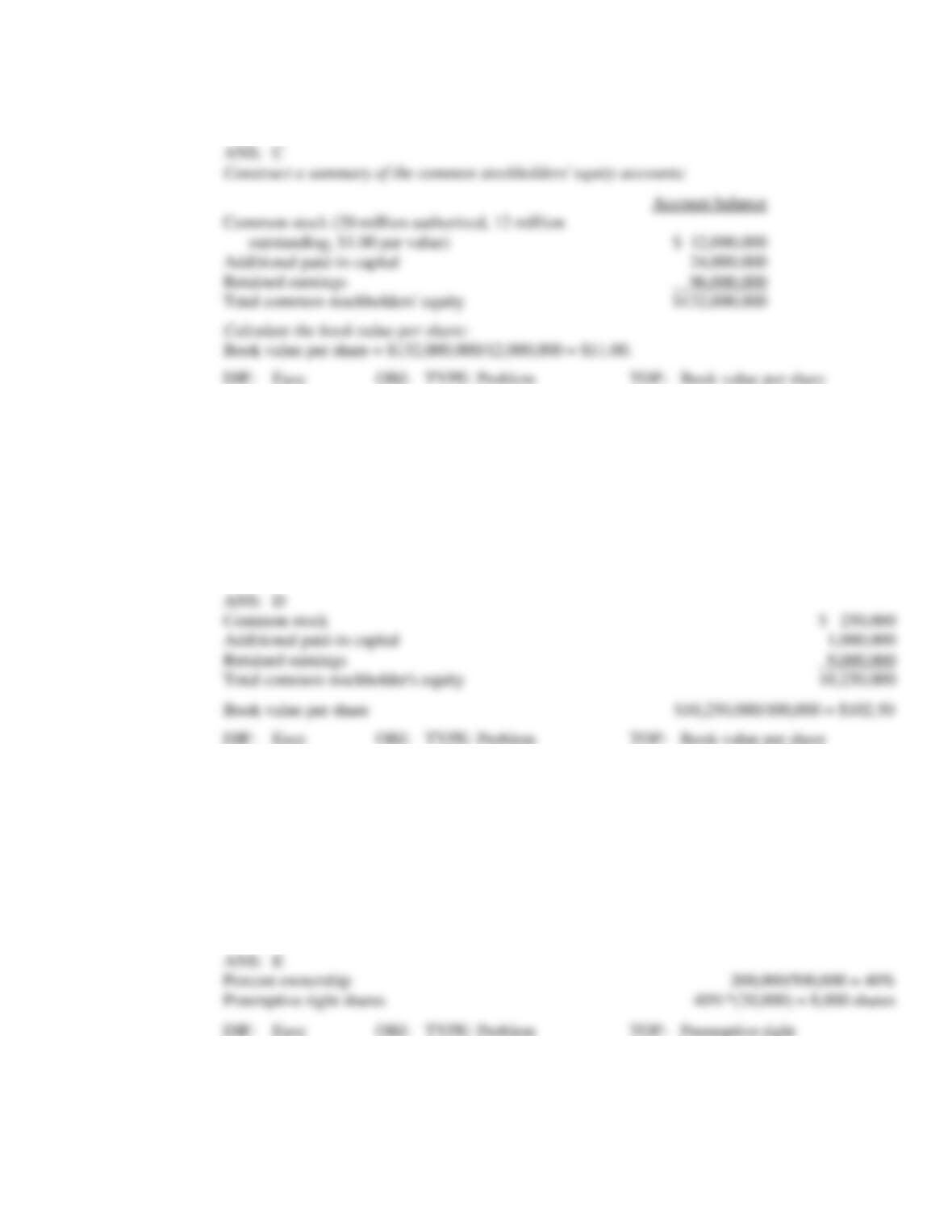
7. Velcraft Company has 20,000,000 shares of common stock authorized, but to date, has only
12,000,000 shares outstanding, each with a $1.00 par value. The company has $24,000,000 in
additional paid-in capital and retained earnings are $96,000,000. What is Velcraft’s current book
value per share?
a.
$1.00
b.
$3.00
c.
$11.00
d.
$6.60
Chapter 7 Stocks-Characteristics and Valuation 131
e.
$9.00
8. Blow Glass Corporation has 100,000 shares of stock outstanding, each with a par value of $2.50
per share. Blow Glass also has another 400,000 shares of stock that are shelf registered. Blow
Glass has retained earnings of $9,000,000 and additional paid-in capital of $1,000,000. What is
Blow Glass’s book value per share?
a.
$90.00
b.
$100.00
c.
$27.50
d.
$102.50
e.
$92.50
9. Scubapro Corporation currently has 500,000 shares outstanding and plans to issue 200,000 more
shares in a seasoned equity offering. The current shareholders have preemptive rights on any new
issue of stock by Scubapro Corporation. An investor with 20,000 shares who exercises his
preemptive rights on the new stock issue will have the right to buy how many stocks?
a.
200,000 shares
b.
120,000 shares
c.
80,000 shares
d.
12,000 shares
e.
8,000 shares
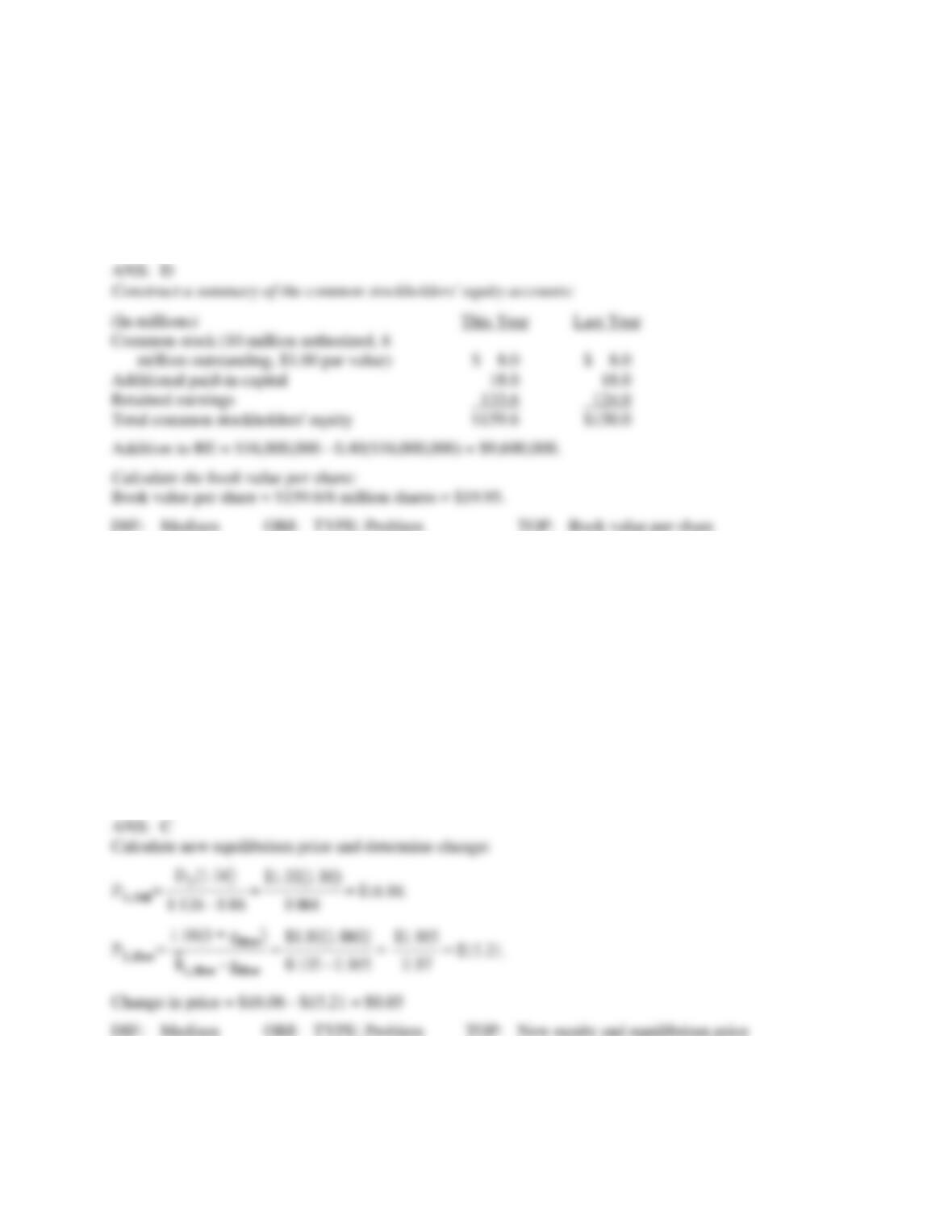
10. Micromain Company has 10,000,000 shares of common stock authorized and 8,000,000 shares
outstanding, each with a $1.00 par value. The firm’s additional paid-in capital account has a
balance of $18,000,000. The previous year’s retained earnings account was $124,000,000. In the
year just ended, Micromain generated net income of $16,000,000 and the firm has a dividend
132 Chapter 7 Stocks-Characteristics and Valuation
payout ratio of 40 percent. What will Micromain’s book value per share be when based on the
final year-end balance sheet?
a.
$20.75
b.
$15.00
c.
$15.96
d.
$19.95
e.
$18.75
11. Nahanni Treasures Corporation is planning a new common stock issue of five million shares to
fund a new project. The increase in shares will bring to 25 million the number of shares
outstanding. Nahanni’s long-term growth rate is 6 percent, and its current required rate of return is
12.6 percent. The firm just paid a $1.00 dividend and the stock sells for $16.06 in the market. On
the announcement of the new equity issue, the firm’s stock price dropped. Nahanni estimates that
the company’s growth rate will increase to 6.5 percent with the new project, but since the project
is riskier than average, the firm’s cost of capital will increase to 13.5 percent. Using the DCF
growth model, what is the change in the equilibrium stock price?
a.
-$1.77
b.
-$1.06
c.
-$0.85
d.
-$0.66
e.
-$0.08
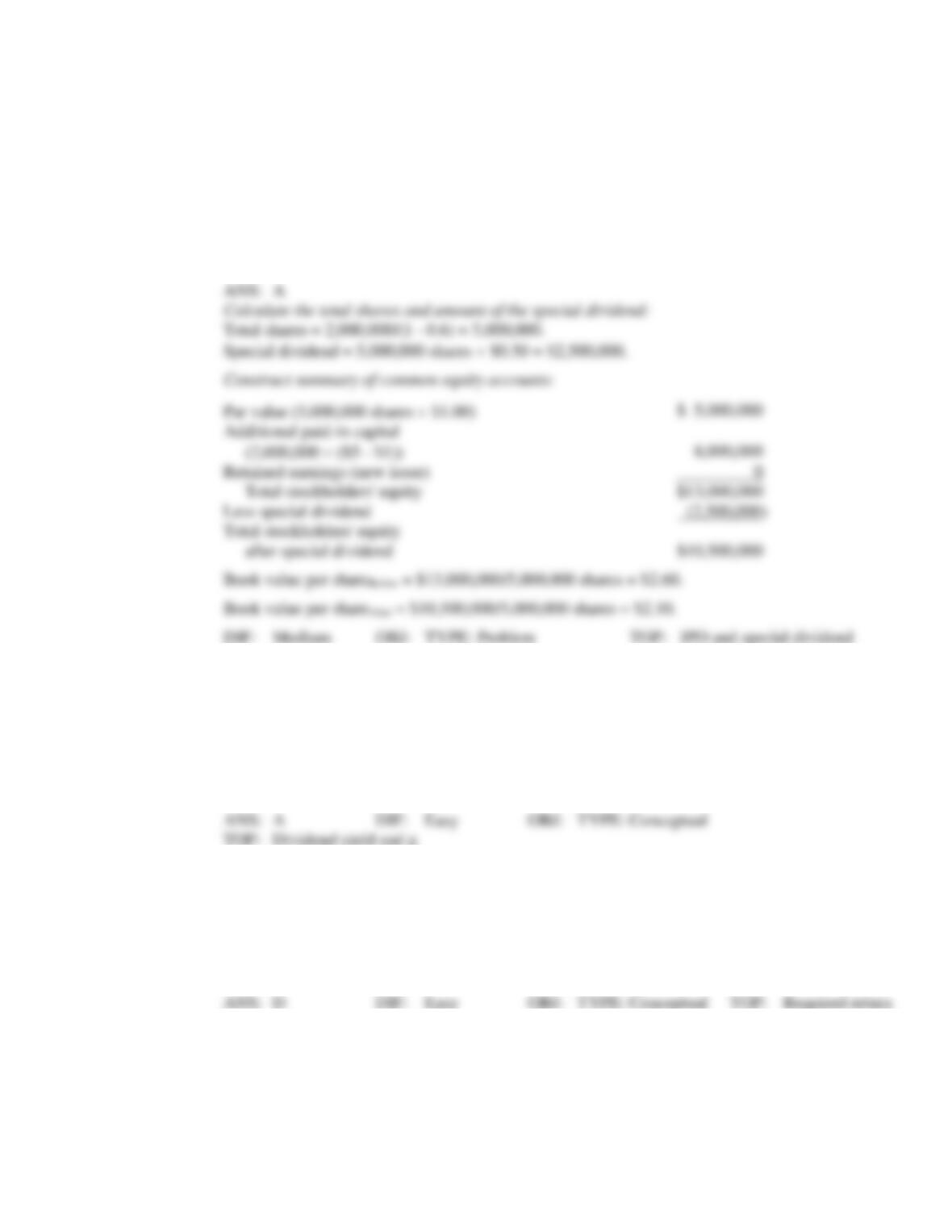
12. Mesmer Analytic, a biotechnology firm, floated an initial public offering of 2,000,000 shares at a
price of $5.00 per share. The firm’s owner/managers held 60 percent of the company’s $1.00 par
value authorized and issued stock following the public offering. One month after the IPO, the
firm’s board of directors declared a one-time dividend of $0.50 per share payable to all
Chapter 7 Stocks-Characteristics and Valuation 133
stockholders, meaning that the owner/managers would receive an immediate dividend, in part out
of the pockets of the new public stockholders. What was the book value per share of the firm
before and after the special dividend was paid?
a.
$2.60; $2.10
b.
$2.60; $2.60
c.
$2.60; $2.30
d.
$1.60; $1.10
e.
$1.60; $1.00
13. Assuming g will remain constant, the dividend yield is a good measure of the required return on a
common stock under which of the following circumstances?
a.
g = 0
b.
g > 0
c.
g < 0
d.
Under no circumstances.
e.
Answers a and b are both correct.
14. If the expected rate of return on a stock exceeds the required rate,
a.
The stock is experiencing supernormal growth.
b.
The stock should be sold.
c.
The company is probably not trying to maximize price per share.
d.
The stock is a good buy.
e.
Dividends are not being declared.
15. Which of the following statements is correct?
a.
The constant growth DCF model can be used to value a stock only if the stock’s dividends
are expected to grow forever at a constant rate which is less than the required rate of return
on the stock.
b.
If the growth rate is negative, the constant growth DCF model cannot be used.
c.
The constant growth DCF model may be written as k0 = D0/P0 + g.
134 Chapter 7 Stocks-Characteristics and Valuation
d.
The constant growth DCF model may be written as P0 = D0/(k + g).
e.
The constant growth DCF model may be written as P0 = D0/(k – g).
16. Alpha’s preferred stock currently has a market price equal to $80 per share. If the dividend paid
on this stock is $6 per share, what is the required rate of return investors are demanding from
Alpha’s preferred stock?
a.
7.5%
b.
13.3%
c.
6.0%
d.
$6.00
e.
None of the above is a correct answer.
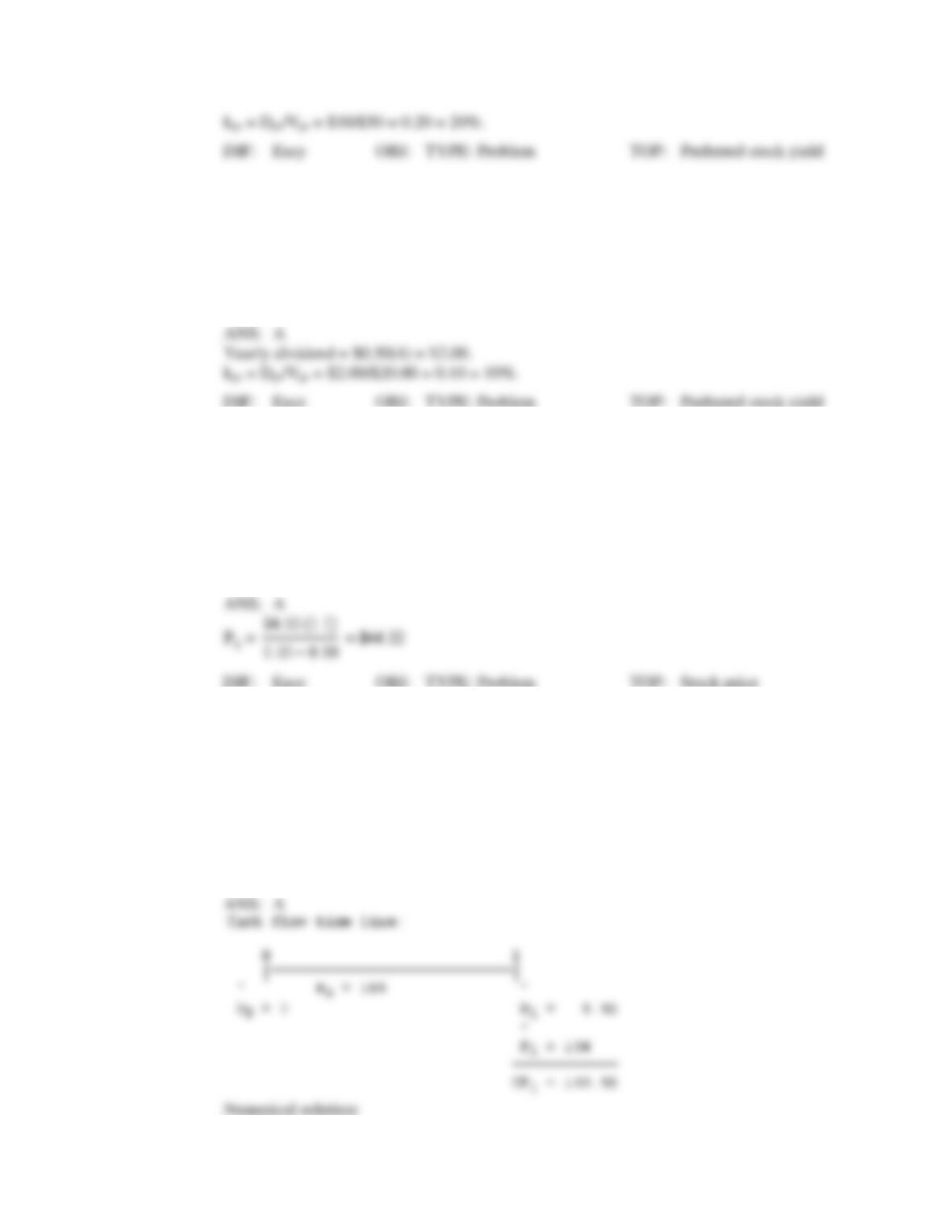
17. Ms. Manners Catering (MMC) has paid a constant $1.50 per share dividend to its common
stockholders for the past 25 years. MMC expects to continue this policy for the next two years,
and then begin to increase the dividend at a constant rate equal to 2 percent per year into
perpetuity. Investors require a 12 percent rate of return to purchase MMC’s common stock. What
is the market value of MMC’s common stock?
a.
$14.73
b.
$15.00
c.
$15.58
d.
$15.30
e.
$12.20
18. A share of perpetual preferred stock pays an annual dividend of $6 per share. If investors require
a 12 percent rate of return, what should be the price of this preferred stock?
a.
$57.25
b.
$50.00
c.
$62.38
d.
$46.75
e.
$41.64
19. A share of preferred stock pays a quarterly dividend of $2.50. If the price of this preferred stock is
currently $50, what is the simple annual rate of return?
a.
12%
b.
18%
c.
20%
d.
23%
e.
28%
Chapter 7 Stocks-Characteristics and Valuation 135
20. A share of preferred stock pays a dividend of $0.50 each quarter. If you are willing to pay $20.00
for this preferred stock, what is your simple (not effective) annual rate of return?
a.
10%
b.
8%
c.
6%
d.
12%
e.
14%
21. The last dividend on Spirex Corporation’s common stock was $4.00, and the expected growth rate
is 10 percent. If you require a rate of return of 20 percent, what is the highest price you should be
willing to pay for this stock?
a.
$44.00
b.
$38.50
c.
$40.00
d.
$45.69
e.
$50.00
22. You are trying to determine the appropriate price to pay for a share of common stock. If you
purchase this stock, you plan to hold it for 1 year. At the end of the year you expect to receive a
dividend of $5.50 and to sell the stock for $154. The appropriate rate of return for this stock is 16
percent. What should be the current price of this stock?
a.
$137.50
b.
$150.22
c.
$162.18
d.
$98.25
e.
$175.83
136 Chapter 7 Stocks-Characteristics and Valuation
23. A share of common stock has a current price of $82.50 and is expected to grow at a constant rate
of 10 percent. If you require a 14 percent rate of return, what is the current dividend on this
stock?
a.
$3.00
b.
$3.81
c.
$4.29
d.
$4.75
e.
$6.13
24. The last dividend paid by Klein Company was $1.00. Klein’s growth rate is expected to be a
constant 5 percent for 2 years, after which dividends are expected to grow at a rate of 10 percent
forever. Klein’s required rate of return on equity (ks) is 12 percent. What is the current price of
Klein’s common stock?
a.
$21.00
b.
$33.33
c.
$42.25
d.
$50.16
e.
$58.75
25. You are given the following data:
(1)
The risk-free rate is 5 percent.
(2)
The required return on the market is 8 percent.
(3)
The expected growth rate for the firm is 4 percent.
(4)
The last dividend paid was $0.80 per share.
Chapter 7 Stocks-Characteristics and Valuation 137
(5)
Beta is 1.3.
Now assume the following changes occur:
(1)
The inflation premium drops by 1 percent.
(2)
An increased degree of risk aversion causes the required return on the market to go to 10
percent after adjusting for the changed inflation premium.
(3)
The expected growth rate increases to 6 percent.
(4)
Beta rises to 1.5.
What will be the change in price per share, assuming the stock was in equilibrium before the
changes?
a.
+$12.11
b.
-$4.87
c.
+$6.28
d.
-$16.97
e.
+$2.78
26. You are considering an investment in the common stock of Cowher Corp. The stock is expected
to pay a dividend of $2 per share at the end of the year (i.e., 1 = $2.0 ). The stock has a beta equal
to 1.2. The risk-free rate is 6 percent. The market risk premium is 5 percent. The stock’s dividend
is expected to grow at some constant rage, g. The stock currently sells for $40 a share. Assuming
the market is in equilibrium, what does the market believe the stock price will be at the end of
three years? (In other words, what is P3?)
a.
$40.00
b.
$42.35
c.
$45.67
d.
$46.31
e.
$49.00
138 Chapter 7 Stocks-Characteristics and Valuation
27. A firm expects to pay dividends at the end of each of the next four years of $2.00, $1.50, $2.50,
and $3.50. If growth is then expected to level off at 8 percent, and if you require a 14 percent rate
of return, how much should you be willing to pay for this stock?
a.
$67.81
b.
$22.49
c.
$58.15
d.
$31.00
e.
$43.97
Chapter 7 Stocks-Characteristics and Valuation 139
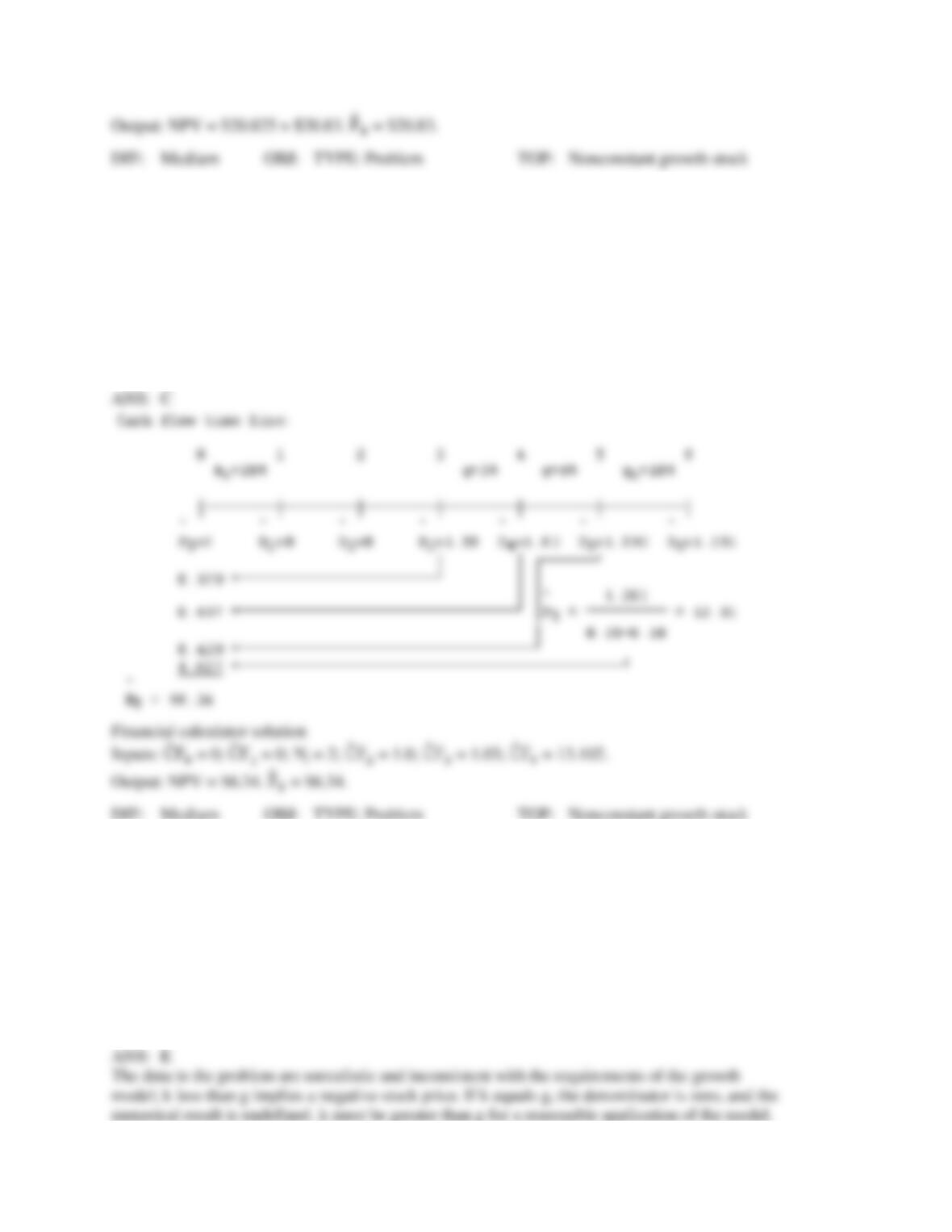
28. Eastern Auto Parts’ last dividend was D0 = $0.50, and the company expects to experience no
growth for the next 2 years. However, Eastern will grow at an annual rate of 5 percent in the third
and fourth years, and, beginning with the fifth year, it should attain a 10 percent growth rate
which it should sustain thereafter. Eastern has a required rate of return of 12 percent. What should
be the present price per share of Eastern common stock?
a.
$19.26
b.
$31.87
c.
$30.30
d.
$20.83
e.
$19.95
140 Chapter 7 Stocks-Characteristics and Valuation
29. The Satellite Building Company has fallen on hard times. Its management expects to pay no
dividends for the next 2 years. However, the dividend for Year 3, D3, will be $1.00 per share, and
the dividend is expected to grow at a rate of 3 percent in Year 4, 6 percent in Year 5, and 10
percent in Year 6 and thereafter. If the required return for Satellite is 20 percent, what is the
current equilibrium price of the stock?
a.
$0
b.
$5.26
c.
$6.34
d.
$12.00
e.
$13.09
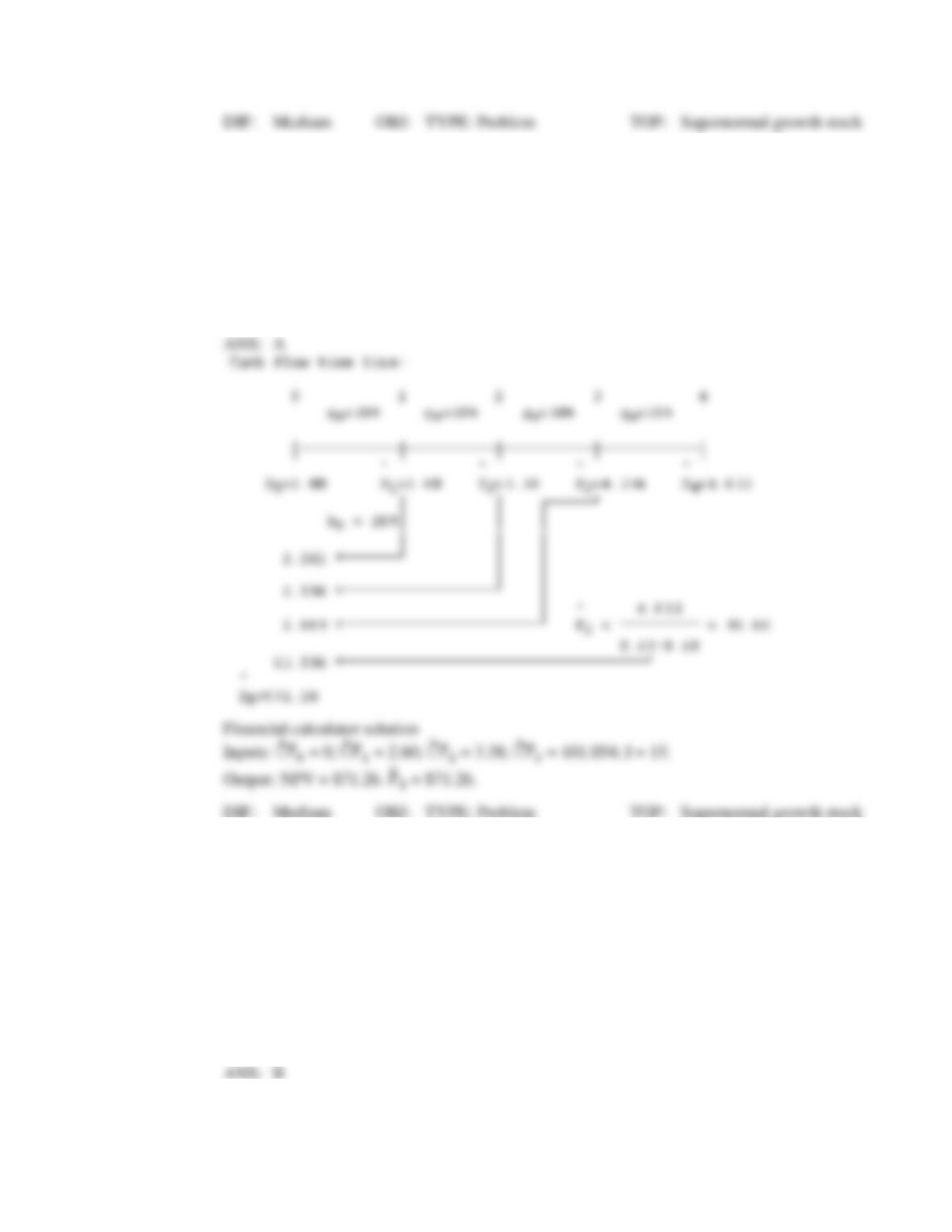
30. A share of stock has a dividend of D0 = $5. The dividend is expected to grow at a 20 percent
annual rate for the next 10 years, then at a 15 percent rate for 10 more years, and then at a long–
run normal growth rate of 10 percent forever. If investors require a 10 percent return on this
stock, what is its current price?
a.
$100.00
b.
$82.35
c.
$195.50
d.
$212.62
e.
The data given in the problem are internally inconsistent, i.e., the situation described is
impossible in that no equilibrium price can be produced.
Chapter 7 Stocks-Characteristics and Valuation 141
31. You are considering the purchase of a common stock that just paid a dividend of $2.00. You
expect this stock to have a growth rate of 30 percent for the next 3 years, then to have a long-run
normal growth rate of 10 percent thereafter. If you require a 15 percent rate of return, how much
should you be willing to pay for this stock?
a.
$71.26
b.
$97.50
c.
$82.46
d.
$79.15
e.
$62.68
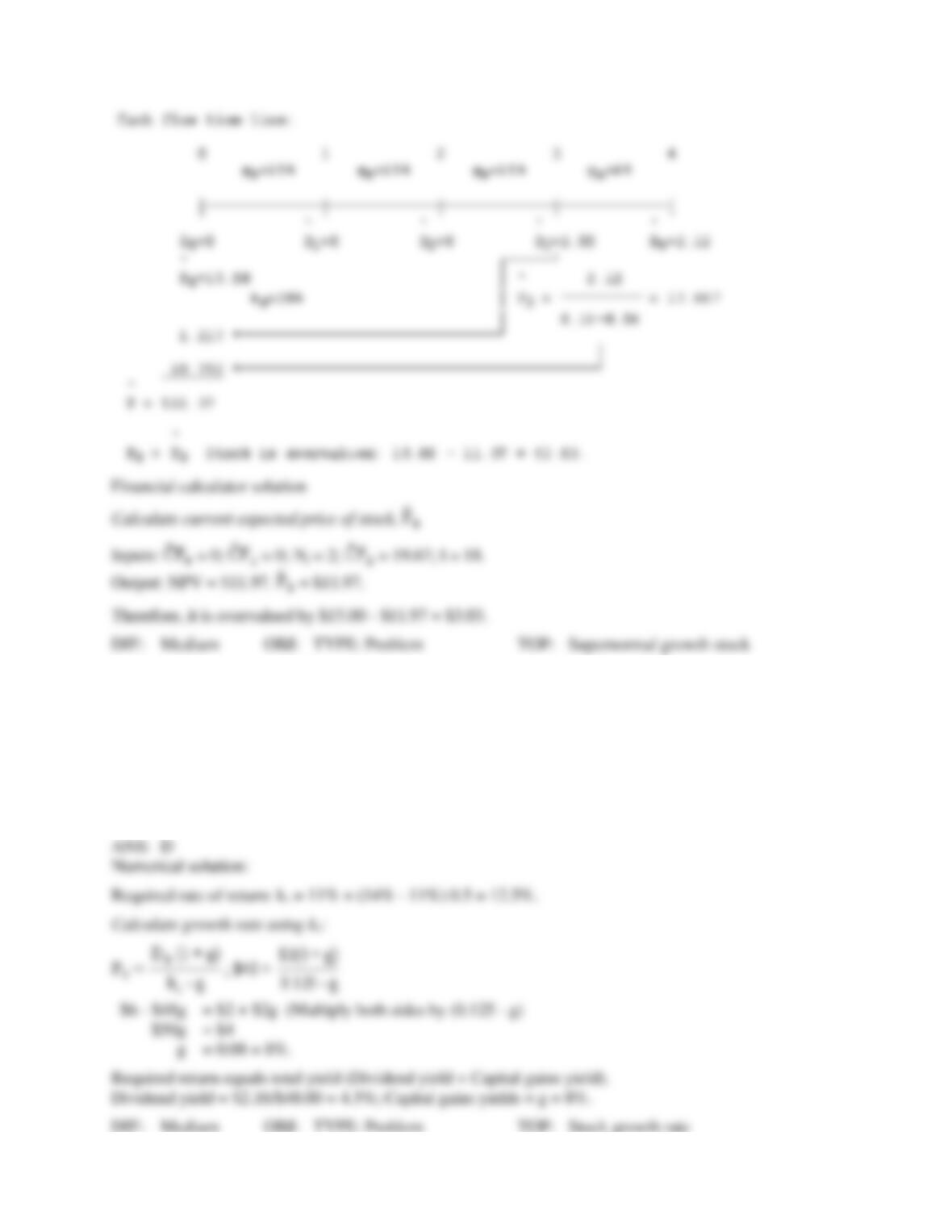
32. DAA’s stock is selling for $15 per share. The firm’s income, assets, and stock price have been
growing at an annual 15 percent rate and are expected to continue to grow at this rate for 3 more
years. No dividends have been declared as yet, but the firm intends to declare a dividend of D3 =
$2.00 at the end of the last year of its supernormal growth. After that, dividends are expected to
grow at the firm’s normal growth rate of 6 percent. The firm’s required rate of return is 18 percent.
The stock is
a.
Undervalued by $3.03.
b.
Overvalued by $3.03.
c.
Correctly valued.
d.
Overvalued by $2.25.
e.
Undervalued by $2.25.
142 Chapter 7 Stocks-Characteristics and Valuation
33. Berg Inc. has just paid a dividend of $2.00. Its stock is now selling for $48 per share. The firm is
half as risky as the market. The expected return on the market is 14 percent, and the yield on U.S.
Treasury bonds is 11 percent. If the market is in equilibrium, what rate of growth is expected?
a.
13%
b.
10%
c.
4%
d.
8%
e.
-2%