On December 31, a physical inventory revealed that the ending inventory was only $210,000. Gordon’s gross profit on net sales has remained
constant at 30 percent in recent years. Gordon suspects that some inventory may have been pilfered by one of the company’s employees. At
December 31, what is the estimated cost of missing inventory?
131. The following information is available for Velva Company for its most recent year:
Net sales
$7,200,000
Freight in
180,000
Purchase discounts
100,000
Ending inventory
560,000
The gross margin is 40 percent of net sales. What is the cost of goods available for sale?
132. Minot Company’s inventory balance on December 31, 2012 was $775,000 before considering the
following transactions:
·
Goods were in transit from a vendor to Minot on December 31, 2012. The invoice price was $62,500, and the goods were shipped FOB
shipping point on December 27, 2012. The goods were received on January 2, 2013.
·
Goods were purchased from a vendor on December 31, 2012. The invoice price was $83,000, with terms FOB shipping point. The goods
were shipped the same day as purchase and received on January 7, 2013.
·
Goods were shipped to Minot Company FOB destination on December 23, 2012, from a vendor. The invoice price was $31,250. The
goods were received on January 2, 2013.
·
Minot had goods consisting of $15,000 on consignment with a customer that were not included in the ending inventory balance.
·
Minot had goods on consignment from a vender of $25,000 that were included in the ending inventory balance.
133. Compute the missing numbers for the following three partial income statements:
Dickison
Beulah
Grafton
Company
Company
Company
Beginning inventory
$ 65,000
$25,400
(e) $______
Purchases
106,000
(c) ______
246,000
Purchase returns and allowances
(a) ______
1,600
10,200
Goods available for sale
167,600
(d) ______
348,400
Ending inventory
(b) ______
23,000
86,800
Cost of goods sold
133,000
67,200
(f) ______
134. Prepare journal entries to record the following four transactions for the Labatt Company using the
perpetual inventory method. (Omit explanations for the entries.)
·
June 1 – purchased on account inventory costing $15,000 terms 2/10 n/30.
·
June 9 – returned inventory costing $1,500 that was purchased on June 1.
·
June 10 – paid for the merchandise purchased on June 1.
·
June 15 – sold one half of its inventory for $12,000 cash. (Assume the inventory purchased on June 1 was the company’s only inventory.)
Accounts Payable
15,000
Inventory
1,500
Inventory
Cash
13,230
Cash
12,000
Sales Revenue
12,000
Inventory
6,615
$3,400 [$65,000 + $106,000 – $167,600]
$34,600 [$167,600 – $133,000]
$66,400 [$90,200 + $1,600 – $25,400]
$90,200 [$67,200 + $23,000]
$112,600 [$348,400 + $10,200 – $246,000]
$261,600 [$348,400 – $86,800]
135. Prepare journal entries to record the following four transactions for Labatt Company using the periodic
inventory method. (Omit explanations for the entries.)
·
June 1 – purchased on account inventory costing $15,000 terms 2/10 n/30.
·
June 9 – returned inventory costing $1,500 that was purchased on June 1.
·
June 10 – paid for the merchandise purchased on June 1.
·
June 15 – sold one half of its inventory for $12,000 cash. (Assume the inventory purchased on June 1 was the company’s only inventory.)
136. Jahn Company had the following balances in its general ledger at December 31, 2012:
Inventory (as of January 1, 2012)
$240,000
Purchases
440,000
Purchase returns and allowances
5,000
For the year 2012, Jahn Company’s electronic sales registers showed a total cost of goods sold of $480,000. Assuming that a physical count of
inventory on December 31, 2012, revealed inventory on hand costing $185,000, complete the following:
a.
Prepare the journal entries needed to adjust the inventory records and close the related purchases accounts, assuming the periodic inventory
method is used.
b.
Prepare any entries necessary to adjust the inventory records and close the appropriate accounts, assuming the perpetual inventory method
is used, but that the information preceding beginning inventory, purchases, and purchase returns and allowances is known.
June 1
s
15,000
Accounts Payable
15,000
Purchase Returns
1,500
Purchase Discounts
Cash
13,230
Cash
12,000
Sales Revenue
12,000
137. Compute the missing numbers in the following income statements:
Year 1
Year 2
Sales revenue
$50,000
(d) ______
Beginning inventory
12,400
(e) ______
Purchases
30,600
$42,000
Purchase returns and allowances
1,000
600
Ending inventory
(a) ______
(f) ______
Cost of goods sold
(b) ______
32,000
Gross margin
14,000
35,000
Expenses
7,600
(g) ______
Net income (or loss)
(c) ______
19,600
b.
d.
g.
Inventory
435,000
Purchases
440,000
Cost of Goods Sold
490,000
Inventory
490,000
($440,000 + $240,000 – $5,000 – $185,000 = $490,000)
b.
Inventory Shrinkage
10,000
Inventory
10,000

138. Ling Company’s inventory records for the current year are as follows:
Number
of Units
Cost per Unit
Total Cost
Beginnin
g
inventor
y
2,200
$3.00
$ 6,600
First
purchase
3,000
$2.90
8,700
Second
purchase
3,500
$2.80
9,800
Third
purchase
2,800
$2.70
7,560
Fourth
purchase
2,500
$2.60
6,500
Goods available for sale
14,000
$39,160
Units sold during the year
9,000
Compute the cost of ending inventory using the following inventory costing methods:
a.
FIFO periodic
b.
LIFO periodic
c.
Average Cost periodic
139. Hillsboro Company’s inventory records for November are as follows::
Date
Balance/Transaction
Units
Cost
November 1
Inventory
7,000
$55.00
9
Purchase
10,000
52.00
15
Sales
15,000
24
Purchase
14,000
50.00
26
Sales
10,000
30
Purchase
4,000
45.00
Compute the cost of ending inventory using the following inventory costing methods:
a.
FIFO periodic
b.
LIFO periodic
c.
Average Cost periodic
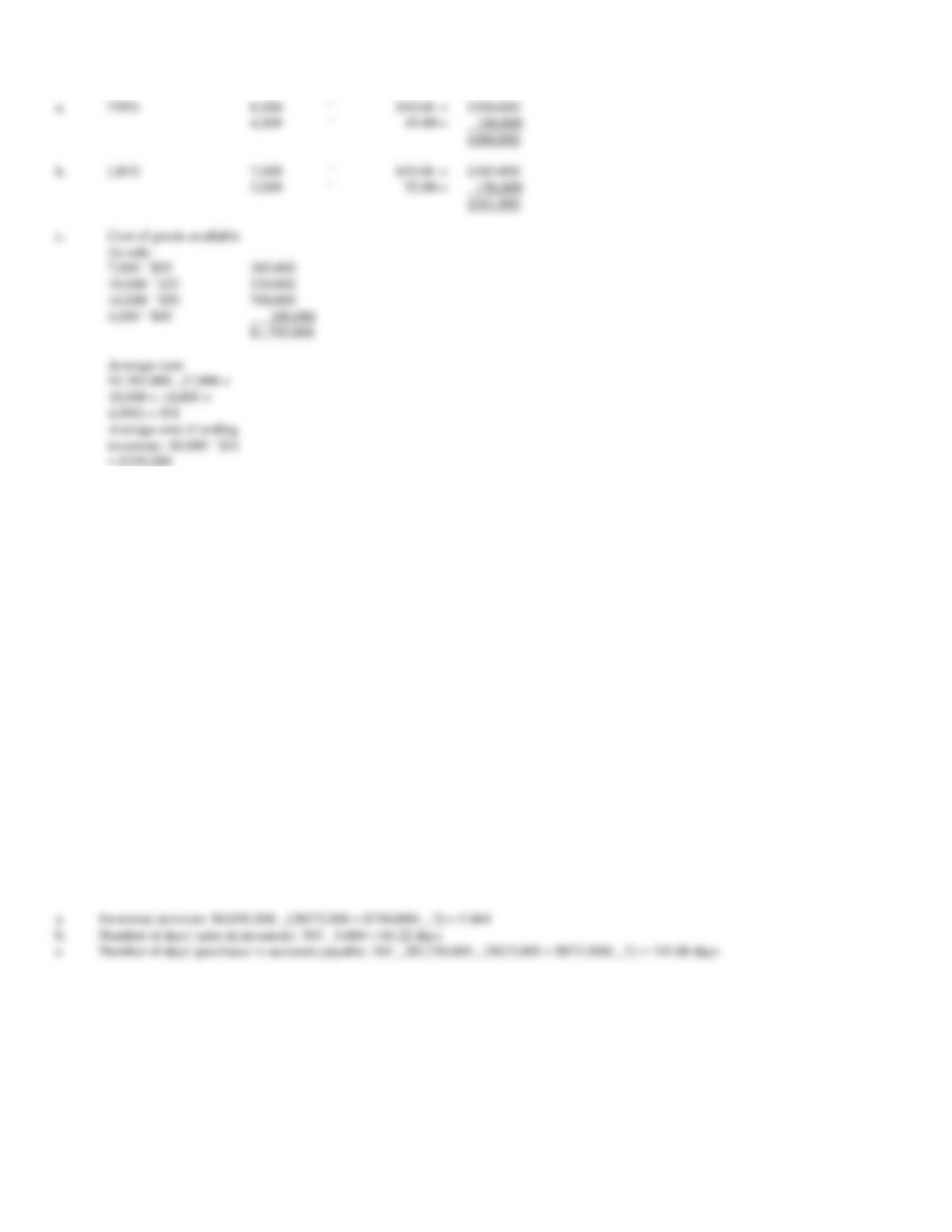
a.
FIFO
2,500
´
$2.60
=
$ 6,500
2,500
´
2.70
=
6,750
$13,250
b.
LIFO
2,200
´
$3.00
=
$ 6,600
2,800
´
2.90
=
8,120
$14,720
5,000 units =
$13,985
140. The following information was taken from the records of Colfax Company:
Beginning inventory
$ 675,000
Ending inventory
750,000
Net credit sales
7,200,000
Cost of goods sold
4,050,000
Purchases
3,250,000
Beginning accounts payable
825,000
Ending accounts payable
975,000
Net income
562,500
Given this information, compute the following ratios for Colfax Company.
a.
Inventory turnover
b.
Number of days’ sales in inventory
c.
Number of days’ purchases in accounts payable
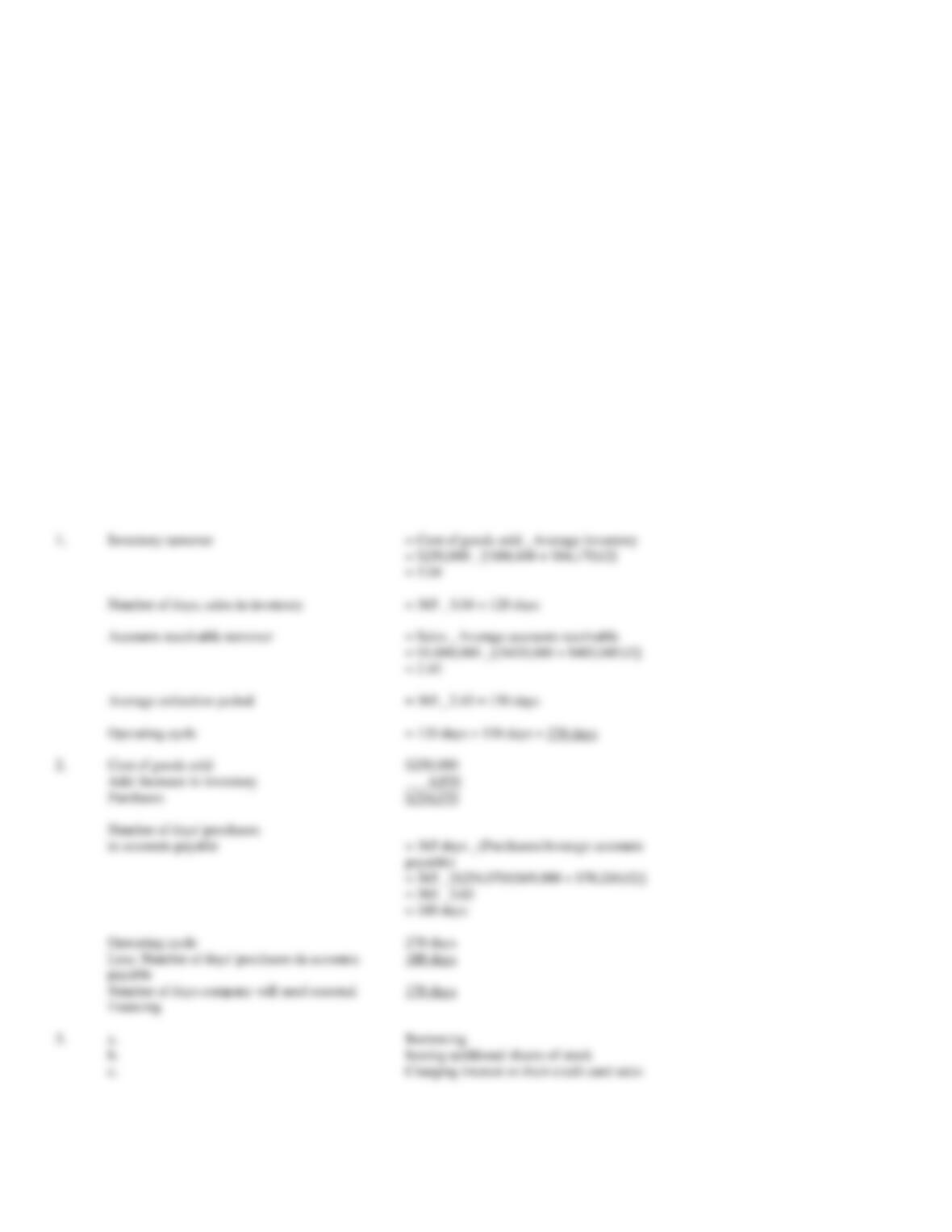
a.
Inventory turnover: $4,050,000 ¸ [($675,000 + $750,000) ¸ 2] = 5.684
b.
Number of days’ sales in inventory: 365 ¸ 5.684 = 64.22 days
c.
Number of days’ purchases in accounts payable: 365 ¸ [$3,250,000 ¸ ($825,000 + $975,000) ¸ 2] = 101.08 days
a.
FIFO
6,000
´
$50.00
=
$300,000
$480,000
b.
LIFO
7,000
´
$55.00
=
$385,000
3,000
´
52.00
=
156,000
$541,000
7,000 ´ $55
385,000
10,000 ´ $52
520,000
14,000 ´ $50
700,000
4,000 ´ $45
180,000
$1,785,000
141. The financial statements of Alphonso, Inc., reflect the following data:
Sales
$1,000,000
Beginning
Inventory
$80,10
0
Cost of
Goods
Sold
250,000
Ending Inventory
84,170
Beginnin
g
Account
s
Beginning
Accounts
Receivable
420,000
Payable
69,000
Ending
Account
s
Ending Accounts
Receivable
403,045
Payable
70,216
You are analyzing the company’s statements to determine how much of the company’s operating cycle must be financed through external financing.
1.
Determine the length of the company’s operating cycle.
2.
Determine the number of days the company will need external financing.
3.
Identify the means of obtaining the necessary external financing.
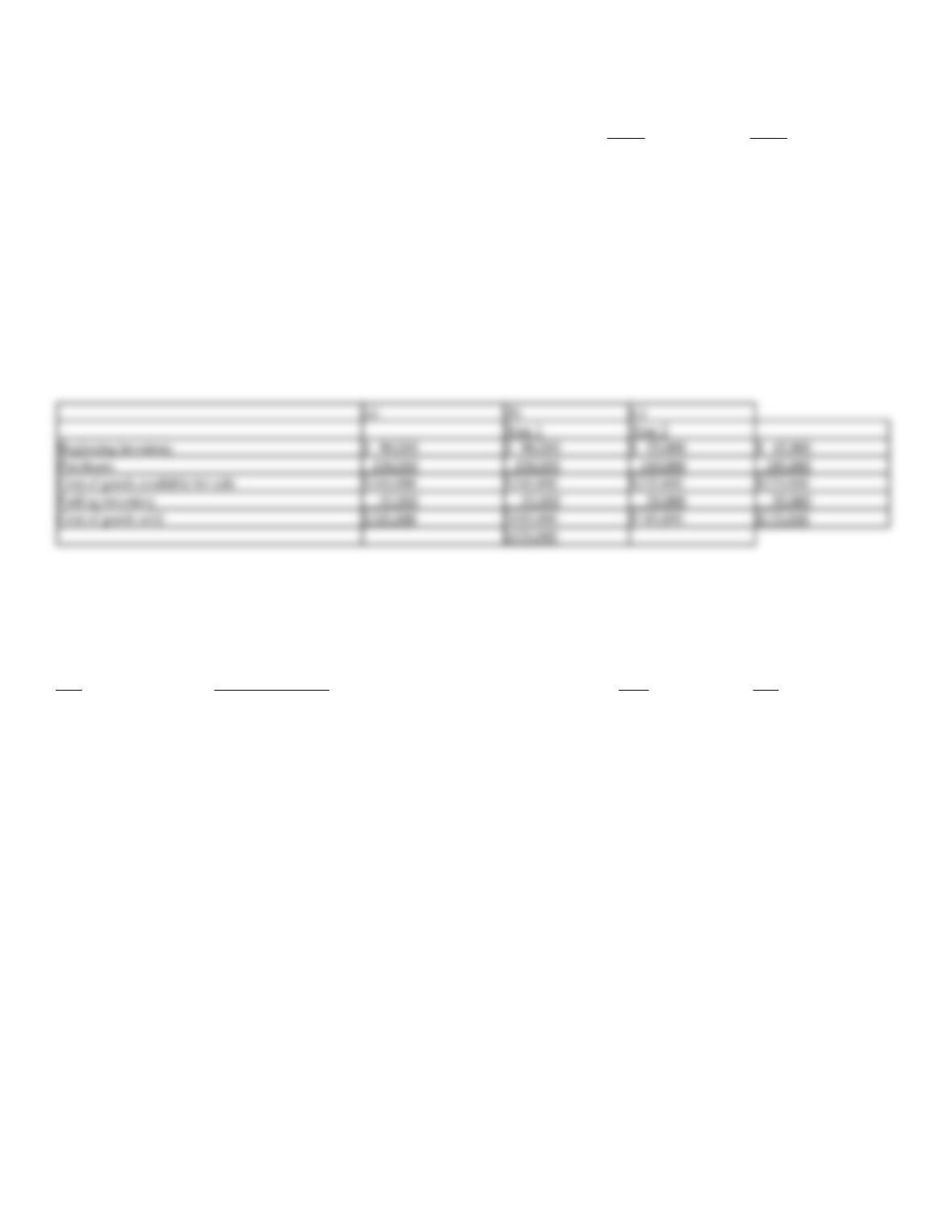
1.
Inventory turnover
= Cost of goods sold ¸ Average inventory
= $250,000 ¸ [($80,100 + $84,170)/2]
= 3.04
Number of days, sales in inventory
= 365 ¸ 3.04 = 120 days
Accounts receivable turnover
= Sales ¸ Average accounts receivable
= $1,000,000 ¸ [($420,000 + $403,045)/2]
= 2.43
Average collection period
= 365 ¸ 2.43 = 150 days
Operating cycle
= 120 days + 150 days = 270 days
2.
Cost of goods sold
$250,000
Add: Increase in inventory
4,070
Purchases
$254,070
Number of days’ purchases
= 365 ¸ [$254,070/($69,000 + $70,216)/2)]
= 365 ¸ 3.65
Operating cycle
270 days
Number of days company will need external
financing
170 days
3.
Borrowing
b.
Issuing additional shares of stock
142. The following data are available for Toltec Company:
Year 1
Year 2
Beginning inventory
$ 90,000
$ 60,000
Purchases
150,000
180,000
Cost of goods available for sale
240,000
240,000
Ending inventory
60,000
50,000
Cost of goods sold
180,000
190,000
Based on these data, answer the following three independent questions:
a.
If ending inventory in year 1 is understated by $5,000 (it is recorded as $55,000), how much is cost of goods sold in year 1?
b.
Assuming the same error as in (1), how much is total cost of goods sold for the two years combined?
c.
If beginning inventory in year 2 is understated by $15,000 (it is recorded as $45,000), how much is cost of goods sold in year 2?
143. Palermo Company is a wholesaler of sporting goods. The activity for NBA-sanctioned basketballs during
November is shown below:
Date
Balance/Transaction
Units
Cost
November 1
Inventory
1,000
$40.00
5
Purchase
1,500
43.00
9
Sales
1,800
17
Purchase
2,400
44.00
23
Sales
1,900
29
Purchase
800
45.00
Given this information, compute the cost of ending inventory using the following inventory costing methods:
a.
FIFO perpetual
b.
LIFO perpetual
c.
Average Cost perpetual
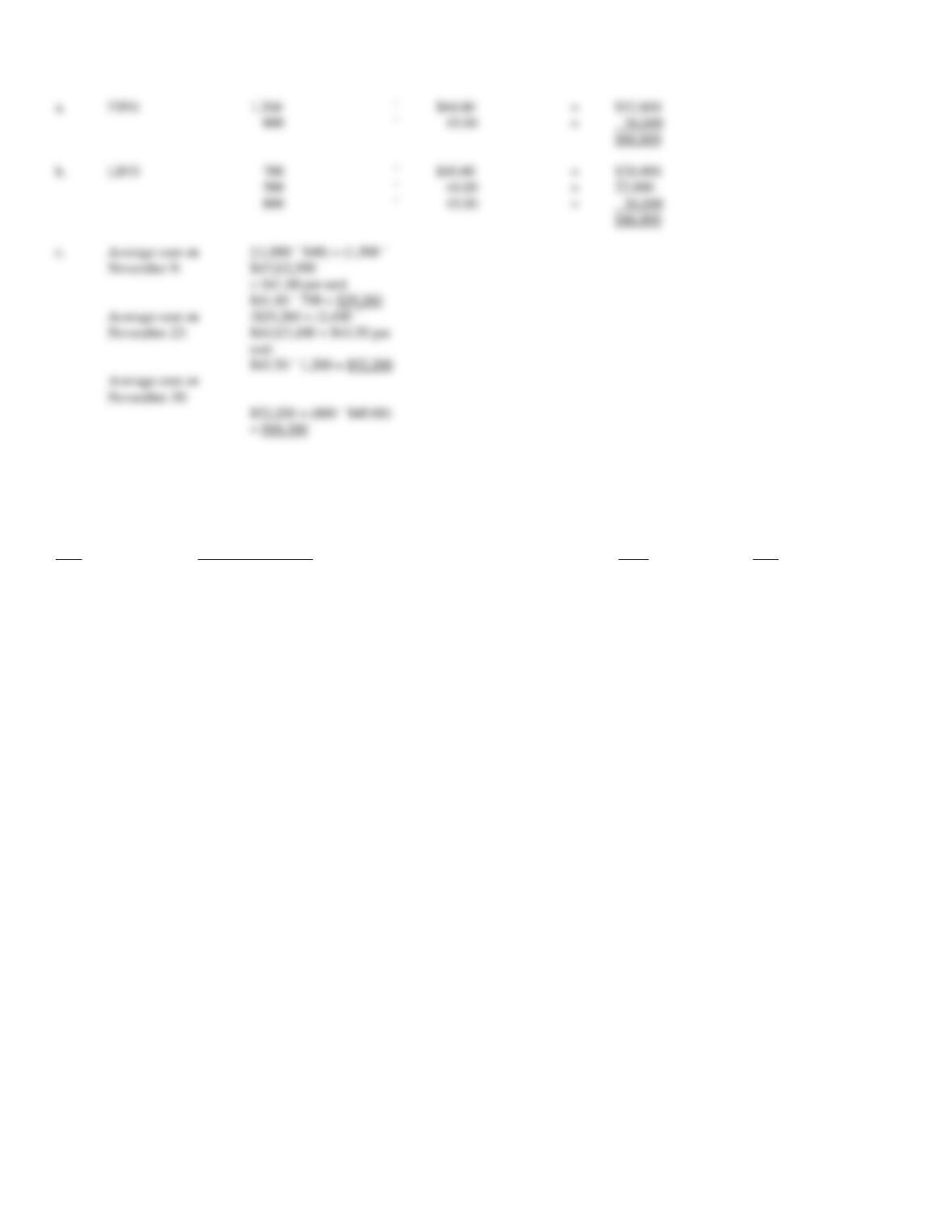
(a)
(b)
(c)
Year 1
Year 2
Beginning inventory
$ 90,000
$ 90,000
$ 55,000
$ 45,000
Purchases
150,000
150,000
180,000
180,000
Cost of goods available for sale
$240,000
$240,000
$235,000
$225,000
Ending inventory
55,000
55,000
50,000
50,000
Cost of goods sold
$185,000
$185,000
$185,000
$175,000
$370,000
144. Rawson Company’s inventory records for April are as follows:
Date
Balance/Transaction
Units
Cost
April 1
Inventory
3,500
$110.00
9
Purchase
5,000
104.00
15
Sales
7,500
24
Purchase
7,000
100.00
26
Sales
5,000
30
Purchase
2,000
90.00
Compute the cost of ending inventory using the following inventory costing methods:
a.
FIFO perpetual
b.
LIFO perpetual
c.
Average Cost perpetual
a.
FIFO
1,200
´
$44.00
=
$52,800
$88,800
b.
LIFO
700
´
$40.00
=
$28,000
500
´
44.00
=
22,000
800
´
45.00
=
36,000
$86,000
= $41.80 per unit
$41.80 ´ 700 = $29,260
$43.50 ´ 1,200 = $52,200
November 30:
145. Rhame Company has the following information related to its two products:
Original
Replacement
Cost
Cost
Ceiling
Floor
Product M
$ 96
$ 72
$ 80
$ 64
Product N
$120
$128
$144
$112
Given the above information, determine the following items:
a.
Net realizable value of each product.
b.
Normal profit margin for each product.
c.
Assuming that the lower of cost or market rule is applied to individual products, the amount at which product M should be valued.
d.
Assuming that the lower of cost or market rule is applied to individual products, the amount at which product N should be valued.
a.
Product M: $80
Product N: $144
b.
Product M: $80 – $64 = $16
Product N: $144 – $112 = $32
c.
Lower of cost or market: $72
d.
Lower of cost or market: $120
a.
FIFO
3,000
´
$100.00
=
$300,000
$480,000
b.
LIFO
1,000
´
$110.00
=
$110,000
2,000
´
$100.00
=
200,000
2,000
´
90.00
=
180,000
$490,000
= $106.47 per unit
146. Feldman Company has the following inventory information for the current year:
Net
Replacement
Realizable
Item
Quantity
Unit Cost
Cost
Value
Floor
1A
100
$34
$36
$45
$41
2A
150
16
13
19
14
3A
50
25
20
21
18
4A
200
41
36
35
34
Determine the total inventory cost to appear on Feldman’s balance sheet under the lower of cost or market rule assuming
a.
The rule is applied to inventory as a whole.
b.
The rule is applied on an item-by-item basis.
147. Hughes Medical Supply, a retail business, had net sales of $92,400 during January. Purchases of
merchandise during the month amounted to $42,700, of which $27,400 had been paid for by the end of January.
The merchandise purchased had a retail sales value of $59,000. On January 1, inventory on hand cost $26,180
and had a retail sales value of $39,400. Traditionally, Hughes’ gross margin percentage has been 30 percent.
Use the gross margin estimation method to determine the cost of Hughes’ inventory at the end of January.
Beginning inventory
$26,180
Purchases
42,700
Goods available for sale
$68,880
Less: Ending inventory
4,200
Cost of goods sold
64,680
Gross margin (0.30 ´ $92,400)
$27,720
Value
1A
100
100 ´ $34
=
$ 3,400
100 ´ $41
=
$ 4,100
$ 3,400
2A
150
150 ´ 16
=
2,400
150 ´ 14
=
2,100
2,100
3A
50
50 ´ 25
=
1,250
50 ´ 20
=
1,000
1,000
4A
200
200 ´ 41
=
8,200
200 ´ 35
=
7,000
7,000
$15,250
$14,200
$13,500
$14,200
b.
$13,500
148. The following information is available for the Williston Company for the month ended September 30:
Inventory, September 1
$ 600,000
Purchases
2,250,000
Freight In
150,000
Sales
3,200,000
Cost of goods available for sale:
$600,000 + $2,250,000 + $150,000 = $3,000,000
Estimated gross margin:
$3,200,000 ´ 40% = $1,280,000
Estimated cost of goods sold:
$3,200,000 – $1,280,000 = $1,920,000
Estimated ending inventory:
$3,000,000 – $1,920,000 = $1,080,000