
Hall: Guyton and Hall Textbook of Medical Physiology, 12th Edition
Chapter 70: The Liver as an Organ
Test Bank
1. Cirrhosis of the liver often leads to hyperbilirubinemia (jaundice). This increase in serum
bilirubin levels in patients with alcoholic cirrhosis most often results from which of the
following?
A. Decreased excretion of bilirubin into bile
B. Increased uptake of bilirubin by hepatocytes
C. Enhanced conjugation of bilirubin
D. Excessive hemolysis
2. A 77-year-old man has a 33-year history of alcoholism and liver disease. He visits his
physician because of swelling in his legs. A decrease in which of the following is likely
to contribute to the development of edema in his legs?
A. Capillary hydrostatic pressure
B. Femoral vein pressure
C. Interstitial fluid hydrostatic pressure
D. Liver lymph flow
E. Plasma albumin concentration
3. Gallstone obstruction at the papilla of Vater can cause acute pancreatitis because of
activation of which of the following substances?
A. Chymotrypsin
B. Enterokinase
C. Lipase
D. Trypsin inhibitor
E. Trypsinogen
4. An 82-year-old man has a 30-year history of alcoholism and liver disease. He visits his
physician because of swelling in his abdomen. An increase in which of the following is a
likely cause of the ascites?
A. Hepatic artery pressure
B. Hepatic vein pressure
C. Hydrostatic pressure of peritoneal fluid
D. Plasma albumin concentration
E. Portal vein pressure

Test Bank
70-2
5. Which portion of the gastrointestinal tract is essential for absorption of bile salts?
A. Colon
B. Duodenum
C. Ileum
D. Jejunum
E. Stomach
6. A 45-year-old African-American male is admitted to the emergency department because
of upper right quadrant pain. The man has a history of sickle cell disease. Laboratory
tests show plasma bilirubin levels are three times greater compared to normal. Ultrasound
studies confirm the presence of gallstones. Which of the following is the most likely
composition of the gallstones in this patient?
A. Bile pigments
B. Calcium
C. Cholesterol
D. Fatty acids
E. Sugar
7. The rate-limiting step in the addition of bilirubin to bile is which of the following?
A. Conjugation
B. Elimination from phagocyte
C. Excretion into bile
D. Release from albumin
E. Uptake by hepatocytes
8. Which of the following cell types produce bile acids?
A. Canalicular epithelial cells
B. Capillary endothelial cells
C. Hepatocytes
D. Kupffer cells
9. A 55-year-old man has a 32-year history of alcoholism and liver disease. He visits his
physician complaining of swelling in his feet and legs. A decrease in which of the
following is the most likely cause of the edema?
A. Arteriolar dilation
B. Capillary hydrostatic pressure

Test Bank
70-3
C. Filtration coefficient
D. Interstitial colloid osmotic pressure
E. Interstitial fluid hydrostatic pressure
F. Plasma colloid osmotic pressure
10. Which component of bile is most abundant on a weight basis?
A. Bile salts
B. Bilirubin
C. Cholesterol
D. Fatty acids
E. Lecithin
11. A 44-year-old white man was brought to the emergency department in an inebriated state.
Physical examination revealed the following: blood pressure of 104/68 mmHg; pulse of
120 beats/min; respiration of 32 breaths/min, and temperature of 99 F. He was markedly
pale with icteric conjunctiva and skin. His abdomen was distended and there was shifting
dullness. The liver was enlarged and tender. The spleen could not be palpated. There was
2+ bilateral edema of his legs and feet. Which of the following values of direct and
indirect bilirubin are most likely in this man (in mg/dL)?
Direct Indirect
A. 1.0 1.3
B. 1.4 2.1
C. 1.8 6.4
D. 2.3 2.4
E. 5.0 1.7
F. 6.8 7.5
12. A 54-year-old man has a 30-year history of alcoholism and liver disease. He visits the
physician because of swelling in his feet and legs. A decrease in which of the following
most likely promotes edema formation in this patient?
A. Albumin production
B. Capillary hydrostatic pressure
C. Filtration coefficient
D. Interstitial colloid osmotic pressure
E. Interstitial fluid hydrostatic pressure
F. Reflection coefficient
13. Which of the following is a forerunner to cirrhosis of the liver?

Test Bank
70-4
A. Colitis
B. Gastritis
C. Pancreatitis
D. Steatohepatitis
E. Tonsillitis
14. Which of the following best describes the liver circulation?
Resistance Pressure Flow
A. High High Low
B. High High High
C. High Low High
D. Low Low High
E. Low Low Low
F. Low High Low
15. A 65-year-old man with a history of alcohol abuse is admitted to the emergency
department after being found lying unconscious in the street. His abdomen was
distended, and there was shifting dullness indicating severe ascites. Which of the
following values for plasma colloid osmotic pressure (PCOP: normal, 28 mmHg), capillary
hydrostatic pressure (PCAP: normal, 17 mmHg), and interstitial hydrostatic pressure (PISF:
normal, −3 mmHg) are likely to be found in the splanchnic organs of this man (in
mmHg)?
PCOP PCAP PISF
A. 10 12 0
B. 12 7 0
C. 14 17 +2
D. 16 21 +1
E. 29 16 −2
F. 34 22 −4
16. The Kupffer cells of the liver are located primarily in which structure?
A. Bile canaliculi
B. Portal vein
C. Sinusoids
D. Space of Disse
E. Terminal lymphatics
Test Bank
70-5
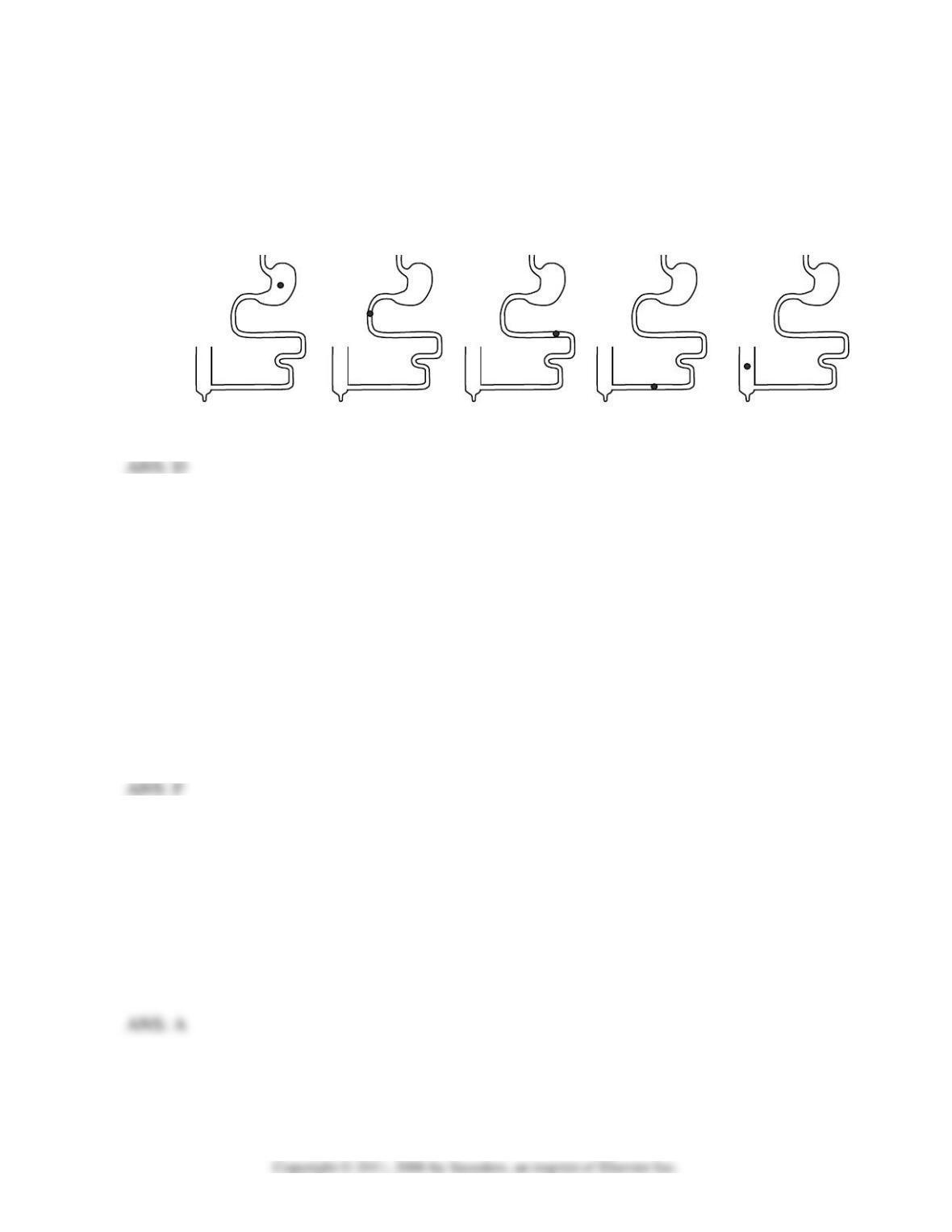
17. A 35-year-old woman is admitted to the emergency department because of severe upper
right quadrant pain. The woman is 5 feet 2 inches tall and weighs 254 pounds (BMI =
46.5). She states that her stools are clay colored and that her urine is dark orange.
Physical examination shows an enlarged liver and icteric conjunctiva. Laboratory results
show elevated serum bilirubin levels. Absorption of bile salts is most likely to be
decreased to the greatest extent at which of the following locations in this patient?
18. Elimination of bilirubin from the body requires several steps under normal conditions
that include (1) conjugation of bilirubin with glucuronic acid, (2) carriage of bilirubin by
albumin in plasma, (3) excretion of bilirubin into bile, and (4) uptake of free bilirubin by
hepatocytes. Which of the following best describes the correct temporal order of events?
A. 4, 3, 2, 1
B. 3, 1, 4, 2
C. 3, 4, 1, 2
D. 2, 1, 4, 3
E. 4, 2, 1, 3
F. 2, 4, 1, 3
G. 1, 2, 3, 4
H. 1, 3, 2, 4
19. An experimental device containing hepatocytes is developed to provide effective support
for patients with hepatic failure pending liver regeneration or liver transplantation.
Hepatocyte viability is best documented by an increase in which of the following?
A. Albumin output
B. Carbon dioxide uptake
C. Ethanol output
D. Lactate dehydrogenase (LDH) uptake
E. Oxygen output
A.
B.
C.
D.
E.

20. Which of the following best describes the rate-limiting step for the addition of bilirubin
to bile?
A. Conjugation
B. Elimination from phagocyte
C. Excretion into bile
D. Release from albumin
E. Uptake by hepatocytes
21. A 45-year-old physician drinks himself into oblivion on a regular basis. What are the
long-term complications of cirrhosis of the liver?
Jaundice Ascites Esophageal Varices Peripheral Edema
A. No Yes Yes No
B. No No Yes Yes
C. Yes Yes No Yes
D. Yes Yes Yes No
E. Yes Yes Yes Yes