Chapter 07 – Activity-Based Costing: A Tool to Aid Decision Making
7-101
121. Cosgrove Company manufactures two products, Product K-7 and Product L-15. Product
L-15 is of fairly recent origin, having been developed as an attempt to enter a market closely
related to that of Product K-7. Product L-15 is the more complex of the two products,
requiring 2.0 hours of direct labor time per unit to manufacture compared to 1.0 hour of direct
labor time for Product K-7. Product L-15 is produced on an automated production line.
Overhead currently is applied to the products on the basis of direct labor-hours. The company
estimated it would incur $510,000 in manufacturing overhead costs and produce 10,000 units
of Product L-15 and 40,000 units of Product K- 7 during the current year.
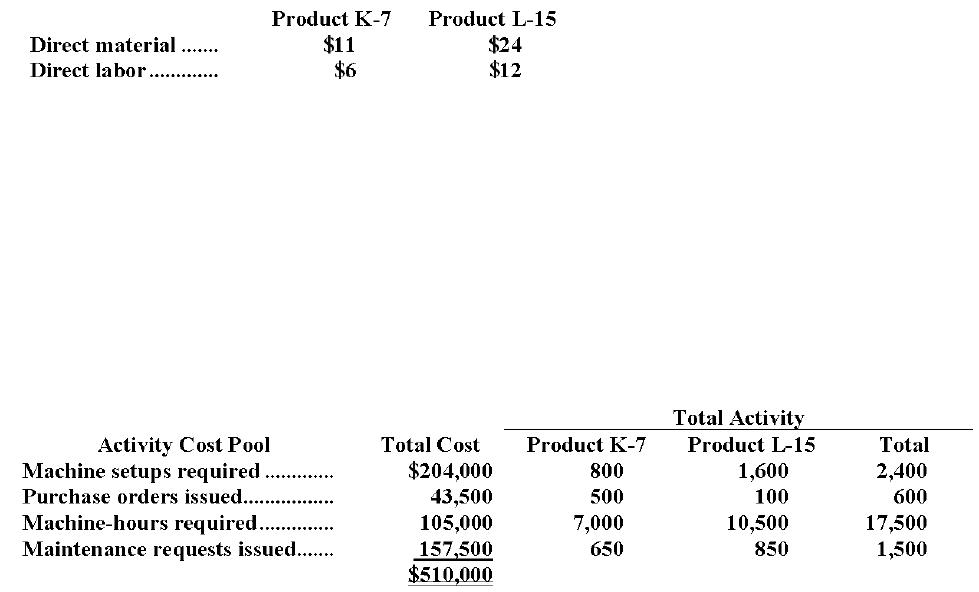
Unit costs for materials and labor are:
Required:
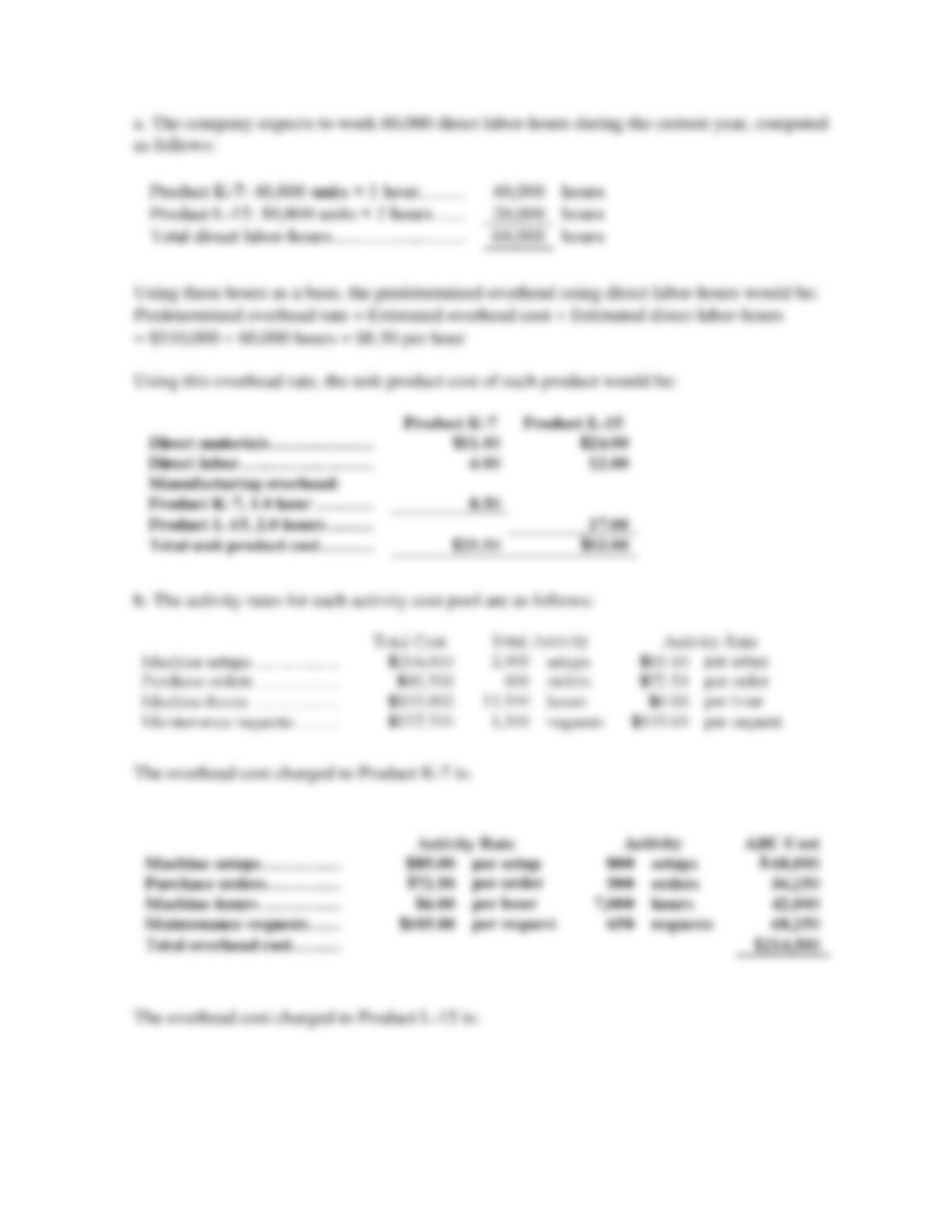
a. Compute the predetermined overhead rate under the current method, and determine the unit
product cost of each product for the current year.
b. The company is considering the use of activity-based costing as an alternative to its
traditional costing method for manufacturing overhead. Data relating to the company’s
activity cost pools for the current year are given below:
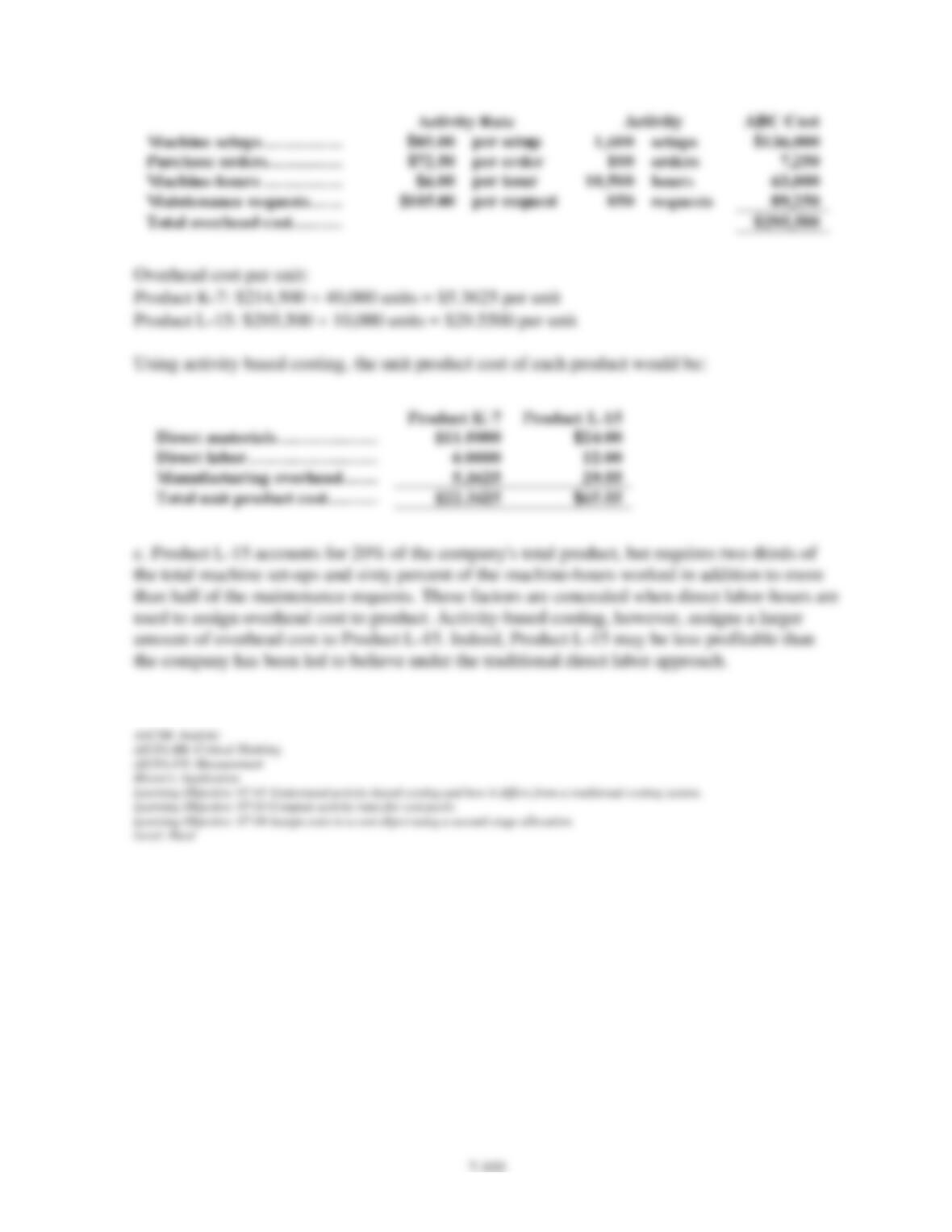
Using the data above, determine the unit product cost of each product for the current year.
c. What items of overhead cost make Product L-15 so costly to produce according to the
activity-based costing system? What influence might the activity-based costing data have on
management’s opinions regarding the profitability of Product L-15?
Chapter 07 – Activity-Based Costing: A Tool to Aid Decision Making
7-102
Chapter 07 – Activity-Based Costing: A Tool to Aid Decision Making
Chapter 07 – Activity-Based Costing: A Tool to Aid Decision Making
7-104
122. Findt & Thompson PLC, a consulting firm, uses an activity-based costing in which there
are three activity cost pools. The company has provided the following data concerning its
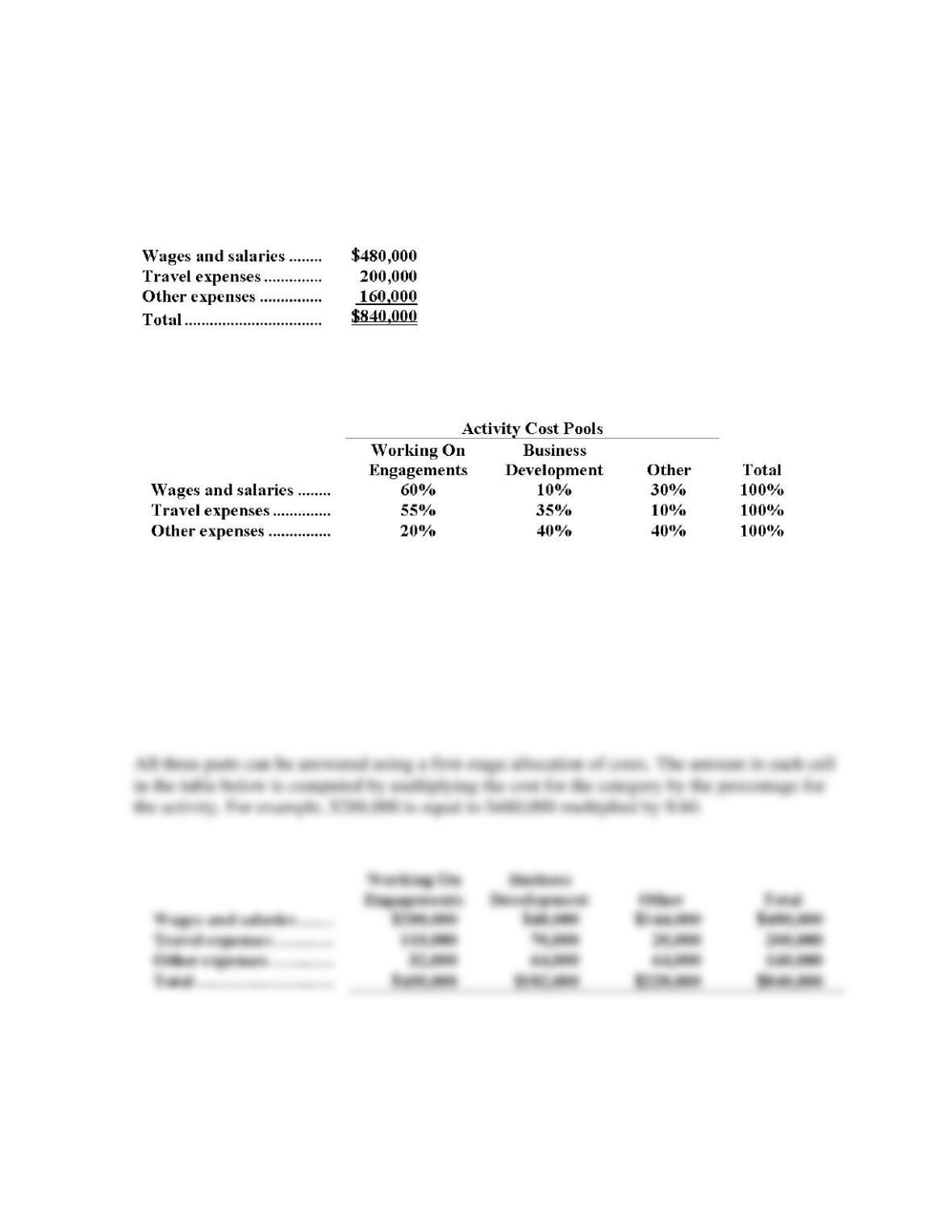
costs and its activity based costing system:
Costs:
Distribution of resource consumption:
Required:
a. How much cost, in total, would be allocated to the Working On Engagements activity cost
pool?
b. How much cost, in total, would be allocated to the Business Development activity cost
pool?
c. How much cost, in total, would be allocated to the Other activity cost pool?
Chapter 07 – Activity-Based Costing: A Tool to Aid Decision Making
7-105
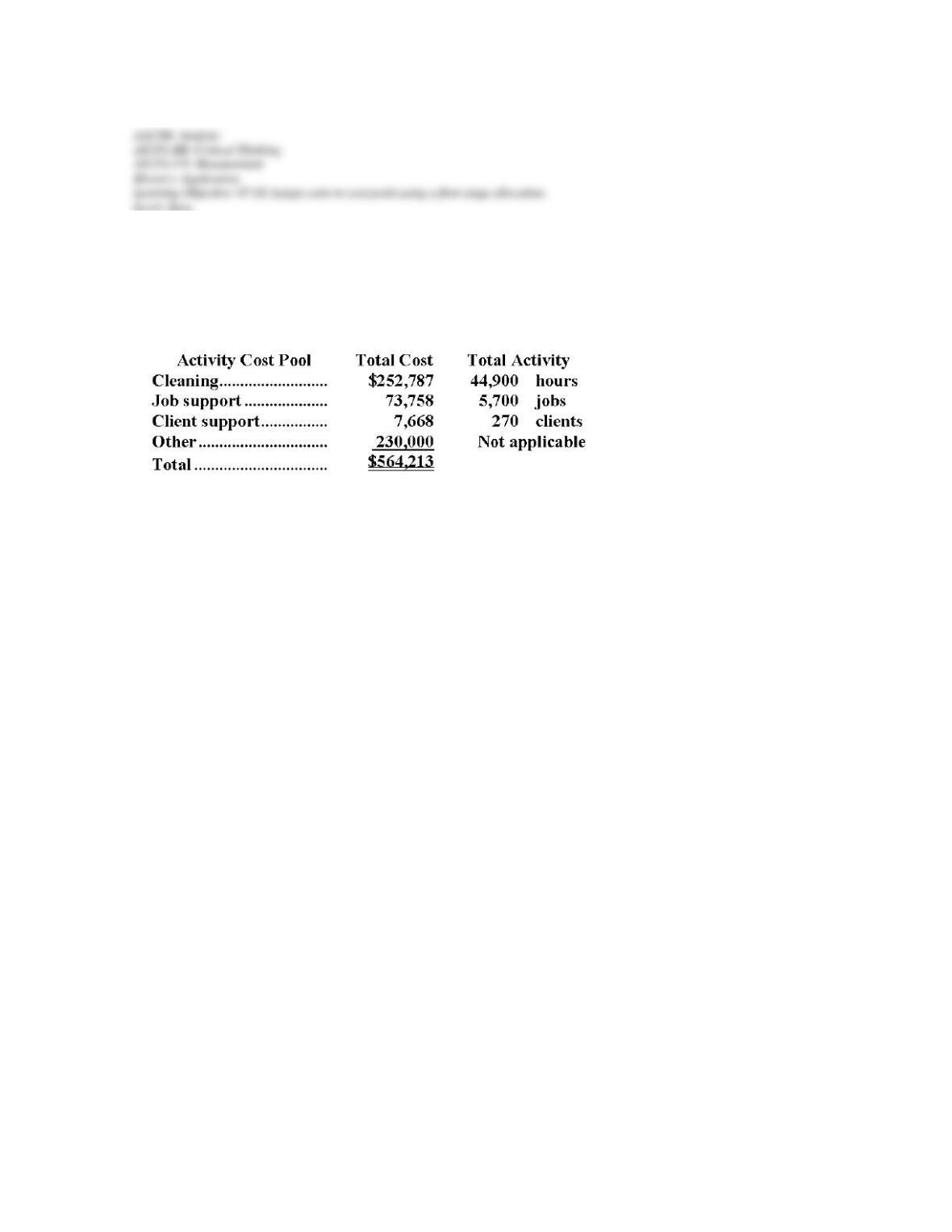
123. Roskam Housecleaning provides housecleaning services to its clients. The company uses
an activity-based costing system for its overhead costs. The company has provided the
following data from its activity-based costing system.
The “Other” activity cost pool consists of the costs of idle capacity and organization-
sustaining costs.
One particular client, the Haan family, requested 49 jobs during the year that required a total
of 245 hours of housecleaning. For this service, the client was charged $2,500.
Required:
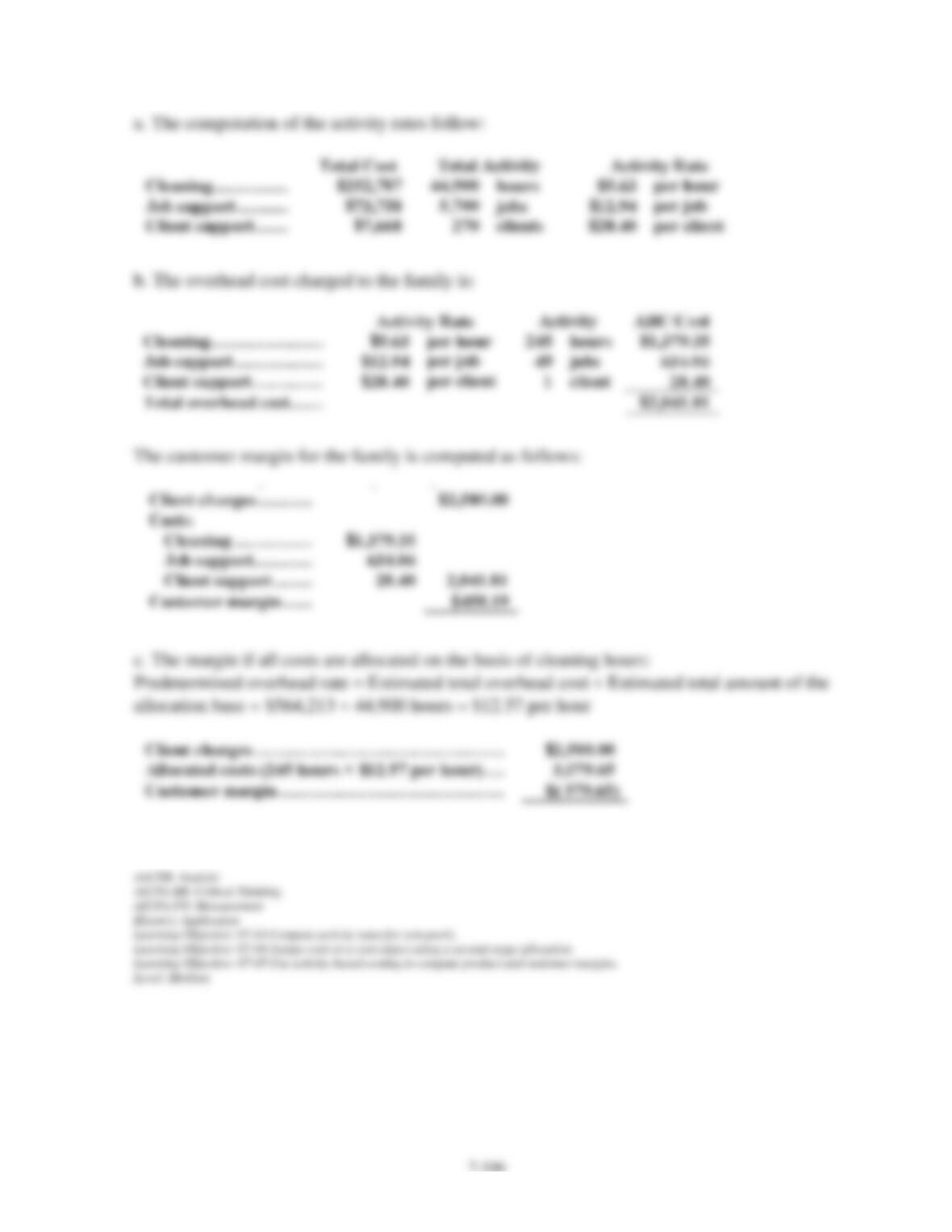
a. Compute the activity rates (i.e., cost per unit of activity) for the activity cost pools. Round
off all calculations to the nearest whole cent.
b. Using the activity-based costing system, compute the customer margin for the Haan family.
Round off all calculations to the nearest whole cent.
c. Assume the company decides instead to use a traditional costing system in which ALL
costs are allocated to customers on the basis of cleaning hours. Compute the margin for the
Haan family. Round off all calculations to the nearest whole cent.
Chapter 07 – Activity-Based Costing: A Tool to Aid Decision Making
Chapter 07 – Activity-Based Costing: A Tool to Aid Decision Making
7-107
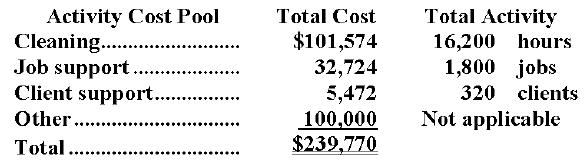
124. The Spurling Cleaning Brigade Company provides housecleaning services to its clients.
The company uses an activity-based costing system for its overhead costs. The company has
provided the following data from its activity-based costing system.
The “Other” activity cost pool consists of the costs of idle capacity and organization-
sustaining costs.
One particular client, the Vandal family, requested 32 jobs during the year that required a total
of 192 hours of housecleaning. For this service, the client was charged $2,200.
Required:
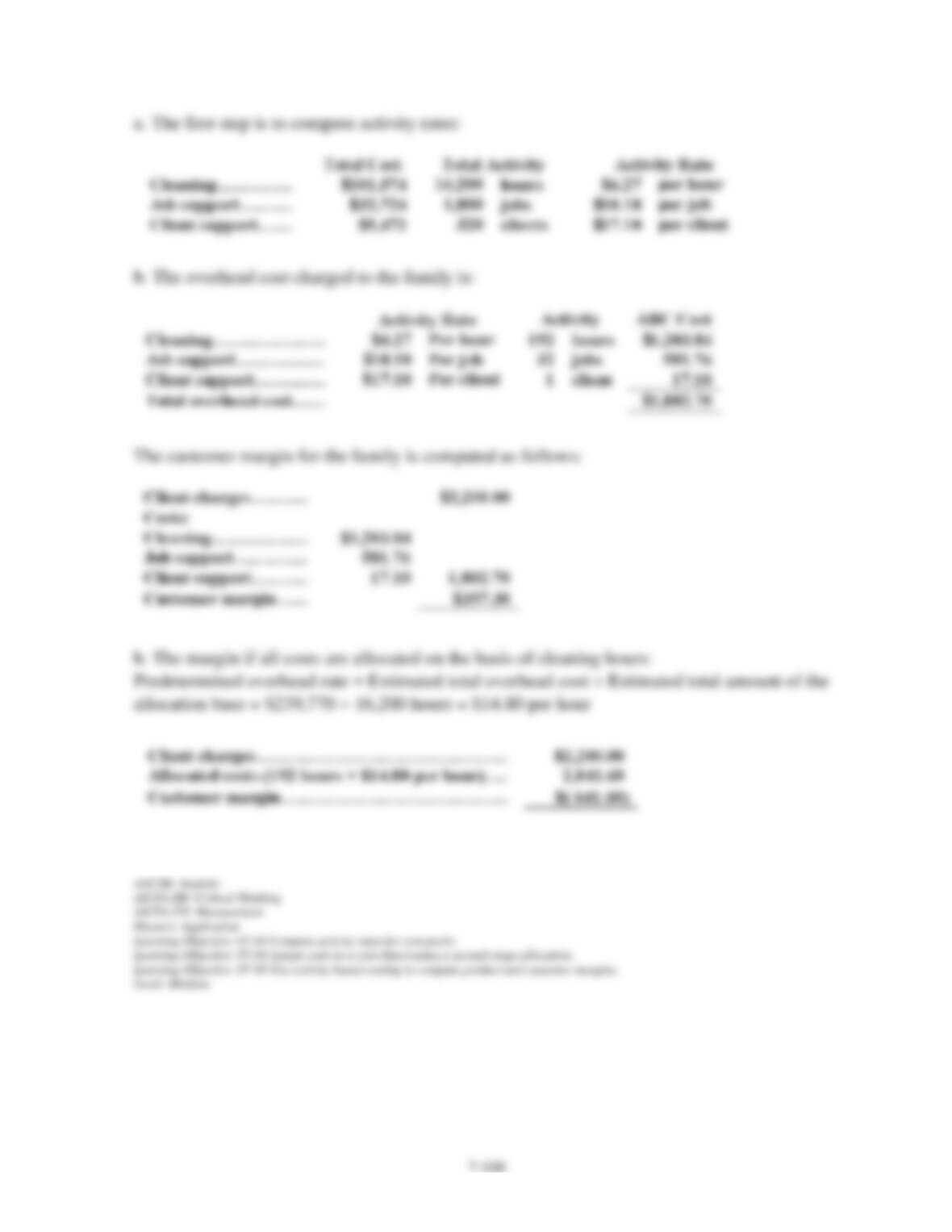
a. Using the activity-based costing system, compute the customer margin for the Vandal
family. Round off all calculations to the nearest whole cent.
b. Assume the company decides instead to use a traditional costing system in which ALL
costs are allocated to customers on the basis of cleaning hours. Compute the margin for the
Vandal family. Round off all calculations to the nearest whole cent.
Chapter 07 – Activity-Based Costing: A Tool to Aid Decision Making

Chapter 07 – Activity-Based Costing: A Tool to Aid Decision Making
7-109
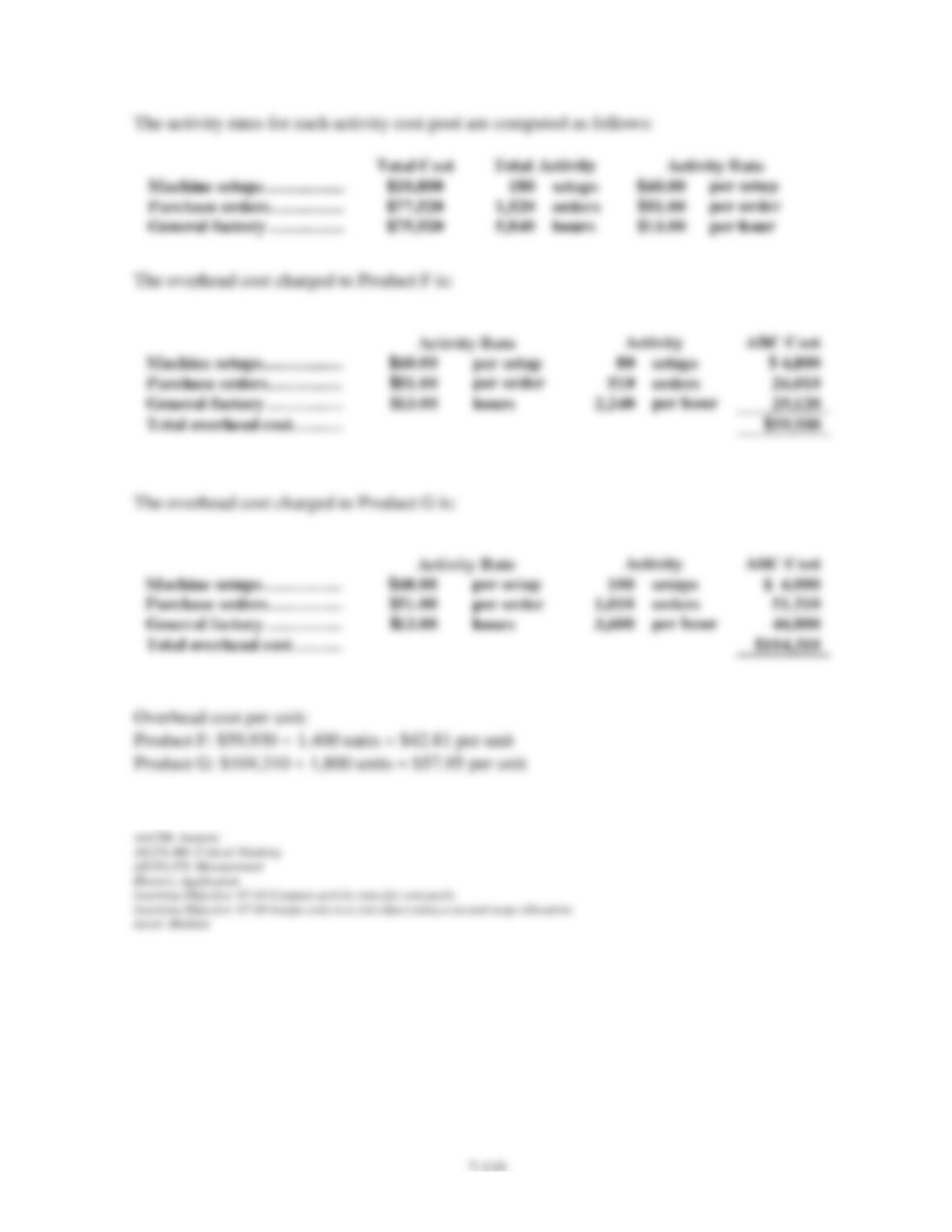
125. Daba Company manufactures two products, Product F and Product G. The company
expects to produce and sell 1,400 units of Product F and 1,800 units of Product G during the
current year. The company uses activity-based costing to compute unit product costs for
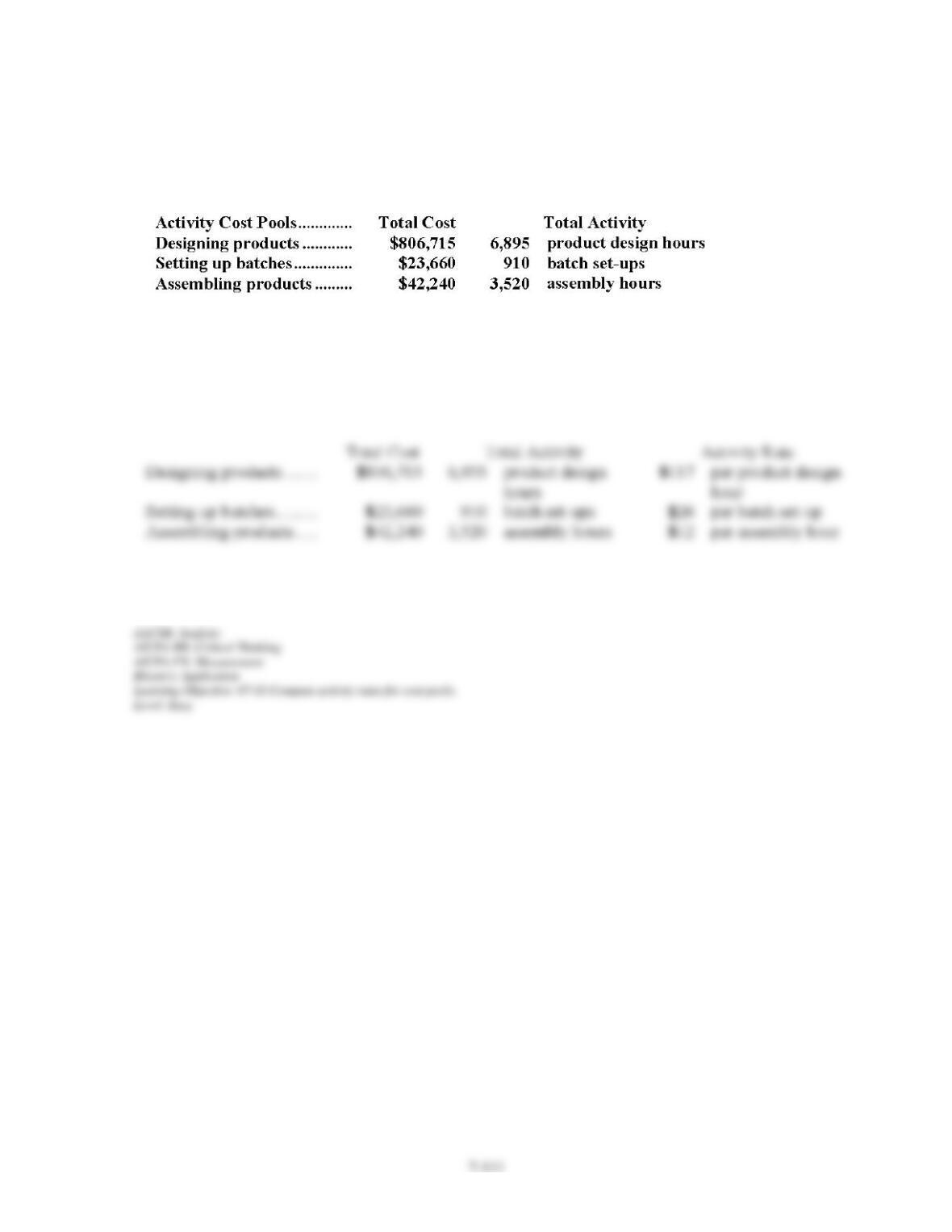
external reports. Data relating to the company’s three activity cost pools are given below for
the current year:
Required:
Using the activity-based costing approach, determine the overhead cost per unit for each
product.
Chapter 07 – Activity-Based Costing: A Tool to Aid Decision Making
Chapter 07 – Activity-Based Costing: A Tool to Aid Decision Making
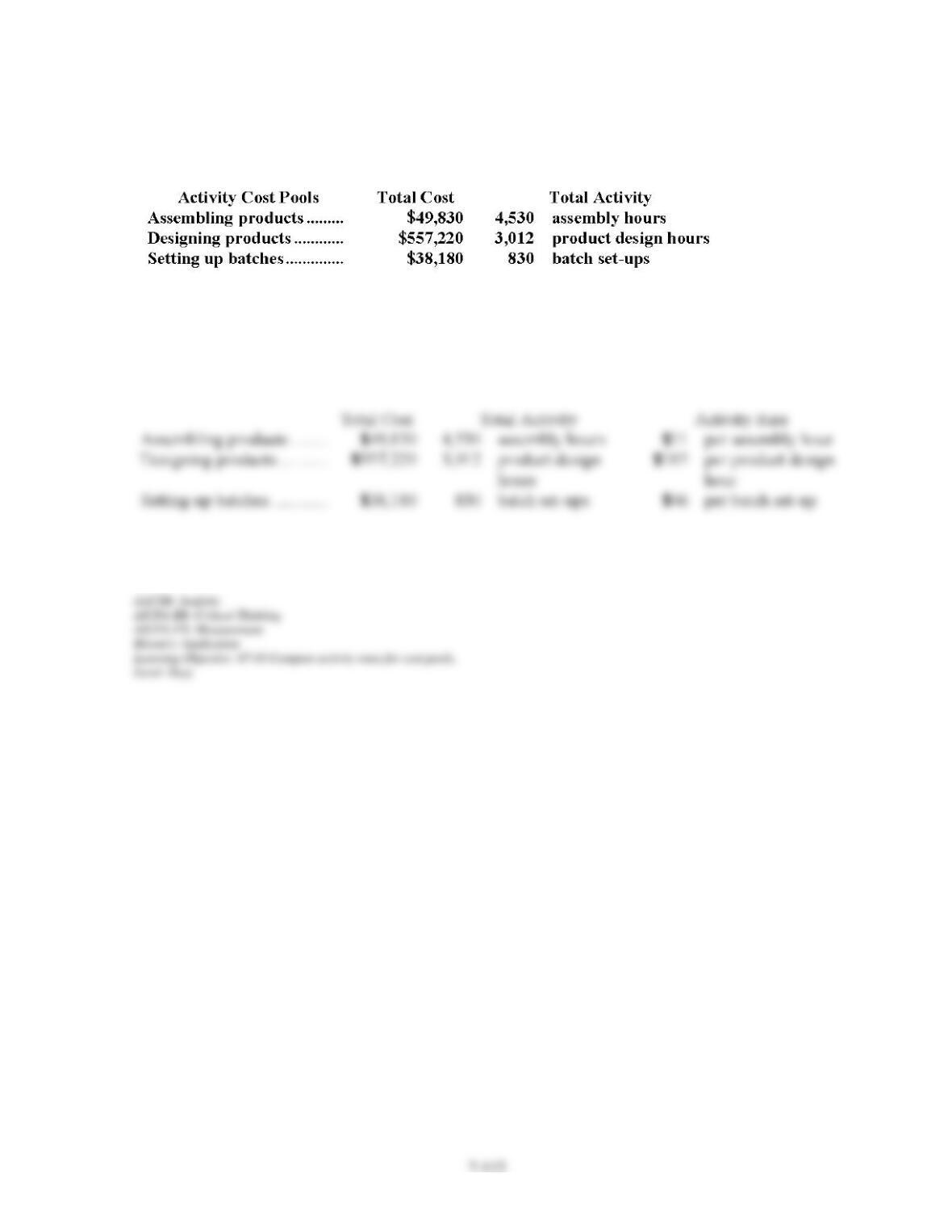
126. Bubb Corporation has provided the following data from its activity-based costing
accounting system:
Required:
Compute the activity rates for each of the three cost pools. Show your work!
Chapter 07 – Activity-Based Costing: A Tool to Aid Decision Making
127. Data concerning three of Pressnell Corporation’s activity cost pools appear below:
Required:
Compute the activity rates for each of the three cost pools. Show your work!
Chapter 07 – Activity-Based Costing: A Tool to Aid Decision Making
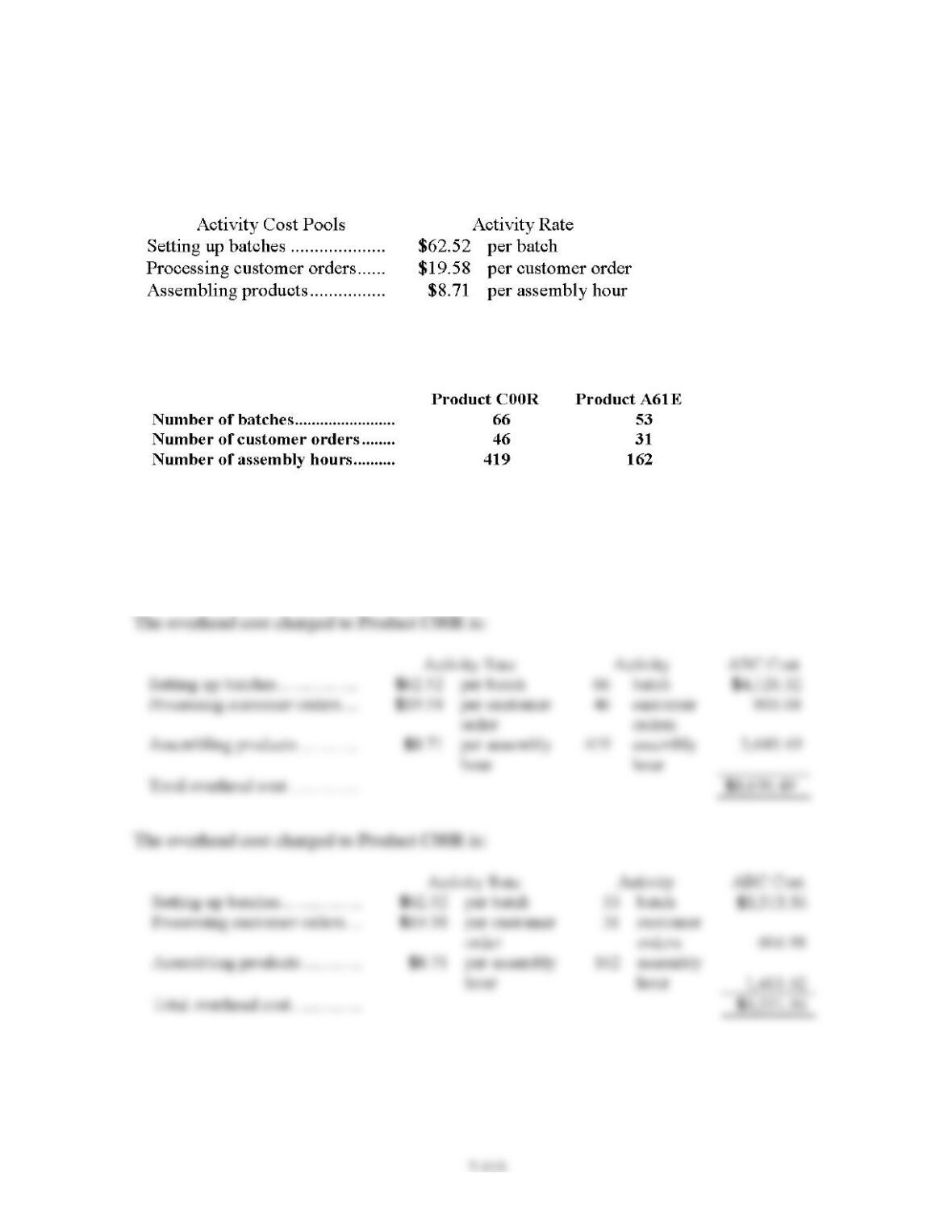
128. Schmeider Corporation uses the following activity rates from its activity-based costing to
assign overhead costs to products.
Data concerning two products appear below:
Required:
How much overhead cost would be assigned to each of the two products using the company’s
activity-based costing system?
Chapter 07 – Activity-Based Costing: A Tool to Aid Decision Making
7-114
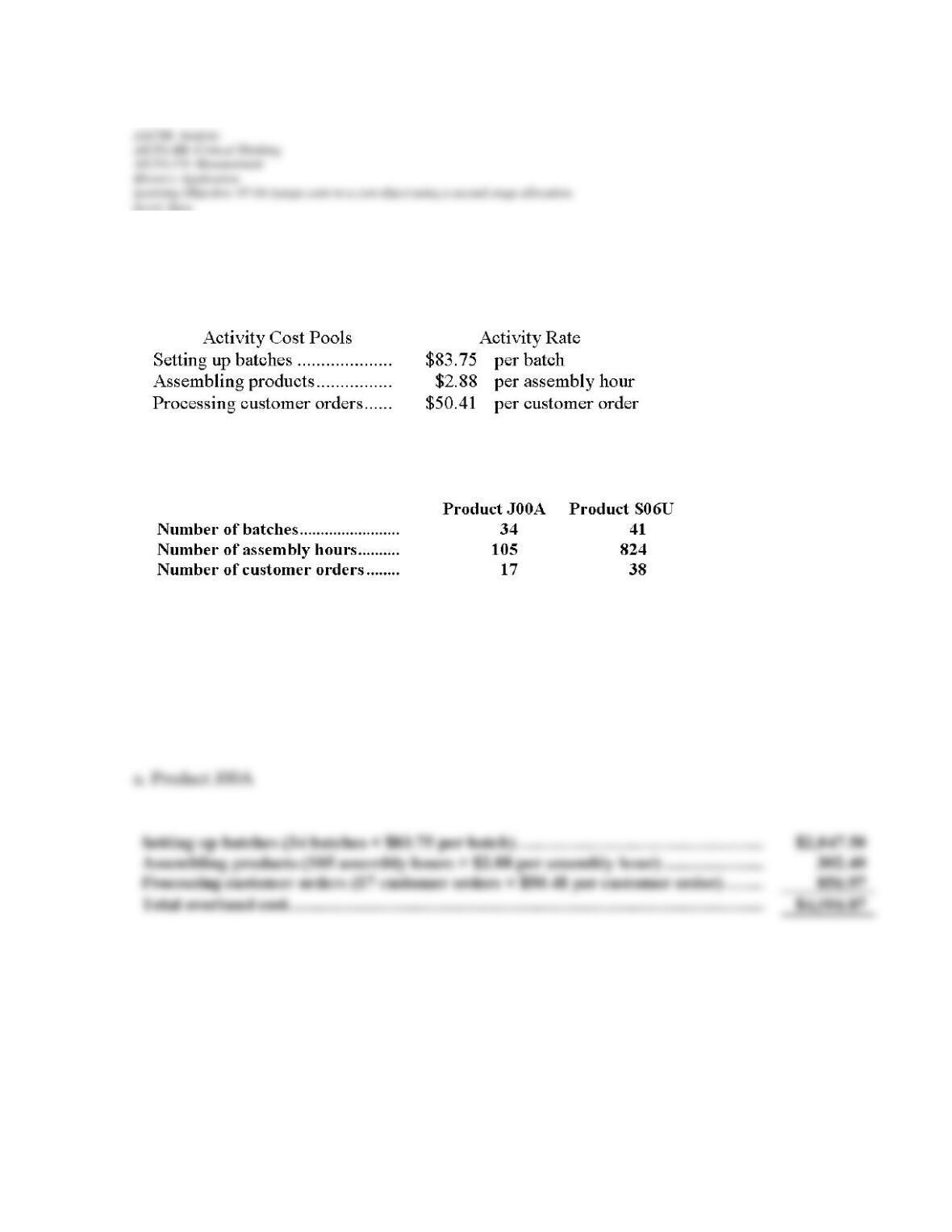
129. Kapoor Corporation uses the following activity rates from its activity-based costing to
assign overhead costs to products.
Data concerning two products appear below:
Required:
a. How much overhead cost would be assigned to Product J00A using the company’s activity-
based costing system? Show your work!
b. How much overhead cost would be assigned to Product S06U using the company’s activity-
based costing system? Show your work!
Chapter 07 – Activity-Based Costing: A Tool to Aid Decision Making
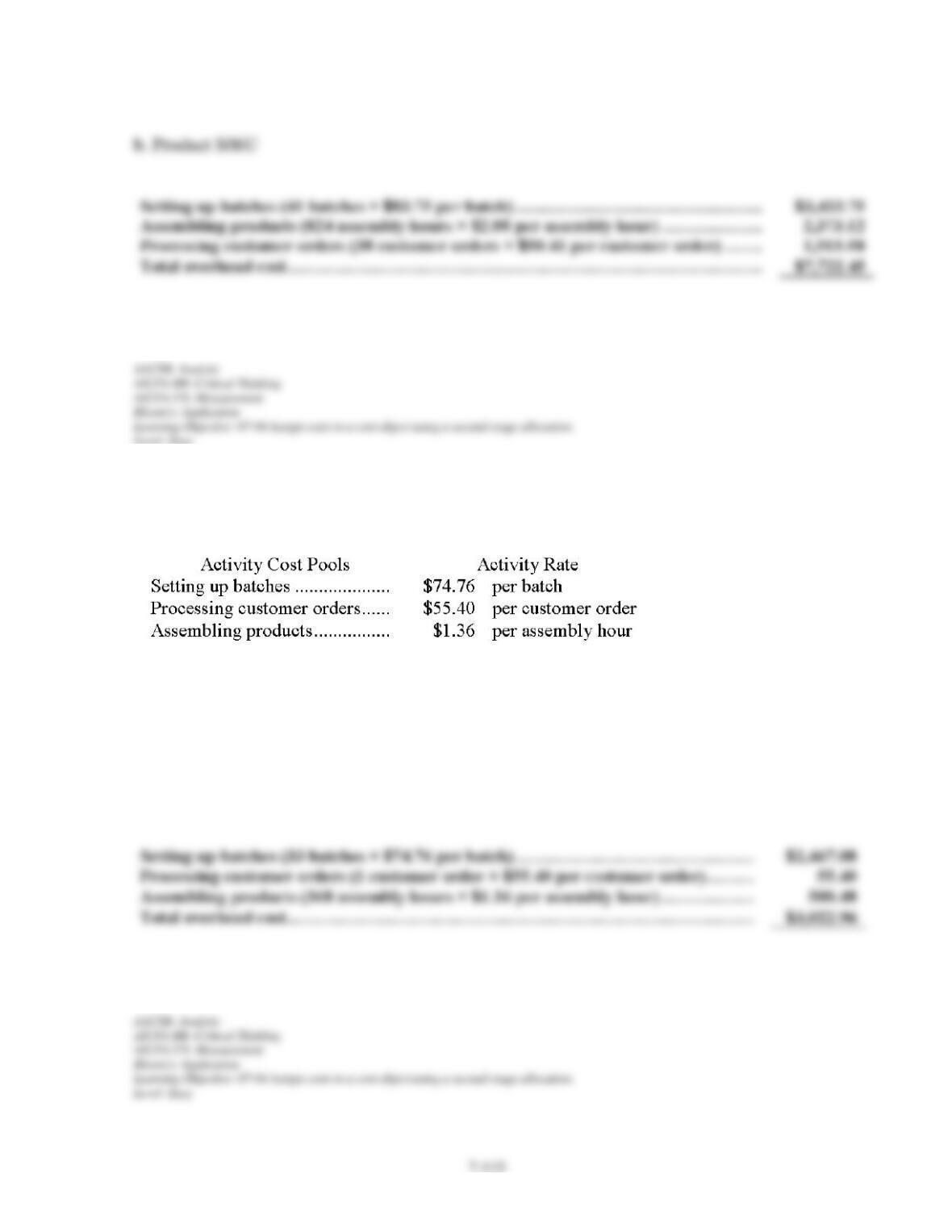
130. Alongi Corporation uses the following activity rates from its activity-based costing to
assign overhead costs to products.
Last year, Product P91M involved 33 batches, 1 customer order, and 368 assembly hours.
Required:
How much overhead cost would be assigned to Product P91M using the company’s activity-
based costing system? Show your work!
Chapter 07 – Activity-Based Costing: A Tool to Aid Decision Making
7-116
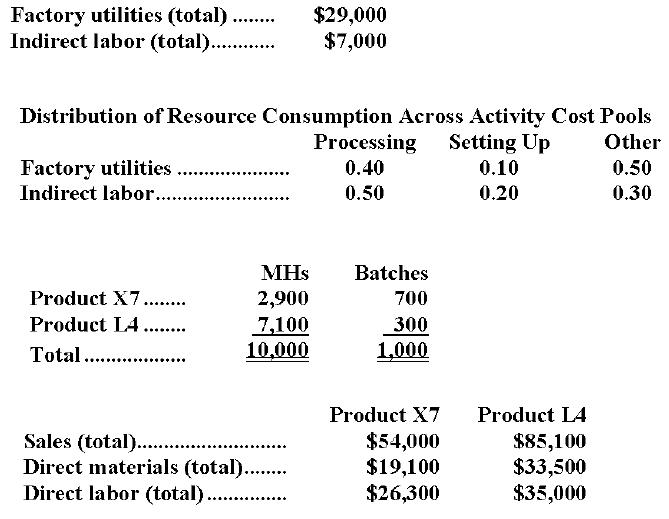
131. Murri Corporation has an activity-based costing system with three activity cost pools–
Processing, Setting Up, and Other. The company’s overhead costs, which consist of factory
utilities and indirect labor, are allocated to the cost pools in proportion to the activity cost
pools’ consumption of resources. Costs in the Processing cost pool are assigned to products
based on machine-hours (MHs) and costs in the Setting Up cost pool are assigned to products
based on the number of batches. Costs in the Other cost pool are not assigned to products.
Data concerning the two products and the company’s costs and activity-based costing system
appear below:
Required:
a. Assign overhead costs to activity cost pools using activity-based costing.
b. Calculate activity rates for each activity cost pool using activity-based costing.
c. Determine the amount of overhead cost that would be assigned to each product using
activity-based costing.
d. Determine the product margins for each product using activity-based costing.