114.
If a bond is selling at a discount, which of the following statements is correct?
115.
If a bond is selling at par value, which of the following statements is correct?
116.
To increase the liquidity for the home mortgage market, Fannie Mae and Freddie Mac
purchased home mortgages from banks and other lenders. They combined the mortgages
into diversified portfolios of loans and issued:
117.
Under what conditions is a bond likely to be called?
118.
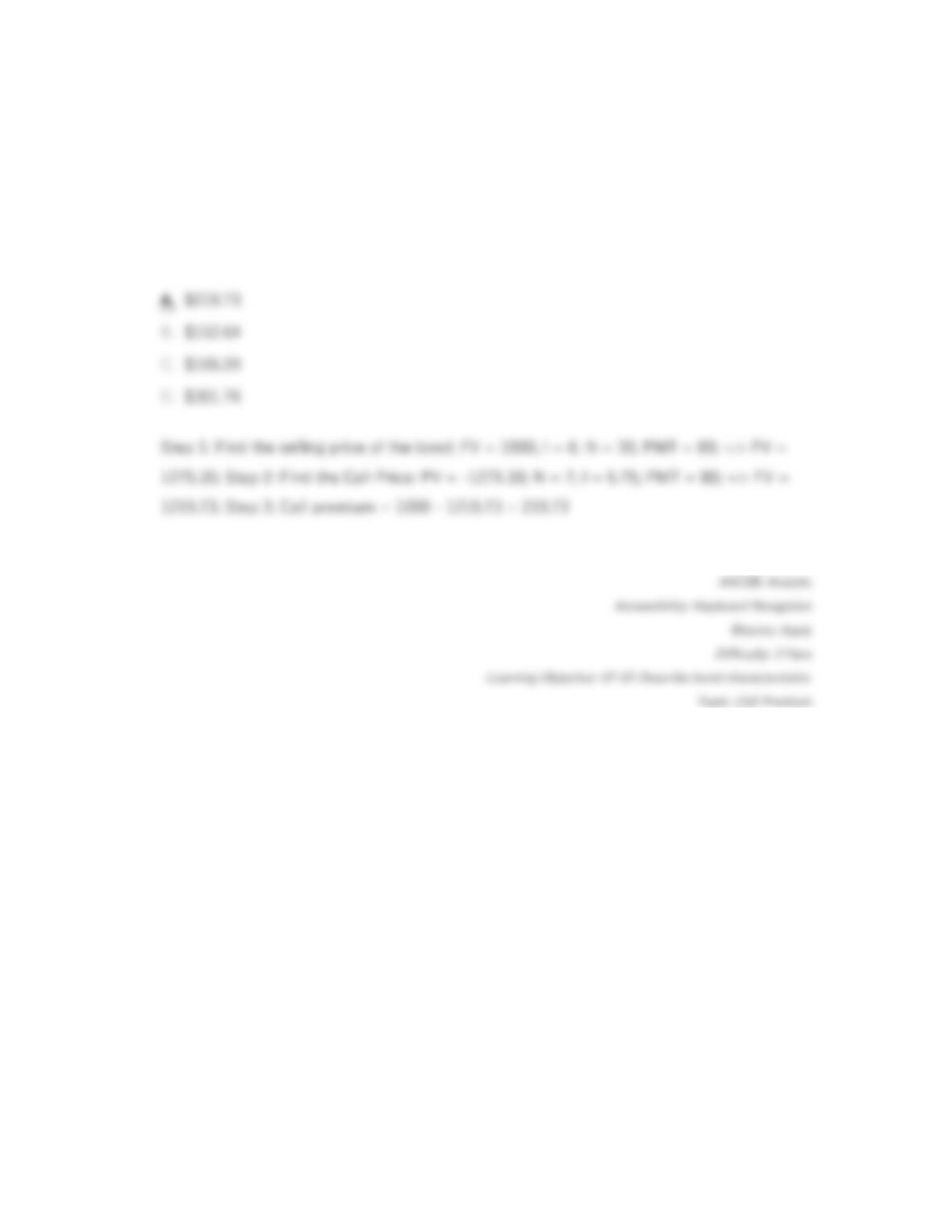
A 30-year bond with an 8 percent coupon has a yield to maturity of 6 percent. The bond
could be called in seven years and if called would generate a yield to call of 5.75 percent.
What is this bond’s call premium? Assume the coupon payments are made annually and
par value is $1,000.
119.
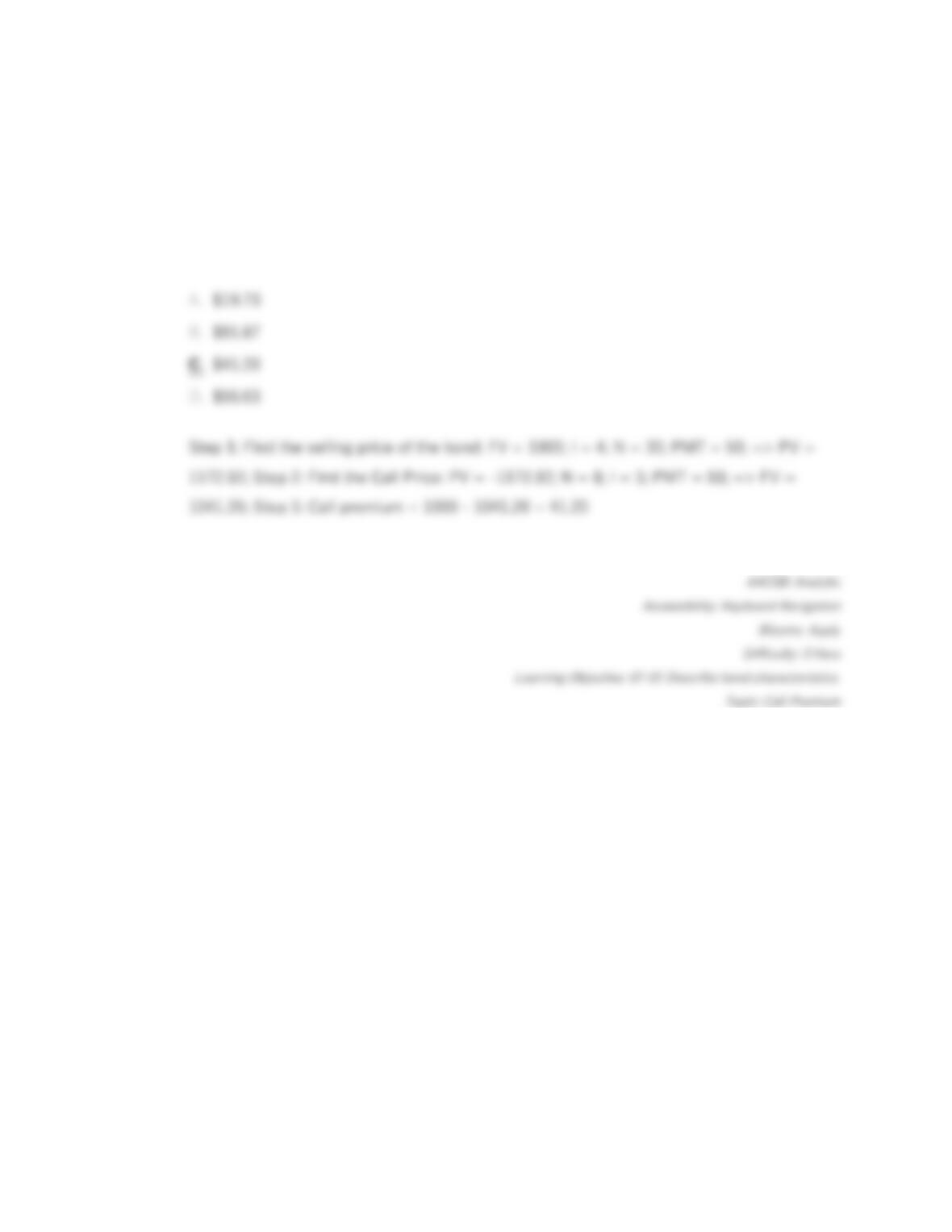
A 15-year bond with a 10 percent coupon has a yield to maturity of 8 percent. The bond
could be called in four years and if called would generate a yield to call of 6 percent. What
is this bond’s call premium? Assume the coupon payments are made semi-annually and
par value is $1,000.
120.
A 5 percent coupon bond has 10 years to maturity and could be called in two years. If the
bond is called, investors will earn 6.2 percent. The call premium is one year of coupon
payments. If coupon payments are made semi-annually and par value is $1,000, what is
the bond’s yield to maturity?
121.
A 7 percent coupon bond has 10 years to maturity and could be called in three years. If the
bond is called, investors will earn 5.5 percent. The call premium is one year of coupon
payments. If coupon payments are made semi-annually and par value is $1,000, what is
the bond’s yield to maturity?
122.
A 10 percent coupon bond has 15 years to maturity and could be called in two years. If the
bond is called, investors will earn 4 percent. The call premium is one year of coupon
payments. If coupon payments are made annually and par value is $1,000, what is the
bond’s yield to maturity?
123.
Describe the relationship between interest rate changes and bond prices.
124.
Describe reasons that the U.S. government and corporations would issue bonds.
125.
Explain why high-income and wealthy people are more likely to buy a municipal bond than
a corporate bond.
126.
Yields of a Bond A 4.75 percent coupon municipal bond has 20 years left to maturity and
has a price quote of 98.9. The bond can be called in five years. The call premium is one
year of coupon payments. Compute and discuss the bond’s current yield, yield to maturity,
taxable equivalent yield (for an investor in the 35 percent marginal tax bracket), and yield
to call. (Assume interest payments are paid semi–annually and a par value of $5,000.)
127.
Bond Ratings and Prices A corporate bond with a 5.75 percent coupon has 10 years left
to maturity. It has had a credit rating of BBB and a yield to maturity of 6.25 percent. The
firm has recently gotten into some trouble and the rating agency is downgrading the bonds
to BB. The new appropriate discount rate will be 6.75 percent. What will be the change in
the bond’s price in dollars and percentage terms? (Assume interest payments are paid
semi-annually and a par value of $1,000.)
128.
What does a call provision allow the issuer to do, and why would they do it?
129.
All else equal, which bond’s price is more affected by a change in interest rates, a bond
with a large coupon or a small coupon? Why?
130.
Explain how investors can assess bond market performance.
131.
What actions taken by the Federal Reserve preceded and possibly helped precipitate the
recent financial crisis?
132.
Explain what the indenture agreement states.
133.
Explain how mortgage-backed securities work.
134.
Provide the definitions of a discount bond and a premium bond. Give examples.
135.
All else equal, which bond’s price is more affected by a change in interest rates, a short–
term bond or a longer-term bond? Why?
136.
Explain how a bond’s interest rate can change over time even if interest rates in the
economy do not change.
137.
Describe the difference between a bond issued as a high-yield bond and one that has
become a “fallen angel.”

138.
Explain what credit quality risk measures.