Chapter 07 – Activity-Based Costing: A Tool to Aid Decision Making
52. What would be the total overhead cost per bouquet according to the activity based costing
system? In other words, what would be the overall activity rate for the making bouquets
activity cost pool? (Round to the nearest whole cent.)
Chapter 07 – Activity-Based Costing: A Tool to Aid Decision Making
53. What would be the total overhead cost per delivery according to the activity based costing
system? In other words, what would be the overall activity rate for the deliveries activity cost
pool? (Round to the nearest whole cent.)
Chapter 07 – Activity-Based Costing: A Tool to Aid Decision Making
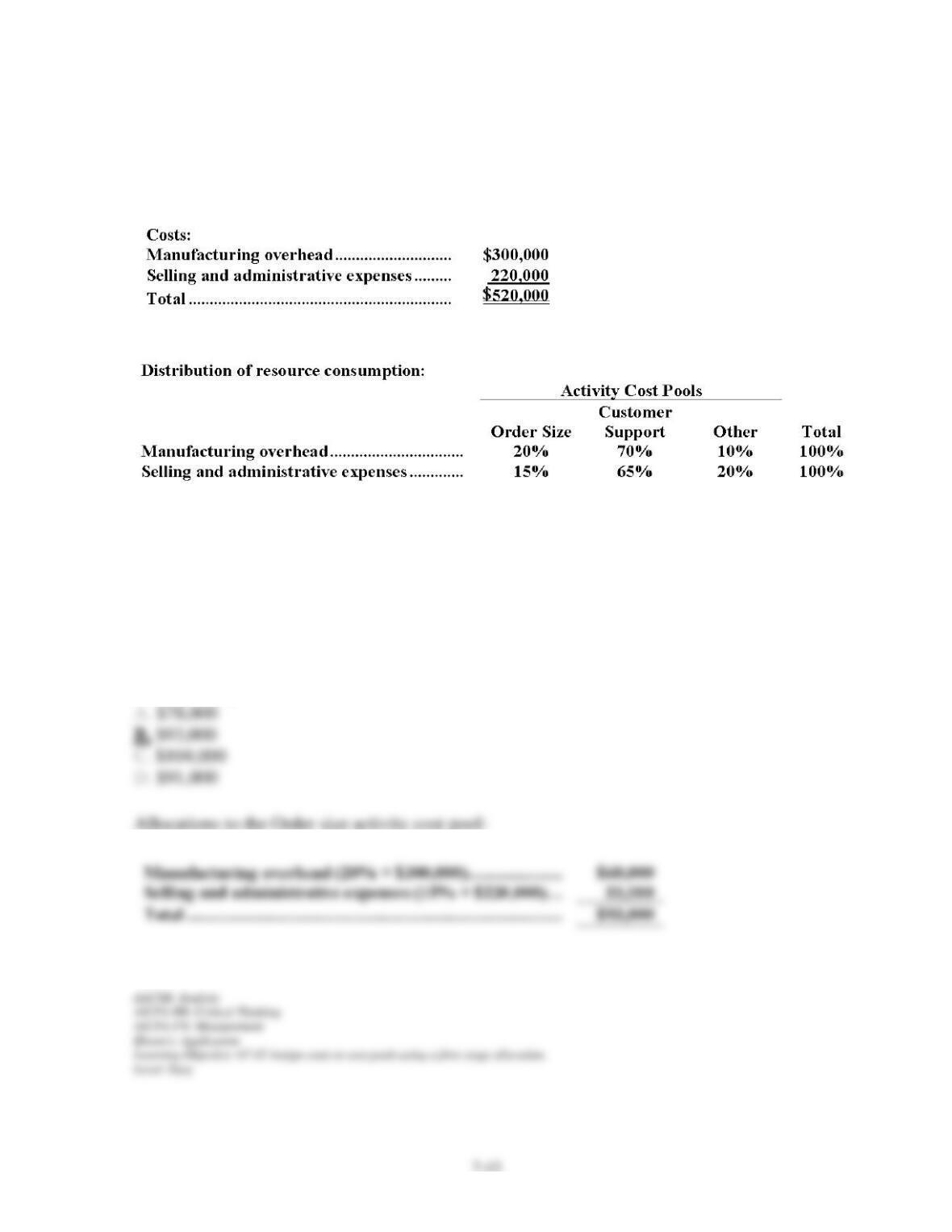
Dillner Company uses an activity-based costing system with three activity cost pools. The
company has provided the following data concerning its costs and its activity based costing
system:
The “Other” activity cost pool consists of the costs of idle capacity and organization-
sustaining costs.
You have been asked to complete the first-stage allocation of costs to the activity cost pools.
54. How much cost, in total, would be allocated in the first-stage allocation to the Order Size
activity cost pool?
Chapter 07 – Activity-Based Costing: A Tool to Aid Decision Making
55. How much cost, in total, would be allocated in the first-stage allocation to the Customer
Support activity cost pool?
56. How much cost, in total, should NOT be allocated to orders and products in the second
stage of the allocation process if the activity-based costing system is used for internal
decision-making?
Chapter 07 – Activity-Based Costing: A Tool to Aid Decision Making
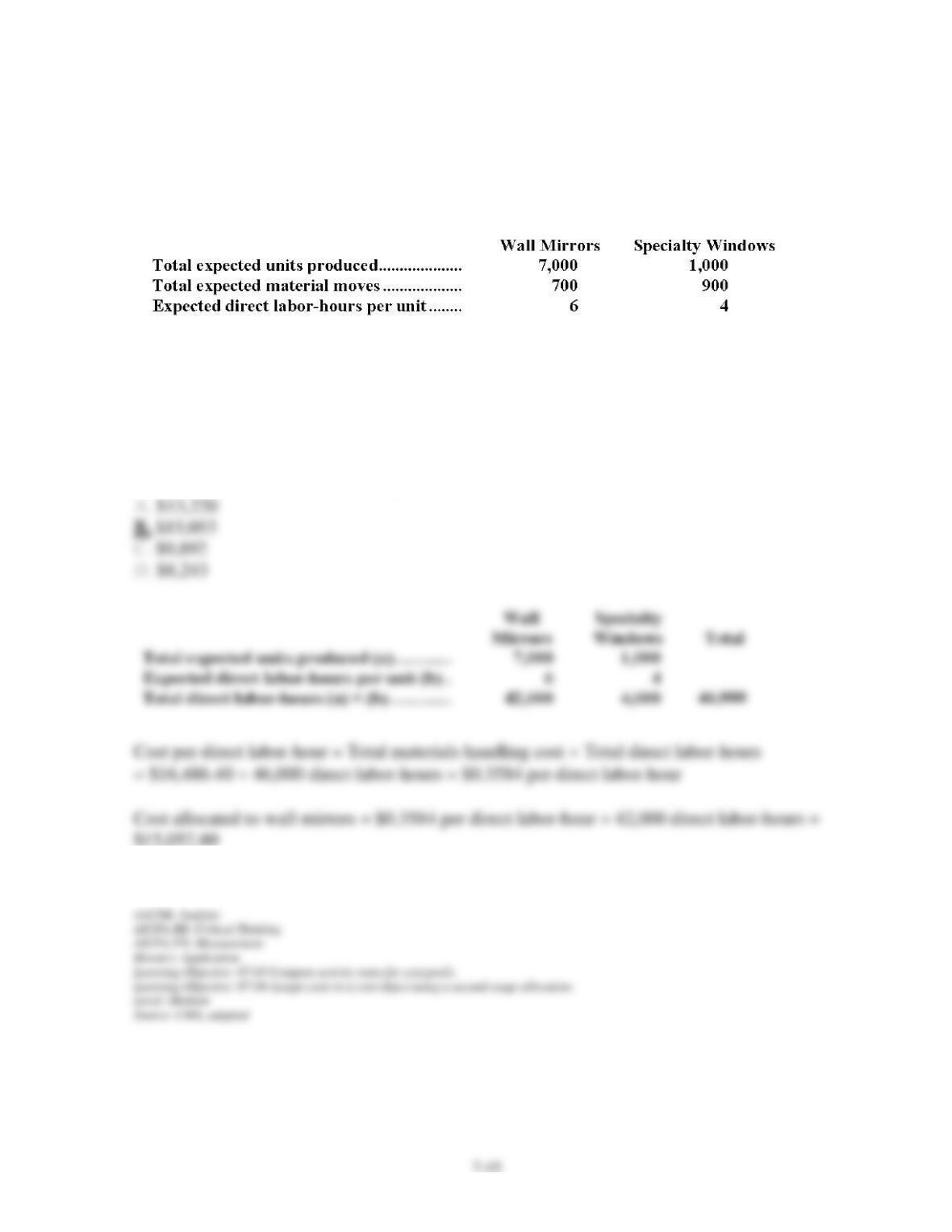
The controller of Ferrence Company estimates the amount of materials handling overhead
cost that should be allocated to the company’s two products using the data that are given
below:
The total materials handling cost for the year is expected to be $16,486.40.
57. If the materials handling cost is allocated on the basis of direct labor-hours, how much of
the total materials handling cost would be allocated to the wall mirrors? (Round off your
answer to the nearest whole dollar.)
Chapter 07 – Activity-Based Costing: A Tool to Aid Decision Making
7-46
58. If the materials handling cost is allocated on the basis of material moves, how much of the
total materials handling cost would be allocated to the specialty windows? (Round off your
answer to the nearest whole dollar.)
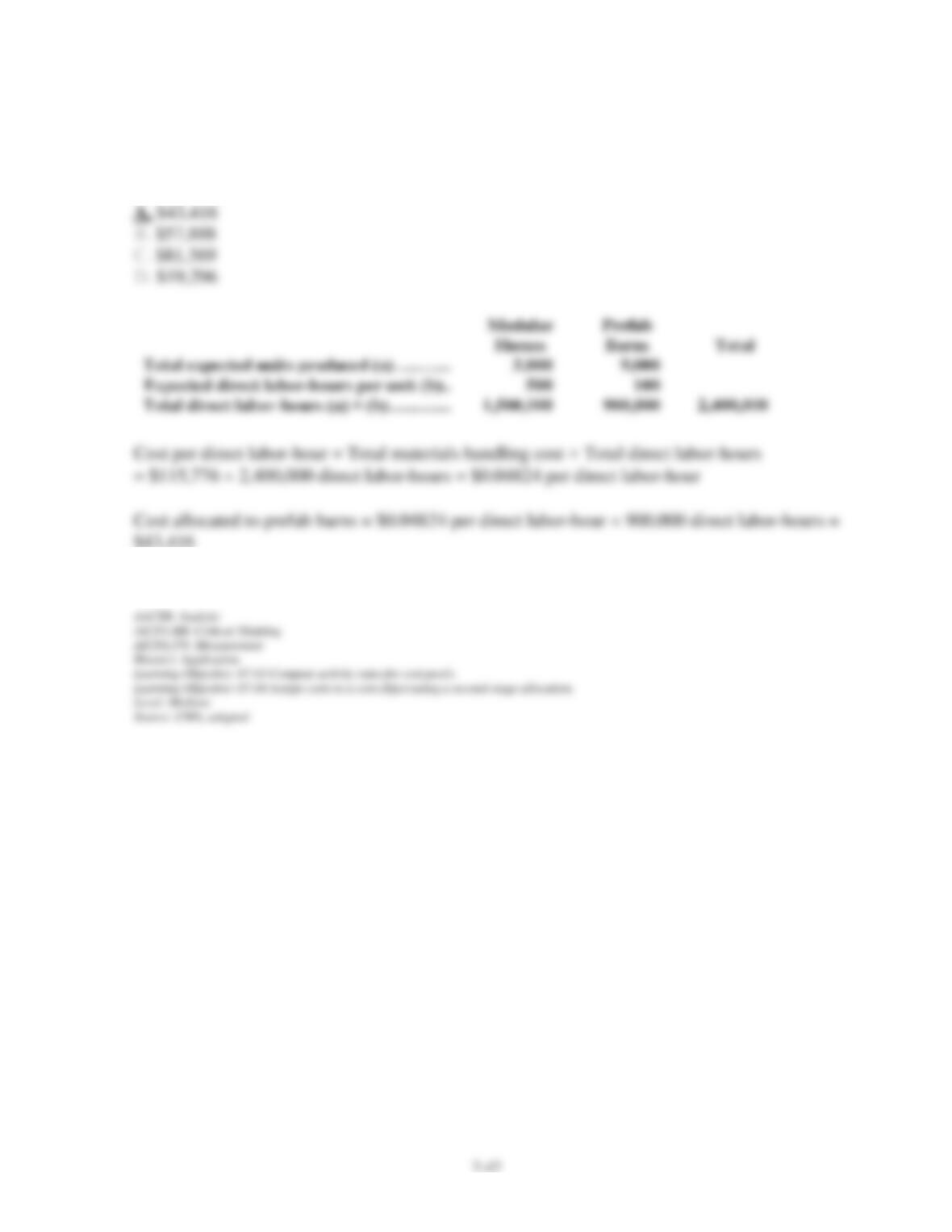
Andujo Company allocates materials handling cost to the company’s two products using the
below data:
The total materials handling cost for the year is expected to be $115,776.
Chapter 07 – Activity-Based Costing: A Tool to Aid Decision Making
59. If the materials handling cost is allocated on the basis of direct labor-hours, how much of
the total materials handling cost would be allocated to the prefab barns? (Round off your
answer to the nearest whole dollar.)
Chapter 07 – Activity-Based Costing: A Tool to Aid Decision Making
7-48
60. If the materials handling cost is allocated on the basis of material moves, how much of the
total materials handling cost would be allocated to the modular homes? (Round off your
answer to the nearest whole dollar.)
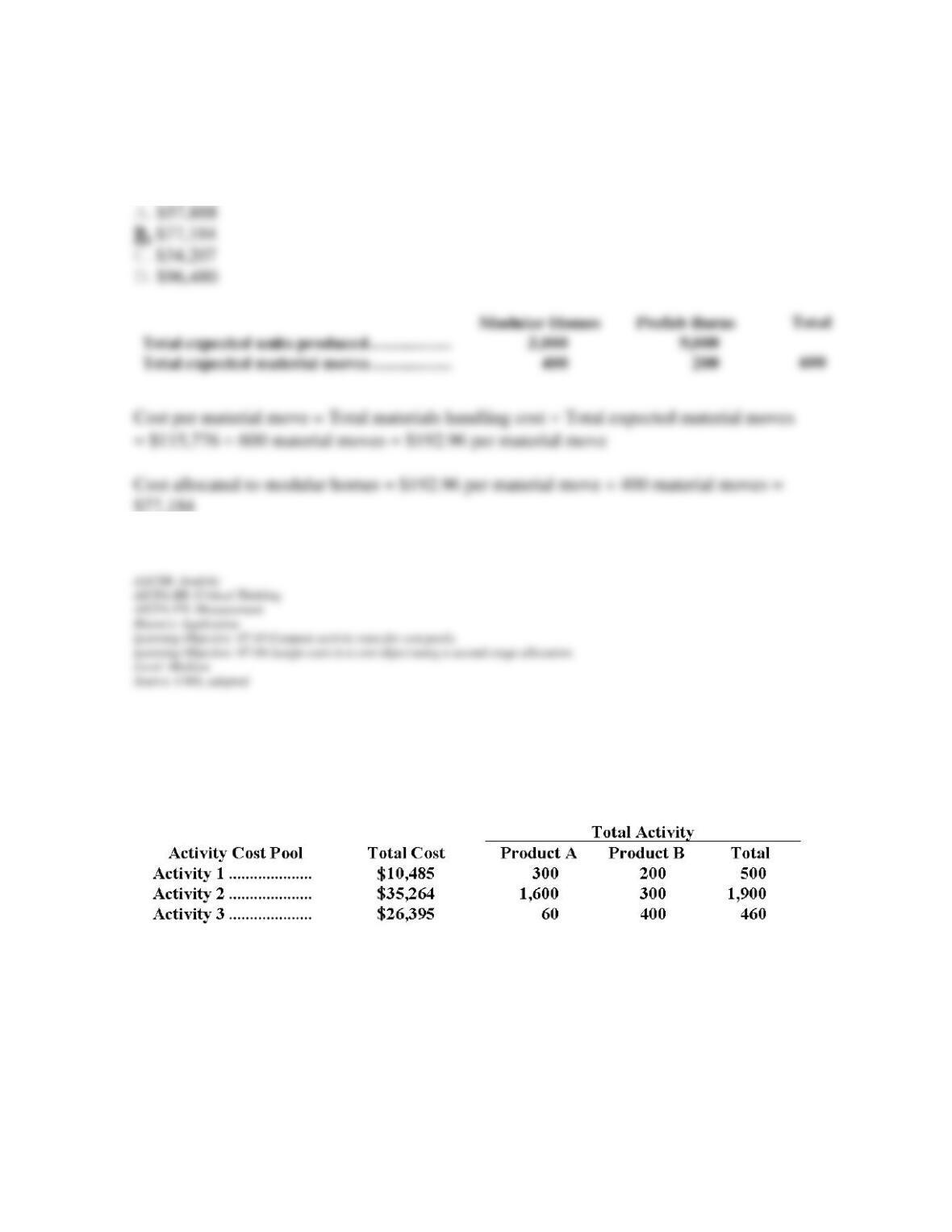
Abraham Company uses activity-based costing. The company has two products: A and B.
The annual production and sales of Product A is 200 units and of Product B is 1,000 units.
There are three activity cost pools, with total costs and activity as follows:
Chapter 07 – Activity-Based Costing: A Tool to Aid Decision Making
61. The activity rate for Activity 2 is closest to:
Chapter 07 – Activity-Based Costing: A Tool to Aid Decision Making
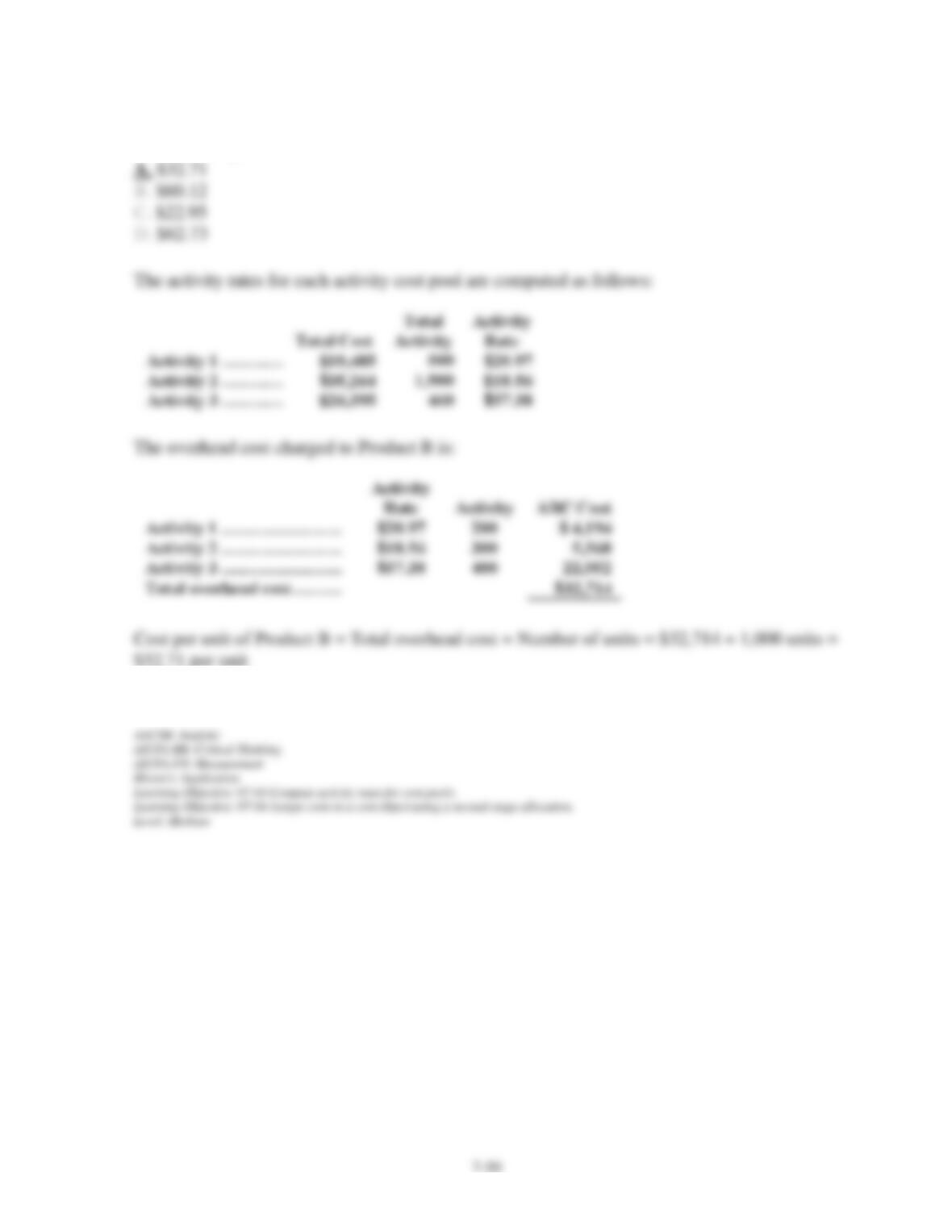
62. The cost per unit of Product B is closest to:
Chapter 07 – Activity-Based Costing: A Tool to Aid Decision Making
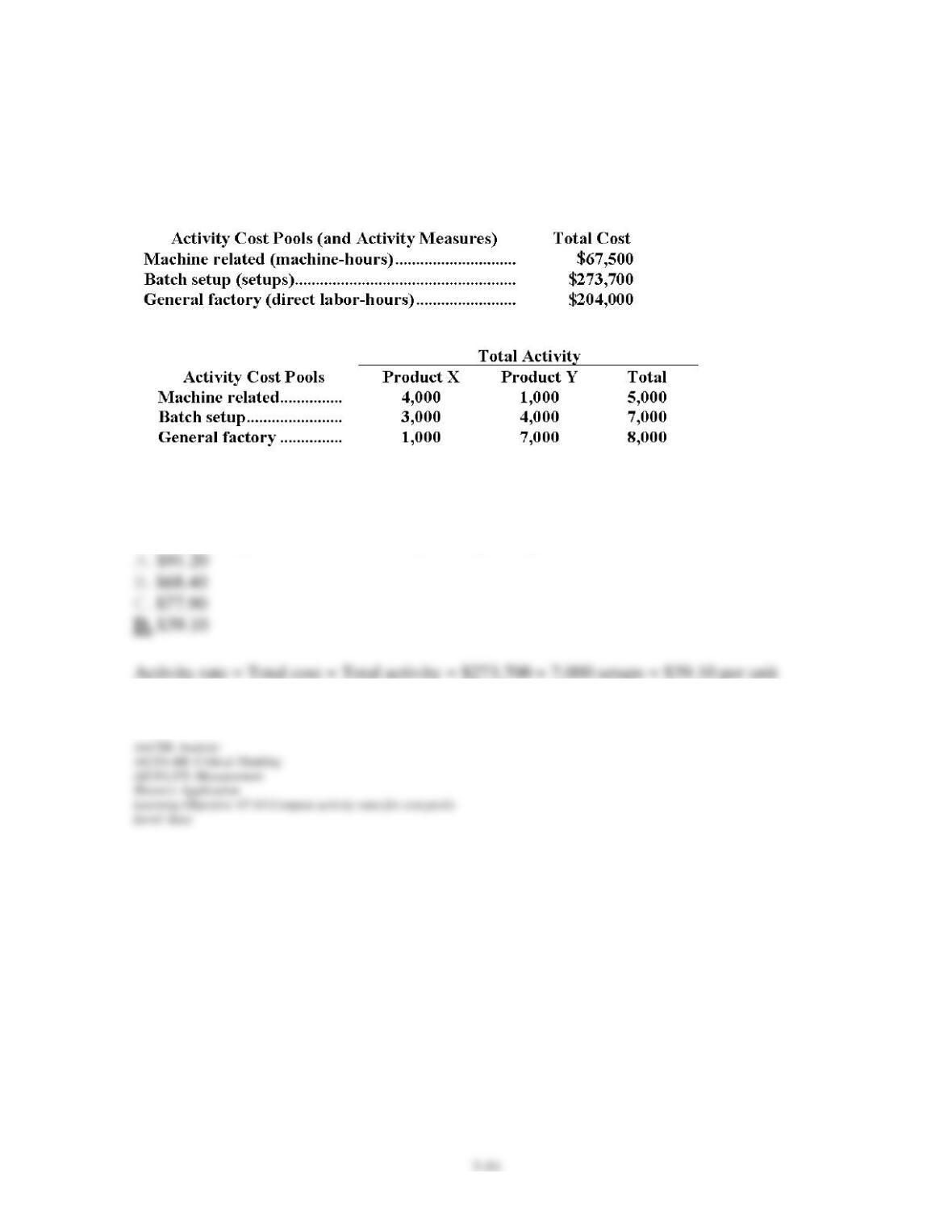
Austad Corporation uses activity-based costing to determine product costs for external
financial reports. The company has provided the following data concerning its activity-based
costing system:
63. The activity rate for the batch setup activity cost pool is closest to:
Chapter 07 – Activity-Based Costing: A Tool to Aid Decision Making
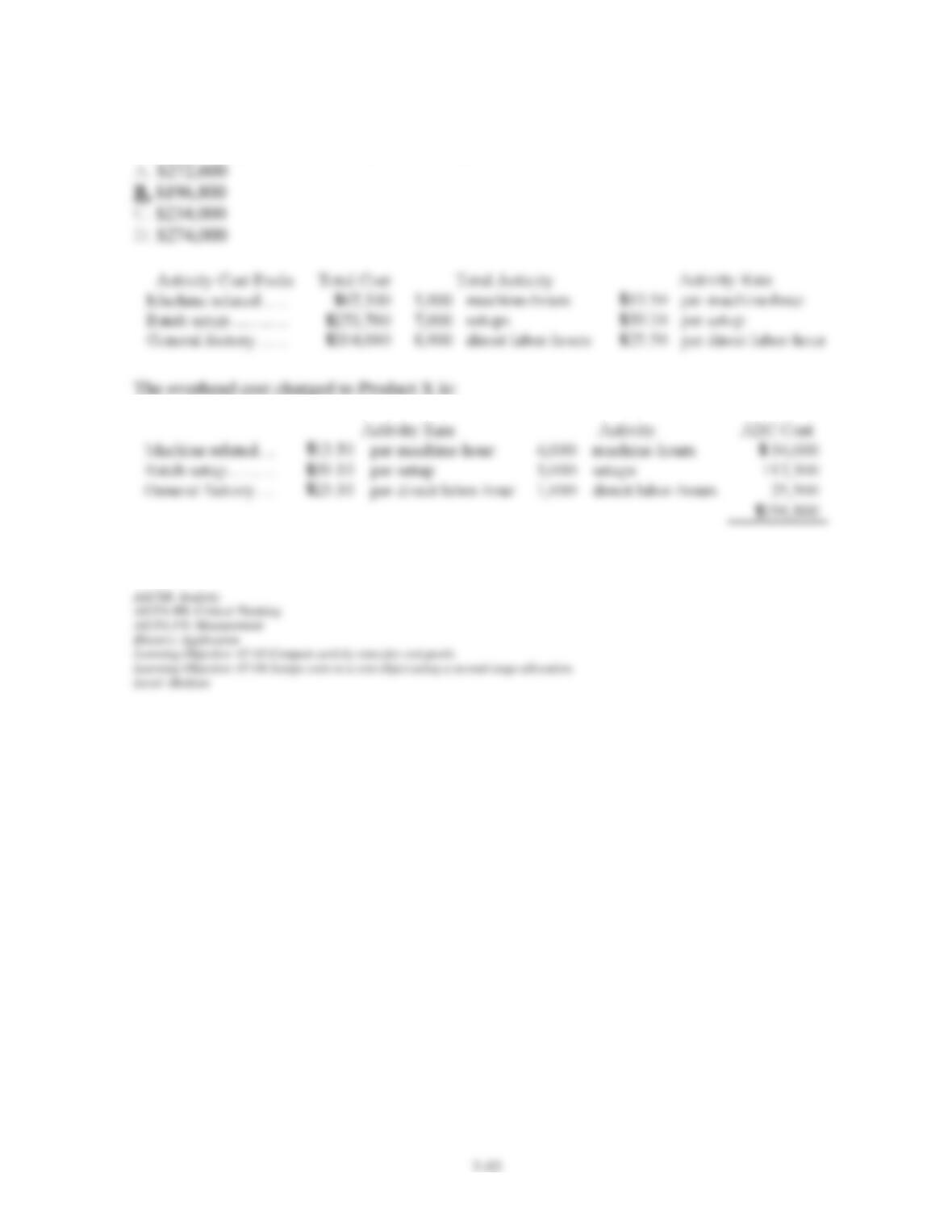
64. The total amount of overhead cost allocated to Product would be closest to:
Chapter 07 – Activity-Based Costing: A Tool to Aid Decision Making
7-53
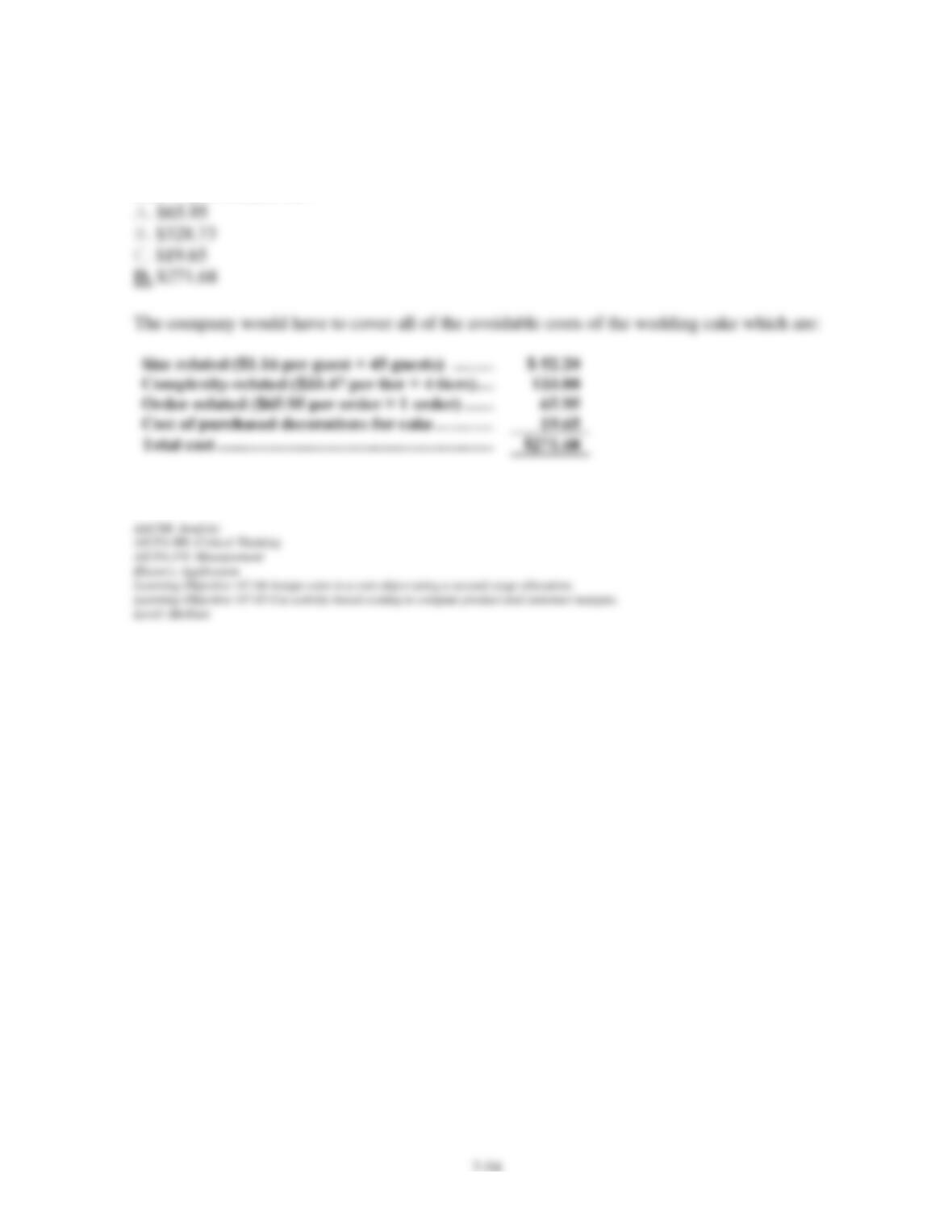
Kozloff Wedding Fantasy Company makes very elaborate wedding cakes to order. The
owner of the company has provided the following data concerning the activity rates in its
activity-based costing system:
The measure of activity for the size-related activity cost pool is the number of planned guests
at the wedding reception. The greater the number of guests, the larger the cake. The measure
of complexity is the number of tiers in the cake. The activity measure for the order-related
cost pool is the number of orders. (Each wedding involves one order.) The activity rates
include the costs of raw ingredients such as flour, sugar, eggs, and shortening. The activity
rates do not include the costs of purchased decorations such as miniature statues and wedding
bells, which are accounted for separately.
Data concerning two recent orders appear below:
Chapter 07 – Activity-Based Costing: A Tool to Aid Decision Making
65. Assuming that all of the costs listed above are avoidable costs in the event that an order is
turned down, what amount would the company have to charge for the Winterhalter wedding
cake to just break even?
Chapter 07 – Activity-Based Costing: A Tool to Aid Decision Making
66. Assuming that the company charges $613.98 for the Manliguis wedding cake, what would
be the overall margin on the order?
Chapter 07 – Activity-Based Costing: A Tool to Aid Decision Making
7-56
67. Suppose that the company decides that the present activity-based costing system is too
complex and that all costs (except for the costs of purchased decorations) should be allocated
on the basis of the number of guests. In that event, what would you expect to happen to the
costs of cakes?
Bevard Nuptial Bakery makes very elaborate wedding cakes to order. The company has an
activity-based costing system with three activity cost pools. The activity rate for the Size–
Related activity cost pool is $0.96 per guest. (The greater the number of guests, the larger the
cake.) The activity rate for the Complexity-Related cost pool is $28.92 per tier. (Cakes with
more tiers are more complex.) Finally, the activity rate for the Order-Related activity cost
pool is $78.19 per order. (Each wedding involves one order for a cake.) The activity rates
include the costs of raw ingredients such as flour, sugar, eggs, and shortening. The activity
rates do not include the costs of purchased decorations such as miniature statues and wedding
bells, which are accounted for separately.
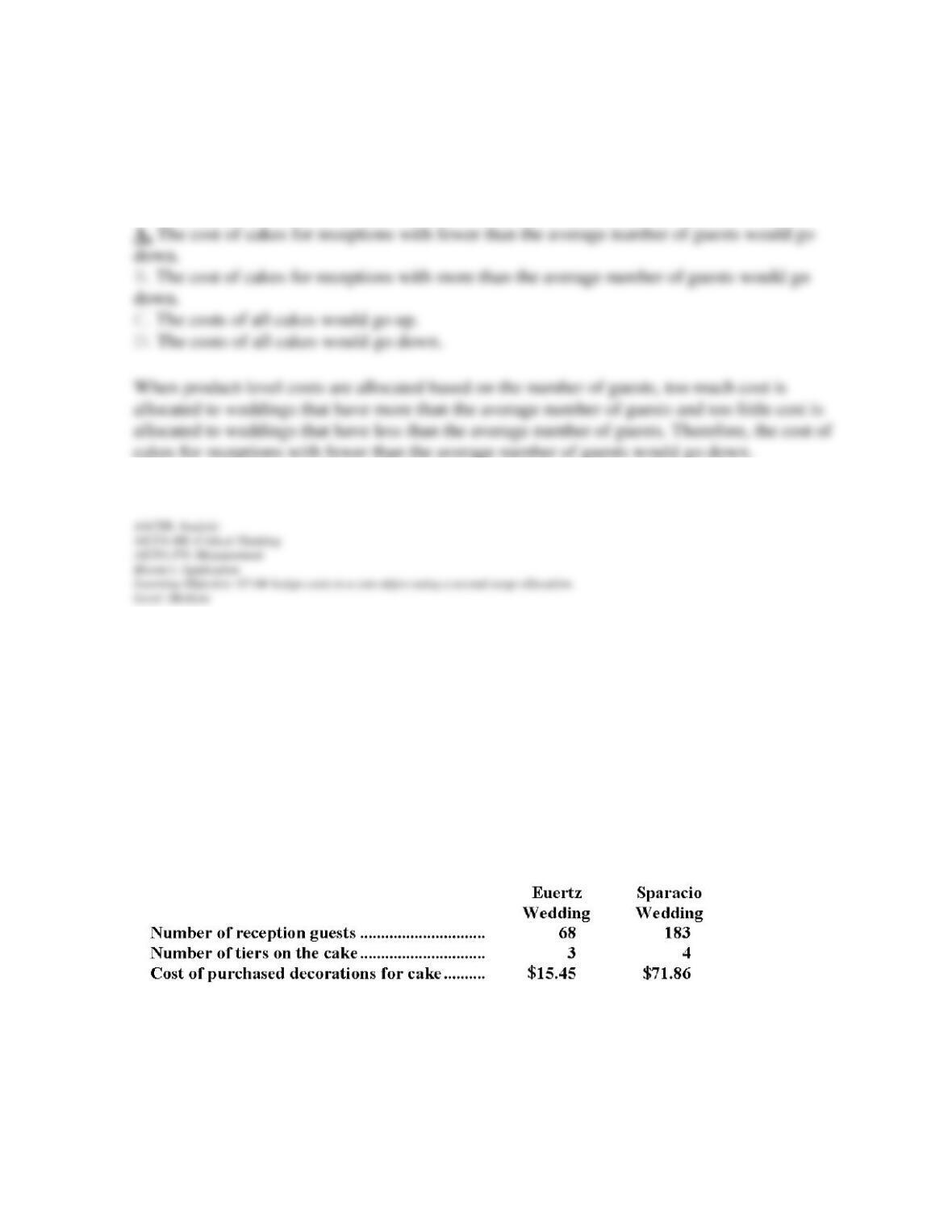
Data concerning two recent orders appear below:
Chapter 07 – Activity-Based Costing: A Tool to Aid Decision Making
68. Assuming that all of the costs listed above are avoidable costs in the event that an order is
turned down, what amount would the company have to charge for the Euertz wedding cake to
just break even?
69. Assuming that the company charges $534.11 for the Sparacio wedding cake, what would
be the overall margin on the order?
Chapter 07 – Activity-Based Costing: A Tool to Aid Decision Making
7-58
Roshannon Corporation uses activity-based costing to compute product margins. In the first
stage, the activity-based costing system allocates two overhead accounts-equipment expense
and indirect labor-to three activity cost pools-Processing, Supervising, and Other-based on
resource consumption. Data to perform these allocations appear below:
In the second stage, Processing costs are assigned to products using machine-hours (MHs)
and Supervising costs are assigned to products using the number of batches. The costs in the
Other activity cost pool are not assigned to products. Activity data for the company’s two
products follow:
Finally, sales and direct cost data are combined with Processing and Supervising costs to
determine product margins.
Chapter 07 – Activity-Based Costing: A Tool to Aid Decision Making
70. How much overhead cost is allocated to the Processing activity cost pool under activity-
based costing in the first stage of allocation?
71. The activity rate for the Processing activity cost pool under activity-based costing is
closest to:
Chapter 07 – Activity-Based Costing: A Tool to Aid Decision Making
72. What is the overhead cost assigned to Product P3 under activity-based costing?
73. What is the product margin for Product P3 under activity-based costing?