10) Price discrimination always benefits
A) the firm and may benefit or harm the consumer.
B) the consumer and may benefit or harm the firm.
C) consumers and firms.
D) consumers only.
11) Which of the following would NOT be considered price discrimination?
A) charging business travelers more money than leisure travelers for plane tickets
B) charging houses in expensive neighborhoods more money for mowing the same size lawn
than in a less expensive neighborhood
C) charging a lower price for dry cleaning men’s shirts than women’s shirts
D) charging more money for a large luxury car than a small economy car
12) Which of the following would NOT be considered price discrimination?
A) charging more money for long distance calls during business hours than on weekends
B) giving students a discount on ski lift tickets
C) charging higher rates for oil delivery to people who live farther from your business
D) charging less money to wash a large luxury car than a small economy car
13) Many hotel chains offer senior citizen discounts to members of AARP. This suggests that the
hotels believe that senior citizens have a ________ demand for hotel rooms than non-seniors.
A) smaller
B) greater
C) more elastic
D) less elastic
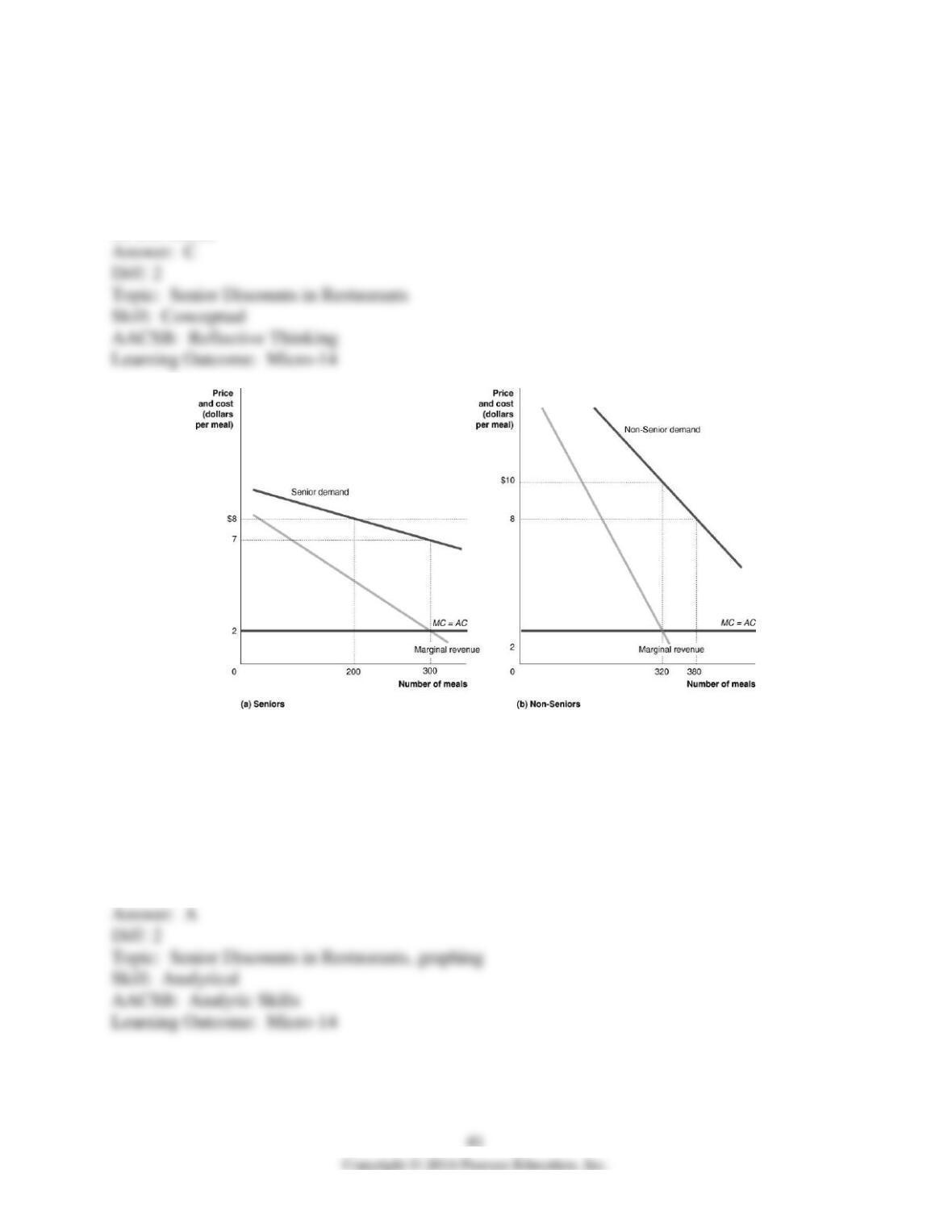
Figure 7.6
14) Figure 7.6 shows prices, demands, and cost data for the only restaurant in a small town. If the
restaurant charges the single price of $8 per meal, what is its profit from senior customers?
A) $1,200
B) $1,500
C) $2,280
D) $2,560
15) Figure 7.6 shows prices, demands, and cost data for the only restaurant in a small town. If the
restaurant charges the single price of $8 per meal, what is its profit from non-senior customers?
A) $1,200
B) $1,500
C) $2,280
D) $2,560
16) Figure 7.6 shows prices, demands, and cost data for the only restaurant in a small town.
Which group’s demand for meals is more price-elastic?
A) the senior customers
B) the non-senior customers
C) the two groups are equally sensitive to a change in price
D) There is not sufficient information.
17) Figure 7.6 shows prices, demands, and cost data for the only restaurant in a small town.
What is its profit from senior customers under the senior discount policy of a $7 senior price and
a $10 non-senior price?
A) $1,200
B) $1,500
C) $2,280
D) $2,560
18) Figure 7.6 shows prices, demands, and cost data for the only restaurant in a small town.
What is its profit from non-senior customers under the senior discount policy of a $7 senior price
and a $10 non-senior price?
A) $1,200
B) $1,500
C) $2,280
D) $2,560
19) Figure 7.6 shows prices, demands, and cost data for the only restaurant in a small town.
Compared to the profit under the single price policy, how much additional profit does the
restaurant earn under the senior discount policy of a $7 senior price and a $10 non-senior price?
A) $920
B) $580
C) $300
D) $280
20) In order to practice price discrimination a firm must be in a market such that the consumers
in its market
A) all have identical tastes.
B) all have identical price elasticities of demand.
C) have different price elasticities of demand.
D) have the same demand for its product.
21) Price discrimination is related to elasticity because
A) the firm can increase revenues by charging customers with elastic demands higher prices and
charging customers with inelastic demands lower prices.
B) the firm can increase revenues by charging customers with elastic demands lower prices and
charging customers with inelastic demands higher prices.
C) the firm can increase revenues by charging all customers higher prices.
D) None of the above; elasticity and price discrimination are unrelated.
22) Price discrimination is based on differences in ________ among groups of consumers and
the differences in ________ that will result.
A) cross elasticities of demand; revenues
B) price elasticities of demand; profits
C) quantities supplied; marginal revenues
D) income elasticities of demand; marginal costs
23) In order to engage in price discrimination, a monopolist has to be able to determine that there
are different groups of consumers that have different ________ for the product.
A) income elasticities of demand
B) price elasticities of demand
C) cross elasticities of demand
D) All of the above are correct.
24) Suppose that a price discriminating monopolist is able to divide its market into two groups. If
the firm sells its product for $50 to the group whose customers have the most elastic demand,
what price are they likely to charge to the group whose customers have the least elastic demand?
A) $50
B) more than $50
C) less than $50
D) The answer depends on the marginal revenue for that group.
25) Suppose that a price discriminating monopolist is able to divide its market into two groups. If
the firm sells its product for $25 to the group whose customers have the least elastic demand,
what price are they likely to charge to the group whose customers have the most elastic demand?
A) $25
B) more than $25
C) less than $25
D) The answer depends on the marginal revenue for that group.
26) Firms who are attempting to engage in price discrimination will offer customers with a
________ demand a higher price and customers with a(n) ________ demand a lower price.
A) lower; higher
B) normal; inferior
C) less elastic; more elastic
D) more elastic; less elastic
27) A firm switching from a single price to a price discrimination scheme will ________ the
price for the group of consumers with relatively elastic demand and ________ the price for the
group of consumers with relatively inelastic demand.
A) decrease; increase
B) decrease; decrease
C) increase; increase
D) increase; decrease
28) Because demand for air travel from people who are traveling on vacation is more ________,
the airlines offer leisure travelers lower prices than business travelers.
A) large
B) elastic
C) inelastic
D) small
29) What is the MOST LIKELY reason that snack foods sold in vending machines is so much
more expensive than the snack foods sold in grocery stores?
A) Snack foods sold in vending machines come in smaller packages, so the per-package costs are
higher.
B) Grocery stores buy in bulk, while vending machine companies tend to buy in smaller
quantities.
C) People who purchase snack foods from vending machines tend to have less elastic demand for
snack foods.
D) Owners of vending machine companies are greedier than owners of grocery stores.
30) What is the MOST LIKELY reason that milk sold in convenience stores is more expensive
than milk sold in grocery stores?
A) Convenience stores sell milk in smaller packages, so the per-gallon packaging costs are
higher.
B) Grocery stores buy in bulk, while convenience stores buy milk in smaller quantities.
C) People who buy milk at convenience stores tend to have less elastic demand for milk.
D) Convenience store owners are greedier than grocery store owners.
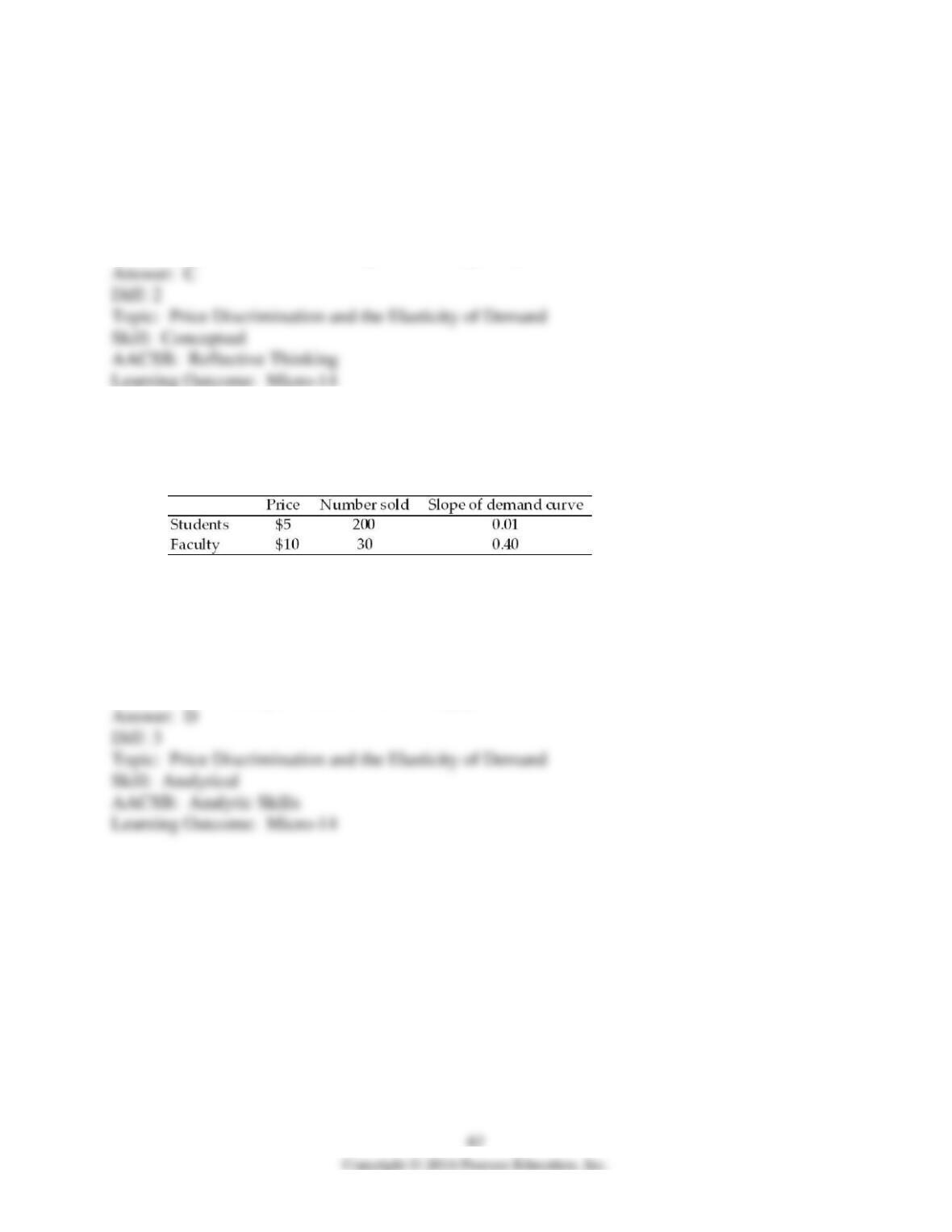
31) You currently sell the same product to both students and faculty members, and are able to
prevent transfer from one group to the other. Your current prices, quantities sold, and the
absolute values of the slopes of the demand curves are as follows
If your marginal cost is $1 and you are interested in maximizing your revenues, how would you
adjust your prices?
A) Increase prices for both groups.
B) Decrease prices for both groups.
C) Increase student price and decrease faculty price.
D) Decrease student price and increase faculty price.
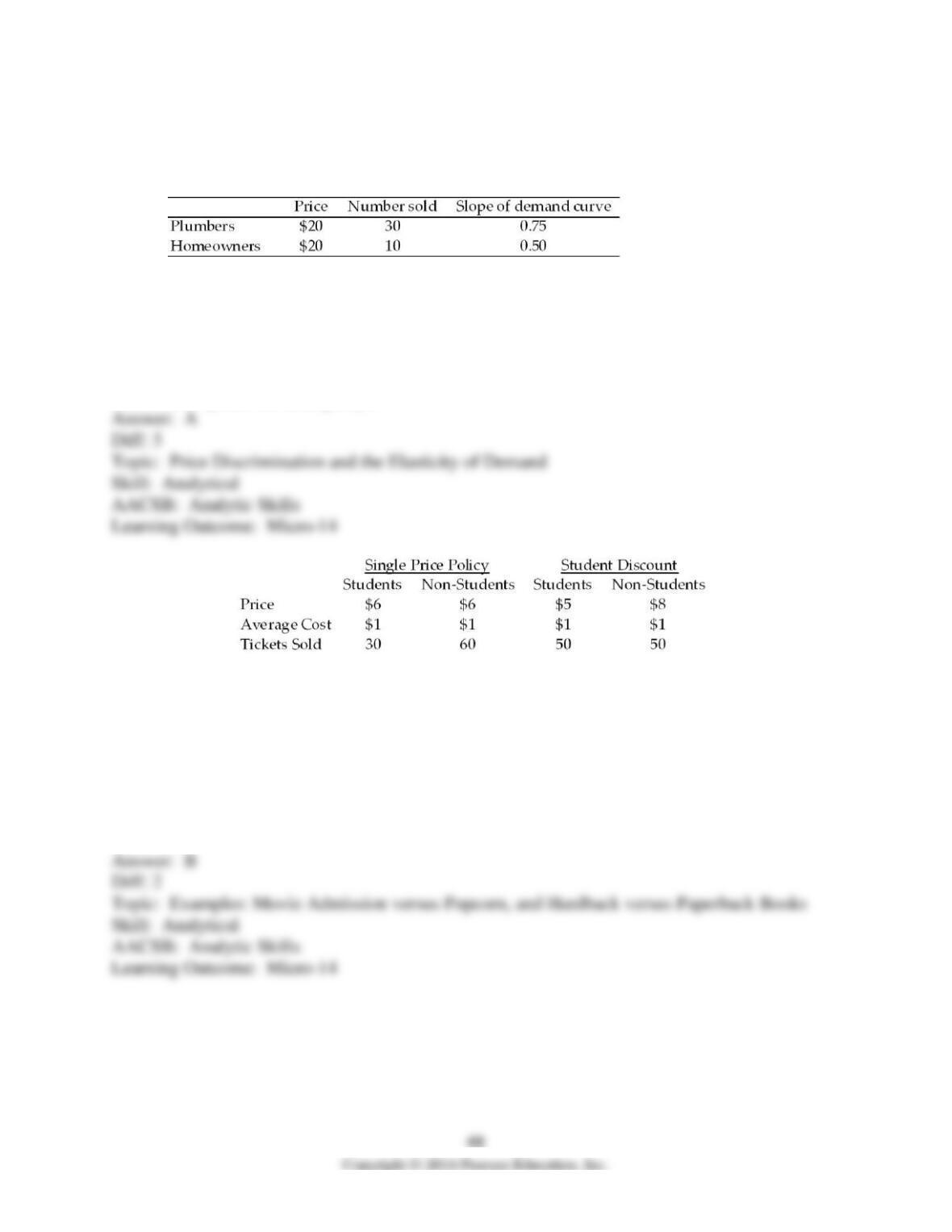
32) You currently sell the same product to both professional plumbers and homeowners, and are
able to prevent transfer from one group to the other. Your current prices, quantities sold, and the
absolute values of the slopes of the demand curves are as follows
If your marginal cost is $10 and you are interested in maximizing your revenues, how would you
adjust your prices?
A) Increase plumbers’ price and decrease homeowners’ price.
B) Decrease plumbers’ price and increase homeowners’ price.
C) Increase prices for both groups.
D) Decrease prices for both groups.
Table 7.2
33) Table 7.2 contains price, demand, and cost data for the Capri Theater, the only first-run
movie theater in a small town. What is its revenue from students under the single price policy?
A) $150
B) $180
C) $450
D) $540
34) Table 7.2 contains price, demand and cost data for the Capri Theater, the only first-run
movie theater in a small town. What is its profit from students under the single price policy?
A) $150
B) $180
C) $450
D) $540
35) Table 7.2 contains price, demand, and cost data for the Capri Theater, the only first-run
movie theater in a small town. What is its revenue from non-students under the single price
policy?
A) $300
B) $360
C) $450
D) $540
36) Table 7.2 contains price, demand, and cost data for the Capri Theater, the only first-run
movie theater in a small town. What is its profit from non-students under the single price policy?
A) $300
B) $360
C) $450
D) $540
37) Table 7.2 contains price, demand, and cost data for the Capri Theater, the only first-run
movie theater in a small town. What is its total profit under the single price policy?
A) $300
B) $360
C) $450
D) $540
38) Table 7.2 contains price, demand, and cost data for the Capri Theater, the only first-run
movie theater in a small town. What is its profit from students under the student discount policy?
A) $200
B) $250
C) $325
D) $375
39) Table 7.2 contains price, demand, and cost data for the Capri Theater, the only first-run
movie theater in a small town. What is its profit from non-students under the student discount
policy?
A) $200
B) $250
C) $350
D) $400
40) Table 7.2 contains price, demand, and cost data for the Capri Theater, the only first-run
movie theater in a small town. What is its total profit under the student discount policy?
A) $450
B) $550
C) $600
D) $650
41) Table 7.2 contains price, demand, and cost data for the Capri Theater, the only first-run
movie theater in a small town. Should the firm adopt the single price policy or the student
discount policy?
A) the single price policy because the firm does not meet the three conditions necessary to
engage in price discrimination
B) the single price policy because price discrimination would not be legal for this firm
C) the single price policy because it is more profitable than price discrimination for this firm
D) the student discount policy because it is more profitable than the single price policy
42) Movie theaters often offer reduced rates for children under 10. This suggests that demand for
adult admission is ________ than demand for children’s admission.
A) more elastic
B) less elastic
C) more variable
D) lower
43) The cost of producing a hardback book is only about 20% higher than producing a paperback
book, yet the hardback price is typically three times the paperback price. This suggests that
demand for paperback books is ________ than demand for hardback books.
A) more elastic
B) less elastic
C) more variable
D) lower
Recall the Application about the reason for the high price of movie popcorn to answer the
following question(s).
44) Recall the Application. Suppose a low demander is willing to pay $8 for a movie, while a
high demander is willing to pay $12 for a movie and popcorn. The theater could charge
________ for admission and ________ for popcorn for each consumer to receive a consumer
surplus of $2.
A) $8; $2
B) $10; $0
C) $6; $4
D) $9; $3
45) Recall the Application. Suppose a low demander is willing to pay $8 for a movie, while a
high demander is willing to pay $12 for a movie and popcorn. If the theater charged $7 for
admission and $4 for popcorn, the low demander would receive a consumer surplus of
________, and the high demander would receive a consumer surplus of ________.
A) $1; $1
B) $5; $6
C) $3; $9
D) $15; $21
46) Recall the Application. Suppose a low demander is willing to pay $8 for a movie, while a
high demander is willing to pay $12 for a movie and popcorn. If the theater charged $8 for
admission and $2 for popcorn, the low demander would receive a consumer surplus of
________, and the high demander would receive a consumer surplus of ________.
A) $2; $6
B) $-2; $4
C) $10; $22
D) $0; $2
47) Recall the Application. Suppose a low demander is willing to pay $8 for a movie, while a
high demander is willing to pay $12 for a movie and popcorn. If the theater charged $2 for
admission and $10 for popcorn, ________ would be willing to go to the movie.
A) only the low demander
B) only the high demander
C) both the low demander and the high demander
D) neither the low demander nor the high demander
48) Price discrimination can be profitable if consumers can resell the product.
49) If a firm wants to engage in price discrimination it must have some market power.
50) If airlines give passengers under the age of 10 a 25% discount, then this is an example of
price discrimination.
51) When a hair stylist charges men less than women for a haircut because men’s hair take less
time to cut, the hairstylist is price discriminating.
52) The reason that movie videotapes cost more money immediately after they are released than
they do six months later is due to price discrimination.
53) When a firm engages in price discrimination it sets marginal revenue equal to marginal cost
for each separate set of consumers.
54) Firms who engage in price discrimination usually make the same amount of money as they
would if they charged one price.
55) All consumers are worse off when firms engage in price discrimination.
56) If a fast food restaurant gives senior citizens a 10% discount on food every day, that is an
example of price discrimination. If they only give the discount on Tuesdays it is not price
discrimination.
57) Movie theaters would make more money if they offered students the same type of discounts
on popcorn that they do on admission.
58) The difference in price between hardback books and paperbacks is primarily explained by
differences in production costs.
59) Why is it important that a firm have market power if it wishes to engage in price
discrimination?
60) Why is it important that a firm can prevent resale of its product if it wishes to engage in price
discrimination?
61) When an electronics company advertises on the local newspaper a 10% discount coupon, is
this an example of price discrimination? Why or why not?
62) Why is it important that a firm have different groups of consumers with different demand
elasticities if it wishes to engage in price discrimination?
63) If you purchased a new model of a digital camera right after it is released you will likely pay
more than if you purchase it six months after release. Why is this an example of price
discrimination on the part of the firm?
64) Bars often offer specials on appetizers during “happy hour.” What does the concept of price
discrimination suggest about why this might be profit-maximizing behavior?
65) Suppose that you own a golf course that is part of a Florida resort. You primarily serve two
groups of people: local residents and tourists. Devise a price discrimination strategy that will
increase your revenues compared to a single-pricing strategy.
66) You own a local sub shop in a college town. You primarily serve two groups of people: local
residents (both students and other local residents) and visitors to your town. Devise a price
discrimination strategy that will increase your revenues compared to a single-pricing strategy.
67) As manager of the only video rental store in town, you have noticed that on Thursday
through Sunday the demand for movie rentals is much less elastic than it is on Monday through
Wednesday. If you are currently charging $3 for a two-night rental, give an example of a pricing
policy that might increase your revenues compared to a single-pricing strategy.