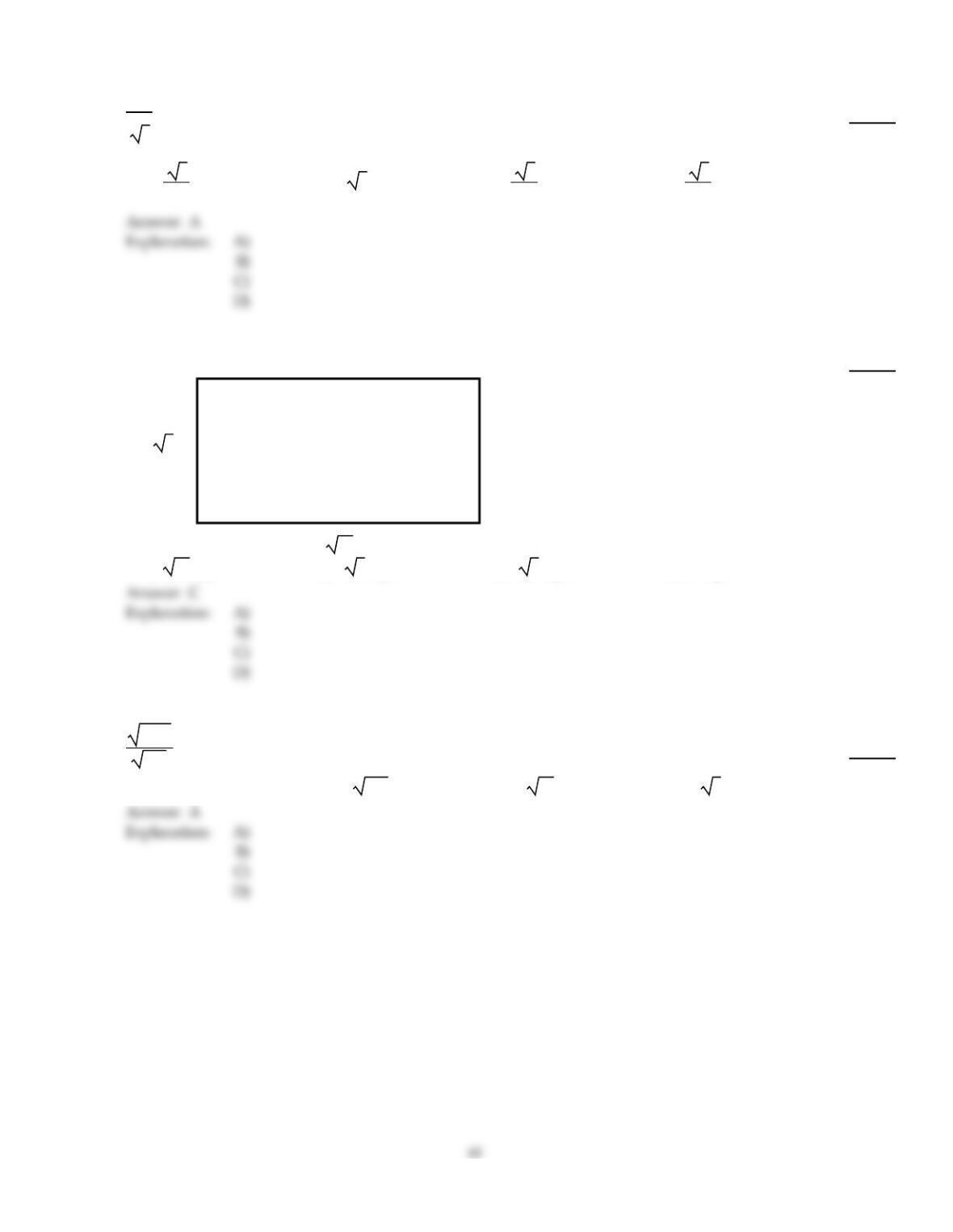
Rationalize the denominator and simplify.
163)
1
33
163)
A)
39
3
B)
333
C)
33
3
D)
33
9
Find the perimeter or area of the figure as indicated. Express your answer in simplified radical form.
164)
Find the area of the rectangle.
3 ft
15 ft
164)
A)
45 sq ft
B)
9 5 sq ft
C)
3 5 sq ft
D)
15 sq ft
Divide and, if possible, simplify.
165)
40x3
10x
165)
A)
2x
B)
2x 10x
C)
2x 10
D)
2x x
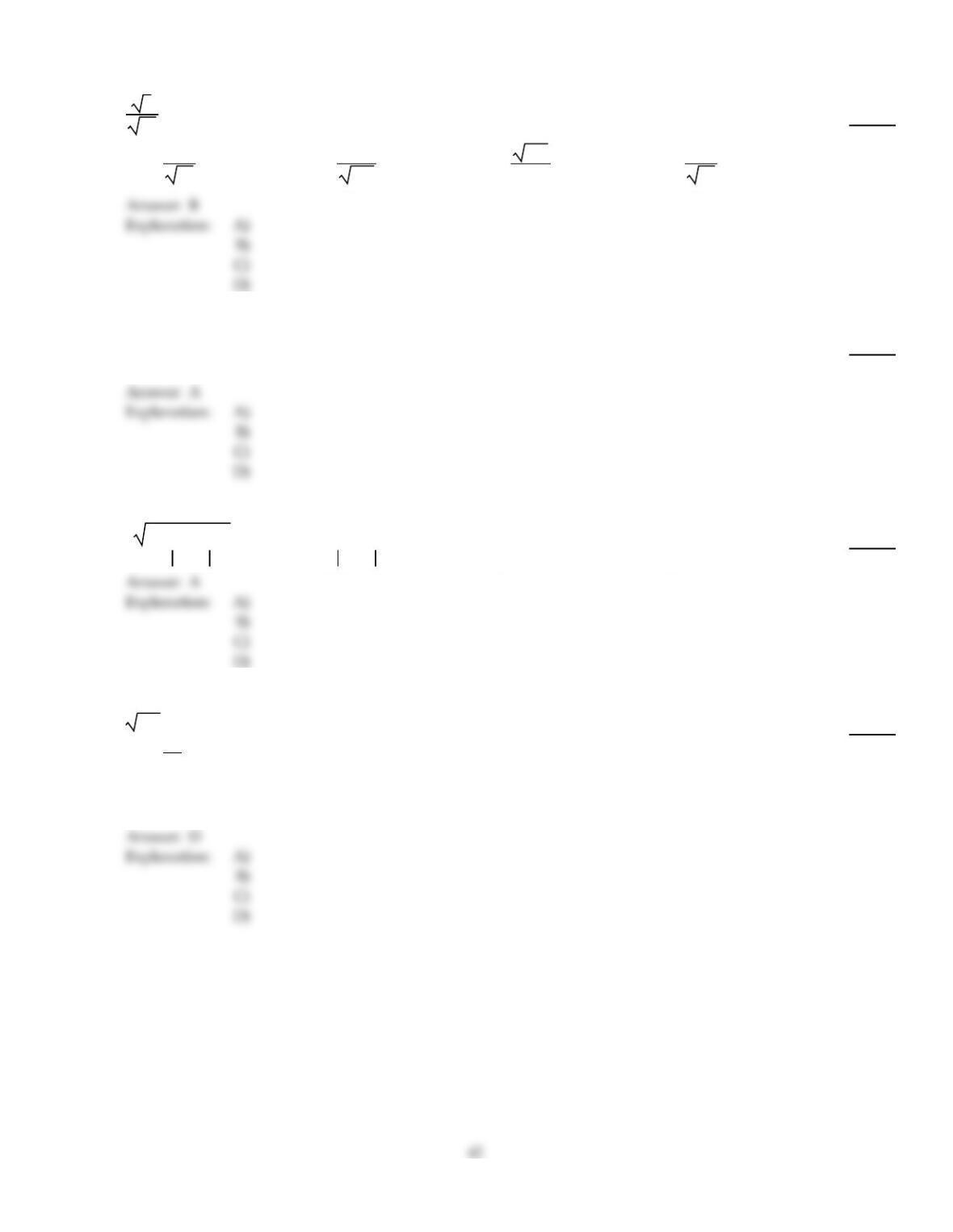
Rationalize numerator.
166)
7
6x
166)
A)
7
6x
B)
7
42x
C)
42x
6x
D)
7
7x
Perform the indicated operation. Write the result in the form a +
bi.
167)
(6 – 2i)(9+ 8i)
167)
A)
70 + 30i
B)
38 – 66i
C)
70 – 30i
D)
–16i2+ 30i + 54
A
Simplify the expression.
168)
–x2– 16x + 64
168)
A)
–x – 8
B)
x – 8
C)
–x – 8
D)
–x + 8
A
Find the square root if it is a real number, or state that the expression is not a real number.
169)
–49
169)
A)
7
49
B)
7
C)
2401
D)
not a real number
D
B
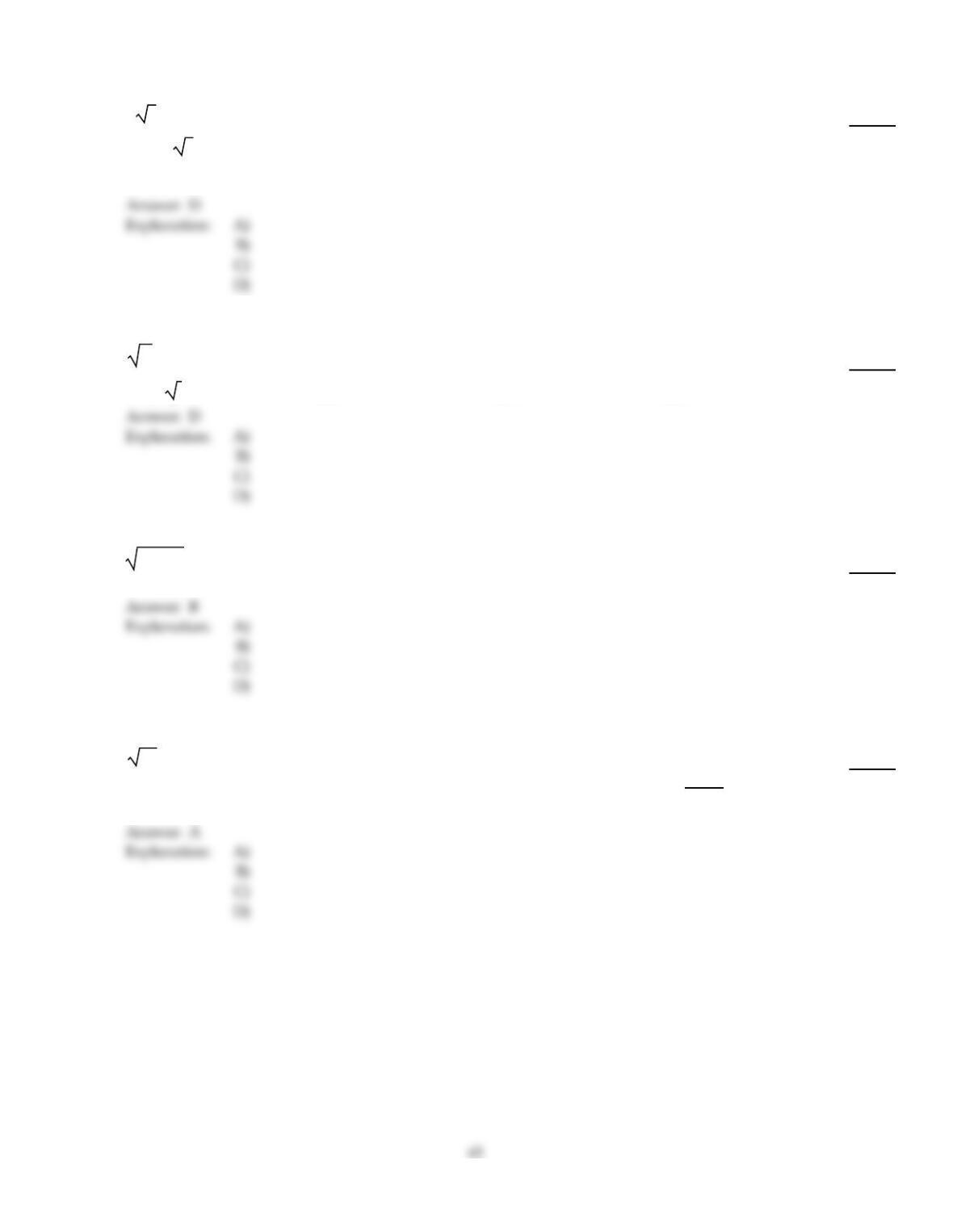
Find the indicated root, or state that the expression is not a real number.
170)
–38
170)
A)
–32
B)
not a real number
C)
2
D)
–2
Simplify the expression. Include absolute value bars where necessary.
171)
7t7
171)
A)
7t
B)
t7
C)
–t
D)
t
D
Solve the equation.
172)
x2– 19 =9
172)
A)
{10}
B)
{10, –10}
C)
{11, –11}
D)
B
Rewrite the expression with a rational exponent.
173)
35p
173)
A)
(5p)1/3
B)
51/3p
C)
(5p)3
D)
1
(5p)3
A
D
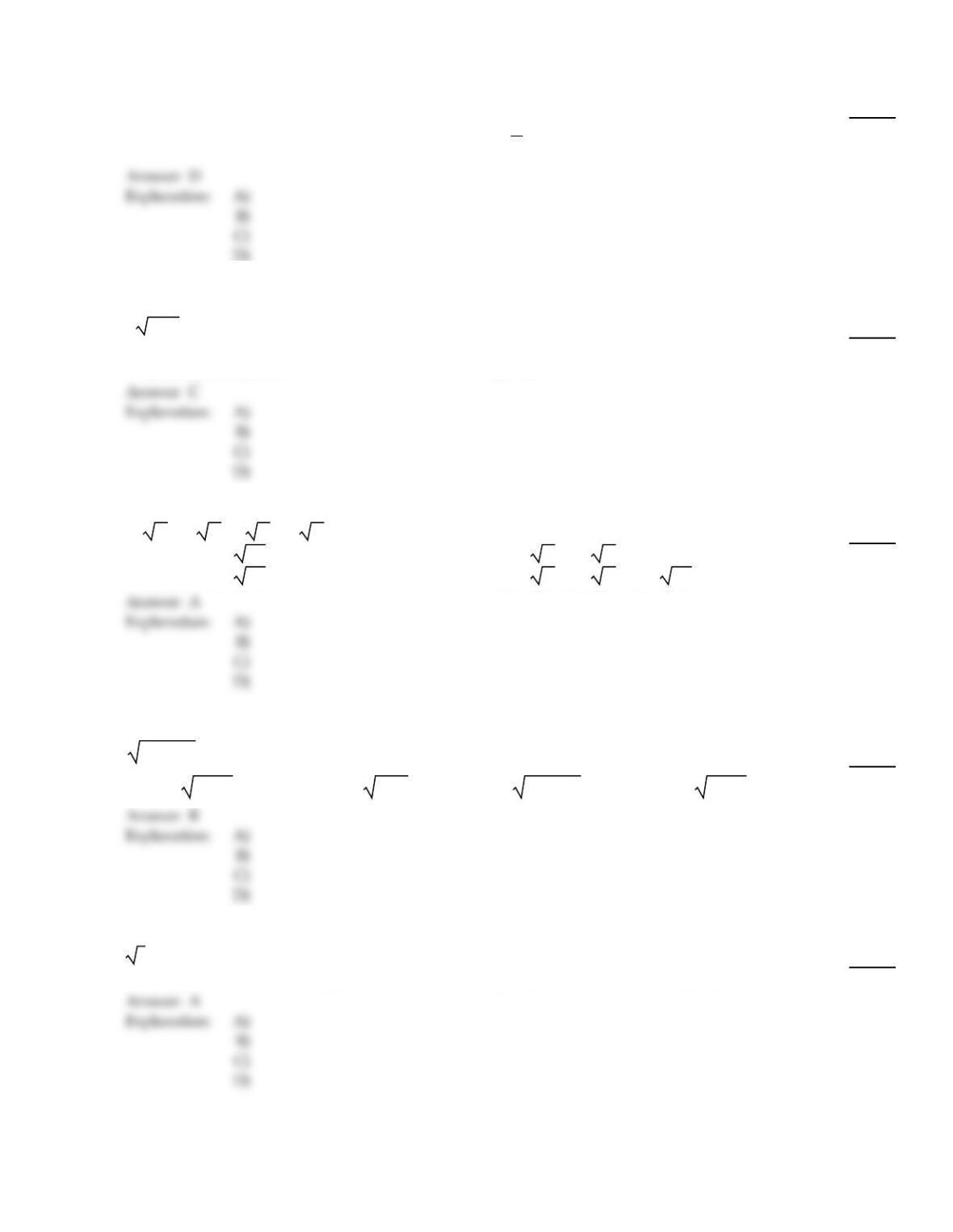
Use radical notation to rewrite the expression. Simplify, if possible.
174)
1441/2
174)
A)
6
B)
72
C)
1
6
D)
12
Find the indicated root, or state that the expression is not a real number.
175)
–4–256
175)
A)
4
B)
–4
C)
not a real number
D)
–16
C
Perform the indicated operation and, if possible, simplify. Assume that all variables represent positive real numbers.
176)
(9 5 +9 3 )( 8 5 +7 3 )
176)
A)
549 +135 15
B)
72 5+63 3
C)
171 +135 15
D)
72 5+63 3+135 15
A
Simplify by factoring. Assume that any variable in a radicand represents a positive real number.
177)
3x3y14z2
177)
A)
xy 3y11z2
B)
xy43y2z2
C)
3x3y14z2
D)
x3y14z2
B
Solve the equation.
178)
x+ 4 =9
178)
A)
{25}
B)
C)
{77}
D)
{169}
A
44
D
Use rational exponents to simplify the expression. If rational exponents appear after simplifying, write the answer in
radical notation.
179)
6x·x
179)
A)
x8
B)
6x2
C)
3x2
D)
2x3
Find each product. Write the result in the form a +
bi.
180)
(4 + 5i)(8+ 8i)
180)
A)
–8– 72i
B)
–8+ 72i
C)
40i2+ 72i + 32
D)
72 + 8i
B
Perform the indicated operation and, if possible, simplify. Assume that all variables represent positive real numbers.
181)
(3 +7)2
181)
A)
16 +6 7
B)
10 +6 7
C)
16 +3 7
D)
9+6 7
A
Simplify the expression. Include absolute value bars where necessary.
182)
4(x +10,000)4
182)
A)
x +10
B)
x +10
C)
x +10,000
D)
x +10,000
C
Use the product rule to multiply.
183)
2·5
183)
A)
10
B)
2 5
C)
7
D)
10
A
C
Rationalize numerator.
184)
3 x
7y
184)
A)
3x
7y
B)
3x
7xy
C)
3 7xy
7y
D)
3x
21xy
Provide an appropriate response.
185)
Express in terms of i and simplify: –252.
185)
A)
6 7i
B)
–6i 7
C)
6i 7
D)
7i 6
Simplify by factoring. Assume that any variable in a radicand represents a positive real number.
186)
19 (x + y)20
186)
A)
19 x2+ 2xy +y2
B)
(x + y) x + y
C)
(x + y) 19 x + y
D)
(x + y) 20 x + y
Rationalize the denominator and simplify.
187)
57
y6
187)
A)
57y2
B)
57y4
y2
C)
y257
D)
457y
y2
Find each product. Write the result in the form a +
bi.
188)
(3 + i 3)(3– i 3)
188)
A)
9+3i
B)
18
C)
6
D)
12
Add or subtract as indicated. You will need to simplify terms to identify like radicals.
189)
74x7– 5x4x3
189)
A)
74x7– 5x4x3
B)
12 4x3
C)
2x 4x7
D)
2x 4x3
190)
38y –354y
190)
A)
332y – 2 3y
B)
53y
C)
2– 3 32
D)
23y– 3 32y
Use properties of rational exponents to simplify the expression. Assume that any variables represent positive numbers.
191)
z–2/7·z3/7
191)
A)
z1/7
B)
z6/7
C)
z–1/7
D)
z7/6
Simplify the expression. Include absolute value bars where necessary.
192)
6x6
192)
A)
x
B)
–x
C)
x
D)
–x
Use the quotient rule to simplify. Assume all variables represent positive real numbers.
193)
4243
x12
193)
A)
3x343
B)
343
x3
C)
3x33
D)
9 3
x3
Use radical notation to rewrite the expression. Simplify, if possible.
194)
811/4
194)
A)
3
B)
–43
C)
9
D)
1
3
Divide and, if possible, simplify.
195)
96
4
195)
A)
4
B)
384
4
C)
96
4
D)
2 6
Rewrite the expression with a rational exponent.
196)
( 23xy)5
196)
A)
(23xy)2/5
B)
(23xy)5/2
C)
(23xy)5
2
D)
(23xy)2
5

Solve the equation.
197)
5x2x=3
197)
A)
{243}
B)
{53}
C)
{9}
D)
{27}
Write in terms of i.
198)
–296
198)
A)
–2i 74
B)
274
C)
–274
D)
2i 74
D
Find the function value indicated for the function. If necessary, round to two decimal places. If the function value is not a
real number and does not exist, state so.
199)
Evaluate r(x) = – x –5 for r(105)
199)
A)
not a real number
B)
10
C)
r( –10 )
D)
–10
D
Find the cube root.
200)
3–1000
200)
A)
–10
B)
100
C)
±10
D)
not a real number
A
C
Rationalize the denominator and simplify.
201)
12x
33x2
201)
A)
12 3x
B)
433x
C)
34x
D)
439x
202)
xy 38
3xy2
202)
A)
38y
B)
38x2y
y
C)
38x2y
D)
83x2y
Use rational exponents to simplify the radical. If rational exponents appear after simplifying, write the answer in radical
notation.
203)
(4xy )
8
203)
A)
(xy)2
B)
4xy
C)
xy2
D)
x2y
Add or subtract as indicated.
204)
313 +2–213
204)
A)
2
B)
13 +2
C)
513 +2
D)
15
50
Rewrite the expression with a rational exponent.
205)
6
205)
A)
61/2
B)
1
2·6
C)
62
D)
1
62
Use radical notation to rewrite the expression. Simplify, if possible.
206)
(–1000)1/3
206)
A)
10
B)
–10
C)
–10 3100
D)
–1
10
Perform the indicated operation. Write the result in the form a +
bi.
207)
2–5i
4+ i
207)
A)
13
17 –18
17 i
B)
13
17 +18
17 i
C)
3
17 –22
17 i
D)
3
17 +22
17 i
Find the function value indicated for the function. If necessary, round to two decimal places. If the function value is not a
real number and does not exist, state so.
208)
Evaluate p(x) =x –25 for p(9)
208)
A)
16
B)
–2
C)
not a real number
D)
–16
Divide and simplify to the form a +
bi.
209)
2+ 3i
5+ 3i
209)
A)
1
16 +9
16 i
B)
1
34 –21
34 i
C)
19
16 +9
16 i
D)
19
34 +9
34 i
Solve the equation.
210)
x2– 4x + 64 = x + 4
210)
A)
– 2
B)
{4}
C)
{–4}
D)
{8}
211)
x2– 15 –x + 5 = 0
211)
A)
B)
{15, 5}
C)
{5}
D)
{–4, 5}
Write in terms of i.
212)
–252
212)
A)
–6 7
B)
–6i 7
C)
6 7
D)
6i 7
Solve the problem.
213)
The number of centimeters, d, that a spring is compressed from its natural, uncompressed position
is given by the formula d =2W
k, where W is the number of joules of work done to move the
spring and k is the spring constant. If a spring has a spring constant of 0.2, find the amount of work
needed to move the spring 2 centimeters.
213)
A)
0.2 joules
B)
0.4 joules
C)
0.8 joules
D)
4 joules
Use the product rule to multiply.
214)
92x7·93x
214)
A)
69x8
B)
6x8
C)
18 6x8
D)
96x8
215)
4x
64 ·64
4
215)
A)
1
4x
B)
1
4x
C)
2 8x
D)
x
D
Find the indicated root, or state that the expression is not a real number.
216)
10 –1
216)
A)
–1
B)
not a real number
C)
0
D)
1
B
Express the function, f, in simplified form. Assume that x can be any real number.
217)
f(x) =3x2+ 30x + 75
217)
A)
f(x) =(x – 5) 3
x
B)
f(x) =x +5 3
C)
f(x) = (x – 5) 3
D)
f(x) = x 78 + 30x
B
53
D
Perform the indicated operation and, if possible, simplify. Assume that all variables represent positive real numbers.
218)
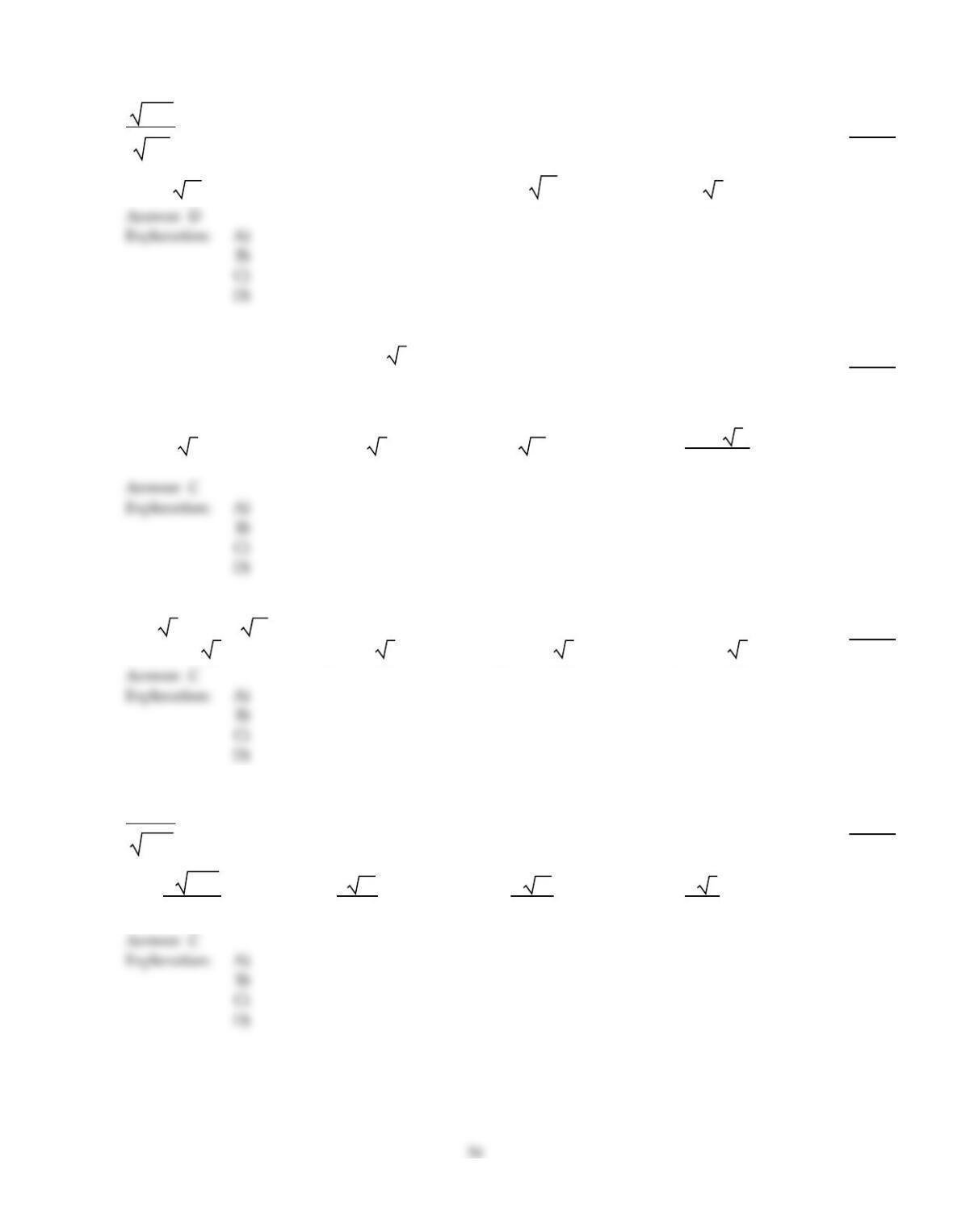
316x6
32x2
218)
A)
x32x
B)
2x
C)
2x 3x2
D)
2x 3x
Solve.
219)
Racing cyclists use the function r(x) = 4 x to determine the maximum rate, r(x), in miles per hour,
to turn a corner of radius x, in feet, without tipping over. What is the maximum rate a cyclist
should travel around a corner of radius 11 feet without tipping over? Leave the solution in
simplified radical form.
219)
A)
12 2 mph
B)
12 +2 mph
C)
411 mph
D)
4(3+2)
r mph
Perform the indicated operation. Write the result in the form a +
bi.
220)
(4 + i 2) + (10 – i 72)
220)
A)
14 + 5 2
B)
14 – 5 2
C)
14 – 5i 2
D)
14 + 5i 2
Rationalize the denominator. Simplify, if possible. Assume that any variables represent positive real numbers.
221)
7
325x2
221)
A)
7325x2
25x2
B)
7 5x
5x
C)
735x
5x
D)
73x
x
Divide and simplify to the form a +
bi.
222)
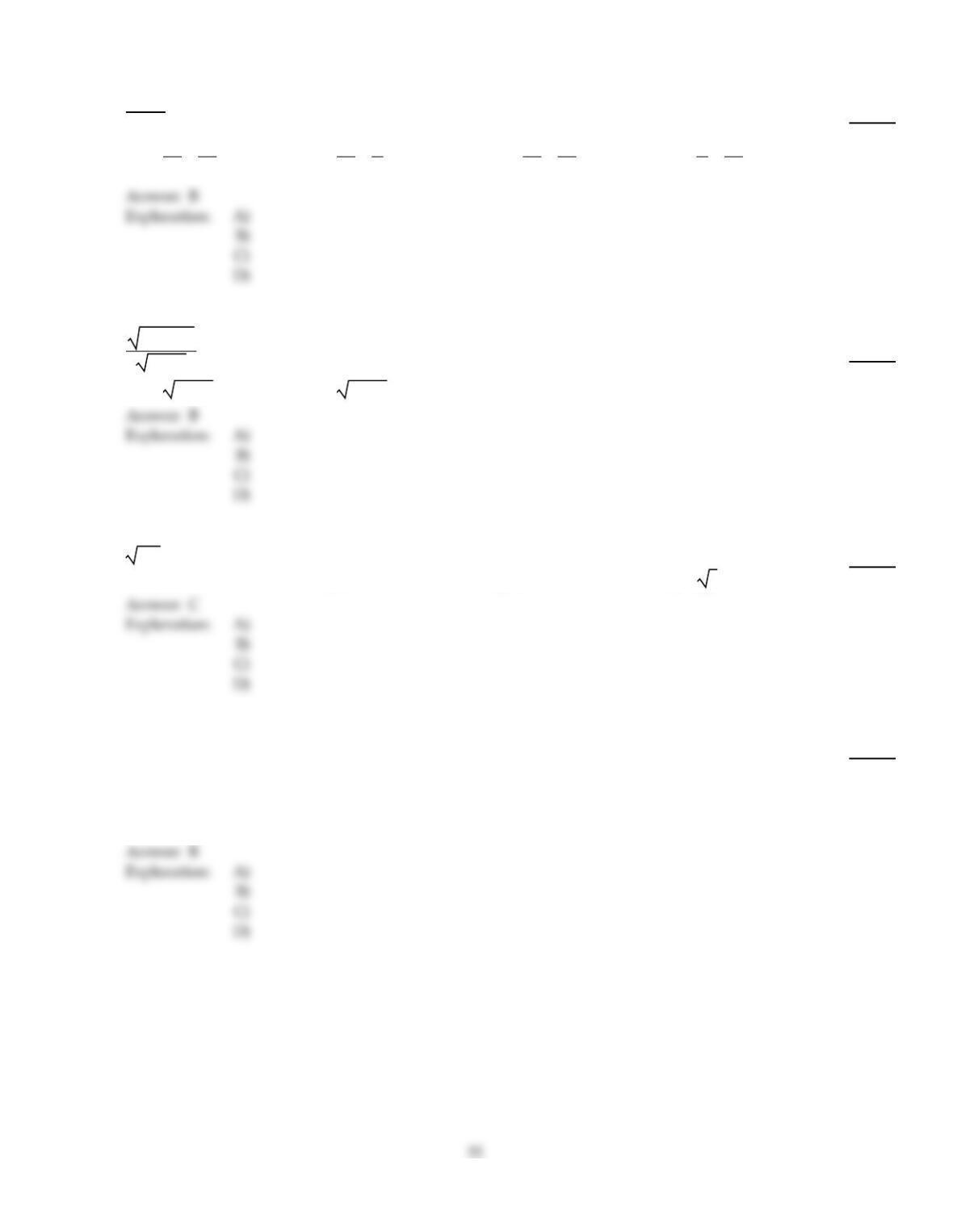
9+ 2i
6+ 8i
222)
A)
19
5–42
5i
B)
7
10 –3
5i
C)
–19
14 +3
14 i
D)
–1
4+3
14 i
Divide and, if possible, simplify.
223)
z2–100
z +10
223)
A)
z +10
B)
z –10
C)
z –10
D)
z +10
Write in terms of i.
224)
–25
224)
A)
–5i
B)
±5
C)
5i
D)
–i 5
Solve.
225)
The function f(x) = 70x3/4 models the number of calories per day, f(x), a person needs to maintain
life in terms of the person’s weight, x, in kilograms. How many calories does a person who weighs
53 kilograms (approximately 116.6 pounds ) need to maintain life? Round to the nearest whole
number.
225)
A)
4754 calories
B)
1375 calories
C)
2486 calories
D)
2701 calories
Rewrite the expression with a rational exponent.
226)
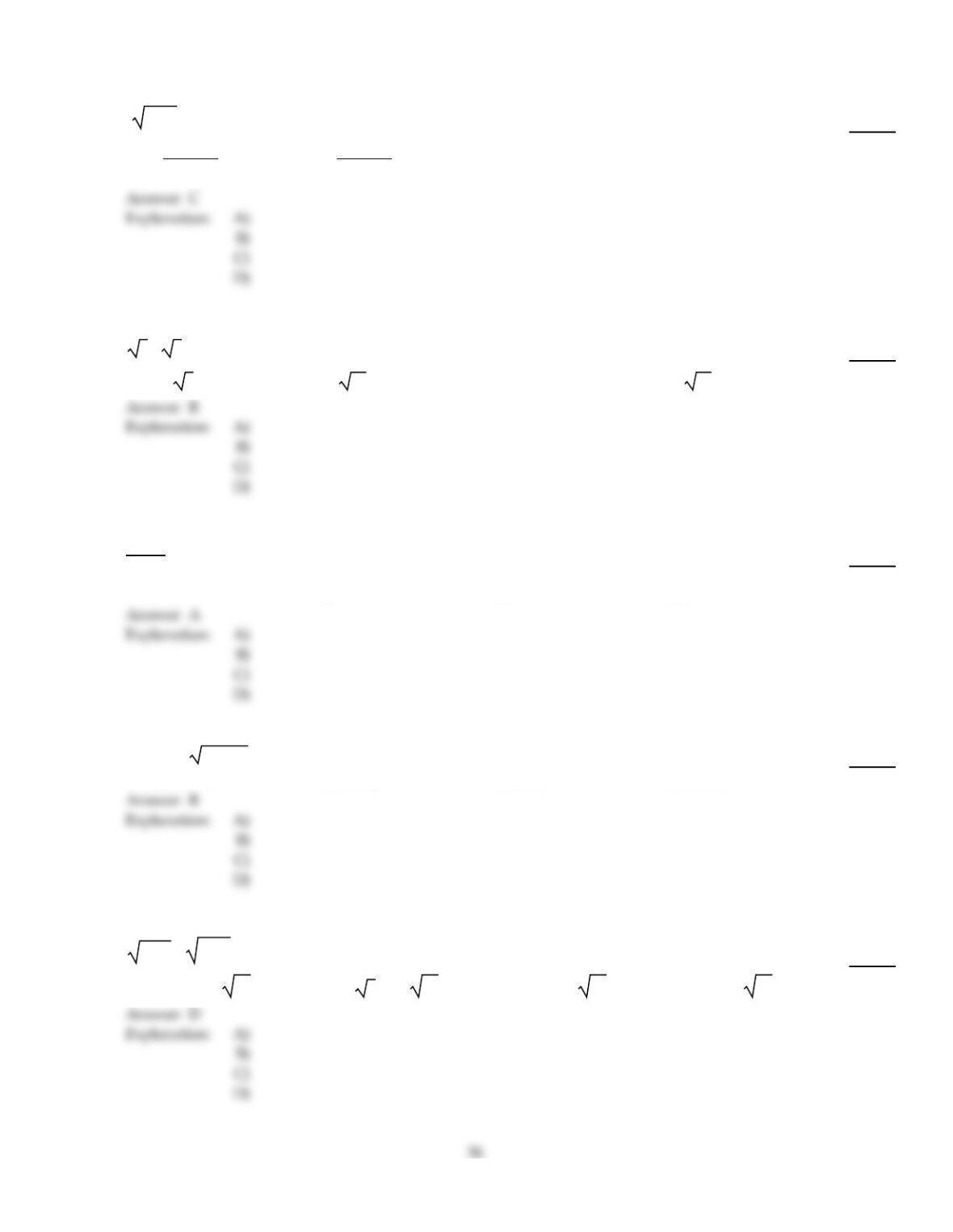
(48x2y)
5
226)
A)
(8x2y)5
4
B)
(8x2y)4
5
C)
(8x2y)5/4
D)
(8x2y)4/5
Use the product rule to multiply.
227)
67·62
227)
A)
762
B)
614
C)
14
D)
14
Divide and simplify to the form a +
bi.
228)
1 + i
–1 – i
228)
A)
–1
B)
0
C)
– i
D)
1
Provide an appropriate response.
229)
Let f(x) =36 –9x. Find the domain of f.
229)
A)
( , –4]
B)
( , 4]
C)
[4, )
D)
( , 4)
Perform the indicated operation and, if possible, simplify. Assume that all variables represent positive real numbers.
230)
364x5+
3x2y9
230)
A)
(4x +y9)3x2
B)
4x 3x+y33x2
C)
(4x3+y3)3x2
D)
(4x +y3)3x2
Simplify by factoring.
231)
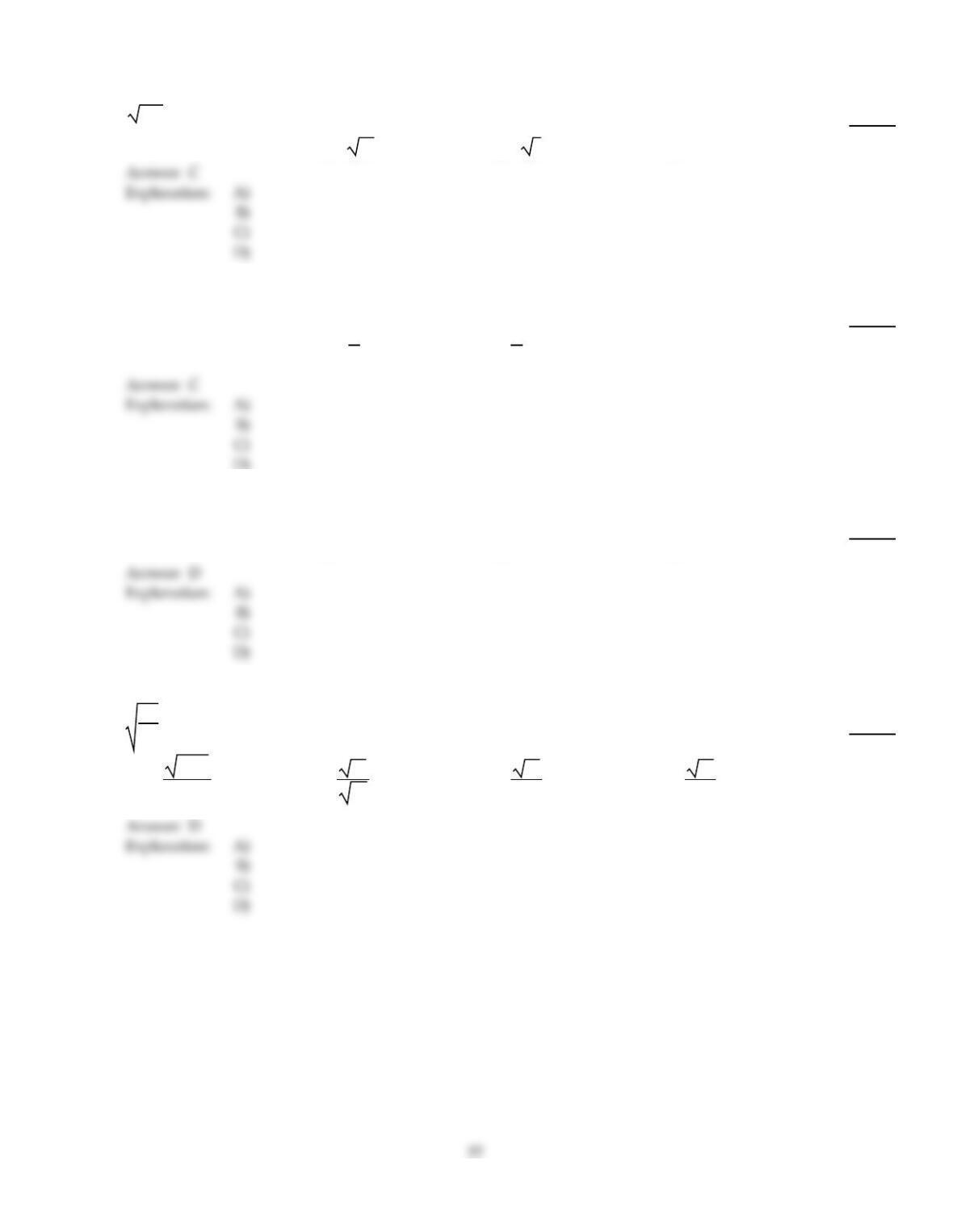
3375
231)
A)
15
B)
5315
C)
533
D)
5
Rewrite the expression with a positive rational exponent. Simplify, if possible.
232)
(–27)–2/3
232)
A)
–9
B)
–1
9
C)
1
9
D)
18
Use radical notation to rewrite the expression. Simplify, if possible.
233)
324/5
233)
A)
256
B)
128
C)
512
D)
16
Use the quotient rule to simplify. Assume all variables represent positive real numbers.
234)
41
x4
234)
A)
41x4
x4
B)
41
x4
C)
41
x
D)
41
x2
Use properties of rational exponents to simplify the expression. Assume that any variables represent positive numbers.
235)
(x–1/2y8/9)1/4
235)
A)
x1/8y2/9
B)
–x1/8y2/9
C)
x–1/4y41/4
D)
y2/9
x1/8
Divide and, if possible, simplify.
236)
189x5y6
3y4
236)
A)
3x4y27xy
B)
3x2y7x
C)
9x2y7x
D)
63xy x
Use radical notation to rewrite the expression. Simplify, if possible.
237)
(–64)4/3
237)
A)
256
B)
–256
C)
4096
D)
not a real number
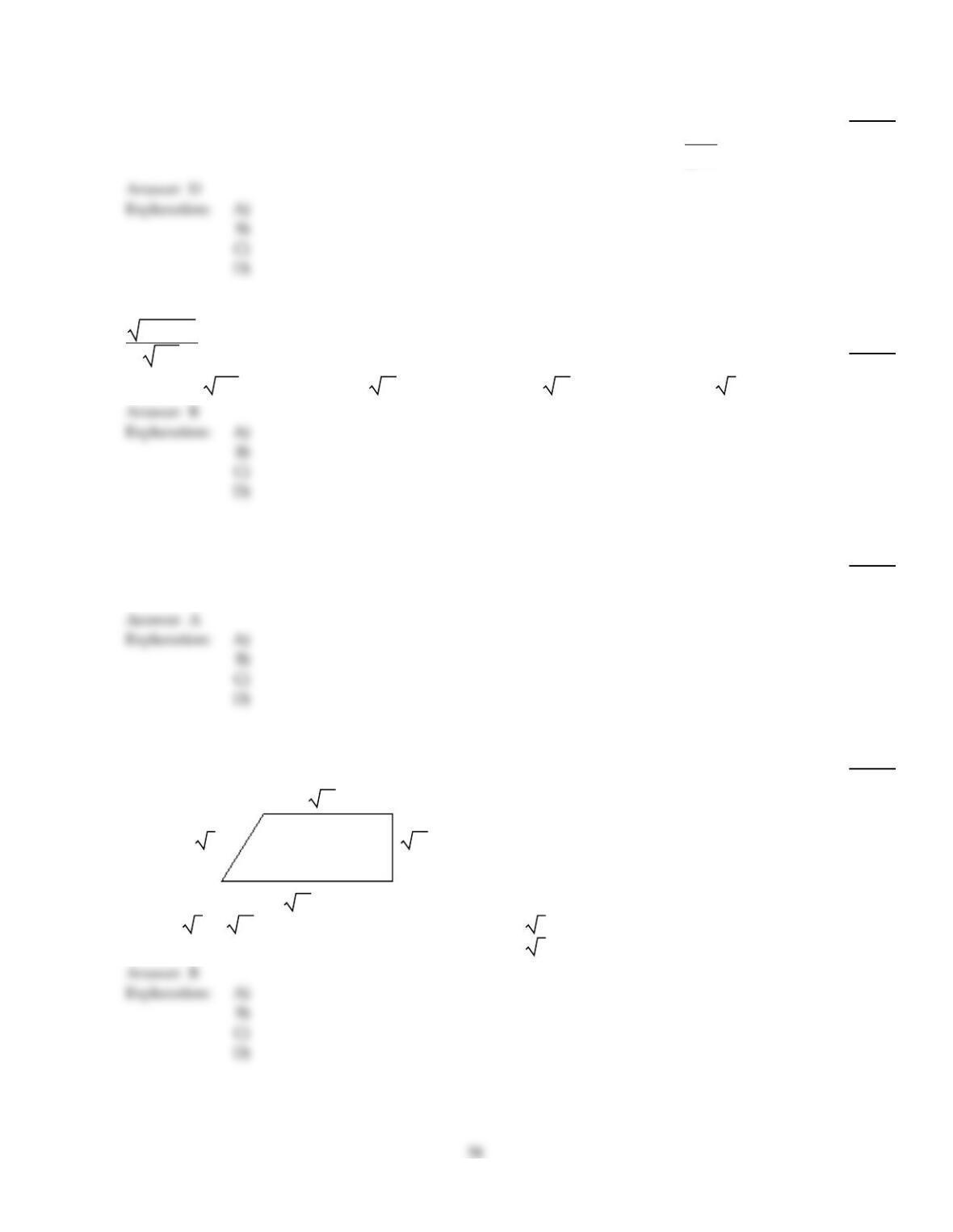
Find the perimeter or area of the figure as indicated. Express your answer in simplified radical form.
238)
Find the perimeter of the trapezoid.
350 in.
6 2 in. 50 in.
398 in.
238)
A)
(27 2+450) in.
B)
47 2 in.
C)
9100 in.
D)
46 2 in.
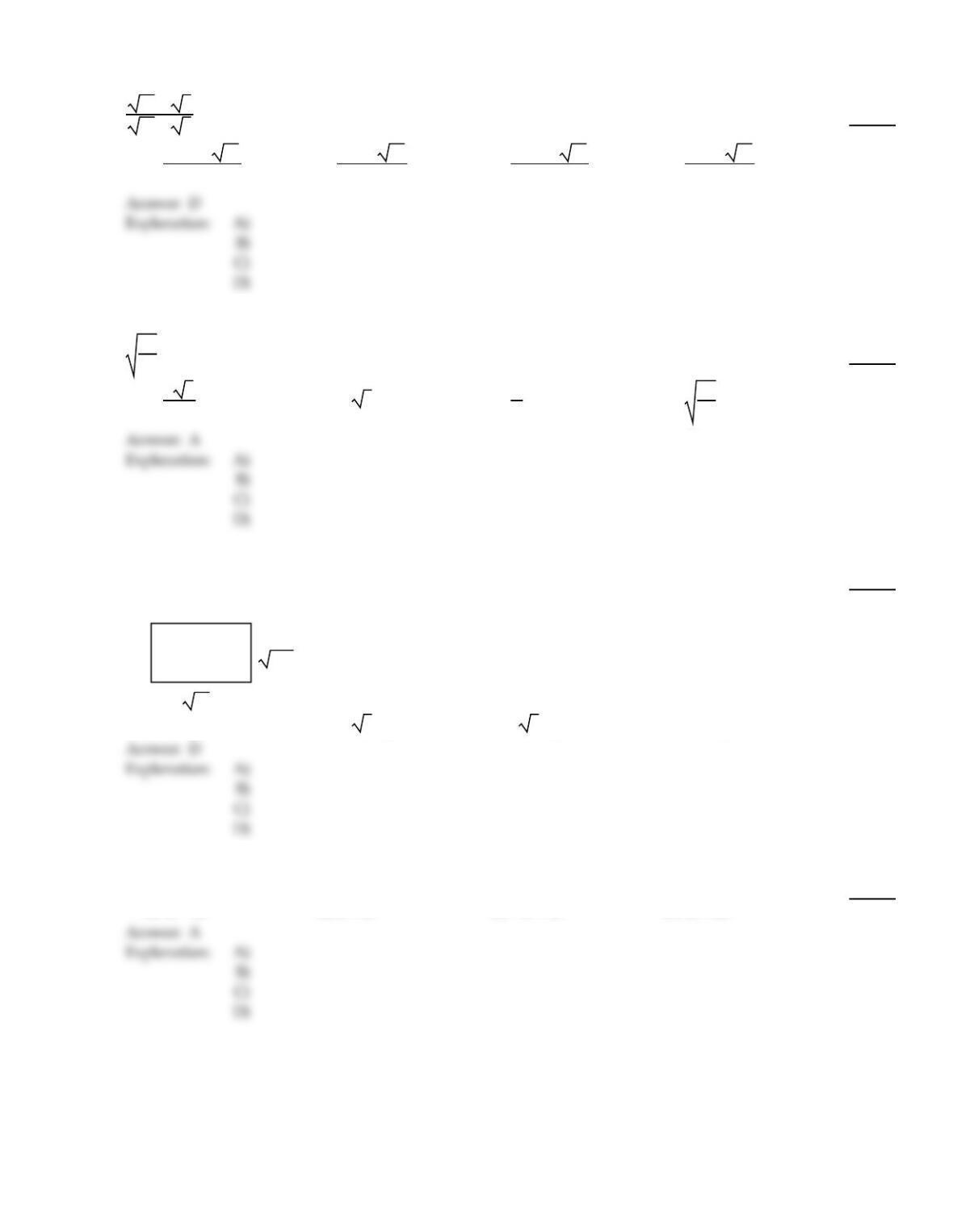
Rationalize the denominator. Simplify, if possible. Assume that any variables represent positive real numbers.
239)
13 +2
13 –2
239)
A)
173 + 2 26
165
B)
15 + 2 26
165
C)
173 + 2 26
11
D)
15 + 2 26
11
Use the quotient rule to simplify. Assume all variables represent positive real numbers.
240)
80
49
240)
A)
4 5
7
B)
16 5
C)
4
7
D)
80
7
A
Find the perimeter or area of the figure as indicated. Express your answer in simplified radical form.
241)
Find the area of the rectangle.
125 ft
420 ft
241)
A)
40 sq ft
B)
40 5 sq ft
C)
8 5 sq ft
D)
200 sq ft
D
Perform the indicated operation. Write the result in the form a +
bi.
242)
(6 – 5i) + (4+ 3i)
242)
A)
10 – 2i
B)
2+ 8i
C)
–10 + 2i
D)
10 + 2i
A
59
D
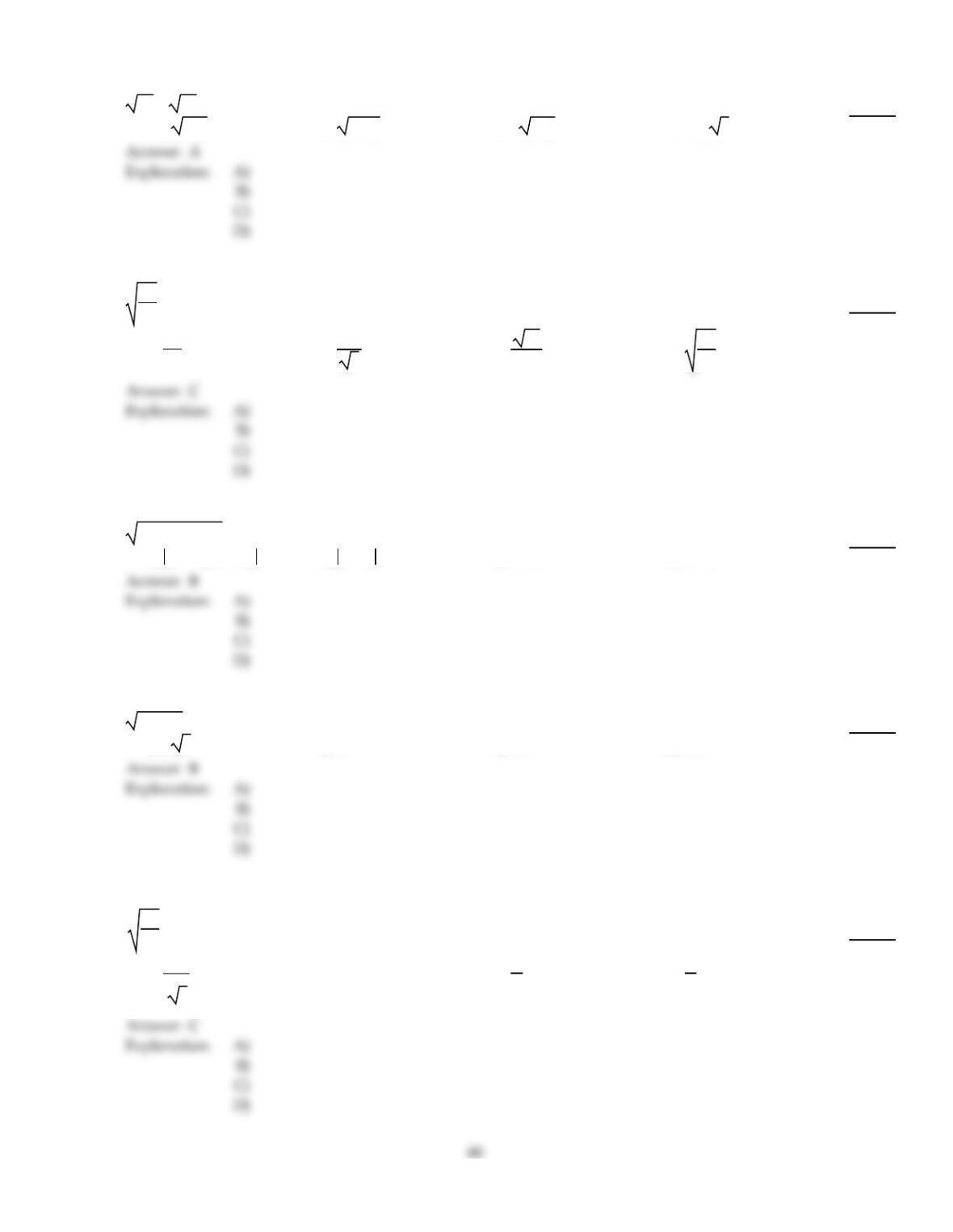
Multiply and simplify. Assume that all variables in a radicand represent positive real numbers.
243)
6x ·3y
243)
A)
3 2xy
B)
18xy
C)
2 3xy
D)
3xy 2
Use the quotient rule to simplify. Assume all variables represent positive real numbers.
244)
10
49
244)
A)
10
7
B)
10
7
C)
10
7
D)
10
7
Simplify the expression.
245)
x2– 12x + 36
245)
A)
(x – 6)( x + 6)
B)
x – 6
C)
x + 6
D)
x – 6
Find the square root if it is a real number, or state that the expression is not a real number.
246)
64 +36
246)
A)
2 7
B)
10
C)
14
D)
100
Find the cube root.
247)
3 1
27
247)
A)
1
33
B)
3
C)
1
3
D)
1
9