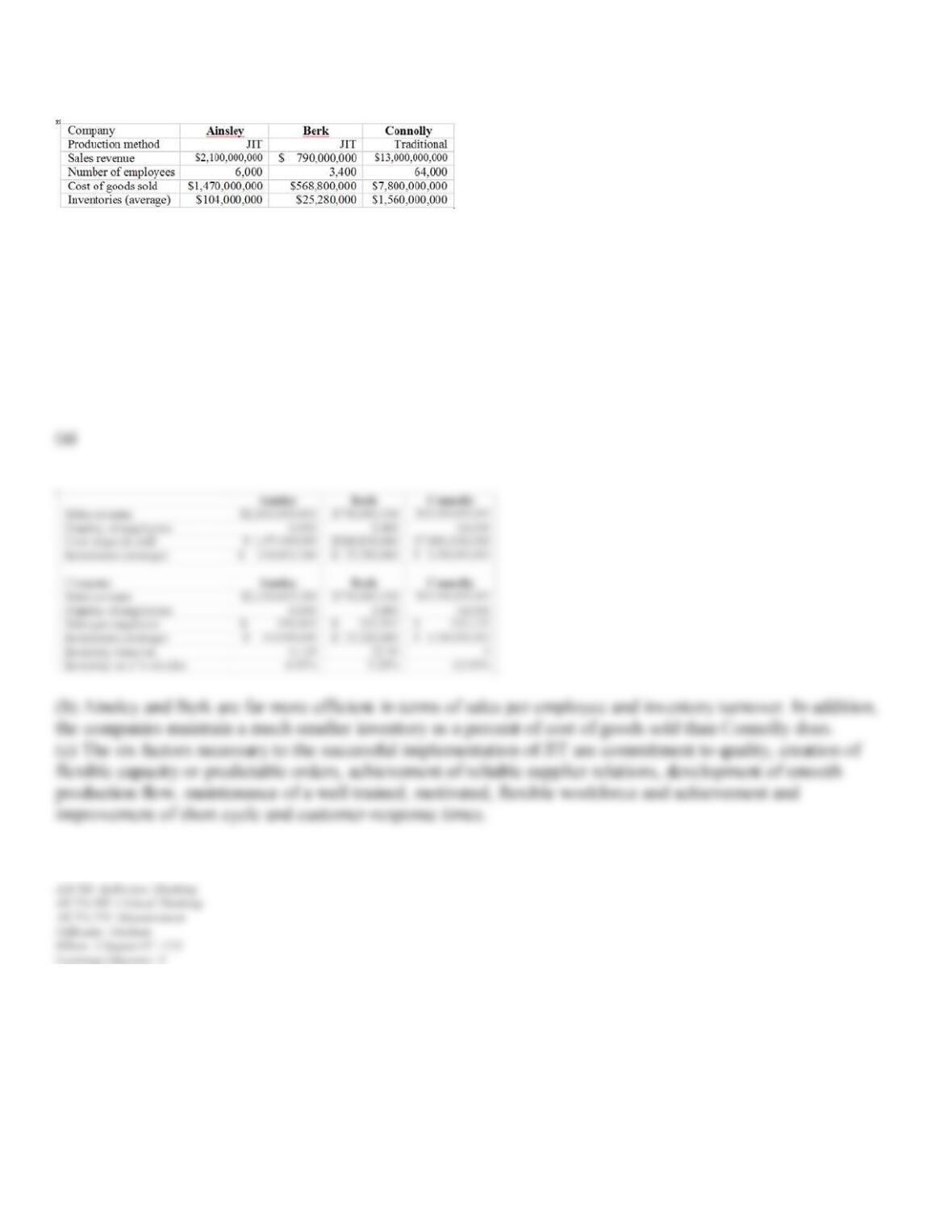
113. Consider the following annual information about three companies in the same manufacturing industry:
Required:
(a) Compute the following for each company:
(1) Sales per employee
(2) Inventory turnover
(3) Inventory as a percentage of sales
(b) Evaluate the relative performance of the three companies.
(c) Connolly is considering the implementation of a just–in-time (JIT) inventory system. What are the six factors
necessary to successful implementation?
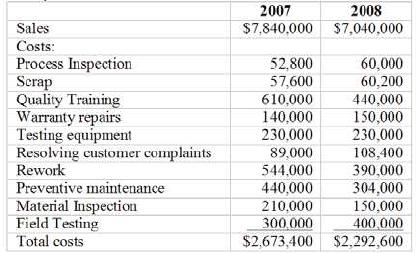
114. Burns Corporation manufactures large kitchen appliances. The following represents financial information
for two years:
Required:
(a) Classify these items into costs of prevention (P), appraisal (A), internal failure(I) or external failure (E)
activities.
(b) Calculate the ratio of prevention, appraisal, internal failure and external failure costs to sales for 2007 and
2008.
(c) Prepare a cost of quality report for 2007.
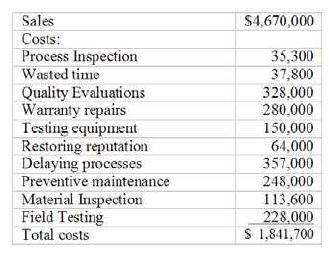
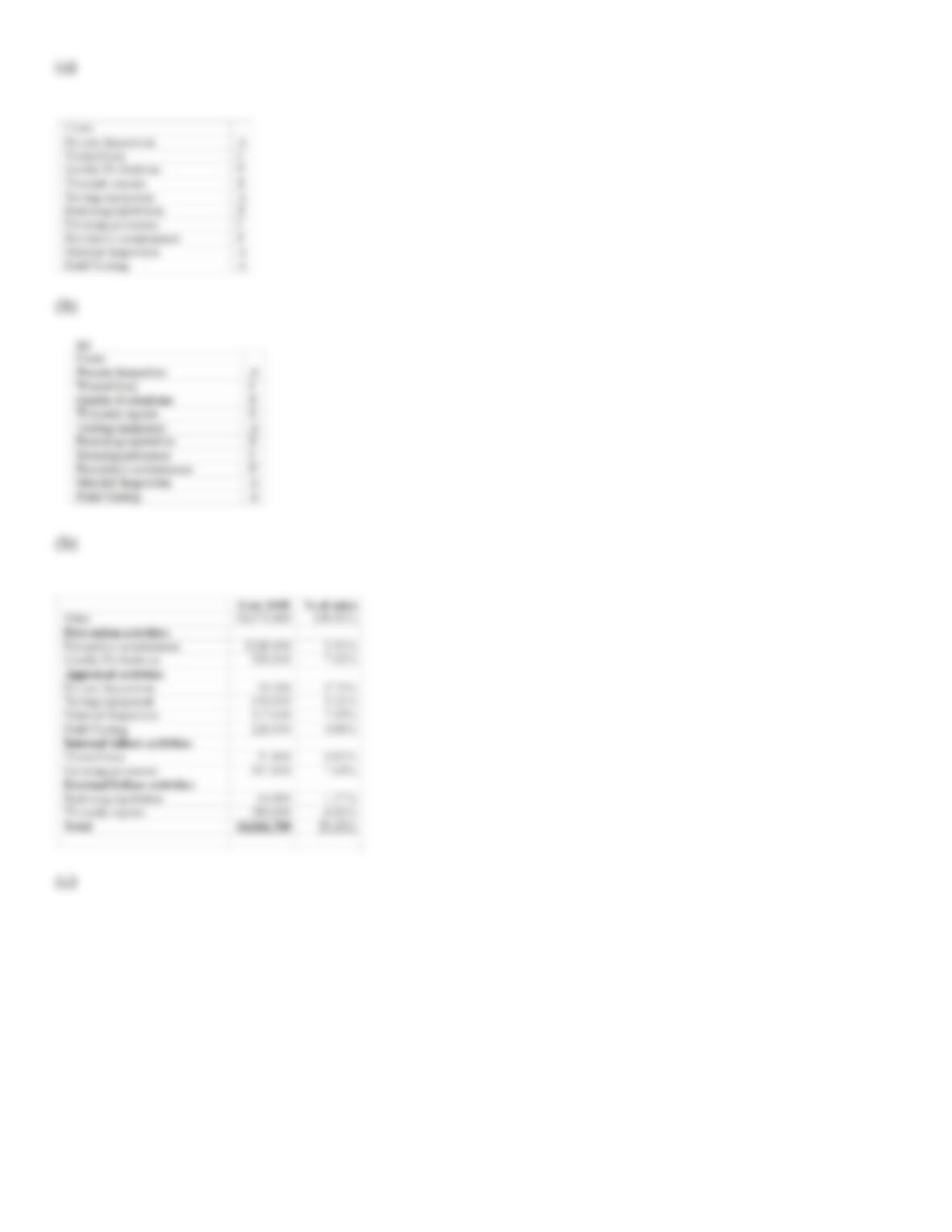
115. Holbrook Corporation is a manufacturer of electronic stereo equipment. The following represents financial
information for the year 2008:
Required:
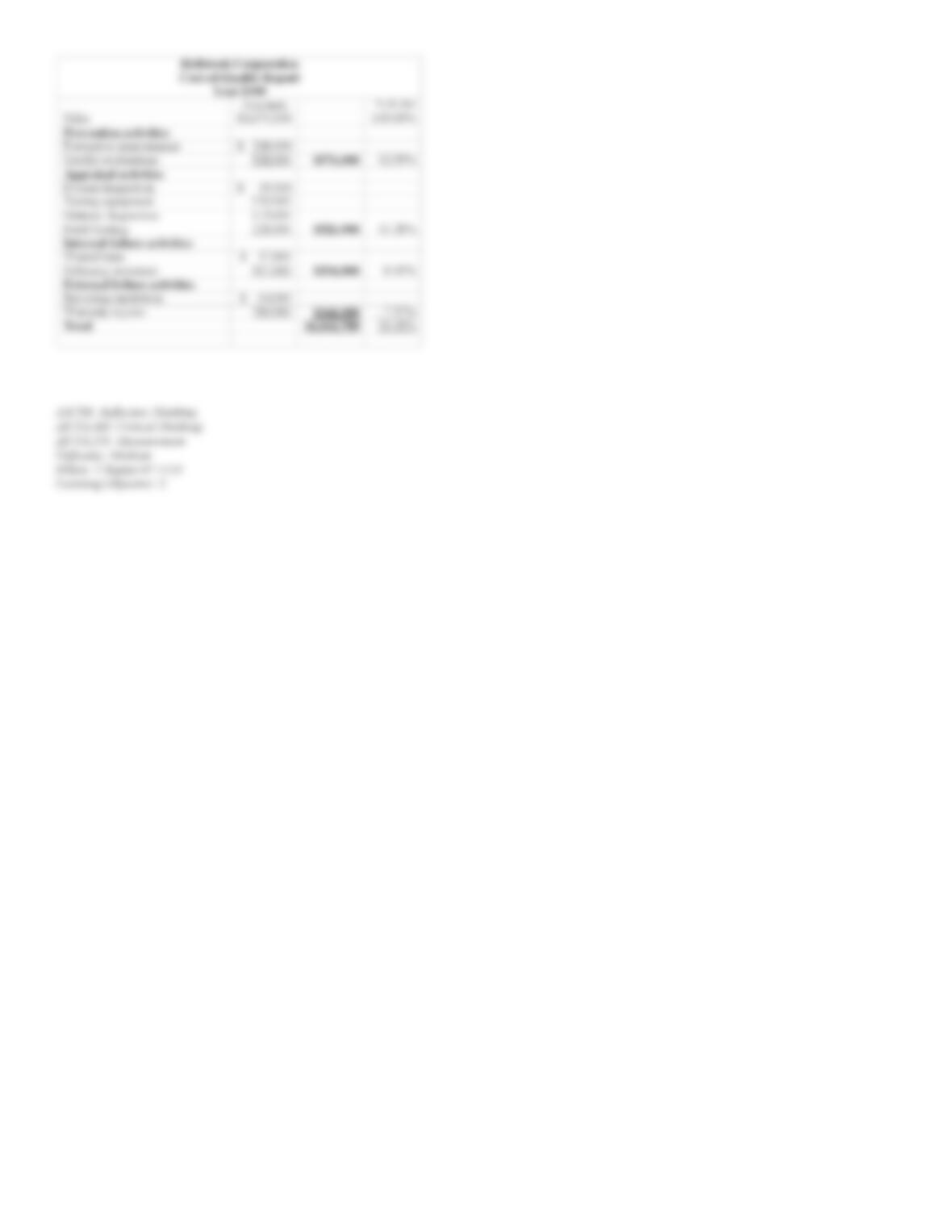
(a) Classify these items into costs of prevention (P), appraisal (A), internal failure (I) or external failure (E)
activities.
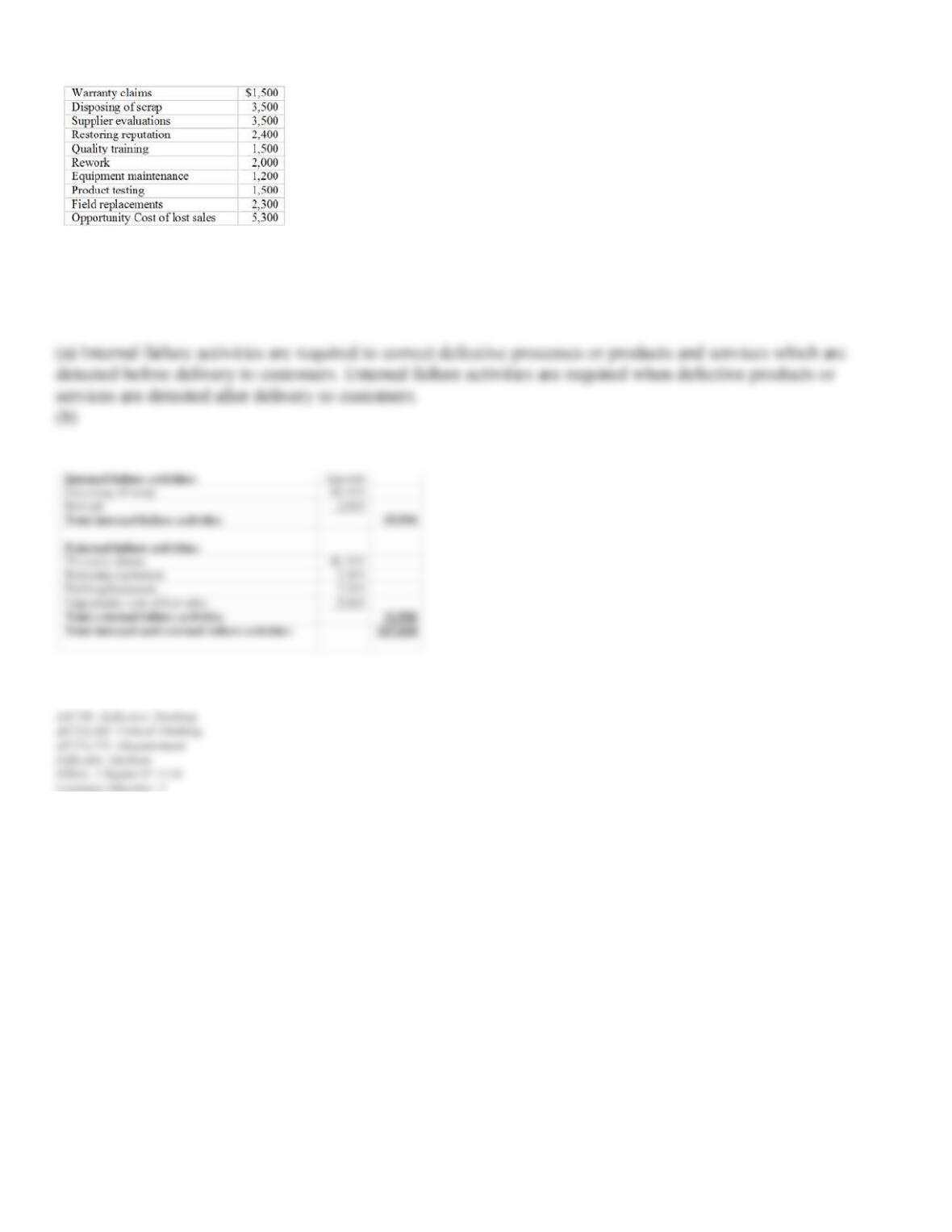
(b) Calculate the ratio of prevention, appraisal, internal failure and external failure costs to sales for the year
2008.
(c) Prepare a cost of quality report for the year 2008.
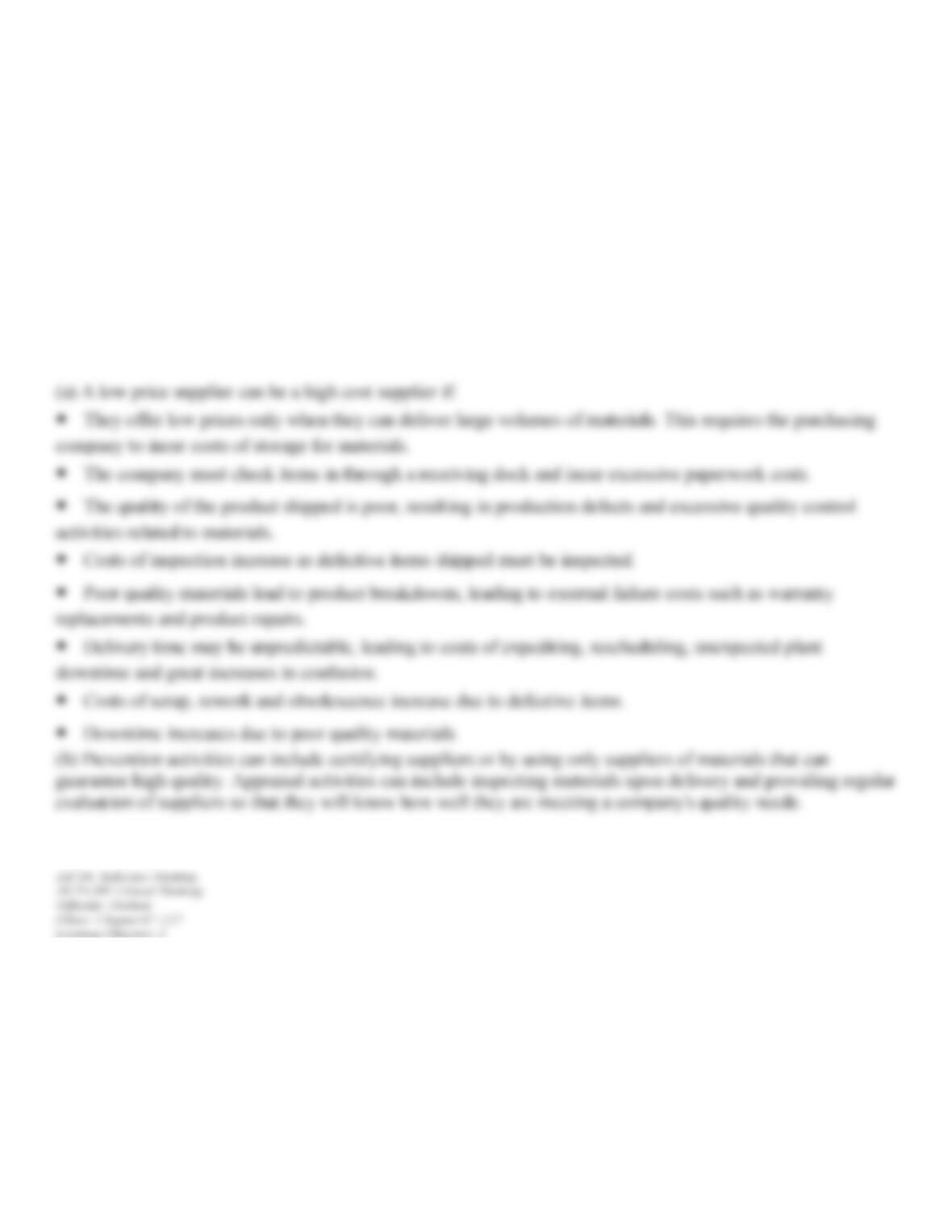
116. Listed below are selected operating costs for Ortez Products last month:
Required:
a) Define internal and external failure activities
b) What was Ortez’s total cost of internal failure and external failure for last month?
117. Companies are continuously seeking ways to improve quality of production and reduce costs. One of the
areas is to work with suppliers to improve the quality and reliability of parts and products shipped. In an article
entitled “In Defense of Activity-Based Cost Management,” Robert S. Kaplan says:
An ABC model can play a major role in improving supplier relationships as well. These relationships must be a
vital part of any quality and cycle-time improvement program. A key insight is to use ABC to distinguish
between low-price and low-cost suppliers. Traditional cost accounting, with its emphasis on purchase price
variances, encourages purchasing people to continually scan the population of potential suppliers to obtain low
price quotations. Most companies have learned, the hard way, that many of their low-price suppliers are actually
extremely high-cost suppliers. (Source: Management Accounting: November, 1992)
Required:
(a) Explain what Kaplan means by “many of their low-price suppliers are actually extremely high-cost
suppliers.”
(b)What general prevention and appraisal activities can be used to improve the quality and reliability of parts
and products shipped from suppliers?
118. Traditionally, companies in the United States have employed a “push” manufacturing style. Studies in
Activity Based Management and Quality Control have indicated that this approach is filled with many
non-value-added activities, which increase overall costs and reduce profits. The “push” style is being replaced
with a “pull” approach.
Required: Briefly describe the major differences between the push and pull approaches. What non-value added
activities are eliminated in a pull manufacturing system?
119. Dayton Extruded Plastics is a company involved in the injection molding process of plastic extruders. The
company had a process of inspection, checking line work and handling returns from customers to identify and
correct quality problems. Scrapped extruders were ground into powder and fed back to the extruders as raw
material; thus all scrapped extruders were reused at some point. The company‘s cost accounting system
indicated that the cost of scrap was “zero,” a view also held by Dayton Extruded’s management. (Source:
“Activity Based management” by Peter B. B. Turney published in Management Accounting)
Required:
a) Comment on the view that scrap costs were zero at Dayton Extruded Plastics.
b) Identify internal and external failure activities that were required by Dayton Extruded.
c) Identify prevention and appraisal activities that could have been employed.
120. Manufacturers have found that the Just-in-Time (JIT) philosophy improves quality, lowers costs and
improves profits. Those that have successfully implemented JIT have found that six components are necessary.
Required: Identify the six components necessary to the successful implementation of JIT and briefly comment
on each.
121. Cessna, the world‘s largest manufacturer of single-engine aircraft and business jets, recently implemented a
program to improve its production system with the goal of eliminating wasted activities throughout the
company. The company‘s goal was to improve all aspects of product delivery from design, supply channels,
production, and distribution. In a structured, 10-month process, the company took the following actions:
(1) Conducted workshops and on-site events to train employees in the new system.
(2) Implemented techniques to reduce the setup time required changing over machines from one product to the
next.
(3) Implemented visual work instructions and quality control checks in the manufacturing process.
(4) Made tool, fixture and engineering design changes to prevent quality defects from occurring.
(5) Redesigned the groupings of machines to shorten the flow time required to finish a product.
(6) Trained operators to perform multiple jobs to distribute work according to demand.
(7) Implemented quality methods assuring that defects were not passed from one workstation to another.
(8) Empowered employees with decision-making powers regarding production processes by developing
standard work and other metrics in the production process.
(9) Implemented a “pull” system of delivering components to the manufacturing floor.
(10) Implemented systems to improve order fulfillment and meet customers’ demands.
Required:
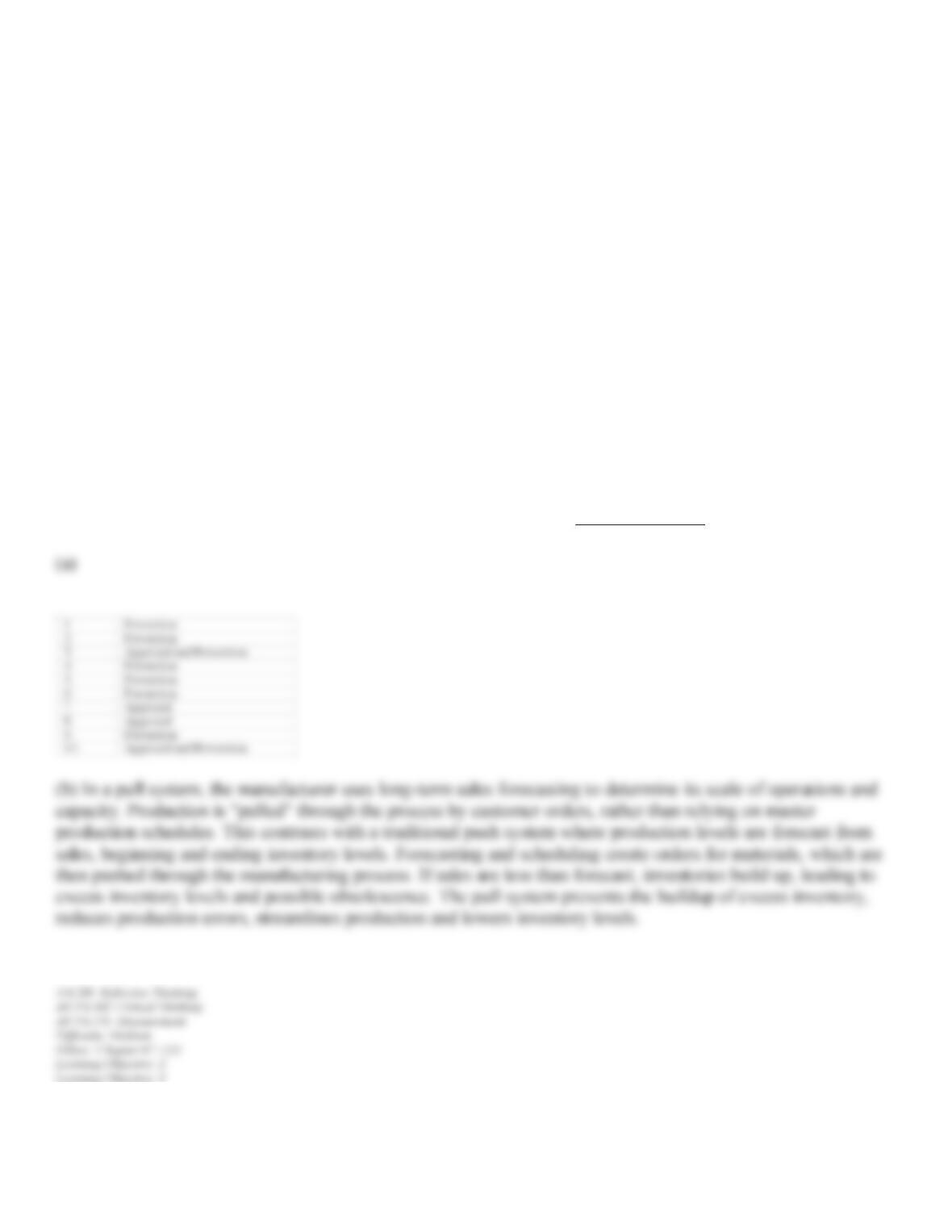
(a) For each of the 10 numbered items, indicate whether the action taken by Cessna was a Prevention activity,
Appraisal activity, Internal failure activity, or External failure activity.
(b) What is meant by a “pull” system of manufacturing? Briefly describe the differences between a pull system
and a traditional manufacturing system. What are the major benefits of a pull system?
(Adapted from “Becoming a Lean Enterprise, A Tale of Two Firms,” Strategic Finance, November, 2002)