7.5-7) Carlton Foods’ computed gross profit for January 31, 20X9 as follows:
Sales $5,200
Cost of goods available for sale 4,800
Ending inventory (200 units) 1,900
Cost of goods sold 2,900
Gross profit $ 2,300
Carlton Foods experienced a sudden decline in the replacement cost of its inventory during the month of
January with per unit costs declining to $6.00 per unit and net realizable values falling to $7.00 per unit.
During March, 20X9 replacement costs rose to $11.00 per unit.
Required:
1) Prepare the appropriate journal entry under U.S. GAAP regulations for January, 20X9.
2) Prepare the appropriate journal entry under IFRS for January, 20X9.
3) Prepare the appropriate journal entry under U.S. GAAP regulations for March, 20X9.
4) Prepare a revised gross profit statement for Carlton Foods as of January, 20X9 under U.S. GAAP
regulations.
7.5-8) Calcey Company had the following inventory balance as of September 30, 20X9.
September 3 order of 400 units @ $10.50 $ 4,200
September 8 order of 100 units @ $11.00 1,100
September 19 order of 200 units @ $11.50 2,300
$ 7,600
On September 20, 20X9, the company sold 240 units at $16.00 per unit. On September 25, 20X9, a
competitor announced a new model which resulted in the cost of Calcey inventory dropping to the new
replacement cost, which was $10.75. Calcey Company uses a perpetual inventory system.
1. What is the balance in the inventory account on September 30, 20X9, if Calcey Company uses:
a. FIFO?
b. LIFO?
2. What journal entry is necessary on September 25, 20X9, if Calcey Company uses lower–of–cost–or–
market, where cost is defined as:
a. FIFO?
b. LIFO?
Learning Objective 7.6 Questions
7.6-1) If the ending inventory is overstated by $15,000 in 20X9, and assuming a constant 30% tax rate, then
what will be the effect on net income in 2X10?
A) Net income will be understated by $4,500 in 2X10.
B) Net income will be overstated by $4,500 in 2X10.
C) Net income will be understated by $10,500 in 2X10.
D) Net income will be overstated by $10,500 in 2X10.
E) Net income will not be overstated or understated in 2X10.
7.6-2) If ending inventory is understated by $8,000 in 20X9, and assuming a constant 30% tax rate, then
what will be the effect on retained earnings in 2X10?
A) The 2X10 ending retained earnings will be understated by $2,400.
B) The 2X10 ending retained earnings will be overstated by $2,400.
C) The 2X10 ending retained earnings will be understated by $5,600.
D) The 2X10 ending retained earnings will be overstated by $5,600.
E) The 2X10 ending retained earnings will not be understated or overstated.
7.6-3) If ending inventory is understated by $7,000 in 20X9, and assuming a constant 30% tax rate, then
what will be the effect on gross profit in 20X9?
A) 20X9 gross profit will be understated by $2,100.
B) 20X9 gross profit will be understated by $4,900.
C) 20X9 gross profit will be overstated by $4,900.
D) 20X9 gross profit will be understated by $7,000.
E) 20X9 gross profit will be overstated by $7,000.
7.6-4) Two separate errors affected Claridy Instrument Company in 20X9. The beginning inventory was
overstated by $17,000 and the ending inventory was overstated by $23,000. Ignoring taxes, net income in
20X9 will be:
A) overstated by $40,000.
B) understated by $23,000.
C) overstated by $23,000.
D) overstated by $6,000.
E) understated by $40,000.
7.6-5) Two separate errors affected Claridy Instrument Company in 20X9. The beginning inventory was
overstated by $17,000 and the ending inventory was overstated by $23,000. Ignoring taxes, net income in
2X10 will be:
A) overstated by $40,000.
B) understated by $23,000.
C) overstated by $23,000.
D) overstated by $6,000.
E) understated by $40,000.
7.6-6) If ending inventory is overstated by $5,000 in 20X9, retained earnings will be overstated in 2X10.
7.6-7) If beginning inventory is overstated by $2,000 in 20X9, net income in 2X10 will be overstated.
7.6-8) If ending inventory is understated by $3,000 in 20X9, net income in 2X10 will be overstated.
7.6-9) If ending inventory is overstated by $3,000 in 20X9, retained earnings at the end of 2X10 will be
correctly stated.
7.6-10) Cutoff errors are failures to record transactions in the correct time period.

36
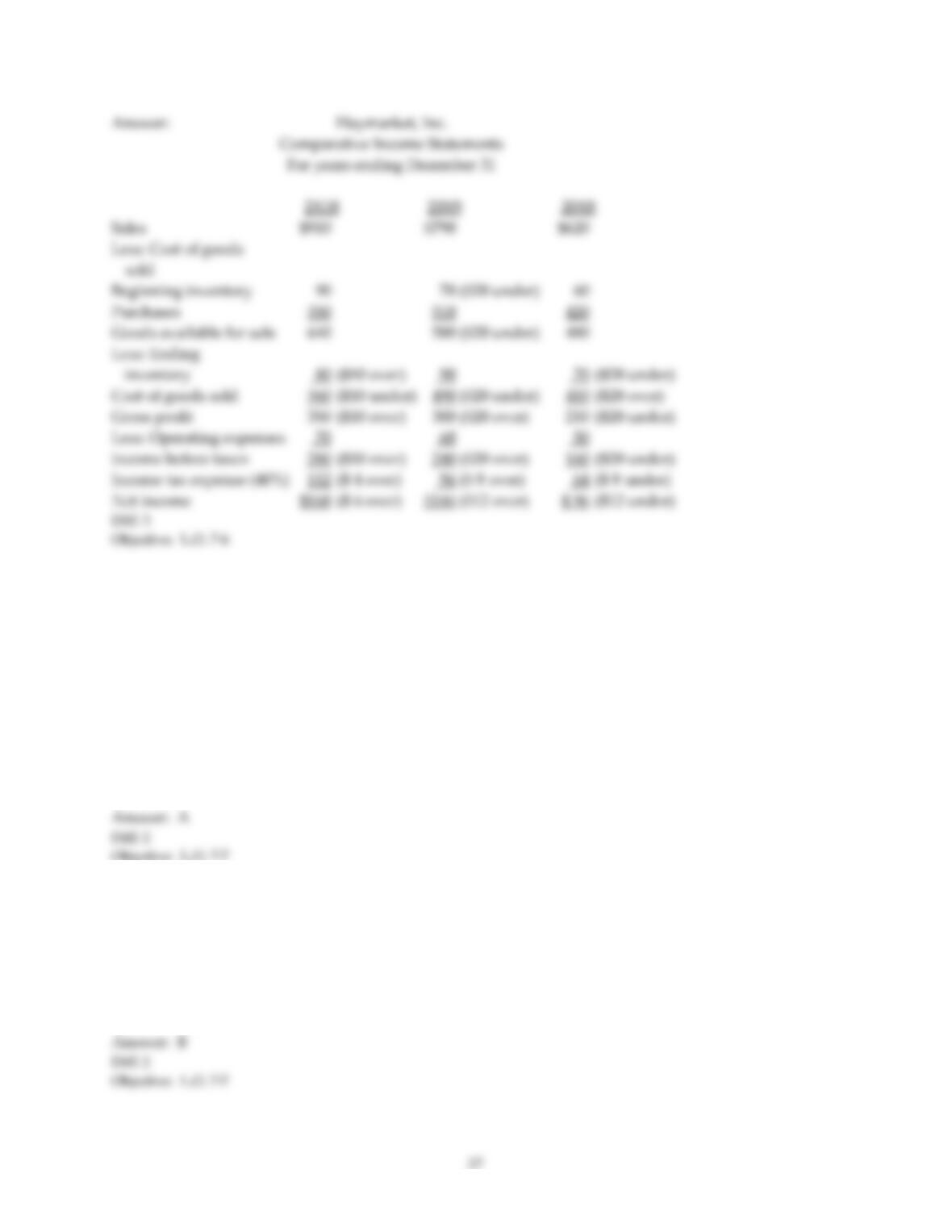
7.6-11) Presented below are the income statements for Haymarket, Inc., for the years ended December 31,
2X10, 20X9, and 20X8.
Haymarket, Inc.
Comparative Income Statements
For years ending December 31
2X10 20X9 20X8
Sales $910 $790 $620
Less: Cost of Goods Sold:
Beginning Inventory 90 70 60
Purchases 550 510 420
Goods Available for Sale 640 580 480
Less: Ending Inventory 80 90 70
Cost of Goods Sold 560 490 410
Gross Profit 350 300 210
Less: Operating Expenses 70 60 50
Income Before Taxes 280 240 160
Income Tax Expense (40%) 112 96 64
Net Income $168 $144 $ 96
In 2X11 it was discovered that the 20X8 ending inventory was understated by $20, and the 2X10 ending
inventory was overstated by $10. The 20X8 beginning inventory and the 20X9 ending inventory were
correctly stated.
Identify the accounts which are incorrect on the 20X8, 20X9, and 2X10 income statements. State the dollar
error (by how much they are incorrect) and whether the amounts overstate or understate balances.
Learning Objective 7.7 Questions
7.7-1) Wallings Company had sales during May 20X9 of $29,000. During the month, the company had
purchases of $17,000. At May 1, 20X9, the company had inventory of $4,500. Assuming the company has a
gross profit percentage of 40%, what is the estimated ending inventory for Wallings Company at May 31,
20X9?
A) $ 4,100
B) $ 4,900
C) $ 7,300
D) $ 7,500
E) $ 9,900
7.7-2) For Lewis Landscapes, the gross profit percentage was 73% in 20X9 and 79% in 20X8. Management
should
A) be pleased at the profits.
B) investigate inventory shrinkage.
C) consider that a competitor’s store closing helped results.
D) decrease prices.
E) hire new auditors.
7.7-3) Finish Line Sports had inventory of $8,000 on Jan 1, 20X9, and $12,000 on Dec 31, 20X9. Sales for
20X9 were $250,000 and the company’s gross profit percentage was 35%. What was the inventory
turnover for Finish Line Sports for 20X9?
A) 7.29 times
B) 8.75 times
C) 13.54 times
D) 16.25 times
E) 25.00 times
7.7-4) The gross profit percentage is calculated as sales divided by gross profit.
7.7-5) Inventory turnover is calculated is cost of goods sold divided by average inventory.
7.7-6) Financial analysts and managers use the gross profit percentage as a measure of profitability and
inventory turnover as a measure of efficient asset use.
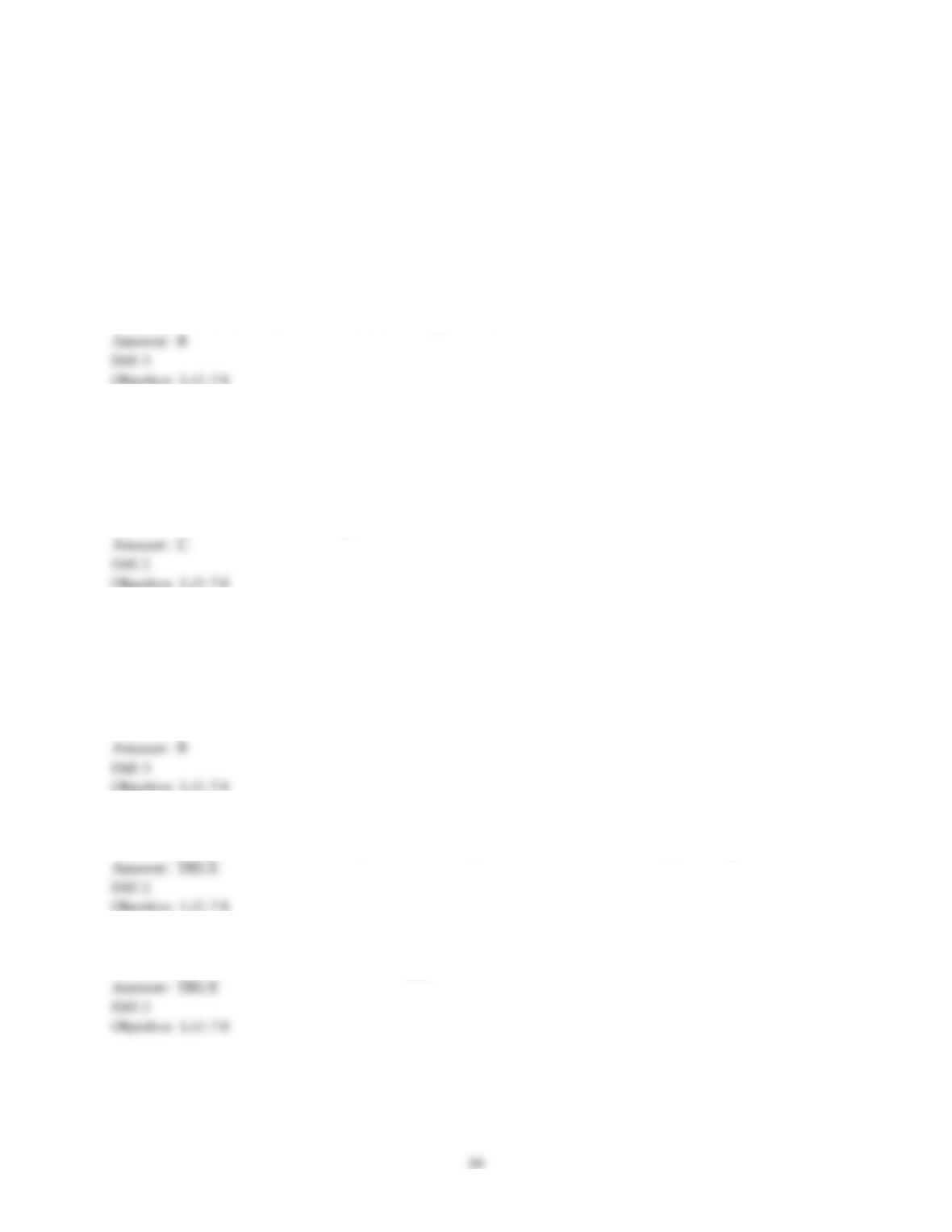
7.7-7) Armstrong Company uses a periodic inventory system. On January 1, 20X6, the company had
beginning inventory of $979,000. From January 1 to April 27, the company purchased $285,000 of
inventory and had sales revenue of $840,000. On the morning of April 28, an earthquake occurred which
resulted in the total loss of all inventory. The company’s gross profit percentage has averaged 40%. What
is the estimated inventory loss due to the earthquake?
Learning Objective 7.8 Questions
7.8-1) Which of the following correctly states an attribute associated with the LIFO inventory valuation
method?
A) The replacement cost is the cost of goods sold of an inventory item that is sold today.
B) An increase in the replacement cost of the inventory held during the current period is called a holding
gain.
C) A LIFO layer is maintained only as long as that purchase is the most recent purchase.
D) Assuming inflation across time periods, a LIFO inventory liquidation will result in a lower net income.
E) A LIFO reserve is established if a deflationary trend occurs.
7.8-2) Because of generally rising prices, a LIFO liquidation will
A) decrease net income.
B) increase cost of goods sold.
C) increase net income.
D) increase inventory.
E) occur often because of matching.
7.8-3) Because of rising prices, most companies that use LIFO
A) have a higher inventory than they would under FIFO.
B) report their LIFO reserve on the balance sheet or in the footnotes.
C) inflate their balance sheet asset total.
D) make stockholders’ owners equity look higher than they would under FIFO.
E) are very rare.
7.8-4) LIFO liquidation refers to the relatively higher profits generated under LIFO when reductions in
inventory levels occur because older, lower inventory costs are used in calculating cost of goods sold.
7.8-5) An increase in the replacement cost or other measure of current value of the inventory held during
the current period is referred to as a holding gain.
7.8-6) The difference between a company‘s inventory valued at LIFO and what it would be under FIFO is
known as a FIFO reserve.
Learning Objective 7.9 Questions
7.9-1) What order does inventory typically travel in an organization?
A) Raw materials, customer, finished goods, work in process
B) Raw materials, work in process, customer, finished goods,
C) Raw materials, work in process, finished goods, customer
D) Work in process, raw materials, finished goods, customer
E) Work in process, finished goods, raw materials, customer
7.9-2) Arko, Inc., manufactures tables. During the month of March, 20X9, Arko purchased 100 table tops
of wood costing $3 per piece, 400 table legs of wood costing $1 per leg, 100 bottles of glue costing $2.50
per bottle, and 800 nails costing $.20 per nail. All raw materials were put into production during March,
20X9, and production wages related to the production of tables amounted to $300. At the end of March,
20X9, ending work in process inventory had 20 table tops of wood, 80 table legs of wood, 20 bottles of
glue, and 160 nails.
Required:
Prepare journal entries for the purchase of raw materials on account, production activity, and completion
of production. How much would the value be in the work in process account at the end of March, 20X9?
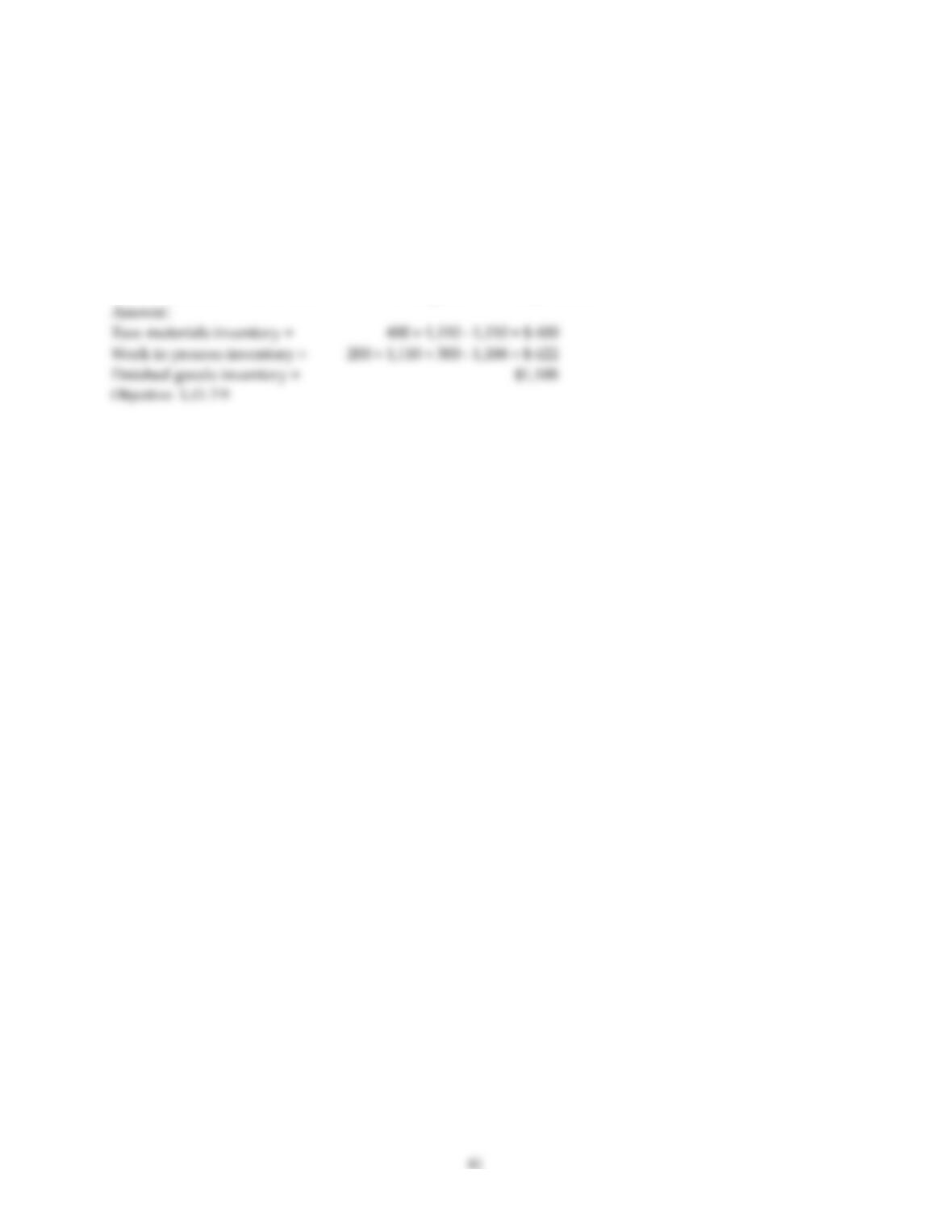
7.9-3) Arko, Inc., manufactures tables. During the month of March, 20X9, Arko purchased 100 table tops
of wood costing $3 per piece, 400 table legs of wood costing $1 per leg, 100 bottles of glue costing $2.50
per bottle, and 800 nails costing $.20 per nail. All raw materials were put into production during March,
20X9, and production wages related to the production of tables amounted to $300. At the end of March,
20X9, ending work in process inventory had 20 table tops of wood, 80 table legs of wood, 20 bottles of
glue, and 160 nails.
What will the inventory balances for Arko, Inc., be on March, 31, 20X9, assuming that the beginning
balance on March 1, 20X9, in the Raw materials inventory account was $400, the Work in process
inventory account was $200, and the Finished goods inventory was $0?