39.
Which of the following costs will not affect cost of goods sold?
40.
Which of the following would not be a component of the year-end inventory balance?
41.
Which of the following is correct?
42.
Which of the following statements is incorrect for a manufacturing entity?
Difficulty: 2 Medium
Learning Objective: 07-01 Apply the cost principle to identify the amounts that should be included in inventory and the
expense matching principle to determine cost of goods sold for typical retailers, wholesalers, and manufacturers.
Topic Area: Items in inventory and costs of purchases
43.
A company provided the following data: sales, $500,000; beginning inventory, $40,000; ending
inventory, $45,000; and gross profit, $150,000. What was the amount of inventory purchased
during the year?
44.
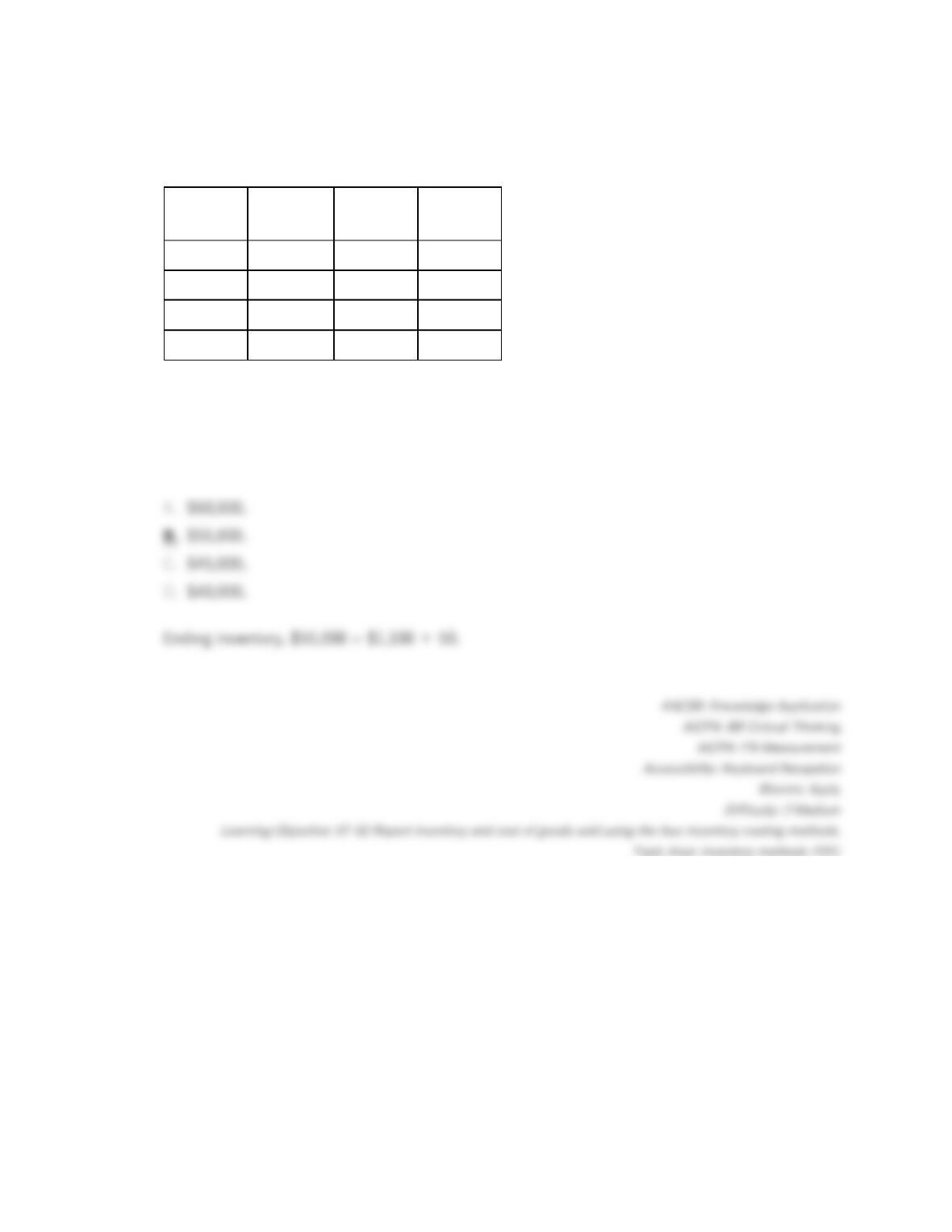
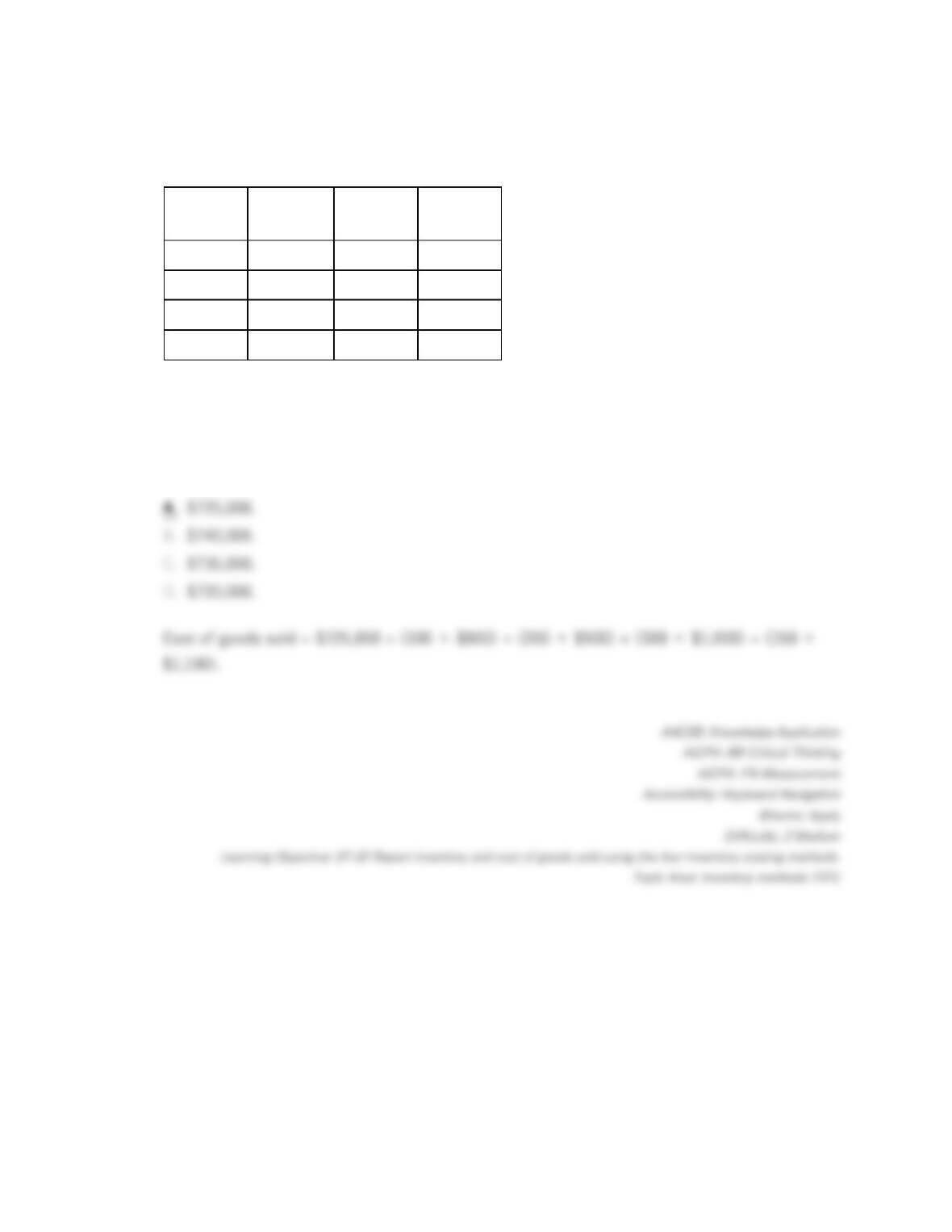
Lauer Corporation uses the periodic inventory system and has provided the following
information about one of its laptop computers:
Date
Transaction
Number of
Units
Cost per
Unit
1/1
100
$800
5/5
Purchase
200
$900
8/10
Purchase
300
$1,000
10/15
Purchase
200
$1,100
During the year, Lauer sold 750 laptop computers.
What was ending inventory using the FIFO cost flow assumption?
Topic Area: Inventory methods-FIFO
45.
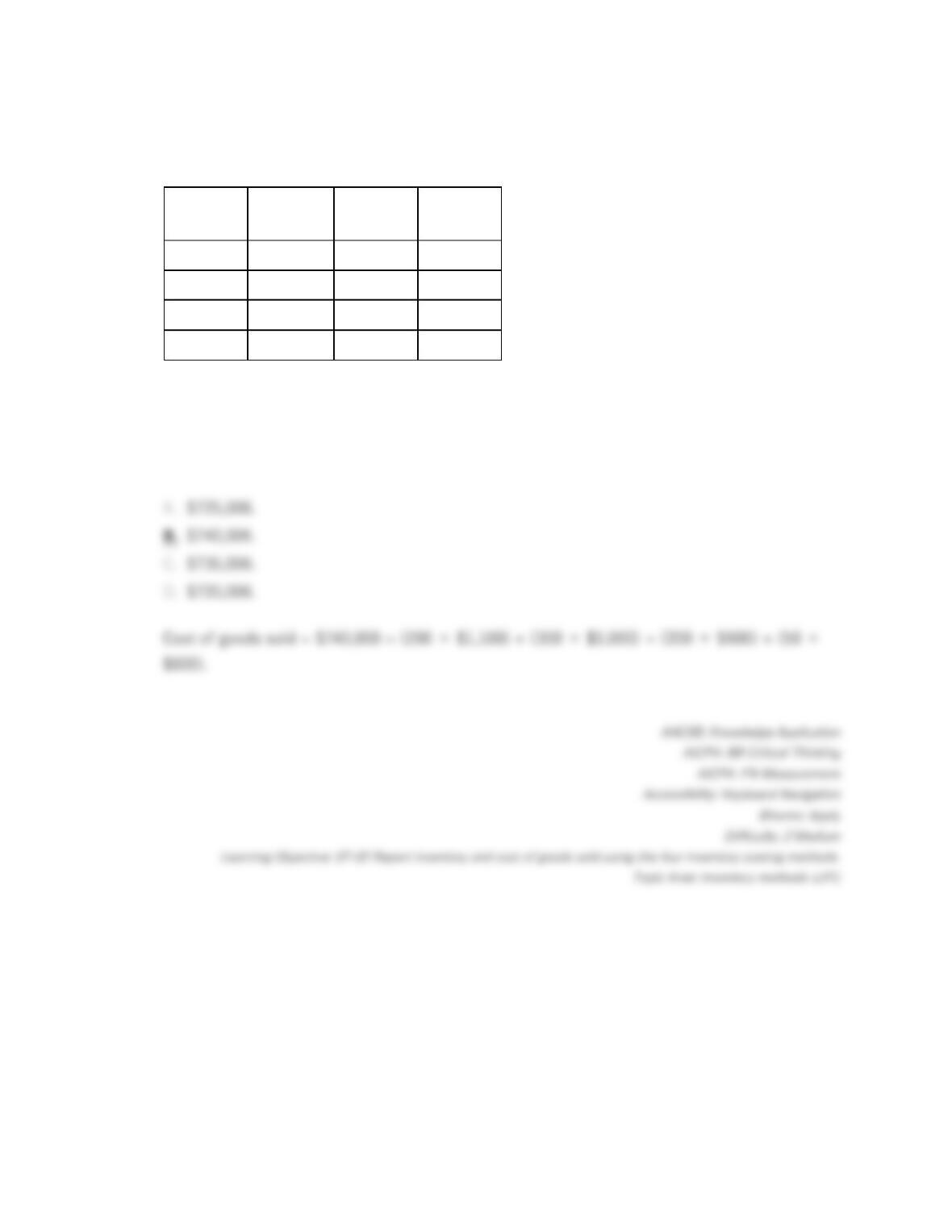
Lauer Corporation uses the periodic inventory system and has provided the following
information about one of its laptop computers:
Date
Transaction
Number of
Units
Cost per
Unit
1/1
100
$800
5/5
Purchase
200
$900
8/10
Purchase
300
$1,000
10/15
Purchase
200
$1,100
During the year, Lauer sold 750 laptop computers.
What was cost of goods sold using the FIFO cost flow assumption?
46.
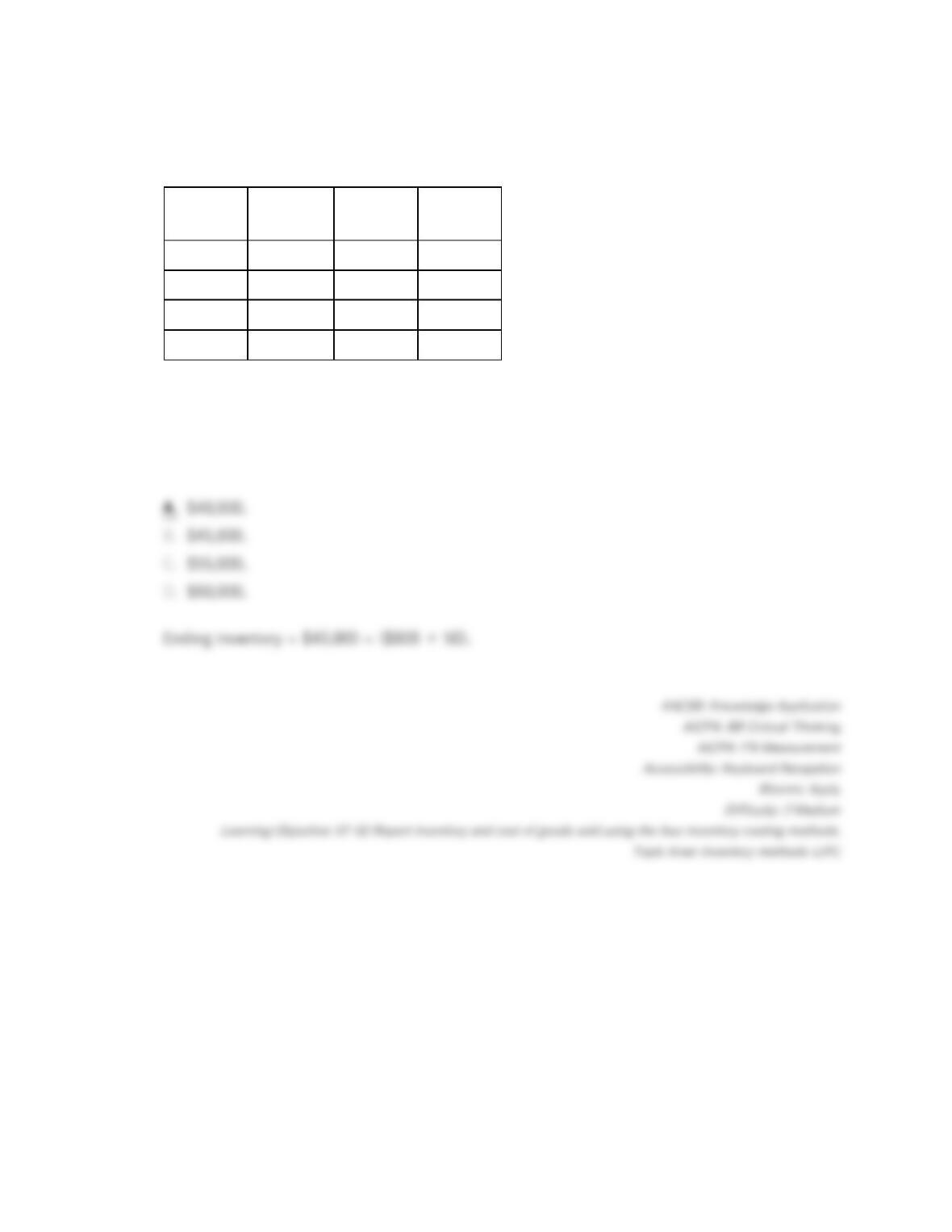
Lauer Corporation uses the periodic inventory system and has provided the following
information about one of its laptop computers:
Date
Transaction
Number of
Units
Cost per
Unit
1/1
100
$800
5/5
Purchase
200
$900
8/10
Purchase
300
$1,000
10/15
Purchase
200
$1,100
During the year, Lauer sold 750 laptop computers.
What was cost of goods sold using the LIFO cost flow assumption?
47.
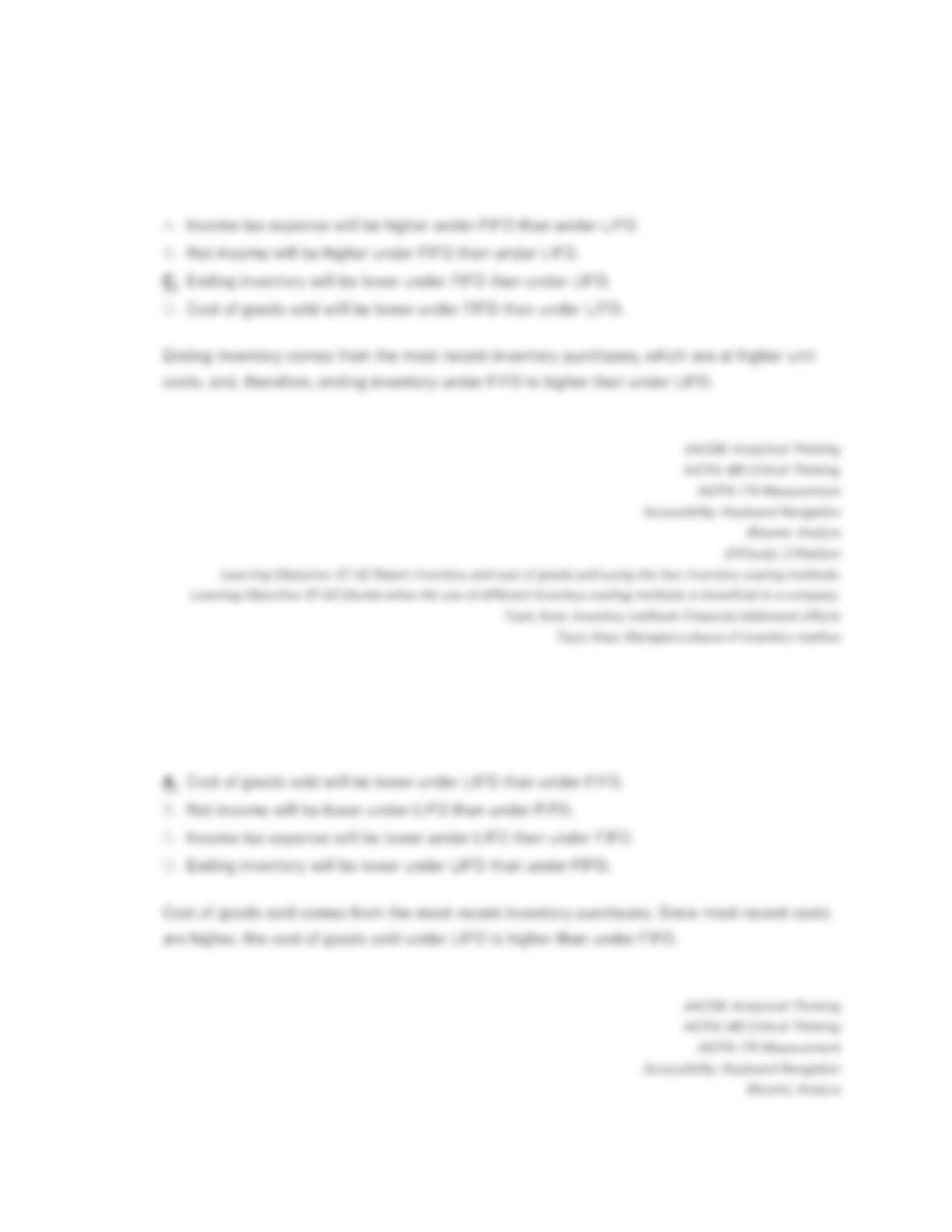
Lauer Corporation uses the periodic inventory system and has provided the following
information about one of its laptop computers:
Date
Transaction
Number of
Units
Cost per
Unit
1/1
100
$800
5/5
Purchase
200
$900
8/10
Purchase
300
$1,000
10/15
Purchase
200
$1,100
During the year, Lauer sold 750 laptop computers.
What was ending inventory using the LIFO cost flow assumption?
48.
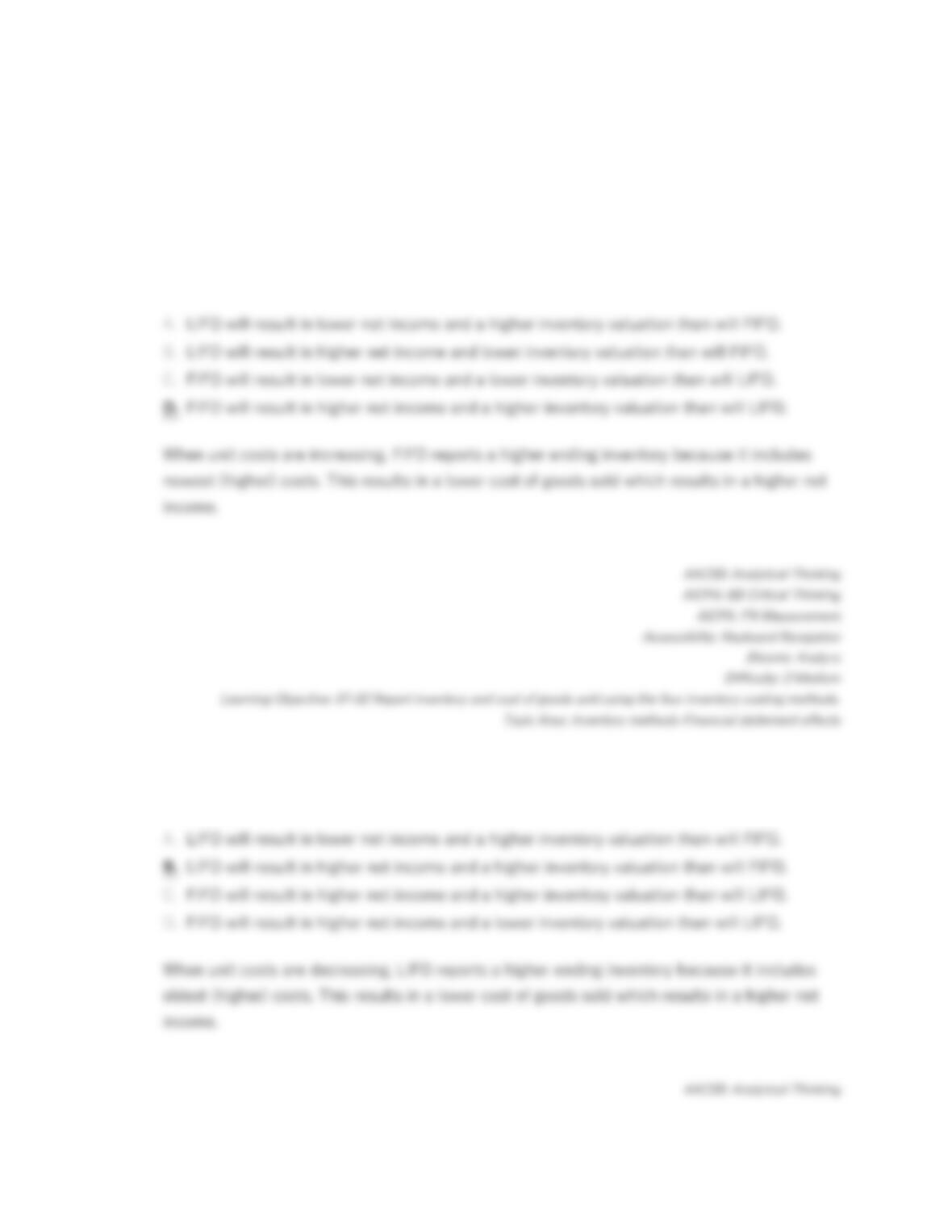
Under the FIFO cost flow assumption during a period of rising costs, which of the following is
false?
49.
Under the LIFO cost flow assumption during a period of rising costs, which of the following is
false?
Difficulty: 2 Medium
Learning Objective: 07-02 Report inventory and cost of goods sold using the four inventory costing methods.
Learning Objective: 07-03 Decide when the use of different inventory costing methods is beneficial to a company.
Topic Area: Inventory methods-Financial statement effects
Topic Area: Managers choice of inventory method
50.
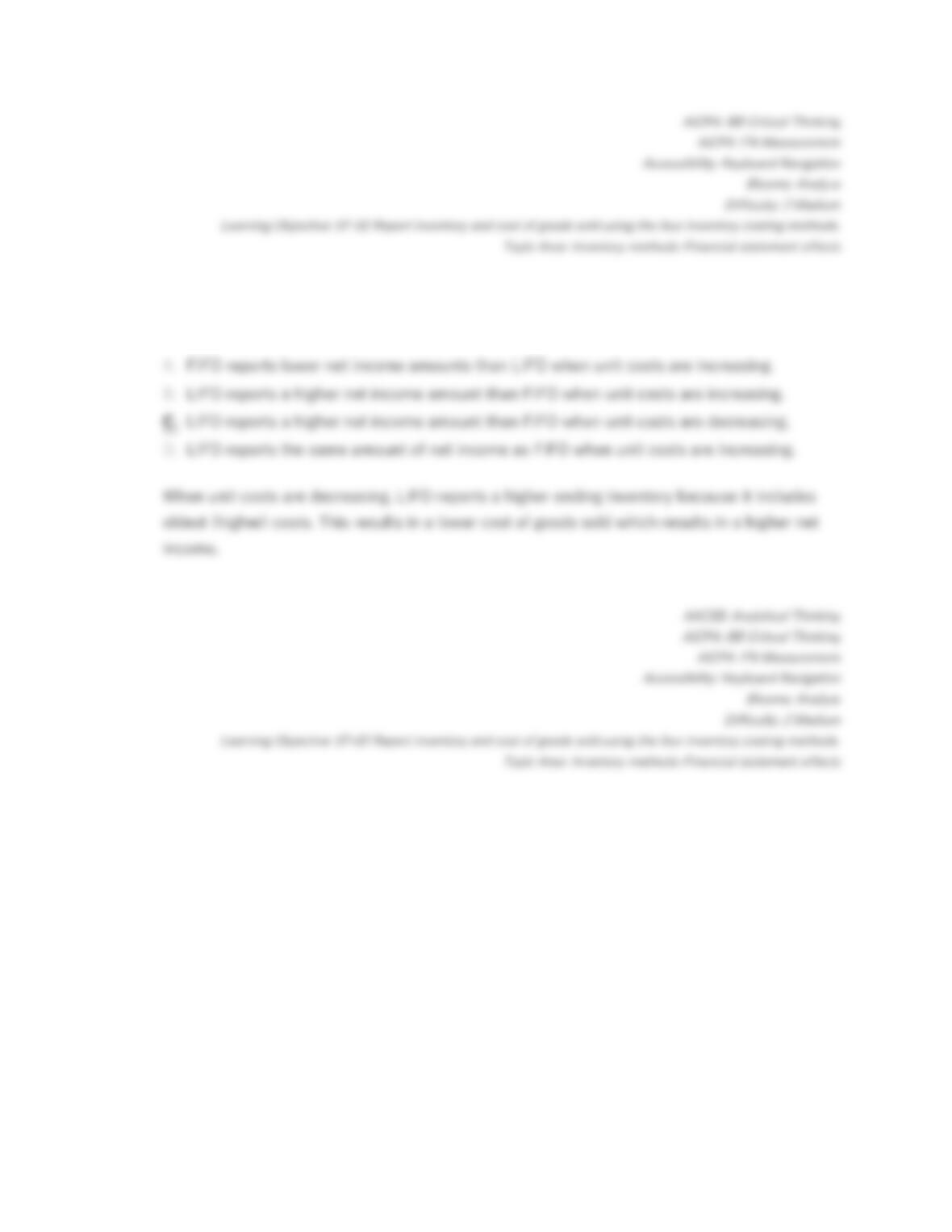
Which of the following statements is correct when inventory unit costs are increasing?
51.
Which of the following statements is correct when inventory unit costs are decreasing?
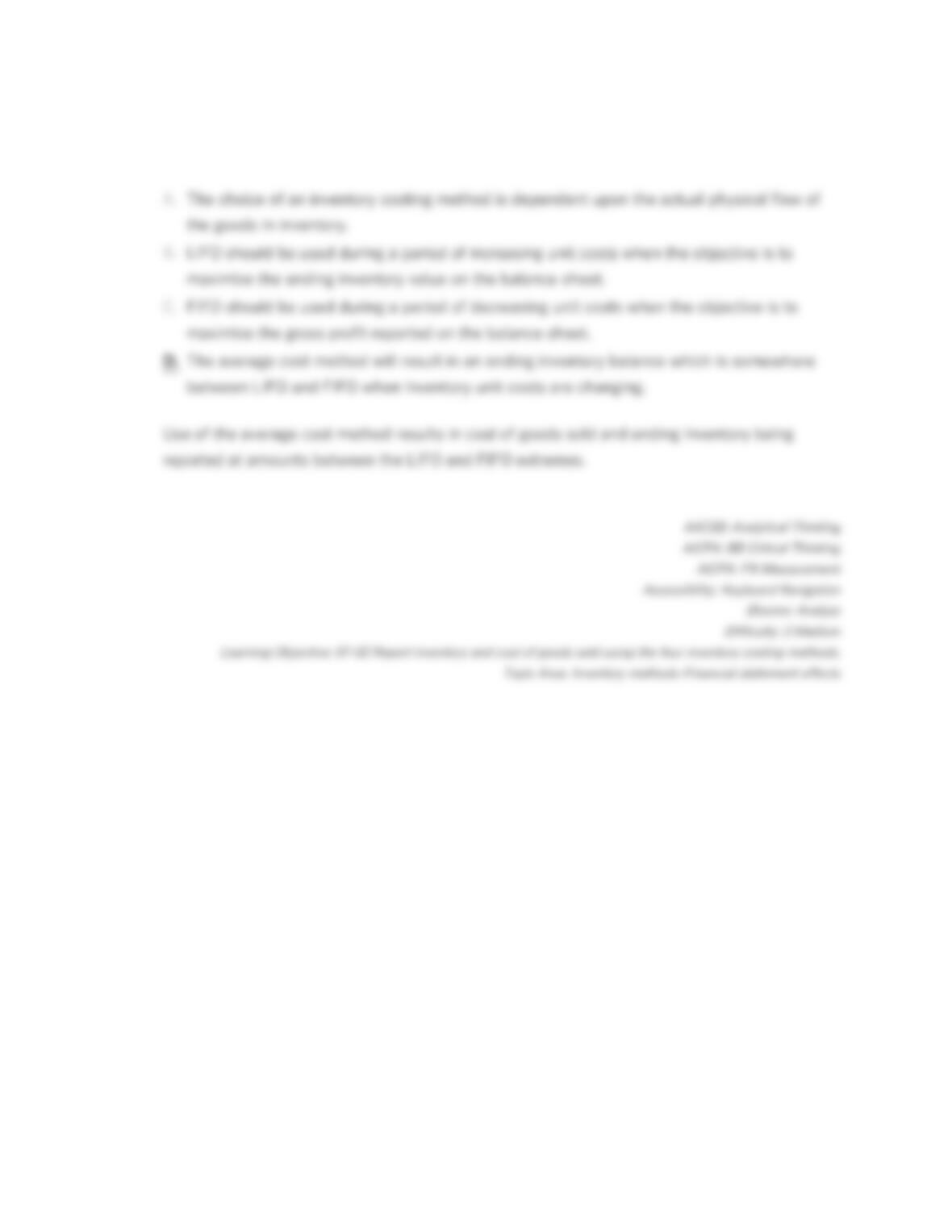
52.
Which of the following statements is correct?
53.
Which of the following statements is correct?
54.
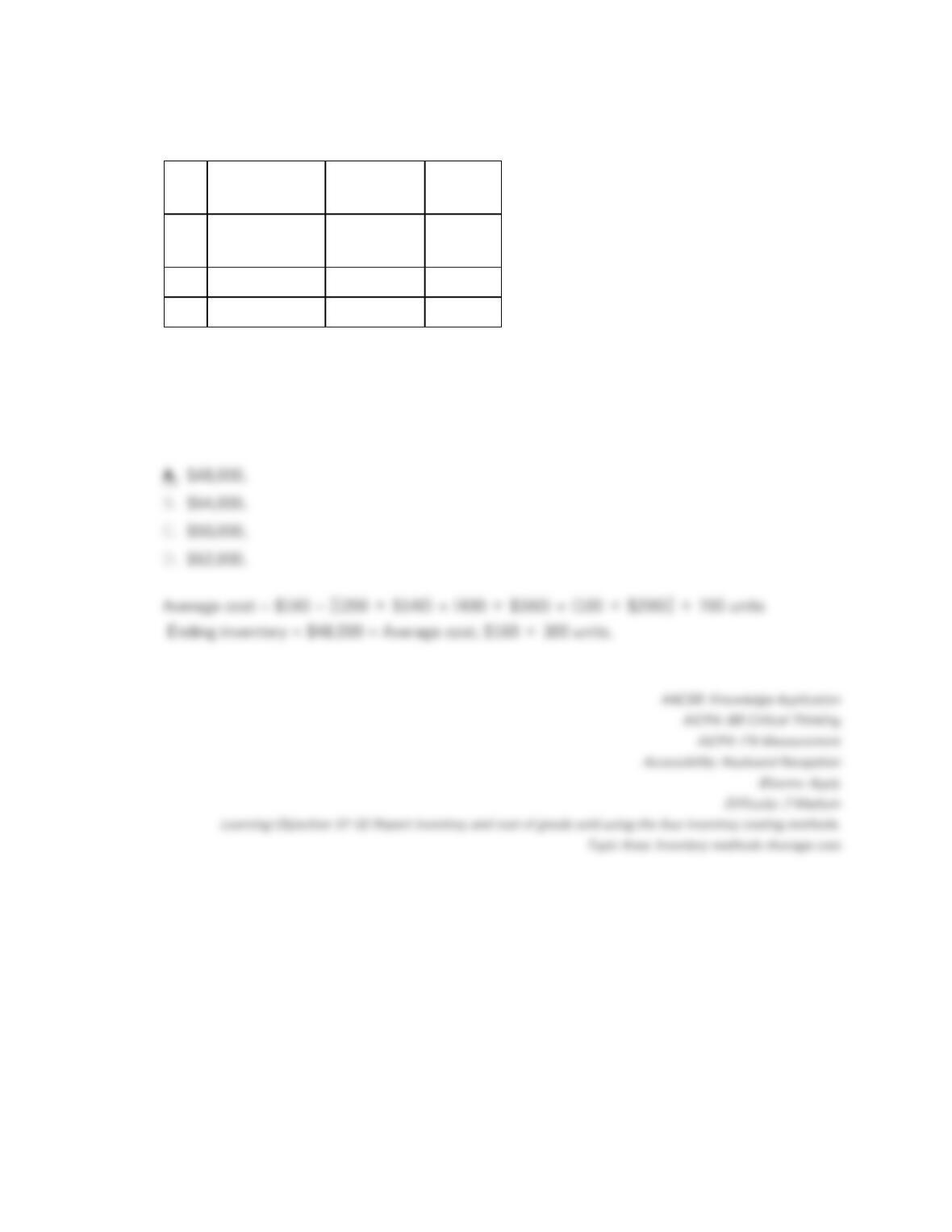
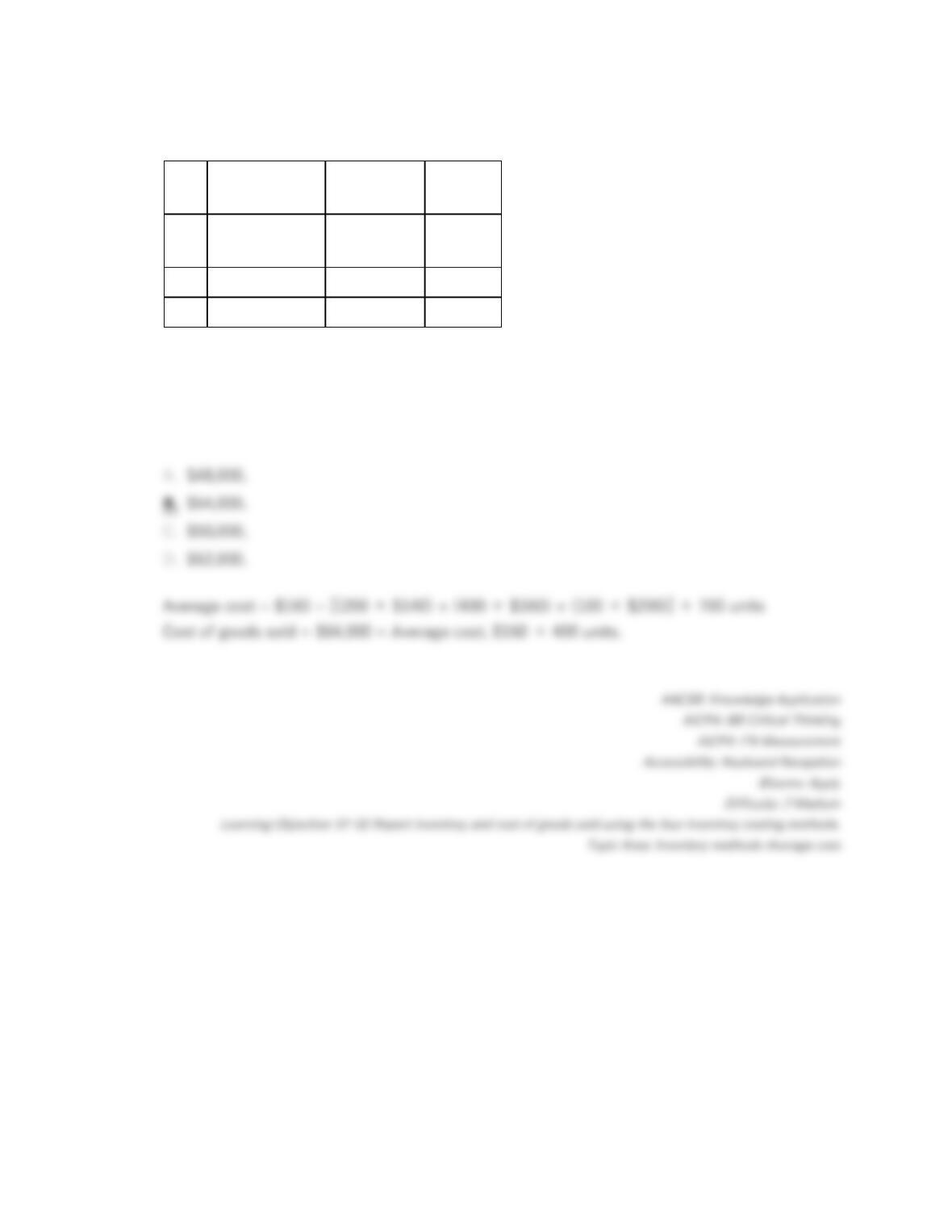
Maxim Corp. has provided the following information about one of its products:
Date
Transaction
Number of
Units
Cost per
Unit
1/1
Beginning
Inventory
200
$140
6/5
Purchase
400
$160
11/10
Purchase
100
$200
During the year, Maxim sold 400 units.
What is ending inventory using the average cost method?
55.
Maxim Corp. has provided the following information about one of its products:
Date
Transaction
Number of
Units
Cost per
Unit
1/1
Beginning
Inventory
200
$140
6/5
Purchase
400
$160
11/10
Purchase
100
$200
During the year, Maxim sold 400 units.
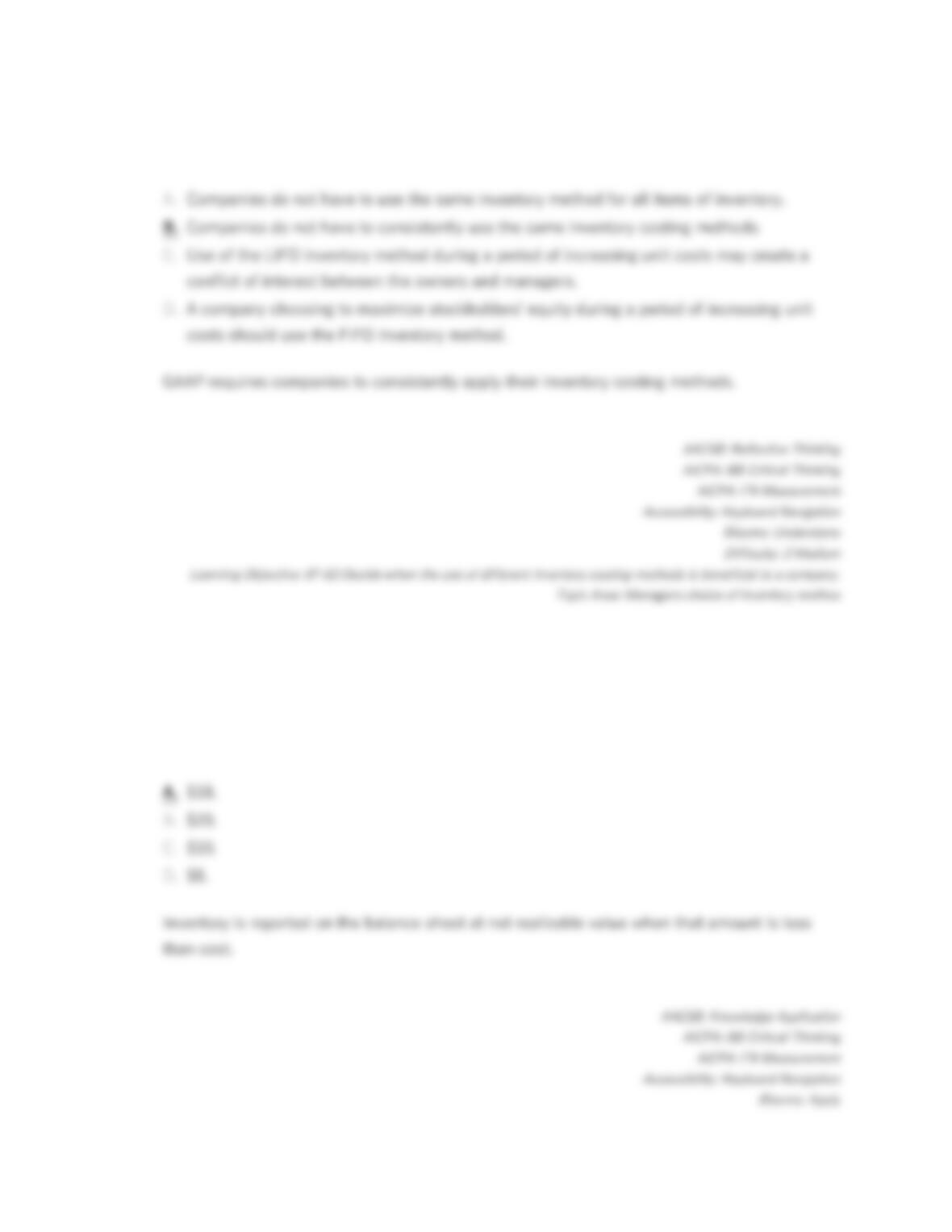
What is cost of goods sold using the average cost method?
56.
Which of the following statements is false?
57.
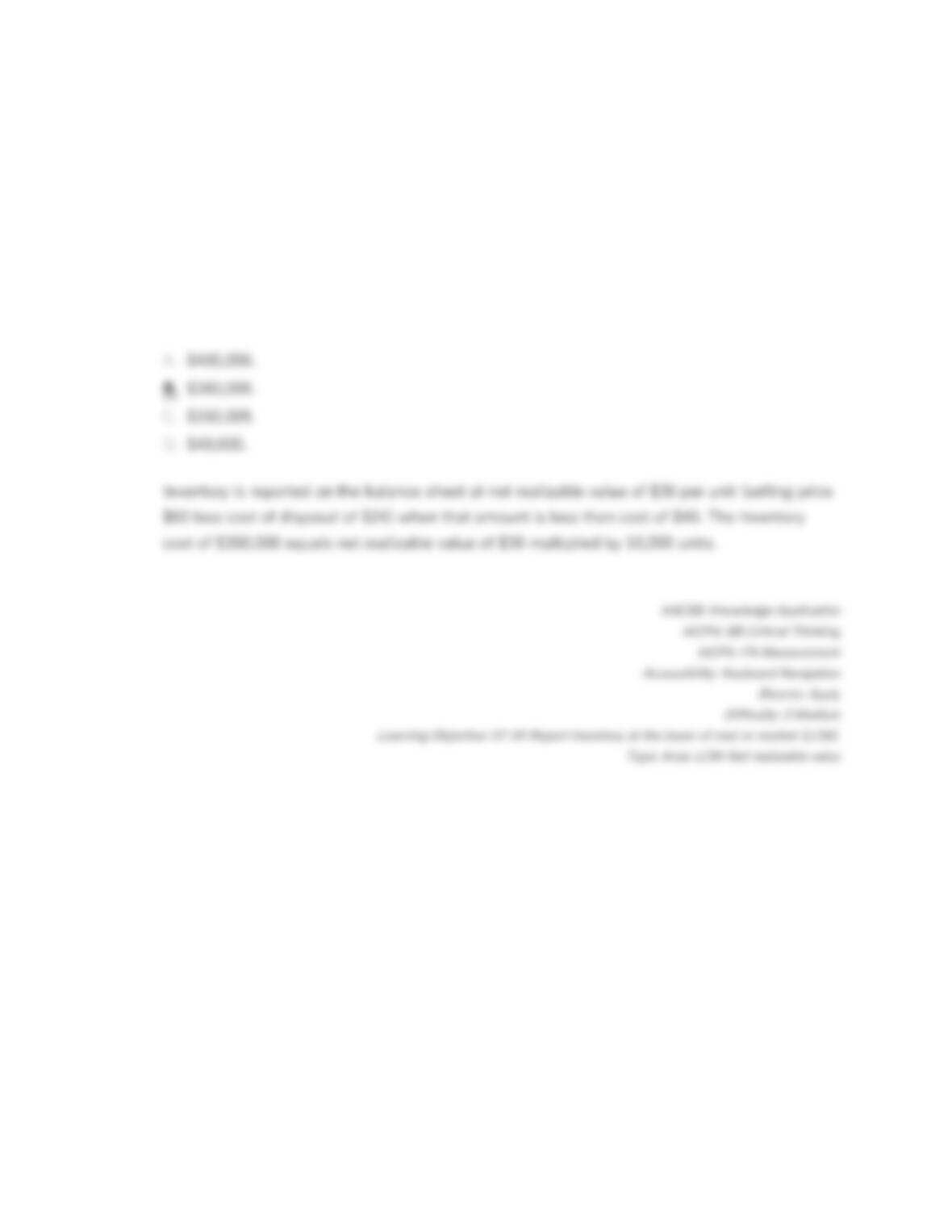
Moore Company purchased an item for inventory that cost $20 per unit and was priced to sell
at $30. It was determined that the disposal cost is $12 per unit. Using the lower of cost or net
realizable value (LCM) rule, what amount should be reported on the balance sheet for
inventory?
Difficulty: 1 Easy
Learning Objective: 07-04 Report inventory at the lower of cost or market (LCM).
Topic Area: LCM-Net realizable value
58.
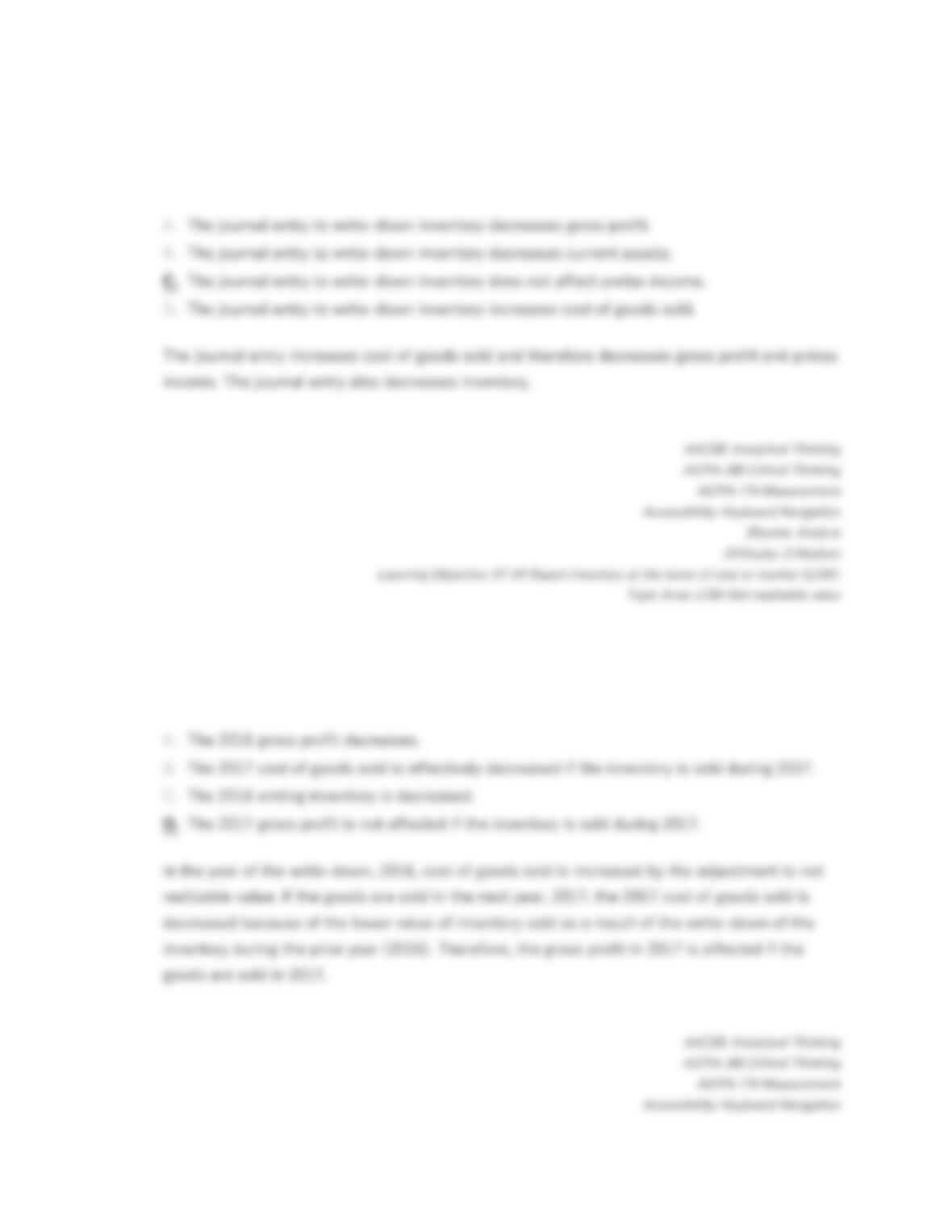
On December 31, 2016, Cruise Company has 10,000 units of an inventory item, which cost $40
per unit when purchased on June 15, 2016. The selling price was $60 per unit. On December
30, 2016 it was determined that disposal cost was $24 per unit. At what amount should the
10,000 units of inventory be reported at on the December 31, 2016 balance sheet?
Learning Objective: 07-04 Report inventory at the lower of cost or market (LCM).
59.
Which of the following statements does not accurately describe the lower of cost or market
(LCM or net realizable value) valuation method for inventory?
60.
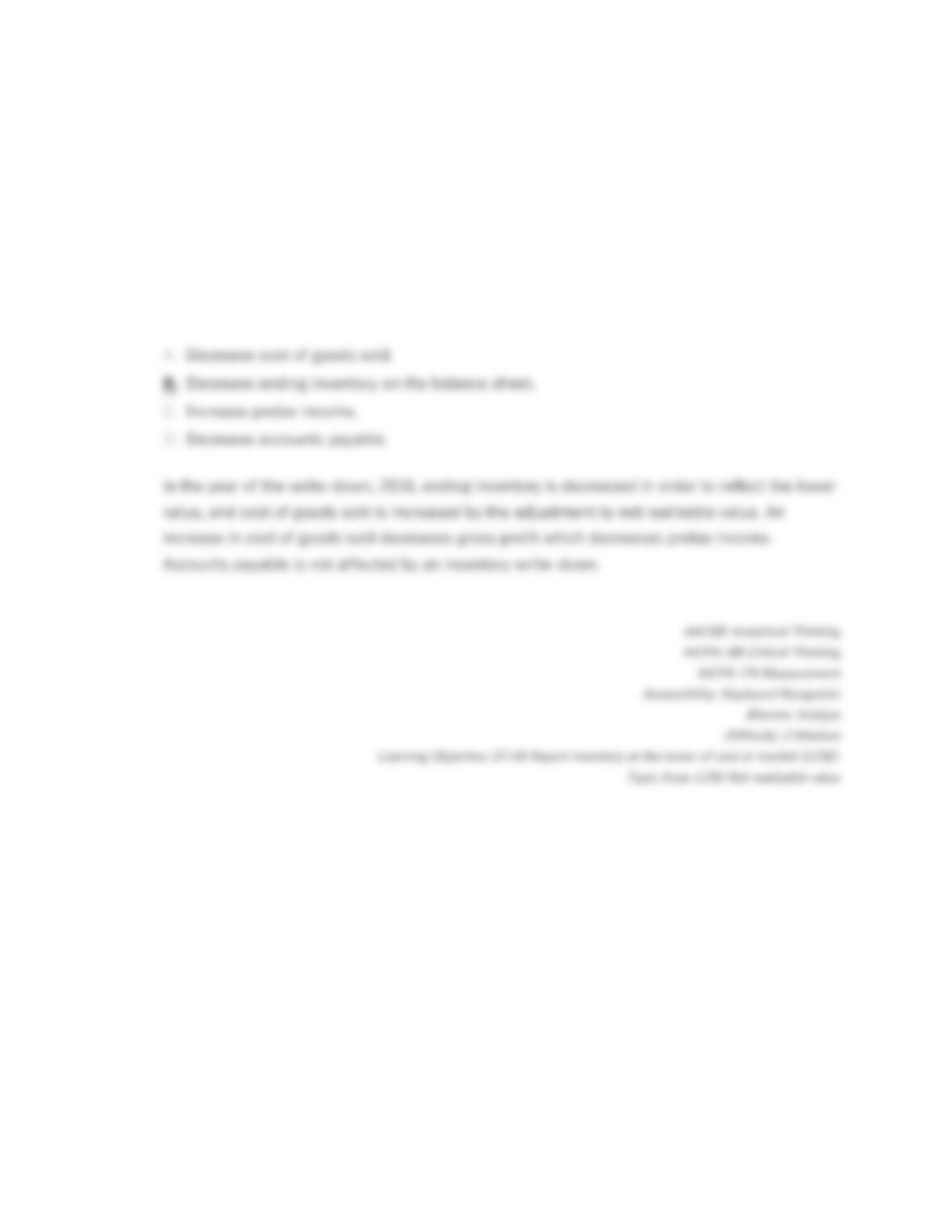
Which of the following statements does not accurately describe the effects of a write-down of
inventory on December 31, 2016 using the lower of cost or market (LCM) valuation method?
Blooms: Analyze
Difficulty: 2 Medium
Learning Objective: 07-04 Report inventory at the lower of cost or market (LCM).
Topic Area: LCM-Net realizable value
61.
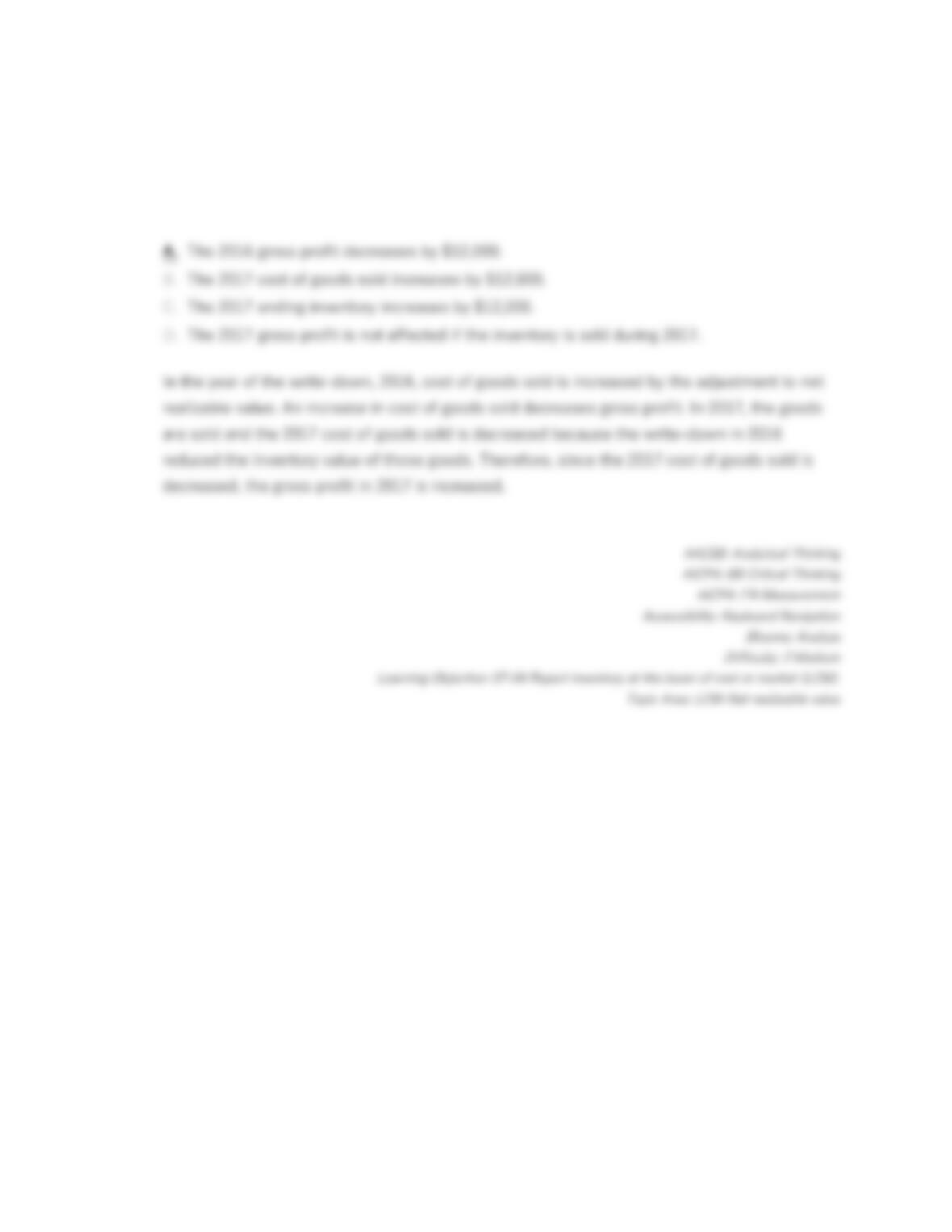
Abel Company must write-down its inventory by $30,000 to the net realizable value of
$450,000 at December 31, 2016. What is the effect of this writedown on the year 2016
financial statements?
Learning Objective: 07-04 Report inventory at the lower of cost or market (LCM).
62.
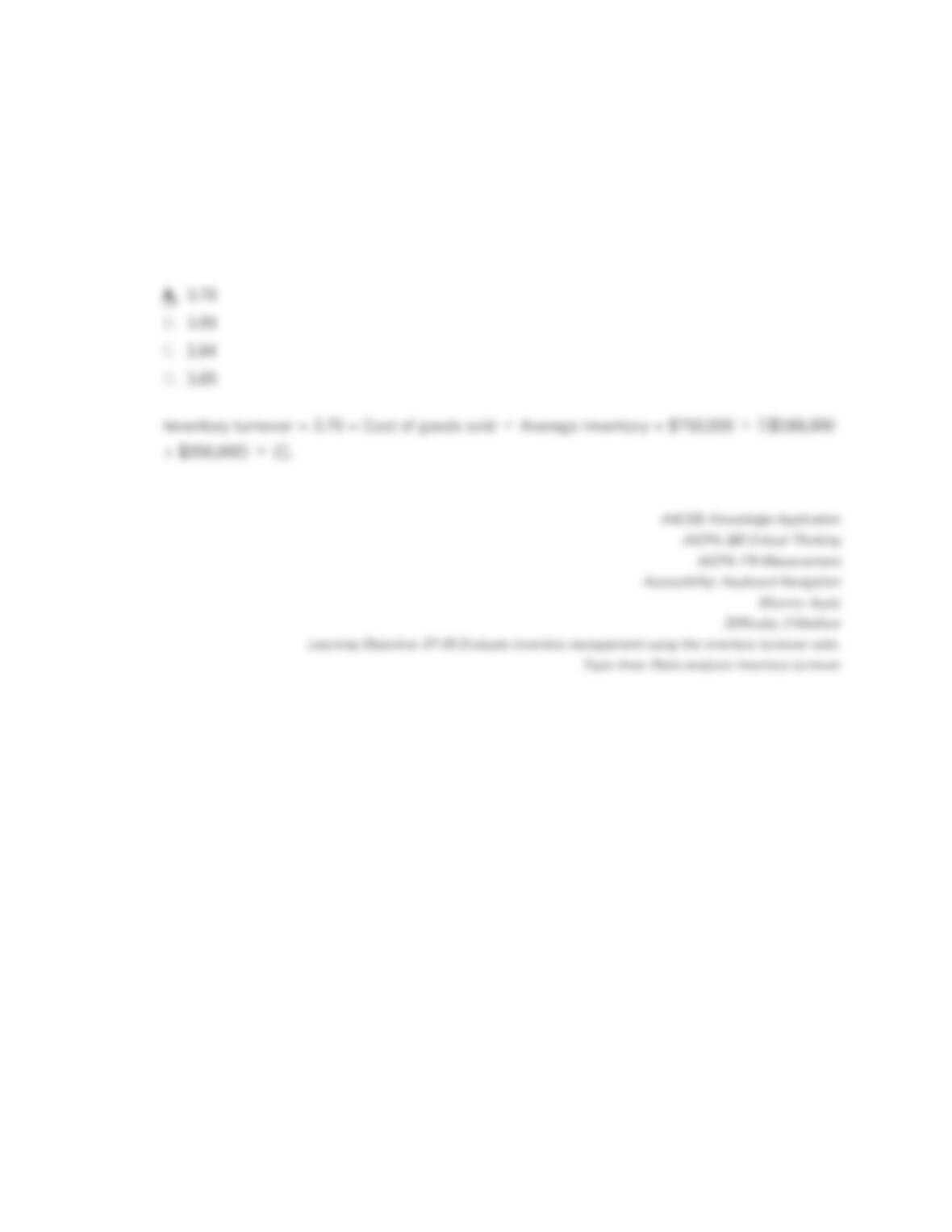
Barrington Company must write down its inventory from its cost of $260,000 to its net
realizable value of $248,000 at December 31, 2016. The inventory will all be sold in the year
2017. Which of the following provides a correct effect of the write-down?
63.
Tinker’s cost of goods sold in the year of sale (2016) was $750,000 and 2015 cost of goods
sold was $770,000. The inventory at the end of 2016 was $188,000 and at the end of 2015 the
inventory was $208,000.
Tinker’s inventory turnover during 2016 was closest to:
64.
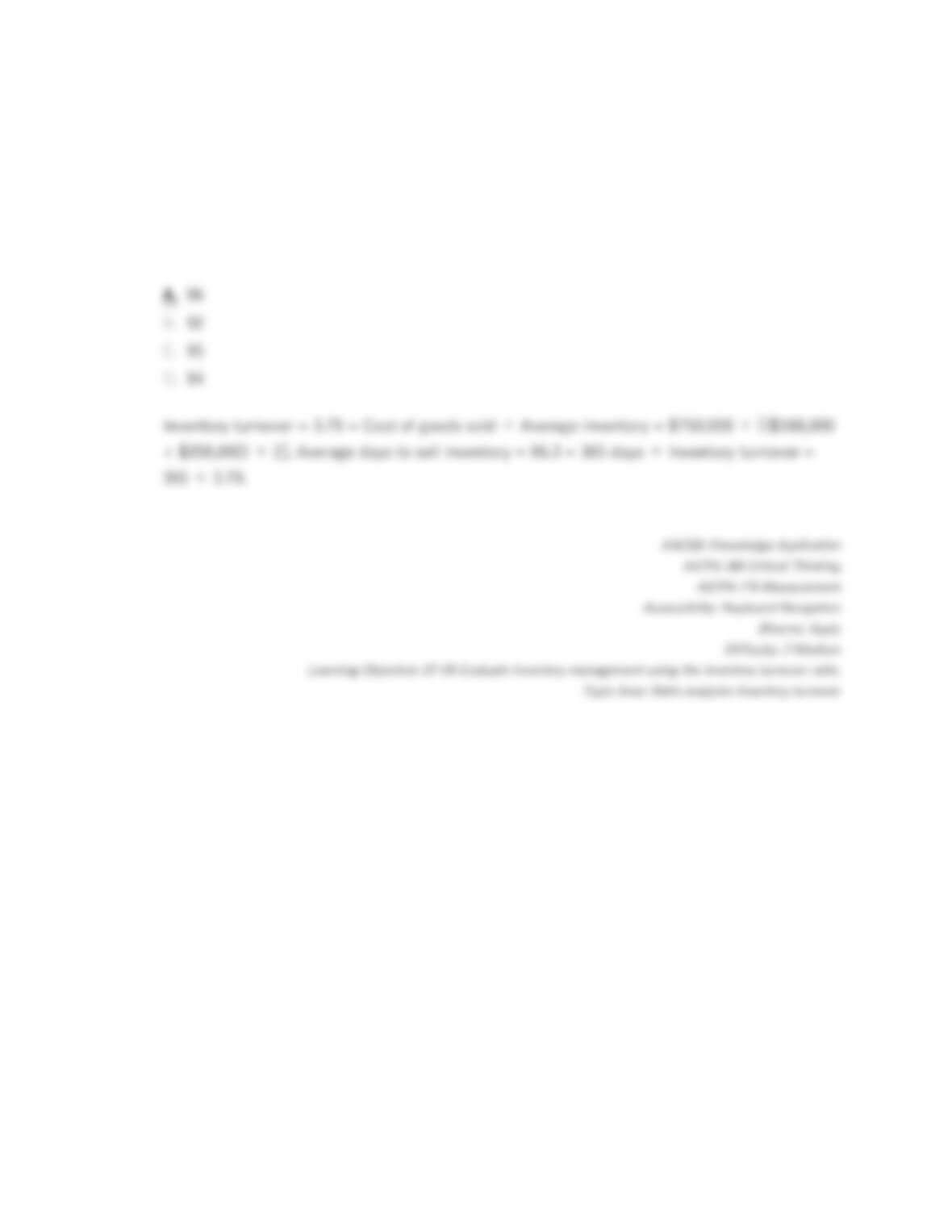
Tinker’s cost of goods sold in the year of sale (2016) was $750,000 and 2015 cost of goods
sold was $770,000. The inventory at the end of 2016 was $188,000 and at the end of 2015 the
inventory was $208,000.
Tinker’s average number of days to sell its inventory during 2016 is closest to: